Two gifted teachers share the fruit of two lifetimes' worth of historical and literary expertise in this introduction to one of the greatest works ever written.
One of the most profound and satisfying of all poems, the Divine Comedy (or Commedia) of Dante Alighieri (1265–1321) is a book for life.
In a brilliantly constructed narrative of his imaginary guided pilgrimage through the three realms of the Christian afterlife—hell, purgatory, and heaven—Dante accomplished a literary task of astonishing complexity.
* He created an unforgettable gallery of characters. * He poetically explored a host of concerns both universal and particular, timely and timeless. * He tapped the combined riches of the biblical and classical traditions in a synthesis that forever placed Western writers in his debt as they tried to build on his foundation.
James Joyce might have been speaking for those writers when he exclaimed, "Dante is my spiritual food!" Geographer of the Cosmos, Student of the Soul
The full achievement of the Commedia, however, goes far beyond anything merely "literary."
Dante is a geographer of the cosmos and a student of the soul. His range spans not only the heights of heaven and the depths of hell but also the recesses of the human heart.
As Dante the pilgrim makes his journey, Dante the poet dramatizes and asks us to reflect on fundamental questions:
* What is the quality of our moral actions? * How does spiritual transformation come about? * What is the nature of good and evil, virtue and vice, sin and sanctity? * Why is the world so full of strife? * How do we go on when we lose things we love, as Dante—through exile—lost his native Florence? * What role do reading and writing play in human life?
In the seven centuries since the Commedia was written, not one of these questions has lost its force.
Moreover, Dante addresses them in a demanding and innovative Italian verse form called terza rima. His complex arrangement of materials makes the Commedia one of the great virtuoso pieces of world literature.
Poet as Pilgrim, Pilgrim as Poet
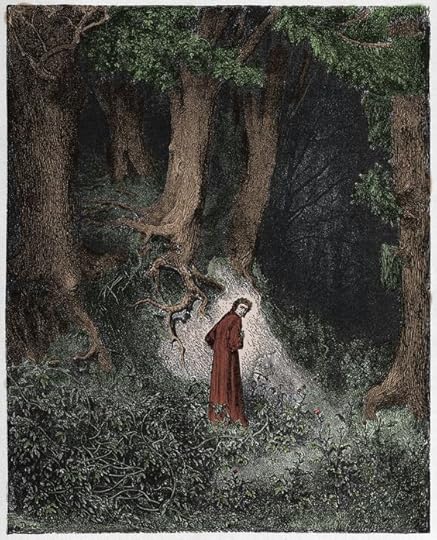
Set at Eastertide in the year 1300, the poem begins with Dante, in the middle of his life, feeling trapped in a "dark wood" of error.
Lost and failing, he is rescued by the great Roman poet Virgil and can find his way again only by means of an extraordinary voyage.
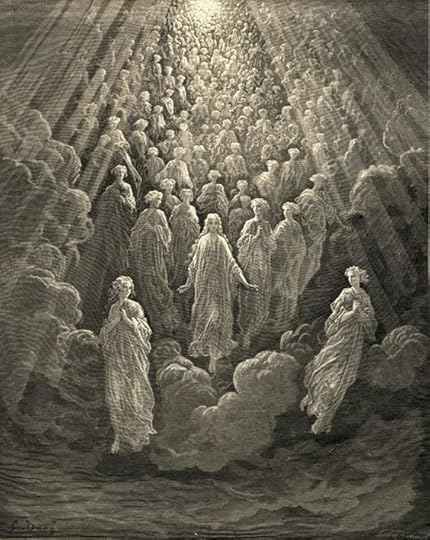
He must pass down through the nine rings of hell, up the seven levels of purgatory to the earthly paradise, and up higher still through the nine spheres of heaven to the empyrean realm where God dwells in glory.
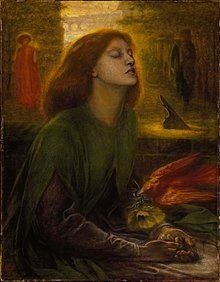
Along the way, Dante changes guides. Virgil gives way to Beatrice, a young woman about whom Dante wrote in his early love poetry and who becomes his guide through most of the spheres of paradise.
And Beatrice, in turn, gives way to Bernard of Clairvaux, a Christian mystic who is Dante's guide for the final cantos—the poem's major divisions—of the Paradiso.
Because Dante frames many of his concerns in terms of contemporary personalities and issues, and because so much of the poem consists of direct encounters between Dante and inhabitants of the afterlife, the lectures focus on providing essential background for and analysis of these encounters.
"We, Like All of You, Are Pilgrims Here"
Dante constructed the Commedia in three parts, and each part conveys an essential element of his message:
* In the Inferno, the poet describes the pilgrim's encounters with an eye toward deepening our insight into the nature of evil and moral choice. You see Dante meeting sinners drawn from each of the categories of sin he describes, ending with a vision of Satan frozen at the bottom of hell.
* In Purgatorio, the poet dramatizes the nature and purpose of moral conversion as repentant sinners arduously prepare themselves for the vision of God in heaven, strengthening their wills in virtue and against the seven deadly sins. Community and its great sustainers, art and ritual, become prominent themes as souls strive toward full redemption.
* In Paradiso, Dante has memorable encounters with great Christian thinkers in the Circle of the Sun and with his own heroic ancestor in the Circle of Mars.
In the final cantos, Dante moves beyond the bounds of space and time and the power of language.
At last, he is granted a mystical, ineffable vision of God. The moment brings to full circle the journey that began when "the Love that moves the stars," mediated by prayer, first sent Virgil to help a troubled pilgrim who found himself lost along the way of life. Your Guides on Dante's Journey
Professors William R. Cook and Ronald B. Herzman are recipients of the Medieval Academy of America's first-ever CARA Award for Excellence in Teaching Medieval Studies.
The skills that earned that award are clearly reflected in these lectures, which provide a rich context against which to appreciate Dante's writing.
You will learn:
* Invaluable background information on Dante's life and times * Why Dante wrote the Commedia * How to approach the various English editions available.
As Professors Cook and Herzman guide you along the journey portrayed in the Commedia, you will learn how each part of the poem is connected to what has come before. You will see Dante "raising the stakes" as each of the questions with which he begins the poem are posed at ever deeper levels of development as the journey continues.
By the time your own journey through these lectures is completed, you will learn why Dante's pilgrimage is an exceedingly enriching experience for anyone who chooses to accompany him.
And you will understand why the Commedia is not a puzzle to be solved or a book to be read and put aside. It is a mystery whose beauty and power can be enjoyed for the rest of your life.
Dr. William R. Cook is the Distinguished Teaching Professor of History at the State University of New York at Geneseo, where he has taught since 1970. He earned his bachelor’s degree cum laude from Wabash College and was elected to Phi Beta Kappa there. He was then awarded Woodrow Wilson and Herbert Lehman fellowships to study medieval history at Cornell University, where he earned his Ph.D.
Professor Cook teaches courses in ancient and medieval history, the Renaissance and Reformation periods, and the Bible and Christian thought. Since 1983 Professor Cook has directed 11 Seminars for School Teachers for the National Endowment for the Humanities.
His books include Images of St. Francis of Assisi and Francis of Assisi: The Way of Poverty and Humility. Dr. Cook contributed to the Cambridge Companion to Giotto and edits and contributes to The Art of the Franciscan Order in Italy.
Among his many awards, Professor Cook has received the Chancellor’s Award for Excellence in Teaching. In 1992 the Council for the Advancement and Support of Education named him New York State’s Professor of the Year. In 2003 he received the first-ever CARA Award for Excellence in the Teaching of Medieval Studies from the Medieval Academy of America.
Politics, Religion, and Her. It seems that some things resonate through time.
So I've only read Inferno, and I thought dear god, i really don't get what he's going on about and maybe it would behoove me to look into all the little nuts and bolts of what Dante was talking about. Because to me he just seemed like some guy with a lot of religious fervor and a bone to pick with some people. And you know what? Well, I wasn't all that far off base! Sure, there's a lot more to The Divine Comedy than just a really long poem, but for once in my life I wasn't reading the room as wrong as I thought.
Ok, and I didn't realize how into this poem so many people were. I mean, like they spend their lives re-reading this and picking it apart and making it into a part of their whole worldview. The two lecturers, William R. Cook & Ronald B. Herzman, were very passionate about it. Sometimes I got the feeling these guys thought this was the real deal. Not gonna lie, that kind of spooked me and caused me to stop taking the lecture quite as seriously.
I respect that this was an incredible poem, an enduring piece of literature, and a well-thought-out religious outlook. Certainly better than Chick Tracts!
But it doesn't resonate with me at all because it leans so heavily on belief in God and sin. I just ended up feeling kind of bad for Dante having wasted all this time and effort trying to unpack an afterlife in relation to how we live our lives on earth. That is not me saying this is a useless piece of literature, just that it doesn't hit me in the feels. However, if you ARE the target audience for this, I think these guys are incredibly excited and informed about the subject matter. I would highly recommend this for anyone thinking of undertaking reading this sucker because there is just so much background information that you need to know to even really begin to understand what Dante was saying.
I probably won't read any more of the Divine Comedy stuff any time soon...or ever? Because if Inferno is supposed to be the most interesting, then I can't see Purgatorio & Paradisio tickling my fancy at all. I'm sorry to say this is just not my bag of cats.
Dante's Divine Comedy by William R. Cook, Ronald B. Herzman is one of those classics that we feel we must be exposed to in order to consider ourselves truly educated. I studied several versions before settling on and selecting this one. It was a good choice in my opinion because the authors provide context and commentary that adds up to so much more than just the words; it was really helpful to provide background and meaning that really helpful with my understanding.
I really enjoyed these lecturers' class on Francis of Assisi. I've begun rereading the Divine Comedy without worrying about notes, so I could just enjoy it as a work of literature (and whatever other inspiration comes to me through the story).
However, it was the perfect excuse to pick up this course when my Audible credit came up. Three lessons in I am enjoying it immensely.
==========
I can't recommend this highly enough as an insightful, engaging overview.
This course on the Divine Comedy was helpful, entertaining, and insightful. It is basic enough for a beginner (like myself) while still packed with material for further reflection and study. Since it has two professors, who take turns teaching in each lecture, it has the feel of a kind of dialogue, which I found refreshing and enjoyable.
They have been working on the Divine comedy for years.The history, the political situation, the western tradition and biblical knowledge that is needed to interpret the poetry lines that were written in Italian in the middle ages is staggering. They did that in a way that is very engaging. I shouldn't have cared about that old poem but then I did care... They actualize it. Good work!
The Commedia, as The Iliad, The Odyssey and The Aeneid, of which it is more than a spiritual successor, are best read with a guide. (Dante knew it and recruited the best!) As Dr. Elizabeth Vandiver, with the others, Professors Cook and Herzmann do a great job walking you through the poem, teaching you how to read it, touching on a few key themes, and sharing anecdotes than enrich your reading. I will list a few things that come to mind when I think my latest reading of the Divine Comedy wouldn't have been the same without this accompaniment:
- The Commedia is a poem of exile. It couldn't have been written in Florence. - For you to appear as a character in the Commedia, you have to be dead by 1300 (or be Pope Boniface VIII) - Dante is deeply rooted in Virgil, who would've been the only source he had for the Trojan stories, not having translations from Homer! - He is also rooted in St. Augustine's Confessions, including him being the protagonist - It's incredibly groundbreaking - Dante *might* have created Ulysses' story of him leaving Ithaca after arriving - Sinners in Hell are self-centered and tell stories only from their point of view - Once you're in Purgatory, YOU'RE SAVED. It only takes time. - Repentance, even at the very end of your life can take you to Purgatory - Purgation is some sort of communal activity - All Paradise is Paradise. - It's like poetry! It rhymes. Inferno is not Dante's final word on anything, and there's generally something that mirrors Hell scenes in Purgatorio and Paradiso. - Family doesn't guarantee anything - Belief without action does not equal salvation - Dante was very concerned with partisanship, and it shows the guelph vs ghibelline strife pervaded all aspects of his life - Dante thought one world empire in Rome, separate from the Church's power was the ideal arrangement. A global emperor would have no incentive for war and injustice, as he would have nothing to gain from it. - Both professors have taught this course in multiple settings: college students tend to like the theatrics of Inferno. Inmates in a maximum security prison relate to Purgatorio, as they too, perceive are serving a time of moral cleansing; and Cistercian monks are fascinated by the theology of Paradiso.
Would have loved to have a little more detail on the explanations of the second half of the book. I think a few things are misconstrued through what seems a non-catholic lens, but I wouldn't be able to categorically state it.
I listened to an audiobook of The Divine Comedy a few years ago, and while I got something from it so much passed me by because I wasn't cross-referencing with notes that give essential context to much of the interactions in the vast poem. This lecture series was a wonderful way to really dive into Dante's masterpiece. The coupled delivery of two professors alternating every minute or two was very unusual for a lecture series, but it worked surprisingly well, as it gave the course a kind of dialogical feel. They gave important background information on Dante and his exile, which influenced the poem significantly, and they were able to place many of the (now obscure) characters in the world of Dante's Florence. There were some neat details I would never have noticed if I was reading it alone, like how certain cantos are linked between the Inferno, Purgatorio and Paradiso, i.e. they treat of the same subject matter but from a different perspective, and also how some families have members in all three locations. The lecturers also explain how the relationship between Dante and Beatrice is a sort of sanctified re-telling of Virgil's story of Aeneas and Dido. The explanation of these kinds of classical references along with the geopolitical background information and the light shed on the way the distinct parts of the poem are interwoven was the major strength of the lecture series.
I am inspired now to go and find a bi-lingual version and step through the poem canto by canto, maybe over the course of several months. There is a lot of wisdom bound up in the poetry, and Dante has a lot to say about virtues and vices and how to order your spiritual life in an appropriate way. The poem is extraordinary in both its vastness and artistic completeness and one could do worse than investing a part of one's life trying to plumb its depths.
When I decided to read Dante's "Divine Comedy", I figured (correctly) that I could use quite a bit of help. This Great Courses audio course features Professors William R. Cook and Ronald B. Herzman in 24 very illuminating lectures (30 minutes each) about Dante's life and times, as well as serving as a guide to reading the poem. After each lecture I would read or listen to the actual poem (see my separate review of Clive James' amazing translation). This worked really well, and I highly recommend this course for anyone with a similar interest in Dante's work.
I listened to these lectures while I was driving, and as a result, there were times that I had to listen to the same lecture over and over again. Interesting thing is, they never got boring. Wonderful.
I often enjoy hearing about old literature, but I can't really stomach reading it myself. If you're like me, and you want to know what Dante's Divine Comedy is all about, this is great. You get a lot of context around it. I learned a lot about Medieval Europe.
One great line that has really stayed with me was about how Dante would be banished from Florence. "You will know how salt is the taste of another man's bread." The authors gave the context that people in Florence DON'T salt their bread, so when Dante was forced out, he experienced salty bread for the first time. It's such a poignant detail.
My first one of the "Great courses" series, which lives up to the announced "greatness" (meaning 5 stars). This is a perfect introduction to Dante's Comedy (seen with the eyes of the beginner in this matter). The course gives a good entry point into the historical context, that one should bear in mind while reading the work itself. After being through one is really eager to undertake a journey together with the Pilgrim in search for the meaning of sin, repentance and redemption. A minor flaw, unfortunately recurrent in nature when it comes to the "Great Courses", is an americanization of the narrative (e.g. "hanky-panky with Dido"), which might seem as being disrespectful for a European, but is essentially a cultural difference, not being worth an agitation. Great work!
An informative series of lectures by a pair of professors who are clearly passionate about their subject. They open up the Divine Comedy.
I think if your going to read a super complex epic poem intended for a 14th-Century Italian audience, you could do a lot worse than following it up with something like this.
What a wonderful, amazing and inspiring course about an even more fantastic book that I will need to read over and over again. Dante is such an example to me of how to deal with adversity, political intrigues, how to do self-research and face your own sins and how to use your talents for truly good purposes.
Oof. First, I want to say that I have "taken" many of the Great Course and honestly, I have not yet had an experience that isn't excellent or better (even life-changing).
Personally, I am interested in beliefs and traditions surrounding the afterlife and I get my courses from the Library (#LibbyApp) so prior to listening to this course I actually listened to a "less popular" series about Dante's Comedìa. Still, when this did become available, I decided to listen. I have, actually, had that identical situation happen in the past with courses discussing another historical work (Homer's Illiad) and, at that time,I was pleasantly surprised to discover that the two courses were radically different, provided unique information, and hardly overlapped at all (shout-out to "The Iliad of Homer" by Elizabeth Vandiver and "Archaeology and the Iliad: The Trojan War in Homer and History" by Eric H. Cline).
Even when courses DO overlap on subject matter, I personally appreciate getting different perspectives, and I strive to have a well rounded view on the context in which works are created. I make an effort to have an empathetic perspective when viewing history. I find that different instructors tend to highlight different contextual issues, and together, these provide a MORE COMPLETE picture of the historical, cultural, sociological, and linguistic context.
Finally, as part of this long preamble to my review, I want to acknowledge that I, as a human, am susceptibility to cognitive biases, such as the kind known as "the Mere-exposure effect". However, I am not personally particularly prone to bias, based on my own history. In particular, I do not have a record of favoring material simply because it is familiar if I find the latter material of objectively superior quality, I tend to be pretty "harsh and cold" in that regard (so much, that my claim "I want to acknowledge that I, as a human" had me chucking at all the instances that my humanity has been called into question) Okay. Onto the review!
So. I started listening to "Dante’s Divine Comedy" and was initially surprised how SIMILAR it actually was to "Dante and his Divine Comedy" by Timothy B. Shutt. They covered much of the same content and at much of the same level of depth. There wasn't a dramatic level of difference or anything that stuck out hugely to ME. One minor difference is that this lecture focused more on the history of Italy/Europe and the other lecture focused more on Dante's personal history. Since it had been awhile (because I had to wait, since this one was quite a bit more popular) I felt like even the familiar content was a good "review".
In general, I felt like there were some things I preferred about the previous lecture and some I prefered about this one. Trying NOT to be derogatory, one thing I WILL say is that, between the three speakers and the two courses, they highlighted certain speech patterns that SOME individuals might find "annoying" or difficult to listen to. As someone who listens to a lot of audio content with a person who has misophonia, I am aware of these things. However, I did not personally mind, and quickly got used to all the lecturers' speech patterns.
Still, as their lectures went on, I began to feel like I did prefer the lecture style and interpretation (read : the content) of the Timothy B. Shutt's lectures. It was a weird and unexpected opinion and I did not expect to feel that way. Again, I don't want to "give too much away" or bias anything but as the lectures went on I started to realize that the interpretation of Dante was actually pretty dramatically different between the two courses. While Shutt seems to view Dante as empathetic, sympathetic and very human, Cook and Herman seem to interpret his sympathy as ERROR and assume he (Dante) would, upon reflection, consider himself duped by the slimy tricksters in hell. None of the characters in hell have a remotely sympathetic story. They're all completely guilty. Even when Dante performs the affect of sympathy, according to Herzman and Cook, we, The Reader, are supposed to be filled with fire and brimstone.
With my cultural relativism on hand, I continued through the lectures, thinking "sure". But my disinclination towards this narrative was firmly cemented when the lecturers were discussing the "forest of the suicides" (Canto XIII) and they made the following comments:
"This is such a dramatic and carefully crafted episode because this is one that really gets to the heart of something that Dante himself is going to have to face up to: Is his life worth living when it isn't going well? Is life worth living when almost all "the givens" of that life have been pulled out from underneath me? "
"We don't know, of course, whether suicide, in any literal sense, was a temptation, for Dante, after he was sent into exile, but certainly, the attitude that leads to it, most certainly was. The idea is that I'm not playing at all if I can't play on my own terms."
As someone who has personally dealt with "the temptation" of suicide, I find that whole interpretation super rude (okay, fine, I'm used to that from old white dudes), fucked up (see above) , and, most importantly, wrong. People kill themselves for all kinds of reasons. People kill themselves out of guilt, shame and depression. And they do it out of duty, obligation or lack of better alternative. People kill themselves to spare other people, to free up wasted resources, to save the planet, to end suffering, or in the face of debilitating illness. Suicide isn't always selfish, impulsive, nor rationalized by circumstances that have the possibility of improvement (see: the objectively false refrain "it will get better… JUST BE PATIENT"). Illnesses like Cancer, Multiple Sclerosis, schizophrenia and Huntington's disease (just to name a few) are all degenerative and all get worse over time. Imagine living in a time where there was NO understanding of the cause. Imagine losing your mind and your ability to care for yourself. And put this in the context of a world where it was not uncommon to, for example, allow a deformed or sickly infant to die from exposure. Imagine how it would feel, requiring the 24/7 care of others, being a financial burden. Do you think it is selfish to entertain the thought "without me, they would not have this expense"? Or, rather,is it selfish NOT to have that thought?
Then, once you have had that thought, what is the selfless person to do with it?
IF we live in a time and place that our religion tells us we will "go to hell" if we commit suicide then you MIGHT suppose that answers the question. But I'd contest that. Because you could argue that trying to avoid hell is trying "save my own skin" and that, in the meantime, I'm burdening the people i care about.
So imagine your life: you have a degenerative disease. You need to get assistance drinking, eating, peeing, pooping, bathing, or generally moving around at all. And at those times, it's painfully obvious that, yes, you are a burden. When you are asking for help, you can't help but feel this is SELFISH, feel like the people you care about are taking care of you at their OWN expense so YOU don't have to burn in hell for eternity.
Yet suicide is framed as being the ultimate selfish act. In those moments, when someone is wiping your ass, I wonder if you'd believe that.
There have been different attitudes towards suicide at different times and places, and still are. The samurai thought it was honorable. These professors, clearly, do not. Attitudes like theirs' neglect the fact that, even if you can't 'play on your own terms' most people don't have the ability or willpower to follow through with suicide. Even in cases of extreme suffering and terminal illness, it's not EASY to take one's own life. The documentary "How to Die in Oregon" discusses the subject of medically assisted suicide and makes this conclusion apparent.
At this point I stopped listening to the lecture. I felt like those statements were such an obvious reflection of a lack of understanding of the context and of humans in general. I don't understand how the lecturers reconcile Dante's apparent sympathy with some people and his sudden, obvious vitriol for others. There are obvious slimy deceptive tricksters in hell, it's clear in the text. Dante is clearly a bit of a N00b. But to interpret every sinner as "deserving" is to put the weight of seven hundred years of organized religion into the battering ram and ignoring the subtlety. I felt like they had their own point that they wanted to get across ("sin is bad") and they carried on accordingly. I supposed that's why they are the ones who lecture at prisons (which they mentioned several times).
As I mentioned early on in this [excessively long] review, I have a particular interest in discussions of the afterlife. I've read (or listened) to hundreds (thousands?) of hours of books and lectures about early Christianity, Hell, Sheol, Gehenna and Hel… etc. I know a lot about the transformation of beliefs over time and, without explaining further here (see my upcoming podcast lol) quite simply, these professors' narrative just don't stack up.
For an alternative I'd recommend Dante and his Divine Comedy by Timothy B. Shutt.
This was a great companion piece to Dante, though, I only wish it was a bit more in depth. it serves more as a brief overview, and to really understand the Divine Comedy, I would recommend pairing this with some deep dive lectures. As usual though, the Great Courses has provided an incredible resource here for anyone wanting to breach this timeless work.
The first time I heard about Dante's famous poem was in the mid-to-late 1990's. At the time I was playing a video game called Warlords 2. Somebody made a map based upon Dante's Inferno which was considered among the highest rated maps. Ever since I admit to having a bit of a curiosity about the poem in general.
I decided to finally satisfy my curiosity by listening to these lectures. Now I have a policy of not giving a star rating to books and stories which were written in centuries in which I had not lived since I really am not the target audience for the story and may miss certain nuances and references. Luckily this is not the actual divine comedy, but rather lectures about the divine comedy in order to help someone who might be interested in reading the poem to better understand who many of the characters are who interact with Dante through his journey and some of the subtleties a modern reader like myself could easily miss.
The professors spend the first four lectures just discussing the background behind the writing of the poem informing us who Dante is, the politics occurring in Northern Italy in the late 13th and early 14th century, and other important sources in which Dante takes many of his characters from before even beginning with the poem.
I think they did a good job and I feel like I am better prepared now to read the poem and to better enjoy it. Other than being a bit annoyed with how one of the professors overused the word "nifty", I would otherwise recommend listening to these lectures for anyone who may be interested in the poem.
Professors Cook and Herzman pull selectively from the three stages of The Divine Comedy to illustrate the pilgrim narrator’s movement from sin and punishment (Hell) to a cleansing process (Purgatory), to a final state of redemption and oneness with God (Heaven). For Dante, one must destroy before one can rebuild. This is the point of Hell. Purgatory prepares souls for the vision of God that is seen in Heaven.
At times, the similarity between Dante’s poem and the Platonic vision is striking. As with the Timaeus, there’s the imagination about heaven and hell. There’s the Socratic-like tearing down that exposes the ignorance of an eternal reality. For Dante, ignorance is the sin of unbelief. It is the sin of heresy, such as the Epicurean belief that the soul dies with the body. As with Plato, Dante’s purification process cleanses the soul from bodily concerns as only the spirit can partake of the eternal world. In short, souls must be re-formed to receive the beatific vision.
The professors dwell on the ins and outs of the Comedy but do not dig into the broader significance of what Dante is about. For example, since humans are obvious sinners, Christians must of necessity believe in free will. If they cannot re-form themselves, they can never enter an eternal world. And as Dante’s God is all-powerful and penetrates all of existence, there can be nothing higher or other. In The Divine Comedy, Dante stakes out the sole claim to Truth.
All of the Great Courses I have done are fantastic. I would never have understood the Divine Comedy in any legitimate way without the foundation material this course provided. Dante's Divine Comedy is a political document as much as it is a philosophical or religious one and I appreciated understanding the historical and political factions in Florence and Rome that formed the basis for many of the characters Dante encounters. The background the course provided made sense of this difficult yet preeminent work.
Can you keep a secret? It's not really common knowledge yet, but I am moving on from the Mediaeval! Yeah, I know, right! I have been absorbed and fascinated by the period pretty much all of my life, and it remains and will always be an absorbing and a fascinating period. But life is short, and to stay still is death. And so with this determined, I decided to run through those last outstanding books before wrapping it all up. And so it came to the big question, either finally get round to reading Dante (something I've managed to avoid in 43 years!) or live a Dante-less life evermore. Dante is problematic for me. It's archetypal Mediaeval literature (yay!). It's also deeply Mediaeval Catholic (oh.) and that's where I have reservations. Of course, you can't fillet the Mediaeval world of it's spirituality and religion, but I have always preferred Chaucer and Boccaccio, with their earthy and urbane anticlericism than Augustine and the pious and heavy-handed 'church fathers'. I never even cared for Dickens' 'Christmas Carol' with it's heavy morality, which is, at heart, a deeply Mediaeval tale of 'redemption' and fear of a vengeful god. Anyway, so much for all of this (apologies dear reader, my keyboard runs before my mind!). I chose this book as a halfway house to decide wether Dante was for me, or not. It's not, but this is absolutely not the fault of the lecturers, who are warmly enthusiastic about the subject, and make it approachable and understandable. They carefully work through the text and expound as they go. It's allowed me to get what I felt I needed without the commitment of going through the original poem, neat as it were, like brandy. And I have learned stuff: Dante speaks of hell yes, but also of purgatory and of heaven. Cook and Herzman reiterate over and again that Dante is more than just his first and most famous volume. It's not just brimstone and sulphur (though it DOES have these too). But finally, Dante as poet and as mediated here, doesn't pull me in. It's a very clever, sincerely held labyrinth that Dante has created, but it is a product of a human mind and a culture that is ultimately too far removed from my own. It's highly artificial, highly structured, highly uniform world view that, I realise, was the aspiration of much of the Mediaeval mind that craved order and straight lines. (Think Brunelleschi's chapel and dome, where strict perfection was associated with godliness). Whereas on the thither side of the industrial revolution we tend to find such uniformity as sterile and deadly dull. Perversely we tend to love the Mediaeval period for it's wonkiness and inconsistency. Things the people of the pre-industrial world themselves abhorred and sought desperately to iron out. And here Dante and I part ways.
Отне ми много месеци да изслушам/прочета този дълъг но прекрасен курс от лекции.
Това са първите лекции през живота си които се водят от двамата лектори, ЕДНОВРЕМЕННО. РЕЗУЛТАТА е много добър.
След време бих прочел оригинала вече разбирайки немалка част от контекста на творбата от 1200те години.
Божествена комедия изглежда като прекрасно произведение вплитащо в себе си теология, история, морал и етика, философия, и основни християнски и човешки теми.
Казва се комедия защото в нея Данте (авторът и главен герой) се разхожда първо през ада, през чистилището и накрая в рая, и понеже започва в зле и завършва в рая, се нарича комедия. Като трагедиите започват добре и завършват зле.
Научих и че антикатолическата опорна точка на пр*тестантите за чистилището, че го измислили за тия дето не са се покаяли, ама са "добри хора" и да се очистят е или заблуда или лъжа.
В чистилището отиват САМО ПОКАЯЛИ СЕ (изповядали се) ПРИЖИВЕ ВЕЧЕ ХОРА. Т е. Опорките са дори още по абсурдни защото чистилището е дори по песимистична представа за отвъдното, тъй като протестите си представят покаянието мърт и рай, а не още хиляди години прочистване от грехове и зависимости полепили се по душата на покаялия се.
За това пр*тестант е мръсна дума, както к*нсервативен и за това не се наричам съм пр*тестант, а евангелист или просто християнин.
Мога да говоря много за курса беше прекрасен препоръчвам го като въведение в Данте . Интересно ми е да прочета или поне да прочета някакъв анализ подобен на този произведенията на данте монархията.
Данте е супер образован човек запознат и участващ политиката на Флоренция и когато човек чете за такива хора си дава сметка че нашите предци в Европа са или с нищо по зле от нас а ако не дори по адекватни за реалността от нашите съвременници.
This was everything I could have hoped for as a guide before reading the Comedia myself. The presenters started with why it should be read, and what to look for in a translation, as well as recommendations for editions with good notes (which would be necessary for in-depth study/understanding). They hit the highlights of each of the 3 divisions of the poem, explaining a lot about the whos and whys of the people Dante meets and what they’re doing. The information was insightful and interesting, and the ~30min format for each of the lectures was perfect if I was short on time, but it was also really easy to listen to 2-3 lectures at a time if I was able. They discussed themes, they were very sincere in their acceptance and discussion of Dante’s faith and the Catholic worldview (I have no idea of their religious background/beliefs) there was no cynicism as far as specifics of Christianity that may seem fantastical or hard to swallow for a non-Christian. Throughout the lectures, they present this poem as an important piece of literature on many levels, and they end with an exhortation to read and re-read it, in whatever capacity one can. They extol the virtues of great literature to change one’s life, and give brief examples of how the Comedia has done this for variety of readers.
A great lecture on Dante's Divine Comedy. Ronald B. Herzman and William R. Cook discuss this classic work in context as well as art in poetry. Dante's guided trek through Purgatory and Hell provides ample opportunity to describe the people who are too attached to the world and the flesh to enjoy an eternity of bliss in Heaven when mortality summons.
The professors give this lecture to several groups who identify with the protagonist but when he is in different realms. Prisoners see themselves in Purgatory atoning for their sins and students see themselves in Hell coping with the everyday stress of life. It is suggested by the author to reread this poem in order to grasp its full meaning and appreciate Dante's genius.
Amazing set of lectures by Prof Bill and Prof Ron. I believe I can call them by their first names, after all we just recently travelled through hell, purgatory and heaven together.
Every individual lecture was extremely engaging and did not assume any form of prior knowledge on the part of the listener. I had always heard of Dante's Divine Comedy as a classic must read, but I didn't have even the tiniest of ideas about the richness of historical legacy in the poem. The task of guiding the listener through it all without getting lost is herculean, but Prof Bill and Prof Ron make it seem so easy. I would recommend this to everyone, irrespective of whether you have read the poem.
This is a great overview of the Divine Comedy, especially for beginners! They don’t have time to cover everything (go get a good translation with thorough notes for that!), but they cover a lot of very interesting things. For a non-scholar I’ve read quite a bit about Dante and read the comedy several times, but I hadn’t seen the strength of connections and the parallels between the characters and ideas of the three parts so clearly before. I’d read it more progressively, so I was very grateful to see how the people and ideas specific to individuals he met was returned to and expanded in each book. With deep and really challenging books, I enjoy reading them over and over and reading various commentaries and just kind of soaking with the text. This was very enjoyable!!
Well .. I mostly finished it, but am counting as done since 19-22 lectures out of 24 feels like I've listened to all of it. It was a good accompaniment to the actual poem, and although I didn't find it until I was already in Paradisio with the pilgrim, I actually went back and listened to some of the specific cantos from Inferno & Purgatorio once I heard their descriptions. I'd recommend it, though with the warning that 24 lectures is a lot-- but then its about a poem that has 100 cantos or sections, so ... Ultimately then, I recommend this book to those interested in Dante and his times
(Audiobook) This audio-compilation offers insight into one of the greatest works in literature. It offers history and analysis of a classic work. The Divine Comedy has so much to it that outside analysis is almost a requirement. Given that a reader would need to know the Bible, Ancient Greek and Roman history/literature and 13th century Italian politics, any guide that can help. Learned some more about the Comedy and the themes and symbolism. If you enjoyed any aspect of the Divine Comedy, this is worth the time to listen.
I have been enjoying learning about the medieval era and understanding how social norms developed leading up to industrialism and The Enlightenment. Dante and his influence on Humanism has been something that has come up time and time again, so I felt like it was time to get more familiar with it before I read it. I was surprised how little of the commedia is actually touched upon. It felt like for every canto that was talked about there were 3 that were skipped.
Fantastic lecture series. It has been a long time for me reading and this was amazing. Now I just need to get the courage to re-read the three books! The enthusiasm of the professors is evident as is their knowledge. They did an awesome job summarizing the three books. I did enjoy looking up images of the maps as that helps to orient you. You know you love a series when you hate to see it end!!! Highest recommendation!