

What do you think?

Joanna d'Arc. Jej historia, wydanie 2
Joanna d'Arc. Jej historia, wydanie 2
Paperback
First published September 30, 2014
About the author
Helen Castor
7 books523 followersHelen Castor is a historian of medieval England and a Fellow of Sidney Sussex College, Cambridge. She directed studies in History at Sidney for eight years before deciding to concentrate on writing history for a wider readership.
Her book Blood & Roses (Faber, 2004, published in revised form in the US by HarperCollins, 2006) is a biography of the fifteenth-century Paston family, whose letters are the earliest great collection of private correspondence surviving in the English language. Blood & Roses was longlisted for the Samuel Johnson Prize for Non-Fiction in 2005, and was awarded the Beatrice White Prize (for outstandingly scholarly work in the field of English Literature before 1590) by the English Association in 2006.
Her next book, She-Wolves: The Women Who Ruled England Before Elizabeth, will be published in the UK by Faber and in the US by HarperCollins.
She lives in London with her husband and son.
Her book Blood & Roses (Faber, 2004, published in revised form in the US by HarperCollins, 2006) is a biography of the fifteenth-century Paston family, whose letters are the earliest great collection of private correspondence surviving in the English language. Blood & Roses was longlisted for the Samuel Johnson Prize for Non-Fiction in 2005, and was awarded the Beatrice White Prize (for outstandingly scholarly work in the field of English Literature before 1590) by the English Association in 2006.
Her next book, She-Wolves: The Women Who Ruled England Before Elizabeth, will be published in the UK by Faber and in the US by HarperCollins.
She lives in London with her husband and son.
Ratings & Reviews
Friends & Following
Create a free account to discover what your friends think of this book!
Community Reviews
Displaying 1 - 30 of 426 reviews

July 8, 2015
The two star rating that I'm giving Joan of Arc: A History has nothing to do with the historical accuracy of the book. On the contrary, I found this to be an extraordinarily well researched and cited biography.
Unfortunately, that mega-effort did not lend itself to a readable or enjoyable book.
The general idea behind Joan of Arc is sound. Helen Castor wanted to present Joan's story in context with an extended history of France for years before and after her appearance on the world stage.
In that way, she thought that the legend of the woman could be separated away from the reality. The reader could appreciate the main players, the attitude towards spiritual visions, the belief of divine will in war and the monarchy, and capture the overall general flavor of the time period.
It was a good premise, but it just didn't work. Maybe this was a doctoral thesis that Castor tweaked a bit and published? It reads like that.
Why is it that experts on topics are rarely able to translate that interest and depth of knowledge into stories that the general public would enjoy? I love medieval history, especially the backgrounds of the handful of female figures who made it into print during that period. This should have been right up my alley.
Joan of Arc: A History read like a school textbook- the dull kind.
Actually, it reminded me of translating Livy's History of Rome from Latin into English during college. It should have been fascinating stuff as he was writing about a particularly exciting period in Roman history when Hannibal was crossing the Alps to invade. But, sadly, Livy got caught up in listing endless details, particularly the size and shape of the elephants. Through description after description, the pace of Hannibal's army slowed to a trickle and then it turned into a snooze-fest.
That also happened in this book.
If you enjoy scholarly research to the point that you just have to have it and nothing else will do, read this book. If you want history to come alive and punch you in the face, pick up something (anything really) by Margaret George or Bernard Cornwell.
I particularly liked The Memoirs of Cleopatra or The Autobiography of Henry VIII: With Notes by His Fool, Will Somers. George may not have the exacting research standards of this biography, but her historical fictions are informative in addition to a delight to read.
I received a free copy of this book through Goodreads First Reads. FTC guidelines: check!
Unfortunately, that mega-effort did not lend itself to a readable or enjoyable book.
The general idea behind Joan of Arc is sound. Helen Castor wanted to present Joan's story in context with an extended history of France for years before and after her appearance on the world stage.
In that way, she thought that the legend of the woman could be separated away from the reality. The reader could appreciate the main players, the attitude towards spiritual visions, the belief of divine will in war and the monarchy, and capture the overall general flavor of the time period.
It was a good premise, but it just didn't work. Maybe this was a doctoral thesis that Castor tweaked a bit and published? It reads like that.
Why is it that experts on topics are rarely able to translate that interest and depth of knowledge into stories that the general public would enjoy? I love medieval history, especially the backgrounds of the handful of female figures who made it into print during that period. This should have been right up my alley.
Joan of Arc: A History read like a school textbook- the dull kind.
Actually, it reminded me of translating Livy's History of Rome from Latin into English during college. It should have been fascinating stuff as he was writing about a particularly exciting period in Roman history when Hannibal was crossing the Alps to invade. But, sadly, Livy got caught up in listing endless details, particularly the size and shape of the elephants. Through description after description, the pace of Hannibal's army slowed to a trickle and then it turned into a snooze-fest.
That also happened in this book.
If you enjoy scholarly research to the point that you just have to have it and nothing else will do, read this book. If you want history to come alive and punch you in the face, pick up something (anything really) by Margaret George or Bernard Cornwell.
I particularly liked The Memoirs of Cleopatra or The Autobiography of Henry VIII: With Notes by His Fool, Will Somers. George may not have the exacting research standards of this biography, but her historical fictions are informative in addition to a delight to read.
I received a free copy of this book through Goodreads First Reads. FTC guidelines: check!

Read
April 8, 2018For me this a book that is very good at what it is - a vivid lively slice of a tiny portion of the hundred years war centred on the terribly brief period of political activism by Joan of Arc. As a glance at many of the other reviews shows one doesn't get close to the Maid of Orleans herself, but then one might define medieval period as the one in which we can't get really close in a biographical sense to any individual. I felt the sense of a connection to a person far stronger in Regine Pernoud's Joan Of Arc By Herself And Her Witnesses, but then that is a book built up from the cross examinations and trials of Joan both pre and post mortum. The problem with drawing on the trial data as Castor points out is that the purpose of the first trial was to find her guilty and of the second to rehabilitate her as a divinely inspired person. It can feel as though we are getting close to a real person but in a sense we just get more of the persona, deeper into a stage character either devil woman or proto-saint.
The most thoughtful and interesting part of the book for me was the epilogue which asked "did Joan's king win the war because she came from God, or did she come from God because he won the war?" (p.245) Much to my amusement the canonisation process was begun in the 1840s precisely because of the historian working on publishing the trial papers, he was convinced of her saintlyness - in other words the process to rehabilitate her and present her as a holy and divinely inspired woman convinced the man reading the papers of that process that she was holy and divinely inspired. It took until 1920 to gain papal assent and her victories in war were taken as evidence of her divine inspiration - that she was later captured and burnt alive was not however interpreted as evidence of divine disapproval - not even it seems by the Devil's advocate.
To go back a bit, Castor points how just how desperate the position of the future Charles VII of France was. The English having won the battle of Agincourt in 1415 had control of France north of the river Loire in conjunction with their ally the Duke of Burgundy. Traditionally the King of France was crowned at Rheims and the ceremony used regalia held at Saint-Denis, both north of the Loire. The French were divided; the previous Duke of Burgundy had been murdered at peace talks between him and the young Dauphin Charles, he as is normal in politics, denied responsibility however the next Duke of Burgundy was not much minded to accept such protestations whoever else was offered up as a scapegoat. The young Charles had some support from the Scots, but few ports on the Atlantic coast for them to land without falling into English hands, Charles managed to fall out with the bastard brother of the Duke of Brittany and the English were besieging Orleans; and once that fell they would be able to raid and campaign freely south of the Loire. In short the French needed a miracle.
Castor points out that it wasn't entirely accidental that one occurred. Charles wasn't- as you may have noticed from the above, even by medieval standards - which could be a bit more pointed, if not stabby, and bruising than modern politics - exactly natural leadership material. He was very keen and good at ordering beautiful suits of armour, and fantastic at making friends who alienated the people who he needed as supporters, but he was never one to lead an army in battle or even to appear too near a battlefield, nor it seems was he like his son so thoroughly political to be utterly devious and calculating.
Nature as we know hates a vacuum, and so such roles were played principally by his mother-in-law, Yolande of Aragon, duchess of Anjou and Queen of Sicily and Jerusalem . While she manoeuvred as best she could to achieve a rapprochement with the Dukes of Brittany and Burgundy she also was interested in holy people generally and while there is no direct evidence, that Yolande ordered it, still less that she manufactured Joan as a mascot and symbol of divine favour, people close to her were involved in identifying and bringing Joan to Court in 1429. If the French needed a miracle to avoid further defeat, some of them were aware they needed a miracle and were keen to grab at anything miracle like with both hands, slightly sinisterly no sooner had Joan being captured by the Burgundians in 1430 (her political career was very short) than another holy person appeared riding with French forces - one William the shepherd rather than hearing voices like Joan, he had stigmata through hands, feet and side, and maybe consciously was an inversion of Joan - while she wore men's clothing and had her hair cut short in the men's style of the time, William the shepherd rode side-saddle (p.200), his career was even shorter than Joan's captured by the English, his dead body was later found dumped in the Seine.
Castor is quite clear that Joan wasn't a war leader, but was someone excluded from military councils, not so much a leader as a mascot, a symbol that God was on the side of the French, and once Charles had been crowned king there was a sense that there was no consensus on what to do with Joan, then 18, but increasingly with ideas of her own - taking the war to the English with more intensity. If in sending her to raise the siege of Orleans the French had nothing to lose, once the siege had been broken, the English defeated, and Charles crowned there was far more to lose, war is a risky business, particularly if you want to prosecute it as Joan did, with repeated assaults on the enemy, trusting in God to achieve victory. Charles was a little risk adverse and didn't have great reserves of men, money or munitions, although the relief of Orleans in 1429 was a turning point in the war , it wasn't until the 1450s that the English had been driven out of France (with the exception of Calais).
Castor's book is neither a study of Joan nor a history of the hundred years war but a retelling of the brief period of her political career starting as a girl of around 17 or so, ending with her execution when she was about 20. She was passionate and intense, even those opposed to her were on occasion won over by her character and determination, something intriguing in the middle ages given her gender, age, social background, particularly since she sought to be politically active even if ultimately she was a short lived wild card in the long struggle for dominance over medieval France.
The book has some colour plates - one a map of France at the time - this was a little too small and gave me a grim reminder that I will need reading glasses soon, and portraits of Philip the Good by Rogier van der Weyden and Cardinal Niccolo Albergati by Jan van Eyck we may not be able to get close to the minds of the people of this era, but we can begin to see what they look like - apart from Joan of Arc of course.
The most thoughtful and interesting part of the book for me was the epilogue which asked "did Joan's king win the war because she came from God, or did she come from God because he won the war?" (p.245) Much to my amusement the canonisation process was begun in the 1840s precisely because of the historian working on publishing the trial papers, he was convinced of her saintlyness - in other words the process to rehabilitate her and present her as a holy and divinely inspired woman convinced the man reading the papers of that process that she was holy and divinely inspired. It took until 1920 to gain papal assent and her victories in war were taken as evidence of her divine inspiration - that she was later captured and burnt alive was not however interpreted as evidence of divine disapproval - not even it seems by the Devil's advocate.
To go back a bit, Castor points how just how desperate the position of the future Charles VII of France was. The English having won the battle of Agincourt in 1415 had control of France north of the river Loire in conjunction with their ally the Duke of Burgundy. Traditionally the King of France was crowned at Rheims and the ceremony used regalia held at Saint-Denis, both north of the Loire. The French were divided; the previous Duke of Burgundy had been murdered at peace talks between him and the young Dauphin Charles, he as is normal in politics, denied responsibility however the next Duke of Burgundy was not much minded to accept such protestations whoever else was offered up as a scapegoat. The young Charles had some support from the Scots, but few ports on the Atlantic coast for them to land without falling into English hands, Charles managed to fall out with the bastard brother of the Duke of Brittany and the English were besieging Orleans; and once that fell they would be able to raid and campaign freely south of the Loire. In short the French needed a miracle.
Castor points out that it wasn't entirely accidental that one occurred. Charles wasn't- as you may have noticed from the above, even by medieval standards - which could be a bit more pointed, if not stabby, and bruising than modern politics - exactly natural leadership material. He was very keen and good at ordering beautiful suits of armour, and fantastic at making friends who alienated the people who he needed as supporters, but he was never one to lead an army in battle or even to appear too near a battlefield, nor it seems was he like his son so thoroughly political to be utterly devious and calculating.
Nature as we know hates a vacuum, and so such roles were played principally by his mother-in-law, Yolande of Aragon, duchess of Anjou and Queen of Sicily and Jerusalem . While she manoeuvred as best she could to achieve a rapprochement with the Dukes of Brittany and Burgundy she also was interested in holy people generally and while there is no direct evidence, that Yolande ordered it, still less that she manufactured Joan as a mascot and symbol of divine favour, people close to her were involved in identifying and bringing Joan to Court in 1429. If the French needed a miracle to avoid further defeat, some of them were aware they needed a miracle and were keen to grab at anything miracle like with both hands, slightly sinisterly no sooner had Joan being captured by the Burgundians in 1430 (her political career was very short) than another holy person appeared riding with French forces - one William the shepherd rather than hearing voices like Joan, he had stigmata through hands, feet and side, and maybe consciously was an inversion of Joan - while she wore men's clothing and had her hair cut short in the men's style of the time, William the shepherd rode side-saddle (p.200), his career was even shorter than Joan's captured by the English, his dead body was later found dumped in the Seine.
Castor is quite clear that Joan wasn't a war leader, but was someone excluded from military councils, not so much a leader as a mascot, a symbol that God was on the side of the French, and once Charles had been crowned king there was a sense that there was no consensus on what to do with Joan, then 18, but increasingly with ideas of her own - taking the war to the English with more intensity. If in sending her to raise the siege of Orleans the French had nothing to lose, once the siege had been broken, the English defeated, and Charles crowned there was far more to lose, war is a risky business, particularly if you want to prosecute it as Joan did, with repeated assaults on the enemy, trusting in God to achieve victory. Charles was a little risk adverse and didn't have great reserves of men, money or munitions, although the relief of Orleans in 1429 was a turning point in the war , it wasn't until the 1450s that the English had been driven out of France (with the exception of Calais).
Castor's book is neither a study of Joan nor a history of the hundred years war but a retelling of the brief period of her political career starting as a girl of around 17 or so, ending with her execution when she was about 20. She was passionate and intense, even those opposed to her were on occasion won over by her character and determination, something intriguing in the middle ages given her gender, age, social background, particularly since she sought to be politically active even if ultimately she was a short lived wild card in the long struggle for dominance over medieval France.
The book has some colour plates - one a map of France at the time - this was a little too small and gave me a grim reminder that I will need reading glasses soon, and portraits of Philip the Good by Rogier van der Weyden and Cardinal Niccolo Albergati by Jan van Eyck we may not be able to get close to the minds of the people of this era, but we can begin to see what they look like - apart from Joan of Arc of course.

May 18, 2022
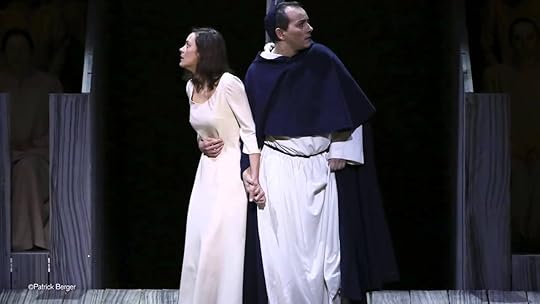
I came to this book from two paths, although I’ve had it in my shelves for a while – either after reading Jan Maat’s review or I paid attention to his review because I had the book already. I will refer to his review because it is comprehensive and insightful.
Soon I will be watching the Teatro Real production of the Oratorio by Arthur Honegger (1892-1955) Jeanne d’Arc au Bûcher, from 1935, with the libretto by Catholic writer Paul Claudel (1868-1955). And I have also recently received this book Cecily, for which offered another episode around the Hundred Years War, which has interested me in the past already.
As Jan Maat’s review is comprehensive and insightful, I will just comment on the things that struck me.
I particularly enjoyed the first section in which the background of the war, with a greater focus on the couple of decades before Joan enters the scene, is reviewed. The assassination of the duke Louis d’Anjou (1407), the disastrous Agincourt battle (1415), the assassination of the duke John the Fearless (1419), the Treaty of Troyes (1420 – which agreed the marriage of the invading king to the daughter of the invaded monarch), the death of those two kings (1422), the continued advance of the English – this is the succession of events that prequel Joan’s role. Reading this section, it became much clearer to me why the new duke of Burgundy, Philip the Good (1396-1467), had to take the side of the English. The assassination of his father just could not let Philip accept the claims to the throne of the Dauphin, Charles, that resulted in a treacherous considering that the magnicide was the result of a treacherous meeting.
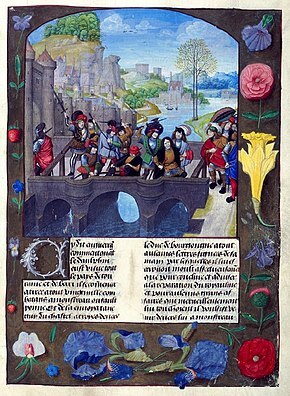
The second aspect that surprised me was for how short a time Joan had any success. It lasted from early 1429, when she managed to be received by the Dauphin in his resistance court in Chinon, until she was captured in May 1430 outside Compiègne. So, just over one year. In between her string of successes were not many either. Two stand out – the recovery of Orléans in just four days after six months of siege and the defiant coronation of Charles in Reims.
The section of the book dedicated to her captivity and trial interested me less. It is an uncomfortable tale – her frantic visions, the cowardly abandonment by her king and his court, and her being demonized for wearing trousers (I am so glad I have been born when I have!!), made me rush through this section.
The last section, with the “After”, drew my attention again. How did it happen that this almost inconsequential person became such a myth? And this happened from soon after her execution. Her infamous trial from 1431 was followed by another one about 25 years later (Joan’s mother attended this second trial), which pushed the pendulum in the opposite direction. With this turnaround the Church managed to extirpate itself from any responsibility and leave the ground ready, just over four hundred years later (1869), for the Bishop of Orléans, Félix Dupanloup, to examine her case again from a religious point of view. This reappraisal followed after the publication in the 1840s of Jules Quicherat’s edition of the transcripts of both trials.
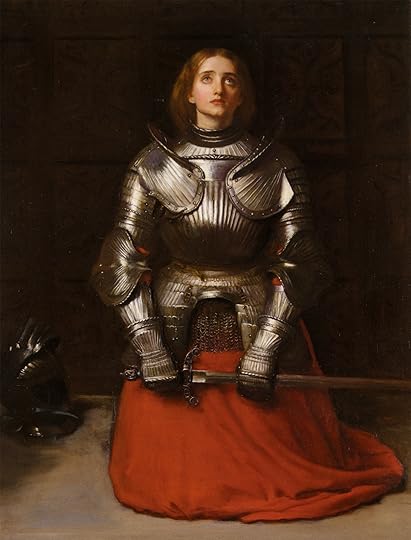
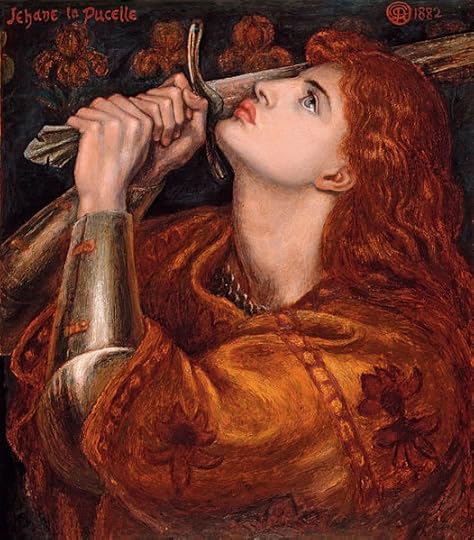
It is from the mid nineteenth century that a considerable proliferation of paintings surged. The artists quickly seized on Quicherat’s findings. This rehabilitation wedded well with the nineteenth century fascination with the Middle Ages.
We have Ingres’ from 1854:

But it wasn’t just the French artists that paid attention to their national heroine. The English Millais (1865) and Gabriel-Rossetti (1882), or the German Hermann Stilke's two of versions (both from 1843) also produced their vision.


My favourite is: Jules Bastien Lepage’s from 1879 in the Metropolitan:
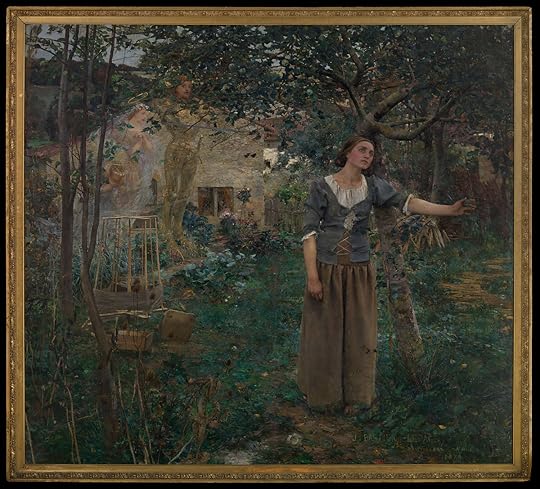
I wonder how much of this popular support helped in declaring Joan of Arc a Saint, in May 1920. Honneger’s Oratorium came at a good time. It was composed few years after her sanctity and during a period of renewed nationalism.
I am now ready to read Claudel’s libretto, Jeanne d'Arc au Bucherand become familiar with Honegger’s music. Marion Cotillard (at the head of the review) will sing the title role at the Real.
And here is a link to the libretto:
https://www.eclassical.com/shop/17115...

January 29, 2025
After reading Helen Castor's magnificent The Eagle and the Hart, I knew I had messed up by not reading her previous books. My first effort to rectify my failure is Joan of Arc. I wanted to start there because I have yet to find a book on the Maiden which left me feeling like I knew who she was better than when I started. As expected, Castor finally delivered that story. The strange part is that she did so by not writing a traditional biography of St. Joan. In fact, she is only in about a third to half of the book. Yes, it is counterintuitive, but hear me out!
It seems the secret to unlocking Joan is to describe in detail the world around her both before and after. A book which starts from her bursting onto the scene would be hard pressed to describe the Hundred Years' War in a short explanation. The war (which I will shorten to The Hundo) is what makes her story possible. The people of the continent were exhausted, lacking in leadership, and then this 18ish year old shows up with a mission from God (yes, I wanted you to hear it like they say it in The Blues Brothers). Was she bipolar? Did God send her to whack a whole bunch of Englishmen? Unclear and beside the point. Joan certainly thought it was God and she definitely got results...until she didn't. The trial (and then the OTHER trial) would cement her immortality on this earth. Castor digs into all of this by somehow keeping Joan at arms length, but simultaneously more clear to the reader.
The book is nearly 10 years old at this point, but Castor's easy prose is just as good as it is today. I have read about the Hundo before. It is very often boring to the point of wishing everyone involved could lose. I was never bored and, more amazingly, I finally think I have a handle on it. Probably. Don't ask too many questions. I know a heck of a lot more about Joan, though! Definitely!
It seems the secret to unlocking Joan is to describe in detail the world around her both before and after. A book which starts from her bursting onto the scene would be hard pressed to describe the Hundred Years' War in a short explanation. The war (which I will shorten to The Hundo) is what makes her story possible. The people of the continent were exhausted, lacking in leadership, and then this 18ish year old shows up with a mission from God (yes, I wanted you to hear it like they say it in The Blues Brothers). Was she bipolar? Did God send her to whack a whole bunch of Englishmen? Unclear and beside the point. Joan certainly thought it was God and she definitely got results...until she didn't. The trial (and then the OTHER trial) would cement her immortality on this earth. Castor digs into all of this by somehow keeping Joan at arms length, but simultaneously more clear to the reader.
The book is nearly 10 years old at this point, but Castor's easy prose is just as good as it is today. I have read about the Hundo before. It is very often boring to the point of wishing everyone involved could lose. I was never bored and, more amazingly, I finally think I have a handle on it. Probably. Don't ask too many questions. I know a heck of a lot more about Joan, though! Definitely!

July 11, 2016
[3.5?] Early July 2016: What if, into the current chaos of the Labour Party, appeared a preternaturally confident teenager without previous political involvement, hogging publicity and insisting they could unify the party, despite being academically unremarkable, and in social class not fitting too well with either the diminishing core working-class vote, or the parliamentary party? And somehow, because everything's such a ridiculous mess that could barely get any worse, and some people are desperate to try anything, this teen gets appointed to manage a campaign for a by-election that was never terribly likely to be won - and under their direction, it is won ... and support starts to grow?
When writing this book, Helen Castor didn't have such a handy contemporary analogy available to communicate the utter weirdness and unlikelihood of Joan's ascendancy to an audience who takes her for granted as a famous historical figure, but that's the kind of context she sets out by spending the first third not on Joan, but on the pandemonium of early-fifteenth-century French politics and war into which she walked.
The above imaginary left-wing 2010s William Hague would be extremely unlikely to gain such traction due to their young age, and would be told to go off and finish their GCSEs whilst doing a bit of youth party work and helping out with leafleting - but being female in the fifteenth century, Joan was even less likely to be taken seriously as a military leader.
A more accurate title for Helen Castor's book would be Joan of Arc in Political Context - which, okay, sounds like an undergrad honours module, but does give a fairer idea of the content, as the casual reader expects something different from a short book on Joan (and it is short - about half the length is references). I for one appreciated a refresher on the destructive machinations between Burgundy, Armagnac and the English in early fifteenth century France. But all these dukes and plots and battles are of less interest to many, and there was so much potentially interesting material missing. The introduction promises that information about Joan herself and her social environment will be forthcoming towards the end, in witness statements at posthumous hearings - but that turned out to be false hope: what's here is scanty.
However, if I'd ever heard much before about the formidable Yolande of Aragon, mother-in-law of the eventual Charles VII, I'd forgotten: one of those medieval royal women whose Francis Urquhart-like influence behind the scenes decided at least as much as any showy battle. The way Castor's book reads, it's as if Yolande was the grandmaster who, over decades, moved the players into place so the Hundred Years' War could be ended.
Castor also includes some highly pertinent information about similar visionary and prophetic figures who had appeared in France in the years before Joan, making pronouncements related to the war. (Some others who were current during Joan's short fame are also mentioned.)
The following read like the key to why Joan was given her chance to be heard at court, when so many like her were not. Her message was the right one, at the right time, with Charles' court on the retreat - but she also fit a pattern already familiar to Yolande:
During that time, holy voices had been raised across Europe to demand an end to the Church’s agony – and Yolande had learned at first hand that these spiritual leaders might be female as well as male. In the 1390s, for example, her mother-in-law, Marie of Brittany – another strikingly formidable dowager duchess of Anjou – had known a peasant woman named Marie Robine, who had begun to receive messages from God...
on 22 February 1398, that Marie Robine first heard a voice from heaven, telling her that she must direct the king to reform the Church and end the schism...
By April, Duchess Marie was taking so close an interest in this divine instruction that she was present in St Michael’s cemetery when Marie Robine had another vision...
Memories of her were still fresh when Yolande arrived in Provence in the following year, and when the young duchess travelled north to the valley of the Loire, she herself encountered another female visionary. Jeanne-Marie de Maillé was a woman of noble birth who, after her husband’s death in 1362, had embraced a life of poverty and prayer as a recluse under the protection of a convent in Tours...
Her connections with the Angevin dynasty were so close that she stood godmother to one of Duchess Marie’s sons, Yolande’s brother-in-law, and she was twice granted an audience with the king, first when Charles VI visited Tours in 1395, and again when she travelled to Paris in 1398...
Jeanne-Marie spent time too with Queen Isabeau, whom [Jeanne-Marie] reprimanded for living in luxury while the people suffered and starved. When Yolande met her, she was already in her seventies, but the two women spent enough time together that when Jeanne-Marie died in 1414, Yolande was a witness at the canonisation hearing.
It was good to see descriptions of Joan's battle tactics, which were actually pretty repetitive (but new to the conflict by aggressively taking the battle to the enemy, when the Armagnacs had been too weary and disillusioned to do that for a long while). When a GR friend read a book about the Hundred Years' War a couple of months ago, I wondered if Joan might have been a natural tactical genius, in the same way as kids who are brilliant at chess. Based on Castor's book, that wasn't the case, but she did seem to share some stereotypical traits with that type: her adamancy that she was right, her independent but repetitive thinking, her disregard of gender norms... (and it's too easy to see this everywhere these days) it all sounds a bit asperger's. Not a concept of Joan I'd ever previously considered.
That was all interesting, but plenty else was lacking in the book. I think a decent single-volume study of Joan needs also to include the following:
- What is known about daily life in villages like Domrémy and for families like Joan's, with a particular emphasis on how prolonged war affected them (e.g. crop damage, looting, sons going to fight). What were their interests in ending the war (duh) and what, if anything, might sway them to one side or another.
- More material about young women in medieval France/ western Europe and social attitudes held by and about them
- Perhaps more about religion: I felt the book did a decent job of communicating how suffused medieval society was with religion, and how everything in life was seen through its lens - but some reviews on here suggest that could have been communicated better to general readers.
- And then there's THE issue that meant I wouldn't round the rating up to 4 stars - because it's a central part of interpreting Joan, because it relates to a significant social issue today, and because I expect a historian of Castor's generation to do better than this lazy lack of interdisciplinary enquiry. That sort of department-bound thinking should have waned with the retirement of those now in their seventies. I should not have had to explain this to other people who've read the book; the book should have done it for me, and to be honest I'm cross that Joan is being taught without this.
The voices.
There is plenty of comparative psychology out there showing how thought processes, presentations, and interpretations of experience differ between cultures - it's not just norms, people's thinking and processing can itself be different. It's possible that what a person now might experience as a memory, or their own thoughts, or a sense of received opinion built up over the years, could have come into the mind of a medieval person as the voice of a supernatural being.
It's known that hearing voices is a common experience which doesn't necessarily mean there is any mental illness present. see: Hearing Voices Network; the work of Richard Bentall. (The UK is ahead of the curve on this issue, and there has been plenty about it in the Guardian Society over the years - I knew of it before I ever thought to study psychology - so even less excuse for Castor's failure to include this.)
There's a lot of material around which can be very interestingly applied to Joan - and which could also have the added contemporary benefit of destigmatisation work with readers of the book. It doesn't require any definitive verdict about Joan - though her organised behaviour does not tally well with early schizophrenia - this is simply presenting contemporary knowlege relevant to one of the most controversial aspects of her as a historical figure.
I may have been spoiled for all other history books by reading Ronald Hutton's Pagan Britain immediately prior to this one. Hutton may not be the most telegenic of historians, but on paper his fairness, humanity and attention to detail is IMO unmatched. At least as much of its topic, Pagan Britain is a history of interpretations and the reasons behind them, and Castor's book felt so meagre by comparison: it presented a straight narrative without elucidating within the text why this version was chosen, without looking at different possible opinions on anything. (I simply wasn't enthused enough to go burrowing in the un-numbered references.) Yes, the books are for different audiences, but the old-school political-history content and serviceable writing style in Joan of Arc simply don't provide the excitement that should in a C21st popular history book that doesn't bother presenting different views on the story.
On the other side from my historiographical doubts, Joan of Arc was also emotionally harrowing. I read most of it fairly quickly, but coming up to her capture, I could hardly bring myself to pick up the book, and despite having said to myself I'd finish it in three days or fewer, took a day and a half longer because I was doing almost anything else apart from read those bits. (I also once played her, as scripted by Bernard Shaw, which made this feel more intensely close than the average history.) It was the cross-examinations that were most horrible and wearing to read. I had long read between the lines of other versions that Joan would have been sexually assaulted, but Castor puts the details in the open (along with how normal this behaviour was considered by her captors) - and it was curious the extent to which her male clothing appeared to have protected her, that she seemed to have become 'fair game' simply by putting on a dress, even though the men always knew she was female. (Something else that a better look at the social history may have explained.)
From the first, the book was also a reminder of how bloody chaotic medieval European history actually was - cities changing hands, the level of instability and unpredictability of life. Of course... this is why I was never that drawn to medieval political history (some of the social history the Black Death really interests me though). It's just too much, whereas early modern had a rhythm that suited me, and by the eigteenth and nineteenth century - as with the Greeks and Romans - things had got too boring without being interestingly modern enough.
This is not a bad book; its presentation of a complex episode of political history is clear and methodical, and would be ideal for A-level students or first year undergrads getting their heads round the chain of events - but there is too much missing here for it to be anything like the current popular work on Joan. It adds something to the field by its reconnecting her with the political and military environment in which she spent her fleeting career, but not unlike Castor's TV documentary presenting stint I saw not long before reading the book, which she had the luck and misfortune to co-host with Lucy Worsley (and in that situation, who isn't going to come off as the one with less spark?) it was fine and competent, but not enthralling when one can see how it may be done better.
When writing this book, Helen Castor didn't have such a handy contemporary analogy available to communicate the utter weirdness and unlikelihood of Joan's ascendancy to an audience who takes her for granted as a famous historical figure, but that's the kind of context she sets out by spending the first third not on Joan, but on the pandemonium of early-fifteenth-century French politics and war into which she walked.
The above imaginary left-wing 2010s William Hague would be extremely unlikely to gain such traction due to their young age, and would be told to go off and finish their GCSEs whilst doing a bit of youth party work and helping out with leafleting - but being female in the fifteenth century, Joan was even less likely to be taken seriously as a military leader.
A more accurate title for Helen Castor's book would be Joan of Arc in Political Context - which, okay, sounds like an undergrad honours module, but does give a fairer idea of the content, as the casual reader expects something different from a short book on Joan (and it is short - about half the length is references). I for one appreciated a refresher on the destructive machinations between Burgundy, Armagnac and the English in early fifteenth century France. But all these dukes and plots and battles are of less interest to many, and there was so much potentially interesting material missing. The introduction promises that information about Joan herself and her social environment will be forthcoming towards the end, in witness statements at posthumous hearings - but that turned out to be false hope: what's here is scanty.
However, if I'd ever heard much before about the formidable Yolande of Aragon, mother-in-law of the eventual Charles VII, I'd forgotten: one of those medieval royal women whose Francis Urquhart-like influence behind the scenes decided at least as much as any showy battle. The way Castor's book reads, it's as if Yolande was the grandmaster who, over decades, moved the players into place so the Hundred Years' War could be ended.
Castor also includes some highly pertinent information about similar visionary and prophetic figures who had appeared in France in the years before Joan, making pronouncements related to the war. (Some others who were current during Joan's short fame are also mentioned.)
The following read like the key to why Joan was given her chance to be heard at court, when so many like her were not. Her message was the right one, at the right time, with Charles' court on the retreat - but she also fit a pattern already familiar to Yolande:
During that time, holy voices had been raised across Europe to demand an end to the Church’s agony – and Yolande had learned at first hand that these spiritual leaders might be female as well as male. In the 1390s, for example, her mother-in-law, Marie of Brittany – another strikingly formidable dowager duchess of Anjou – had known a peasant woman named Marie Robine, who had begun to receive messages from God...
on 22 February 1398, that Marie Robine first heard a voice from heaven, telling her that she must direct the king to reform the Church and end the schism...
By April, Duchess Marie was taking so close an interest in this divine instruction that she was present in St Michael’s cemetery when Marie Robine had another vision...
Memories of her were still fresh when Yolande arrived in Provence in the following year, and when the young duchess travelled north to the valley of the Loire, she herself encountered another female visionary. Jeanne-Marie de Maillé was a woman of noble birth who, after her husband’s death in 1362, had embraced a life of poverty and prayer as a recluse under the protection of a convent in Tours...
Her connections with the Angevin dynasty were so close that she stood godmother to one of Duchess Marie’s sons, Yolande’s brother-in-law, and she was twice granted an audience with the king, first when Charles VI visited Tours in 1395, and again when she travelled to Paris in 1398...
Jeanne-Marie spent time too with Queen Isabeau, whom [Jeanne-Marie] reprimanded for living in luxury while the people suffered and starved. When Yolande met her, she was already in her seventies, but the two women spent enough time together that when Jeanne-Marie died in 1414, Yolande was a witness at the canonisation hearing.
It was good to see descriptions of Joan's battle tactics, which were actually pretty repetitive (but new to the conflict by aggressively taking the battle to the enemy, when the Armagnacs had been too weary and disillusioned to do that for a long while). When a GR friend read a book about the Hundred Years' War a couple of months ago, I wondered if Joan might have been a natural tactical genius, in the same way as kids who are brilliant at chess. Based on Castor's book, that wasn't the case, but she did seem to share some stereotypical traits with that type: her adamancy that she was right, her independent but repetitive thinking, her disregard of gender norms... (and it's too easy to see this everywhere these days) it all sounds a bit asperger's. Not a concept of Joan I'd ever previously considered.
That was all interesting, but plenty else was lacking in the book. I think a decent single-volume study of Joan needs also to include the following:
- What is known about daily life in villages like Domrémy and for families like Joan's, with a particular emphasis on how prolonged war affected them (e.g. crop damage, looting, sons going to fight). What were their interests in ending the war (duh) and what, if anything, might sway them to one side or another.
- More material about young women in medieval France/ western Europe and social attitudes held by and about them
- Perhaps more about religion: I felt the book did a decent job of communicating how suffused medieval society was with religion, and how everything in life was seen through its lens - but some reviews on here suggest that could have been communicated better to general readers.
- And then there's THE issue that meant I wouldn't round the rating up to 4 stars - because it's a central part of interpreting Joan, because it relates to a significant social issue today, and because I expect a historian of Castor's generation to do better than this lazy lack of interdisciplinary enquiry. That sort of department-bound thinking should have waned with the retirement of those now in their seventies. I should not have had to explain this to other people who've read the book; the book should have done it for me, and to be honest I'm cross that Joan is being taught without this.
The voices.
There is plenty of comparative psychology out there showing how thought processes, presentations, and interpretations of experience differ between cultures - it's not just norms, people's thinking and processing can itself be different. It's possible that what a person now might experience as a memory, or their own thoughts, or a sense of received opinion built up over the years, could have come into the mind of a medieval person as the voice of a supernatural being.
It's known that hearing voices is a common experience which doesn't necessarily mean there is any mental illness present. see: Hearing Voices Network; the work of Richard Bentall. (The UK is ahead of the curve on this issue, and there has been plenty about it in the Guardian Society over the years - I knew of it before I ever thought to study psychology - so even less excuse for Castor's failure to include this.)
There's a lot of material around which can be very interestingly applied to Joan - and which could also have the added contemporary benefit of destigmatisation work with readers of the book. It doesn't require any definitive verdict about Joan - though her organised behaviour does not tally well with early schizophrenia - this is simply presenting contemporary knowlege relevant to one of the most controversial aspects of her as a historical figure.
I may have been spoiled for all other history books by reading Ronald Hutton's Pagan Britain immediately prior to this one. Hutton may not be the most telegenic of historians, but on paper his fairness, humanity and attention to detail is IMO unmatched. At least as much of its topic, Pagan Britain is a history of interpretations and the reasons behind them, and Castor's book felt so meagre by comparison: it presented a straight narrative without elucidating within the text why this version was chosen, without looking at different possible opinions on anything. (I simply wasn't enthused enough to go burrowing in the un-numbered references.) Yes, the books are for different audiences, but the old-school political-history content and serviceable writing style in Joan of Arc simply don't provide the excitement that should in a C21st popular history book that doesn't bother presenting different views on the story.
On the other side from my historiographical doubts, Joan of Arc was also emotionally harrowing. I read most of it fairly quickly, but coming up to her capture, I could hardly bring myself to pick up the book, and despite having said to myself I'd finish it in three days or fewer, took a day and a half longer because I was doing almost anything else apart from read those bits. (I also once played her, as scripted by Bernard Shaw, which made this feel more intensely close than the average history.) It was the cross-examinations that were most horrible and wearing to read. I had long read between the lines of other versions that Joan would have been sexually assaulted, but Castor puts the details in the open (along with how normal this behaviour was considered by her captors) - and it was curious the extent to which her male clothing appeared to have protected her, that she seemed to have become 'fair game' simply by putting on a dress, even though the men always knew she was female. (Something else that a better look at the social history may have explained.)
From the first, the book was also a reminder of how bloody chaotic medieval European history actually was - cities changing hands, the level of instability and unpredictability of life. Of course... this is why I was never that drawn to medieval political history (some of the social history the Black Death really interests me though). It's just too much, whereas early modern had a rhythm that suited me, and by the eigteenth and nineteenth century - as with the Greeks and Romans - things had got too boring without being interestingly modern enough.
This is not a bad book; its presentation of a complex episode of political history is clear and methodical, and would be ideal for A-level students or first year undergrads getting their heads round the chain of events - but there is too much missing here for it to be anything like the current popular work on Joan. It adds something to the field by its reconnecting her with the political and military environment in which she spent her fleeting career, but not unlike Castor's TV documentary presenting stint I saw not long before reading the book, which she had the luck and misfortune to co-host with Lucy Worsley (and in that situation, who isn't going to come off as the one with less spark?) it was fine and competent, but not enthralling when one can see how it may be done better.

September 4, 2014
Writing the biography of a medieval figure is always a difficult undertaking. However, the life of Joan the Maid is better documented than most, largely due to the transcripts of her trial for heresy and the subsequent investigation which cleared her name twenty five years after her death. Author Helen Castor attempts not only to tell her story, but to put her life – and death – in context, within the history of a turbulent time for France, by interpreting the trial transcripts and of making clear the religious beliefs of the time.
The book begins with the battle of Agincourt, of feuds and factions, and France a fractured kingdom. It is important to point out that Joan herself does not put in an appearance during the first part of this book. However, for many readers (myself included), who know little about the events of this time, understanding the politics and factions that abounded at the time help set the scene. We first read of Joan’s appearance at about a quarter of the way into this read, when she arrives at Chinon, having tried, unsuccessfully, to reach the king the previous year. It is now 1429 and Joan, a village girl, still in her teens, in men’s clothes, says she has been sent by God not just to instruct the king but to help him recover his kingdom from the English. If only the king would give her an army, she would drive the English out of France and lead him to his coronation. This message, obviously puts Charles in a quandary – if he followed a false prophet, this would lead to disaster. In the same way, rejecting a true prophet would be equally catastrophic.
Time and again, Joan had to prove herself. Initially, she had to prove her integrity, her maidenhood, her faith and habits to Charles. She was questioned by theologians and had to try to prove her authenticity before undertaking her mission. Joan travelled to Orleans and the scarred and hungry town reacted with hope to the news of this miraculous maid coming to save them. Indeed, the siege was lifted within four days and it seemed a miracle. This book follows her onwards – always trying to convince those around her to fight against English rule – and on to her capture. As a prisoner, accused of heresy, she again faced of interrogation. Only this time, she was not arguing to help her king, but effectively to save her life. If she was found guilty she would burn, if not she might be spared.
This is a fascinating read, which really puts the life of Joan of Arc is historical perspective. It gives great background, looks at Joan as an icon, a saint, a heroine and a woman who fought in a man’s world. It examines what she achieved, gives insight into her trial and how remarkably self possessed she was despite her age and shows, with real poignancy, how vulnerable she was. Although I do feel I know much more about Joan and her place in history, and understand why the author approached her story in the way she did, I did feel at the end that I might have liked to have read more about her life before she entered the historical arena by approaching the king. I understand why the author used the trial transcripts to look at her personal history, and that we are lucky so much remains to help reconstruct her life; but I felt that, although I understood her more, I still did not really know this elusive young woman. Overall, though, this is an enjoyable, and readable, biography, which is especially good for those who know little about the historical period in which Joan of Arc lived. Lastly, I received a copy of this book from the publisher, via NetGalley, for review.
The book begins with the battle of Agincourt, of feuds and factions, and France a fractured kingdom. It is important to point out that Joan herself does not put in an appearance during the first part of this book. However, for many readers (myself included), who know little about the events of this time, understanding the politics and factions that abounded at the time help set the scene. We first read of Joan’s appearance at about a quarter of the way into this read, when she arrives at Chinon, having tried, unsuccessfully, to reach the king the previous year. It is now 1429 and Joan, a village girl, still in her teens, in men’s clothes, says she has been sent by God not just to instruct the king but to help him recover his kingdom from the English. If only the king would give her an army, she would drive the English out of France and lead him to his coronation. This message, obviously puts Charles in a quandary – if he followed a false prophet, this would lead to disaster. In the same way, rejecting a true prophet would be equally catastrophic.
Time and again, Joan had to prove herself. Initially, she had to prove her integrity, her maidenhood, her faith and habits to Charles. She was questioned by theologians and had to try to prove her authenticity before undertaking her mission. Joan travelled to Orleans and the scarred and hungry town reacted with hope to the news of this miraculous maid coming to save them. Indeed, the siege was lifted within four days and it seemed a miracle. This book follows her onwards – always trying to convince those around her to fight against English rule – and on to her capture. As a prisoner, accused of heresy, she again faced of interrogation. Only this time, she was not arguing to help her king, but effectively to save her life. If she was found guilty she would burn, if not she might be spared.
This is a fascinating read, which really puts the life of Joan of Arc is historical perspective. It gives great background, looks at Joan as an icon, a saint, a heroine and a woman who fought in a man’s world. It examines what she achieved, gives insight into her trial and how remarkably self possessed she was despite her age and shows, with real poignancy, how vulnerable she was. Although I do feel I know much more about Joan and her place in history, and understand why the author approached her story in the way she did, I did feel at the end that I might have liked to have read more about her life before she entered the historical arena by approaching the king. I understand why the author used the trial transcripts to look at her personal history, and that we are lucky so much remains to help reconstruct her life; but I felt that, although I understood her more, I still did not really know this elusive young woman. Overall, though, this is an enjoyable, and readable, biography, which is especially good for those who know little about the historical period in which Joan of Arc lived. Lastly, I received a copy of this book from the publisher, via NetGalley, for review.

October 30, 2016
France in 1429 was a divided kingdom. At war with the English on and off since 1337, with a weak king and a ruling class destroyed by the catastrophe of Agincourt, it looked as if the English king would finally secure the throne of France. The English held the capital and most of northern France, and in league with Philip of Burgundy - at that time one of the most powerful of the regional French princes - was closing in for the kill.
Into this impossible situation flared the comet that was Joan of Arc. Fired with an unshakeable conviction that she was a manifestation of the will of God, she brought purpose and confidence to the French forces and set in train a turn in the fortunes of war that ultimately expelled the English from France.
By then Joan was long dead. Captured and burnt as a heretic by the English. War at this time was fought equally in the pulpit as on the battlefield. The favour of God was sought and demonstrated by success in war, with reverses as much to do with Gods displeasure as a feat of arms.
What I liked about this book was that it illuminates the way in which people at the time saw the conduct of war, with the theological dimension being as important as supplies and soldiers. It was theology that ensured that in 1431 Joan would be confirmed a heretic and burnt, yet in 1456 with the English chased away she would be exonerated by a review based on mostly the same evidence.
A good read
Into this impossible situation flared the comet that was Joan of Arc. Fired with an unshakeable conviction that she was a manifestation of the will of God, she brought purpose and confidence to the French forces and set in train a turn in the fortunes of war that ultimately expelled the English from France.
By then Joan was long dead. Captured and burnt as a heretic by the English. War at this time was fought equally in the pulpit as on the battlefield. The favour of God was sought and demonstrated by success in war, with reverses as much to do with Gods displeasure as a feat of arms.
What I liked about this book was that it illuminates the way in which people at the time saw the conduct of war, with the theological dimension being as important as supplies and soldiers. It was theology that ensured that in 1431 Joan would be confirmed a heretic and burnt, yet in 1456 with the English chased away she would be exonerated by a review based on mostly the same evidence.
A good read

October 11, 2014
More history than biography...
Helen Castor begins this retelling of the life of Joan the Maid by explaining that, although her story is better documented than most from this period, it isn't always possible to take the sources at face value. Since her legend was being created while she was still alive, and since so much hung on the idea of which side in the war had the support of God, then an inevitable bias has to be expected in the various accounts of her actions and words. So Castor has set out to put Joan's story into the context of the times, and to do that she starts fourteen years before Joan appears, taking us back to Agincourt, and then working forward.
This is a fairly short book, actually more history than biography. It's well-written and therefore easy to read, and Castor explains the various alliances and enmities clearly – having very little previous knowledge of the period, I was able to follow the various shifting loyalties without too much difficulty, and undoubtedly feel better informed about the events and personalities of the time. She describes the background to the feud between the Burgundians and the Armagnacs which split the French resistance to the English claim to the throne. And she shows how the English policy towards any final peace was circumscribed by the infancy of the King (after Henry V's death), with his regent in France, the Duke of Bedford, feeling unable to reach decisions to which young Henry VI might object when he came to power.
By taking this approach, by the time of Joan's arrival on the scene, Castor had built up enough of a picture of the near desperation of the Armagnac faction that it made it slightly less inexplicable why they would have been willing to give credence to this young girl, claiming to have been sent by God to lead an army and ensure the coronation of Charles VII. But only slightly. Though Castor does make clear the importance of religious symbolism and signs at the period, I felt that the crucial point of how exactly Joan got access to the French King remained a little vague. Castor tells us the events – when it happened, who accompanied her, etc., – but left me with no real feeling of why initially any of the important men around the King took her seriously. However, once having rather shimmied past that bit, Castor's descriptions of Joan's involvement in the war and subsequent capture and trial are very well told, with the various political pressures on all sides being clearly explained.
So as history the book works well, especially for someone like myself coming new to the period, though I did wonder if it was in depth enough to add much for people with a reasonable existing understanding of the people and events. I didn't feel it worked quite so well as biography however. Perhaps there isn't enough information available to make it possible, but I didn't come away from it feeling that I really understood Joan as a person. There is little about her background prior to her arriving at Charles' court, and after that, although the events are well described, somehow her personality didn't seem to come through.
There only seem to be two possibilities about Joan – either she actually was God's emissary on earth or she was mentally ill. Castor rather oddly doesn't seem to take a view on that. On the one hand, I felt strongly that she was implicitly ruling out the possibility of Joan being visited by angels telling her that God was on France's side, or more specifically on the side of the Armagnacs. But, on the other hand, she really gave no other interpretation. Not that I'm a great fan of retrospective diagnosis of mental illnesses, but I felt the possibility at least needed to be discussed. The result was that she remained a rather nebulous figure, to me at least.
Happily Castor doesn't end the story with Joan's death. She continues with the history of the war up to the point where the English were finally driven out of France – she doesn't delve into it in depth but covers it well enough so that it provides a satisfactory overview. And she also continues Joan's story after death, with the various reviews of her trial that eventually led to her being declared innocent of heresy. The epilogue tells the final chapter in her story – her canonisation as a saint in 1920.
Overall, I found this an interesting and informative read which, while it perhaps didn't wholly satisfy me as a biography, worked very well as an introduction to the history of the period.
NB This book was provided for review by the publisher, Faber and Faber Ltd.
www.fictionfanblog.wordpress.com
Helen Castor begins this retelling of the life of Joan the Maid by explaining that, although her story is better documented than most from this period, it isn't always possible to take the sources at face value. Since her legend was being created while she was still alive, and since so much hung on the idea of which side in the war had the support of God, then an inevitable bias has to be expected in the various accounts of her actions and words. So Castor has set out to put Joan's story into the context of the times, and to do that she starts fourteen years before Joan appears, taking us back to Agincourt, and then working forward.
This is a fairly short book, actually more history than biography. It's well-written and therefore easy to read, and Castor explains the various alliances and enmities clearly – having very little previous knowledge of the period, I was able to follow the various shifting loyalties without too much difficulty, and undoubtedly feel better informed about the events and personalities of the time. She describes the background to the feud between the Burgundians and the Armagnacs which split the French resistance to the English claim to the throne. And she shows how the English policy towards any final peace was circumscribed by the infancy of the King (after Henry V's death), with his regent in France, the Duke of Bedford, feeling unable to reach decisions to which young Henry VI might object when he came to power.
By taking this approach, by the time of Joan's arrival on the scene, Castor had built up enough of a picture of the near desperation of the Armagnac faction that it made it slightly less inexplicable why they would have been willing to give credence to this young girl, claiming to have been sent by God to lead an army and ensure the coronation of Charles VII. But only slightly. Though Castor does make clear the importance of religious symbolism and signs at the period, I felt that the crucial point of how exactly Joan got access to the French King remained a little vague. Castor tells us the events – when it happened, who accompanied her, etc., – but left me with no real feeling of why initially any of the important men around the King took her seriously. However, once having rather shimmied past that bit, Castor's descriptions of Joan's involvement in the war and subsequent capture and trial are very well told, with the various political pressures on all sides being clearly explained.
So as history the book works well, especially for someone like myself coming new to the period, though I did wonder if it was in depth enough to add much for people with a reasonable existing understanding of the people and events. I didn't feel it worked quite so well as biography however. Perhaps there isn't enough information available to make it possible, but I didn't come away from it feeling that I really understood Joan as a person. There is little about her background prior to her arriving at Charles' court, and after that, although the events are well described, somehow her personality didn't seem to come through.
There only seem to be two possibilities about Joan – either she actually was God's emissary on earth or she was mentally ill. Castor rather oddly doesn't seem to take a view on that. On the one hand, I felt strongly that she was implicitly ruling out the possibility of Joan being visited by angels telling her that God was on France's side, or more specifically on the side of the Armagnacs. But, on the other hand, she really gave no other interpretation. Not that I'm a great fan of retrospective diagnosis of mental illnesses, but I felt the possibility at least needed to be discussed. The result was that she remained a rather nebulous figure, to me at least.
Happily Castor doesn't end the story with Joan's death. She continues with the history of the war up to the point where the English were finally driven out of France – she doesn't delve into it in depth but covers it well enough so that it provides a satisfactory overview. And she also continues Joan's story after death, with the various reviews of her trial that eventually led to her being declared innocent of heresy. The epilogue tells the final chapter in her story – her canonisation as a saint in 1920.
Overall, I found this an interesting and informative read which, while it perhaps didn't wholly satisfy me as a biography, worked very well as an introduction to the history of the period.
NB This book was provided for review by the publisher, Faber and Faber Ltd.
www.fictionfanblog.wordpress.com

October 17, 2016
This is an intelligent and detailed re-telling of the story of Joan of Arc, to give her her English name. Castor is alive to the problems of the sources, many of which are either politically or religiously biased, and/or written so far after the events that their agenda is to re-tell their own story of Jeanne. Despite that, though, no historian can avoid them, and can only be self-consciously aware of the distortions, inconsistencies and contradictions raised by the historical record.
At the same time, Castor tries to tell the story not through modern eyes but in its own terms: she doesn’t, therefore, ask questions about the reality of Jeanne’s voices and what they might tell us about her mental or physical state, but instead views the story via the theological conceptions of the fifteenth century. What was at stake for the church at the time was the question of whether the voices came from heaven or from hell – and, thus, whether Jeanne was a messenger of god or the devil.
This isn’t always an easy read as Castor uncovers the complicated politics of the period – and she starts with Azincourt, when Jeanne was just a baby in order to set the political scene onto which Jeanne bursts. She is also very conscious of the gender issues prompted by Jeanne’s story – as were contemporaries such as Christine de Pizan who claimed Jeanne as a feminist icon already in the fifteenth century.
So this isn’t hard-core academic history but is a book which expects, and repays, close attention – not a light holiday or bed-time read, but recommended for a modern and self-aware reading of the Maid of Orleans.
(This review is from an ARC courtesy of the publisher)
At the same time, Castor tries to tell the story not through modern eyes but in its own terms: she doesn’t, therefore, ask questions about the reality of Jeanne’s voices and what they might tell us about her mental or physical state, but instead views the story via the theological conceptions of the fifteenth century. What was at stake for the church at the time was the question of whether the voices came from heaven or from hell – and, thus, whether Jeanne was a messenger of god or the devil.
This isn’t always an easy read as Castor uncovers the complicated politics of the period – and she starts with Azincourt, when Jeanne was just a baby in order to set the political scene onto which Jeanne bursts. She is also very conscious of the gender issues prompted by Jeanne’s story – as were contemporaries such as Christine de Pizan who claimed Jeanne as a feminist icon already in the fifteenth century.
So this isn’t hard-core academic history but is a book which expects, and repays, close attention – not a light holiday or bed-time read, but recommended for a modern and self-aware reading of the Maid of Orleans.
(This review is from an ARC courtesy of the publisher)

April 28, 2015
I originally requested this as an ARC from Netgalley, because I enjoyed Helen Castor’s She-Wolves, but I never got round to it in time and ended up buying the book recently. This is a bit too dry to be a story, but Castor certainly “pick[ed her] way through the evidence, choosing what to weave into a seamless story”. It doesn’t spend much time in the narrative on talking about conflicting testimony, apocryphal stories, etc — I’m left not quite sure how sure Castor is about some of the events she describes. The notes are pretty extensive though, with plenty of references for anyone with the patience to follow up on it.
As with She-Wolves, this is a pretty readable book, and Castor manages to bring across Joan’s indomitable spirit, her conviction, and, yeah, her sassiness. From the records we have, it seems that we have a pretty consistent picture of Joan as a pious girl who believed wholly in what she was doing, and that she was heaven-sent to fulfil her mission.
One thing I wondered, though — would we treat her any better today? People talk about how badly she was treated, particularly when in Anglo-French custody but also in the endless requests to prove herself and her virginity. But we’d treat her as mad today, not venerate her. Mind you don’t take Joan the hero and act ‘holier than thou’ about the medieval people who condemned her. You likely would too, though for different reasons, however pretty and sassy and self-confident she was.
Originally posted here.
As with She-Wolves, this is a pretty readable book, and Castor manages to bring across Joan’s indomitable spirit, her conviction, and, yeah, her sassiness. From the records we have, it seems that we have a pretty consistent picture of Joan as a pious girl who believed wholly in what she was doing, and that she was heaven-sent to fulfil her mission.
One thing I wondered, though — would we treat her any better today? People talk about how badly she was treated, particularly when in Anglo-French custody but also in the endless requests to prove herself and her virginity. But we’d treat her as mad today, not venerate her. Mind you don’t take Joan the hero and act ‘holier than thou’ about the medieval people who condemned her. You likely would too, though for different reasons, however pretty and sassy and self-confident she was.
Originally posted here.
September 22, 2019
This was an interesting look at the figure of Joan of Arc through the lens of the political forces of her era. I knew virtually nothing about the 100 Year War prior to reading this.

September 15, 2019
The Truth always Comes Out.
Hats off to Helen Castor for telling the story of The Maid chronologically rather than en media res. To tell the story from the perspective of en media res results in highlighted questions and scrambled information. To tell the story in chronological order allows for human fallibility that does not/does not need lead to character assassination.
What a boon to biographers and their readers that so much documentation was recorded and kept for church records. At the request of Bishop Cauchon, a notary and his assistant
Produced an official transcript of the proceedings
Gathered correspondence
Appended witness statements
Appended public letters which announced Jean's execution.
Can there be a more complete record of a woman of the Middle Ages? Even during the earlier part of the Early Modern Period such records were often non existent for women of middling to high status.
About Time the story got told chronologically. RIP Joan, The Maid.
Hats off to Helen Castor for telling the story of The Maid chronologically rather than en media res. To tell the story from the perspective of en media res results in highlighted questions and scrambled information. To tell the story in chronological order allows for human fallibility that does not/does not need lead to character assassination.
What a boon to biographers and their readers that so much documentation was recorded and kept for church records. At the request of Bishop Cauchon, a notary and his assistant
Produced an official transcript of the proceedings
Gathered correspondence
Appended witness statements
Appended public letters which announced Jean's execution.
Can there be a more complete record of a woman of the Middle Ages? Even during the earlier part of the Early Modern Period such records were often non existent for women of middling to high status.
About Time the story got told chronologically. RIP Joan, The Maid.

December 15, 2022
Arribé a las costas de este libro escrito por la historiadora británica, especialista en la Inglaterra Medieval y profesora en la Universidad de Cambridge Helen Castor; en búsqueda de un texto que continuara la historia inconclusa de la Guerra de los Cien Años planteada por el profesor Jonathan Sumption en su colección “The Hundred Years War” la cual, a la fecha sólo está escrita hasta el cuarto tomo que concluye con las muertes de Enrique V de Inglaterra y Carlos VI “El Loco” de Francia, quedando aún por ser narrado el epílogo sangriento y a la vez heroico de tan largo y feroz conflicto.
Pues bien, “Juana de Arco. La Historia de la Doncella de Orleans” puede parecer a simple vista una biografía al uso (tal como el subtítulo indica), con una narración cronológica de la vida, obra y batallas de Juana la Doncella de Orleans. Sin embargo la aproximación de la autora es eminentemente contextual (en un principio) y su intención es situar al lector desde el primer capítulo en el enredado contexto geopolítico de Francia e Inglaterra a principios del siglo XV, con un prólogo que arranca en la trascendental batalla de Azincourt en octubre de 1415. Con esa declaración de intenciones, es evidente que este libro no busca hacer un relato cronológico de la historia de Juana de Arco desde que saliera de las campiñas de Domrémy hasta su juicio y ejecución el 30 de mayo de 1431 en Ruan y por el contrario, la autora busca contar la historia de Francia durante esos años tumultuosos para comprender cómo una joven campesina logró jugar un papel tan excepcional en la guerra y voltear las tornas de la misma a favor del reino de Francia.
La segunda parte del libro nos llevará lo más cercano a una biografía en el sentido estricto de la palabra, con un relato conciso y directo desde el momento en que una joven vestida de hombre se presentó a las puertas de Chinon en 1429 ante el Delfín de Francia; pasando por el milagroso rescate de la Orleans asediada, las campañas militares auxiliares en las que participó Juana hasta su captura en Compiègne en 1430; con un énfasis extraordinario en el proceso de acusación, juicio y ejecución de Juana, etapa que es tal vez la mejor documentada por fuentes históricas primarias.
Y es tal vez la tercera parte del libro donde mejor se puede apreciar el trabajo de contextualización de la autora y en especial, su intento de mostrar el impacto que tuvo Juana de Arco y sus acciones para la posteridad. En lugar de dar por terminado el libro con la muerte en la hoguera de la Doncella, Castor continúa el relato histórico con los últimos estertores de la Guerra de los Cien Años, junto con las alianzas, traiciones y batallas que desencadenaría la expulsión definitiva de los ingleses de territorio francés luego de la debacle en la Batalla de Castillón en 1453. Una vez la estrella de la victoria se asomó en el trono de Carlos VII, el recuerdo de la Doncella, juzgada y quemada como hereje hacía casi 20 años, empezaba a tomar fuerza nuevamente hasta llevar a la revisión de su juicio y declarar la nulidad de la sentencia, convirtiendo su vida y obra en una leyenda que perduraría incluso hasta su canonización casi cinco siglos después en 1920.
En conclusión, la gran fortaleza de este libro es la contextualización histórica y geopolítica de una figura mítica como Juana de Arco, logrando de manera espléndida situar su efigie en los últimos cuarenta años de la Guerra de los Cien Años, en especial su legado que a día de hoy se sigue erigiendo como el símbolo de Francia representada como heroína e ícono de índole proteica, adoptada por nacionalistas, monárquicos, liberales, socialistas, católicos, protestantes e incluso, protagonistas dispares en pleno conflicto como ocurriese con el régimen de Vichy y a su vez, la Resistencia Francesa. Tal vez no sea el libro indicado para quien busque una biografía crítica, cronológica y más profunda del personaje (en cuyo caso recomiendo Joan of Arc, the maid of Orleans del gran Jules Michelet o Jeanne d'Arc deRégine Pernoud), sin embargo, resulta perfecto para quienes quieran conocer a Juana en su contexto histórico o para aquellos que andan buscando un relato sobre los últimos años del conflicto entre Francia e Inglaterra, como fue mi caso.
Pues bien, “Juana de Arco. La Historia de la Doncella de Orleans” puede parecer a simple vista una biografía al uso (tal como el subtítulo indica), con una narración cronológica de la vida, obra y batallas de Juana la Doncella de Orleans. Sin embargo la aproximación de la autora es eminentemente contextual (en un principio) y su intención es situar al lector desde el primer capítulo en el enredado contexto geopolítico de Francia e Inglaterra a principios del siglo XV, con un prólogo que arranca en la trascendental batalla de Azincourt en octubre de 1415. Con esa declaración de intenciones, es evidente que este libro no busca hacer un relato cronológico de la historia de Juana de Arco desde que saliera de las campiñas de Domrémy hasta su juicio y ejecución el 30 de mayo de 1431 en Ruan y por el contrario, la autora busca contar la historia de Francia durante esos años tumultuosos para comprender cómo una joven campesina logró jugar un papel tan excepcional en la guerra y voltear las tornas de la misma a favor del reino de Francia.
La segunda parte del libro nos llevará lo más cercano a una biografía en el sentido estricto de la palabra, con un relato conciso y directo desde el momento en que una joven vestida de hombre se presentó a las puertas de Chinon en 1429 ante el Delfín de Francia; pasando por el milagroso rescate de la Orleans asediada, las campañas militares auxiliares en las que participó Juana hasta su captura en Compiègne en 1430; con un énfasis extraordinario en el proceso de acusación, juicio y ejecución de Juana, etapa que es tal vez la mejor documentada por fuentes históricas primarias.
Y es tal vez la tercera parte del libro donde mejor se puede apreciar el trabajo de contextualización de la autora y en especial, su intento de mostrar el impacto que tuvo Juana de Arco y sus acciones para la posteridad. En lugar de dar por terminado el libro con la muerte en la hoguera de la Doncella, Castor continúa el relato histórico con los últimos estertores de la Guerra de los Cien Años, junto con las alianzas, traiciones y batallas que desencadenaría la expulsión definitiva de los ingleses de territorio francés luego de la debacle en la Batalla de Castillón en 1453. Una vez la estrella de la victoria se asomó en el trono de Carlos VII, el recuerdo de la Doncella, juzgada y quemada como hereje hacía casi 20 años, empezaba a tomar fuerza nuevamente hasta llevar a la revisión de su juicio y declarar la nulidad de la sentencia, convirtiendo su vida y obra en una leyenda que perduraría incluso hasta su canonización casi cinco siglos después en 1920.
En conclusión, la gran fortaleza de este libro es la contextualización histórica y geopolítica de una figura mítica como Juana de Arco, logrando de manera espléndida situar su efigie en los últimos cuarenta años de la Guerra de los Cien Años, en especial su legado que a día de hoy se sigue erigiendo como el símbolo de Francia representada como heroína e ícono de índole proteica, adoptada por nacionalistas, monárquicos, liberales, socialistas, católicos, protestantes e incluso, protagonistas dispares en pleno conflicto como ocurriese con el régimen de Vichy y a su vez, la Resistencia Francesa. Tal vez no sea el libro indicado para quien busque una biografía crítica, cronológica y más profunda del personaje (en cuyo caso recomiendo Joan of Arc, the maid of Orleans del gran Jules Michelet o Jeanne d'Arc deRégine Pernoud), sin embargo, resulta perfecto para quienes quieran conocer a Juana en su contexto histórico o para aquellos que andan buscando un relato sobre los últimos años del conflicto entre Francia e Inglaterra, como fue mi caso.

March 25, 2016
Unfortunately, the tile of this book is deceiving. The name may not had been the author’s original choice (possibly the publisher’s?), I have come across a few books that use name dropping as a marketing tool to attract readers, but for people like me this marketing device inevitably leads to disappointment.
The author opens the book with the political situation during the dynastic clash for the control of the French crown, the English invasion and the battle of Agincourt at the beginning of 1400s. It is a reasonable start but Castor dedicates five chapters to the complex climate in France and England before even introducing the protagonist. This first part occupies more than a third of the book (excluding illustrations, list of characters, family trees, notes and bibliography, these last two sections fill half the book).
The second part, despite being named “Joan”, is a lengthy blow-by-blow account of the Anglo-Burgundian vs Armagnac military campaigns (in which Joan is only one of the many players) rather than the biography that I expected. The reader will have to wait until the end of this second part, chapter 9 to be exact (her testimony at the trial) to begin to learn something about Joan’s life.
Finally, the third part, which occupies another quarter of the book, continues the history of the war for another twenty years or so after her death until the final retreat of the English from France (with the exception of the port city of Calais). Only at the end of the book, the testimonies of the witnesses at her second trial (25 years after the first) shed some light about Joan’s past, for a dozen or so pages.
So, at least 80% of the book is not about Joan of Arc's life. Instead, it is a summary of a brief period in French history and, although well done, is certainly not the “portrait of a 19-year-old peasant who ….” that the book blurb promised.
Here, you will not find in-depth analysis of Joan’s claims to be the messenger of God, nor the theological position and implications at the time (for example was the papacy aware of her campaign and of the trial? and if so what was their position?), no insights on the religious or cultural historical context (e.g. how was heresy defined at the time? What were her contemporaries beliefs about women, sorcery and superstition?), and more importantly you will not get a sense of who Joan was and what her personality was like.
With a name like “The history of the Ango-Burgundian and French Armagnac conflict before, during and after Joan of Arc”, I would rate the book 4-5 stars, but as it is named “Joan of Arc, a history”, I must rate it much less. It is a pity, because this historical period is interesting and Castor’s writing of the strategies during the war (like at the siege of Orleans, the many political manoeuvrings and her descriptions of the battlefields) are engaging.
I would recommend this book as a chronology of the dynastic battle for the French crown during the first half of 15th century (complete with a detailed genealogy of the main players), but if you, like me, are looking forward to reading a biography of Jehanne la Pucelle, look elsewhere.
The author opens the book with the political situation during the dynastic clash for the control of the French crown, the English invasion and the battle of Agincourt at the beginning of 1400s. It is a reasonable start but Castor dedicates five chapters to the complex climate in France and England before even introducing the protagonist. This first part occupies more than a third of the book (excluding illustrations, list of characters, family trees, notes and bibliography, these last two sections fill half the book).
The second part, despite being named “Joan”, is a lengthy blow-by-blow account of the Anglo-Burgundian vs Armagnac military campaigns (in which Joan is only one of the many players) rather than the biography that I expected. The reader will have to wait until the end of this second part, chapter 9 to be exact (her testimony at the trial) to begin to learn something about Joan’s life.
Finally, the third part, which occupies another quarter of the book, continues the history of the war for another twenty years or so after her death until the final retreat of the English from France (with the exception of the port city of Calais). Only at the end of the book, the testimonies of the witnesses at her second trial (25 years after the first) shed some light about Joan’s past, for a dozen or so pages.
So, at least 80% of the book is not about Joan of Arc's life. Instead, it is a summary of a brief period in French history and, although well done, is certainly not the “portrait of a 19-year-old peasant who ….” that the book blurb promised.
Here, you will not find in-depth analysis of Joan’s claims to be the messenger of God, nor the theological position and implications at the time (for example was the papacy aware of her campaign and of the trial? and if so what was their position?), no insights on the religious or cultural historical context (e.g. how was heresy defined at the time? What were her contemporaries beliefs about women, sorcery and superstition?), and more importantly you will not get a sense of who Joan was and what her personality was like.
With a name like “The history of the Ango-Burgundian and French Armagnac conflict before, during and after Joan of Arc”, I would rate the book 4-5 stars, but as it is named “Joan of Arc, a history”, I must rate it much less. It is a pity, because this historical period is interesting and Castor’s writing of the strategies during the war (like at the siege of Orleans, the many political manoeuvrings and her descriptions of the battlefields) are engaging.
I would recommend this book as a chronology of the dynastic battle for the French crown during the first half of 15th century (complete with a detailed genealogy of the main players), but if you, like me, are looking forward to reading a biography of Jehanne la Pucelle, look elsewhere.

June 3, 2022
Superbly entertaining and keeps your heart beating with anticipation at the marvelous and dramatic history of Joan of Arc.
Read to commemorate her memory at the 591th anniversary of her death on May 30th.
Read to commemorate her memory at the 591th anniversary of her death on May 30th.

December 12, 2025
The famous story of Joan of Arc, rendered in the most accessible narrative form by Helen Castor. I just wish that there were footnotes that would contextualize some of the happenings because I felt lost at times between the names and genealogies.

April 29, 2020
This book is not so much about Joan but more about France at the end of the 100 year war. Castor chooses to tell the story from its overall political standpoint. The book starts 15 years before Joan’s appearance and outlines the factions, treacheries and infighting that mired the French King’s court and its war with the English. Charles VI was mad and a regent ruled, and his successor, the Dauphin, later Charles VII, was accessory to the murder of the popular Duke of Burgundy, leader of the rival faction who supported the claim of English King, Henry V, to the French throne. The King disowned the Dauphin as a result of his crime, and acknowledged the English king as his heir. French nobles fought on both sides - this was not regarded as a war between French and English, but supporters of the true king - both sides claiming theirs was it.
By the time Joan shows up, the old King is dead, but the Dauphin has not been crowned and has fled to Bruges. French spirits are low, The English are winning, and Orleans is under a hopeless siege. Joan claims she had visions telling her to lead the French army to drive the English from France and crown Charles VII as king. She is examined and they let her go to Orleans. She succeeds in freeing the city, and sparks a new hope and energy in France. The rest is history, as they say. What she sets in motion leads to a re-united France in about 20 years later.
I found the focus of Joan’s trials interesting: no one questioned she heard voices. Paramount to decide was wether the voices came from God or the devil. Clearly, political affiliation greatly influenced whom the judges were going to attribute them.
Castor dispenses with citing sources or historian-type minutia, which leads to a straightforward narrative full of action. We are told what happened and when, who was there. This makes for a good story. However she also dispenses with character development.. We don’t really get to know Joan, nor any other characters. Nor do we learn much about how people lived at the time. This is pretty old-fashioned battles, kings, events, dukes history.
I went through thos fast on audio while sewing masks - reading probably would have been more immersive, but no time for that now. I enjoyed it but I wish Castor made an effort to make it more personal.
By the time Joan shows up, the old King is dead, but the Dauphin has not been crowned and has fled to Bruges. French spirits are low, The English are winning, and Orleans is under a hopeless siege. Joan claims she had visions telling her to lead the French army to drive the English from France and crown Charles VII as king. She is examined and they let her go to Orleans. She succeeds in freeing the city, and sparks a new hope and energy in France. The rest is history, as they say. What she sets in motion leads to a re-united France in about 20 years later.
I found the focus of Joan’s trials interesting: no one questioned she heard voices. Paramount to decide was wether the voices came from God or the devil. Clearly, political affiliation greatly influenced whom the judges were going to attribute them.
Castor dispenses with citing sources or historian-type minutia, which leads to a straightforward narrative full of action. We are told what happened and when, who was there. This makes for a good story. However she also dispenses with character development.. We don’t really get to know Joan, nor any other characters. Nor do we learn much about how people lived at the time. This is pretty old-fashioned battles, kings, events, dukes history.
I went through thos fast on audio while sewing masks - reading probably would have been more immersive, but no time for that now. I enjoyed it but I wish Castor made an effort to make it more personal.

March 5, 2018
This was the first biography of Joan of Arc that I’ve read, and I thought it was a good starting point. About the first third dealt with the situation in the Hundred Year’s War before Joan came to the scene, and then the book followed her life, the effects of her mission, and how she’s been viewed since the 15th century. The tone was more scholarly than narrative. I can’t compare it to other books on the subject, but it added to my knowledge. Probably about 3.5 stars, so I’m rounding up.

September 6, 2015
review to follow

May 27, 2026
“As for my words and deeds, I lay them before God and refer in all things to Him, who had me do what I have done.”
In the midst of history, in the midst of the roar of war, the political games, and the acts of men one young girl stands out as an anomaly. How can a girl of only nineteen (younger when she started this journey) create such a stir?
Helen Castor lovingly and thoughtfully paints a portrait of St. Joan of Arc and the world she lived in. Her account of the political context only makes Joan’s story more incredible. I have always loved Joan of Arc but this biography made me admire and love her more. If you are interested in this remarkable servant of God I highly recommend this biography. It is nonbiased and enjoyable to read.
“I wait on God, my Creator, in everything. I love Him with all my heart.”
In the midst of history, in the midst of the roar of war, the political games, and the acts of men one young girl stands out as an anomaly. How can a girl of only nineteen (younger when she started this journey) create such a stir?
Helen Castor lovingly and thoughtfully paints a portrait of St. Joan of Arc and the world she lived in. Her account of the political context only makes Joan’s story more incredible. I have always loved Joan of Arc but this biography made me admire and love her more. If you are interested in this remarkable servant of God I highly recommend this biography. It is nonbiased and enjoyable to read.
“I wait on God, my Creator, in everything. I love Him with all my heart.”

March 16, 2019
Note: Read up on the hundred years war between England and France, use wikipedia, anything, just gain an understanding of the period from 1337 to 1453, whereby the House of Plantagenet tried to wrestle control of France. I am not that familiar with this period, apart from Henry V and his victory at Agincourt in 1415. This is where Helen Castors' study begins. The first part of the book details the conflict in France between the Burgundians and the Armagnacs, the Burgundians being allied with the English. It is quite a heavy going first section of the book. Part two of the book, we are looking around over a hundred pages in, before we encounter Joan the Maid, a young Woman who claimed to have a vision from God and his Angels to save France against the English. She was tested by the Priests of the Armagnacs, and deemed her visions were true and that she was Holy inspired, and subsequently she was allowed to fight for Charles VI to restore France.
However, in the book, she only really is discussed in just maybe over a hundred pages in. Her victories in relieving the siege of Orleans, and pushing the English back are her most famous achievements she is noted for. She wore mens clothes, armour, and back on those religious times that was seen as a blasphemy for any Woman to do that. However, her zeal and piousness led to some spectacular victories and a great moral booster for Charles. Then it all went wrong, she was captured by the Burgundians, who wanted her ransomed by the Armagnacs, but in the end she was handed over to the English. I am not going to get waded down in explaining her history - read the book - but essentially she was tried by noted theologians of the day, most being sympathetic to the English. Her fate was sealed, she refused to confess that she was a 'witch' and all the other negative aspects of being a Woman with close cropped hair and wearing mens clothing - and so on - that her voices did not come from Saints and God and that she was possessed by demons. It was, as later appeared, a fixed trial and she was burnt at the stake in Rouen in 1431. The English got their revenge, but that did not last that long as the Burgundians and Armagnacs under Charles VII became united and drove the English out of Normandy only several years later. One of Joans prophecies predicted this, and I guess she was exonerated afterwards when her case was re-examined after Charles' victory. There is the basic premise of the book.
The book I found was quite heavy going, mainly because of all the French town names which were unfamiliar and also the amount of French nobility too. It did become somewhat tedious, however there is a family tree at the beginning of the book and also some templates of a map of France and the various characters involved. The study of Joan the Maid broke it up and made it more interesting, and the final two chapters dealt with her exoneration and, in 1920 her eventual canonisation as eventually she was believed by the Catholics has being sent from god. Today, she is still quite a divisive figure in France, with both the right and left wing claiming her as their own. Which ever way you look at it, she became a saint, her trial was fixed, she was brave and zealous and won some major victories over the English (Orleans being her most notable achievement). But the book did drag in certain places, and it was not exactly what I was looking for. Well written and researched though, with a great source of references. I think I will give this a 3.5, rounded back down to a 3 because it did become somewhat of a grind in certain places. I recommend for History students, as well as someone who is more familiar with France than I am (at least Medieval France).
However, in the book, she only really is discussed in just maybe over a hundred pages in. Her victories in relieving the siege of Orleans, and pushing the English back are her most famous achievements she is noted for. She wore mens clothes, armour, and back on those religious times that was seen as a blasphemy for any Woman to do that. However, her zeal and piousness led to some spectacular victories and a great moral booster for Charles. Then it all went wrong, she was captured by the Burgundians, who wanted her ransomed by the Armagnacs, but in the end she was handed over to the English. I am not going to get waded down in explaining her history - read the book - but essentially she was tried by noted theologians of the day, most being sympathetic to the English. Her fate was sealed, she refused to confess that she was a 'witch' and all the other negative aspects of being a Woman with close cropped hair and wearing mens clothing - and so on - that her voices did not come from Saints and God and that she was possessed by demons. It was, as later appeared, a fixed trial and she was burnt at the stake in Rouen in 1431. The English got their revenge, but that did not last that long as the Burgundians and Armagnacs under Charles VII became united and drove the English out of Normandy only several years later. One of Joans prophecies predicted this, and I guess she was exonerated afterwards when her case was re-examined after Charles' victory. There is the basic premise of the book.
The book I found was quite heavy going, mainly because of all the French town names which were unfamiliar and also the amount of French nobility too. It did become somewhat tedious, however there is a family tree at the beginning of the book and also some templates of a map of France and the various characters involved. The study of Joan the Maid broke it up and made it more interesting, and the final two chapters dealt with her exoneration and, in 1920 her eventual canonisation as eventually she was believed by the Catholics has being sent from god. Today, she is still quite a divisive figure in France, with both the right and left wing claiming her as their own. Which ever way you look at it, she became a saint, her trial was fixed, she was brave and zealous and won some major victories over the English (Orleans being her most notable achievement). But the book did drag in certain places, and it was not exactly what I was looking for. Well written and researched though, with a great source of references. I think I will give this a 3.5, rounded back down to a 3 because it did become somewhat of a grind in certain places. I recommend for History students, as well as someone who is more familiar with France than I am (at least Medieval France).

February 5, 2023
A rather fresh look at the Maid of Orleans, Joan of Arc. Only this time, the author makes a point of researching not only the transcripts of her interviews under the English/Burgundian clergy but the proceedings that annulled her condemnation years afterwards.
It also gives insight in the history over France from shortly after the Battle at Agincourt along with the French royal family - one side represented by the Duke of Burgundy and the other by the Armagnac faction - basically two rival cadet households vying for the Crown of France. The Crown that was unstable on the head of Charles VI or Charles the Mad who fell into in English hands while his youngest son (4 older brothers died before their father) Charles retreated to the south and let his forces attempt to regain lost territory and eventually the Crown. Which is where Joan comes in.
She was firm in her conviction that angels and saints were speaking to her and Castor's basic viewpoint provides not only her words but the beliefs and political environment she had to live within. Creating a real person as well as letting the author shine by revealing her amidst the background of 15th century France. A time period that not only that spawned numerous visionaries that supposedly heard God's voice - or that of a saint or angel - but long-term consequences that lingered for decades, impacting alliances and reversals.
Enlightening, interesting and certainly a well-researched history of a person that is revealed to be a three-dimensional and vibrant individual.
2023-015
It also gives insight in the history over France from shortly after the Battle at Agincourt along with the French royal family - one side represented by the Duke of Burgundy and the other by the Armagnac faction - basically two rival cadet households vying for the Crown of France. The Crown that was unstable on the head of Charles VI or Charles the Mad who fell into in English hands while his youngest son (4 older brothers died before their father) Charles retreated to the south and let his forces attempt to regain lost territory and eventually the Crown. Which is where Joan comes in.
She was firm in her conviction that angels and saints were speaking to her and Castor's basic viewpoint provides not only her words but the beliefs and political environment she had to live within. Creating a real person as well as letting the author shine by revealing her amidst the background of 15th century France. A time period that not only that spawned numerous visionaries that supposedly heard God's voice - or that of a saint or angel - but long-term consequences that lingered for decades, impacting alliances and reversals.
Enlightening, interesting and certainly a well-researched history of a person that is revealed to be a three-dimensional and vibrant individual.
2023-015

December 7, 2015
Helen Castor describes the story of Joan of Arc as normally being written backwards. Everything is colored by the knowledge of what she would become to history. Also, the histories pour over the transcripts of her trials looking for clues to her early life from people who had already been heavily impacted by what she had done.
So, Castor starts with the story of the civil war that tore France apart and allied Burgundy with an English bid for the French throne. How continuous political dissension tore apart the Kingdom of France and left it unable to act even in the face of a serious external threat.
And only at this point, is Joan introduced, at the point where she steps in to contemporary reports. Castor does a careful job of trying to present the religious attitudes of the day, of showing both how popular opinion would have reacted to events, and the careful scholastic investigation into Joan's claims.
The last part of the book continues the collapse of English France after her death, and concludes with her second trial, where greatly changed political conditions guaranteed a different verdict than the original. It is at that point where people from Joan's home village were questioned, and anything is said of her early life. There is then a short afterword that talks about her canonization as a saint in 1920.
In all, it's a surprisingly short book, but well done, and a good look at early fifteenth-century France.
So, Castor starts with the story of the civil war that tore France apart and allied Burgundy with an English bid for the French throne. How continuous political dissension tore apart the Kingdom of France and left it unable to act even in the face of a serious external threat.
And only at this point, is Joan introduced, at the point where she steps in to contemporary reports. Castor does a careful job of trying to present the religious attitudes of the day, of showing both how popular opinion would have reacted to events, and the careful scholastic investigation into Joan's claims.
The last part of the book continues the collapse of English France after her death, and concludes with her second trial, where greatly changed political conditions guaranteed a different verdict than the original. It is at that point where people from Joan's home village were questioned, and anything is said of her early life. There is then a short afterword that talks about her canonization as a saint in 1920.
In all, it's a surprisingly short book, but well done, and a good look at early fifteenth-century France.

Read
December 8, 2014I'm sorry to say that I was really disappointed with this book, and gave up on the last third. The principle reason: there was hardly any Joan of Arc in it! She doesn't appear until the 26% mark, and she's dead by 57%. In a book about Joan of Arc, she's only in a third of it, and that just doesn't seem right.
For an overview on medieval French politics, this book is brilliant, but what I was really hoping for was a women's history on one of the boldest and most influential women in history. This book is not it.
For an overview on medieval French politics, this book is brilliant, but what I was really hoping for was a women's history on one of the boldest and most influential women in history. This book is not it.

October 30, 2014
Castor's biography of the famous French saint doesn't feature Joan's early life and instead starts with a background of events in France leading up to the siege of Orleans. Some of the politics behind it all were a bit hard to wade through but all in all this was an interesting depiction of Joan of Arc's life after she joined up with the Dauphin.
February 20, 2022
Hay que tener valor para publicar este libro como "La historia de la doncella de Orleans" y, en sus páginas, calificarlo como lo mejor que se ha escrito hasta la fecha. No voy a entrar en detalles, pero si en tu historia de la doncella de Orleans solo se trata a Juana en tres capítulos, mal vamos. Es un libro sobre la Guerra de los Cien Años desde Azincourt, donde naturalmente se trata el papel de Juana y su juicio posterior. Y está muy bien, pero no me lo vendas como una biografía porque no lo es. Que sí, que naturalmente las fuentes que nos hablan de Juana son muy escasas y conocemos el juicio y poco más, pero se puede reconstruir algo desde ahí y, además, enlazarlo con la Guerra. No habría supuesto mucho desbarajuste en el libro y habría sido más fiel a lo que supuestamente se vende.
En fin, las páginas del arresto y el juicio, lo más interesante; el resto, un embolao' propio de la Guerra de los Cien Años con tantísimo detalle que es imposible no perderse. La autora se pierde en minucias de la guerra que no aportan absolutamente nada, supongo que para rellenar y darle más peso al libro. El tono literario con el que tiñe este desaguisado pretende, entiendo yo, darle un carácter divulgativo al libro y amenizar la lectura. Pero si ese era su cometido, podría haber eliminado bastante paja que no aporta nada a la hora de entender un conflicto ya de por sí lioso como es esta guerra.
En definitiva, y para resumir, que no merece la pena. Si quieres leer sobre Juana de Arco, búscate otro libro. Si tu interés es la Guerra de los Cien Años, desde Azincourt en adelante tienes una obra muy interesante y detallada.
En fin, las páginas del arresto y el juicio, lo más interesante; el resto, un embolao' propio de la Guerra de los Cien Años con tantísimo detalle que es imposible no perderse. La autora se pierde en minucias de la guerra que no aportan absolutamente nada, supongo que para rellenar y darle más peso al libro. El tono literario con el que tiñe este desaguisado pretende, entiendo yo, darle un carácter divulgativo al libro y amenizar la lectura. Pero si ese era su cometido, podría haber eliminado bastante paja que no aporta nada a la hora de entender un conflicto ya de por sí lioso como es esta guerra.
En definitiva, y para resumir, que no merece la pena. Si quieres leer sobre Juana de Arco, búscate otro libro. Si tu interés es la Guerra de los Cien Años, desde Azincourt en adelante tienes una obra muy interesante y detallada.

February 18, 2019
***(*)
Vele jaren geleden bezocht ik Rouen in Frankrijk, ik stond er o.a. op de plek waar eens de brandstapel van Jeanne d'Arc was. Ook is het zo dat je in Frankrijk geen kerk kan binnenkopen zonder dat je de beeltenis van Jeanne tegenkomt, en dat voor iemand die pas in de 20ste eeuw, 500 jaar na haar terdoodveroordeling, werd heilig verklaard. Het is dus geen wonder dat ik dit boek kocht toen ik het een aantal maanden geleden in de boekhandel vond. Ook al omdat het geschreven is door Helen Castor van wie ik eerder het uitstekende "She-Wolves" las.
Het boek begint met een handig overzicht van de hoofdrolspelers in die tijd en verschillende stambomen (geen overbodige luxe).
Het boek is meer dan enkel het verhaal van en over Jeanne d'Arc, het is het verhaal van Jeanne in die tijd, gesitueerd in de geschiedenis, in de 100-jarige oorlog. Deel 1 is dus volledig gewijd aan het uit de doeken doen van de situatie toen, wie is wie, wie doet met wie en wie is tegen wie - een vrij harde noot om te kraken, maar ik was blij dat ik sommige namen en slagen toch kende!
Deel 2 gaat over Jeanne, over haar wilskracht, haar roeping, haar drang om haar koning tot koning te laten zalven, haar gevangenschap, haar geloof, haar angsten en twijfel, haar veroordeling. Dit deel is zo meeslepend! Het stuk over executie heeft mij van mijn melk gebracht. Ik heb veel bewondering en eerbied gekregen voor deze jonge vrouw (ze was een tiener!) die zonder versagen op haar doel afging.
Deel 3 gaat over haar rehabilitatie 25 jaar na haar dood en is vrij kort. Het toont hoe je de dingen anders ziet wanneer de slag gestreden is, het stof is gaan liggen, de winnaar op zijn troon zit.
Een boeiend, zij het niet simpel, boek!
Vele jaren geleden bezocht ik Rouen in Frankrijk, ik stond er o.a. op de plek waar eens de brandstapel van Jeanne d'Arc was. Ook is het zo dat je in Frankrijk geen kerk kan binnenkopen zonder dat je de beeltenis van Jeanne tegenkomt, en dat voor iemand die pas in de 20ste eeuw, 500 jaar na haar terdoodveroordeling, werd heilig verklaard. Het is dus geen wonder dat ik dit boek kocht toen ik het een aantal maanden geleden in de boekhandel vond. Ook al omdat het geschreven is door Helen Castor van wie ik eerder het uitstekende "She-Wolves" las.
Het boek begint met een handig overzicht van de hoofdrolspelers in die tijd en verschillende stambomen (geen overbodige luxe).
Het boek is meer dan enkel het verhaal van en over Jeanne d'Arc, het is het verhaal van Jeanne in die tijd, gesitueerd in de geschiedenis, in de 100-jarige oorlog. Deel 1 is dus volledig gewijd aan het uit de doeken doen van de situatie toen, wie is wie, wie doet met wie en wie is tegen wie - een vrij harde noot om te kraken, maar ik was blij dat ik sommige namen en slagen toch kende!
Deel 2 gaat over Jeanne, over haar wilskracht, haar roeping, haar drang om haar koning tot koning te laten zalven, haar gevangenschap, haar geloof, haar angsten en twijfel, haar veroordeling. Dit deel is zo meeslepend! Het stuk over executie heeft mij van mijn melk gebracht. Ik heb veel bewondering en eerbied gekregen voor deze jonge vrouw (ze was een tiener!) die zonder versagen op haar doel afging.
Deel 3 gaat over haar rehabilitatie 25 jaar na haar dood en is vrij kort. Het toont hoe je de dingen anders ziet wanneer de slag gestreden is, het stof is gaan liggen, de winnaar op zijn troon zit.
Een boeiend, zij het niet simpel, boek!

April 12, 2020
Amazing book about Joan of Arc's time including the circumstances in France that weren't easy at all. I liked Helen Castor's clarity in her narrative. It is more than just Joan's story. A book worth reading about my favorite hero.

February 25, 2025
Got this book as a gift. A lot of history in this book which was great. Joan does show up to the scene until much later which was okay. Still enjoyed this book a lot!


July 29, 2017
The great strength of this book is its organization. Part One establishes the context of the 100 years war, so the reader can understand the circumstances under which Joan arrived on the scene; Part Two spans between Joan's arrival at court and her death; and Part Three discusses the events of the war after Joan's death. Castor notes that this organization is to give context to the historical sources available, many of which were retrospective testimonies given in light of what Joan had already accomplished. As a reader, I found this organization was immensely helpful to my understanding of the events of Joan's life. Moreover, I found the larger events of the 100 years war (Castor's work covers the third and final "Lancaster Phase" of the war, from 1415-1453) to be absolutely fascinating. Part One features brutal assassinations, entertaining political machinations, and horrific battle massacres. Many of the historical details are true gems (e.g., the Duke of Burgundy's castle was filled with "ingenious contraptions, finely wrought automata and galumphing practical jokes"). There is a lot going on, and it was sometimes difficult to keep track of all the details, but I still had great fun reading this. Part Two was in comparison less interesting, as it featured events I already had knowledge of and I found the figure of Joan herself oddly less compelling (but neither of these are faults of Castor). Overall, this is a thoroughly researched work that carefully considers the historical evidence while still telling a clear, detailed and fascinating narrative story.
Displaying 1 - 30 of 426 reviews