AN ADVISOR TO TRUMP ASSERTS THAT ‘EVERY WORD IN THIS BOOK … IS ABSOLUTELY TRUE’
Dr. Scott Atlas wrote in the Introduction to this 2021 book, “The reader should feel confident of two certainties. One is that every word in this book, every event described, every statement quoted, is absolutely true. The second is that several people described in this book will vehemently deny its truth… because they will have been exposed … beyond the protection of their media allies… And I remain stunned at the acceptance by the American people of draconian rules, restrictions, and unprecedented mandates… that are … destructive, and wholly unscientific… we must still ask why so few were willing to speak out when the most disastrous health policies were foisted on ordinary people and … our children…” (Pg. 6-7)
In the first chapter, he asserts, “Dr. [Deborah] Birx, Dr. [Robert] Redfield, and Dr. [Anthony] Fauci… dominated all discussions about the health and medical aspects of the emerging pandemic. One thing was very clear---all three were cut from the same cloth. First, they were all bureaucrats… Second, they shared a long history in HIV/AIDS as a public health crisis…” (Pg. 12) He continues, “I asked myself, ‘Where are the critical thinkers?’ As a health policy researcher for more than fifteen years with decades in medical science and data analysis, I had never seen such flawed thinking. I was bewildered at … the reliance on fundamentally flawed science.” (Pg. 13)
He cites Dr. John Ioannidis (‘one of the world’s most renowned epidemiologists’), who “pointed out the simple biological fact that isolating young, healthy people with no significant risk for serious illness would reduce the chances of developing herd immunity, a biological phenomenon that protects the population and prevents death in high-risk individuals.” (Pg. 16)
In his publications of March and April of 2020, “I advocated a more focused protection model that would entail increasing protection of the elderly… because they were not being protected by the lockdown, while allowing younger, healthy people with an extremely low risk to function, so that the harms of the lockdown would end.’ The publication went viral…” (Pg. 24-25) He acknowledges, “But from a few colleagues at Stanford University, I received very different reactions. One psychiatry professor … warned me that ‘right wing media were using me.’ I was stunned… I was still naively assuming that … medical scientists would care about the data and nothing else… to admonish me because my analysis and policy views were aired on media they considered unacceptable? I was totally disgusted.” (Pg. 29)
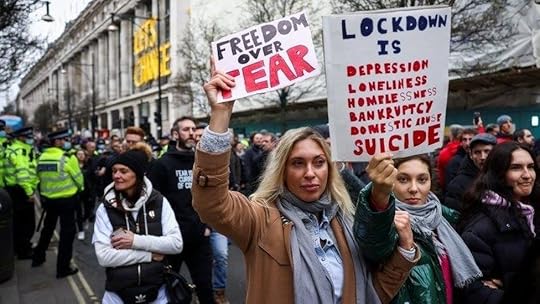
He argues, “America was uniquely hysterical in its disregard of actual data on schools and children, more off the rails than almost anywhere in the world.” (Pg. 36) He continues, “serious health harms to kids, who had no significant risk from illness itself, were being created by school closures… approximately 300,000 unreported child abuse cases from those spring closures alone… one in four young people… had contemplated suicide… a tripling of self-harm in teenagers requiring doctor visits… anxiety and depression…” (Pg. 38)
He was called to the White House: “The vice president … excitedly showed me a … chart documenting the increasing number of PCR tests administered by the day in the United States. ‘Congratulations!’ I replied, feigning excitement. But inside, I realized something far more significant was being revealed. The White House was looking at … rudimentary numbers without detail… without any concept of what really mattered… That was my first ‘OMG’ moment. This seemed like a naïve reaction to political criticism, rather than… a focused, well thought out plan on how to stop the destruction from the pandemic. I knew the country was really in deep trouble.” (Pg. 53)
He explains, “The main reason for my presence was to impact policy… After all, I was a health policy expert, not an epidemiologist or virologist… my role was to devise a set of policies that minimized the harms of the pandemic… To delegate policy to people solely concerned with stopping the infection, without any understanding of the destruction of the lockdowns, would have been reckless. But that’s exactly what happened.” (Pg. 70)
He contends, “The problem was that the president’s message---end the lockdown and use a focused protection of the high-risk---was directly contrary the to lockdown message of the Task Force. Allowing the national policy message to be contrary to the message of the president … was a gross error. It allowed the destructive lockdown policy to remain in place and presented a picture of a chaotic national leadership… Those who advised the president to allow that to continue did him and the nation a tremendous disservice.” (Pg. 72) He comments, “while I didn’t want to believe it, everything about the pandemic was political.” (Pg. 96)
He recounts, “Expressing his opinion about the Task Force members to CNN on September 27, 2020, Dr. Anthony Fauci remarked, ‘Most are working together. I think, you know, what the outlier is.’ I was proud to be the outlier in this group---and not just because I was totally right, while the ‘inliers’ were disastrously wrong. My personal character and background also make me an outlier, particularly among the Washington political class and academic elites.” (Pg. 101)
He admits, “No question, the Trump administration’s communications team was overwhelmed; so perhaps I should have anticipated that they would also be unprepared for my casual introduction to the media… I assumed the White House team understood that if I was delegitimized, then the president would be undermined as well… An all-out attempt to undermine my credibility was immediately underway, involving gross distortions, straw man arguments based on blatant misrepresentations of my views, and straight-out lies… The media … [was] engaging in propaganda tactics scarcely different from those used by regimes like the USSR or Communist China.” (Pg. 123-124)
He observes, “Contrary to the stated policy of the president, though, the Task Force members were continually pushing their own advice to the public … I often wondered why they wouldn’t simply tell the president to his face they disagreed with him and at least have the integrity to say if he wanted other policies, they would resign. Instead, they chose to stay and put forth mixed messages to the public… This schizophrenic messaging from the White House, I believe, represented one of the president’s most significant errors of judgment… He relied too much on his most trusted political advisors. I recognized that their intentions were to help him win the 2020 election; that was their job.” (Pg. 130-131)
At his first Task Force meeting, “I… went into a very simple explanation of the concept of herd immunity, since dozens of people were listening to this meeting… I explained that if a large enough percentage of people had antibodies, they block the pathway of the spread, thereby preventing the unprotected from getting infected.” (Pg. 145) He continues, “I went on to … make the case that we should not lock down everyone, since that was enormously harmful… How did I know this? I had done the research myself in collaboration with scholars from three other academic institutions. I had analyzed the data in detail… The others on the Task Force clearly had not. Everyone was basically frozen;’ tension filled the room… Once the meeting adjourned, I left the Situation Room without lingering. I naturally assumed no one else agreed with me… I felt a little dejected but also angry. There were ‘America’s best doctors’?... The truth is that I was the only doctor in the room who ever spoke about the health harms of the lockdowns…” (Pg. 146-148)
He recounts, “Headlines were … breathlessly quoting ‘several anonymous sources’ said to be in the room who claimed I was ‘advising that we should let the virus spread’ or ‘advocating a herd immunity strategy.’ Of course, I had never said anything like that, not even remotely advocating that the infection be allowed to spread…” (Pg. 156-157)
He notes, “As the traveling representative of the White House Coronavirus Task Force, Dr. Birx spoke about mandates and lockdowns, even when her statements directly conflicted with those of the president of the United States… It did not matter that her… restrictions… were not backed by sound science… When I asked [the VP’s chief of staff, and Trump’s Chief of Staff] how to handle questions about Birx’s discordant advice, there was one consistent reply from both: ‘We agree, Scott… but we don’t want to rock the boat.’ … I was frankly dumbstruck at the lack of leadership in the White House…” (Pg.187-189) He states, “To this day, I cannot understand why the human cost of the lockdowns never mattered to anyone else on the Task Force…” (Pg. 204)
He states, “the disconnect between the Oval Office and the rest of the White House had become severe. The president needed to understand… that some of the country’s leading experts disagreed with Dr. Birx’s recommendations… I had a gut feeling that, despite my warm welcome, academic expertise was not valued highly by this White House that prided itself on populism and distrust of technocratic elites.” (Pg. 209)
He argues in the book’s concluding Coda, ‘the most harmful distortion to the American public was … that I was advising the president to intentionally let the infection spread as a way to achieve ‘herd immunity.’” Nevertheless, he then approvingly reproduces ‘The Great Barrington Declaration,’ which clearly stated, “As immunity builds in the population, the risk of infection to all… falls. We know that all populations will eventually reach herd immunity… Our goal should therefore be to minimize mortality and social harm until we reach herd immunity.’” (Pg. 327-328)
‘Absolutely true?’ Given his vehement criticisms of BOTH the ‘orthodox’ Birx/Fauci perspective, as well as of the Trump White House, it would seem to be “either Dr. Atlas, or the world.”