

What do you think?

Ma nuit au musée
Comme un ciel en nous
Si l’on s’en tient aux faits, l’auteure passe la nuit du 7 au 8 mars 2020 au musée du Louvre, section des Antiques, salle des Cariatides, avec un sac en bandoulière dans lequel il y a, entre autres, une barre de nougat illicite.
Les faits, heureusement, ne sont rien dans ce livre personnel, original, traversé d’ombres nocturnes et de fantômes du passé, de glissades pieds nus sous la Vénus de Milo, ce livre joyeux et mélancolique, qui précise vite son intention : « Je suis venue ici cette nuit pour redevenir la fille de mon père. »
Quel père, en fait ? Celui, biologique, né en 1951 dans un village du Monténégro, alors une partie de la défunte Yougoslavie, qui vient à Paris par amour, par fuite, pour voir le Louvre, une ville dans la ville, un père qui ne sait pas bien parler le français et voit tout en noir et blanc. Celui, plus probable, le père exilé à qui l’on a dit que « sa fille ne parlera jamais français », l’esthète-pilleur qui se promène l’air de rien avec sa fille Jakuta au Louvre, et lui demande, lui transmet en héritage : « Et toi, comment t’y prendrais-tu pour voler la Joconde ? ». En effet : comment ?
Même si l’auteure exprime que « la honte vous rassemble bien mieux que le reste », il serait aisé, après la lecture, d’affirmer que l’amour, celui réciproque d’un père pour sa fille unique, vous rassemble et vous tient debout. Comme la Vénus de Milo, les siècles durant.
Les faits, heureusement, ne sont rien dans ce livre personnel, original, traversé d’ombres nocturnes et de fantômes du passé, de glissades pieds nus sous la Vénus de Milo, ce livre joyeux et mélancolique, qui précise vite son intention : « Je suis venue ici cette nuit pour redevenir la fille de mon père. »
Quel père, en fait ? Celui, biologique, né en 1951 dans un village du Monténégro, alors une partie de la défunte Yougoslavie, qui vient à Paris par amour, par fuite, pour voir le Louvre, une ville dans la ville, un père qui ne sait pas bien parler le français et voit tout en noir et blanc. Celui, plus probable, le père exilé à qui l’on a dit que « sa fille ne parlera jamais français », l’esthète-pilleur qui se promène l’air de rien avec sa fille Jakuta au Louvre, et lui demande, lui transmet en héritage : « Et toi, comment t’y prendrais-tu pour voler la Joconde ? ». En effet : comment ?
Même si l’auteure exprime que « la honte vous rassemble bien mieux que le reste », il serait aisé, après la lecture, d’affirmer que l’amour, celui réciproque d’un père pour sa fille unique, vous rassemble et vous tient debout. Comme la Vénus de Milo, les siècles durant.
160 pages, Paperback
First published September 1, 2021
About the author
Jakuta Alikavazovic
42 books19 followersJakuta Alikavazovic est née en 1979 à Paris. Lauréate de la Bourse « écrivain » de la Fondation Lagardère en 2007 et du prix Goncourt du premier roman en 2008, elle a publié aux éditions de l’Olivier Histoires contre nature (2006), Corps volatils (2007, Points 2010) et Le Londres-Louxor (2010, Points 2012).
Ratings & Reviews
Friends & Following
Create a free account to discover what your friends think of this book!
Community Reviews
Displaying 1 - 30 of 69 reviews

Read
October 14, 2024Sometimes the books I read don't need me to say anything about them apart from a brief note to help label them in my book memory. Several fictions I've read in the last few weeks fall into that category, and since I've been busy with real life lately, I have dealt with their reviews that way.
I've also read some non-fiction books recently and it would save me a lot of time if I could review them in the same brief fashion. But I can't. They refuse to be compressed into a two-line 'exhibit label' in my virtual book library. No, I have to work out my experience with them in words because when I become intensely involved with a book, I need to steal a bit of its essence and mold it into something of my own.
There's a sense that 'stealing an essence' is exactly what Jakuta Alikavazovic is doing in this very creative piece of non-fiction, but the essence she steals is an unusual one.
The title, Comme un ciel en nous translates as 'Like a sky inside us'. Alikavazovic explains that for her, the 'sky inside us' is love, in particular the love she feels for her father. Just as the sky is ever changing, that love is ever changing too.
As a child, her love for her father was her universe. As a teenager it became something she wanted to distance herself from, so much so that she left their home in Paris and went as far away as she could.
But now, as an adult, her love for her father is something she wants to examine up close, and the telescopic lens she chooses is this extended essay.
When she was a child, Alikavazovic's father (an immigrant from ex-Yugoslavia) didn't have a job, so he was the parent who minded her after school and during holiday time. His favourite place for them to hang out was the Louvre. Sometimes he'd teach her chess in the café, but most of the time they'd walk through the collections while he'd entertain her with stories about the various artworks. On one particular day, he said he had to make a phone call and told her to wait for him beside the statue of the Venus de Milo, a statue she was so familiar with it felt like part of her family. The eight-year old waited beside the statue for a long time. Eventually the place was nearly empty, and she wondered if she'd have to spend the night alone in the museum.
Her father returned eventually, and that might have been the end of that story. But instead it's the beginning of this very beautiful essay. In early 2020, Jakuta Alikavazovic, who was by then a prize-winning author, requested permission to spend a night in the Louvre as research for this piece of writing. Her request was granted and she turned up one cold March evening with her sleeping bag, and stayed on after everyone else left and the lights went out.
This essay is like a search for lost time, the opportunity to remember her father as he was in her childhood, and the close bond they shared while they roamed the Louvre. But it's also a chance to think about the things they didn't share: who he had been before he came to France aged twenty, fleeing an unstable regime; what his life was like in Paris when she wasn't with him; who or what his friends might have been. But especially to think about his preoccupation with stealing artworks. The essay is rhythmed around a question he used to ask her as they wandered the Louvre: Et toi, comment tu t’y prendrais, pour voler la Joconde ? (How would you set about stealing the Mona Lisa?).
It was a rhetorical question, of course, but Jakuta Alikavazovic finally answers it in this essay. She believes that the best way to steal an art work is to love it. To love it so much that it becomes part of yourself. And the artwork that she has absorbed into herself in that kind of intense way is not the Mona Lisa but the Venus de Milo.
Yes, it is beside the beloved statue that she chooses to place her sleeping bag the night she spends in the Louvre. She doesn't sleep much as you can imagine. How could anyone sleep surrounded by so much marble? And although it's dark, the whiteness of the statues shine through just as memories do when we close our eyes.
Before it's completely dark, she spots the figure of the Dancing Satyr whose partner Nymph is not in the Louvre but in the Metropolitan Museum in New York. It so happens that I'd visited the Met just before reading this book and I'd seen the Satyr's partner nymph—in yet another example of how my reading life seems to dance with my real life. A further parallel between this book and that visit to New York was when Jakuta Alikavazovic remembers back to the time she was in revolt against her father. She left Paris, the city he loved so much, and fled to the US, a place he thought of as the antithesis of the art world he was steeped in. While she was there, she denied she spoke French though he'd spent many years struggling to learn it. She also denied that she liked classical art and instead immersed herself in the type of art her father derided such as Performance Art and Land Art. And one afternoon in Washington Square in New York, she denied she could play chess.
Although those denials are heart-rending, I smiled when I read the line about chess, remembering the afternoon I'd spent in Washington Square watching the chess players—and wishing I could join them.
In fact I smiled a lot while reading this essay, and I've reread some of the lines so often that I feel I've absorbed them into myself. Yes, I've kind of stolen bits of it yet I'm also spreading the word about its existence, and so I'm adding something to it too.
That's a little similar to how Jakuta Alikavazovic describes the Venus de Milo: it's a subtraction and an addition at the same time. A subtraction from a block of marble but a fabulous addition to the art world.
And I bet you're wondering if Jakuta subtracted anything from the Louvre while she was there, alone like a thief in the darkness? Would you be surprised to hear that instead, she added something—though no one may ever find out what it is.
Whatever it may be that she secreted in the Louvre, it is certain that she has added a very fine essay to the world of literature.
……………
Soon after Jakuta Alikavazovic spent her night in the Louvre, the museum, and all the museums in the world, closed for a long time.
Who knows but perhaps the Dancing Satyr got a chance to invite the Venus de Milo for an extended waltz and the Nymph in the Metropolitan may have found a dancing partner too.
……………
If I mentioned Jakuta Alikavazovic's name very often in this review, it's because of a little aside in one of the chapters: a member of a Literature Prize jury once told her that the reason he didn't vote for her book was that he couldn't pronounce her name.
It's hard to be an immigrant. It's also hard to be the child of an immigrant.
I've also read some non-fiction books recently and it would save me a lot of time if I could review them in the same brief fashion. But I can't. They refuse to be compressed into a two-line 'exhibit label' in my virtual book library. No, I have to work out my experience with them in words because when I become intensely involved with a book, I need to steal a bit of its essence and mold it into something of my own.
There's a sense that 'stealing an essence' is exactly what Jakuta Alikavazovic is doing in this very creative piece of non-fiction, but the essence she steals is an unusual one.
The title, Comme un ciel en nous translates as 'Like a sky inside us'. Alikavazovic explains that for her, the 'sky inside us' is love, in particular the love she feels for her father. Just as the sky is ever changing, that love is ever changing too.
As a child, her love for her father was her universe. As a teenager it became something she wanted to distance herself from, so much so that she left their home in Paris and went as far away as she could.
But now, as an adult, her love for her father is something she wants to examine up close, and the telescopic lens she chooses is this extended essay.
When she was a child, Alikavazovic's father (an immigrant from ex-Yugoslavia) didn't have a job, so he was the parent who minded her after school and during holiday time. His favourite place for them to hang out was the Louvre. Sometimes he'd teach her chess in the café, but most of the time they'd walk through the collections while he'd entertain her with stories about the various artworks. On one particular day, he said he had to make a phone call and told her to wait for him beside the statue of the Venus de Milo, a statue she was so familiar with it felt like part of her family. The eight-year old waited beside the statue for a long time. Eventually the place was nearly empty, and she wondered if she'd have to spend the night alone in the museum.
Her father returned eventually, and that might have been the end of that story. But instead it's the beginning of this very beautiful essay. In early 2020, Jakuta Alikavazovic, who was by then a prize-winning author, requested permission to spend a night in the Louvre as research for this piece of writing. Her request was granted and she turned up one cold March evening with her sleeping bag, and stayed on after everyone else left and the lights went out.
This essay is like a search for lost time, the opportunity to remember her father as he was in her childhood, and the close bond they shared while they roamed the Louvre. But it's also a chance to think about the things they didn't share: who he had been before he came to France aged twenty, fleeing an unstable regime; what his life was like in Paris when she wasn't with him; who or what his friends might have been. But especially to think about his preoccupation with stealing artworks. The essay is rhythmed around a question he used to ask her as they wandered the Louvre: Et toi, comment tu t’y prendrais, pour voler la Joconde ? (How would you set about stealing the Mona Lisa?).
It was a rhetorical question, of course, but Jakuta Alikavazovic finally answers it in this essay. She believes that the best way to steal an art work is to love it. To love it so much that it becomes part of yourself. And the artwork that she has absorbed into herself in that kind of intense way is not the Mona Lisa but the Venus de Milo.
Yes, it is beside the beloved statue that she chooses to place her sleeping bag the night she spends in the Louvre. She doesn't sleep much as you can imagine. How could anyone sleep surrounded by so much marble? And although it's dark, the whiteness of the statues shine through just as memories do when we close our eyes.
Before it's completely dark, she spots the figure of the Dancing Satyr whose partner Nymph is not in the Louvre but in the Metropolitan Museum in New York. It so happens that I'd visited the Met just before reading this book and I'd seen the Satyr's partner nymph—in yet another example of how my reading life seems to dance with my real life. A further parallel between this book and that visit to New York was when Jakuta Alikavazovic remembers back to the time she was in revolt against her father. She left Paris, the city he loved so much, and fled to the US, a place he thought of as the antithesis of the art world he was steeped in. While she was there, she denied she spoke French though he'd spent many years struggling to learn it. She also denied that she liked classical art and instead immersed herself in the type of art her father derided such as Performance Art and Land Art. And one afternoon in Washington Square in New York, she denied she could play chess.
Although those denials are heart-rending, I smiled when I read the line about chess, remembering the afternoon I'd spent in Washington Square watching the chess players—and wishing I could join them.
In fact I smiled a lot while reading this essay, and I've reread some of the lines so often that I feel I've absorbed them into myself. Yes, I've kind of stolen bits of it yet I'm also spreading the word about its existence, and so I'm adding something to it too.
That's a little similar to how Jakuta Alikavazovic describes the Venus de Milo: it's a subtraction and an addition at the same time. A subtraction from a block of marble but a fabulous addition to the art world.
And I bet you're wondering if Jakuta subtracted anything from the Louvre while she was there, alone like a thief in the darkness? Would you be surprised to hear that instead, she added something—though no one may ever find out what it is.
Whatever it may be that she secreted in the Louvre, it is certain that she has added a very fine essay to the world of literature.
……………
Soon after Jakuta Alikavazovic spent her night in the Louvre, the museum, and all the museums in the world, closed for a long time.
Who knows but perhaps the Dancing Satyr got a chance to invite the Venus de Milo for an extended waltz and the Nymph in the Metropolitan may have found a dancing partner too.
……………
If I mentioned Jakuta Alikavazovic's name very often in this review, it's because of a little aside in one of the chapters: a member of a Literature Prize jury once told her that the reason he didn't vote for her book was that he couldn't pronounce her name.
It's hard to be an immigrant. It's also hard to be the child of an immigrant.
May 14, 2024
Michel Chaouli starts his recent book on poetic criticism from this definition:
I think it is a fantastic characterisation of the process. But also it is an elusive description of a work that triggers such a response. At least that is what I feel when I start to understand that I’ve read something very special. And then this last sentence, the feeling “I don’t know how” to tell about it starts to be overwhelming, at least for a time being.
This is where I am with this wonderful essay. I’ve read it in one sitting. And I need to spend more time thinking what is that special “something” here.
A shimmering constellation of ideas and themes? Taken apart, they might be not that unique though personal, poignant and profound. But how she weaved them together through language is unique. Also how she has created a situation, almost a performance in order to write it.
What makes a good essay? What is the difference between a personal essay and autofiction? Montaigne allegedly said “to write essays is to paint oneself.” Did he write autofiction? No. He wrote essays. And this is book is not a piece of autofiction- this is an essay! I know it. I feel it. But what is the difference?
Is art always an act of stealing?
I am going to think about all of those questions and more. I am going to try find out and possibly come back.
But for now I will leave you with the words by Kate Briggs, the ones that had attracted me to this book at the first place:
The first sentence of the total three has seduced me, not at least by its shape. Though I have to say I do not believe the writer wanted to her identity to be split into those easily definably categories of "daughter, mother, emigrant" etc. In my view, it trivialised a bit what she intended to create. I feel she would like to avoid those easily definable labels that classify us all into a set of boxes of predefined sizes easily understood. I felt this writer wanted to appear as complex human being in the complex world. However, whatever reservations I've got with Kate Briggs's praise, I do not regret a single bit I've been seduced into reading this book.
“Something speaks to me. I must tell you about it. But I don’t know how.”
I think it is a fantastic characterisation of the process. But also it is an elusive description of a work that triggers such a response. At least that is what I feel when I start to understand that I’ve read something very special. And then this last sentence, the feeling “I don’t know how” to tell about it starts to be overwhelming, at least for a time being.
This is where I am with this wonderful essay. I’ve read it in one sitting. And I need to spend more time thinking what is that special “something” here.
A shimmering constellation of ideas and themes? Taken apart, they might be not that unique though personal, poignant and profound. But how she weaved them together through language is unique. Also how she has created a situation, almost a performance in order to write it.
What makes a good essay? What is the difference between a personal essay and autofiction? Montaigne allegedly said “to write essays is to paint oneself.” Did he write autofiction? No. He wrote essays. And this is book is not a piece of autofiction- this is an essay! I know it. I feel it. But what is the difference?
Is art always an act of stealing?
I am going to think about all of those questions and more. I am going to try find out and possibly come back.
But for now I will leave you with the words by Kate Briggs, the ones that had attracted me to this book at the first place:
“Jakuta Alikavazovic charges her prose with tension and truth, offering the companionship of her generous, seeking mind while also daring to turn the light off- to leave us for brief moments alone in the dark - for the purpose of drawing closer to the absences structuring this extraordinary portrait of the writer as a daughter, as a mother, as a second generation emigrant, as a patient sifter of the most formative stories, her powers of transgression and self-preservation stashed in a shoulder bag. This book is deeply compelling, secret and surprising. I loved it.”
The first sentence of the total three has seduced me, not at least by its shape. Though I have to say I do not believe the writer wanted to her identity to be split into those easily definably categories of "daughter, mother, emigrant" etc. In my view, it trivialised a bit what she intended to create. I feel she would like to avoid those easily definable labels that classify us all into a set of boxes of predefined sizes easily understood. I felt this writer wanted to appear as complex human being in the complex world. However, whatever reservations I've got with Kate Briggs's praise, I do not regret a single bit I've been seduced into reading this book.

April 5, 2023
‘Como un cielo en nosotros’ es uno de los textos que más me ha gustado en años. De esos que mientras lo tienes entre las manos, habla de alguna forma a tu corazón y, cuando eso pasa, que son pocas veces, sabes que estás ante algo que jamás olvidarás y a lo que, sin duda, volverás. Y también, algo que sabes que no importa cuánto o cómo hables de él, no podrás hacerle justicia
En apenas 100 páginas, Jakuta Alikavazovic, se las apaña para hablar de toda una vida. A partir de la narración de una curiosa experiencia no exenta de un gran misterio, la noche que pasó en el museo Louvre del 7 al 8 de marzo de 2020 (esto es algo que puede hacerse, leed el libro para más info), presenta un conjunto de recuerdos en torno a la figura de su padre, alternados con reflexiones sobre lo que ve y siente allí, en la Sala de las Cariátides, cuando todo queda a oscuras.
Así, tenemos dos grandes escenarios. El primero, el museo Louvre, inseparable de mil y un curiosidades y pensamientos sobre el arte en general, su historia y también, sobre diferentes piezas en particular. Este museo que se convierte en detonante para la autora, que regresa allí para “volver a ser la hija de su padre”. El segundo escenario, y quizá el más importante, es la memoria. A través de la cual Jakuta invoca a su padre, un exiliado de la extinta Yugoslavia, un esteta, un rey de las apariencias, un enamorado de Paris, del arte y del Louvre. Una figura tan carismática que basta su recuerdo para fascinarnos. Un hombre a quien conocemos a través de pequeños detalles como cuando aprendió francés leyendo (“por eso, a pesar de su acento, hablaba como un libro”). Un padre que se pasó media vida preguntando a su hija “¿y tú cómo te las ingeniarías para robar La Gioconda?”. Una cuestión convertida en mantra que volverá a la Jakuta adulta, no solo hija, ya madre, esa noche en el Louvre de marzo de 2020.
Un libro que habla de tantas cosas, pero sobre todo (o así lo he sentido yo), de amor. “El amor de mi padre era un cielo dentro de mí, y su realidad, la viera o no, era tan evidente como el cielo que hay encima de mí”. Arropada por la oscuridad del museo, Jakuta se reencuentra con su yo niña y mira bajo un nuevo tamiz determinados recuerdos que toman ahora nuevos significados y, sobre todo, generan nuevas preguntas. ¿Quién era realmente su padre? ¿Llegó a conocerle realmente? ¿Era su padre dos personas? ¿Por qué estaba tan obsesionado con conseguir el plan perfecto para robar el cuadro más famoso del mundo?
Un libro de esos inclasificables, un ensayo literario, algo así como una biografía sin serlo, una muy buena anécdota, un recuerdo puesto sobre el papel, un ligero pero potente tratado de arte… en el fondo, ¿qué más da lo que sea? Es un texto-tesoro y con eso me quedo. Un texto que es imposible leer sin subrayar, sin buscar en internet, sin pensar, ¿cuándo voy a sacar un rato para volver a leerlo?
Una historia de no ficción pero que tiene todo lo bueno de una novela que creo que puede encantar a todo el mundo, pero si te gusta el arte, ¡irá directo a tus favoritos!
En apenas 100 páginas, Jakuta Alikavazovic, se las apaña para hablar de toda una vida. A partir de la narración de una curiosa experiencia no exenta de un gran misterio, la noche que pasó en el museo Louvre del 7 al 8 de marzo de 2020 (esto es algo que puede hacerse, leed el libro para más info), presenta un conjunto de recuerdos en torno a la figura de su padre, alternados con reflexiones sobre lo que ve y siente allí, en la Sala de las Cariátides, cuando todo queda a oscuras.
Así, tenemos dos grandes escenarios. El primero, el museo Louvre, inseparable de mil y un curiosidades y pensamientos sobre el arte en general, su historia y también, sobre diferentes piezas en particular. Este museo que se convierte en detonante para la autora, que regresa allí para “volver a ser la hija de su padre”. El segundo escenario, y quizá el más importante, es la memoria. A través de la cual Jakuta invoca a su padre, un exiliado de la extinta Yugoslavia, un esteta, un rey de las apariencias, un enamorado de Paris, del arte y del Louvre. Una figura tan carismática que basta su recuerdo para fascinarnos. Un hombre a quien conocemos a través de pequeños detalles como cuando aprendió francés leyendo (“por eso, a pesar de su acento, hablaba como un libro”). Un padre que se pasó media vida preguntando a su hija “¿y tú cómo te las ingeniarías para robar La Gioconda?”. Una cuestión convertida en mantra que volverá a la Jakuta adulta, no solo hija, ya madre, esa noche en el Louvre de marzo de 2020.
Un libro que habla de tantas cosas, pero sobre todo (o así lo he sentido yo), de amor. “El amor de mi padre era un cielo dentro de mí, y su realidad, la viera o no, era tan evidente como el cielo que hay encima de mí”. Arropada por la oscuridad del museo, Jakuta se reencuentra con su yo niña y mira bajo un nuevo tamiz determinados recuerdos que toman ahora nuevos significados y, sobre todo, generan nuevas preguntas. ¿Quién era realmente su padre? ¿Llegó a conocerle realmente? ¿Era su padre dos personas? ¿Por qué estaba tan obsesionado con conseguir el plan perfecto para robar el cuadro más famoso del mundo?
Un libro de esos inclasificables, un ensayo literario, algo así como una biografía sin serlo, una muy buena anécdota, un recuerdo puesto sobre el papel, un ligero pero potente tratado de arte… en el fondo, ¿qué más da lo que sea? Es un texto-tesoro y con eso me quedo. Un texto que es imposible leer sin subrayar, sin buscar en internet, sin pensar, ¿cuándo voy a sacar un rato para volver a leerlo?
Una historia de no ficción pero que tiene todo lo bueno de una novela que creo que puede encantar a todo el mundo, pero si te gusta el arte, ¡irá directo a tus favoritos!

February 13, 2025
At the midway point in this book's life, the author ended up in a dark forest of uncertainty about which way to send the work; and the protagonist, also the author, notices the lights in the Louvre switched off early.
From that point on there was much searching in the dark for a story; but many sentences were constructed as questions largely as a vehicle to keep more words on the page. The more words, since printing is in black, the darker it all got until sense was lost. There seemed to be no guide through this sculptured forest.
From that point on there was much searching in the dark for a story; but many sentences were constructed as questions largely as a vehicle to keep more words on the page. The more words, since printing is in black, the darker it all got until sense was lost. There seemed to be no guide through this sculptured forest.

November 29, 2025
What would you do if you would be allowed to spend a night at the Louvre?
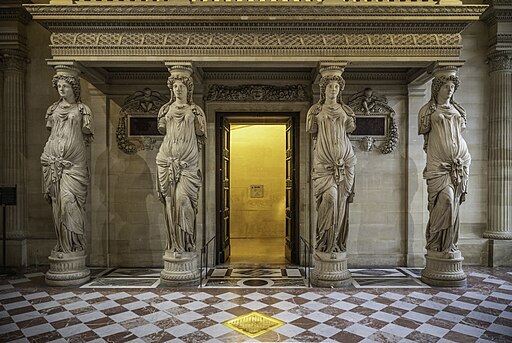
Salle des Cariatides in the Louvre (Via Wikimedia Commmons)
The guard gives her a telephone number to use in case of emergency, warning her:
Alikavazovic’s night becomes her captivating inner search for her father and her own identity: Does she, the daughter of an immigrant, feel at home in France? The ancient sculptures are immigrants too…
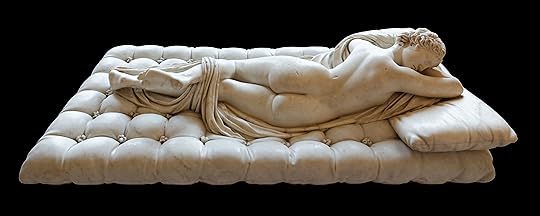
Apparently Jakuta Alikavazovic was not the only one sleeping at that part of the Louvre: The Sleeping Hermaphrodite (Via Wikimedia Commons)
I read this book on my way by train to Amsterdam, to visit the current Brancusi exhibition at the H’ART museum. Walking around the museum I kept thinking: How would it feel to spend the night here, in company of these sculptures? Synchronicity made sure I feel connected to Jakuta Alikavazovic: Brancusi has created his own Cariatide…
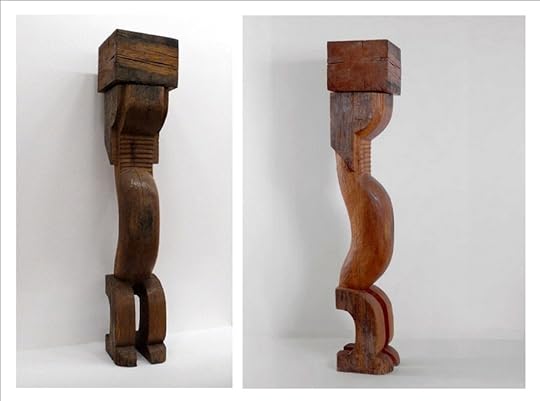
Constantin Brancusi’s Cariatide, 1914-1928 (Via art.moderne.utl13.fr)
I discovered this book thanks to my GR friend Fionnuala. After reading her beautiful review I thought I would like this book and I was right. An inspiring and enchanting essay.
Quotes
'Comment dort-on, au pied de la statue la plus célèbre du monde ?Jakuta Alikavazovic spends a night all alone at the department of Greek Antiquities at the Sully wing of the museum. Salle des Cariatides serves as her bedroom.
Bien ?
Mal?' p.88
Salle des Cariatides in the Louvre (Via Wikimedia Commmons)
The guard gives her a telephone number to use in case of emergency, warning her:
'On ne sait jamais. Vous allez voir. Les choses sont différentes, ici, la nuit.' p.28She walks around and lets her thoughts wander about life, art, the museum, the ancient sculptures around her and mostly about her Yugoslavian father. When she was a child her father took her often to visit the Louvre. He was fascinated by art and the French culture. Each time he posed her the question:
’Et toi, comment t'y prendrais-tu, pour voler la Joconde?'Was this just a game? This question is quite alarming when you read it now, just a few weeks after the French Crown Jewels were stolen from the Louvre.
Alikavazovic’s night becomes her captivating inner search for her father and her own identity: Does she, the daughter of an immigrant, feel at home in France? The ancient sculptures are immigrants too…
Apparently Jakuta Alikavazovic was not the only one sleeping at that part of the Louvre: The Sleeping Hermaphrodite (Via Wikimedia Commons)
I read this book on my way by train to Amsterdam, to visit the current Brancusi exhibition at the H’ART museum. Walking around the museum I kept thinking: How would it feel to spend the night here, in company of these sculptures? Synchronicity made sure I feel connected to Jakuta Alikavazovic: Brancusi has created his own Cariatide…
Constantin Brancusi’s Cariatide, 1914-1928 (Via art.moderne.utl13.fr)
I discovered this book thanks to my GR friend Fionnuala. After reading her beautiful review I thought I would like this book and I was right. An inspiring and enchanting essay.
Quotes
'Ou peut-être sentent-ils, ces lieux, que l'on n'a pas la conscience entièrement tranquille. Que l'on n'a pas le cœur entièrement tranquille.' p.9
'je suis la fille d'un homme qui, à chacune de mes visites au musée, me demandait combien j'avais vu d'animaux peints et de levers de soleil, combien j'avais vu de navires et de clairs de lune. Combien j'avais vu de fenêtres, combien d'escaliers. Combien de gardiens et de caméras. Et combien d'issues de secours? Et combien d'extincteurs ? Non, aucun d'entre eux ne savait que je suis la fille d'un homme qui, à chacune de nos visites, me demandait:
Et toi, comment t'y prendrais-tu, pour voler la Joconde?'p.12
'Mon secret, c'est que je suis venue ici, cette nuit, pour redevenir la fille de mon père.' p.29
'Mes cheveux sont la première partie de moi à toucher une sculpture.' p.32
'Oui, c'est ainsi que le lieu se débarrasse de l'électricité: comme on fait la poussière. Le grain de l'air change. On ne respire pas de la même manière. Ni moi, ni eux.
Eux: les lieux. Les œuvres.
Eux: les souvenirs.' p.40
'Je sais, comme savent les enfants, certaines choses de mon père, des choses qu'il ne m'a pas dites' p.96
'Je me promène, je les caresse encore un peu - ces statues qui sont des souvenirs en trois dimensions, sortis de l'obscurité des crânes et des cœurs: enfin, il est possible de voir, de toucher ce qu'un autre a vu, ce qu'un autre a compris et aimé d'une chose qui, elle, est à jamais perdue. C'est toute leur beauté, me semble-t-il aujourd'hui, d'être une mémoire extraite de la matière.' p.105

Read
January 9, 2025"I love Paris for its constant collision of secrets" (17).
"The history of art is a ghost story for grown-ups" (34).
"Nationalisms disgusted him. He just wanted to live in beauty" (56).
"What we call growing up is a series of betrayals" (77).
"If reality is a stylistic effect, perhaps the same is true of life?" (133).
"The history of art is a ghost story for grown-ups" (34).
"Nationalisms disgusted him. He just wanted to live in beauty" (56).
"What we call growing up is a series of betrayals" (77).
"If reality is a stylistic effect, perhaps the same is true of life?" (133).
February 19, 2025
Shortlisted for the 2025 Republic of Consciousness Prize for Small Presses, United States & Canada
august, 2026; reread
August 2026, Women-in-Translation Month(listed in order read)
1. We Were Forbidden, Jacqueline Harpman (tr. Ros Schwartz)
2. The Summer Book, Tove Jansson (tr. Thomas Teal)
3. The Weight of Things, Marianne Fritz (tr. Adrian Nathan West)
4. The Taiga Syndrome, Cristina Rivera Garza (tr. Suzanne Jill Levine & Aviva Kana) (RR)
5. The Iliac Crest, Cristina Rivera Garza (tr. Sarah Booker) (RR)
6. Like a Sky Inside, Jakuta Alikavazovic (tr. Daniel Levin Becker) (RR)
7. In Memory of Memory, Maria Stepanova (tr. Sasha Dugdale)
8. Drive Your Plow Over the Bones of the Dead, Olga Tokarczuk (tr. Antonia Lloyd-Jones)
[January to July: 53; August: +8]
february, 2025:
first to read from this longlist! &, WOW. immediately added two other books by Fern Books (the small press, based in Oakland & Paris) to my Want to Read, & my love gifted them to me. definitely a five-star for me, as auto-fiction (definitely some Ernaux / heavy french vibes), art, family, place, culture, recent immigration, even light, & much more are explored. so happy this was longlisted & to be introduced to this new-to-me with only three books published so far press.
[no spoilers below, but a few passages of many more that I heart so read further at your own risk!]
In the beginning, sometimes I left messages in the street.
Somebody is living in the Louvre, one of the messages would say.
—David Markson, Wittgenstein's Mistress
*
His own place where gradually, with great effort, he regained the ability to see colors, those colors that in French he lacked the words to name and that perhaps for that reason, he said, he struggled, physically struggled, to perceive. (23)
*
[…] I used the word charron, an obscure shade of blue, and the editor wanted to change it.
It's not that it doesn't exist, but nobody will understand it, she told me, and because I was young, because I was shy (and sensible, too, and ambitious, I acquiesced. She was wrong, though: my father would have understood. (24-5)
*
Of course he'd read it. Of course. Here are some of the words he circled:
lévitative lézardait fruitarien
I never used them again.
(25)
*
But we're not there yet. We're far from there. First we have to take photos. I hate photos. I hate having to freeze under someone else's gaze. I'm meant to be the one who looks.
This is one implication of having said yes when asked, upstairs, in front of the pyramid, if I was the writer: to say yes was to assert that I'm here to see, not to be seen. (31)
*
You never know. You'll see. Things are different here at night. (33)
*
I should, I suppose, begin with love. A feeling like a sky inside of us. And, like a sky, ever changing. Love and the shapes we try to give it. To conjure it. To hold it still. To hold it still is to betray it: it moves on, always. The feeling changes, or the shape it took for us. A body, a face, now aged. That tomorrow will no longer exist. Sometimes love lives on, alone. (49)
*
So much does he believe - he wouldn't use these words, I doubt he's familiar with the aphorism, I take it upon myself to translate certain of his expressions, certain of his looks, his silences, into comprehensible terms-so much does he believe that pour vivre heureux, vivons cachés: happiness comes to those who hide.
But how many ways are there to be your father's daughter? In spite of it all, I have lived on my own secrets. (57)
*
Let's go back even further, my father said. It's not even certain that the original purpose of what we call art was to be seen.
In a way, we could go so far as to say that art, what we call art, is made less to be seen than to be stolen. (60)
*
One day, in a fit of pique, I will answer, Yes I know the one about the Palladium, how the hell could I not. And he won't say anything, and neither will I, and we'll walk in silence.
How I regret that sentence today. How I'd love to hear him ask me the question again. I'd answer, No, I don't know the one about the Palladium. Remaining condemned to ignorance, eternally a child, now seems to me a rather small price to pay to stop time. To double back, to recover what can't be recovered. But this regret is an adult's regret: the proof, living inside of me, that we don't return, that we can't go backward.
And you, how would you go about stealing the Mona Lisa? (61)
*
This glassworker living in France at the time of the events in question will claim he kept the painting under his bed for two years. And I wonder how you sleep with the Mona Lisa under your bed. How you dream. (68)
*
So many questions. And you, how would you go about stealing the Mona Lisa? And how do you sleep, how do you dream, with the world's most famous portrait slipped beneath your bedframe? Well? Poorly? Or not at all?
So many questions that aren't the right ones: this is how it took me almost a quarter of a century to wonder what it really was that drove my father to ask me that exact question. Into what part of his life, his secret life, he was unknowingly-or perhaps knowingly-trying to initiate me. (71)
*
Few people know it, but the Venus de Milo has a secret compartment. At the heart of the world's most famous sculpture is not a dense stone or, per the cliché, the figure waiting to spring forth; at the heart of the most famous sculpture in the world is an empty space. Beneath the right breast, an enclosure, from which a restorer extracted, in 2009 or 2010, a piece of paper, rolled up tightly, on which was written, in pencil: Restored Aprils, 1936 by Libeau, Stonemason - Louvre.
If one day my father told me I'll be back and didn't come back, if one day I had to leave him a note because over my legs and over my shoulders and my face the light was rising, rising and then all of a sudden disappearing, it is there, without a doubt, that I would slip it. (75-6)
*
What we call growing up is a series of betrayals. (77)
*
And me, I loved, or thought I loved, complicated authors and complicated cocktails. (77)
*
Reflecting the sky was, to me, the most perfect, the most noble, the most exhilarating definition of art. And it was reflected, that American sky to which my father has never raised his eyes, in the twists and turns of Spiral Jetty, the work I took the bus to see that time I pretended not to speak French. (81)
*
But is that really what it was? Sometimes it takes years to understand the real reason behind a feeling, And for as long as you don't understand it, it exists, intact. time has no power over it; where this feeling lingers. it s like I'm twenty forever. Perhaps what really bothered me was that by stubboraly refusing to open my mouth. in front of that Greyhound bus, I had refused to take my place in the francophone community— a place that isn't guaranteed, that had to be conquered, familially and individually, conquered by circling, in pencil, words like
lévitative lézardait fruitarien
and so many others-and I turned away from all that, from the world my parents, my father, had worked so hard to join.
(82-3)
*
And you, how would you go about stealing the Mona Lisa?
Who cares about your Mona Lisa? The world is all fire and blood, you think I give a shit if she follows me with her eyes? This I longed to say to him.
(87)
*
Once you know the work by heart, once you know it better than the body you have loved most in the world, or better than your own body, which is sometimes(often) not the same body, then you destroy it.
The work now exists nowhere, really, but in your head.
Nowhere but in your heart.
You have pulled off the perfect theft. (90)
*
What do we talk about when we talk about art?
He thinks it over. Then answers: My skin.
(91)
*
if indeed one can choose to make one's home not in a country but in art, not in a nation but in beauty. In spite of which, in spite of it all, the question of belonging always, one day or another, catches up with us. (106)
_____
from the head judge, Lori Feathers:
In this evocative novella on memory and art, Alikavazovic's narrator is granted permission to spend the night alone inside the Louvre. Solitary amidst the artwork and her thoughts, she recalls her childhood and the many times she visited the museum with her father, an enigmatic immigrant from Montenegro. "He forged a refined French for himself and took meticulous care of it; in a way, I suppose, it was like wearing a handsome coat. So, despite his accent, he spoke like a book. Like the books I would later write. Or rather it's I who write the way he spoke, the way I believe he spoke." This charming father was obsessed not just with art, but also instances of its theft, something that his daughter finds difficult to understand.The night at the Louvre becomes the narrator's reckoning with her father's legacy and her relationship to her own art as a writer. A beautiful, heartfelt narrative.
about the press:
Fern Books is a small press unhurriedly dedicated to forms of writing, and ideas about publishing, that are thoughtful and generous and expansive. We're interested in literary risk-taking, adventures in form and content and authorship, and the connections and relationships fostered between books and their readers.
We aim to think out loud, as it were, about whose imaginations literary text can stir, what makes text literary in the first place, and what shapes besides bound printed matter it might take. As we work on answering these questions, we plan to publish books— among other things—that we believe make the world a more enchanting, welcoming, and sane place.
Based in Oakland & Paris.
august, 2026; reread
August 2026, Women-in-Translation Month(listed in order read)
1. We Were Forbidden, Jacqueline Harpman (tr. Ros Schwartz)
2. The Summer Book, Tove Jansson (tr. Thomas Teal)
3. The Weight of Things, Marianne Fritz (tr. Adrian Nathan West)
4. The Taiga Syndrome, Cristina Rivera Garza (tr. Suzanne Jill Levine & Aviva Kana) (RR)
5. The Iliac Crest, Cristina Rivera Garza (tr. Sarah Booker) (RR)
6. Like a Sky Inside, Jakuta Alikavazovic (tr. Daniel Levin Becker) (RR)
7. In Memory of Memory, Maria Stepanova (tr. Sasha Dugdale)
8. Drive Your Plow Over the Bones of the Dead, Olga Tokarczuk (tr. Antonia Lloyd-Jones)
[January to July: 53; August: +8]
february, 2025:
first to read from this longlist! &, WOW. immediately added two other books by Fern Books (the small press, based in Oakland & Paris) to my Want to Read, & my love gifted them to me. definitely a five-star for me, as auto-fiction (definitely some Ernaux / heavy french vibes), art, family, place, culture, recent immigration, even light, & much more are explored. so happy this was longlisted & to be introduced to this new-to-me with only three books published so far press.
[no spoilers below, but a few passages of many more that I heart so read further at your own risk!]
In the beginning, sometimes I left messages in the street.
Somebody is living in the Louvre, one of the messages would say.
—David Markson, Wittgenstein's Mistress
*
His own place where gradually, with great effort, he regained the ability to see colors, those colors that in French he lacked the words to name and that perhaps for that reason, he said, he struggled, physically struggled, to perceive. (23)
*
[…] I used the word charron, an obscure shade of blue, and the editor wanted to change it.
It's not that it doesn't exist, but nobody will understand it, she told me, and because I was young, because I was shy (and sensible, too, and ambitious, I acquiesced. She was wrong, though: my father would have understood. (24-5)
*
Of course he'd read it. Of course. Here are some of the words he circled:
lévitative lézardait fruitarien
I never used them again.
(25)
*
But we're not there yet. We're far from there. First we have to take photos. I hate photos. I hate having to freeze under someone else's gaze. I'm meant to be the one who looks.
This is one implication of having said yes when asked, upstairs, in front of the pyramid, if I was the writer: to say yes was to assert that I'm here to see, not to be seen. (31)
*
You never know. You'll see. Things are different here at night. (33)
*
I should, I suppose, begin with love. A feeling like a sky inside of us. And, like a sky, ever changing. Love and the shapes we try to give it. To conjure it. To hold it still. To hold it still is to betray it: it moves on, always. The feeling changes, or the shape it took for us. A body, a face, now aged. That tomorrow will no longer exist. Sometimes love lives on, alone. (49)
*
So much does he believe - he wouldn't use these words, I doubt he's familiar with the aphorism, I take it upon myself to translate certain of his expressions, certain of his looks, his silences, into comprehensible terms-so much does he believe that pour vivre heureux, vivons cachés: happiness comes to those who hide.
But how many ways are there to be your father's daughter? In spite of it all, I have lived on my own secrets. (57)
*
Let's go back even further, my father said. It's not even certain that the original purpose of what we call art was to be seen.
In a way, we could go so far as to say that art, what we call art, is made less to be seen than to be stolen. (60)
*
One day, in a fit of pique, I will answer, Yes I know the one about the Palladium, how the hell could I not. And he won't say anything, and neither will I, and we'll walk in silence.
How I regret that sentence today. How I'd love to hear him ask me the question again. I'd answer, No, I don't know the one about the Palladium. Remaining condemned to ignorance, eternally a child, now seems to me a rather small price to pay to stop time. To double back, to recover what can't be recovered. But this regret is an adult's regret: the proof, living inside of me, that we don't return, that we can't go backward.
And you, how would you go about stealing the Mona Lisa? (61)
*
This glassworker living in France at the time of the events in question will claim he kept the painting under his bed for two years. And I wonder how you sleep with the Mona Lisa under your bed. How you dream. (68)
*
So many questions. And you, how would you go about stealing the Mona Lisa? And how do you sleep, how do you dream, with the world's most famous portrait slipped beneath your bedframe? Well? Poorly? Or not at all?
So many questions that aren't the right ones: this is how it took me almost a quarter of a century to wonder what it really was that drove my father to ask me that exact question. Into what part of his life, his secret life, he was unknowingly-or perhaps knowingly-trying to initiate me. (71)
*
Few people know it, but the Venus de Milo has a secret compartment. At the heart of the world's most famous sculpture is not a dense stone or, per the cliché, the figure waiting to spring forth; at the heart of the most famous sculpture in the world is an empty space. Beneath the right breast, an enclosure, from which a restorer extracted, in 2009 or 2010, a piece of paper, rolled up tightly, on which was written, in pencil: Restored Aprils, 1936 by Libeau, Stonemason - Louvre.
If one day my father told me I'll be back and didn't come back, if one day I had to leave him a note because over my legs and over my shoulders and my face the light was rising, rising and then all of a sudden disappearing, it is there, without a doubt, that I would slip it. (75-6)
*
What we call growing up is a series of betrayals. (77)
*
And me, I loved, or thought I loved, complicated authors and complicated cocktails. (77)
*
Reflecting the sky was, to me, the most perfect, the most noble, the most exhilarating definition of art. And it was reflected, that American sky to which my father has never raised his eyes, in the twists and turns of Spiral Jetty, the work I took the bus to see that time I pretended not to speak French. (81)
*
But is that really what it was? Sometimes it takes years to understand the real reason behind a feeling, And for as long as you don't understand it, it exists, intact. time has no power over it; where this feeling lingers. it s like I'm twenty forever. Perhaps what really bothered me was that by stubboraly refusing to open my mouth. in front of that Greyhound bus, I had refused to take my place in the francophone community— a place that isn't guaranteed, that had to be conquered, familially and individually, conquered by circling, in pencil, words like
lévitative lézardait fruitarien
and so many others-and I turned away from all that, from the world my parents, my father, had worked so hard to join.
(82-3)
*
And you, how would you go about stealing the Mona Lisa?
Who cares about your Mona Lisa? The world is all fire and blood, you think I give a shit if she follows me with her eyes? This I longed to say to him.
(87)
*
Once you know the work by heart, once you know it better than the body you have loved most in the world, or better than your own body, which is sometimes(often) not the same body, then you destroy it.
The work now exists nowhere, really, but in your head.
Nowhere but in your heart.
You have pulled off the perfect theft. (90)
*
What do we talk about when we talk about art?
He thinks it over. Then answers: My skin.
(91)
*
if indeed one can choose to make one's home not in a country but in art, not in a nation but in beauty. In spite of which, in spite of it all, the question of belonging always, one day or another, catches up with us. (106)
_____
from the head judge, Lori Feathers:
In this evocative novella on memory and art, Alikavazovic's narrator is granted permission to spend the night alone inside the Louvre. Solitary amidst the artwork and her thoughts, she recalls her childhood and the many times she visited the museum with her father, an enigmatic immigrant from Montenegro. "He forged a refined French for himself and took meticulous care of it; in a way, I suppose, it was like wearing a handsome coat. So, despite his accent, he spoke like a book. Like the books I would later write. Or rather it's I who write the way he spoke, the way I believe he spoke." This charming father was obsessed not just with art, but also instances of its theft, something that his daughter finds difficult to understand.The night at the Louvre becomes the narrator's reckoning with her father's legacy and her relationship to her own art as a writer. A beautiful, heartfelt narrative.
about the press:
Fern Books is a small press unhurriedly dedicated to forms of writing, and ideas about publishing, that are thoughtful and generous and expansive. We're interested in literary risk-taking, adventures in form and content and authorship, and the connections and relationships fostered between books and their readers.
We aim to think out loud, as it were, about whose imaginations literary text can stir, what makes text literary in the first place, and what shapes besides bound printed matter it might take. As we work on answering these questions, we plan to publish books— among other things—that we believe make the world a more enchanting, welcoming, and sane place.
Based in Oakland & Paris.

March 17, 2025
A meditative novel (essay?) about love and relationships. Our relationships with our fathers, with our personal histories, with art and the history of art. Jakuta ponders all of these topics during a night spent in the Louvre. For those of us not well versed in art history, we also get the added bonus of learning about some of the famous pieces in the museum, particularly the Venus de Milo. A powerful little book that I find myself thinking about quite a bit. Well written and well deserving of being shortlisted for the RoC US/Canada prize. Solid four stars.

February 1, 2025
Shortlisted for the 2024 Republic of Consciousness Prize, United States and Canada
At the time neither the security personnel nor the curator, nor even my editor, who supported me at every stage, championed my plan and my methods, knew this: I am the daughter of a man who, each time I visited the museum, asked me how many painted animals and sunrises I had seen, how many boats and moonlit nights. How many windows I’d seen, how many stairs. How many security guards and cameras. And how many emergency exits? And how many fire extinguishers? No, none of them knew that I am the daughter of a man who, each time we visited, asked me:
And you, how would you go about stealing the Mona Lisa?
Like a Sky Inside (2024) is translated by Daniel Levin Becker from Comme un ciel en nous (2021) by Jakuta Alikavazovic, and is published by Fern Books. The original won the 2021 Prix Médicis essai for non-fiction.
The novel, although perhaps a novel without fiction, opens (from a longer extract here)
From March 7 to 8, 2020, I spent the night in the Louvre, alone. Alone and at the same time anything but.
In the antiquities section. In the Salle des Cariatides, though I was compelled during the night to move my cot. Because places have souls; places have lives, especially in the dark; and it is sometimes the case that the places most visited, most paced and strolled in, can, once empty, unfurl and exact their own kind of revenge, chasing away those presumptuous enough to linger.
Or maybe they sense, these places do, when one’s conscience is not altogether at peace. When one’s heart is not altogether at peace.
This was part of a series of such museum stays by authors, as part of Alina Gurdiel’s Ma nuit au musée (see below). The date of the stay is also striking - a week to the day before the Covid lockdown in Paris, with events outside moving more swiftly that people's perception of risk (We won’t know, neither of us, that in a week the world as we know it will no longer exist.)
For Jakuta Alikavazovic, a Frenchwoman whose parents emigrated to France from Bosnian and Montenegrin, the choice of museum had a particular resonance. Her father (I'm going to treat the narrator as the author) came to Paris in 1971, aged 20, to escape military service, and when his daughter was born (in 1979) in lieu of a legacy, introduced her instead to art via his beloved Louvre.
What do you pass down to your daughter, your only daughter, when you've turned your back on your past? When you've managed, or believe you've managed, to reinvent yourself in another country, another language?
My father took me to the Louvre. The history of art is a ghost story for grown-ups, he would tell me. The history of art is what he passed down to me in place of his own history, erased and redrawn skillfully, over time. For time is his art, and time works in his favor, by the distance it extends from the moment of origin with each passing year, years beneath which I have learned to discern, sometimes, here and there, a pentimento: a shape that can still be made out underneath the one the artist preferred, choosing, repenting, to make visible instead.
Her father seems to have had a particular fascinating with art theft. As per the opening quote, one of the observational games he played with her in the museum was to ask her to work out how she might steal the Mona Lisa.
And the novel covers thefts from the theft of the Palladium from Troy in ancient Greek antiquity to the Isabella Stewart Gardner Museum theft in 1990. And in an intriguing passage, she mentions that someone told her her father was at one stage a suspect in the 2010 theft from the Musée d'Art Moderne de Paris, although she comments this could simply be a simplistic case of assumed connection, the person ultimately convincted being a Frenchman of Bosnian origin Vjeran Tomic.
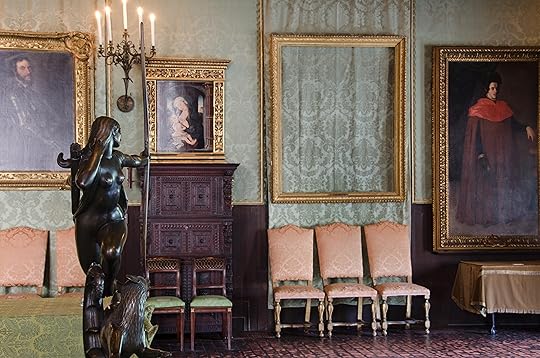
The empty frames still on display at the Isabella Stewart Gardner Museum
Her own taste in art, in something of a rejection of her father's more classical taste, tends to large-scale modern land art, including Spiral Jetty by Robert Smithson, and Vertical Earth Kilometer and The Lightning Field by Walter De Maria, all managed by the Dia Art Foundation.
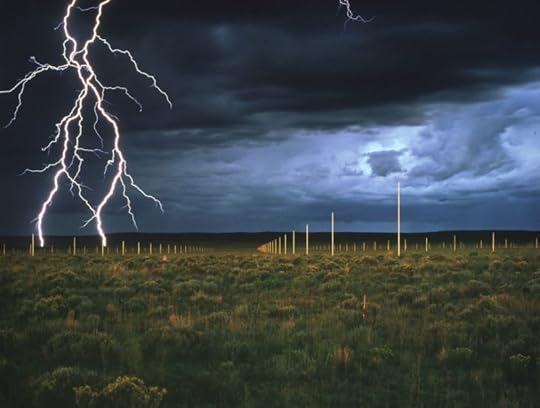
Picture of the The Lightning Field being struck by lightning
although it is on a trip to see Smithson's work than an incident makes her mentally reconnect with her father.
There is also some fascinating ekphrastic commentary on the role of light in art, and how the works in the Louvre are not designed for our modern age, also drawing on Tanizaki's In Praise of Shadows .
Where the novel was less successful for me was the more autobiographical passages that link to the author's life and writing, with which I'm less familiar; and also an teasing device she uses, a literary McGuffin, of an illicit object she took into the Louvre and means to leave behind. Indeed the actual experience itself, of staying the night in the museum, felt relatively peripheral.
Nevertheless, a well-crafted and fascinating book, one that I suspect exceeded the expectations of the curators of the Ma nuit au musée project.
And a final random but intriguing, to me, point. Like many non-English authors, Alikavazovic is also a translator. One of the novel's she has translated into French is Anna Burns' brilliant Booker winning Milkman. That novel has a famous scene - which inspired the cover artwork - where the narrator is at am adult education French class, and the teacher reads a passage describing the sky, only for the class to protest that the passage does not describe the sky as blue. The teacher, to counter their point, and as it is close to sunset, asks them to look at the sky outside...
3.5 stars.
The publisher
Fern Books is a small press unhurriedly dedicated to forms of writing, and ideas about publishing, that are thoughtful and generous and expansive. We’re interested in literary risk-taking, adventures in form and content and authorship, and the connections and relationships fostered between books and their readers. We aim to think out loud, as it were, about whose imaginations literary text can stir, what makes text literary in the first place, and what shapes besides bound printed matter it might take. As we work on answering these questions, we plan to publish books—among other things—that we believe make the world a more enchanting, welcoming, and sane place.
Initial view from one of the judges
Head judge Lori Feathers says this about Like a Sky Inside by Jakuta Alikavazovic (translated by Daniel Levin Becker) from Fern Books:
In this evocative novella on memory and art, Alikavazovic's narrator is granted permission to spend the night alone inside the Louvre. Solitary amidst the artwork and her thoughts, she recalls her childhood and the many times she visited the museum with her father, an enigmatic immigrant from Montenegro. "He forged a refined French for himself and took meticulous care of it; in a way, I suppose, it was like wearing a handsome coat. So, despite his accent, he spoke like a book. Like the books I would later write. Or rather it's I who write the way he spoke, the way I believe he spoke." This charming father was obsessed not just with art, but also instances of its theft, something that his daughter finds difficult to understand.The night at the Louvre becomes the narrator's reckoning with her father's legacy and her relationship to her own art as a writer. A beautiful, heartfelt narrative.
Ma nuit au musée
ChatGPT translation: Locked alone in the museum of their choice for the night with only a camp bed, the writer must, at the end of this unique experience, compose a text inspired by the night’s events. Fiction, non-fiction, essay… A blank slate is offered to those who take on the challenge. The collection is not bound to any literary genre, nor is the resulting piece intended to follow the conventions of an art book. On the contrary, the writer is invited to explore the solitude sparked by this night of confinement. Cut off from the world, with only the artworks as intermediaries, they naturally enter into a dialogue with the pieces and the meanings or stories they convey. But above all, it is an introspective conversation—one that unfolds in the quiet depths of the night.
Authors who have participated include: Kamel Daoud, Éric Chevillard, Leïla Slimani, Ananda Devi and many others.
At the time neither the security personnel nor the curator, nor even my editor, who supported me at every stage, championed my plan and my methods, knew this: I am the daughter of a man who, each time I visited the museum, asked me how many painted animals and sunrises I had seen, how many boats and moonlit nights. How many windows I’d seen, how many stairs. How many security guards and cameras. And how many emergency exits? And how many fire extinguishers? No, none of them knew that I am the daughter of a man who, each time we visited, asked me:
And you, how would you go about stealing the Mona Lisa?
Like a Sky Inside (2024) is translated by Daniel Levin Becker from Comme un ciel en nous (2021) by Jakuta Alikavazovic, and is published by Fern Books. The original won the 2021 Prix Médicis essai for non-fiction.
The novel, although perhaps a novel without fiction, opens (from a longer extract here)
From March 7 to 8, 2020, I spent the night in the Louvre, alone. Alone and at the same time anything but.
In the antiquities section. In the Salle des Cariatides, though I was compelled during the night to move my cot. Because places have souls; places have lives, especially in the dark; and it is sometimes the case that the places most visited, most paced and strolled in, can, once empty, unfurl and exact their own kind of revenge, chasing away those presumptuous enough to linger.
Or maybe they sense, these places do, when one’s conscience is not altogether at peace. When one’s heart is not altogether at peace.
This was part of a series of such museum stays by authors, as part of Alina Gurdiel’s Ma nuit au musée (see below). The date of the stay is also striking - a week to the day before the Covid lockdown in Paris, with events outside moving more swiftly that people's perception of risk (We won’t know, neither of us, that in a week the world as we know it will no longer exist.)
For Jakuta Alikavazovic, a Frenchwoman whose parents emigrated to France from Bosnian and Montenegrin, the choice of museum had a particular resonance. Her father (I'm going to treat the narrator as the author) came to Paris in 1971, aged 20, to escape military service, and when his daughter was born (in 1979) in lieu of a legacy, introduced her instead to art via his beloved Louvre.
What do you pass down to your daughter, your only daughter, when you've turned your back on your past? When you've managed, or believe you've managed, to reinvent yourself in another country, another language?
My father took me to the Louvre. The history of art is a ghost story for grown-ups, he would tell me. The history of art is what he passed down to me in place of his own history, erased and redrawn skillfully, over time. For time is his art, and time works in his favor, by the distance it extends from the moment of origin with each passing year, years beneath which I have learned to discern, sometimes, here and there, a pentimento: a shape that can still be made out underneath the one the artist preferred, choosing, repenting, to make visible instead.
Her father seems to have had a particular fascinating with art theft. As per the opening quote, one of the observational games he played with her in the museum was to ask her to work out how she might steal the Mona Lisa.
And the novel covers thefts from the theft of the Palladium from Troy in ancient Greek antiquity to the Isabella Stewart Gardner Museum theft in 1990. And in an intriguing passage, she mentions that someone told her her father was at one stage a suspect in the 2010 theft from the Musée d'Art Moderne de Paris, although she comments this could simply be a simplistic case of assumed connection, the person ultimately convincted being a Frenchman of Bosnian origin Vjeran Tomic.
The empty frames still on display at the Isabella Stewart Gardner Museum
Her own taste in art, in something of a rejection of her father's more classical taste, tends to large-scale modern land art, including Spiral Jetty by Robert Smithson, and Vertical Earth Kilometer and The Lightning Field by Walter De Maria, all managed by the Dia Art Foundation.
Picture of the The Lightning Field being struck by lightning
although it is on a trip to see Smithson's work than an incident makes her mentally reconnect with her father.
There is also some fascinating ekphrastic commentary on the role of light in art, and how the works in the Louvre are not designed for our modern age, also drawing on Tanizaki's In Praise of Shadows .
Where the novel was less successful for me was the more autobiographical passages that link to the author's life and writing, with which I'm less familiar; and also an teasing device she uses, a literary McGuffin, of an illicit object she took into the Louvre and means to leave behind. Indeed the actual experience itself, of staying the night in the museum, felt relatively peripheral.
Nevertheless, a well-crafted and fascinating book, one that I suspect exceeded the expectations of the curators of the Ma nuit au musée project.
And a final random but intriguing, to me, point. Like many non-English authors, Alikavazovic is also a translator. One of the novel's she has translated into French is Anna Burns' brilliant Booker winning Milkman. That novel has a famous scene - which inspired the cover artwork - where the narrator is at am adult education French class, and the teacher reads a passage describing the sky, only for the class to protest that the passage does not describe the sky as blue. The teacher, to counter their point, and as it is close to sunset, asks them to look at the sky outside...
3.5 stars.
The publisher
Fern Books is a small press unhurriedly dedicated to forms of writing, and ideas about publishing, that are thoughtful and generous and expansive. We’re interested in literary risk-taking, adventures in form and content and authorship, and the connections and relationships fostered between books and their readers. We aim to think out loud, as it were, about whose imaginations literary text can stir, what makes text literary in the first place, and what shapes besides bound printed matter it might take. As we work on answering these questions, we plan to publish books—among other things—that we believe make the world a more enchanting, welcoming, and sane place.
Initial view from one of the judges
Head judge Lori Feathers says this about Like a Sky Inside by Jakuta Alikavazovic (translated by Daniel Levin Becker) from Fern Books:
In this evocative novella on memory and art, Alikavazovic's narrator is granted permission to spend the night alone inside the Louvre. Solitary amidst the artwork and her thoughts, she recalls her childhood and the many times she visited the museum with her father, an enigmatic immigrant from Montenegro. "He forged a refined French for himself and took meticulous care of it; in a way, I suppose, it was like wearing a handsome coat. So, despite his accent, he spoke like a book. Like the books I would later write. Or rather it's I who write the way he spoke, the way I believe he spoke." This charming father was obsessed not just with art, but also instances of its theft, something that his daughter finds difficult to understand.The night at the Louvre becomes the narrator's reckoning with her father's legacy and her relationship to her own art as a writer. A beautiful, heartfelt narrative.
Ma nuit au musée
ChatGPT translation: Locked alone in the museum of their choice for the night with only a camp bed, the writer must, at the end of this unique experience, compose a text inspired by the night’s events. Fiction, non-fiction, essay… A blank slate is offered to those who take on the challenge. The collection is not bound to any literary genre, nor is the resulting piece intended to follow the conventions of an art book. On the contrary, the writer is invited to explore the solitude sparked by this night of confinement. Cut off from the world, with only the artworks as intermediaries, they naturally enter into a dialogue with the pieces and the meanings or stories they convey. But above all, it is an introspective conversation—one that unfolds in the quiet depths of the night.
Authors who have participated include: Kamel Daoud, Éric Chevillard, Leïla Slimani, Ananda Devi and many others.

June 26, 2026
A charming book that in short form explores several issues: the immigrant experience, the place of art in museums, the "gaze", the writing experience, a father-daughter relationship, and the writing process.
as a young girl, the narrator, became aware of her father's allure of Paris and the Louvre which he considered a city within the city of light. He as a 20 year old, fleeing the draft in Yugoslavia, though poor he made sure he had an elegant overcoat, "if you look poor too, you're screwed...a good real estate investment, my father thought, was a handsome coat. A coat to live in, to live intensely." Reading this passage, I was easily reminded of Gogol's mid-level clerk who drove himself into poverty and madness in the great short story, The Overcoat.
The narrator's father was specifically enamored with the Mona Lisa that hung there; he would play a game with her in which he would ask, "and you, how would you go about stealing the Mona Lisa?"
Now, as a writer, she talks herself into an assignment in which the museum allows her to spend the night there walking the galleries and bedding down for the night. This unusual setting frames much of the story that plays out. Inevitably she explores her own history and the role art plays in all our lives. She elicits specific examples like musing about Walter de Maria's, Spiral Journey, a gigantic art earthwork: "you can stand on it but you can't take it in all at once. In this way it's like life, like your life, elusive at the moment it's experienced, already past once it allows itself to be captured."
As she ponders what was first experienced as his innocent question about stealing the Mona Lisa she starts to question whether he might have been involved in another museum heist in which a band of Slavic thieves stole some art pieces from another museum. She also ponders that "once you know it [a work of art] by heart...the work now exists nowhere, really, but n your head. Nowhere but in your heart. You've pulled off the perfect heist."
Thinking of her family's own history escaping the war in Yugoslavia: "what do we talk about when we talk about art? Conservation. Permanence. A vow of eternity...eternally cared for, eternally cherished, once it is recognized as such." Yet in the face of war when people's lives are finite by death and destruction the worshipping of art "strikes me as obscene."
This is a book that certainly resonated in me the awe I often experience when in a museum or in the Rose Reading Room at the 42nd Street New York Public Library. The austere majesty of being in the presence of the creative arts is often inspiring allowing oneself to soar in one's own mind. As in Jakuta Alikavazovic's gem, Like A Sky Inside, imagining spending a quiet night in solitude there feels almost holy.
as a young girl, the narrator, became aware of her father's allure of Paris and the Louvre which he considered a city within the city of light. He as a 20 year old, fleeing the draft in Yugoslavia, though poor he made sure he had an elegant overcoat, "if you look poor too, you're screwed...a good real estate investment, my father thought, was a handsome coat. A coat to live in, to live intensely." Reading this passage, I was easily reminded of Gogol's mid-level clerk who drove himself into poverty and madness in the great short story, The Overcoat.
The narrator's father was specifically enamored with the Mona Lisa that hung there; he would play a game with her in which he would ask, "and you, how would you go about stealing the Mona Lisa?"
Now, as a writer, she talks herself into an assignment in which the museum allows her to spend the night there walking the galleries and bedding down for the night. This unusual setting frames much of the story that plays out. Inevitably she explores her own history and the role art plays in all our lives. She elicits specific examples like musing about Walter de Maria's, Spiral Journey, a gigantic art earthwork: "you can stand on it but you can't take it in all at once. In this way it's like life, like your life, elusive at the moment it's experienced, already past once it allows itself to be captured."
As she ponders what was first experienced as his innocent question about stealing the Mona Lisa she starts to question whether he might have been involved in another museum heist in which a band of Slavic thieves stole some art pieces from another museum. She also ponders that "once you know it [a work of art] by heart...the work now exists nowhere, really, but n your head. Nowhere but in your heart. You've pulled off the perfect heist."
Thinking of her family's own history escaping the war in Yugoslavia: "what do we talk about when we talk about art? Conservation. Permanence. A vow of eternity...eternally cared for, eternally cherished, once it is recognized as such." Yet in the face of war when people's lives are finite by death and destruction the worshipping of art "strikes me as obscene."
This is a book that certainly resonated in me the awe I often experience when in a museum or in the Rose Reading Room at the 42nd Street New York Public Library. The austere majesty of being in the presence of the creative arts is often inspiring allowing oneself to soar in one's own mind. As in Jakuta Alikavazovic's gem, Like A Sky Inside, imagining spending a quiet night in solitude there feels almost holy.

August 24, 2023
30 Books in 30 Days / Book #24
WiT 2023 / Book #7
Not quite my cup of tea, unfortunately.
2.5*
WiT 2023 / Book #7
Not quite my cup of tea, unfortunately.
2.5*

January 22, 2025
A writer, by some sort of permission, is set to spend the night at Louvre among paintings and sculptures, in the vicinity of Mona Lisa and Venus of Milo. This being Paris, the permission is granted, the night is spent.
Apart from this peculiar incident, nothing much is going on. The writer is alone with her thoughts and memories. Some are memories of her mother, who gained access to Moscow Library by presenting a small replica of Venus of Milo, many of her father, who came to Paris in his twenties from Montenegro, giving up his language.
The prose is elegant and clear and some of the sentences carry weight. These two are my favorites: 1. History of art is ghost-stories for grown-ups; 2. Reality is when you bump into things.
A 130-page essay that's not likely to alter the course of history. Even though, I liked it.
Apart from this peculiar incident, nothing much is going on. The writer is alone with her thoughts and memories. Some are memories of her mother, who gained access to Moscow Library by presenting a small replica of Venus of Milo, many of her father, who came to Paris in his twenties from Montenegro, giving up his language.
The prose is elegant and clear and some of the sentences carry weight. These two are my favorites: 1. History of art is ghost-stories for grown-ups; 2. Reality is when you bump into things.
A 130-page essay that's not likely to alter the course of history. Even though, I liked it.

May 7, 2024
This was great!!

December 29, 2024
When I was nearing the end the first time, I couldn’t bear the thought: I didn’t want the book to be over. So I started from the beginning and reread it. Finally I finished and what can I say? it’s one of my favorite books this year.
“The darkness changes everything. It’s electricity that keeps the statues in place. It’s electricity that makes the walls and floors motionless. But this place [the Louvre] and these artworks preceded electricity, and may yet outlast it. The Salle de Cariatides, the antiques department, the marbles and the travertine, the Hermes and the Venuses—spaces and works seem discreetly to bristle, yes, as though casting off the artificial light in which they were bathed all day—they cast it off like a bird might shake as it leaves a fountain—they cast it off as one might abandon a shawl, letting it slip with a shrug of the shoulders, with a sigh: as one might do the dusting. Yes, this is how the place rids itself of electricity: as we dust. The grain of the air changes. We don’t breathe in the same way. Not me, not them.
Them: the place and the artworks.
Them: memories.”
“The darkness changes everything. It’s electricity that keeps the statues in place. It’s electricity that makes the walls and floors motionless. But this place [the Louvre] and these artworks preceded electricity, and may yet outlast it. The Salle de Cariatides, the antiques department, the marbles and the travertine, the Hermes and the Venuses—spaces and works seem discreetly to bristle, yes, as though casting off the artificial light in which they were bathed all day—they cast it off like a bird might shake as it leaves a fountain—they cast it off as one might abandon a shawl, letting it slip with a shrug of the shoulders, with a sigh: as one might do the dusting. Yes, this is how the place rids itself of electricity: as we dust. The grain of the air changes. We don’t breathe in the same way. Not me, not them.
Them: the place and the artworks.
Them: memories.”

May 19, 2023
Es un libro bellamente escrito, pero no he sido capaz de entrar en su voz narradora ni que me despierte interés. Problema mío, sin duda.

June 17, 2024
«Vemos algo que nos gusta y lo tomamos. Lo tomamos porque lo que nos gustaría atrapar es el instante completo y conservarlo para siempre, bebernos el cielo, incorporarnos al paisaje, pero eso es imposible. El tiempo transcurrirá pase lo que pase y ese lugar seguirá estando fuera de nosotros.»
Este íntimo y precioso libro parte de la misma premisa que 'El perfume de las flores de noche', de Leila Slimani, y es la de pasar una noche entre las paredes de un museo para escribir.
En este caso, en el museo del Louvre, sobre la identidad, la emigración y la figura del padre, de una forma profundamente íntima y personal, como si la autora, a través de las esculturas y pinturas que ve, se trasladara a su infancia, a la niña que fue, para ir desgranando cada detalle que no comprendió en su momento.
Y así, vamos conociendo a su padre desde los ojos de su hija, de la niña que fue a la mujer (y madre, también) en la que se ha convertido. Pero no solo sus defectos, virtudes, miedos y sueños; también cómo y por qué llegó a París, una ciudad que no le acogió precisamente, sino que le hizo sentir extranjero y diferente. "Pero, ¿acaso llegamos alguna vez a conocer de veras a nuestro padre?" se pregunta la autora en un punto del libro. Y así es, realmente, ya que solo vemos lo que ellos quieren que veamos.
Pero, también, y no menos importante, este libro es un recorrido por distintas obras de arte del Louvre para reflexionar sobre el papel del arte en nuestras vidas, lo que hace que una obra maestra lo sea, el lugar del que proceden y cómo se deben sentir al ser observadas por millones de personas cada año. Y, os guste el arte o no, creo que es igualmente interesante porque lo utiliza también como pretexto para hablar de emigración, identidad y sentido de pertenencia.
En resumen, me ha parecido una preciosidad de libro. Y que no os engañe su brevedad porque es profundo e íntimo, y está cargado de reflexiones que te dejan pensando después de haberlo leído.
Este íntimo y precioso libro parte de la misma premisa que 'El perfume de las flores de noche', de Leila Slimani, y es la de pasar una noche entre las paredes de un museo para escribir.
En este caso, en el museo del Louvre, sobre la identidad, la emigración y la figura del padre, de una forma profundamente íntima y personal, como si la autora, a través de las esculturas y pinturas que ve, se trasladara a su infancia, a la niña que fue, para ir desgranando cada detalle que no comprendió en su momento.
Y así, vamos conociendo a su padre desde los ojos de su hija, de la niña que fue a la mujer (y madre, también) en la que se ha convertido. Pero no solo sus defectos, virtudes, miedos y sueños; también cómo y por qué llegó a París, una ciudad que no le acogió precisamente, sino que le hizo sentir extranjero y diferente. "Pero, ¿acaso llegamos alguna vez a conocer de veras a nuestro padre?" se pregunta la autora en un punto del libro. Y así es, realmente, ya que solo vemos lo que ellos quieren que veamos.
Pero, también, y no menos importante, este libro es un recorrido por distintas obras de arte del Louvre para reflexionar sobre el papel del arte en nuestras vidas, lo que hace que una obra maestra lo sea, el lugar del que proceden y cómo se deben sentir al ser observadas por millones de personas cada año. Y, os guste el arte o no, creo que es igualmente interesante porque lo utiliza también como pretexto para hablar de emigración, identidad y sentido de pertenencia.
En resumen, me ha parecido una preciosidad de libro. Y que no os engañe su brevedad porque es profundo e íntimo, y está cargado de reflexiones que te dejan pensando después de haberlo leído.
October 29, 2025
Serendipitously picked this up amidst the Louvre Heist craze. From the Albertine bookstore, of course, near the French embassy in New York.
Read the first few pages at Bemmelman’s bar, the remainder on the sofa in my manhattan apartment.
Despite the miraculous locations read in, the book was just OK.
Read the first few pages at Bemmelman’s bar, the remainder on the sofa in my manhattan apartment.
Despite the miraculous locations read in, the book was just OK.
June 20, 2026
I honestly don't know how to feel. The translation could have messed with things because some parts did land really well while others fell super flat. There were some lines and even entire sections where you could tell what the author was going for, but something about the execution just didn't elicit the full emotional effect, making them feeling overwritten and vaguely annoying.

June 13, 2023
a la pregunta de como robar algo y que nadie se de cuenta hasta que no hayan pasado dos o tres días lo único que se me ocurriría decir es que yo no lo haría porque se me notaría demasiado en la cara y seguro que me declararía culpable antes que incluso judas cuando se ahorcó por los remordimientos. pero a la pregunta de como robarías la gioconda del louvre solo se me ocurre que leyendo #comouncieloennosotros. no sería la primera vez que la mona lisa desaparece y ya sabemos que lo que ocurre una vez puede volver a ocurrir muchas más...
la protagonista tiene acceso a pasar una noche completa en el museo del louvre. ese museo, el lugar por el que su padre llegó hasta París, ahora se cierne sobre ella con todas sus luces y sombras, misterios y secretos. y así junto a un gran bolso que contiene todo lo necesario para pasar doce horas frente a las obras de arte mas relevantes del mundo, la protagonista hace un recorrido por el significado del arte en la historia del hombre, por la fuerza que su belleza provoca a quien lo mira y de ahí el deseo de robarlo, porque el arte es arte solo por el hecho de que nos gusta mirarlo. pero no solo el arte nos conmueve sino que también mueve al hombre de lugar. lo mueve de su lugar de origen y lo hace aprender otras costumbres , nuevos idiomas y el nombre de los colores. eso fue lo ultimo que aprendió el padre de la protagonista: el nombre de los colores. ¿de que colores vemos las cosas si no somos capaces de reconocer bajo una nomenclatura el azul, el amarillo o el verde? ¿cuáles son los secretos que esconden las obras de arte? no ya la enigmatica sonrisa de la gioconda sino por ejemplo ¿que podria ocultar la venus de Milo? ¿cuando se nos revela el verdadero arte ? será esa revelación por la que no hace tanto, apenas un siglo, se robó la mona lisa del louvre, para poder mirarla y encontrar el sentido de lo que llamamos arte y belleza. "el arte de mi padre era saber abrir los ojos. y saber sonreir por lo que veía". con un pie a pocos dias del confinamiento mundial, una mujer, ahora madre también , decide pasar la noche en el museo del louvre no tanto por el documento que pueda extraer de esa estancia tan peculiar sino como lazo de unión con su padre, de ver con sus propios ojos lo que hizo que su padre eligiese parís, a pesar de tener que luchar con ser inmigrante, de que le costase aprender el idioma y que por todo eso le señalasen con el dedo. ¿Y tú como te las ingeniarias para robar la gioconda?
la protagonista tiene acceso a pasar una noche completa en el museo del louvre. ese museo, el lugar por el que su padre llegó hasta París, ahora se cierne sobre ella con todas sus luces y sombras, misterios y secretos. y así junto a un gran bolso que contiene todo lo necesario para pasar doce horas frente a las obras de arte mas relevantes del mundo, la protagonista hace un recorrido por el significado del arte en la historia del hombre, por la fuerza que su belleza provoca a quien lo mira y de ahí el deseo de robarlo, porque el arte es arte solo por el hecho de que nos gusta mirarlo. pero no solo el arte nos conmueve sino que también mueve al hombre de lugar. lo mueve de su lugar de origen y lo hace aprender otras costumbres , nuevos idiomas y el nombre de los colores. eso fue lo ultimo que aprendió el padre de la protagonista: el nombre de los colores. ¿de que colores vemos las cosas si no somos capaces de reconocer bajo una nomenclatura el azul, el amarillo o el verde? ¿cuáles son los secretos que esconden las obras de arte? no ya la enigmatica sonrisa de la gioconda sino por ejemplo ¿que podria ocultar la venus de Milo? ¿cuando se nos revela el verdadero arte ? será esa revelación por la que no hace tanto, apenas un siglo, se robó la mona lisa del louvre, para poder mirarla y encontrar el sentido de lo que llamamos arte y belleza. "el arte de mi padre era saber abrir los ojos. y saber sonreir por lo que veía". con un pie a pocos dias del confinamiento mundial, una mujer, ahora madre también , decide pasar la noche en el museo del louvre no tanto por el documento que pueda extraer de esa estancia tan peculiar sino como lazo de unión con su padre, de ver con sus propios ojos lo que hizo que su padre eligiese parís, a pesar de tener que luchar con ser inmigrante, de que le costase aprender el idioma y que por todo eso le señalasen con el dedo. ¿Y tú como te las ingeniarias para robar la gioconda?

December 30, 2025
I picked up this book on a whim because I was intrigued by the premise - an author is approved to spend a night all alone in the Louvre and write about her experience. It is soon revealed that this particular author has a special relationship with the Louvre; her father who was an immigrant used to bring her to the museum often, and one of his main inquiries to her over the years was, "And you, how would you go about stealing the Mona Lisa?" As a young child, she treated this question as a game and came up with all sorts of inventive answers. But over time, she started to wonder why he kept asking this question, and did it actually hint at something more about her father's past and personality.
This is a work of autofiction - it is heavily autobiographical, but is still considered a work of fiction because of some of the made up elements in the story. Alikavazovic does a fine job of weaving in elements about her relationship with her father and how it relates to various works of art on display in the Louvre. Their relationship is complicated; she loves him deeply, but she also rebels against a lot of the things he believed and stood for. The title actually refers to the depth of love she has for her father, and it becomes apparent to her at one point when she thought she lost him. I enjoyed her reflections about the place that art occupies in our national histories, both the good and bad aspects of it. I wish she had spent more time talking about her night at the museum and its affect on her in the present versus her relationship with her father outside of the museum, but overall, this was still a compelling read. There are many points that were raised which will keep me thinking about them for quite awhile.
This is a work of autofiction - it is heavily autobiographical, but is still considered a work of fiction because of some of the made up elements in the story. Alikavazovic does a fine job of weaving in elements about her relationship with her father and how it relates to various works of art on display in the Louvre. Their relationship is complicated; she loves him deeply, but she also rebels against a lot of the things he believed and stood for. The title actually refers to the depth of love she has for her father, and it becomes apparent to her at one point when she thought she lost him. I enjoyed her reflections about the place that art occupies in our national histories, both the good and bad aspects of it. I wish she had spent more time talking about her night at the museum and its affect on her in the present versus her relationship with her father outside of the museum, but overall, this was still a compelling read. There are many points that were raised which will keep me thinking about them for quite awhile.

February 12, 2026
a novella that covers a single night the author spent in the louvre, interspersed with reflections on art, foreignness, family history, and what it means to be your father's daughter. which sounds great on paper, but actually just felt like it meandered on for 130 pages only to reach an unsatisfying conclusion.
i actually think this novella would've been better if the author chose 1-2 topics to focus on and fully flesh out. i get what she was trying to do, and you do get that "ohh so that's how all of the stories fit together" feeling at the end, but it didn't have the intended emotional impact for me.
my favorite parts were the author's reflections on her relationship with her father, where the prose really shined. favorite lines (no spoilers):
• "My love for my father was a sky inside of me, as obviously real as the sky above my head, whether I could see it or not."
• "What we call growing up is a series of betrayals."
• "To punish him for his fictions, I adopted other fictions--not realizing that in doing so I was becoming not less his daughter but more."
• "Sometimes it takes years to understand the real reason behind a feeling. And for as long as you don't understand it, it exists, intact; time has no power over it; where this feeling lingers, it's like I'm twenty forever."
• "What makes a masterpiece? Our gaze? Or its own?"
• "...it was precisely this effort that finally made me my father's daughter. I never resemble him as much as when I distance myself, as when I abandon him."
i actually think this novella would've been better if the author chose 1-2 topics to focus on and fully flesh out. i get what she was trying to do, and you do get that "ohh so that's how all of the stories fit together" feeling at the end, but it didn't have the intended emotional impact for me.
my favorite parts were the author's reflections on her relationship with her father, where the prose really shined. favorite lines (no spoilers):
• "My love for my father was a sky inside of me, as obviously real as the sky above my head, whether I could see it or not."
• "What we call growing up is a series of betrayals."
• "To punish him for his fictions, I adopted other fictions--not realizing that in doing so I was becoming not less his daughter but more."
• "Sometimes it takes years to understand the real reason behind a feeling. And for as long as you don't understand it, it exists, intact; time has no power over it; where this feeling lingers, it's like I'm twenty forever."
• "What makes a masterpiece? Our gaze? Or its own?"
• "...it was precisely this effort that finally made me my father's daughter. I never resemble him as much as when I distance myself, as when I abandon him."

May 31, 2023
Me imaginaba que este libro iba a ser increíble y me alegro mucho de no haberme equivocado. La premisa parte de la propuesta que se le hace a la autora para que pase una noche de marzo 2020 (previa al confinamiento) en el Museo del Louvre y escriba sobre ello.
A partir de ahí la autora trata temas como la infancia, la relación con su padre y cómo el arte fundamentó su relación, la inmigración, la falta de raíces y el rechazo de esas mismas. Y el amor.
Cuenta también cómo esa falta de pertenencia a un sitio (en este caso la antigua Yugoslavia) crea una nueva personalidad que es insostenible, puesto que realmente nunca llegas a pertenecer a otro país (como Francia). Su padre luchó contra esta desesperanza a través del arte, queriendo formar parte de la burguesía francesa, porque lo peor que te puede pasar es, cito literalmente, "ser extranjero y ser pobre".
Hace una crítica brutal al arte entendido y aprisionado dentro de las instituciones, y reflexiona sobre la verdadera esencia y belleza de las obras (¿no pasa exactamente igual con los idiomas?).
Yo no sé cómo me las ingeniaría para robar La Gioconda, pero sé que cuando vaya a un museo me fijaré en muchísimos más detalles que antes de haber leído este libro.
A partir de ahí la autora trata temas como la infancia, la relación con su padre y cómo el arte fundamentó su relación, la inmigración, la falta de raíces y el rechazo de esas mismas. Y el amor.
Cuenta también cómo esa falta de pertenencia a un sitio (en este caso la antigua Yugoslavia) crea una nueva personalidad que es insostenible, puesto que realmente nunca llegas a pertenecer a otro país (como Francia). Su padre luchó contra esta desesperanza a través del arte, queriendo formar parte de la burguesía francesa, porque lo peor que te puede pasar es, cito literalmente, "ser extranjero y ser pobre".
Hace una crítica brutal al arte entendido y aprisionado dentro de las instituciones, y reflexiona sobre la verdadera esencia y belleza de las obras (¿no pasa exactamente igual con los idiomas?).
Yo no sé cómo me las ingeniaría para robar La Gioconda, pero sé que cuando vaya a un museo me fijaré en muchísimos más detalles que antes de haber leído este libro.
July 25, 2024
Llibre de no ficció mescla entre memòria i assaig. Es punt de partida és una nit as museu del Louvre durant sa que s'autora reflecciona sobre sa seva relació amb son pare, sobre sa memòria, sobre ser immigrant i sobre ser filla d'immigrants, i també sobre s'art i lo que significa per ella i lo que significa com enllaç amb son pare. Interessant, bellament escrit i enllaçat. Crec que és una lectura que no s'acaba quan l'acabes de llegir, sinó que a mesura que passa es temps va millorant i li vas traient es suc.
Read
October 25, 2024Translation the most compelling magic.. also once you leave it’s already too late.. oh & btw? We see something we like & we take it. We take it bc we wish we could catch the entire moment & hold onto it forever — swallow the sky, become one w the landscape — but that’s just not possible. Time will pass no matter what, and no matter what the place will remain apart, external. So we lean down & without thinking pick up a stone & slip it in our pocket. In place of the sun, or the forest, or the sea….. 🪄🪄🪄
September 14, 2021
J'adore le jeu que l'auteure évoque entre la réalité et la fiction, l'extérieur et l'intérieur. Le livre est joliment écrit, mais parfois, un peu trop stylistique à mon goût que cela met une sorte de distance entre moi et ces récits personnels, soit disant "intimes." Mais l'amour qu'elle a pour son père est bien évident, ce qui rend le texte touchant. Je dirais plutôt 3,5 étoiles mais je l'arrondis à 4 étoiles parce que j'ai bien apprécié le livre et il mérite une deuxième lecture.
June 23, 2025
A beautiful tribute to the writer's dad that reads a bit like a hazy puzzle that comes together only at the very end. Leaves a poignant impression of a man who clearly had a deep appreciation of art and beauty despite having to flee his home and integrate into a community that never truly saw him as one of their own — and the writer's own troubled (yet loving) relationship with him. All this under the very interesting premise of a night spent alone in the Louvre.


February 13, 2024
«Y tú, ¿cómo te las ingeniarías para robar La Gioconda?».
Esa es la pregunta del millón. La que siempre le hacía su padre cuando de niña la llevaba a visitar el Louvre.
La autora de este pequeño pero magnífico ensayo pasará una noche en el Louvre intentando responder a esa pregunta. Una noche acompañada por las sombras de reliquias de tiempos pasados, pero también por sus propias sombras. La de aquella niña que intentaba llamar la atención de su padre, la misma que años después puso distancia y la que ahora busca entre los rincones inhóspitos del Louvre reencontrarse con su pasado, con ese amor inquebrantable que nunca ha dejado de sentir por él a pesar de la distancia y la pérdida de la infancia.
Y es que esta pequeña joya es sobre todo una carta de amor de una hija a su padre. La autora nos habla a corazón abierto de la única manera en que puede llegar a él, por medio del arte y el amor que un hombre exiliado y despojado de su propia lengua siente por Paris, por el arte, el museo y la Venus de Milo.
Un libro hecho para subrayar en su totalidad. De los que tocan la patata y te dejan el corazón calentito.
Maravilloso, de verdad. Os gustará tanto si leéis ensayo como si no. Es un libro muy especial ❤️
Esa es la pregunta del millón. La que siempre le hacía su padre cuando de niña la llevaba a visitar el Louvre.
La autora de este pequeño pero magnífico ensayo pasará una noche en el Louvre intentando responder a esa pregunta. Una noche acompañada por las sombras de reliquias de tiempos pasados, pero también por sus propias sombras. La de aquella niña que intentaba llamar la atención de su padre, la misma que años después puso distancia y la que ahora busca entre los rincones inhóspitos del Louvre reencontrarse con su pasado, con ese amor inquebrantable que nunca ha dejado de sentir por él a pesar de la distancia y la pérdida de la infancia.
Y es que esta pequeña joya es sobre todo una carta de amor de una hija a su padre. La autora nos habla a corazón abierto de la única manera en que puede llegar a él, por medio del arte y el amor que un hombre exiliado y despojado de su propia lengua siente por Paris, por el arte, el museo y la Venus de Milo.
Un libro hecho para subrayar en su totalidad. De los que tocan la patata y te dejan el corazón calentito.
Maravilloso, de verdad. Os gustará tanto si leéis ensayo como si no. Es un libro muy especial ❤️

June 28, 2023
2,5*
Está muy bien escrito pero me ha aburrido un montón porque no me interesa la temática y se me ha hecho muy repetitivo.
A los amantes del arte les gustará un montón. No es mi caso.
Está muy bien escrito pero me ha aburrido un montón porque no me interesa la temática y se me ha hecho muy repetitivo.
A los amantes del arte les gustará un montón. No es mi caso.
Displaying 1 - 30 of 69 reviews