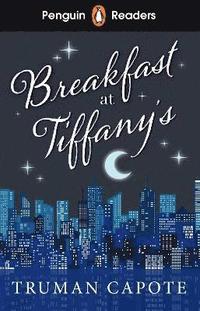
Penguin Readers is an ELT graded reader series for learners of English as a foreign language. With carefully adapted text, new illustrations and language learning exercises, the print edition also includes instructions to access supporting material online.
Titles include popular classics, exciting contemporary fiction, and thought-provoking non-fiction, introducing language learners to bestselling authors and compelling content.
The eight levels of Penguin Readers follow the Common European Framework of Reference for language learning (CEFR). Exercises at the back of each Reader help language learners to practise grammar, vocabulary, and key exam skills. Before, during and after-reading questions test readers' story comprehension and develop vocabulary.
Breakfast at Tiffany's, a Level 4 Reader, is A2+ in the CEFR framework. The text is made up of sentences with up to three clauses, introducing more complex uses of present perfect simple, passives, phrasal verbs and simple relative clauses. It is well supported by illustrations, which appear regularly.
Visit the Penguin Readers website Exclusively with the print edition, readers can unlock online resources including a digital book, audio edition, lesson plans and answer keys.
An unnamed writer remembers living in New York City in the United States of America during World War II. He becomes friends with one of his neighbors, the beautiful yet strange, Holly Golightly.
Librarian Note: There is more than one author by this name in the Goodreads database.
Truman Capote was an American writer whose non-fiction, stories, novels and plays are recognised literary classics, including the novella Breakfast at Tiffany's (1958) and In Cold Blood (1965), which he labeled a "non-fiction novel." At least 20 films and TV dramas have been produced from Capote novels, stories and screenplays.
He was born as Truman Streckfus Persons to a salesman Archulus Persons and young Lillie Mae. His parents divorced when he was four and he went to live with his mother's relatives in Monroeville, Alabama. He was a lonely child who learned to read and write by himself before entering school. In 1933, he moved to New York City to live with his mother and her new husband, Joseph Capote, a Cuban-born businessman. Mr. Capote adopted Truman, legally changing his last name to Capote and enrolling him in private school. After graduating from high school in 1942, Truman Capote began his regular job as a copy boy at The New Yorker. During this time, he also began his career as a writer, publishing many short stories which introduced him into a circle of literary critics. His first novel, Other Voices, Other Rooms, published in 1948, stayed on The New York Times bestseller list for nine weeks and became controversial because of the photograph of Capote used to promote the novel, posing seductively and gazing into the camera.
In the 1950s and 1960s, Capote remained prolific producing both fiction and non-fiction. His masterpiece, In Cold Blood, a story about the murder of the Clutter family in Holcomb, Kansas, was published in 1966 in book form by Random House, became a worldwide success and brought Capote much praise from the literary community. After this success he published rarely and suffered from alcohol addiction. He died in 1984 at age 59.
Breakfast at Tiffany’s by Truman Capote is a novella centered around Holly Golightly, a young woman living in New York City. The narrator, an aspiring writer, becomes interested by Holly’s unconventional lifestyle, her charm, and her past. Set in the 1940s, the story explores themes of loneliness, independence, and the search for belonging. Holly’s character remains an iconic figure of mystery. The novella is a reflection on identity and the masks people wear in order to remain hidden but in the spotlight.
"I want to still be me when I wake up one fine morning and have Breakfast at Tiffany's. " -- Truman Capote, Breakfast at Tiffany's.
I DISLIKED this book so much. I mean not an average dislike -- a deep and corrosive dislike.
I think of all the classics I read (or tried to read) this year this is the one I disliked most. I almost gave it a one.
The protagonist is so dislikeable, I could not stand her and the whole book is about all these people adoring her and it just got boring as hell. It really did.
Now I know this book is considered a classic. That's why I read it. I am on a classic binge.
However Holly Golightly is not someone I related to nor had the slightest interest in. And the whole book is about her. There is barely any plot. It's just all about this woman whom history loves but whom I missed the boat on.
I usually try to give classics at least a three. I am not always successful. I seriously considered a one because besides everything I just described the book depressed the heck out of me. There's one I will never pick up again.
I have heard the film is way better so I suppose that might be the way to go.
SPOILER:
Plus she does the unthinkable. She screams at her pet and walks away from after saying they were as one. The only reason is because she's a bit##. (But don't worry. The cat is fine and gets a good home!)
I'm sorry but if you hate the main character of a book and she's like in almost every scene it is really hard to like the book itself because the book is essentially HER. So it's fair to say this will not go down as a fun reading experience.
Never have I ever been so deceived by a book - by that I mean confused and surprised. This is largely due to the fact that I had absolutely so idea what the story was about but it certainly ain’t a group of people sitting around Tiffany’s (a person) breakfast table!
Throughout the book I swayed back and forth between confusion and understanding the plot - thankfully it was a novella so there wasn’t too much too be uncertain about.
I think the most charming part of the book I came across was when Holly says she sometimes gets “the mean reds,” which is different than having the blues. The mean reds, she says, is a kind of “angst,” and the only way she knows how to deal with it is by taking a taxi to Tiffany’s jewelry store and gazing at its beauty and protected by the security guards. This makes her feel calm, she says, because it feels like nothing bad could ever happen at Tiffany’s. She claims that if she could find a place in real life that made her feel like this, she would settle there immediately. I thought that painted such a calming picture. Do you have a place like that?
The narrator is unnamed but has lived with or beside this friend Holly. I wanted them to be together, to become something more but in the end he only receives only one telegram from Holly saying that she’s living in Buenos Aires and will send him a permanent address when she has one - she never does. He is disappointed because he wants to tell her that he found her cat (whom has no name) and he hopes that Holly, like the cat, has found somewhere she belongs.
Capote has such a beautiful way with words and characterizations. As someone who adores the film, I feel like most people probably know this novel doesn't exactly have the same tone. It's darker, more multidimensional.
It's a beautifully written book, and Capote did something that many writers at the time were not doing: He wrote an unapologetically selfish female character, and (in my opinion) didn't condemn her for it.
Knowing that Capote imagined a Marylin Monroe type for the character of Holly makes perfect sense. Holly Golightly is beautiful and charming. She has a guilelessness about her that is 100% phony, but no one minds the facade (except perhaps the narrator). She uses what skills she has at her disposal to survive, and seemingly thrive.
Holly's desires for freedom and security are, by the very nature of the world she lives in, conflicting. As a woman with no support system in 1958, it is not possible for her to have both. But she is happy to have either, to use her "wiles" to live the free happy life she wants, or her charm to find a rich older man to take care of her. The cat is also clearly symbolic of Holly: trapped and well-fed, OR free and on the hunt. The real tragedy is the option for both is ripped away from her in the end, and she is forced to give up security forever when her freedom is threatened.
It's ironic to me that the movie chose to make the narrator her love interest, and give them a "happy" ending together. In reality, if Holly had ended up in a monogamous relationship with the narrator, a poor writer with no career prospects, she would lose both her freedom and security. And that is something book Holly would never allow.
Hm I am a bit perplexed at what I just read … vibes were interesting.
My favorite quote was “I don’t like to see him run because there’s something funny looking about him when he runs”. Who knew the author created the ick in 1958.
Capote is such an effortless writer. I wanted to take a highlighter to all the genius sentences. It's a good story but its brilliance is in the quality of the writing itself.
Consider this one of those classics you have to read at least once. If you're like me, you saw the movie a handful of times growing up, but never knew there was a book behind it. Like every book/movie combo, there are a number of differences, but I wouldn't say there's anything significantly off with the movie other than maybe Holly’s hair color, the book having a slightly darker tone to it, and the setting being later in time. Overall, I did enjoy getting to experience the book side of Holly Golightly and her adventures through NYC, and other parts of the world. It's difficult not picturing Audrey Hepburn while reading the book because of the icon she became. Also, if you are not already aware, there are various slurs in both the book and movie that are unacceptable.
THIS BOOK IS FOR YOU IF: You're looking for a classic short story that has a free-spirited leading lady wit, charm, and class.
من کتابهای کوتاهی که در کم حجمیشون اینقدر چیزهای خوب برای گفتن دارن رو خیلی دوست دارم،
کتاب در مورد یه دختر خیلی جوون و زیباست به اسم هالی گلایتلی که زندگی پرزرق و برقش رو به طور کلی از آشنایی با شوگرددیهای پولدار متنوع میگذرونه، و سعی میکنه به این طریق وارد دنیای اونها بشه.
ولی هالی، نمیدونم تا کجا برای رسیدن به ثباتی که در ذهنته قراره پیش بری، اما با وجود سبکسری، بیخیالی، اجتماعی بودن و شاد بودنت، پر از آسیبی، و فکر میکنی که آزادی، اما بیشتر خودت رو در یک زندانی ساخته شده از میلههای رهایی حبس کردی، و دنبال یک رویایی از تعهد و تعلقی، ولی در نهایت خودت میدونی که چقدر تنهایی و هرقدر هم تلاش کنی هیچ چیزی اون رو پر نمیکنه.
‘Never love a wild thing, Mr Bell,’ Holly advised him. ‘That was Doc’s mistake. He was always lugging home wild things. A hawk with a hurt wing. One time it was a full-grown bobcat with a broken leg. But you can’t give your heart to a wild thing: the more you do, the stronger they get. Until they’re strong enough to run into the woods. Or fly into a tree. Then a taller tree. Then the sky. That’s how you’ll end up, Mr Bell. If you let yourself love a wild thing. You’ll end up looking at the sky’.
I think the above quote is the most beautiful thing I have read since S.E Hinton’s ‘stay golden’ quote. Maybe not all of us but most of us have fallen in love with someone wild, they are so irresistible. You love them because of their passion, uniqueness and undomesticated personality but you know deep down they are never truly yours or were ever yours in the first place because wild things can never be kept or tamed. And we are left looking up in the sky hoping to get a glimpse of the wild love we once lost that is unleashed upon the world again. You never want to love a wild thing again because the damage of loosing them is so heart breaking you don’t think you could survive a lose like that again. But nevertheless you dream of them almost every night and in the mundaneness of life, their memory is what keeps you strong.
Holly is a wild thing, you can’t help but love her.
I felt like I couldn’t justify dressing up in Audrey Hepburn’s Breakfast at Tiffany’s classic outfit for yet another Halloween without having read the book. And the OG Holly Golightly could not be more different than my naive conception of the character—from her wild blonde hair replacing the dark brunette bun, to her whimsical, slightly petulant persona supplanting the timeless poise and sophistication I had associated with Hepburn. Other than my shock at the dissimilarity of the protagonist, the story was colorful and entertaining, though personally nothing to ride home about. I did, however, enjoy the depiction of a powerful, multidimensional female protagonist, who casts a gravitational pull with her guiles and charisma, embroiling all.
Still pondering what I think of this book. The characters and language are very much of its time, by todays standards very unlikable, however the writing is amazing. Despite not liking any of the characters at all I was absolute sucked in with the writing, will be reading more Capote in the future. Having seen clips of the film I am surprised at how different the stories are, however I see why it is considered a classic of it’s time. Overall enjoyed it despite its flawed characters and will read more Truman Capote in the future.
Het was voor een klassieker best makkelijk te lezen, maar het was een beetje een vreemd verhaal en anders dan ik had verwacht.
Het ging over Holly en zij is gewoon heel careless en problematisch en de narrator is verliefd op haar. Daar komt het verhaal op neer. Was wel prima als tussendoor, kort boekje.
it s a good one, but idk why i like the movie more, oh wait, Audrey Hepburn is an icon and she s the key. the producer knew what he was doing there. ♡ not biased at all, No, No. Yes, i m a big Audrey fan so, ofc i appreciate her art more, so the movies wins this time. lots of kisses and blesses for y'all ♡
I've stayed away from this book for so long because the movie is my favorite movie ever. I mean, you can see why they had to change some things for Hollywood. I like this Holly as much as I like Hepburn's Holly, although this one is much grittier. Obviously there is a lot of language in here that is no longer acceptable, or was never really acceptable, but I definitely think it is the way people talked. Overall, I enjoyed it. I still like the movie better.
This is one of those books that I always meant to read but never did. I love the movie and love Capote, so I thought it was time. The original Holly is much grittier but still as buoyant as Hepburn’s. The ending is different but unusually, I like both. I could certainly see the story going with direction. Overall, I enjoyed this book.