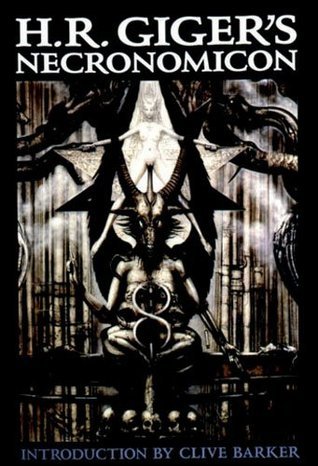
"H.R. GIGER'S NECRONOMICON: A startling milestone on the darkly lit road once traveled by the likes of Bosch, Brueghel, Lovecraft, Poe and Kafka. Giger's remarkable book of the dead gives us some of the most powerful images ever an artist drew from the well of the imagination.
Hans Ruedi Giger (1940 - 2014) was an Academy Award-winning Swiss painter, sculptor, and set designer best known for his design work on the film Alien.
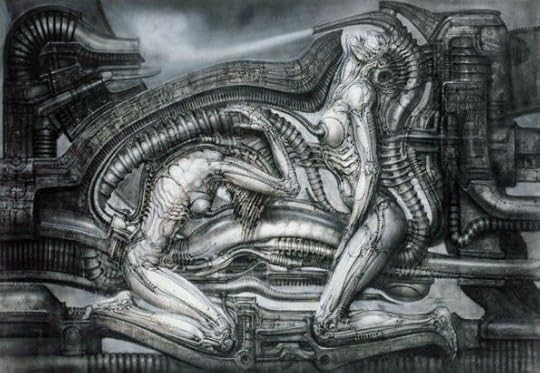
گیگر طراح خوفناکترین هیولای سینماست، یعنی جناب زنومورف از سری بیگانه که یکی از طراحیهای همین کتابه. البته اثر نهایی با چیزی که توی کتاب هست کمی تفاوت داره و ترسناکتر شده باقی طراحیها هم ترکیبی از ماشین و بیولوژی انسانه و خیلی جذابن. البته چیزای مریض و جنسی هم وسط کاراش هست :دی
چه کتاب سمی و دارکی بود! بخاطر شباهت اسمش با نکرونومیکون لاوکرافتی وسط تلاش هام برا پیدا کردن فایل های مرتبط با اون، بهش برخوردم و چون پر از طراحی بود خوندمش/دیدمش. ولی واقعا مغز مریضی داشته طرف.
I have a giant version of this incredible art book and it is every bit as beautiful as it is disturbing. Giger was on to something here man. This imagery makes me want to write... things. It makes me uncomfortable in the best ways. Since my version is also the giant-sized version, it has also acted as my dinner tray as I've bounced around from town to town these last few years on my writing journey. Always a topic starter (and a great way to tell if a date shares your taste for the dark things). Get it for the full images alone. The man was a tortured genius.
Giger's first giant coffee-table art book was also my first book by him. I bought it on my 14th birthday and took it along on a family road trip from California to Texas, which the book and a Crosby, Stills & Nash tape sort of turned into a mystical journey.
Seeing the huge, Guernica-sized airbrushed paintings and reading about Giger's experiences and dreams is a highly immersive experience. This book covers the best period of the artist's work, which makes it superior to Necronomicon II and Biomechanics.
This book is a real trip and I'd recommend it to any appreciator of art, surrealism, and the bizarre in general.
One of my most treasured books. Giger is a huge favorite. His art has influenced the look of modern science fiction films, comic books, album art to the core. I ape him all the time when I'm doodling. I can't help it- those biomichanical tentacles are just in me, now! Funny story about this book. My friend Chris got it first when his dad picked it up for him at an antique auction (?) I was insane with jelousy as we started flipping though the satanic masterpiece. The inside cover of the hardcover is printed with a signature from Salvador Dali. If you've seen the book, you know it is really well printed, so the signature looks very authentic. So authentic that . . .well, we were young, and we'd never seen the book before, and we were stoner metalheads. So we got really excited, thinking Chris' Dad had stumbled upon a copy of Necronomicon signed by Salvador Dali. My friend's dad took the wind out of our sails almost immediately after looking at the signature under a light, but for a minute there, we were in possession of the ultimate Necronomicon. We were going to be rich!
The imagination behind all the artwork is insane. And the style is so instantly recognisable (or lesser so for people who never watched any Alien movies).
I’ve had this for a few years after finding a fairly worn copy in a bookstore for a decent price, but I hadn’t read this cover-to-cover before. The book is pretty large so it’s impressive to behold, but I also think it’s probably going to fall apart easily if I look at it too much. A bit about the art. There are a few different themes in Giger’s art but it is all unmistakably him. At the beginning of the book, there are a number of images I really like that are from the 60s, before he started using the airbrush. Then there are a few sort of industrial, still-life works in colour, some of which are related to a dream that he recounts here. Then it goes into the airbrush works for the rest of the book, which are mostly a cold bluish chrome, but there are a few more colour artworks. Some of his art is warped, busy works that are a bit hard to look at, because shapes morph into other shapes and it’s difficult to get a sense of perspective unless you move move further away from the huge page. They remind me of what I like about James Gleeson, minus the nice colours, and with a lot more skull/machine/baby/vagina motifs. I don’t tend to like his symmetrical works as much as these more abstract ‘landscapes’. Then there are the ‘Necronom’ series, which most people will recognise as the Alien figures. These are also among my favourites, and there are some pieces here that aren’t included in the ‘Giger’s Alien’ book, which might just be more about his design work for the movie. There are also a few pages about his designs for Dune, and he writes about meeting Jodorowsky and Dali. There’s a bunch of text by Giger throughout the book. Biographical info, anecdotes, the sad story of his friend Li, thoughts about his artistic process and about art in general. He’s a pretty funny character - very cynical. The piece called ‘Scholarships’ is particularly enjoyable. At the end, there’s a more academic piece by another writer, which I didn’t think was particularly necessary to include.
Pretty nightmarish stuff. It makes you appreciate the vision Ridley Scott had to help turn one of Giger’s demonic creations into a 3D physical thing. I wish Hellraiser had gone more down the Giger path but it probably would have been too disturbing for anyone to watch safely.
Giger is probably the most original artist of the fantastic since H. Bosch. His work is engaging and seriously strange stuff. "Necronimicon" has a biographical focus on the author - relating the evolution of his work and technique to the progression of his life. This is essential reading for anyone interested in the man's work.
I wouldn't say I'm an artwork connoisseur by any means. I can appreciate art when I see it, but modern art leaves me pretty cold, so I don't know that I get it. However, when I love art, I really love it. I love looking at Salvador Dali's work and I wouldn't say I *love* looking at H.R. Giger's work, but I think it's incredible.
His art book, H.R. Giger's Necronomicon has what is probably his most famous work of art, because it clearly was the inspiration for the alien in the film Alien.
Giger's work in like fascinating. The longer I stare at it, the more unnerved I get by it. I think it's fitting that this book is called Necronomicon, clearly taken from horror author H.P. Lovecraft. Lovecraft describes his protagonists in multiple stories being unable to look at, or describe an esoteric item or creature lest they lose their mind and that feeling, of wanting to look away, but being fascinated by what I'm seeing and then *needing* to look away as I get increasingly more unnerved is exactly the feeling I have looking at Giger's artwork.
In closing, I don't know that I could give Giger a higher praise than this, but if Hell is a place that exists and if for some reason I was to end up there and it could be individualized per person, putting me in a Giger-esque hell for eternity would be the stuff of my nightmares and I would *hate* it.
* Quick aside - But one critique about the Alien franchise and it is a franchise I love and have a lot of affection for, but they really lose the horror aspect for me after the first film. Sure, the Xenomorphs are big creepy bug looking creatures, but like my description of Giger's artwork, when the xenomorphs lose that mechanical horror aspect, as if they could be both machine and organic tissue, so you're really not sure what you're looking at, that's just the epitome of Lovecraftian horror and honestly I don't think anyone does that better than Giger.
Details a fantastic collection of both earlier drawings as well as that of the famous characteristic "Necronom IV" which became the underlying inspiration for 1979's film Alien. Although thematically dwelling in the artistic landscapes of the dark with heavy inspiration from the fantastical horror genre I also find uplifting themes in Giger such as his exploration of sexuality and the inventiveness of his biomechanical contraptions. Highly recommended for anyone remotely interested in the art of Giger or who enjoy the horror genre.
Note: I don't like the star rating and as such I only rate books based upon one star or five stars corresponding to the in my opinion preferable rating system of thumbs up/down. This later rating system increases in my humble opinion the degree to which the reader is likely to engage with a review instead of merely glancing at the number of stars of a given book.)
Giger's art leaves me wondering at how poor language is sometimes. There really isn't a way to describe the sensation his work had on me and still does. While there are many passages scattered throughout this work, the real joy was opening this large book and spending a few minutes on each page and just really following the lines, feeling the textures, and trying to see the figures beginning and ending in the dirty and somehow decaying machinery that seemed to be sapping life while simultaneously creating it. Giger's work is often called horrific, and while I won't deny his work can shock, I suspect again the poverty of the English language. Giger's work is, and the joy and appreciation of it comes from simply observing the existence as it seems ever and always coming alive to the viewer as they stare at it, and the way it lingers in your mind even after you've closed the book.
I read this after learning about Giger's involvement in Alien's concept art. His work is very dark, so this is definitely not for everyone.
If you have an interest in the Alien movies, as well as Prometheus, The Matrix, and many more you'll appreciate the connection.
In case you finished this book and still want some more, here´s a really cool documentary that shows how Giger was able to turn his vision into a reality. It´s fascinating to see him develop his craft. He even got an Oscar for this!
This book was perfect for October. It has that eerie Twilight Zone feeling mixed with mad science, archaeology, and ancient language. While some of the terminology and references have become outdated (that’s to be expected with a book of its time), the stories are intriguing and it was very much like a series filled with monsters, ghouls, aliens, and ghost stories. It did get long and somewhat repetitive at times but I enjoyed this classic in honor of this spooky month of the dead.
Also, the audio version is like you’re at a sleepover listening to friends tell scary stories with only a flashlight.
H.R. Giger's art is eerie but has an oddly divine and metallic quality to it. It's like Dante's Inferno crossed with cyberpunk nightmares like Blade Runner, The Matrix, Ghost in the Shell and Akira. It represents the fear he once held for where the human race was heading in the dark and unknown future. He's responsible for the iconic designs of the Ridley Scott Alien franchise.