

What do you think?

Buried Truths and the Hyatt Skywalks: The Legacy of America’s Epic Structural Failure
In 1981 the sudden collapse of two skywalks in Kansas City’s Hyatt hotel killed 114 people and injured another 200. There never was a public trial, nor a full airing of everything that went wrong. Richard A. Serrano shared a Pulitzer Prize for his coverage of the disaster at the time; now he returns to the tragedy to learn all that went wrong, how it could have been avoided, and what lasting effects persist today—for engineering and the legal system, but most importantly those who suffered. Drawing on legal depositions, evidentiary material, and recollections from 240 survivors, first responders, and construction officials, Buried Truths and the Hyatt Skywalks is the story of this monumental catastrophe and what it teaches us today.
The Friday evening Tea Dance was all the rage that summer of 1981. Each week the lobby filled with throngs of revelers, some celebrating atop the skywalks themselves. On July 17, without warning, the steel support systems buckled and the concrete and glass skywalks crashed onto the crowded lobby. The devastation reverberated far beyond the ruins. Firefighters, police officers, and paramedics suffered from deep depression, cycled through divorce, hit the bottle, and in some instances committed suicide. The hotel had been built using a new fast-track method with key construction decisions often made on the fly, including changing the skywalk design from six heavy hanger rods to twelve thinner poles. Within a year the skywalks were splintering inside. Even then the collapse could have been averted, but special inspection panels to check the hanging walkways were never opened.
Though wholly avoidable, the Hyatt disaster did bring significant changes—some good and some problematic. Tougher industry guidelines were enforced for US construction projects. Police officers, firefighters, and health care workers are now treated for PTSD and other psychological trauma after working a tragic event. But the rush to settle all the Hyatt lawsuits helped usher in a controversial new era of nondisclosure agreements.
Buried Truths and the Hyatt Skywalks explores America’s worst structural engineering disaster. Though the world has moved on, survivors and witnesses still vividly recall that night. This is their story.
The Friday evening Tea Dance was all the rage that summer of 1981. Each week the lobby filled with throngs of revelers, some celebrating atop the skywalks themselves. On July 17, without warning, the steel support systems buckled and the concrete and glass skywalks crashed onto the crowded lobby. The devastation reverberated far beyond the ruins. Firefighters, police officers, and paramedics suffered from deep depression, cycled through divorce, hit the bottle, and in some instances committed suicide. The hotel had been built using a new fast-track method with key construction decisions often made on the fly, including changing the skywalk design from six heavy hanger rods to twelve thinner poles. Within a year the skywalks were splintering inside. Even then the collapse could have been averted, but special inspection panels to check the hanging walkways were never opened.
Though wholly avoidable, the Hyatt disaster did bring significant changes—some good and some problematic. Tougher industry guidelines were enforced for US construction projects. Police officers, firefighters, and health care workers are now treated for PTSD and other psychological trauma after working a tragic event. But the rush to settle all the Hyatt lawsuits helped usher in a controversial new era of nondisclosure agreements.
Buried Truths and the Hyatt Skywalks explores America’s worst structural engineering disaster. Though the world has moved on, survivors and witnesses still vividly recall that night. This is their story.
- GenresNonfiction
431 pages, Kindle Edition
First published September 1, 2021
About the author
Richard A. Serrano
6 books12 followersA native of Kansas City, Missouri, Richard A. Serrano reported on the Hyatt skywalks tragedy, the cause of the collapse, and the ensuing litigation for the Kansas City Times, for which he shared a Pulitzer Prize.
Richard A. Serrano is a Pulitzer Prize–winning former Washington correspondent for the Los Angeles Times. He spent 45 years covering the Pentagon, the wars in Haiti and the middle East, the US Justice Department, the FBI, and the War on Terror.
Serrano lives in Fairfax, VA.
Richard A. Serrano is a Pulitzer Prize–winning former Washington correspondent for the Los Angeles Times. He spent 45 years covering the Pentagon, the wars in Haiti and the middle East, the US Justice Department, the FBI, and the War on Terror.
Serrano lives in Fairfax, VA.
Ratings & Reviews
Friends & Following
Create a free account to discover what your friends think of this book!
Community Reviews
Displaying 1 - 10 of 10 reviews

March 25, 2022
I was just a few months shy of my 11th birthday when two suspended walkways at a luxury hotel, less than an hour's drive from my home, came crashing down during a weekly Tea Dance in the hotel's lobby. All told, 114 people died and more than 200 others were hurt, and even at my relatively young age, I knew that this tragedy would be felt in Kansas City for decades.
This exhaustively researched (I will admit that I didn't read the 66 pages of source notes that came between the book's prose and its index) covers everything from the arrival in Kansas City of J.C. Hall, his early entrepreneurial endeavors before he founded the Hallmark Cards empire, and the construction of Crown Center and then the Hyatt Regency, where the skywalks disaster took place, to the massive accident and rescue efforts, to the cleanup of the site, through the lawsuits that followed, and right up to the struggles that survivors and their loved ones face to this day. I personally know at least two individuals who lost a mother and a sister, respectively, to the skywalks' collapse, but I'm confident that even a reader with no connections to the event will be affected by this book.
If I have any quibbles, they are minor -- I occasionally found the wording, sentence structure, and punctuation awkward, but will defer to the author and editor with regard to that. I also felt that it would have been nice to include a list of those who lost their lives and perhaps those who were hurt. Many of them were mentioned by name in the narrative, but not all, and I feel some recognition wouldn't be out of line.
All in all, a great read for those into true crime or disaster books, history, or nonfiction in general.
This exhaustively researched (I will admit that I didn't read the 66 pages of source notes that came between the book's prose and its index) covers everything from the arrival in Kansas City of J.C. Hall, his early entrepreneurial endeavors before he founded the Hallmark Cards empire, and the construction of Crown Center and then the Hyatt Regency, where the skywalks disaster took place, to the massive accident and rescue efforts, to the cleanup of the site, through the lawsuits that followed, and right up to the struggles that survivors and their loved ones face to this day. I personally know at least two individuals who lost a mother and a sister, respectively, to the skywalks' collapse, but I'm confident that even a reader with no connections to the event will be affected by this book.
If I have any quibbles, they are minor -- I occasionally found the wording, sentence structure, and punctuation awkward, but will defer to the author and editor with regard to that. I also felt that it would have been nice to include a list of those who lost their lives and perhaps those who were hurt. Many of them were mentioned by name in the narrative, but not all, and I feel some recognition wouldn't be out of line.
All in all, a great read for those into true crime or disaster books, history, or nonfiction in general.
Read
October 30, 2022Note: I stopped putting stars on my reviews a while back after reading about how the star rating system is so often misused and abused.
I was a teenager living in Kansas City, Missouri when the Hyatt skywalks collapsed during a jam-packed tea dance, killing hundreds, injuring scores more, and dividing the lives of everyone in the city into a before and after.
Richard Serrano's book takes a comprehensive look at factors and context of the tragedy. He shares a history of Hallmark (the company behind the construction of the hotel,) the main players involved, the engineering aspects of the skywalks, and the lives of many people affected by one of the greatest disasters in Kansas City history. As one of the reporters who originally covered the story, he had access to a lot of documentation, which he presents here. Lawsuits and investigations dragged on for years. The incident led to a nation-wide audit and rethinking of building standards and practices.
Serrano does a good job weaving all the threads together -- sharing personal accounts of victims and witnesses, following some of their stories through the decades. Equally wrenching to the stories of those present for the dance are the accounts of the first responders, many of whom suffered with PTSD for the rest of their lives.
There were failures on so many levels, and I hope lessons were learned.
I was a teenager living in Kansas City, Missouri when the Hyatt skywalks collapsed during a jam-packed tea dance, killing hundreds, injuring scores more, and dividing the lives of everyone in the city into a before and after.
Richard Serrano's book takes a comprehensive look at factors and context of the tragedy. He shares a history of Hallmark (the company behind the construction of the hotel,) the main players involved, the engineering aspects of the skywalks, and the lives of many people affected by one of the greatest disasters in Kansas City history. As one of the reporters who originally covered the story, he had access to a lot of documentation, which he presents here. Lawsuits and investigations dragged on for years. The incident led to a nation-wide audit and rethinking of building standards and practices.
Serrano does a good job weaving all the threads together -- sharing personal accounts of victims and witnesses, following some of their stories through the decades. Equally wrenching to the stories of those present for the dance are the accounts of the first responders, many of whom suffered with PTSD for the rest of their lives.
There were failures on so many levels, and I hope lessons were learned.

February 27, 2022
I began reading this book mainly because I knew it’s author when I was the press information officer at San Diego Police Department and he was a reporter on the police beat for the Los Angeles times. I quickly discovered that he had been a reporter for the Kansas City star I believe and had won A Pulitzer Prize for his writing. This book was indeed sad to read but extraordinarily well written and detailed. And yet another great book exposing secrets in a corporate world.

July 28, 2026
I attended UMKC for 4 1/2 years, graduating in 2021. I lived at Hospital Hill one of those years. I've been to Crown Center a couple of times. I minored in history. One of the courses I took was urban history, which included a great deal of Kansas City history.
Still I left Kansas City having never heard of the Hyatt skywalk collapse.
When I happened to read about it three months ago in the comments of a Facebook post about Missouri tragedies, I was shocked--shocked that a disaster of this magnitude happened in the city I once called home, and shocked that it's talked about so infrequently today. Online, those who were alive at the time insist everyone in Kansas City knows about it; those born later, some who have lived in the city their entire lives, have often never heard of it. When I went back to visit last month, I asked a few of my college friends, and they weren't aware of this tragedy either.
Many times I looked at the Sheraton Crown Center (nee Hyatt Regency hotel) thinking what a beautiful building it was. Taller than everything around it and topped with a revolving restaurant, it commands attention. I was completely unaware of its dark history.
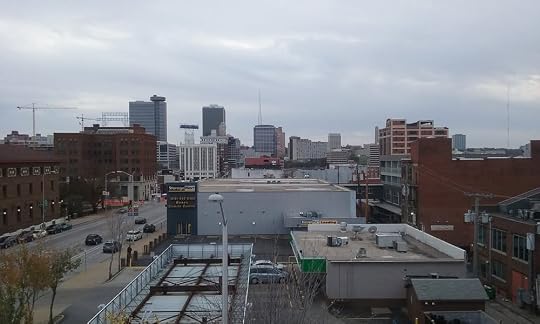
A photo I took in 2018 from atop the roof of Messenger Coffee, perhaps the first time I noticed the hotel (left)
I read this book in July 2026, in time for the 45th anniversary of the tragic collapse that was responsible for 114 fatalities and over 200 injuries during a Friday evening tea dance. The book is told in three parts--Regency, Requiem, and Reckoning, sort of a before, during, and after--covering the history of the hotel, hundreds of survivors' and witnesses' stories, and the aftermath. It's deep and thoroughly researched, though at times a little dry, at times a little hectic jumping from one firsthand account to another.
I was appalled to learn everything that went wrong as early as the building's construction. An ironworker was killed on the job. The roof collapsed. Several people noticed cracks and issues with the skywalks before the hotel was even open to the public, yet nothing was done. During the two-and-a-half year period, safety inspectors only spent a total of 18 hours at the site (hey, I once spent a cumulative 18 hours reading source material for a single college essay!). The oversights were infuriating.
The firsthand accounts are heartbreaking, gruesome, and at times difficult to read. One victim's leg had to be amputated with a chainsaw to free him from under the skywalks; he died soon after. Another, pinned between skywalks and paralyzed from the shoulders down, could no longer brush cockroaches away when they crawled on her in her apartment. Many of the first responders suffered psychologically, with some turning to alcohol and a couple ending their own lives. But, as bleak of a time this was for Kansas City, the story is not without its moments of hope--several lives saved, some using their settlement money to help others, and even a hotel guest finding love in the form of an injured man in the hospital.
This book introduced me to some concepts I was previously unfamiliar with, such as fast-track building, in which construction begins before design drawings are complete. I have very little engineering knowledge, but as a writer and artist who tends to jump headfirst into creative projects only to abandon them halfway through, this sounds like a terrible idea. I also learned about the fireman's rule--that firefighters can't seek compensation for their psychological trauma because it's part of their job. An unfortunate but necessary measure. I was pleased to learn that this disaster was taken seriously by engineering schools, who added courses about ethics and extensively taught the skywalk collapse as an example of the dangers of negligence.
Today, a memorial statue stands across from the hotel, tucked away on a street I don't think I ever traveled despite having lived so close. Maybe someday when I return to Kansas City, I'll get a chance to see it in person.
Still I left Kansas City having never heard of the Hyatt skywalk collapse.
When I happened to read about it three months ago in the comments of a Facebook post about Missouri tragedies, I was shocked--shocked that a disaster of this magnitude happened in the city I once called home, and shocked that it's talked about so infrequently today. Online, those who were alive at the time insist everyone in Kansas City knows about it; those born later, some who have lived in the city their entire lives, have often never heard of it. When I went back to visit last month, I asked a few of my college friends, and they weren't aware of this tragedy either.
Many times I looked at the Sheraton Crown Center (nee Hyatt Regency hotel) thinking what a beautiful building it was. Taller than everything around it and topped with a revolving restaurant, it commands attention. I was completely unaware of its dark history.
A photo I took in 2018 from atop the roof of Messenger Coffee, perhaps the first time I noticed the hotel (left)
I read this book in July 2026, in time for the 45th anniversary of the tragic collapse that was responsible for 114 fatalities and over 200 injuries during a Friday evening tea dance. The book is told in three parts--Regency, Requiem, and Reckoning, sort of a before, during, and after--covering the history of the hotel, hundreds of survivors' and witnesses' stories, and the aftermath. It's deep and thoroughly researched, though at times a little dry, at times a little hectic jumping from one firsthand account to another.
I was appalled to learn everything that went wrong as early as the building's construction. An ironworker was killed on the job. The roof collapsed. Several people noticed cracks and issues with the skywalks before the hotel was even open to the public, yet nothing was done. During the two-and-a-half year period, safety inspectors only spent a total of 18 hours at the site (hey, I once spent a cumulative 18 hours reading source material for a single college essay!). The oversights were infuriating.
The firsthand accounts are heartbreaking, gruesome, and at times difficult to read. One victim's leg had to be amputated with a chainsaw to free him from under the skywalks; he died soon after. Another, pinned between skywalks and paralyzed from the shoulders down, could no longer brush cockroaches away when they crawled on her in her apartment. Many of the first responders suffered psychologically, with some turning to alcohol and a couple ending their own lives. But, as bleak of a time this was for Kansas City, the story is not without its moments of hope--several lives saved, some using their settlement money to help others, and even a hotel guest finding love in the form of an injured man in the hospital.
This book introduced me to some concepts I was previously unfamiliar with, such as fast-track building, in which construction begins before design drawings are complete. I have very little engineering knowledge, but as a writer and artist who tends to jump headfirst into creative projects only to abandon them halfway through, this sounds like a terrible idea. I also learned about the fireman's rule--that firefighters can't seek compensation for their psychological trauma because it's part of their job. An unfortunate but necessary measure. I was pleased to learn that this disaster was taken seriously by engineering schools, who added courses about ethics and extensively taught the skywalk collapse as an example of the dangers of negligence.
Today, a memorial statue stands across from the hotel, tucked away on a street I don't think I ever traveled despite having lived so close. Maybe someday when I return to Kansas City, I'll get a chance to see it in person.

March 1, 2023
I purchased my copy of this book from Amazon in December 2022.
I moved to the Kansas City area recently and my wife and I have been exploring the many sights and experiences the city has to offer. In December 2022 we visited the downtown Crown Center to view the Christmas decorations. Something about the tall Sheraton hotel at one end of the Crown Center, with the circular revolving restaurant atop it, seemed somehow familiar from something I had seen on TV or read about many years ago. I even mentioned to my wife that I recalled a structural collapse had once occurred at some downtown Kansas City hotel in the late 1970's or early 1980's...could this be the place where it had happened? A little web research revealed that the Sheraton used to be the Hyatt Regency and indeed there had been an accident involving overhead walkways collapsing into the lobby in July 1981 killing over 100 people. A little more research led me to this book. The author provides some interesting history on the development of the Crown Center, then details on the hotel's construction, the collapse of the "skywalks" during a dance in the lobby, the response by police, firefighters, EMT's and local hospitals, the horrific aftermath for the survivors and the families of the dead, and the years-long legal battles that ensued. The narrative is a little disjointed at times but the book does cover many angles of the story. My biggest quibble is that the author never provides a clear and straightforward explanation of why the skywalk structures failed. During construction, there was a design change to the steel used to suspend the skywalks, but why did this change cause the skywalks to fail? The author dances and skips around this, but never quite nails the reason. I used to be an engineer, and looking at the sketch in the book of the original design and the modified design, it's pretty obvious to me how the change led to the failure: the change put the weight of two skywalks onto a support that was designed to hold the weight of only one. Why not explain this in layman's terms in the book? Four out of five stars.
I moved to the Kansas City area recently and my wife and I have been exploring the many sights and experiences the city has to offer. In December 2022 we visited the downtown Crown Center to view the Christmas decorations. Something about the tall Sheraton hotel at one end of the Crown Center, with the circular revolving restaurant atop it, seemed somehow familiar from something I had seen on TV or read about many years ago. I even mentioned to my wife that I recalled a structural collapse had once occurred at some downtown Kansas City hotel in the late 1970's or early 1980's...could this be the place where it had happened? A little web research revealed that the Sheraton used to be the Hyatt Regency and indeed there had been an accident involving overhead walkways collapsing into the lobby in July 1981 killing over 100 people. A little more research led me to this book. The author provides some interesting history on the development of the Crown Center, then details on the hotel's construction, the collapse of the "skywalks" during a dance in the lobby, the response by police, firefighters, EMT's and local hospitals, the horrific aftermath for the survivors and the families of the dead, and the years-long legal battles that ensued. The narrative is a little disjointed at times but the book does cover many angles of the story. My biggest quibble is that the author never provides a clear and straightforward explanation of why the skywalk structures failed. During construction, there was a design change to the steel used to suspend the skywalks, but why did this change cause the skywalks to fail? The author dances and skips around this, but never quite nails the reason. I used to be an engineer, and looking at the sketch in the book of the original design and the modified design, it's pretty obvious to me how the change led to the failure: the change put the weight of two skywalks onto a support that was designed to hold the weight of only one. Why not explain this in layman's terms in the book? Four out of five stars.

April 28, 2024
5 Stars, and it read like a thriller, but I may be biased because I was in KC when the Skywalks fell and I swam with Hallmark's General Counsel's son for years before the 9th grade. So I knew the exact locations and had visited the lobby with family before and after, eating at the Peppercorn Duck Club frequently, etc.
For a non-KC person, they might still receive something valuable about how buildings were built before the Hallmark disaster and thereafter. It made me appreciative of QA and QC - all those "boring" lists that need to be checked off in order to review the product if something goes wrong. But people can still get complacent, and that's when things truly break down.
I was young and oblivious but heard about how too many people were standing on the bridges, causing the overload. But the book showed me it was much worse than that. Today, I might be more wary of older buildings in KC based on what all I learned from this book. But also in Singapore and China when they can raise newer buildings in half the amount of time than we do in the West. What corners did they cut in manufacturing the steel to save time and money?
The book gave me what I was searching for: answers to what/how it happened and who all were ruined, killed, destroyed in the process. It gave me a dark history about KC that Hallmark quickly wanted to recover from. I am grateful it changed the engineering processes for future generations. But I am so sorry that so many had to suffer and die to make these changes in construction and structural engineering at the time.
Mom and I will hunt for the memorial which was put up in 2015 (hidden/out of view). Fascinating. No one wants to take blame, and they still don't want to talk about it or share the memorial, either.
For a non-KC person, they might still receive something valuable about how buildings were built before the Hallmark disaster and thereafter. It made me appreciative of QA and QC - all those "boring" lists that need to be checked off in order to review the product if something goes wrong. But people can still get complacent, and that's when things truly break down.
I was young and oblivious but heard about how too many people were standing on the bridges, causing the overload. But the book showed me it was much worse than that. Today, I might be more wary of older buildings in KC based on what all I learned from this book. But also in Singapore and China when they can raise newer buildings in half the amount of time than we do in the West. What corners did they cut in manufacturing the steel to save time and money?
The book gave me what I was searching for: answers to what/how it happened and who all were ruined, killed, destroyed in the process. It gave me a dark history about KC that Hallmark quickly wanted to recover from. I am grateful it changed the engineering processes for future generations. But I am so sorry that so many had to suffer and die to make these changes in construction and structural engineering at the time.
Mom and I will hunt for the memorial which was put up in 2015 (hidden/out of view). Fascinating. No one wants to take blame, and they still don't want to talk about it or share the memorial, either.

January 22, 2023
I’m kind of obsessed with this tragedy. I lived in KC for 20 years and no people involved. It is a fascinating and detailed account of the background history, the tragedy itself, and all of the fallout. I’m no engineer, but I found that the explanation of everything not too hard to follow. My only criticisms were that it sometimes felt disjointed, and the prose was a little wonky in places.

May 14, 2022
This was a tough one to get through, but detailed such a significant time for our city. I can't shake some of the details presented here. Professionally written and seemingly unbiased, I recommend for anyone in KC during that time.
February 24, 2023
The first half of the book was interesting, but the second half, dealing with the legal fallout of the event, was tedious and long-winded. A strong editor would have helped. I gave up near the end.

May 31, 2024
Very tragic sad story of 1981 structural failure of Hyatt skywalks in Kansas City and the coverup and lack of oversight during construction. 114 killed & 200 injured 😞
Displaying 1 - 10 of 10 reviews