

What do you think?
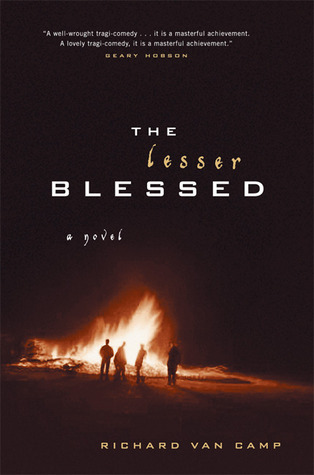
The Lesser Blessed
A fresh, funny look at growing up Native in the North, by award-winning author Richard Van Camp.
Larry is a Dogrib Indian growing up in the small northern town of Fort Simmer. His tongue, his hallucinations and his fantasies are hotter than the sun. At sixteen, he loves Iron Maiden, the North and Juliet Hope, the high school "tramp." When Johnny Beck, a Metis from Hay River, moves to town, Larry is ready for almost anything.
In this powerful and often very funny first novel, Richard Van Camp gives us one of the most original teenage characters in fiction. Skinny as spaghetti, nervy and self-deprecating, Larry is an appealing mixture of bravado and vulnerability. His past holds many terrors: an abusive father, blackouts from sniffing gasoline, an accident that killed several of his cousins. But through his friendship with Johnny, he’s ready now to face his memories—and his future.
Marking the debut of an exciting new writer, The Lesser Blessed is an eye-opening depiction of what it is to be a young Native man in the age of AIDS, disillusionment with Catholicism and a growing world consciousness.
A coming-of-age story that any fan of The Catcher in the Rye will enjoy.
Larry is a Dogrib Indian growing up in the small northern town of Fort Simmer. His tongue, his hallucinations and his fantasies are hotter than the sun. At sixteen, he loves Iron Maiden, the North and Juliet Hope, the high school "tramp." When Johnny Beck, a Metis from Hay River, moves to town, Larry is ready for almost anything.
In this powerful and often very funny first novel, Richard Van Camp gives us one of the most original teenage characters in fiction. Skinny as spaghetti, nervy and self-deprecating, Larry is an appealing mixture of bravado and vulnerability. His past holds many terrors: an abusive father, blackouts from sniffing gasoline, an accident that killed several of his cousins. But through his friendship with Johnny, he’s ready now to face his memories—and his future.
Marking the debut of an exciting new writer, The Lesser Blessed is an eye-opening depiction of what it is to be a young Native man in the age of AIDS, disillusionment with Catholicism and a growing world consciousness.
A coming-of-age story that any fan of The Catcher in the Rye will enjoy.
128 pages, Paperback
First published January 1, 1996
About the author
Richard Van Camp
57 books325 followersA Dogrib (Tlicho) Dene from Fort Smith, NWT, Richard Van Camp is an internationally renowned storyteller and best-selling author. He is the author of the novel, The Lesser Blessed, a collection of short stories, Angel Wing Splash Pattern, and two children’s books with Cree artist, George Littlechild. His new baby book: Welcome Song for Baby: A Lullaby for Newborns is the official selection of the Books for BC Babies program and is being given to every newborn baby in British Columbia in 2008. His new novel, Blessing Wendy, will be released in the fall of 2009 through Orca Book Publishers. Richard was awarded Storyteller of the Year for both Canada and the US by the Wordcraft Circle of Native Writers and Storytellers. You can visit Richard at his website: www.richardvancamp.org.
Ratings & Reviews
Friends & Following
Create a free account to discover what your friends think of this book!
Community Reviews
Displaying 1 - 30 of 246 reviews

November 22, 2011
The Lesser Blessed is set in the fictional town of Fort Simmer - based on Fort Smith in the Northwest Territories, a very harsh, bleak part of Canada. Seventeen-year-old Larry is a Dogrib (Tlicho) Indian (as is the author), living with his mother who's studying part-time to be a teacher. Tall and skinny and covered in burn scars under his clothes, he has a wildly active mind and a poet's tongue. When he becomes friends with Johnny Beck, a Métis boy recently arrived in town who already has a reputation, he's also introduced to drugs, cigarettes and becomes closer than ever before to the girl of his dreams, local town slut and Johnny's girlfriend, Juliet Hope.
There's something sweet and endearing about Larry, whose narrative voice comes through clearly and full of personality. He has a vivid imagination, and the way he speaks internally reminds me of me as a teenager - it's his artistic side I feel I can relate to, not the abusive childhood or tragic accident or violent friends. And as the story of his past - of his burns and the truth about his father - becomes clear, you also start to feel afraid of what might become of him, that he'll go down a certain, easy path and become a "floater" (a town drunk).
Larry is a storyteller, and a very resilient kid. The way he describes things is often quite beautiful. There's a lot you can read between the lines here, a lot that is revealed not just about these kids - a mix of white, Métis and First Nations' - but about these impoverished, bleak northern communities of poverty, addiction, STDs and violence. The landscape is one of freezing cold wilderness, caribou hunting and social assistance housing. It's a landscape of people, of trial and tragedy and fortitude and survival. It's not all bleak, but when you're reading this in a comfy house in a sophisticated city, coming from a fairly typical white family, the problems of Indian reservation schools, of drug and alcohol problems, of a school system seriously failing its youth, seem so far away and beyond you. Which makes this an important book, on the social justice front, as well as a very human story.
Speaking of the school system portrayed here - which you get the feeling is spot-on in its depiction, it makes my heart bleed. I don't know how typical it is for Canadian or North American schools - I don't have enough experience with the schools here to tell, though the single desks in neat rows, keeping students separate from each other, forced to just face the front, the teacher, and absorb or memorise, seems fairly indicative even in urban schools. As does the teacher who doesn't understand what teaching really means, or what students need in order to learn. I was cheering when Johnny suggested to their teacher that they should move the classroom around so the students are facing the windows, and the teacher can get the sun on his back. The teacher's reaction... well, it may be hard to get teachers to go to the schools in places like the Northwest Territories, but that's no excuse for ruining the chances the students have, or giving them such a god-awful experience. If that's what education means to them, it's no wonder they have no enthusiasm or wish to pursue post-secondary education (there are other reasons, I know, but kids need encouragement and a positive experience, at the very least).
For such a short book (119 pages), it packs quite a punch. I can't say I loved it, though I was impressed by it and I did become emotionally invested in the characters. It was just the right length for the story it told and the way it was told. It wasn't always easy to connect closely with Larry though, because he keeps so much close to his chest, but you get to know him better than anyone else. The other characters were just as well drawn, from his mum and her boyfriend, Jed, to Johnny, Darcy, Juliet and Jazz. Once I started reading, I realised it wasn't a Young Adult novel at all - not that they can't read it, if they want to (it's heavy in violence, drug use, swearing, sex and other mature subject matter, as well as being pretty depressing really), but it didn't strike me as a book deliberately written for teenagers.
I find that, a lot of the time, people will label a book YA if the protagonist is a teenager. That is not and never has been the defining characteristic of a YA book! But I do remember reading books in grade 10, for example, about teens with alcohol abuse, or realising they're a lesbian etc. I don't know that I ever read anything with this much violence in it, or anything this abstract in its narrative structure. I don't think it's written as a Young Adult novel because of the layers, the depth, the things you only get after having lived and kept your eyes and ears open - experience, I guess.
But teens would still get a lot out of it, because this is a coming-of-age story, a story of being a teenager. A story of a boy running scared from the past, from the abuse of adults, from the world he's forced to live in and somehow overcome. Never more strongly has a story, and a character, captured that sense of harsh reality in trying to find your place in the world, a world that often forces you to choose between your native culture and white post-colonial expectations.
This book is being made into a film, due out in 2012.
There's something sweet and endearing about Larry, whose narrative voice comes through clearly and full of personality. He has a vivid imagination, and the way he speaks internally reminds me of me as a teenager - it's his artistic side I feel I can relate to, not the abusive childhood or tragic accident or violent friends. And as the story of his past - of his burns and the truth about his father - becomes clear, you also start to feel afraid of what might become of him, that he'll go down a certain, easy path and become a "floater" (a town drunk).
Larry is a storyteller, and a very resilient kid. The way he describes things is often quite beautiful. There's a lot you can read between the lines here, a lot that is revealed not just about these kids - a mix of white, Métis and First Nations' - but about these impoverished, bleak northern communities of poverty, addiction, STDs and violence. The landscape is one of freezing cold wilderness, caribou hunting and social assistance housing. It's a landscape of people, of trial and tragedy and fortitude and survival. It's not all bleak, but when you're reading this in a comfy house in a sophisticated city, coming from a fairly typical white family, the problems of Indian reservation schools, of drug and alcohol problems, of a school system seriously failing its youth, seem so far away and beyond you. Which makes this an important book, on the social justice front, as well as a very human story.
Fort Simmer braces for two things in winter. The first is the cold. The second is the Floaters. Floaters are the town drunks who stagger around the community at all hours of the night. Hobo Jungle is where they camp. But when it's cold out, they come into town to pass out in the alleys, or in the hotel lobby or at the taxi stand. Some throw bricks through the windows of the Bay so they can be charged and shipped off to Yellowknife where they can hibernate and clean up. They are the lost, and Johnny and I walked among them. The ice popped and cracked under our feet and we shimmied like we were wearing kimonos. [p.59]
Speaking of the school system portrayed here - which you get the feeling is spot-on in its depiction, it makes my heart bleed. I don't know how typical it is for Canadian or North American schools - I don't have enough experience with the schools here to tell, though the single desks in neat rows, keeping students separate from each other, forced to just face the front, the teacher, and absorb or memorise, seems fairly indicative even in urban schools. As does the teacher who doesn't understand what teaching really means, or what students need in order to learn. I was cheering when Johnny suggested to their teacher that they should move the classroom around so the students are facing the windows, and the teacher can get the sun on his back. The teacher's reaction... well, it may be hard to get teachers to go to the schools in places like the Northwest Territories, but that's no excuse for ruining the chances the students have, or giving them such a god-awful experience. If that's what education means to them, it's no wonder they have no enthusiasm or wish to pursue post-secondary education (there are other reasons, I know, but kids need encouragement and a positive experience, at the very least).
The sad thing about our school was that we were so far behind the system. It's true, and as a result, the students in our school were baby birds falling to their deaths while the school was guilty of failure to breathe. The teachers often sent their own kids down south to get an education. [...] One day we were having a huge debate about whether it was environment or upbringing that creates a criminal. I looked around. Wasn't it fucking obvious? With the quiet bleeding labour of shellfish in our lockers. The sweet rotting flesh of our feet. The fluorescent lights making me weakdizzydemented. The crab cream two desks over. The gum under my desk. The spits on the floor. The silverfish. The crunch under my runners. The bleeding badge of the sun. My father's teeth. The crunch under my runners. Kevin Garner was selling drugs in the back row. Clarence Jarome was jamming his HB pencil into the primer of a 12-guage slug. Everybody in the room, as their bodies cooled out, had their eyes fusing shut... [p.8]
For such a short book (119 pages), it packs quite a punch. I can't say I loved it, though I was impressed by it and I did become emotionally invested in the characters. It was just the right length for the story it told and the way it was told. It wasn't always easy to connect closely with Larry though, because he keeps so much close to his chest, but you get to know him better than anyone else. The other characters were just as well drawn, from his mum and her boyfriend, Jed, to Johnny, Darcy, Juliet and Jazz. Once I started reading, I realised it wasn't a Young Adult novel at all - not that they can't read it, if they want to (it's heavy in violence, drug use, swearing, sex and other mature subject matter, as well as being pretty depressing really), but it didn't strike me as a book deliberately written for teenagers.
I find that, a lot of the time, people will label a book YA if the protagonist is a teenager. That is not and never has been the defining characteristic of a YA book! But I do remember reading books in grade 10, for example, about teens with alcohol abuse, or realising they're a lesbian etc. I don't know that I ever read anything with this much violence in it, or anything this abstract in its narrative structure. I don't think it's written as a Young Adult novel because of the layers, the depth, the things you only get after having lived and kept your eyes and ears open - experience, I guess.
But teens would still get a lot out of it, because this is a coming-of-age story, a story of being a teenager. A story of a boy running scared from the past, from the abuse of adults, from the world he's forced to live in and somehow overcome. Never more strongly has a story, and a character, captured that sense of harsh reality in trying to find your place in the world, a world that often forces you to choose between your native culture and white post-colonial expectations.
This book is being made into a film, due out in 2012.

October 2, 2020
Internationally praised and the subject of a critically acclaimed film, Richard Van Camp's best selling novel about coming of age in Canada's North has achieved the status of an Indigenous classic and it was included in CBC's list of 100 novels that make you proud to be Canadian. I read the special 20th anniversary edition featuring a new introduction from the author, as well as two short stories that follow the lives of the novel's main characters.
The Lesser Blessed tracks the exploits of Larry Soul, a Dogrib teenager living in the small Northern town of Fort Simmer. After losing much of his memory in a violent accident, what he loves more than anything is reading, hearing and collecting stories. With no interest in booze or sports, he floats on the edges of high school life, sustained by his love of Iron Maiden and a hopeless passion for a school hottie Juliet Hope. When good-looking, trouble-seeking Johnny Beck moves into town, he shakes up Larry's dreamy existence and leads him into a life of sex, drugs and violence, bringing him face to face with memories that he's done his best to lose.
This is a coming of age tale with poetry and prose and raunchy one-liners.
The Lesser Blessed tracks the exploits of Larry Soul, a Dogrib teenager living in the small Northern town of Fort Simmer. After losing much of his memory in a violent accident, what he loves more than anything is reading, hearing and collecting stories. With no interest in booze or sports, he floats on the edges of high school life, sustained by his love of Iron Maiden and a hopeless passion for a school hottie Juliet Hope. When good-looking, trouble-seeking Johnny Beck moves into town, he shakes up Larry's dreamy existence and leads him into a life of sex, drugs and violence, bringing him face to face with memories that he's done his best to lose.
This is a coming of age tale with poetry and prose and raunchy one-liners.

February 25, 2016
Growing up is painful. Faces crack with acne, hormones blossom, and love singes and scars. Adolescence isn't easy, but I can only begin to imagine what it's like for a First Nations boy surrounded by alcoholism, drug addiction, shame, and dominating poverty.
Van Camp knows how to devastate. His images are so powerful I could feel Larry's fear, anguish, and naïve optimism. I cried out for every character through death, abuse, flames, overwhelming sexuality.
I felt like a rumpled piece of trash at the end. I wanted to scream, screech "It's a trap!" on each page. But I realized that for countless First Nations/Native American youth in the USA and Canada, life is a continuous sequence of traps, and once you fall down it's nearly impossible to climb out.
Van Camp has written something unforgettable, something so raw and powerful I'll never forget. Read it.
Van Camp knows how to devastate. His images are so powerful I could feel Larry's fear, anguish, and naïve optimism. I cried out for every character through death, abuse, flames, overwhelming sexuality.
I felt like a rumpled piece of trash at the end. I wanted to scream, screech "It's a trap!" on each page. But I realized that for countless First Nations/Native American youth in the USA and Canada, life is a continuous sequence of traps, and once you fall down it's nearly impossible to climb out.
Van Camp has written something unforgettable, something so raw and powerful I'll never forget. Read it.

April 2, 2018
Not a book I would recommend for reading enjoyment. It is falsely advertised as a fun read.

August 17, 2018
I don’t have words for this. I gulped it down like a starving animal. Richness and beauty and horror and joy, steady and unlikely and unwieldy.
March 10, 2016
"After a while, I settled down and whispered, "I am my father's scream." (p. 38)
The Lesser Blessed by Richard Van Camp was a novel that I was very reluctant to finish. The writing style was unlike any other style I had ever seen before, some parts of it didn't make much sense, but they weren't supposed to- this was directly in the mind of the teenage protagonist, Larry Sole. The scattered thoughts that connected Larry to his past made the reading experience that much more intriguing, in the end, not all is revealed, but it is how it's supposed to be- some things are meant to be buried. Larry Sole, a Dogrib First Nations, lives in the fictional town of Fort Simmer, in northern Canada. He has a crush on the school slut, Juliet Hope, and befriends her newest boyfriend, Johnny Beck. Johnny brings Larry to the full party experience of the 80s, with drugs, sex and fights. Each chapter is like a hard pill to swallow, but one that will bring the next pain and the next pain until there is relief. Though this does not sound like a particularly good reason to read this book, it is both of hurt and healing.
Sherman Alexie, on the cover of the book, praised it as "First Nation noir madness." That explains it exactly- Van Camp captures what sort of mindset was in many First Nations youth, especially after the first recognition of their rights after the mindless cruel abuse during the residential school era and sixties scoop. Larry Sole is half insanity from his past and half spiritually poetic with traditional Dogrib storytelling flare. He, after befriending and finally ending his crumbling friendship/ feud with Johnny and seeing Juliet off after his first time with her, comes to term with both his past, and his path to the future. This story is both of acknowledging whatever past a First Nations may have, but to know that the future is still ahead, "life was still unwrapped" (p. 119) and to not dwell to much on what has passed, and who has passed. Each of the important characters to Larry Sole were either benefiting his past or future.
Verna Sole, Larry's mother did not have very much part in this book as one would think. She is mostly described as being a little afraid to settle down again with someone, afraid to risk herself to someone after her late husband. Larry knew that his mother let his father get away with many more things than she should have, but she was trapped in this terribly abusive relationship. Her life was more destroyed than Larry's could ever have been. Verna is the personification of the past, something that Larry did not want to face- however she has moved on, at least slightly. With Jed, she feels some happiness, she's back in school studying again to improve her life. Something that prompts Larry to do the same.
'"I'm just a kid, Lare," he whispered. "I want to be beautiful just a little bit longer."' (p. 117)
Johnny Beck, the Métis, is a boy behind a facade of confidence. Using strong, almost revolutionary like words to get what he wants, feathering his hair like the tips of raven feathers, Johnny is a great spirit, but a fake one. You could compare him to the apartment he lives in- empty on the inside. When Larry is introduced to his world of popularity in this small town, in his stoned nights out and plastercine smoke blackouts, his past creeps through the cracks like rain on a broken tin roof- Johnny keeps Larry grounded to the past, even while Larry fights to escape it. "[He] could not longer see the Jesus in Johnny." (p. 44)
Though he is known to be someone to split when things don't work out for him, Jed, the sort of boyfriend of Larry's mother gives Larry a good balance between dealing with his past and not dwelling upon it. His many stories that he tells Larry both entertain him and teach him lessons. Somewhat like an elder, Jed has Larry's approval to be with his mother, as well as his respect.
Just like her surname, Hope is exactly what Juliet brings Larry. In the beginning of the novel, she is simply an unattainable object for Larry to lust after, but as the novel progresses, she becomes nearer and nearer to him, both proximity-wise and reality-wise. She, like Johnny is not what she seems. She gives into the pressures of popularity like Johnny, but she in her depths is like "a fawn shot in mid-leap." (p. 41) Also compared to a skinned dove and references to clipped wings, it is clear that she is someone who could never be free. Her being pregnant also complicates things. But to her, having a baby is something that could fix her, make her perfect again.
Finally, the unseen and barely spoken of character, Larry's father is the master of his past. He is the ultimate obstacle for Larry to hurtle. It is implied the Larry killed his own father and burnt the house down after. It is also implied that Larry was forced to perform sexual acts on his father. These dark beads of memories have strung themselves upon Larry for years, but in renewing himself and entering new eras in his life, he can overcome what he has gone through. Like the breakthrough of native rights in the 70s and 80s, so too can Larry breakthrough his own demons and move forward.
One thing that had perpetually confused me was the repeated mentioned of the story of the Dogrib origin, how a female dog had six puppies, but while she was out turned into humans. She caught them in their human form and they all ran to the bag they stayed in- only 3 made it in the bag, turning back into puppies, while 2 boys and 1 girl did not, and stayed human, becoming the first Dogribs. The puppies who made it back into the bag were killed by the mother. Running back to the bag for me meant running back to whats familiar, to the past. Therefore, the past kills you- the Dogribs must believe in looking ahead.
Another repeat of words was "rest, sleep, die"- mentioned both with the story Larry told Juliet over the phone about a mother getting rid of her son who was haunting her, and the dead bird that Larry spoke to before burying it- or perhaps Larry was speaking to himself, how he must let his past rest, sleep and die. This story is about moving forward, whether it be in that strange era, with the horrifying past of the First Nations of Canada, or with Larry- as he looks to a future with a mate he can be with in the end.
The Lesser Blessed by Richard Van Camp was a novel that I was very reluctant to finish. The writing style was unlike any other style I had ever seen before, some parts of it didn't make much sense, but they weren't supposed to- this was directly in the mind of the teenage protagonist, Larry Sole. The scattered thoughts that connected Larry to his past made the reading experience that much more intriguing, in the end, not all is revealed, but it is how it's supposed to be- some things are meant to be buried. Larry Sole, a Dogrib First Nations, lives in the fictional town of Fort Simmer, in northern Canada. He has a crush on the school slut, Juliet Hope, and befriends her newest boyfriend, Johnny Beck. Johnny brings Larry to the full party experience of the 80s, with drugs, sex and fights. Each chapter is like a hard pill to swallow, but one that will bring the next pain and the next pain until there is relief. Though this does not sound like a particularly good reason to read this book, it is both of hurt and healing.
Sherman Alexie, on the cover of the book, praised it as "First Nation noir madness." That explains it exactly- Van Camp captures what sort of mindset was in many First Nations youth, especially after the first recognition of their rights after the mindless cruel abuse during the residential school era and sixties scoop. Larry Sole is half insanity from his past and half spiritually poetic with traditional Dogrib storytelling flare. He, after befriending and finally ending his crumbling friendship/ feud with Johnny and seeing Juliet off after his first time with her, comes to term with both his past, and his path to the future. This story is both of acknowledging whatever past a First Nations may have, but to know that the future is still ahead, "life was still unwrapped" (p. 119) and to not dwell to much on what has passed, and who has passed. Each of the important characters to Larry Sole were either benefiting his past or future.
Verna Sole, Larry's mother did not have very much part in this book as one would think. She is mostly described as being a little afraid to settle down again with someone, afraid to risk herself to someone after her late husband. Larry knew that his mother let his father get away with many more things than she should have, but she was trapped in this terribly abusive relationship. Her life was more destroyed than Larry's could ever have been. Verna is the personification of the past, something that Larry did not want to face- however she has moved on, at least slightly. With Jed, she feels some happiness, she's back in school studying again to improve her life. Something that prompts Larry to do the same.
'"I'm just a kid, Lare," he whispered. "I want to be beautiful just a little bit longer."' (p. 117)
Johnny Beck, the Métis, is a boy behind a facade of confidence. Using strong, almost revolutionary like words to get what he wants, feathering his hair like the tips of raven feathers, Johnny is a great spirit, but a fake one. You could compare him to the apartment he lives in- empty on the inside. When Larry is introduced to his world of popularity in this small town, in his stoned nights out and plastercine smoke blackouts, his past creeps through the cracks like rain on a broken tin roof- Johnny keeps Larry grounded to the past, even while Larry fights to escape it. "[He] could not longer see the Jesus in Johnny." (p. 44)
Though he is known to be someone to split when things don't work out for him, Jed, the sort of boyfriend of Larry's mother gives Larry a good balance between dealing with his past and not dwelling upon it. His many stories that he tells Larry both entertain him and teach him lessons. Somewhat like an elder, Jed has Larry's approval to be with his mother, as well as his respect.
Just like her surname, Hope is exactly what Juliet brings Larry. In the beginning of the novel, she is simply an unattainable object for Larry to lust after, but as the novel progresses, she becomes nearer and nearer to him, both proximity-wise and reality-wise. She, like Johnny is not what she seems. She gives into the pressures of popularity like Johnny, but she in her depths is like "a fawn shot in mid-leap." (p. 41) Also compared to a skinned dove and references to clipped wings, it is clear that she is someone who could never be free. Her being pregnant also complicates things. But to her, having a baby is something that could fix her, make her perfect again.
Finally, the unseen and barely spoken of character, Larry's father is the master of his past. He is the ultimate obstacle for Larry to hurtle. It is implied the Larry killed his own father and burnt the house down after. It is also implied that Larry was forced to perform sexual acts on his father. These dark beads of memories have strung themselves upon Larry for years, but in renewing himself and entering new eras in his life, he can overcome what he has gone through. Like the breakthrough of native rights in the 70s and 80s, so too can Larry breakthrough his own demons and move forward.
One thing that had perpetually confused me was the repeated mentioned of the story of the Dogrib origin, how a female dog had six puppies, but while she was out turned into humans. She caught them in their human form and they all ran to the bag they stayed in- only 3 made it in the bag, turning back into puppies, while 2 boys and 1 girl did not, and stayed human, becoming the first Dogribs. The puppies who made it back into the bag were killed by the mother. Running back to the bag for me meant running back to whats familiar, to the past. Therefore, the past kills you- the Dogribs must believe in looking ahead.
Another repeat of words was "rest, sleep, die"- mentioned both with the story Larry told Juliet over the phone about a mother getting rid of her son who was haunting her, and the dead bird that Larry spoke to before burying it- or perhaps Larry was speaking to himself, how he must let his past rest, sleep and die. This story is about moving forward, whether it be in that strange era, with the horrifying past of the First Nations of Canada, or with Larry- as he looks to a future with a mate he can be with in the end.
This entire review has been hidden because of spoilers.

September 23, 2012
I met Richard Van Camp recently at an early childhood education conference and decided I had to read his book. It is hard to believe that such a nice, funny man, and writer of beautiful children's books, could write such a raw, dark, disturbing novel. This coming of age story about a native teen growing up in the fictional town of Fort Simmer, NWT (based on Van Camp's home town of Fort Smith), deals with drugs, alcoholism, abuse, promiscuity and tragedy. It is not for the faint of heart, and definitely not for kids. It was hard to read about such subject matter, but it gives great insight into the problems faced by native kids. However, for me it leaves too many questions unanswered. I would have liked a somewhat longer book with more answers. It does end on a note of hope, which makes it somewhat easier to read such a dark novel. I am looking forward to seeing the movie based on this book.

February 22, 2014
I've always been fascinated by Canada's far north and the people who live there, and this book paints what must be an honest picture of what it means to be there. This is a compelling, fast read. I was drawn to keep turning the pages, to see what happens next – but when I was done I went straight back to the beginning to read it again, only slower, because I wanted to savour Van Camp's fabulous words. This novel should be a Canadian classic and Van Camp should now be included alongside Canada's other iconic authors. Highly, highly recommend.
November 7, 2018
This was a book about the redemption of broken bodies. Reading in parts like a drugged-out haze, and incorporating drugs, fighting, and sex, it was a maelstrom of feeling in the life of teenage poet, Larry. Some parts were quite disturbing, communicating as it did the brokenness of people. The book redeemed itself with a poem at the end, communicated as Larry buries a dead ptarmigan.

April 6, 2016
My introduction to Richard Van Camp. His writing is accessible and honest, and despite the bleakness of growing up native in northern Canada, he keeps hope alive amidst the dark lives of his characters.

November 23, 2025
Trigger warnings: Sexual assault, rape, gore, drug and alcohol use, harm towards animals
I didn’t like how all of the guys talked about women and I was uncomfortable with all of the unnecessary harm to animals that was present in this novel.
I read this for class.
I didn’t like how all of the guys talked about women and I was uncomfortable with all of the unnecessary harm to animals that was present in this novel.
I read this for class.

July 27, 2016
Really glad to be reading this book for the very first time. It's extraordinarily good.

January 11, 2021
One of the reasons I read is to enter into the experiences of people different from me, people whose experiences and perspectives and positions are not mine. My experience of and perspectives on the world are inevitably narrow; reading helps me broaden them, helps me feel a little bit of what it's like to be not-me. The narrator of this short novel is very unlike me--in terms of gender, racialization, culture, environment, family circumstances, life experiences--and that's why I read it. And it was pretty wonderful.

July 10, 2017
I enjoyed The Lesser Blessed, an original book and debut novel written by Richard Van Camp and published in 1996. It is the coming of age story of Larry, a teenage male of the Dogrib tribe in the North West Territories, Canada. The novel was later adapted and released as an independent film with the same name in 2012.
It was more of a young adult book than I was expecting and to some degree, it reminded me of an indigenous version of the television series Degrassi High. It was also raunchier than I was expecting but I felt it was a realistic representation of oversexed teenage boys with raging hormones. I cannot really comment on whether this sex obsession represents a minority or majority of teenage males’ but definitely doubt that it is specific to indigenous males. It is likely universal to all young males, so pre-disposed. Teen girls are also portrayed as sexually active but their motivating factors seem to be in order to fit in, to become popular and to feel loved. Unfortunately, in many cases, sex was forced upon females by aggressive males and could hardly be considered consensual. With respect to teen sex, I think the story could have taken place anywhere in the world and is definitely not specific to indigenous teens.
There is a lot more to Larry than his long-time love for Juliet. He’s considerate and caring - a real softie. He is also a poet and storyteller, a dreamer and visionary. He was abused as a child and raised by his mom on her own - a mom who is studious and working hard to make a better life for both of them. Because of Larry’s background, there are many examples of poetry, indigenous stories, dream sequences and native traditions that become part of the novel. Van Camp does a good job of integrating indigenous culture into the novel and teaching readers more about Dogrib life. Given Larry’s environment in a community highly populated by natives, the story is filled with many examples of the aftermath of colonialism and the widespread abuse suffered in many residential schools - physical and sexual violence, separated parents, live-in friends and relatives, rampant partying, alcohol and drug abuse. Much of the poetry, story telling and living conditions described reflect the North West Territories faithfully - the hard, freezing winter people have to endure, the isolation, the snow, the bundling up and walking everywhere, poor housing with insufficient heating inside, as well as a lack of clothing, food and other supplies. The extremely cold weather seems to outlast all the summer stock piles with the snow too high to bring in any replenishment. The locale and bitter weather is a predominate character in the story and frequently made me shiver.
As a debut novel, Van Camp’s writing is good. His characters are well developed and he writes in a crisp and straightforward manner when required; as well as in a lyrical format, when showing Larry’s softer side and writing about his poetry and story telling. Van Camp also makes good use of humour and writes dialogue well.
Given that it is such a short book, a reader will learn a surprising amount about the lives and lifestyles of natives living in the far north - in the North West Territories of Canada in this case. One will also learn a fair amount about the sexuality teens - something not specific to the North West Territories but happening all over the world.
The Lesser Blessed is a solid 3 1/2 star debut rounded down to 3 stars for Goodreads. I’m looking forward to Van Camp further honing his writing skills and to reading more work from this creative, edgy and in your face author.
It was more of a young adult book than I was expecting and to some degree, it reminded me of an indigenous version of the television series Degrassi High. It was also raunchier than I was expecting but I felt it was a realistic representation of oversexed teenage boys with raging hormones. I cannot really comment on whether this sex obsession represents a minority or majority of teenage males’ but definitely doubt that it is specific to indigenous males. It is likely universal to all young males, so pre-disposed. Teen girls are also portrayed as sexually active but their motivating factors seem to be in order to fit in, to become popular and to feel loved. Unfortunately, in many cases, sex was forced upon females by aggressive males and could hardly be considered consensual. With respect to teen sex, I think the story could have taken place anywhere in the world and is definitely not specific to indigenous teens.
There is a lot more to Larry than his long-time love for Juliet. He’s considerate and caring - a real softie. He is also a poet and storyteller, a dreamer and visionary. He was abused as a child and raised by his mom on her own - a mom who is studious and working hard to make a better life for both of them. Because of Larry’s background, there are many examples of poetry, indigenous stories, dream sequences and native traditions that become part of the novel. Van Camp does a good job of integrating indigenous culture into the novel and teaching readers more about Dogrib life. Given Larry’s environment in a community highly populated by natives, the story is filled with many examples of the aftermath of colonialism and the widespread abuse suffered in many residential schools - physical and sexual violence, separated parents, live-in friends and relatives, rampant partying, alcohol and drug abuse. Much of the poetry, story telling and living conditions described reflect the North West Territories faithfully - the hard, freezing winter people have to endure, the isolation, the snow, the bundling up and walking everywhere, poor housing with insufficient heating inside, as well as a lack of clothing, food and other supplies. The extremely cold weather seems to outlast all the summer stock piles with the snow too high to bring in any replenishment. The locale and bitter weather is a predominate character in the story and frequently made me shiver.
As a debut novel, Van Camp’s writing is good. His characters are well developed and he writes in a crisp and straightforward manner when required; as well as in a lyrical format, when showing Larry’s softer side and writing about his poetry and story telling. Van Camp also makes good use of humour and writes dialogue well.
Given that it is such a short book, a reader will learn a surprising amount about the lives and lifestyles of natives living in the far north - in the North West Territories of Canada in this case. One will also learn a fair amount about the sexuality teens - something not specific to the North West Territories but happening all over the world.
The Lesser Blessed is a solid 3 1/2 star debut rounded down to 3 stars for Goodreads. I’m looking forward to Van Camp further honing his writing skills and to reading more work from this creative, edgy and in your face author.

May 14, 2016
Uau. A história não chega a ser completamente original para mim, que já li uma boa quantidade de contemporâneos e YAs, mas ela definitivamente não é um clichê; o cenário e background cultural do Larry e todos os personagens torna tudo mais interessante. Nunca tinha lido um livro que se passe nos Northern Territories ou que envolvesse a cultura das First Nations e The Lesser Blessed conseguiu me mostrar uma pequena (mas suficiente) dose de cultura e tradição misturada com os dias de hoje do ponto de vista de um garoto adolescente.
O que eu mais gostei com certeza foi a escrita direta e introspectiva. Larry é um ótimo personagem com todas as qualidades e defeitos que um adolescente pode ter.
O que eu mais gostei com certeza foi a escrita direta e introspectiva. Larry é um ótimo personagem com todas as qualidades e defeitos que um adolescente pode ter.

June 11, 2016
I had the pleasure of hearing Richard Van Camp speak after reading The Lesser Blessed. He has so many incredible stories to tell, only a small number of which he has written into his novels. This is a beautiful and heartbreaking book that I think will stay with me for years to come. It deals with alcohol and drug abuse, physical abuse, promiscuity and navigating high school years in a nuanced and powerful way. I'm amazed at how much this book made me feel in a little over one hundred pages. Looking forward to reading the rest of his work and hopefully I will get to meet him again.

January 2, 2014
I read this book years ago. I remember liking it, but didn't remember much about it. This year, I saw the movie, which was fantastic. I decided to re-read the book and was so glad I did. It's a really wonderfully written and gutsy piece. I also have a greater appreciation for it since I went on vacation in the north this year.

May 29, 2016
Larry is a sensitive teen growing up in a harsh environment. Alcohol and drug experimentation. Dances, fights and sex. Short disjointed chapters at the beginning make more sense on second reading. Some poetic passages and other blunt, violently brutal scenes and also low-brow funny dialogues between the characters.

December 11, 2021
Did not like this book. The main character was just a jerk and the author kept describing the characters genitalia in ways that were not needed. I do not need to know about this dude’s “horse cock” or this girl’s breasts. There wasn’t really a story, either. I could not tell you what happened in this book if you had a gun pointed to my head.

March 13, 2016
One of the best Canadian storytellers, and children book author. His novel is nothing but brilliant and tells the story that few of us are ever exposed to of a Dogrib teen growing up in a Northern town.

January 22, 2017
4.5-5/5stars! Wow! I really enjoyed this book. I don't know what to say about it right now though. I need to think about it for a bit. Expect a review on the blog in a few days!

July 26, 2017
review pending

October 16, 2021
Easily one of my top ten books of all time.

December 16, 2013
I picked this up on a whim, and I'm glad that I did. Van Camp's novel explores the world of Larry, a Native American teenager living in the Canadian North, and explores topics such as Native culture in modern society, the legacy of residential schools, masculine coming of age, peer pressure, substance abuse, guilt, violence, familial and romantic relationships, sexuality, poverty and ineffectual education.
The writing style of the novel is mostly stream-of-consciousness, interspersed with more epistolary like entries concerning particular scenes and legends and stories told to him by his step-father Jed. I enjoy Van Camp's use of writing style to reflect Larry's state of mind; the more emotional the scene, the more stream-of-consciousness, dreamlike and fragmented the prose. This is used to great effect.
There are many strong segments, but as some of my favourites have plot spoilers, I will only include a few without here:
1) We were going through the six stages of rigor mortis, droning on and on about the verb etre, which means 'to be.' it didn't mean a damn thing to me, but I had it down pat: 'Je suis, tu es, il est, elle est, nous sommes, vous etes, ils sont, elles sont.' I was with the rest of the damn worker bees singing this death chant mantra when we heard a great rumbling.
2) The ice popped and cracked under our feet and we shimmied like we were wearing kimonos.
3) The ravens snapped their black razor bills like a million crabs in battle. I couldn't see the ravens but I bet they were sharpening their beaks and watching us, their life-steam rising like a thousand tangled arms.
The main narrative thread in the novel is Larry's pursuit of Juliette, and a consistent theme is the expression of healthy and unhealthy sexuality. This is largely displayed via Larry's crush/sexual infatuation with a girl from his school named Juliette. While Larry seems to genuinely admire her as a person and considers her a human being with feelings, he also often displays an astounding lack of knowledge about healthy relationships and consent. This is made evident through passages such as when he states that if Juliette fell over, he'd hump her leg (read, sexually assault her while she is defenseless).
This attitude is further demonstrated to be in the young male population at large via his friend Johnny, who is also Juliette's boyfriend. He states, after being asked if he used a condom: "Fuck no," he said, "and if she gives me the clap, I'll kill her." There is no excuse for this, as earlier in the book, Johnny jests that women buy his condoms for him because he's so attractive and good in bed, so clearly he knows that he should be using protection, but considers this a woman's responsibility to take care of.
Sadly, this is reflective of the all-too-common attitude where women are often considered the gatekeepers of sex (responsible for controlling both their desires and those of their partner), the scapegoats of sex (they are considered solely responsible for any consequences arising from sex) and the stingy/foolish providers of sex (prudes and undateable if they don't give what men are asking them for and sluts if they do). The realities compared to these attitudes are often quite different (men have consequences too) but are often hidden, denied or avoided.
In Johnny's case, he is clearly against using condoms, and likely would refuse to if Juliette provided them, even though he seems to expect her to and would harshly punish her should he suffer any consequences himself. (Johnny does eventually suffer a consequence of sorts later on in the book, which he narrowly misses escaping.)
Thankfully, Larry at least seems to be shocked by Johnny's statement about hurting Juliette should he get a STI, thinking to himself, 'What a fuckin' thing to say about Juliette.' He doesn't elaborate why this is wrong or speak up however, and this continues another theme in the novel, in which people may think that something is wrong, but no one speaks up against it. In a large way, Larry's narrative is about learning to express himself, finding his voice and refusing to be silenced.
There are many passages where Larry's narrative and his actions show that he considers himself owed sex from Juliette simply because he finds her attractive and wants it from her, and despite the fact that she is dating his friend. The cause of his unhealthy understanding of sexual boundries and appropriate sexual conduct is eventually revealed, and readers can deduce between the lines that there is a correlation; my one regret with this novel is that his treatment of Juliette isn't more clearly linked with his traumatic background.
This is not a light read, but it is an important one. There are complicated topics covered, often with violence and vulgarity, though I would argue that this is necessary. Sometimes life experiences are ugly, and I would argue, stories that portray them with honesty are just as needed as narratives of positive experiences are.
I recommend this for people who are interested in the Canadian North, Native North Americans, Native American culture, Native American legends, Native American life in modern society, the legacy of residential schools, domestic abuse, sexual abuse, poverty, coming of age stories, male coming of age stories, male friendships, peer pressure, drug and substance abuse, Canadian authors, Native American authors, sexuality, attitudes towards women, violence against women, survivors, gaining your voice, experimental narration, stream-of-consciousness, dark humour, recovery, familial relationships and learning to heal.
The writing style of the novel is mostly stream-of-consciousness, interspersed with more epistolary like entries concerning particular scenes and legends and stories told to him by his step-father Jed. I enjoy Van Camp's use of writing style to reflect Larry's state of mind; the more emotional the scene, the more stream-of-consciousness, dreamlike and fragmented the prose. This is used to great effect.
There are many strong segments, but as some of my favourites have plot spoilers, I will only include a few without here:
1) We were going through the six stages of rigor mortis, droning on and on about the verb etre, which means 'to be.' it didn't mean a damn thing to me, but I had it down pat: 'Je suis, tu es, il est, elle est, nous sommes, vous etes, ils sont, elles sont.' I was with the rest of the damn worker bees singing this death chant mantra when we heard a great rumbling.
2) The ice popped and cracked under our feet and we shimmied like we were wearing kimonos.
3) The ravens snapped their black razor bills like a million crabs in battle. I couldn't see the ravens but I bet they were sharpening their beaks and watching us, their life-steam rising like a thousand tangled arms.
The main narrative thread in the novel is Larry's pursuit of Juliette, and a consistent theme is the expression of healthy and unhealthy sexuality. This is largely displayed via Larry's crush/sexual infatuation with a girl from his school named Juliette. While Larry seems to genuinely admire her as a person and considers her a human being with feelings, he also often displays an astounding lack of knowledge about healthy relationships and consent. This is made evident through passages such as when he states that if Juliette fell over, he'd hump her leg (read, sexually assault her while she is defenseless).
This attitude is further demonstrated to be in the young male population at large via his friend Johnny, who is also Juliette's boyfriend. He states, after being asked if he used a condom: "Fuck no," he said, "and if she gives me the clap, I'll kill her." There is no excuse for this, as earlier in the book, Johnny jests that women buy his condoms for him because he's so attractive and good in bed, so clearly he knows that he should be using protection, but considers this a woman's responsibility to take care of.
Sadly, this is reflective of the all-too-common attitude where women are often considered the gatekeepers of sex (responsible for controlling both their desires and those of their partner), the scapegoats of sex (they are considered solely responsible for any consequences arising from sex) and the stingy/foolish providers of sex (prudes and undateable if they don't give what men are asking them for and sluts if they do). The realities compared to these attitudes are often quite different (men have consequences too) but are often hidden, denied or avoided.
In Johnny's case, he is clearly against using condoms, and likely would refuse to if Juliette provided them, even though he seems to expect her to and would harshly punish her should he suffer any consequences himself. (Johnny does eventually suffer a consequence of sorts later on in the book, which he narrowly misses escaping.)
Thankfully, Larry at least seems to be shocked by Johnny's statement about hurting Juliette should he get a STI, thinking to himself, 'What a fuckin' thing to say about Juliette.' He doesn't elaborate why this is wrong or speak up however, and this continues another theme in the novel, in which people may think that something is wrong, but no one speaks up against it. In a large way, Larry's narrative is about learning to express himself, finding his voice and refusing to be silenced.
There are many passages where Larry's narrative and his actions show that he considers himself owed sex from Juliette simply because he finds her attractive and wants it from her, and despite the fact that she is dating his friend. The cause of his unhealthy understanding of sexual boundries and appropriate sexual conduct is eventually revealed, and readers can deduce between the lines that there is a correlation; my one regret with this novel is that his treatment of Juliette isn't more clearly linked with his traumatic background.
This is not a light read, but it is an important one. There are complicated topics covered, often with violence and vulgarity, though I would argue that this is necessary. Sometimes life experiences are ugly, and I would argue, stories that portray them with honesty are just as needed as narratives of positive experiences are.
I recommend this for people who are interested in the Canadian North, Native North Americans, Native American culture, Native American legends, Native American life in modern society, the legacy of residential schools, domestic abuse, sexual abuse, poverty, coming of age stories, male coming of age stories, male friendships, peer pressure, drug and substance abuse, Canadian authors, Native American authors, sexuality, attitudes towards women, violence against women, survivors, gaining your voice, experimental narration, stream-of-consciousness, dark humour, recovery, familial relationships and learning to heal.

June 9, 2026
A real gut punch finish. I loved the movie, but the book is a whole different emotional ride. I'm so glad I finally got to read it. Painful and cringe, it is an amazing portrait of adolescence and trauma.
CW:
CW:

January 17, 2024
Liked it but didn’t love it. I felt it dealt with all the stereotypes of northern communities and didn’t really offer a lot to counter that. Larry was an interesting character though.

January 23, 2017
Sometimes I when I finish a book I am reminded that this is the reason I even read books at all. This book is one of the most masterful pieces of fiction I have ever read or seen. This is a revelation. This is a masterpiece.
I met Richard Van Camp about six years ago, at the Strathcona Branch of the Edmonton Public Library. I used the library as an office, and sat in the same cubicle area almost every week day. Every few weeks, I would be there at the same time as Van Camp, who would be entertaining a group of thirty to fifty elementary age children with his children's books and stories. My cubicle was at the back of the room they were using, facing away from where he stood. I didn't mind it. I liked his stories. But I'd never read anything he'd written.
I was writing my own book at the time, a theological and political commentary on the book of James in the Bible. The day I felt I'd finished my first draft, Van Camp was there. When the children left, I introduced myself and told him how I liked his visits. He was very kind, very friendly, very gentle, just as he always was with the children. I told him I'd finished my book that day.
"Today, you have given birth!" he said, enthusiastically, arms wide.
"And it is a good day to finish writing a book. It was a full moon last night." he added.
He asked what my book was called. I told him I was probably going to call it Radical Religion. He looked startled, composed himself, asked questions. I told him a little about it.
I should have known by his startle what a terrible name that was. Yeesh. I was in a bit of a bubble.
Anyway, he told me about this book, and I promised I'd read it. But it was actually his friendly, gentle, open personality that kept me away from it all these years. I like edgy, raw books. My favourite books are provocative and challenging. I don't prefer books that are nice. And Richard Van Camp is very nice.
The Lesser Blessed is not nice. I can hardly believe this book came out of that nice man. This book is a nightmare. Really. It felt as I read it like he'd hacked my brain and made me dream. His sentence structure, his descriptions, and his narrative perspective combine to draw the reader in to a horror, but a horror so real it feels experienced. I am slain.
This is a coming-of-age tale, one that is thoroughly and uniquely Canadian, thoroughly and uniquely the coming of age of the second generation First Nations after the Residential Schools. It is painful as a broken heart. It is as real as your bones within you. It is violence and longing and poverty and sex and high school and drugs and betrayal and regret and scars. It is Canada.
As I write this, I think maybe the reason the Van Camp I met was so warm and full of smiles is that he has exercised all of the rest of himself into these pages.
Less than a month into 2017, and I suspect already that this may become my favourite book of this year, as Silence was in 2016.
I recommend this book to anyone who reads English. It has also been translated into French and German, so I recommend it to anyone who reads those languages, too. It's been adapted into a film, which I have not seen, but I'll still recommend that also, to anyone who does not read.
I especially recommend it to Canadians.
I especially recommend it to any Canadians who are or love or know or work closely with FNMI Canadians. And I recommend it to those who aren't or don't. Maybe after reading this book, you will.
I recommend the book to thoughtful, mature high school aged young adults, who can handle the very intense subject matter.
I'm buying this book. It is going on my shelf next to A Clockwork Orange, East of Eden, and Silence.
*
I reread this book from January 23 until February 8, 2017. I read it aloud to the class I teach on life skills and employability. It was a powerful experience.
I met Richard Van Camp about six years ago, at the Strathcona Branch of the Edmonton Public Library. I used the library as an office, and sat in the same cubicle area almost every week day. Every few weeks, I would be there at the same time as Van Camp, who would be entertaining a group of thirty to fifty elementary age children with his children's books and stories. My cubicle was at the back of the room they were using, facing away from where he stood. I didn't mind it. I liked his stories. But I'd never read anything he'd written.
I was writing my own book at the time, a theological and political commentary on the book of James in the Bible. The day I felt I'd finished my first draft, Van Camp was there. When the children left, I introduced myself and told him how I liked his visits. He was very kind, very friendly, very gentle, just as he always was with the children. I told him I'd finished my book that day.
"Today, you have given birth!" he said, enthusiastically, arms wide.
"And it is a good day to finish writing a book. It was a full moon last night." he added.
He asked what my book was called. I told him I was probably going to call it Radical Religion. He looked startled, composed himself, asked questions. I told him a little about it.
I should have known by his startle what a terrible name that was. Yeesh. I was in a bit of a bubble.
Anyway, he told me about this book, and I promised I'd read it. But it was actually his friendly, gentle, open personality that kept me away from it all these years. I like edgy, raw books. My favourite books are provocative and challenging. I don't prefer books that are nice. And Richard Van Camp is very nice.
The Lesser Blessed is not nice. I can hardly believe this book came out of that nice man. This book is a nightmare. Really. It felt as I read it like he'd hacked my brain and made me dream. His sentence structure, his descriptions, and his narrative perspective combine to draw the reader in to a horror, but a horror so real it feels experienced. I am slain.
This is a coming-of-age tale, one that is thoroughly and uniquely Canadian, thoroughly and uniquely the coming of age of the second generation First Nations after the Residential Schools. It is painful as a broken heart. It is as real as your bones within you. It is violence and longing and poverty and sex and high school and drugs and betrayal and regret and scars. It is Canada.
As I write this, I think maybe the reason the Van Camp I met was so warm and full of smiles is that he has exercised all of the rest of himself into these pages.
Less than a month into 2017, and I suspect already that this may become my favourite book of this year, as Silence was in 2016.
I recommend this book to anyone who reads English. It has also been translated into French and German, so I recommend it to anyone who reads those languages, too. It's been adapted into a film, which I have not seen, but I'll still recommend that also, to anyone who does not read.
I especially recommend it to Canadians.
I especially recommend it to any Canadians who are or love or know or work closely with FNMI Canadians. And I recommend it to those who aren't or don't. Maybe after reading this book, you will.
I recommend the book to thoughtful, mature high school aged young adults, who can handle the very intense subject matter.
I'm buying this book. It is going on my shelf next to A Clockwork Orange, East of Eden, and Silence.
*
I reread this book from January 23 until February 8, 2017. I read it aloud to the class I teach on life skills and employability. It was a powerful experience.

September 30, 2008
So I've been trying to think of a better word than "feverish" to describe the feeling of reading this book, because I think that word is trite and cliche.. but I really can't. It's fitting; especially because this book has a good amount of drug use and therefore drug-induced haziness and it thus feels kind of deluded and cloudy. Which is apt because, this is a book that deals with adolescence, which is fitting to be portrayed as being a confusing, disorienting, druggy, kind of time.
That style took me a while to get used to; at first I was just like "this isn't very high quality writing" (because I'm a snob) but then I conceded that, perhaps, it was a stylistic choice and was thus was what worked best.
It was a good book, though it read like a YA book, which is not an insult, just strange b/c it is not really marketed as a YA book. Also, it didn't really expand beyond its themes dealing with adolescent lust/longing/struggle. There was some issues with cultural/racial identity that were also interesting, but mostly it was about this particular person's struggle. For a good example of a YA book that succeeds in being about MORE than just a single issue check out Paper Towns shamelessplug>.
Aaanyway. In the afterward/acknowledgment thing, the author listed a bunch of bands that he listened to and claimed inspired him in some way, in writing this book.. I don't remember them all but, one of them was The Cure. And I was like.. "yeah, I bet you like The Cure!". Draaama.
That style took me a while to get used to; at first I was just like "this isn't very high quality writing" (because I'm a snob) but then I conceded that, perhaps, it was a stylistic choice and was thus was what worked best.
It was a good book, though it read like a YA book, which is not an insult, just strange b/c it is not really marketed as a YA book. Also, it didn't really expand beyond its themes dealing with adolescent lust/longing/struggle. There was some issues with cultural/racial identity that were also interesting, but mostly it was about this particular person's struggle. For a good example of a YA book that succeeds in being about MORE than just a single issue check out Paper Towns shamelessplug>.
Aaanyway. In the afterward/acknowledgment thing, the author listed a bunch of bands that he listened to and claimed inspired him in some way, in writing this book.. I don't remember them all but, one of them was The Cure. And I was like.. "yeah, I bet you like The Cure!". Draaama.
August 30, 2010
Richard Van Camp is not a widely-read author at this point in his developing literary career, but this short novel is a vivid, searing account of growing up native in rural Canada. I admire this book because of the unabashed intensity of the content and the clarity of the descriptions; the result is that it comes across as honest, unaffected, and tremendously powerful. The story is told from the point of the main character, Larry Sole, a teenager who is a member of the Dogrib Nation, and we see through his eyes and feel through his growth the effects of death, physical/sexual abuse, homicide, neglect, drug use, racism, poverty, and physical illness. It is a cutting, uncluttered account.
October 20, 2014
Not that it was awful it's just not my style. But this story should be told, I just think it could have been told better. I would only recommend this story for someone that wants to read a messed up jumbled story.
Spoilers!!!!!
So what I think happened is that the main character (who I believe is native American) had a father that raped his aunt, who was being abused at her own home already. And I think the father was abusing his wife also. Then the main character killed his father because no one was going to punish the father. Then I think the main character set himself and his cousins on fire....
So yea, messed up story.
Spoilers!!!!!
So what I think happened is that the main character (who I believe is native American) had a father that raped his aunt, who was being abused at her own home already. And I think the father was abusing his wife also. Then the main character killed his father because no one was going to punish the father. Then I think the main character set himself and his cousins on fire....
So yea, messed up story.
Displaying 1 - 30 of 246 reviews