An ingenious lost Christmas mystery returns to print for the first time since 1944
'Did you say he was ill?' asked John from behind. 'Nothing much. Wanted some mince pies. Paulina said they were unlucky before Christmas, so of course he ate five or six.'
Good old Uncle Willie - rich, truculent and seemingly propped up by his fierce willpower alone - has come to stay with the Redpaths for the holidays. It is just their luck for him to be found dead the morning after Christmas day, dressed in his Santa Claus costume, seemingly poisoned by his favourite chocolates. Or was there something sinister in the mince pies? If so, was it the ones stashed in his room or those sent to him mysteriously by post? More importantly, since his will was recently redrafted, who stands to gain by this unseasonable crime?
First published in 1944, Murder After Christmas is a lively riot of murder, mince pies and misdirection, cleverly playing with beloved murder mystery tropes to create something pacey, light-hearted, and admirably suited for the holiday season.
I will give this points for its madcap tone but that wasn't the read I was looking for so my enjoyment was tempered. I think this would make for a great adaptation. Country house, a large cast of characters and running jokes ("...but not until after Christmas") and all the Christmas trimmings including mince pies (so many mince pies!). It could be fun and I'd likely love it but as a reader, I just didn't. I really wanted to puzzle this out but this story just really wasn't having it.
The murder takes place within the first quarter of the way in and that was to the good. Chapter 6 finds the body & the whole story spans 18 chapters. I assumed that once the detectives arrived on the scene the story would take on a more serious tone. Not so much. Anyway, I don't expect to love every book and I'm glad I read this. It had all the things my season reads heart desires and I felt all holiday hungover after it. Ticket punched.
I will, of course, continue reading the British Library Crime Classics.
A Coal After Christmas Review of the British Library Crime Classics paperback (October 10, 2021) of the original Macdonald & Co. hardcover (1944).
It is a thin line between "ingenious" (as described in the Goodreads synopsis for Murder After Christmas) and "convoluted and confusing," which is what I found the book to be. Rich Uncle Willie comes to stay with the Redpaths for Christmas and is then found shortly afterwards dead and dressed as Santa Claus inside a snowman outside the house. Investigation reveals the cause as poisoning, but the exact source is uncertain and how did the body get inside the snowman anyway? There are plenty of suspects as it is uncertain who will inherit. A further complication arises when it is revealed that his wife is dead as well. Who inherits is dependent on which of them died first.
The tone of the book did not feel in keeping with the subject matter, as it had too much levity and jokes about murdering the old man before the event actually occurs. The convoluted plot then made it rather hard to follow. Overall this became only a so-so read, but it was still perfect for the season. It continues my annual tradition of reading a seasonally themed British Library Crime Classic at this time of the year.
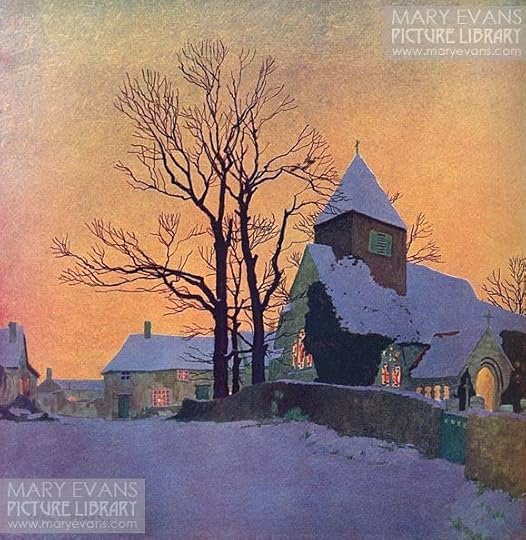
The original source print for the cover of “Murder After Christmas” from Colliers Magazine 1930. Image sourced from the Mary Evans Picture Library.
As explained in editor Martin Edwards' introduction, Rupert Latimer was the penname of Algernon Victor Mills (1905-1953) who only wrote 2 or 3 novels. Even the exact number is uncertain as it is possible that Death in Real Life and The Unenchanted Circle are the same book under different titles.
Trivia and Links The British Library Crime Classic series are reprints of forgotten titles from the 1860's through to the 1950's. You can see a list at the British Library Crime Classics Shop (for North America they are reprinted by the publisher Poisoned Pen Press). There is also a Goodreads Listopia for the series which you can see here.
What starts out like it'll be a cozy Christmas crime read (try saying that quickly), is actually quite snarky in tone, surprising to me at least for a book written in the 1940s.
Before the actual murder happens, chapters whizz by with all the characters making jokes about offing another character, as if it's nothing, they do this all the time and there's a war on, you know.
It's well written, but I thought the mystery itself gets kind of lost in all the back-and-forth.
(Thanks to Poisoned Pen Press for providing me with a Christmas review copy through NetGalley)
I found this a delightful, hilarious and amusing little puzzle of a murder. The first half is sorting out who’s who and why so many love yet want the victim dead obviously not over Christmas. So scene is set for a murder at some point and then mass confusion reigns with so many characters trying/failing and basically getting in the way of the poor detectives to work out what has gone on. This is where the book for me stumbles a bit, due to certain characters it becomes almost pantomime in certain of its scenes. I couldn’t understand how they worked it out and really by that point I was as bamboozled as the chief Constable. I am not sure what I feel about this, as it was fun and very good festive but at the same time it was all a bit too much. And a bit waffle. Wasn’t keen on the detective either. But over all it’s still decent just not on par with the golden greats
Uncle Willie is rich and old, and therefore would be much more useful to his greedy relatives dead than alive, if only they could be sure who he’d left his money to. The Redpaths have reluctantly invited him to stay over Christmas, and jokingly discuss how they could go about murdering him – after Christmas, obviously, because they wouldn’t want to spoil the festivities. They’re not the only people who want Uncle Willie’s money though, and soon all kinds of relatives are turning up to try to inveigle themselves into his good graces. Happily for all involved Uncle Willie is indeed murdered, after Christmas.
This is told as a kind of farce and is one of those where it will all depend on whether the humour works for a reader or not. In my case, unfortunately mostly not. There are parts that are quite amusing, but it is repetitive to the point where the joke wears very thin indeed, and since all the characters are utterly unlikeable, including Uncle Willie, there was no one for me to care about, which might have kept my interest. The plot is convoluted and the cast of greedy relatives so large that I never really worked out who was who or how they were related to Uncle Willie and each other.
However, there is much talk of mince pies and Santa Clauses, and there are footprints in the snow, and a snowman, and lots of boxes of chocolate, so it does have enough festive jollity to just about carry it through the general messiness. Not sure I’d recommend it as a particularly good mystery, but if you’re in the mood for something light and the humour happens to work for you, then it’s an enjoyable enough way to spend a few festive hours. 2½ stars for me, so rounded up.
NB This book was provided for review by the publisher, the British Library.
Author Rupert Latimer weaves a novel that’s equal parts Golden Age mystery and P.G. Wodehouse. The large cast of family members, neighbors, hangers-on and constabulary are humorous without becoming silly or twee. The family’s laugh-out-loud antics and the sly comments on wartime England along with a surprisingly puzzling mystery add up to a wonderful read.
Sadly, Rupert Latimer (pen name for Algernon Vernon Mills), sickly from boyhood, died relatively young and produced only a few murder mysteries; I can only hope that British Library Crime Classics chooses to rerelease every last one.
In the interest of full disclosure, I received this book from NetGalley and Poisoned Pen Press in exchange for an honest review.
Thank you to NetGalley and Poisoned Pen Press for an e-galley of this novel.
If you are familiar with the project Martin Edwards and the British Library have embarked on, you will understand why it is significant when Martin Edwards calls a book "unorthodox" in his introduction to the story. This one definitely fits that description. At times I couldn't figure out whether the characters were meant to be as strange as the narration indicated or if this was just the style of writing of Rupert Latimer. It's for sure I needed to keep that description in mind as I read this Christmas murder mystery that seemed to go right off the rails at times. Still, I'm very glad it has been made available once again and glad I read it - once.
Sir Willoughby Keene-Cotton is unable to travel to his villa in San Remo Italy this Christmas season because of the unpleasantness of war on the Continent. Sir Willoughby's stepdaughter, Rhoda Redpath, decides to invite him to come to them for Christmas. After all, with all this cold weather maybe he will catch a chill and die. Said in a joking way, of course. Or was it? When the joke turns out to be true everything hangs on exactly when Sir Willoughby actually died. A lot of people have a stake in that information and the police are having a hard time getting proof of much of anything with all the strange characters wandering about the place.
This is unorthodox, yes, but it is also interesting to read and especially difficult to try to figure out. The author put in so many twists and turns I had no idea of who, what, or when but I was pretty sure of where! Turned out I was wrong.
Out of all the books I have read so far from the golden period of crime ‘Murder After Christmas’ is one of the most entertaining and enjoyable. It is a hidden gem. As one other reviewer put it, it’s cross between PG Woodhouse and a classic whodunnit. Trying to solve the crime is half the fun, the other half is the brilliant collection of characters and suspects, you meet along the way, and the victim of the crime, Uncle Willie’ is the most entertaining of them all.
The story takes place in the most iconic of whodunnit settings, a country mansion at Christmas. Sir Willoughby Keene-Cotton - Uncle Willie, who has lead a colourful life gathers with his family for the festivities in what turns out to be his will be his last Christmas. There is an abundance of suspects and motives and a plethora of mince pies to wade through to find the solution and of course there is the obligatory detective to untangle the plot and sort out those mince pies from the chocolates. It’s not such a shock that Uncle Willie ends up the corpse, even before we get to that point the family member’s main topic of conversation seems to be how to kill Uncle Willie!
‘As the plot thickens the storyline becomes increasingly eccentric which results in Smythe, the Chief Constable observing that it is “almost a relief to realise there’s still a war on after listening to all that stuff”.
Murder After Christmas was written by a little known writer, Rupert Latimer, and has been out of print for three-quarters of a century, it was first published in 1944. I am pleased this this rather unorthodox Christmas whodunnit was unearthed and reprinted as it was a pleasure reading it. There is also a nice prologue that’s worth a read too.
I did not enjoy this parody of detective fiction. There were so many characters, telling lies and keeping secrets, it was nearly impossible to remember who was who and the storyline was convoluted and silly. Not to mention the mince pies! One star for the nice cover illustration.
When Sir Willoughby Keene-Cotton is found dead in the snow, dressed as Father Christmas, on boxing day at his step-daughters house, suspicions are raised that it may be foul play. He was immensely rich, and there are several people who could potentially benefit from his will, but who will depends on whether he died before or after Christmas. What follows is a twisty turny, madcap mystery that is highly entertaining, as long as you can suspend disbelief.
*Many thanks to Netgalley and the publishers for a review copy in exchange for an honest opinion.*
If ever a book needed a list of characters, it's this one, along with an explanation of how they are related to each other, and most importantly, to the murder victim Sir Willoughby Keene-Cotton, known as Uncle Willie. Most of Uncle Willie's extended family are gathered for Christmas at a large house called Four Corners owned by one part of the Redpath family. People arrive, people leave and don't come back, and people leave and do come back.
There is a lot of dialogue in this book and this is wonderful, but almost all the characters are incapable or unwilling to tell the complete story of their behaviour in any given situation. And then they contradict themselves. A lot of them admit that they'd like to murder Uncle Willie but then say they didn't actually commit murder. Another character says he dumped Uncle Willie on the lawn after they found him on a footpath because he didn't want to spoil a treasure hunt.
There is a shoal of red herrings and your credulity will be stretched by characters who hide food inside a snowman, sew mince-pies inside a chair, and forget to tell their loved ones that a relation has died.
Having said that, it's an enjoyable read and I'm glad that the British Library is publishing over a hundred of these stories from the 'Golden Age' of British detective fiction from the 1930s and 1940s.
My head is whirling from this book and not in a good way! The plot is not bad but the writing style is extremely ‘camp’, haphazard and extremely annoying. I’m not sure if this is deliberate on the part of the author but it left me with a headache - all the repetitive dialogue and the unnecessary details. I liked Superintendent Culley but even he got my nerves by the end…they all did! And all this talk of ‘an altruistic’ murder is such a load of BS.
Unlikeable characters & an unnecessarily complicated plot & narrative, made this less enjoyable than it could have been. The humour wasn’t bad though - a tiny redeeming feature. Avoidable!
Another Christmas read in the run up to Halloween! 😀
I love a classic British murder mystery novel, and this one ticks 2 of those 3 boxes. It's a murder mystery, and it's British - it is not a classic, I'm afraid. It's not bad either. It just became tedious at the halfway point, and I began to care less and less who the killer was - not a good sign for a murder mystery. The unveiling at the end was good, but it rambled too much for my liking. The characters were interesting enough. The police constable (whose name I can not remember now - not a good sign) was the most curious of the lot. It's a fun enough read, but the plot is stretched very thin in places!
Would I recommend this novel? It's not essential reading, no, but it's worthy of a pass should you be tired of Christie or Sayers.
This was an enjoyable festive murder mystery from the British Library Crime Classics collection. These vary tremendously, but I am happy to say that Murder After Christmas was worth reading.
It was lively, tongue-in-cheek and threw in just about every Golden Age element you could list.
I'm only giving it 3 stars because it felt very long winded and because sometimes I felt a bit baffled by the characters (I kept wondering if they were MEANT to be acting so strangely?)
Still, there was some excellent misdirection. I thought I had it all wrapped up and I was nowhere close!
Recommended if you're looking for a light, Christmassy mystery read. Warning though - it will make you want to eat mince pies!
Dnf, just not interested after getting about a third in. Too many characters, couldn’t keep track of who was who, married to who, related to who…and not clicking with the writing style.
Very clever and humorous Golden Age mystery that falls into the category of the rich elderly gentleman with many relatives waiting to inherit. It's the type of book in which you get to the end and want to go back and reread how you missed the clues and just how it was all pulled off so successfully.
Whether before or after Christmas, it has all the elements of a good Christmas mystery: Father Christmas, mince pies, chocolates, snow, and warm fires; as well as, lots of suspects with multiple motives, nefarious means, and varieties of opportunity. The ending is delicious and quite a surprise.
With the elimination of some minor characters, this would make a wonderful BBC production or a movie in the vein of Knives Out.
I love how the British Library Crime Classics has been resurrecting forgotten novels from the Golden Age. I have found some absolute gems and hope to find more (thanks to Poisoned Pen Press making them available on this side of the Pond ... and the New York Public Library having so many available digitally). This one? Well, I think there's a reason it was forgotten and perhaps it should have stayed that way. It actually made my head hurt and m pretty sure both stars given were for the introduction by Martin Edwards.
This was a fun but over-the-top romp with more twists and turns than I could keep track of. I sympathize with the detective and his superior who just did NOT want him to find yet another clue.
I enjoy this series from the British Library. Most are mysteries from the Golden Age of mysteries which was the era which included Agatha Christie. Like many Christmas mysteries, this is set in a "big house' in the country. There is inevitably a blizzard with a houseful of trapped guests. There is a death. Was it murder? And who is/are the rightful heirs of the deceased's fortune?
The least serious murder mystery I've ever read. As if Jeeves, Wooster, and Aunt Agatha were in charge of the investigation. "Are they all on the borderline?" asks the Inspector, who's no less certifiable. A good portion of the humor comes from the liberal use of adverbs as the characters report, retort, and expostulate nostalgically, grumblingly, broadmindedly, retentively, commiseratingly, and on and on. "Poor old turnip," was my favorite phrase as I hungered for the plentiful mince pies which apparently is a British thing at Christmas, and explains my mother always cooking such at the holidays and my friends not knowing what they were. I also didn't grasp the British affection for Yuletide mysteries, but I've read a few now and this was quite Christmassy.
Quite good fun, memorable characters, most unlikeable but not hate-able. An interesting resolution, to be sure! Must read this again some Christmastide to piece it all together.
3.5 stars. This could be an absolutely excellent book, but I think it was in dire need of some editing!
On the plus side it’s clever and well written, with a humorous and light style that makes it an enjoyable read. On the downside, it’s pretty repetitive at times, with some winding an unnecessary elements that take away from what could be a snappy ingenious whodunnit.
There’s also some truly unlikeable and over-privileged characters that you get the sense the author has a lot of sympathy for!
3.5 stars. You'll enjoy this most if you accept from the beginning that it's meant to be absurd, rather than a serious or realistic murder mystery. Obviously (and especially once the solution is revealed) the behavior of several characters is entirely ridiculous from a realistic point of view, but when viewed more as a mischievous holiday-themed spoof of mystery conventions it's quite funny and entertaining.
This book presents a very good puzzle plot, and I was nowhere near solving it. (Which I rarely do.) At least three times I thought the story was finished when it was not.
I would give it four stars, but I went down to three because I had so much trouble keeping the characters straight. This has happened to me before, and usually I do not blame the author. Often, it is because the narrator has not done a sufficient job differentiating the characters’ voices, which was part of my problem here. Moreover, this author spent very little time introducing his characters. There a lot of them, and new ones keep appearing well past the halfway mark. I should have taken notes.
3.5 stars Frank and Rhoda Redpath invite Rhoda's stepfather to spend Christmas with them, their son John, his girlfriend and Frank's aunt Paulina, with a few ulterior motives. Unfortunately, after he has been with them a few days they are thinking that might not have been a good decision. Uncle Willie is rather contrary, forgetful and secretive, although being a Sir has opened doors in the local community for the Redpaths. Uncle Willie is on his third marriage, the first to an actress, the second to Rhoda's mother and now he is married to a widow (although how often they have actually met is open to debate certainly they don't live together) who will inherit everything on his death and who has children in reduced circumstances. After a Christmas Tree party at which he had played one of the two Santa's Uncle Willie is found dead by the snowman and the cause is found to be laudanum. Which begs the question was it an accidental overdose as his cough medicine contained laudanum, or was it murder and if it was what was it in? There is a further complication when it is discovereed that Uncle Willie's wife died on Christmas Day so now his will is invalid as he is considered to have died intestate so who will get his money? This is not a straightforward case due to Frank's quixotic nature, John's inquisitive nature, and the fact that people try to hide things and lie more than usual. The whole Redpath family seems to be eccentric and quirky and certainly some of their behaviours are hard to explain, such as inviting the inspector investigating the case to come and stay with them. There is also the fact that the chief constable knew both the victim and the suspects and keeps changing his mind about who is guilty. I did enjoy this and I really liked Frank and especially Rhoda Redpath, as well as Pauline Redpath. But I found the last part of the story dragged quite considerably so much so that I actually felt like giving up on it except that I wanted to see if my guess about the villian was correct, so instead reverted to talking to the book saying "oh for god's sake get on with it"!!
Ealing Studios, famous for British comedies in the 1950s, missed a bet by not adapting this 1944 novel to film. Murder After Christmas features many British eccentrics, most of them part of an extended family, all seemingly encumbered with extraordinarily bad judgement complicated by an excess of discretion cloaked in civility.
"'With so many detective stories written, murdering people has become a kind of intellectual sport nowadays,' said Frank."
Sir Willoughby Keene-Cotton, somewhere in his nineties and quite rich, goes to the Redpath's home for Christmas since Mrs. Redpath is his step-daughter, and ends up dead via an overdoes of laudanum. How this was accomplished is a part of the mystery and involves pre-Christmas mince pies and post-Christmas mince pies, both eaten and uneaten, war-time rationing -- waste was a great taboo -- as well as boxes of chocolates and cough syrup, in addition to family, distant family, near-family, friends and assorted others jockeying to get near the great man, none of whom seem shy admitting they had considered how best to murder the old boy as an intellectual sport.
Really an amusing and sometimes quite funny mystery, you may not ever think of the phrase "cast your bread upon the water" in quite the same way after reading it.
Murder After Christmas does not disappoint on the Christmassy front, with a plot centred around poisoned mince pies, a "Christmas Tree" (the name for a party given by the main characters on Boxing Day), and an unassuming role played by the snowman in the garden.
The murder victim is Uncle Willie, an extremely rich man who is staying with his stepdaughter Rhoda, and her husband Frank Redpath for Christmas. Willie is spending the season trying to write his memoirs, if only he could remember the names of all of his wives and in what order he married them!
Who murdered Uncle Willie and why gets quite complicated and I'm not fully sure I understand, but it is a a very jolly book, it kept me guessing until the very end and I enjoyed reading it.
This entire review has been hidden because of spoilers.