Phnom Penh is a city of beauty and degradation, tranquillity and violence, and tradition and transformation; a city of temples and brothels, music and gunfire, and festivals and coups. But for many, it is simply an anarchic celebration of insanity and indulgence. Whether it is the $2 wooden shack brothels, the marijuana-pizza restaurants, the AK-47 fireworks displays, or the intricate brutality of Cambodian politics, Phnom Penh never ceases to amaze and amuse. For an individual coming from a modern Western society, it is a place where the immoral becomes acceptable and the insane becomes normal. Amid this chaos lives an extraordinary group of foreign residents. Some are adventurers whose passion for life is given free rein in this unrestrained madhouse. Others are misfits who, unable to make it anywhere else, wallow in the decadent and inviting environment. This unparalleled first-hand account provides a fascinating, shocking, disturbing and often hilarious picture of contemporary Phnom Penh and the bizarre collection of expats who make it their home. As they search for love in the brothels or adventure on the firing range, Phnom Penh Journey follows them into the dark heart of guns, girls and ganja.
I originally read this book several years ago well before I wrote reviews. I gave it three stars back then, but thinking back on it I had wondered if I undersold it. Stars are interesting - I often consider whether they are not only related to the quality of the book, but the circumstances in which it was read, and even the context in which it is read.
In this book, the author spends time with a bunch of shifty expats in Phnom Penh under false pretences - because, obviously, he is writing a book - about dodgy expats. His cover story is that he is in Cambodia on a break from biology research on marine life in Vietnam's coastal waters. This allows him to make multiple trips over the period 1996 to 1998.
This book obviously sets out with the intention to shock. It runs a triple theme of guns, girls and ganja. On guns and ganja he doesn't spend an awful lot of time. The situation is, basically, that they are both very readily available at moderate and low cost respectively.
It is the girls where the author concentrates his time, although it is the guns and ganja where he manages his gonzo journalism - he steers pretty much clear of the girls, except for a couple of research visits.
And it is with the girls that the story of the expats receives the most coverage. Almost exclusively prostitutes, although some are girlfriends as well, and most are far younger than generally considered acceptable. While the prostitution is rife, and 13-14 year old girls are involved in vast numbers, and at the shocking cost starting at only $2 - the most disturbing information is arguably the brazen behaviour of the expats.
Almost all of he expats within the authors circle of 'friends' are English teachers. They are from a variety of places - USA, Denmark, New Zealand, Australia and the UK amongst others. It is not so much the terrible debauched behaviour of these men, who range from young to middle aged, but the openness with which they not only go about this behaviour, but also the willingness to openly discuss it amongst themselves without even a facade of decency to shelter behind.
Nevertheless, the book covers a few other elements of life as a (relatively) wealthy expat in Cambodia. The coup of July '97 forces a change to the situation for the expats. Many decide it is necessary to leave and head either home, or to the 'next' place. Others, with perhaps fewer options, decide to stay. But things are different - fewer tourists, and fewer English schools.
As well as some discussion around various aspects of Khmer culture and the Khmer people, and a relatively brief history, this book follows a half a dozen main characters through various situations and stories in Phnom Penh, and then in the short period after they leave.
Ultimately the book sets out to shock, and at some level it does. At the same time, it was not very well written (or edited), sets out to be gratuitous and sensational. I also thought the author sat on the fence. He misled those he wrote about into thinking he was one of them, but never committed to a true gonzo journalism scenario. He messed with some guns, but no more than a few shots at an (unofficial) shooting range; and with some drugs - but not really as much as the others; and he dressed up his few minor interactions with prostitutes as research.
I was amused to find this book still gets three stars from me - probably between three and four, but nearer three.
Earlier in 2023, I wrote a review based on what I remembered from having read “Off the Rails in Phnom Penh” in 2003. This book had popped into my mind many times over the years, and with a first-ever trip to Cambodia coming up, I thought I’d review it. Now that I’ve spent a week in Cambodia, and been lucky enough to find a copy of Off the Rails in a second-hand bookshop in New Zealand, I want to re-review it.
Off the Rails in Phnom Penh is a much better book than I remembered. It’s engaging and informative, and the editing isn’t bad, despite some reviewers getting a bee in their bonnet about ColUmbia instead of ColOmbia. What I remembered most was the chapter titled ‘Sex.’ This chapter details the adventures of a group of (mainly) English teachers who live or hang out at the Majestic Hotel. They make trips to brothel villages around Phnom Penh to sleep with teenage prostitutes for as little as two dollars.
Prostitution which is usually considered morally wrong, exploitative, or at least shameful to partake of in the West, is more or less celebrated at the Majestic.
Not surprisingly, this section garnered the most attention and furore – how could people resist the outrage of these white male villains served to them on a plate? While the chapter remains an interesting exposition on a taboo topic, Off the Rails has much more going on. However, apart from an excellent piece in the defunct Mekong.net, I haven’t read any reviews commenting on Gilboa’s succinct summing up of Cambodia’s troubled history or his report on the coup of ‘97. Sex rather than violence outrages the Western mind. When reflecting on my trip, I found his chapter on Cambodia in the second half of the twentieth century helpful. It’s easy to keep in mind the horrors of the Khmer Rouge regime from 1975 to 79. What’s harder to remember is what happened from 1970 to 75, and from 1979 to 97. Gilboa explains both of these periods in a concise fashion.
The thing that disturbed me most during my second reading was that Hun Sen, who careful readers will note is the real villain of the tale, is still, in 2023, Prime Minister of Cambodia. Throughout the book, which came out twenty-five years ago, Hun Sen and his CPP (Cambodian People’s Party) are presented as ruthless operators who don’t hesitate to take violent action. When Hun Sen’s rival plan to meet, this happens:
“Hun Sen predicted – he didn't threaten, he just predicted – there might be a grenade attack on the meeting. He wouldn’t have anything to do with it, of course, he just had an inkling it would happen.”
Another Hun Sen tactic is to accuse his enemies of what he himself is doing, as we find out during the coup Hun Sen launches against his co-Prime Minister, Prince Ranaridh.
Listening to Hun Sen angrily rail away, Reiner translates what he can. “He keeps talking about illegal weapons and the Khmer Rouge troops brought to Phnom Penh by Ranaridh. He says it’s not a coup but he has the force to prevent a coup by Ranaridh using the illegal weapons and KR troops. “Classic CPP,” says Joe. “They do something and then accuse the other side of it.”
Joe and Reiner are but two of the many contacts Gilboa makes at the Majestic. They fit into Gilboa’s adventurer category of flotsam expats. The adventurers dabble in the girls, guns, and ganja but they have skills to operate outside Cambodia, a place in the mid-90s where teaching four hours of English a day, sober or not, could earn you a living. In the lifer category – those who couldn’t face up to the real world outside – are Eric and especially Mike. At one stage Mike is too wasted to get up and go to work. Eric tries to help:
Eric continues heroically trying to save his friend from himself but finally gives up and goes to class, leaving Mike comatose on the couch. I was touched by the concern this militaristic, racist, homophobic, child molesting smack addict showed toward his friend.
Even the amoral Eric can see Cambodia would be better off without Hun Sen, and claims with his military training he could take Sen out if the CPP’s political enemies would give him a sniper rifle.
“If FUNCINPEC can give me one Schmit-Rubens and a hundred thousand dollars, I’ll guarantee within one month, Hun Sen goes down.”
In the lawless, corrupt Cambodia of the 90s where government workers earned sixteen dollars a month but drove 50,00 dollar cars, Hun Sen was already working on his cult of personality and positioning himself as a humanitarian.
For the past couple of weeks, Phnom Penh has been a buzz because an unknown organization awarded Hun Sen this prize for his efforts toward peace.
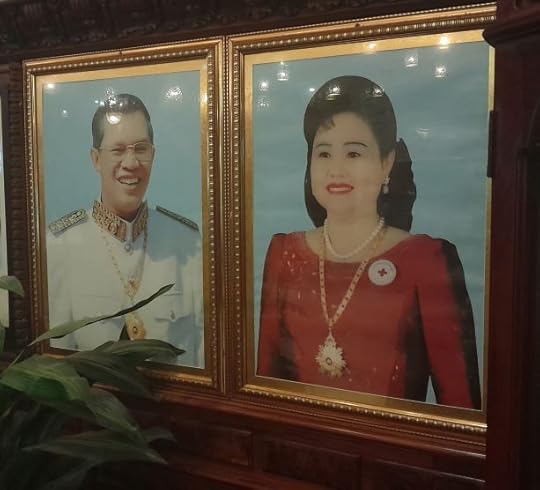
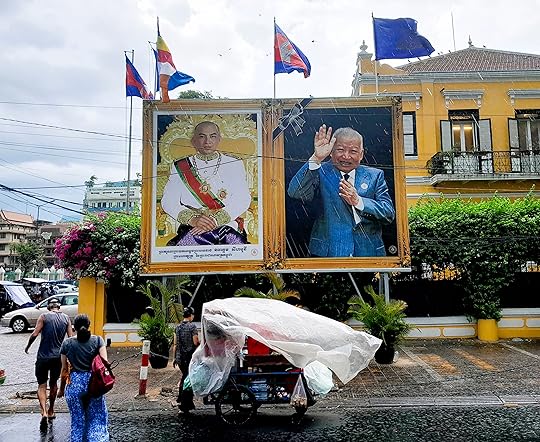
During my recent Southeast Asia trip, I saw a cult of personality in the propaganda for the sinister Thai King and for Uncle Ho in Vietnam. However, the current political leaders of Thailand and Vietnam kept a low profile. By contrast, in Cambodia, I saw hagiographic pictures of Hun Sen and his wife – almost as many as of the previous and current king. Here is an example from the lobby of my hotel. Both Hun Sen and his wife are wearing medals and, naturally, she sports a Red Cross badge. The following image shows the late King Sihanouk and King Norodom. (Photo taken the very moment the storm hit.)
The United Nations Transitional Authority in Cambodia didn’t do anything when Hun Sen refused to accept the election results in 1993. He lost the election but brokered a power-sharing deal. Also – on the topic of where moral outrage should be directed – the UNTAC police and troops arriving in the war-torn country led to a huge increase in prostitution and AIDS. The worst offenders were the Bulgarians, nicknamed the Vulgarians.
UNTAC personnel were given a hundred and forty-five dollars a day for living expenses – in a country where the average income is about one hundred and twenty a year.
The chapter on drugs is perhaps the least interesting in the book. Modern-day backpackers in Southeast Asia of the weed-smoking persuasion would laugh at the photo of Gilboa proudly holding a large bag of low-quality ganja that cost him two dollars. A joke when you consider what’s now legally available on the streets of Bangkok as you can see below.
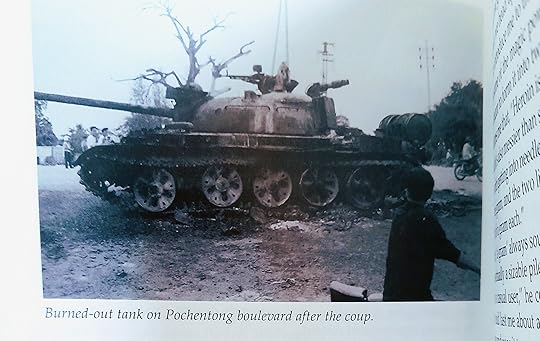
More impactful are the photos of burned-out tanks Gilboa took during the 1997 coup.
On a motorbike, he sets out to report on the coup and finds the airport and its surrounds looted by Hun Sen’s victorious soldiers. At one stage, the motorbike won’t start and he comes uncomfortably close to Khmer Rouge troops recently out of the jungle and now on the side of the CPP.
“Unlike the teenage soldiers in town who are generally good-humored, these advancing troops get ready to kill at the slightest excuse. I get a very bad feeling.
I enjoyed his amateur conflict reporting and admired his desire to find out what was going on. While a quote on the cover describes the book as a Gonzo rant in the style of Hunter S. Thompson, I find the book more the descendant of Michael Herr’s "Dispatches," rather than anything by the overrated Thompson. Like Herr, Gilboa uses a lot of quoted speech in his work and it’s up to the reader to decide what to believe. But we get a sense of time and place.
Leave the conflict reportage to the professionals you might say. But I got a decidedly jaded picture of war reporters working for the big networks from Francesca Borri’s book "Syrian Dust." Borri, another disciple of Michael Herr, tells of reporters with big budgets turning up to war-torn Aleppo and paying big bucks to fixers so they can get shots of kid soldiers with Kalashnikov rifles smoking cigarettes. These kinds of staged images allow CNN’s Anderson Cooper to employ his best morally outraged expression. The ‘real’ freelance war reporters like Borri can’t make a living…even if they ask for seventy euros an article they will be undercut by other desperados. And living in a conflict zone is not cheap.
Gilboa attempts to explain what makes the Khmer people tick. He doesn’t go particularly in-depth, but he’s more interesting than your friends telling you they too have been to Cambodia too, and the people were lovely, the food delicious, and the history sad. The author is a rare creature: a reflective extrovert. Despite real potential as a writer, he hasn’t added to this 1998 effort. Instead, he moved on to work as an actor in Chinese language soap operas – yes, as a token Mandarin-speaking white guy. And then he reinvented himself as a percussionist in Singapore.
I can’t say I found Phnom Penh as charming as Gilboa did. One of the main changes since the 90s is that the roads are now paved – but certainly the traffic remains chaotic. The lawlessness has gone but the city remains gritty. The only time I saw traffic cops was when they cleared the road to make way for a couple of black SUVs with tinted windows to pass through – something which hasn’t changed since the time of Off the Rails. Probably Sebastian Strangio’s "Hun Sen’s Cambodia" is a good book to read to know what’s going on. Hun Sen is now a big friend of China and if one wants to investigate sleaze, they need to look at Chinese organised crime in Sihanoukville.
I did come across three flotsam expats like those described in the book. My partner is Mexican and always keen to eat tacos. So we ended up in a foreign-run taco restaurant in downtown Phnom Penh. One of the owners sat at the bar smoking, cigarette ash falling down the front of his shirt. A big man, his tattooed forearms looked like those of a T-rex against his beer belly – lifting the beer glass to his mouth was obviously the extent of his exercise routine. From California, he’d been in Cambodia twenty years - he used to be an artist, used to speak Spanish, used to study Khmer but had given up. A cartoon of him, his Cambodian wife, and his son on the wall showed he wasn’t completely full of shit about being an artist. He did a shot of tequila and began to tell of the good old days of dirt roads in Phnom Penh when a Khmer too high to hold a gun straight might try to rob you. He had a sadness about him, an air of opportunities lost. I didn’t think him a bad soul and he knew a few things about making tacos. His business partner, a Brit who took the orders, and ordered the Cambodian barman around was drunk and unpleasant, as was his Italian wife. Glassy-eyed and covered in tattoos, she loudly told the story of how she’d broken her leg while falling down the steps drunk. Very funny she thought it. The Californian too had a gammy leg, his ankle was swollen and bruised. A drunken accident? Gout? They talked about booze a lot – I used to find these Off the Rails expats fascinating in my twenties. Now they bore me. Probably the middle-aged Gilboa feels the same.
Review before re-reading and trip:
Off the Rails in Phnom Penh chronicles the adventures of the expat community in the 90s, in the post-civil war era of anything-goes hedonism. It made quite an impression on me and here I am writing a review twenty years after reading it… Cambodia has come a long way in the 21st century, and I don’t expect much of the vibe described in the book to remain. Be forewarned this review doesn’t strictly stick to the book.
Having seen what could happen in Thailand out alone at night with too many beers inside, I decided to skip Cambodia in my Indochina travels in 2003. I’d heard of the debaucheries on offer there and they scared me. Now, in 2023, I’m excited to finally visit that country this June.
Instead of Cambodia, I went to Laos to get away from – the unhealthy for me at that stage – Thailand. I’m not against a party lifestyle or P4P sex, but you’ve got to know how to lead this lifestyle so it squares with your moral limits, and you keep safe and healthy. Hang on, is that possible? Maybe not, and that’s part of the attraction.
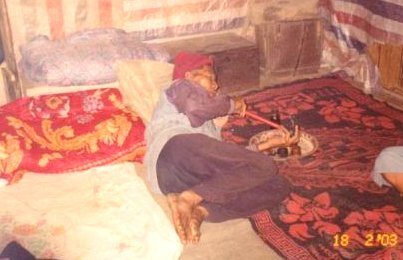
In the Northernmost province of Laos, Phongsali, I did a three-day trek staying in Akha and Hmong villages. Although I saw Akha smoking opium, they didn’t offer me any.
Their teeth stained by blood-coloured juice freaked me out. I didn't know chewing betels nut with slaked lime caused this. After, I went down to Laos’s temple town Luang Prabang and, in a hostel, swapped my copy of Graham Greene’s The Quiet American for Amit Gilboa’s Off the Rails in Phnom Penh.
I’ve talked to people who fired machine guns while drunk in Cambodia in the 90s and early 2000s and heard talk of shooting cows with bazookas. Some said they turned green and nearly passed out from ganja pizza (this you can still do I’m guessing). The guns and ganja are in Gilboa’s book, but where he aims to shock it with the underage prostitutes available for as little as two dollars. The book is set before the coup in 1997, a time of true off-the-rails hedonism. Hun Sen ousted his co-premier in this coup. Old Hun is still in charge! The resulting violence had a negative effect on the tourist industry and many expats left.
The expats Gilboa hangs out with at a hostel bar (if I remember rightly) are open about visiting prostitutes. Many of them are English teachers, a group whose reputation has taken many hits over the years. Balboa only partakes in two brothel visits, on the first of these a girl of about 19 – who, interestingly, is Vietnamese – gives him a blowjob. Right there Gilboa has admitted something that would get him, by today’s standards, struck off the list of the human race in the West…with the liberal left being the first to yell for his lynching. I’m just old enough to remember a time in the 80s when the conservative right shouted the loudest to lynch moral transgressors. Gilboa claims he did it as research for his book. I think he was trying to find his own moral boundary. Once he overstepped, he didn’t keep going. These days he looks to be a happy family man in Singapore. He hasn’t written another book. He’s probably scarred from the negative reaction to Off the Rails. Although he set out to cause a stir, he overestimated his ability to deal with the vitriol.
This book pissed me off for many reasons. I'll first begin by outlining the most trivial of these and get myself gradually more worked up to finish in a full rant. Firstly, it's bloody ColOmbia. It's an o, not a u. Get it sorted. Secondly, there were 2 more spelling mistakes/omissions and I do think for such a short book, that's unacceptable. Whoever edited this sucks. Thirdly, this by no means went 'into the dark heart' of the issue. The book never attempted to explain why ex-pats are so damn depraved and reprehensible in Phnom Penh. Instead, Gilboa thinks one depraved anecdote after another will suffice. Not to mention that the history bit is concise to the point of omitting important aspects of recent history and does not give a full and probably just picture of Cambodia in the 1990s. Of course we can infer that those ex-pats he surrounded himself with were simply losers who knew they could only get away with their disgusting behaviour abroad, where sadly, westerners aren't subject to the same moral laws and expectations, neither by themselves or locals. Regardless, I think there could have been much more substance to this book than what we were eventually given. Off the Rails was sensationalistic, poorly-written (even for a business journalist), and gratuitous. Obviously Gilboa wanted to shock, but I'm not sure the entire book in its current form was necessary. I don't know what it is, but it just felt like porn lit to me. Which brings me to Gilboa as an individual. Whilst he tries to distance himself from the dredges of humanity he hangs out with, in my opinion he isn't any better. I don't care if he didn't have 'proper' sex with a prostitute, the fact he had to dress up his inclination to visit the brothels and get high as 'research' just pissed me off. He had the gall to admit guilt and moral objections or caution, in a pathetic attempt to convince the reader into thinking him different to the assholes he spent all his time with. He isn't. He lived at the Majestic along with the rest, he partook in their conversations (research my ass) and indulged in all their activities. The entire book is an excuse to indulge and do some 'research', nothing more. I am utterly disgusted at the whole idea, the person, the behaviour and how he can profit from the misfortunes of Cambodians. Gilboa takes the moral high ground which makes him even more reprehensible in my eyes. I only wish I could kick him in the face.
The only thing this book is worth is the anthropological perspective on expats in the nineties in Cambodia.
These people are A-holes, using women in brothels in the worst ways possible. I just wanted to reach into this book and beat the hell out of these guys. Plus the author seems to celebrate this behavior, even partially participating in it, saying things like, that's just how it goes in Cambodia, and they really care about these women. I'm sorry, if they really cared they wouldn't subjugate them.
The history chapter was convoluted as hell and the book seemed to have no structure except for, now I want to talk about this. Also, he says he fact checked everything but almost all of this book is comprised of anecdotes from drugged out expats he meets.
Don't read it. Don't support this guy. I'm so happy I bought a copy of this book so this author doesn't get any money.
Although the author is certainly no Hunter S. Thompson as the cover may imply, this is a factual and intriguing look at the seedier side of an already seemy city, Phnom Penh. I bought this from a child selling books out of a basket in Phnom Penh, actually, and this book describes the Cambodian capital very realistically.
People here on Goodreads often call the author talentless, spineless, a terrible person for sleeping with hookers, etc. My regret with the novel was actually that Gilboa did not go further in his exploits. I don't like describing his weed-eating experiences as research. He should have just called it what it was: having fun with marijuana, and never tried to justify it. Just let the whoring and drugging be what they are.
As for the criticisms I see regarding how he just exploits these poor young girls, this obviously comes from readers who have no experience in Cambodia, Southeast Asia generally, and who have never read William T. Vollmann.
A good read overall, but I enjoyed "Butterfly Stories" for a more in-depth, well-written, lyrical approach to the underbelly of squalored cities in Southeast Asia.
An interesting but problematic first draft of a book. Apart from the writing error themselves, the author's attitude is also problematic. His analysis is very surface level. He doesn't display a strong enough connection to Cambodia and doesn't find the meaning behind the events, or what was going on there at that time.
First off the author is completely full of shit. He tries to be a Hunter Thompson style journalist documenting life in Cambodia but is really nothing more than an ignorant American that sees Cambodians as subhumans.
His attempt at trying to be a political scientist is an utter joke. It's convoluted, bias, and not credible in the least. After a few pages of that section, I completely skipped it because there was nothing redeemable.
The book revolves around a bunch of ex pat losers hanging out and telling their stories. They are entertaining. Their lives are pathetic. I actually enjoyed reading about these people, even though they are wastes of human life. Perhaps that's what makes it interesting in the first place. My problem was with the author himself. The guy is a piece of cowardly trash. An immature man child that sees the world in much the similar way colonialist must have seen "other" people.
For example, there's a part where he talks about the rampant prostitution due to poverty. He goes into detail about "kiddie corners," child brothels where foreign men pay to have sex with children. The author writes about this in solemn tone, but later he himself pays for oral sex with a 15/16 year old girl, and has the nerve to rationalize it as "research."
I couldn't give this book 1 star because the people he meets are fascinating. You're probably better off passing up this one.
Middling travelogue from a Cambodian expat who lived there 1996-1998. Hits all the expected notes: sex, drugs, violence, plus an overview of the Khmer Rouge & Cambodian politics. But it just didn't do it for me. The essays suffer from a lack of humor and the writer's voice isn't memorable.
The Exile it's not. If you want to see this sort of thing done better (done brilliantly, in fact) check out "The Exile: Sex, Drugs and Libel in the New Russia" :
A rather debauched but useful insight into a post-Khmer Rouge Cambodia; the Kingdom isn't quite the Wild East anymore but this book sets the scene for modern Cambodia well, with many of the problems in the book, largely the drugs, guns and prostitution, still prevalent today. This certainly isn't a book that I'd recommend to the easily offended, but I still thought it a worthwhile read to help make sense of contemporary Cambodia.
Informative and entertaining, though tragic. But I find myself wondering why the author felt the need to define words like "strip mall," and "gecko." Despite the occasional condescention on the part of the author, it was an enjoyable read...Inasmuch as reading about stoners who frequent brothels offering 12-to-17-year-old prostitutes can be "enjoyable." Still though, an important read with many insights into the culture, history, and politics of this fascinating country.
One of life’s eternal questions must be ‘Why do most people behave pretty much the way they should, most of the time?’ Excluding the odd bit of swearing at speed cameras and folk who ‘forget’ a few little things on their tax returns, society gets along because the majority behave in line with the law and the norms of social interaction. You can put it down to it ethics, a desire to conform with the ‘greater good’ or even at its most base, a fear of getting caught. Even though our prisons are apparently bursting at the seams, one way or another, most people behave themselves most of the time.
So what would happen if you took away the laws; if prostitution, drugs and guns were readily available and nobody was likely to give you a hard time for using them? Nobody would raise an eyebrow if you popped off to a brothel in your lunch break the way that many of us might pop into a Starbucks and it would cost about the same amount; nobody would notice, or apparently mind, if you showed up to work stoned and couldn’t make it through the afternoon without heroin; and if you got mad at someone you could get them bumped off for a few hundred dollars. All this and more is standard fare in Amit Gilboa’s horrible little book about Cambodia’s capital city, Phnom Penh, in the late 1990s.
Gilboa pitches his book as an account of the things he saw and heard when visiting Cambodia in the mid-1990s. From what I could work out – and to be fair I didn’t try too hard – he had a job in Viet Nam and needed to pop over the border to get his visa renewed every few months. Hanging out at a Phnom Penh hotel called the Majestic he decided to keep an account of the comings and goings of the ex-pats he met in the city. Most are not highly-paid professionals on well-funded business expatriations; his people are the drifters who are drawn to the city by cheap drugs, cheap sex and an apparent surfeit of testosterone matched only in its extreme by their lack of brain cells. Most, somewhat shockingly, had picked up jobs as English teachers – including some who barely spoke the language themselves. Hence the great quote from a Romanian -born English teacher – “I been teach English in Cambodia since four years”. Others had taken a strategic decision to go to Cambodia for financial reasons – indeed one guy we are introduced to is a heroin addict who worked out it was cheaper and safer to be an addict in Cambodia where he could afford it than to go home where he’d have to turn to crime to fund his habit. Other characters are quite happy to pay a few dollars to pre-teen prostitutes without appearing to consider it wrong or even particularly worthy of discussion or comment. These folks really are the type of people you don’t want to sit next to and you really don’t want to know too much about their lives. If you shook hands with them, you’d have to count your fingers afterwards.
The book starts with an attempt to put the political situation in Cambodia into perspective, introducing the Pol Pot years and the aftermath of the Killing Fields. I expected to find this interesting but it dragged on for so long and in such a poorly written drone that I found myself skipping through to get to the next chapters. There was also a lot of self-satisfied smug justification for why he’d written the book, pitching it as a sort of ‘Secret Squirrel mission’ to capture the dark underbelly of this group of international ‘flotsam’. He tries to set himself apart from the scum that surrounds him but I can’t help thinking the ‘detached observer’ role is used to its own advantage. Sensibly he avoids the whoring-around that’s common amongst his set but then decides that he must visit at least one brothel to do ‘research’ but he won’t go all the way. So that’s OK then, or is it? And he’ll cycle to the town where the brothel is and get a good work out – as if that somehow makes it better. Then he’ll go on a buying mission to get cannabis and it wouldn’t be REAL research if he didn’t snort a line or two or heroin as well.
In some ways, I might have respected the writer more if he’d not tried to justify his very tenuous moral high-ground. A book about drugs and prostitution written by a user will still be disturbing but we’re likely to stand a better chance of learning something useful about why they do it than we will in one written by an outsider.
I like a book that leaves me knowing more about a country and its society than I knew before but in the chapters titled ‘Drugs’, ‘Sex’, ‘Lawlessness’ etc. I realised that after the boring historical chapter it was still possible for the book to get worse. I know things about Cambodia that I didn’t know before – where to buy a kilo of cannabis for $2, that cigarette papers cost more than cannabis, that people snort heroin rather than injecting it because they think that’s less addictive and sadly, I know too much about what you can get a Vietnamese prostitute to do for a few dollars that a Cambodian one will refuse to do and what both will offer as an extra for a couple of dollars more. Ignorance in matters like this is undoubtedly bliss.
The widespread prostitution is for me the most shocking aspect of the book, especially the exploitation of girls as young as 12 years old. The expats really don’t seem to see anything wrong in what they do although one group do decide to instigate a ‘house rule’ that their perverted housemate can’t bring any prostitutes who are younger than 14 to their house. Isn’t it good to know that people have ‘standards’? I was left wondering what it took to get Gary Glitter expelled from Cambodia a few years ago when it appears that every Tom, Dick and Harry was happily molesting minors. Was he made an example of or was he really doing things that were worse than the people in this book – it really beggars belief that he could have been.
It’s been suggested that this book is a ‘Heart of Darkness’ or an ‘On the Road’ for the 1990s but that’s just not true – there’s no plot, there’s no character development and this is just a cheap little excuse for some pretty vile titillation dressed up as documentary prose. Gilboa is a poor writer and I really don’t know how he ever got this rubbish published. Even with the horrible subject matter, a half decent writer could have created a compelling tale that might have forced us to feel some kind of understanding for the perverts and paedophiles that inhabit this book. Instead Gilboa just strings together one nasty little anecdote after another. I’m not a prude and I’ve read plenty of books that are shocking, explicit or tackle violent situations but the least I ask for is a justification for the inclusion of the shocking material and sadly this book fails to deliver.
If you are looking for information to help you decide whether to visit Cambodia, you won’t get it in this book. If you are looking for titillation, there must be much better-written smut on the market that’s much more readily available. Would the world be worse if this book had never been written? I don’t think so – in fact for the first time I’ve actually started to understand the urge to burn books.
I picked up this novel from a hostel while travelling in Cambodia. On holiday from my job as a teacher in Vietnam. The continuity between my story and the opening of this novel were there. Both westerners, holidaying in Cambodia along with teachers, from Vietnam. The comparison ends there.
This book was sensationalist, white-washed, white man trash.
A wanna be Hunter S Thompson who thinks he is Louis Theroux does a deep dive on 1990s Cambodia.
Starts off with what feels like a historical info dump because he feels like he has to before he gets into the ‘juicy content’.
His journalistic flavour, if you will, means being forced into ‘research’ with women (girls, teens, children), and allowing men who are literally p****philes and SAers to talk freely and rile eachother up.
I felt sick reading this. There are so many other intelligent ways you could write. The way he speaks about Khmer people is also rotten, during a coup when he tries to run away because suddenly Cambodia is scary and America is calling, he called the families fleeing ‘poor and pathetic’.
Well. This is a poor and pathetic excuse of journalism all so a man can have his cake and eat it.
For lack of something to read, I purchased this book, one of a few English language books that looked interesting, at a Chiang Mai news stand. This is possibly the worst book I've ever read. The author, who freely writes about his exploration of Cambodia's brothels, is both arrogant and disgusting in what he describes. I couldn't read the whole thing, and I only post it as a warning to not waste your time, even if you've found yourself without a book and it's the only one available to you in a foreign country. This so-called author is unable to overcome his own self-created sleeze-factor as he lamely attempts to write in a Hunter S. / Gonzo journalism sort of fashion. Most of all it's just a badly written glorification of the type of sexual tourism that exploits and abuses young women and children. No redeeming value to be found here. Gilboa is a hack.
Read this during my time with a NGO in Phnom Penh. I thought this was a mildly interesting read, so why only 1 star? Well, besides the writers piss-poor writing-skills, I couldn't get over the fact that he sympatized to some degree with some of the guys exploiting teenage girls over there and made excuses for them...besides that he came across as a rightous and self-serving person.
I enjoyed this book. The author is very honest and upfront, which I appreciate, and the characters he describes were interesting to learn about. The book provides some history of Cambodia, some politics, and also some unofficial accounts of everyday life in Phnom Penh during the 90’s. I wish I could jump in a time machine and experience that era first hand.
As someone who only recently lived in Siem Reap's red light district, in a hotel populated with Russian alcoholics, local ladyboys, and random meth heads, this book has more relevance for me than most people. Hookers, some of whom lived across the road, sometimes visited. Siem Reap is not noted for its sex business—from this observer, the local sex business looks like a tug of war between deathpats, ex-pats busily drinking themselves to oblivion, and ice-babes, yaba consuming females, intent on separating them from their dollars before they depart. Yaba is a brain shattering chemical combination of amphetamines and caffeine. Probably a neural equivalent of nitroglycerine and dynamite together. Interactions seem as romantic as a napalm strike. Strangely, apart from the underage factor, things don't look too different from the times Amit Gilboa described. Okay, there are not many shootings here. However, recently a local woman smashed her lovers' skull open with a padlock in a sock, and a Brit was jailed for a hammer attack on his partner. Amit Gilboa is writing about the capital city, so the scale is much larger. I first arrived in Phnom Penh during the period he describes. The police and military were shooting at each other. Pot was on sale at the market for $20 a kilo! Basically, the book describes what young guys do when they can. It ain't pretty. Some may throw up in their mouths. Readers beware.
In 2017, I visited Cambodia for the very first time. In search for traditional music instruments, I checked out a local market, where an ambulant trader with a sad face asked me whether I wanted to buy any of the books he was selling. Maybe out of pity for him and the inhumane drama his country has gone through, I did not hesitate and bought this and another book. In the summer of 2025, I finally found the time to read it. It read like the raw notes of a late twenty year old backpacker's field notes, describing some of the same-age backpacker population that discovered Phnom Penh for things that they could not do back home or purchase at the same low price. It is an eye opener and reveals how traveling to a poor country can change the morale of Western people. The book is indeed entirely written from the perspective of the curious, adventurous Westerner. The author goes through many aspects of expats' somewhat sad and unreal lives. Unreal because they are mostly based on the enormous difference in wealth and status between the expats and the local population. This book is a shocking account of these stories. Maybe I would have liked the book better in my late twenties. Moreover, I have to remind myself that it was written and experienced in the nineties. I think this book falls short relative to today's post me-too and woke era. Nevertheless, I found it an interesting historical read from a single perspective.
Hard to give a review of this book without getting judgemental really fast. For one thing- this is NOT FOR JUNIOR READERS. This is all about adults getting their debauchery on in a big way. It's sort of a guide book to how Not to Act in a Foreign country. The author follow various semi-interesting characters he meets in a Cambodian hotel, and chronicles his sojourns there in the 1996-8 period of civil friction. Before and after Hun Sen's bloody 1997 ascension to power, Gilboa follows his cast-off crew of expats about their daily work(usually teaching english) , and then commercial sex and a veritable cornucopia of Inebrients (Cannabis/Heroin/cocaine/Barbituates/Alcohol). It's all so cheap that few show any self-control at all. Not sure about the veracity or compelling nature of any of these stories- but I am still both amused and appalled. There is some very interesting material on the historical/political situation and Khmer culture. Read at your own risk.
If you are going to write a book about a country, don't look for the story in an ex-pat bar full of the most cynical people. The author talks about the qualities of the Khmer people, but he doesn't actually go out and talk to any of the people, instead relying on the opinions of the people he meets in the bar.
The stories are just bar stories. They could be true, there's usually a grain of truth in bar stories, but just recognize that's all you're getting in this book.
Full disclosure: I've traveled, been to places like the Majestic, and met the people who hang out at those types of places. I prefer to hang out on the street with the locals, share a meal, learn a little of the language and talk football. That's where you learn about a place.
If this non-stop rain subsides tomorrow here in the northern Thai hinterland Khlong Nam Lai village 380 km from BKK (Bangkok) I will burn “Off the Rails in Phnom Penh” i’ll throw it into the flames of my campfire behind our house. Shame on You Amit Gilboa! Johannes Koistinen-Lindgren who once flew on a DC-10 from HEL to SIN.
Interesting account of Phnom Penh 1996 - 1997, particularly if you’re currently an expat here like me, 27-28 years later. Some similarities but quite a few differences - but those similarities are definitely there! Some good historical content in between grotesque tales of debauchery.
Fascinating narration set in 1990s Cambodia of what can happen when there are no restrictions, limits or accountability on male behavior in society; a study in debauchery.
I read it while traveling in Vietnam, preparing for Cambodia, cried multiple times reading it. Disturbing in some traits. Crazy that I didn’t know anything about it before being in SE Asia