

What do you think?

A Quality of Light
My life as a Kane was lit in the Indigos, Aquamarines and Magentas of a home built on quiet faith and prayer. But Johnny changed all that. Where I had stood transfixed by the gloss on the surface of living, he called me forward from the pages of the books, away from the blinders that faith can surreptitiously place upon your eyes and out into a world populated by those who live their lives in the shadow of necessary fictions.
336 pages, Paperback
First published March 17, 1997
About the author
Richard Wagamese
26 books1,632 followersRichard Wagamese was one of Canada's foremost Native authors and storytellers. He worked as a professional writer since 1979. He was a newspaper columnist and reporter, radio and television broadcaster and producer, documentary producer and the author of twelve titles from major Canadian publishers.
Ratings & Reviews
Friends & Following
Create a free account to discover what your friends think of this book!
Community Reviews
Displaying 1 - 30 of 83 reviews

April 9, 2018
In this novel, Wagamese once again unfurls the underlying theme of his fractured past: that of being ripped, as a baby from his Ojibway parents and raised in white society for 25 years. Although well-written (we can see the progress made between Keeper'n Me and this one) I remain a bit puzzled about this methods.
He introduces two young boys. Joshua, is a native child adopted into a white, Presbyterian family; John is from a rough-and-tumble white family from the mean streets of Toronto. The two become friends when John's (drunken) family return to their native soil in the heart of southwestern Ontario farm country, where Joshua is being raised as a good Christian lad. The bizarre thing here is that Joshua's life reads as an odd incarnation of Norman-Rockwell-Meets-Stepford-Wives. Everything is more good than goodness; everything is shiny and bright, like a new copper penny.
It is John, the city lad, who teaches Joshua, the farm boy, "how to be an Indian": a story that begins the first summer they meet, and culminates in Josh's ultimate salvation when he returns to his people. It is a story worth exploring -- very much so -- once you get away from Norman Rockwell. It is as if Wagamese entered a fugue state in recounting Josh's early life:nothing feels real about it, nothing rings true: not the way these people act, talk, think. The setting is perfect. The people are straw. But perhaps that was Wagamese's intent? (I can't make my mind up on that aspect of the novel; I just know it was dissatisfying to read.)
Wagamese is always at his best when he offers his kernels of wisdom, wrapped in tidy little paragraphs. He should have been a poet. All his truths emerge from the simplest riffs that he takes, once a story touches his heart.
Absolutely worth reading, even if you jump from truth to truth, like a grasshopper through the pages of this book.
A few quotes I liked:
There is, I believe, a part of all of us, born in our wounding, that wants to believe that there are answers to be found in the hollow faces of buildings and places our loved ones once inhabited. We arrive expectant as pilgrims, believing that something real will emanate from those surroundings and touch us with the fabric of the life we seek to reclaim. We want to walk across the territories they navigated, carrying a need like a longing across the floor boards, gardens and pavement, our desperation making it a holy ground, awaiting the consolations of a reticent earth. It never happens of course, because they are only buildings, streets and cities, and they speak only of the anonymous passage of time with no voice to soothe our melancholy. Still, we are pilgrims.
~~~~~ ~~~~~ ~~~~~ ~~~~~
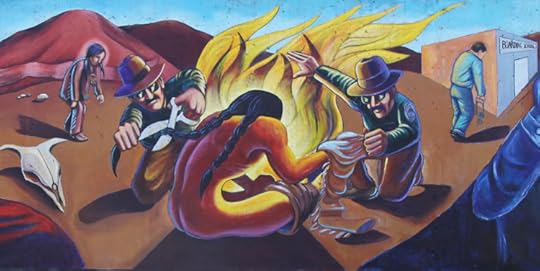
Painting: Assimilation by Judy Baca
~~~~~ ~~~~~ ~~~~~ ~~~~~
That's how assimilation starts, Josh. They take everything away and never allow you access to the information about yourself or your people, your history, your heritage, your spiritual legacy, your language. When the attack starts you're so removed from yourself, a part of you starts to believe it all. Pretty soon you're willing to do anything to fit in, to appear to be part "of" instead of apart "from", to shut the shouting off so you can live with some semblance of peace. The more you adopt the outside ways, the more you disappear because there's nothing left to chain you to yourself, your real self. You'd do anything to shut out the shouting, but by the time it dies down around you, the price tag appears and you realize that it's going to take forever for the yelling to go down inside yourself.
How do I know all this? Look at my life. I was never given a history or a heritage either. I guess the truth is that you don't have to be an Indian to be disinherited. The only difference between you and me is that I was white and never had to enter a room skin first.
He introduces two young boys. Joshua, is a native child adopted into a white, Presbyterian family; John is from a rough-and-tumble white family from the mean streets of Toronto. The two become friends when John's (drunken) family return to their native soil in the heart of southwestern Ontario farm country, where Joshua is being raised as a good Christian lad. The bizarre thing here is that Joshua's life reads as an odd incarnation of Norman-Rockwell-Meets-Stepford-Wives. Everything is more good than goodness; everything is shiny and bright, like a new copper penny.
It is John, the city lad, who teaches Joshua, the farm boy, "how to be an Indian": a story that begins the first summer they meet, and culminates in Josh's ultimate salvation when he returns to his people. It is a story worth exploring -- very much so -- once you get away from Norman Rockwell. It is as if Wagamese entered a fugue state in recounting Josh's early life:nothing feels real about it, nothing rings true: not the way these people act, talk, think. The setting is perfect. The people are straw. But perhaps that was Wagamese's intent? (I can't make my mind up on that aspect of the novel; I just know it was dissatisfying to read.)
Wagamese is always at his best when he offers his kernels of wisdom, wrapped in tidy little paragraphs. He should have been a poet. All his truths emerge from the simplest riffs that he takes, once a story touches his heart.
Absolutely worth reading, even if you jump from truth to truth, like a grasshopper through the pages of this book.
A few quotes I liked:
There is, I believe, a part of all of us, born in our wounding, that wants to believe that there are answers to be found in the hollow faces of buildings and places our loved ones once inhabited. We arrive expectant as pilgrims, believing that something real will emanate from those surroundings and touch us with the fabric of the life we seek to reclaim. We want to walk across the territories they navigated, carrying a need like a longing across the floor boards, gardens and pavement, our desperation making it a holy ground, awaiting the consolations of a reticent earth. It never happens of course, because they are only buildings, streets and cities, and they speak only of the anonymous passage of time with no voice to soothe our melancholy. Still, we are pilgrims.
~~~~~ ~~~~~ ~~~~~ ~~~~~
Painting: Assimilation by Judy Baca
~~~~~ ~~~~~ ~~~~~ ~~~~~
That's how assimilation starts, Josh. They take everything away and never allow you access to the information about yourself or your people, your history, your heritage, your spiritual legacy, your language. When the attack starts you're so removed from yourself, a part of you starts to believe it all. Pretty soon you're willing to do anything to fit in, to appear to be part "of" instead of apart "from", to shut the shouting off so you can live with some semblance of peace. The more you adopt the outside ways, the more you disappear because there's nothing left to chain you to yourself, your real self. You'd do anything to shut out the shouting, but by the time it dies down around you, the price tag appears and you realize that it's going to take forever for the yelling to go down inside yourself.
How do I know all this? Look at my life. I was never given a history or a heritage either. I guess the truth is that you don't have to be an Indian to be disinherited. The only difference between you and me is that I was white and never had to enter a room skin first.

September 2, 2021
This is the second book thats made me cry. At times quite literal burst out crying. Richard Wagamese's words sit like a butterfly on my chest. The most delicate, magical thing I've yet come across.
A stunningly beautiful story. A story of finding ones truth, ones light, through the sludge of life.
The raw spirit in the book is still physically resonating with me. Everytime I think about it, the feeling comes back.
I'll digress briefly to say that at times it was a little too philosophical Christian for me, but that's just me.
As I got towards the end, I wasn't sure if I wanted to round down the book as a whole to 4 stars but the ending convinced me that this was a 5 star book.
Lastly, it contains likely the most powerful passage I have ever read (it's at the end). I want to re-read those words to anyone that will listen to me, lol.
What an organic bright light Richard was, and continues to be to the Indigenous community and beyond. I learned so much from this book.
5/5 stars.
A stunningly beautiful story. A story of finding ones truth, ones light, through the sludge of life.
The raw spirit in the book is still physically resonating with me. Everytime I think about it, the feeling comes back.
I'll digress briefly to say that at times it was a little too philosophical Christian for me, but that's just me.
As I got towards the end, I wasn't sure if I wanted to round down the book as a whole to 4 stars but the ending convinced me that this was a 5 star book.
Lastly, it contains likely the most powerful passage I have ever read (it's at the end). I want to re-read those words to anyone that will listen to me, lol.
What an organic bright light Richard was, and continues to be to the Indigenous community and beyond. I learned so much from this book.
5/5 stars.

December 6, 2014
"Bein' Indian, Ojibway, is about learning the teachings and putting them into practice in your life. It's not about how you look, where you live, who you live with. It's about what you carry inside, not what you show to the world. It's an inside truth. When you have it within you, you can go anywhere, do anything -- you will always be an Indian, an Ojibway." (p. 208).
May 23, 2014
I have read about transgender issues, but never about "race" gender issues. Richard Wagamese has a beautiful touching story about Johnny, who feels he is a native Indian his whole life and who's best friend is a native boy, adopted by a white couple, who feels like a 'white' boy. The friendship between these two boys is special, and gives a most touching narrative about them growing up and this friendship changing over the years. Richard Wagamese writes stories that stay with you long after you finish his books.

November 3, 2019
With every story by Richard Wagamese, I am struck by his poetic, beautiful mastery of words. He was a true storyteller and such a loss for Canadians.
As I read this story, I could not help to feel that he was writing about the childhood that he wished for, that he deserved and that could not have been further from the challenges he experienced.
While this book did at times feel like a bit of a lecture, it opens the reader to thinking about their own experiences, to considering privilege, racism and bullying. It is powerful in the message and the reader savours the descriptive passages.
This book was a gift, given to me during a challenging time which I finished on my birthday. It was a gift in reading the powerful words of Richard Wagames and it was a gift of pondering the history lessons that were taught in school vs. the history that I am learning through fiction and non-fiction.
I would have liked to give it 4.5 stars. It was a terrific read but if you have not read Medicine Walk, Indian Horse or Ragged People, please make sure to add them to your TBR piles as they are absolute 5 star novels!
As I read this story, I could not help to feel that he was writing about the childhood that he wished for, that he deserved and that could not have been further from the challenges he experienced.
While this book did at times feel like a bit of a lecture, it opens the reader to thinking about their own experiences, to considering privilege, racism and bullying. It is powerful in the message and the reader savours the descriptive passages.
This book was a gift, given to me during a challenging time which I finished on my birthday. It was a gift in reading the powerful words of Richard Wagames and it was a gift of pondering the history lessons that were taught in school vs. the history that I am learning through fiction and non-fiction.
I would have liked to give it 4.5 stars. It was a terrific read but if you have not read Medicine Walk, Indian Horse or Ragged People, please make sure to add them to your TBR piles as they are absolute 5 star novels!

August 29, 2013
A Quality of Light tells the story of two isolated ten year old boys, pretty much mirror images of each other (one born Native but raised by white people and one born of White Trash but who feels Native at heart), who are thrust together, becoming blood brothers and life-long influences on each other, whether together or apart.
Joshua is an Ojibway who was adopted as an infant by a deeply spiritual, farming Christian couple who infuse him with a love of God and a love of the land. They consider him to be as much a part of their family as any biological son could be, and since they view Joshua with perfect acceptance, they never realise that they are doing him a disservice by not acknowledging his Native roots. By contrast Jonathan, raised in an aura of instability, moving often and abruptly across the sprawling and impersonal city of Toronto, is essentially ignored by his alcoholic father and enabling mother. When Jonathan's family moves back to the rural idyll of Mildmay, he and Joshua bond over a love of baseball and books, bringing out the best, the warrior, in each other. As young men they clash over what they see to be their individual responsibilities to themselves and to their communities and their paths diverge, only to meet up again later in a politically charged and very public confrontation. This is broadly the plot, which I found compelling, but in the particulars I wasn't completely impressed.
The writing promised to be interesting and lyrical, opening with a meditation on the nature of light and its connection to memory: You lay on a hillside in the high sky heat of summer, the red behind your eyelids making you so warm and safe and peaceful, it's like the scarlet a part of you remembers through the skin of your mother's belly when you, your life and the universe was all fluid, warmth and motion. But this light metaphor crops up several times in each chapter, and instead of serving to anchor the story, it becomes strained, a distraction. And while I did enjoy many turns of phrase (Jonathan describing his drunken father: People would say "Let's go out for a couple" and they'd be thinking a couple of beers and my father would be thinking a couple of weeks), in a lot of places I found it overwritten: It's not so much the lurk and leer of death that elevates us in the face of war as the tintinnabulation of life within and around us. (Not only do I not perfectly understand that sentence, but I think that only Edgar Allan Poe gets to non-ironically use the word tintinnabulation. Like, evermore.) And to add one last complaint, Joshua and Jonathan spend a lot of time sermonising to each other, giving long monologues about what they believe and what they have learned. Granted, there was obviously a lot of information that Richard Wagamese wanted to include in this book, but it felt unnatural and preachy.
As I was reading, I became impatient with how perfect the characters of Joshua and his family are: turning the other cheek with idealised Christian charity, even refusing to publicly name the attackers who beat Joshua into the hospital. I later became impatient with Jonathan's experience with perfect Natives: every Native, in every band he visits across North America, has an idealised connection with the land and culture of their peoples. Even the militants who provoke confrontation at Alcatraz or Oka aren't seeking money or land settlements or revenge, just respect and dignity. But when the boyhood friends do finally come face to face, these idealised characters seemed to rise to the level of archetypes, and I think that was the author's plan: By being unwavering representatives of their individual philosophies the plot takes on a fable-like feeling and the two men might just as easily have been Mole and Spider seeking the light in a Creator story; creatures of a fixed nature, acting according to impulses they don't question. By then having the friends find the common ground between them, they are revealed to be the humans they were born to be-- creatures capable of seeking and discovering the light inside themselves. (Or am I overthinking this?)
There were cliché moments in A Quality of Light -- in particular heartfelt exchanges between father and son -- but I ultimately found them touching. I think that the author had a lot of love for his characters and sympathy for the different points of view. What I appreciated the most in this book was the opportunity to take a hard look at the injustices that have been suffered by the Native peoples, from residential schools to full out massacres, and they are discussed with justifiable anger but not bitterness or fatalism. There aren't any answers offered here, no path to move forward toward the shared prosperity that I do believe every Canadian wants, but I welcome any opportunity to have these conversations. I realise that this is one of Richard Wagamese's first novels, and having read Indian Horse, I know that he has grown in technique and art and am looking forward to reading another of his books very soon.
Joshua is an Ojibway who was adopted as an infant by a deeply spiritual, farming Christian couple who infuse him with a love of God and a love of the land. They consider him to be as much a part of their family as any biological son could be, and since they view Joshua with perfect acceptance, they never realise that they are doing him a disservice by not acknowledging his Native roots. By contrast Jonathan, raised in an aura of instability, moving often and abruptly across the sprawling and impersonal city of Toronto, is essentially ignored by his alcoholic father and enabling mother. When Jonathan's family moves back to the rural idyll of Mildmay, he and Joshua bond over a love of baseball and books, bringing out the best, the warrior, in each other. As young men they clash over what they see to be their individual responsibilities to themselves and to their communities and their paths diverge, only to meet up again later in a politically charged and very public confrontation. This is broadly the plot, which I found compelling, but in the particulars I wasn't completely impressed.
The writing promised to be interesting and lyrical, opening with a meditation on the nature of light and its connection to memory: You lay on a hillside in the high sky heat of summer, the red behind your eyelids making you so warm and safe and peaceful, it's like the scarlet a part of you remembers through the skin of your mother's belly when you, your life and the universe was all fluid, warmth and motion. But this light metaphor crops up several times in each chapter, and instead of serving to anchor the story, it becomes strained, a distraction. And while I did enjoy many turns of phrase (Jonathan describing his drunken father: People would say "Let's go out for a couple" and they'd be thinking a couple of beers and my father would be thinking a couple of weeks), in a lot of places I found it overwritten: It's not so much the lurk and leer of death that elevates us in the face of war as the tintinnabulation of life within and around us. (Not only do I not perfectly understand that sentence, but I think that only Edgar Allan Poe gets to non-ironically use the word tintinnabulation. Like, evermore.) And to add one last complaint, Joshua and Jonathan spend a lot of time sermonising to each other, giving long monologues about what they believe and what they have learned. Granted, there was obviously a lot of information that Richard Wagamese wanted to include in this book, but it felt unnatural and preachy.
As I was reading, I became impatient with how perfect the characters of Joshua and his family are: turning the other cheek with idealised Christian charity, even refusing to publicly name the attackers who beat Joshua into the hospital. I later became impatient with Jonathan's experience with perfect Natives: every Native, in every band he visits across North America, has an idealised connection with the land and culture of their peoples. Even the militants who provoke confrontation at Alcatraz or Oka aren't seeking money or land settlements or revenge, just respect and dignity. But when the boyhood friends do finally come face to face, these idealised characters seemed to rise to the level of archetypes, and I think that was the author's plan: By being unwavering representatives of their individual philosophies the plot takes on a fable-like feeling and the two men might just as easily have been Mole and Spider seeking the light in a Creator story; creatures of a fixed nature, acting according to impulses they don't question. By then having the friends find the common ground between them, they are revealed to be the humans they were born to be-- creatures capable of seeking and discovering the light inside themselves. (Or am I overthinking this?)
There were cliché moments in A Quality of Light -- in particular heartfelt exchanges between father and son -- but I ultimately found them touching. I think that the author had a lot of love for his characters and sympathy for the different points of view. What I appreciated the most in this book was the opportunity to take a hard look at the injustices that have been suffered by the Native peoples, from residential schools to full out massacres, and they are discussed with justifiable anger but not bitterness or fatalism. There aren't any answers offered here, no path to move forward toward the shared prosperity that I do believe every Canadian wants, but I welcome any opportunity to have these conversations. I realise that this is one of Richard Wagamese's first novels, and having read Indian Horse, I know that he has grown in technique and art and am looking forward to reading another of his books very soon.
This entire review has been hidden because of spoilers.

January 4, 2018
I am Anishnaabe so I can appreciate the authenticity of the traditional cultural teachings and references throughout the book. I grew up off the reserve in a nearby town and went to Catholic school as a kid so I can empathize with the main character Joshua. I wasn't adopted like Joshua was but I was divorced from my culture as a kid.
Joshua, an Anishnaabe boy, was raised by adoptive non- native parents and went to school and church as a kid off reserve. His best friend was Johnny, a German boy, who interestingly embraced the "warrior" spirit and its ethos as a young man. I won't reveal too much about the plot but Wagamese does a nice job of weaving cultural identity and the search for life's meaning into a dramatic storyline.
My favourite character was the Elder from Cape Croker that Joshua meets as a teenager. When I was 30 ( I'm 49 now) I moved onto the reservation and was adopted by my ceremonial family. My Elder was a man named Pat. He welcomed me into the sweat lodge and into his home for feasts. I really connected with that part of this book.
Wagamese remains my favourite author. This is one of his earlier books ( he wrote 15 during his literary career) and if you've never read him I would recommend Indian Horse or Medicine Walk first. He wrote these two a couple years before his death in 2017.
Baa maa pii miinwaa ( talk to you later)
Joshua, an Anishnaabe boy, was raised by adoptive non- native parents and went to school and church as a kid off reserve. His best friend was Johnny, a German boy, who interestingly embraced the "warrior" spirit and its ethos as a young man. I won't reveal too much about the plot but Wagamese does a nice job of weaving cultural identity and the search for life's meaning into a dramatic storyline.
My favourite character was the Elder from Cape Croker that Joshua meets as a teenager. When I was 30 ( I'm 49 now) I moved onto the reservation and was adopted by my ceremonial family. My Elder was a man named Pat. He welcomed me into the sweat lodge and into his home for feasts. I really connected with that part of this book.
Wagamese remains my favourite author. This is one of his earlier books ( he wrote 15 during his literary career) and if you've never read him I would recommend Indian Horse or Medicine Walk first. He wrote these two a couple years before his death in 2017.
Baa maa pii miinwaa ( talk to you later)

August 6, 2018
This is one of the most recent Richard Wagamese’ books that I have read but it is only the second book he wrote. This book written so early in his career, demonstrates how good his fiction writing was when he started out and foreshadows what a heartfelt and accomplished writer and storyteller he would become. Wagamese is Ojibway. His indigenous tradition is oral storytelling but through education, training and practise, he has mastered storytelling using the written word.
The Quality of Light is a fictional story with wonderfully fleshed out characters and a plot that kept me wondering what would happen next. The story is full of love and wonderful relationships but the world is not a perfect place and Wagamese juxtaposes goodness and respect with anger, abuse, racism and brutality.
It is a wonderful story of familial love and nurturing, and of a boyhood friendship, that lasts a lifetime. These friendship stories are set within an even bigger story of how Native Canadian Aboriginals have had their land and livelihood, their culture, their traditions, their dignity and self-respect stolen from them. Wagamese uses a boyhood friendship between a native Objibway boy named Joshua, adopted by a white family, who love and support him; and a white boy from Toronto, named Johnny, whose family life is full of parental abuse and neglect. Although not genetically native, Johnny considers himself a “warrior” and “Indian” at heart. Wagamese uses the stories of the two boys, later grown men to illustrate and inform readers of the big picture of Native his/herstory in Canada but unfortunately typical of Aboriginal treatment throughout the world.
Wagamese weaves many traditional native fables and stories into the book and provides a good grounding of the beliefs and practises that form the basis for aboriginal life before colonization and the loss of their lands, forests and rivers - ultimately the loss of their way of traditionally supporting themselves and their families.
This story is filled with spiritual and ethical discussions and lessons. The primary characters - Joshua, the native boy and his white adoptive parents exude faith, goodness, love of God and similar love and respect for others. Their Christian faith is the foundation of their lives. They are not judgmental but live in a way that many aspire to - treating others as you would like yourself to be treated. This spiritual (not religious) underpinning to the book is not preachy. I felt it really grounded the book. It made me think a lot, ponder why as humans we are not more kind to each other. It really appealed and spoke to my own sense of a higher self.
Wagamese ties in this spirituality with Native culture and explains to readers how this spirituality is the underpinning of Native tradition and their years-old his/herstory of taking care of the earth, taking only what is needed, practising blessing ceremonies before taking and always giving thanks after receiving any blessing or gift from the earth, water or sky. As a reader, I got a real sense of Native culture. It is such a shame that so many Canadians have such poor opinions of Indigenous people, without knowing their full story - how spiritual their ways were……and how white Canadians treated them like savages and stripped them of all their rights, traditions and self-respect.
Wagamese’s message is very powerful. Using characters to convey his message, he does not blame but rather demonstrates. His focus is not about ‘only’ native healing or ‘only’ white healing. It is about ‘everyone’ healing. Blame is not even in Wagamese’s equation. His basis is that ‘all’ Canadians have been hurt and wounded by past events. He suggests that we work together and this will enable us to find ways to heal and to create a better country and world that is able to accommodate everyone with an open heart and open mind.
p. 291 Johnny speaking to Joshua. “But some of them will get it. The learned, the enlightened, the creative, the inspired, the recovering wounded. They’ll understand. And those are the kind of people we need to speak to about our survival. The ones who understand intuitively that surviving isn’t about going back, it’s about learning how to pull out the arrows and heal.”
P. 300 Johnny speaking to Joshua. “I was born with an Indian heart and an Indian mind. I was. I was if you believe that human purpose is to find your own humble place in the scheme of things, that salvation is a process. That we’re not born to control but to belong. If you believe your God is a living God alive in every thing and every body and that life is the most sacred thing. If you believe those things, then I was born to be, and I am an Indian. Just as much as you, minus the blood and skin of course, but just as much.
I had the warrior thing wrong for a long time. But now I know the truth. And the truth is that being a warrior is living principled and moral…..and dying the same way. It’s learning that life all around you depends ultimately on kindness, respect, purity, harmony, balance…..and sacrifice. That’s what being a warrior is all about.”
A Quality of Life is a profound book. It is hard to imagine it was written so early in a writer’s career and about twenty years before the Truth and Reconciliation Report. This book is proof that writing from the heart and speaking the truth will ultimately find readers. It also demonstrates that if only one author writes from the heart and speaks the truth, hearts can be opened. It is one of the most moving books I’ve read by any author. It touched my soul and moved me to tears.
4 1/2 stars
The Quality of Light is a fictional story with wonderfully fleshed out characters and a plot that kept me wondering what would happen next. The story is full of love and wonderful relationships but the world is not a perfect place and Wagamese juxtaposes goodness and respect with anger, abuse, racism and brutality.
It is a wonderful story of familial love and nurturing, and of a boyhood friendship, that lasts a lifetime. These friendship stories are set within an even bigger story of how Native Canadian Aboriginals have had their land and livelihood, their culture, their traditions, their dignity and self-respect stolen from them. Wagamese uses a boyhood friendship between a native Objibway boy named Joshua, adopted by a white family, who love and support him; and a white boy from Toronto, named Johnny, whose family life is full of parental abuse and neglect. Although not genetically native, Johnny considers himself a “warrior” and “Indian” at heart. Wagamese uses the stories of the two boys, later grown men to illustrate and inform readers of the big picture of Native his/herstory in Canada but unfortunately typical of Aboriginal treatment throughout the world.
Wagamese weaves many traditional native fables and stories into the book and provides a good grounding of the beliefs and practises that form the basis for aboriginal life before colonization and the loss of their lands, forests and rivers - ultimately the loss of their way of traditionally supporting themselves and their families.
This story is filled with spiritual and ethical discussions and lessons. The primary characters - Joshua, the native boy and his white adoptive parents exude faith, goodness, love of God and similar love and respect for others. Their Christian faith is the foundation of their lives. They are not judgmental but live in a way that many aspire to - treating others as you would like yourself to be treated. This spiritual (not religious) underpinning to the book is not preachy. I felt it really grounded the book. It made me think a lot, ponder why as humans we are not more kind to each other. It really appealed and spoke to my own sense of a higher self.
Wagamese ties in this spirituality with Native culture and explains to readers how this spirituality is the underpinning of Native tradition and their years-old his/herstory of taking care of the earth, taking only what is needed, practising blessing ceremonies before taking and always giving thanks after receiving any blessing or gift from the earth, water or sky. As a reader, I got a real sense of Native culture. It is such a shame that so many Canadians have such poor opinions of Indigenous people, without knowing their full story - how spiritual their ways were……and how white Canadians treated them like savages and stripped them of all their rights, traditions and self-respect.
Wagamese’s message is very powerful. Using characters to convey his message, he does not blame but rather demonstrates. His focus is not about ‘only’ native healing or ‘only’ white healing. It is about ‘everyone’ healing. Blame is not even in Wagamese’s equation. His basis is that ‘all’ Canadians have been hurt and wounded by past events. He suggests that we work together and this will enable us to find ways to heal and to create a better country and world that is able to accommodate everyone with an open heart and open mind.
p. 291 Johnny speaking to Joshua. “But some of them will get it. The learned, the enlightened, the creative, the inspired, the recovering wounded. They’ll understand. And those are the kind of people we need to speak to about our survival. The ones who understand intuitively that surviving isn’t about going back, it’s about learning how to pull out the arrows and heal.”
P. 300 Johnny speaking to Joshua. “I was born with an Indian heart and an Indian mind. I was. I was if you believe that human purpose is to find your own humble place in the scheme of things, that salvation is a process. That we’re not born to control but to belong. If you believe your God is a living God alive in every thing and every body and that life is the most sacred thing. If you believe those things, then I was born to be, and I am an Indian. Just as much as you, minus the blood and skin of course, but just as much.
I had the warrior thing wrong for a long time. But now I know the truth. And the truth is that being a warrior is living principled and moral…..and dying the same way. It’s learning that life all around you depends ultimately on kindness, respect, purity, harmony, balance…..and sacrifice. That’s what being a warrior is all about.”
A Quality of Life is a profound book. It is hard to imagine it was written so early in a writer’s career and about twenty years before the Truth and Reconciliation Report. This book is proof that writing from the heart and speaking the truth will ultimately find readers. It also demonstrates that if only one author writes from the heart and speaks the truth, hearts can be opened. It is one of the most moving books I’ve read by any author. It touched my soul and moved me to tears.
4 1/2 stars

April 13, 2020
I really, really loved this book.

November 23, 2018
I could understand if some readers found this book preachy. There were, indeed, moments when the characters seemed to be used as vessels to carry a heavy-handed message, but in general the story was beautiful, the friendship between the boys/men was moving, and the politics and religion took a back seat for me.
Perhaps 3.75 stars.
Perhaps 3.75 stars.

October 23, 2019
I loved the first 2/3 of this novel. It is a coming-of-age story with wonderful characters and a fascinating take on a native child (Joshua) raised in a strong protestant faith and how he reconciles his heritage and his native religion with the protestant faith of his adoptive parents. The two cultures meet in Joshua's love of the land, his sense of stewardship of it, which he shares with his white farming parents and his native people. The character of Jonny, his rebellious white friend, is fantastic. Jonny acts as a foil for Joshua, accusing him of being an "apple" (red on the outside, white on the inside). The way Joshua deals with racism when he first encounters it in high school is inspiring, although it does stretch the limits of credibility.
Wagamese' writing is spectacular. His descriptions bring the setting and characters alive and are in many cases sheer poetry. It is a joy to read his writing, and his beautiful wording does not get in the way of the story he is telling or seem out of place.
The final third, or maybe final quarter is, however, too repetitious. The arguments between Josh and Jonny go over the same ground, statements of faith are repeated in only slightly different wording -- I found myself skipping over paragraphs and even pages. In the final act of a book, the pace should speed up to a dramatic and thematic climax, but in this novel the repetition and reflective descriptions drag it down and get in the way of the pulse of the story. Sadly, the ending is a bit cliche and contrived.
Overall, this is a beautiful and thought-provoking novel, which could have been extraordinary with a good editing in the last section.
Still well-worth the read.
Wagamese' writing is spectacular. His descriptions bring the setting and characters alive and are in many cases sheer poetry. It is a joy to read his writing, and his beautiful wording does not get in the way of the story he is telling or seem out of place.
The final third, or maybe final quarter is, however, too repetitious. The arguments between Josh and Jonny go over the same ground, statements of faith are repeated in only slightly different wording -- I found myself skipping over paragraphs and even pages. In the final act of a book, the pace should speed up to a dramatic and thematic climax, but in this novel the repetition and reflective descriptions drag it down and get in the way of the pulse of the story. Sadly, the ending is a bit cliche and contrived.
Overall, this is a beautiful and thought-provoking novel, which could have been extraordinary with a good editing in the last section.
Still well-worth the read.

September 23, 2021
Amazing as always.
I thought it was interesting that the real root of the word Indian is the Latin Du corpus in Dio which means people of god. Apparently "Columbus was so taken by the spiritual nature of the people that he stumbled upon that he believed them to be created in the very image of god. Proponents of the story insist that this is the real root of the word Indian rather than the folksy notion that a seasoned navigator like Columbus could have harbored the thought that he'd landed in India. How he could have subjected them to the slaughter he did after that initial revelation was beyond my comprehension."
I always wondered why the People who had such a strong spiritual beliefs of their own were converted to Christianity. It had to do with the cross which was the same symbol that the People "considered very sacred and they considered it far too sacred a symbol to be displayed."
"When the black robes arrived the People were amazed because they wore these symbols around their necks. They thought, These must be very spiritual beings because they wear this honour for all to see. These must be beings worthy of our honour, respect and attention. That's the real reason the priests were listened to and allowed to go about spreading the message of their Christian God. Not because of the rightness of the white man's religion or the power of their God. But because of trust. a trust with its roots in the divine. And they knew. The priests knew because once they learned the language and familiarized themselves with the iconography of the People they knew the real story, the real reason the land was opened in front of them. But it was never included in history because it didn't serve to justify either the continued invasion of land, mind and spirit or the impression of Aboriginal people as dull pagans. It would have only highlighted their breach of trust. So they buried it."
My favourite part is the Epilogue which is Wagamese's beautifully told story of how light came into the world. I'll paraphrase it here because I want to remember it.
I thought it was interesting that the real root of the word Indian is the Latin Du corpus in Dio which means people of god. Apparently "Columbus was so taken by the spiritual nature of the people that he stumbled upon that he believed them to be created in the very image of god. Proponents of the story insist that this is the real root of the word Indian rather than the folksy notion that a seasoned navigator like Columbus could have harbored the thought that he'd landed in India. How he could have subjected them to the slaughter he did after that initial revelation was beyond my comprehension."
I always wondered why the People who had such a strong spiritual beliefs of their own were converted to Christianity. It had to do with the cross which was the same symbol that the People "considered very sacred and they considered it far too sacred a symbol to be displayed."
"When the black robes arrived the People were amazed because they wore these symbols around their necks. They thought, These must be very spiritual beings because they wear this honour for all to see. These must be beings worthy of our honour, respect and attention. That's the real reason the priests were listened to and allowed to go about spreading the message of their Christian God. Not because of the rightness of the white man's religion or the power of their God. But because of trust. a trust with its roots in the divine. And they knew. The priests knew because once they learned the language and familiarized themselves with the iconography of the People they knew the real story, the real reason the land was opened in front of them. But it was never included in history because it didn't serve to justify either the continued invasion of land, mind and spirit or the impression of Aboriginal people as dull pagans. It would have only highlighted their breach of trust. So they buried it."
My favourite part is the Epilogue which is Wagamese's beautifully told story of how light came into the world. I'll paraphrase it here because I want to remember it.

May 22, 2026
This felt like such a thoughtful and layered exploration of the Sixties Scoop and what happens when someone grows up disconnected from where they come from. What stayed with me most was Johnny’s struggle with identity and how trapped he becomes by the stories he tells himself about who he is supposed to be. It really speaks to how people can become imprisoned by disconnection without even realizing it.
The contrast between Johnny and Joshua was one of the strongest parts of the book for me. Joshua feels grounded in himself, while Johnny feels fractured and constantly searching for something he can’t fully name. You can feel the tension between those two ways of existing throughout the novel.
I really loved how Wagamese handled religion through Johnny’s story. The idea that Indigenous people trusted the people in the black robes because they believed tthat they were bringing light and guidance, only for that trust to become tangled with shame and disconnection, felt incredibly powerful.
Throughout the book, light is tied to knowledge, truth, and healing. Wagamese does this so quietly without ever forcing it.
The contrast between Johnny and Joshua was one of the strongest parts of the book for me. Joshua feels grounded in himself, while Johnny feels fractured and constantly searching for something he can’t fully name. You can feel the tension between those two ways of existing throughout the novel.
I really loved how Wagamese handled religion through Johnny’s story. The idea that Indigenous people trusted the people in the black robes because they believed tthat they were bringing light and guidance, only for that trust to become tangled with shame and disconnection, felt incredibly powerful.
Throughout the book, light is tied to knowledge, truth, and healing. Wagamese does this so quietly without ever forcing it.
Read
October 5, 2020Starts out as what seems like a typical “boys growing up together, best friends for life” kind of narrative. A few interesting variations evolve, not least of which is a couple of victories over prejudice and racism. By the middle, the novel has become much more than that. The ending is heart-wrenching and brilliant.

May 10, 2020
This book changed the way I perceived concepts of Native identities. I cried the entire way through. Wagamese's interaction with language is truly inspiring.

December 18, 2022
eternal light. eternal life

December 18, 2022
very wise

June 18, 2024
This moves into my top 5 novels of all-time! The prose is beautiful!

March 11, 2025
There were tears. Poetic writing, some of which i wish took more time with. Big messages on identity and spirit being a warrior. 4.5

November 10, 2025
3.5 stars rip Johnny
This entire review has been hidden because of spoilers.

November 30, 2018
A beautifully written synthesis of many important and complex issues. Would recommend to anyone.
November 21, 2014
It feels like the author is trying to say you don’t know who you truly are until you find out for yourself. Many times in the book the author used stereotypes and words that we don’t use nowadays as examples. Joshua Kane is an amazing character who expresses his own beliefs and everyone has their own beliefs that should be cherished. The author used many situations to express his themes. Using one on one with Joshua and other characters, violence, friendship and hope to express his theme. I really liked the part “ the maze”, life is complicated, you could go on and on or you could end up in a dead end but as long as you don’t give up on the maze you’ll learn important things. I think the author had expressed everything we ( the audience) needed to know. I found the book interesting from the title, book cover and the words expressed inside the book. People can relate to this book and the words written in it, I sure did. There are a few weaknesses in this book, like the stereotypes, when people read this book some might not read the book to the end due to the uncalled for name calling, expressions of the outer characters and the way indigenous people are portrayed in the book.

February 19, 2015
Brilliant! Richard Wagamese masterfully uses the friendship of the two boys to illustrate some preconceived notions and stereotypes, but goes much deeper than that in a way that explained a more nuanced situation. He paints a picture of "what good parenting looks like" in his portrayal of Joshua's parents and steadfast conviction worth aspiring to. Highly recommended!
September 5, 2014
While this was one of Richard's later books, I found it didn't measure up to many of his others. I kept questioning where he was going with the hyper religious aboriginal character set against the wanna be "Indian". The ending was sady predictable. It didn't reach me as his other books have.

June 17, 2013
Wagamese brings it with this novel. I like how he showed compassion in the standoff. Well done.
October 11, 2014
An excellent story on so many levels! The messages are timeless.

December 26, 2014
amazing read. I'd recommend this to anyone.
December 29, 2016
Loved this book. I have loved each and every one of Richard Wagamese's books I've read.
This one is quiet, reflective and spiritual. Heartily recommend it.
This one is quiet, reflective and spiritual. Heartily recommend it.

January 21, 2017
This is one of the best books I have read in a long time. I love this author. I'm working through every one of his exceptional books!

September 3, 2017
review pending
Displaying 1 - 30 of 83 reviews