Boys and men of Berlin. A captivating journey through their lives, love affairs and misdemeanours across the city’s turbulent history.Felix and Walther bestride a deep class divide, forging an enduring bond in 1890s Prussia. Kaspar and Max navigate the fraught upheavals of the Weimar Republic by skilfully marketing the only commodity in demand. Young Kazimierz leaves his impoverished Silesian village and sets off on an epic journey to the Prussian capital, the seat of an ageing Frederick the Great. His heavenly beauty, endearing naivety and, ultimately, fate will transform his life once through the gates of the city.Echoes within echoes. Circles within circles. Wealth, poverty and moral compromise. The privilege and toxic masculinity of the Prussian officer class.
Paolo G. Grossi was born and raised in Milan. Thirty years ago he spent a weekend in London and decided to stay. Like most Italians, opera and the visual arts are his main passions. When not writing you will surely find him attending a performance, visiting a museum and, of course, spending some time cycling in Berlin or around the Wannsee. He lives in London with his partner David.
This is a challenging novel to rate or review because despite flaws I enjoyed it immensely but it would be misleading if I did not allow thee flaws to be reflected i my star rating. Enjoyment wise I would happily give it four but I am only giving it two and even that that compared to my usual rating standards is high.
The worst flaw concerns the stories (I will discuss the novel's structure in a moment) set in Wilhelmine Germany (the 'second' German 'empire') because the author doesn't attempt or, if he has attempted, totally failed to create a believable historical setting. At its simplist the characters are surrounded by 19th century decor and are wearing 19th century clothes but they are twentieth/twenty-first century people in all other ways; this 'dressing-up' of modern characters in fancy-dress and believing you have created 'historical' characters is one of the great failings of a great deal of current 'historical' fiction - particularly i many novels with 'gay' characters. There is a habit for authors to project back into the past homophobic attitudes, attacks, etc. that they have experienced; as if anti 'gay' attitudes are a continuum, which it isn't and the author, as would everyone, would benefit from at least a cursory read of the relevant years in the diaries of Count Harry Kessler.
This failure of the characters to act, behave or think in appropriate ways for their historical period (I think he has two young men in the 1920s referring to themselves as 'bros' or 'dudes') is universal throughout the novel.
The other great failure of this novel is the truly appalling editing - I am generally forgiving of spelling/grammar bloopers like those these days because even larger 'mainstream publishers do not devout the resources necessary to avoid them - but quantity in this novel was massive and it including a great deal of laboured and clunky phrasing.
But I read the whole novel and enjoyed it while novels like 'Nova Scotia House' by Charlie Porter, 'The Gift of Rain' by Tan Twang Eng and 'Jean' by Madeleine Dunnigan just annoyed me to distraction. So we have a novel that is seriously flawed but which I read with great enjoyment. On that basis I leave you with no recommendation from me only a cop-out in which I suggest you make up your own mind.
Much more a novel with characters who are gay than a gay romance. We get to meet interesting characters from different strata of society in different historical periods. The cover reminded me of those you see on something written by Edith Wharton where you know you are going to see the world and people's interactions on two levels - the faces shown to the world to allow people to survive and function and then the deeper levels where their true selves are revealed. Often, those don't match in saddening ways. I also think it's impossible to read this after two World Wars and not look for hints of how those conflicts developed over time and what people's beliefs were that could plant those seeds. An absorbing, thought provoking read.
Another anthology containing 8 short stories, like I did before I will give each tale a brief review, they deserve it rather than an overall review. Story One This was a really sweet and interesting read, an age gap, which I adore, friendship Karl hopes will expand into something more, he's totally smitten with this older man. Bill, an American transplant to Germany, is fascinated by this eager, friendly young waiter. Story Two This was a long one, when I looked at the list of contents I assumed it was separate stories, they weren't bunched together to show it was one tale in chapters. Anyway, although slightly baffling at first I soon got used to the writing style and thoroughly enjoyed this long story. Felix was a very likeable man and all the other characters made for a good, solid tale. Story Three This is a brutal read at first, set during WW2 around German Obersturmfuher (whew) who in need of a typist and nastily talks of finding one among the camps prisoners and killing him or her afterwards. I find anything mentioning Nazis utterly distasteful and I seriously considered skipping this one, but, thankfully, it was very short. Story Four Set shortly before WW2 breaks out this story, towards the end, links to the previous tale. Life is tough in Germany, the economy is shit and men are losing their jobs all over while Brown Shirts bully and hassle the population. I found this story a tiny bit boring I'm afraid, but the end part was more interesting. Story Five A very gentle, touching tale of two older gentleman of Germany who've seen and been through so much. This links to story three although many years later. It's a beautiful tale, very touching. Story Six Oh my, I don't want to say too much about this story except it's beautiful and tragic, keep the tissues near by. Story Seven An absolutely wonderful tale of clawing from the depth and reaching the heights, you will love this touching story, it's just beautiful, again I don't want to give too much away but this author is amazing, playing hard with our emotions. Story Eight The best or the worst for last, stunningly heartbreaking this continues from story two, Felix's story. It had me in tears, no, in sobs. So tenderly and beautifully written but so flipping sad, I hated this ending, so fucking sad! Also, there is a very interesting and fascinating authors note at the end.
I wish this had been better, but it wasn’t. I was hoping for at least a flavour of Stefan Zweig, but no such luck. The first piece was so bad, I thought to myself, is the Conrad Press (the book’s publisher) a vanity press? I held off checking until I’d finished all 379 pages.
The Tiergarten Tales is a series of ten short stories set in Berlin from the late eighteenth century to the present day; around the halfway point, it becomes apparent that there are connections between certain characters and events in different narratives, which does add some interest. The author is an Italian who has lived in Britain for the past thirty years. It is an achievement to write a book, and even more of an achievement to write a book in a second language. Unfortunately, Grossi’s English skills are not up to the challenge: the prose is clumsy, and the dialogue stilted and lifeless. Word choices are frequently unhappy, and although the writer is presumably attempting to suit his vocabulary to each story’s historical moment, it is mostly beyond him: in Zoologische Garten, which begins in the early thirties, two sixteen year olds talk about being ‘chilled’ (undeniably in the modern sense) and ‘freaked out.’
Might this book have been more successful written in Italian, and then translated? Maybe a little. The surface might have read more smoothly, but the author’s characters, aside from a few necessarily nasty ones to drive the plotting, would still have been bland and idealized, and his outlook sentimental: nice people being kind and nice, sometimes improbably so (in Zoologische Garten, the older man who picks up two teenage prostitutes for a threesome is inevitably rich and handsome, and falling in love with one of them, protects him from the Nazis by whisking him away to a life of connubial bliss in South America).
As for the Conrad Press being a vanity publisher? Here’s a quote from their website:
We’ve been there ourselves, having penned books and experiencing the frustration of being just another ignored manuscript. We understand the significance of your work and are dedicated to turning your dreams into a successful literary career.… Our costs are notably lower than other ‘author contribution business model’ publishers.
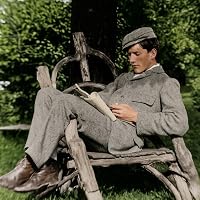
That being said, the look of the finished product is very professional (I like the cover image), and it did end up in my city library. I was torn between giving one and two stars: I wouldn’t want to stomp on anyone’s dreams, but it just isn’t terribly good. I admired the ambition but not the end result.
This story collection spans more than a century of gay life in and around Berlin. The earliest – three stories plus an epilogue that combine to make a novella – is the study of a complex marital ‘arrangement’ in 1890s Prussia. Felix Kimmich, the son of a well-to-do landowner, camouflages a lifelong liaison with his butler-turned-secretary (with a few rent-boys on the side) behind a marriage of convenience to a broad-minded lesbian; the conventions of the era are beautifully captured and inventively circumnavigated.
A concentration camp story has the commandant developing a crush on an inmate who is there by mistake, like the Boy in Striped Pyjamas. A modern setting introduces a gay widower trying to effect a reconciliation with a bi friend’s estranged and disturbed young son. The love affair between a viola player at the Berlin opera and a blind boy in the audience is exquisitely poignant, and emperor/queen Frederick the Great is treated to a charming episode he would surely have relished.
Paolo Grossi is an Italian writing in English about Germany – an intriguing back-story. His style reminds me happily of Angus Wilson, who wrote gay-themed stories and novels in the 1950’s and 60s with an elegance and restraint that are not always on offer to readers of 21st-century fiction. And, of course, The Tiergarten Tales inevitably bring a few pleasing echoes of Christopher Isherwoood – ‘Mr Issyvoo’.
Paolo Grossi is a writer I look forward to see more of.
This is a wonderful set of stories (some connected to one earlier in the collection) providing the reader with such a brilliantly conveyed range of emotions and set in a variety (physical settings, periods of history, families) of contexts.
There are two themes common to each, the Tiergarten area of Berlin and intimate relationships between men. The intimacy of these relationships is never described graphically and is very much a reflection of the state of each relationship as opposed to being placed to offer titillation.
These stories represent a very fine debut and I recommend them wholeheartedly to all with a genuine interest in the ways of humanity. Additionally, based on his commentary at the end of the book, the author impresses as a delightful personality.
Sparsely written and deeply compelling, this collection of interlinked shorts cuts a swathe through time and provides a queer history of Tiergarten that’s both unflinching and beautiful.
This touches on some dark themes (cw for homophobia, suicide, sexual assault, war crimes, stigmatising attitudes to mental health, and violence) so it’s by no means an easy read, but a rewarding one for its insights into the human condition and lines of pure poetry that took my breath hostage.
I didn't finish the first story. I really like the front cover image, but as I was reading, I realised that this was not a well-written book. There are many many sudden and clunky switches of point of view, strange jumps in the narrative, it's just not good to read. I really wanted to like it. 5 stars for the front cover though.
I don't normally like short stories but these ones are linked by the characters in each story. The book covers from the 18 century until the present. A very interesting read lots of repression but some good times as well.
A sequence of chapters, not necessarily chronological, but linked through the theme of male relationships. Some characters appear several times, others once or less often. Love more evident than sex