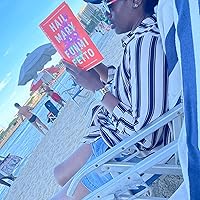
What does it mean when God is presented as male? What does it mean when - from our internal assumptions to our shared cultural imaginings - God is presented as white?
These are the urgent questions Chine McDonald asks in a searing look at her experience of being a Black woman in the white-majority space that is the UK church - a church that is being abandoned by Black women no longer able to grin and bear its casual racism, colonialist narratives and lack of urgency on issues of racial justice.
Part memoir, part social and theological commentary, God Is Not a White Man is a must-read for anyone troubled by a culture that insists everyone is equal in God's sight, yet fails to confront white supremacy; a lament about the state of race and faith, and a clarion call for us all to do better.
Here’s where McDonald is coming from: she moved to England from Nigeria with her family as a small child, grew up on the Evangelical end of Anglicanism, works for Christian Aid, and is married to a white man. She’s used to being the only Black person in the room when she steps into a church or other Christian setting in the UK. “It is a sad fact that the Church often lags behind on racial justice, remaining intransigent on issues that the world has long since labelled oppressive and unjust [such as opposing interracial marriage].” Always in the background for her is the way Black people are being treated in other parts of the world: although she wrote the bulk of this book before George Floyd’s murder, she has updated it with details about Donald Trump’s late outrages and the Black Lives Matter movement. Her chief concern is for her young son, growing up as a male with brown skin.
The book is shaped around moments of revelation large and small. For instance, McDonald opens with the first time she saw a God who looked like her. It was through The Shack, a bestselling novel by William P. Young in which God the Father is portrayed as a big Black woman (played by Octavia Spencer in the film version). She notes how important such symbolism is: “When a Black woman only sees God reflected as a white man, then somewhere in her subconscious she believes that white men are better representations of God than she is, that she is made less in the image of God than they are.” Other topics are the importance of equal access and education (she went to Cambridge), and standards of beauty. Beyoncé helped her to love her body, curves and all, and feel a sense of Black sisterhood. I liked getting glimpses into her life, such as her big Nigerian wedding to Mark.
This was a difficult read for 3 reasons. 1. I didn't agree with her conflation of God's self revelation of 'He' and the human construct of a 'white' god. However, I felt I should ignore that. I am more interested in the main contention of the book than an area of theology where we disagree. But, that was difficult to overcome. 2. Her experience is so different to mine. But, that is exactly why I needed to read the Book. I do not grasp how 'easy' I get it as a white man. So, whilst it was hard to understand, she made it easier by her honesty and amazing ability to communicate clearly. 3. The things that have been done to people in the name of 'religion' is horrendous. One of the chapters had a 'trigger' warning - and it was needed. I felt sick at times reading about how we have treated people. This is an important book that needs to be read. I need to think through my own actions. So, whilst I may quibble of some doctrines, this is a vital book in understanding the experiences of others.
I knew when I bought this book that it wouldn't be comfortable reading, and indeed it wasn't, but I'm glad to have stepped outside my comfort zone with this one. We need a bit more of that, frankly. I'm not going to try and critique this provocative and intensely personal book. I didn't agree with everything she said, far from it, but I feel privileged to have come away with new insights and to have learnt lots by hearing and seeing another perspective. I come away better able to grapple with the challenges of racism, equality and inclusion that we must all engage with.
I think this is a book that everyone needs to read. Regardless of interest in theology and religion, the Christian Church within the modern world, history, black/feminist theology; this book is relevant to anyone currently living today. Regardless of race, this book is an eye-opener to things that you might believe you understand but really don’t. In some ways, I could relate to this book, in regards to feeling excluded from the Church as a female who is not allowed to become a priest, or subjugated to roles of ‘virgin’ or ‘mother’ within my Church, but there was other things that I couldn’t relate to and haven’t experienced, for I am not a black woman. This book has made me realise that I will never understand how excluded black women can feel not only within society, but the Church too. As somewhere that should be inclusive of all minorities, the Church both intentionally and unintentionally excludes women and black people through the depiction of God as a white male. Although I already agreed with the title of the book prior to reading that ‘God is not a White Man,’ I never realised the impact that Christianity being ‘white-centred’ could have on those that were not of white ethnicity. This book makes me want to strive for change, to make an inclusive and better place for black people so that the world and Church is something that everyone calls home.
Provocative and I think potentially prophetic for heralding change. Words feel inadequate to try and capture all kinds of thoughts this has rightly and at times uncomfortably stirred. This is not a book that will allow a reader to simply chalk up a justice read to look good on a Good Reads list. It calls for heart examination and action to follow. As a christian who is white and male, what Chine Mcdonald writes throws light afresh how sadly within church circles, too, white supremacy can be insidiously present. The book is not just about the church world, though. There is much more to digest and reflect on. I am grateful to have read this book, now for reflecting on what next in terms of response.
Great book, highly recommend. I preferred listening to the audiobook which is narrated really well by the author, compared to the paperback where the text was too small! The book is structured well too. She explores important themes in this book which the average UK Christian needs to hear. I particularly resonated with the parts where she talks about her experiences with identity (was she Nigerian or British?) and about love life.
Although some theological differences I wouldn't agree with, it was a really helpful to hear of Chine's experience, humbling and challenging - she's got a clear and great vision to help the church in the UK grow in inclusion and to help everyone see themselves as made in God's image.
I loved reading some of McDonald’s takes on the image of God as a white man, and what it means that God is perceived this way. I do wish this book would’ve been structured better. It began and ended with discussions on theology, but in the middle section McDonald delved into her own experiences and more general theories on racism. Many of these topics were, needless to say, very important, but I had really hoped the focus within this book would stay on theology, the church and racism. These topics now passed by as subtopics (a chapter on studying as a POC would briefly mention how theology is still dominated by white people, for example) but given the title and blurb I would’ve liked for them to take center stage more.
I read this book primarily as an RE teacher, but as a woman, I also found it hugely moving and inspiring. Chine McDonald generously shares her own experiences to help us understand why it's important not to see God as a white man. At the end of the book, she shares her own MLK-inspired dream that her golden-brown boy will never doubt that he is made in the image of God.
As a teacher, I found numerous case studies and examples that I could weave into my curriculum. The Beyoncé church, Nigerian Christianity, the Redeemed Christian Church of God, Anton Wilhelm Amo, and the Wales Window in Birmingham Alabama, are just some examples.
For those of us working on diversifying our curriculum, McDonald writes about her disappointment that while studying theology at university, she never took part in or witnessed a discussion about black theology. She does not want her son to have to dig through dusty archives to find stories of African and black dignity.
I can see this being a book I will return to often.
With a rich mix of research and anecdotes from lived experience, Chine McDonald graciously unpacks the harm of white patriarchy in the church, and gives a picture of how it can be different. This book is a gift to the church, quoting her passage:
‘Jesus in the Sermon on the Mount, which is found in chapters 5-7 of Matthew’s Gospel, puts forwards this radical idea of God’s kingdom as being countercultural, turning things as we know them on their heads. It’s in this upside-down place that the last will be first and those who mourn, the oppressed, the vilified, the subjugated, will be the blessed ones. This is the place in which white supremacy - and its lies about who is worthy of dignity and value - will die. This is the black where Black dignity finds its fulfillment, in front of a living God who welcomes us home.’
Having been in an interracial marriage and having having 2 black children I thought I would know something about this subject. But no, I did not. Chine expounds on the subject of white supremacy culture. She approached from many different angles and I found that very helpful. She has exposed me to many new writers and areas I have to research. I found this an uncomfortable read in many places, but I would definitely recommend this book to anyone. It is definitely a book to be read by white Christians in the west, but even if you are not religious, but want to expand your knowledge about racism, I believe you would find a lot in this book. I notice Chile McDonald has written another book. I will be reading that and anything else she writes in the future.
I struggled with this book if I’m honest. I knew I wouldn’t agree with parts of it before reading and it was hard to get past that. The authors theology is vastly different to mine which means we come at completely different angles.
I felt, like society generally, too but store was put on my feeling/experience/opinion rather than fact. For example, 1) being asked where you are from is a standard question to be asked regardless of skin colour and 2) a conservative evangelical pastor saying he believes his job is to preach the gospel not get involved in politics is not in and of itself racist.
The book is on its strongest ground when the author talks through historical racism in the church in both the UK and US. Sobering. Unfortunately there are no real answers in this book.
Bringing it back home to God in religion especially christianity. God is not man and God is not white so God is NOT a white man.
"This book is for all those ready to face the hard and painful truths about race, identity and the imago Dei - the idea that every human, no matter their colour, has a special quality that resembles the divine beauty of God."
Chine uses her experiences from education, work, life and other to explain feminism and the idea of equality.
"When a black woman only sees God reflected as a white man, then somewhere in her subconscious she believes that white men are better representation of God than she is, that she is made less in the image of God that they are."
This book is a moving, personal, and well-researched challenge to white supremacy in Christianity.
Drawing from personal experiences as a Black woman who grew up in England after being born in Nigeria, the author weaves in current events, such as the murder of George Floyd and the influence of Beyoncé, alongside historical moments like the speeches of Martin Luther King Jr.
This book illustrates how white supremacy became embedded in Christianity and why we must work to diversify it. It presents this argument in an emotionally powerful yet rational and elegant way.
Chine McDonald presents a powerful argument for the way God has been presented as white. But what she does is to deconstruct this from a series of perspectives: the way God is portrayed, Africa is portrayed, interracial marriage, the black sisterhood, the impact of Covid. And while each argues using a whole range of sources what makes the book compelling is Chine's own experience which she brings to bear. A great read.
This is an excellent book! Extremely thought provoking, at times amusing, and always deeply personal.
As a British reader, I would have liked to hear more British examples rather than American, as I think this would have been even more challenging and insightful. However, this did not take away from my appreciation of this book. I highly recommend it to anyone keen to understand life through another lens.
I know why this book has 5 stars, it deserves them. It’s necessary. Having read so much on race recently I loved the personal aspects she added, the personal stories were what gave the book real stand out appeal. The summary and constant quoting from other books and the historic references were a little jarring. But it’s an important book and I am very glad I read it.
While not quite as vicious (and therefore not quite as unputdownable) as The Ghost Ship, with which it shares a number of ideas, this moving and cutting book explores a number of ways in which racism and misogyny is part and parcel of most religions, and needn't be.
McDonald makes some important points, many of them powerfully and all of them worth listening to.
.Honest and at time vulnerable exploration of what it means to be a black woman in a world where white supremacy is considered the norm. I found it left me feeling profoundly challenged, at times ashamed and close to tears.
Brilliant, personal, moving & thought provoking look at white supremacy & its effect on how the world has been shaped including depicting God as “white” & the failure to treat Black people as Imago Dei. It’s an accessible theological book for all to help make the world a better place
Incredibly well researched, and a honest self-giving look into the intersection of faith, racism, gender, and the impact of white, male, christianity on culture in the UK and around the world. Brilliantly, powerful, informed read.
‘The Church needs to be more open to a mosaic-like image of its congregation rather than one in which the colours of the pieces obviously ‘match’. The beauty comes in the chaos- a tapestry of difference that demonstrates the diversity of the kingdom of God’ (pg. 202)
Wow. Read this book.
Feeling incredibly convicted and challenged but also hopeful. McDonald’s final sentence sums it up, ‘we are going to need white men to play their part in dethroning the white man’s god.’
This made for difficult reading but it was really necessary. As someone who grew up in a church, it was really interesting - although not all about religion. I liked the variety of it and I’d recommend it to my white friends (especially those in churches).
Took time to read and adsorb what was being said. Challenging in some aspects. Not sure how we change our attitudes, ingrained (for some of us) over a lifetime, but just being more aware helps, I hope.