Librarian's note: An alternative cover edition for this ISBN can be found here.
Un homme se fuit en parcourant le monde, entraînant dans son long voyage son épouse, essayant d’oublier ses pulsions amorales. - Un matin, j'eus une curieuse révélation sur moi-même: Moktir, le seul des protégés de ma femme qui ne m'irritât point, était seul avec moi dans ma chambre. Je me tenais debout auprès du feu, les deux coudes sur la cheminée, devant un livre, et je paraissais absorbé, mais pouvais voir se refléter dans la glace les mouvements de l'enfant à qui je tournais le dos. Une curiosité que je ne m'expliquais pas bien me faisait surveiller ses gestes. Moktir ne se savait pas observé et me croyait plongé dans la lecture. Je le vis s'approcher sans bruit d'une table où Marceline avait posé, près d'un ouvrage, une paire de petits ciseaux, s'en emparer furtivement, et d'un coup les engouffrer dans son burnous.
Diaries and novels, such as The Immoralist (1902) and Lafcadio's Adventures (1914), of noted French writer André Gide examine alienation and the drive for individuality in an often disapproving society; he won the Nobel Prize of 1947 for literature.
André Paul Guillaume Gide authored books. From beginnings in the symbolist movement, career of Gide ranged to anticolonialism between the two World Wars.
Known for his fiction as well as his autobiographical works, Gide exposes the conflict and eventual reconciliation to public view between the two sides of his personality; a straight-laced education and a narrow social moralism split apart these sides. One can see work of Gide as an investigation of freedom and empowerment in the face of moralistic and puritan constraints, and it gravitates around his continuous effort to achieve intellectual honesty. His self-exploratory texts reflect his search of full self, even to the point of owning sexual nature without betraying values at the same time. After his voyage of 1936 to the Union of Soviet Socialist Republics, the same ethos informs his political activity, as his repudiation of Communism suggests.
This book mesmerized and shocked me in equal measure.
Beautiful in its writing, quiet in its execution, seductive in its message and destructive in its implications.
The book begins with a suppressed young dutiful intellectual and ends with a despairing debauched and self-deluded libertine. In between is some of the most exquisite writing and the transformation of a young man from upstanding citizen to a malignant narcissist.
The book utilizes the vicissitudes of landscape, weather and nuances of emotions to seduce the reader into rooting for this most hateful of villains and his attempts at self-transformation. We are in North Africa, France, Switzerland and Italy. We are in the heat, windstorms, alpine winters and sensuous springtimes. We are seduced by beauty, attempts at love, philosophical arguments, works of great art and intimate conversation.
We are initially excited by his sexual awakening and burgeoning awareness of his own sensual beauty. We are smitten to the periodic devotions to his wife, his superficial helpfulness to those in need, his appreciation of the underdogs of society and his rejection of snobbery and elitism. Then delusion sets in....he mistakes his desires for needs and the most subtle of evils begins to occur. His appreciation for youths turns to taboo encounters of the most predatory kind. He facilitates the underprivileged to turn against each other through the use of trickery and guile so that he can watch like the most selfish of voyeurs. Most cruelly of all he turns on his wife and watches her die while at the same time sucking in all of her beauty, loyalty and kindness to enforce his own life force. In the end he calls on his friends so that he can confess and likely seduce them into offering in their spirits to him like a soul-thirsty incubus.
I found this book haunting, sublime and wicked.
This book is dangerous in the wrong hands.
A disturbing but important experience and a chance to reflect on the self and where one fits on the continuum.
I wish I had read L’Immoraliste around the year 1904. That would have been about two years after it was published and about two years before Picasso started distorting eyes and mouths and jaws and limbs in his painted prostitutes.
I am trying to picture myself dressed in yards and yards of bombazine, chiffon and lace, shapely cut to follow my already markedly thin waist, thanks to those bone stays that have cinched it into a harness, sorry, a corset. I need to feel the effort of breathing in, languidly, and the relief of breathing out before I can breathe in again and hopefully catch the oxygen I did not quite get the previous time.
I would also need to feel the weight of my long hair pinned up around my head and pulled by combs that have scratched my scalp, and may be also of a wide-brimmed hat with feathers and ribbons, sitting on top of that mass of hair. And because of all that accoutrement I would have to stay well perked up rather than lean comfortably against the back of the velvety sofa.
If I want to digest this book properly, to imagine all that conscription seems more pressing than brushing up my Nietzsche.
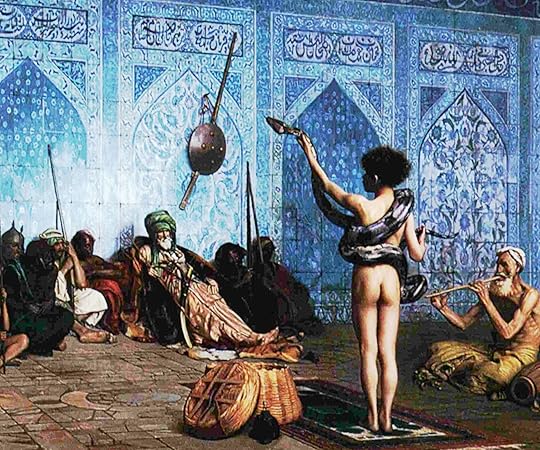
Or, if I wanted to feel a frisson in any way related to the way Michel falls under the spell of young men in Bikra, rather than dismiss it as irrelevant or accept it in a politically correct fashion; I may have to look for some kind of additional aid. Jean-Léon Gérôme, who died in the year of my hypothetical reading --1904, has a handy proposal for blending sexuality and exotic aesthetics.
I would need all of the above, and other things too, to be able to appreciate the exhilaration that Michel, the claimed immoral-man, is having when in Tunisia, by the sea, he decides to take off his clothes and feel the bright sun that warms his skin and limbs and illuminates him into embracing a new life. Otherwise the idea of a scantly clad man on a beach might now evoke images of overweight tourists cooking themselves into red lobsters under a charring sun.
And similarly goes for getting the conceptual implications of the contrast between classical and gothic architecture. Or for feeling deeply disturbed by the possible implications of Michel’s pursued and revealed individualism, instead of just feeling irritated by this obnoxious and egotistical jerk who is being such an ass to his poor wife.
Because, sadly, many of the signs that in this book herald freedom have now lost their power, because, happily, now they are commonplace. If they did succeed in breaking conventions their effect was short-lived. If Gide’s novel can taste insipid now, and Picasso’s tortured figures have become cute magnets for the refrigerator, may be we have to look elsewhere for the liberating effect sought by modernity.
What about Coco Chanel’s dispensing with the corset?
Yeah well how immoral could things really get when this thin novel was published in 1902? It turns out – quite immoral. Our narrator, Michel, gradually finds out that what he really wants to do is not to write dry essays on Gothic antiquities and buy another elaborate hat for his pallid wife, no, what he really wants to do is have sex with young boys. So he does.
Michel is the very person who these days would be arrested at the airport on returning from his three month holiday in Vietnam. In his case it’s Algeria. Michel’s proclivities are not unique, they are shared by many, alas. Football coaches, priests, etc. If Michel had gone back to his haunts forty years later he might have run into William Burroughs doing the same things. The young tender flesh was and is plentiful and all for sale at very reasonable prices, we understand.
Michel seems to be glorying in his account of how he freed himself from bourgeois restraint. Yes, it probably killed his wife and bankrupted him, but he is free! Free!
In his preface Andre Gide says “I intended to make this book as little an indictment as an apology and took care to pass no judgement”.
It turns out that a lot of this story is directly or queasily quasi autobiographical. Andre married to please his parents and did not have sex with his wife. Michel is the same except he kindly consented to have one-time sex with his wife and she immediately became pregnant, so that relieved him of further responsibility.
This wife is a barely-there cipher. Michel’s first person confession is so claustrophobically self-involved that she drifts like a ghost through the whole sorry tale. I think she says about two sentences before dying of TB. Whereas Charles the 17 year old lusty peasant lad who entrances Michel, he gets pages and pages about hedging and ditching and making hay.
Andre Gide writes in a suggestively decorous and quite maddening style. Most of the time you are wondering what he actually means.
I reached a point of enjoying in others only the wildest behavior, deploring whatever constraint inhibited any excess. I came close to regarding honesty itself as no more than restriction, convention, timidity.
And again
I ended by enjoying the dissimulation itself, savoring it as I savored the functioning of my unsuspected faculties. And I advanced every day into a richer, fuller life, toward a more delicious happiness.
Spit it out, man, of what does this wildest behavior and this delicious happiness consist? But there are only nods and winks, and in 1902 a nod was as good as a wink to a blind horse.
This was a quick but grotesque read. I’m not sure why it gets all those 4 and 5 stars.
سيرة ذاتية أندريه جيد في مرحلة من مراحل حياته وعلاقته مع زوجته.
يصف أندريه حياته الرتيبة القائمة على العمل حتى وجد نفسه انه احد الأغنياء. تزوج بدون حب وكانت علاقته معها علاقة عادية خالية من الشغف رغم اعتناءها به وهو في مرحلة المرض. ليكتشف بعد ذلك انه يحبها كثيرا وظهر ذلك من خلال عنايته لزوجته خلال فترة مرضها بعد ان انعكس الوضع.
هذه الفترة التي يصفها كانت عبارة عن رحلات وسفر من مدينة الى مدينة الى قرية . يبدع هنا جيد في وصف الطبيعة وكذلك الأشخاص الذين يقابلهم في رحلاته وكان له علاقة بهم. ومن خلال احداث الرواية، هناك دعوة الى العودة الى الطبيعة والحياة البسيطة والاختلاط بالناس البسطاء ومحاولة صداقتهم . ظهر ذلك واضحا من خلال شراءه لمزرعة والاعتناء بها والتعامل مع الفلاحين وغيرهم.
اُسلوب الكاتب رائع واضح بسيط لا يميل الى التعقيد من خلال إيصال الفكرة بعيدا عن الاطالة.
“Knowing how to free oneself is nothing; the difficult thing is knowing how to live with that freedom”
Freedom is perhaps the heaviest of the burdens to carry through our lives. For to be free means to get rid of all references, all dogmas, but how could one get rid of those; for all the ethics and moral codes, we have developed over ages though evolution, define our societal structures. And to maintain order in our society we need these structures or least that is how we know it. How terrifying to find that freedom alone, how frightening to realize that there needn’t to be a moral point and purpose to our actions, and that the moral constructs humans create are so transient as to be non-existent. The existential thought is the basis of Existentialist literature as Sartre used to maintain- man defines his life himself and must take responsibility to live his life accordingly. Morality speaks of a system of behavior in regards to standards of right or wrong behavior. The word carries the concepts of: (1) moral standards, with regard to behavior; (2) moral responsibility, referring to our conscience; and (3) a moral identity, or one who is capable of. Morality has become a complicated issue in the multi-cultural world we live in today. There is always a conflict between our social obligations and our actions as individuals. For one’s actions are governed by one’s upbringing- the ideas, the references which may have accumulated over the years in one’s life and that’s why what may look ‘right’ to someone may not be for others. The question of morality is not the simple conflict between ‘right’ and ‘wrong’ at consciousness of individual level; rather it is the great conflict between what we, human beings, as a ‘society’ may feel ‘morally’ accepted or not. And how do we measure what is morally accepted or not, we use age old concept of majority, so the question of morality involves the ever existed tussle between our individual consciousness and our consciousness as a society. We may feel robbed of our individual ‘voice’ due to these societal standards but we accepted them for harmonious existence of human beings. Moreover, we always need references to move forward in life, for we, humans, are not strong enough to live our life without any references or purposes as we may call them. And perhaps that is the basis of all our morality, ethics, belief systems etc. That’s how we have been progressing- we get rid of our dogmas only to develop the new ones, as it is perhaps the quintessential necessity of our nature.
For if my call seemed an urgent one, if I made you travel so far to find me, it was purely so that I might see you, and that you might listen to me. That is all I require: the chance to speak to you. For I have reached a point in my life where I can’t go on. It is not a question of weariness- I no longer understand anything. I need… I need to talk, as I say. Knowing how to free oneself is nothing; the difficult thing is knowing how to live with that freedom.
"Morality is simply the attitude we adopt towards people we personally dislike.” -Oscar Wilde
The Immoralist examines the case of a man with his wife and child, means and career, a man caught up therefore in a complicated network of overlapping relations and responsibilities, who comes to see his whole life as a hypocritical sham and, in pursuit of his true, authentic, homosexual self, abandons everything. It presents the classic universal problem of individual freedom, identity, and what constitutes “life”. Michel, the novel’s main character is awakened from his life-long “lethargy” with a fierce desire to change his mask, or rather to find his real self hidden behind the layers of adopted morality, education, and social obligations. He used to be a strict young scholar interested only in “ruins and books”. Now he wants to be free of all obligation and inhibition to fully experience the pleasure and sensuality brought about by his late homosexual awakening. To do so, he sacrifices wife, career, and wealth. Yet when he began to understand himself his desires better, he grew stronger and healthier. Yet with this change, Michel did not seem to develop his own sense of morality; rather he sometimes acted in accordance with generally accepted morality and sometimes against it. At that point, Michel was happy; he still had a framework of morality through which to understand and direct his life. What appears to be a simple tale distinguishing the right and wrong is an intricate delineation of this distinction between ‘thoughts’ and ‘emotions’. The book is a like fruit filled with bitter ash, like those colocynths which sprout in the most arid deserts: rather than quench your thirst, they scorch your mouth even more, yet against their backdrop of golden sand they are not without a certain beauty.
’After all, what is there to live for? I have worked hard to the end, done my duty with passion and dedication. Apart for that….oh, what else is there?’ I thought, admiring my own stoicism. What was really painful was the ugliness of my surroundings.
There is nothing more tragic, for someone who has faced death, than a long convalescence. After my brush with the wing of death, the things that seemed important before no longer mattered; other things had taken their place, things which had never seemed important before, which I didn’t even know existed. The accredit layers of acquired learning flaked away like greasepaint, offering glimpses of bare flesh, the real person hidden underneath.
“So far, about morals, I know only that what is moral is what you feel good after and what is immoral is what you feel bad after.” -Ernest Hemingway
Fear is the mother of immorality. -Friedrich Nietzsche
Michel is an ‘immoralist’ because he has adopted Nietzsche’s view that morality is weapon of the weak, of a slave mentality. To become fully human, men must have courage to kill the God that has infected the freedom of their will. There was, of course, a great deal more to Nietzsche’s critique of Christianity and its effect on Western civilization than could be encapsulated in the much misunderstood notion of the Ubermensch, the Superman. Michel takes Nietzsche simplistically, abandoning Culture for Nature, letting the weak go to wall, and in the end losing everything. Gide knew what to leave as well as what to take of Nietzsche- and when to keep Nietzsche within bounds of his books. While pursuing his natural inclinations, Gide cherished and retained his wife, his independent means and his professional position. In working out a modus Vivendi that could accommodate both his marriage and his homosexual adventures, he called on the un-Nietzschean but very Gidean quality of compromise.
“Am I a good person? Deep down, do I even really want to be a good person, or do I only want to seem like a good person so that people (including myself) will approve of me? Is there a difference? How do I ever actually know whether I'm bullshitting myself, morally speaking?” -David Foster Wallace
As like with all works of art, The Immoralist preserves its fluid outlines and remains un-susceptible to formulas; it may yield therefore to the most divergent interpretations. What Michel seeks is not pleasure, of this or that kind, but the free play of instinct. The whole drama springs form a ‘profound antimony’: acquired instinct is no longer instinct; it becomes a negative force, the negation of culture. When he abandons all that he has acquired in life, when he believes that he has found his true self, he is left with nothing. At once critique and apologia, The Immoralist confronts ‘the fundamental, eternal problem of the moral conditions of our existence’ the gap between what we were and what we have become.
It was great experience to read this book by Gide; as usual with Gide, he had been able to create heart-wrenching tale with simple words- his ability, to conjure up profound effect through his prose with simple seemingly innocuous words, is second to none. However, the problem of morality, of of inauthentic existence, the book portrays so well and convincingly; the solution to it may come across a compromising one. Nevertheless, it is a great read for someone who wants to dig in to the great tussle of morality human beings have been facing since the very outbreak of civilization.
This is a strange tale, almost a parable. A young Frenchman marries a young woman and anticipates a wonderful life. But he is so anxious to live life to the fullest and experience everything that he drags his wife with him even when she is ill.
He does not seem to know what he is looking for except somehow to “live life to the fullest.” Eventually his wife develops tuberculosis and still he wears her out traveling, and she dies. He doesn’t skip a beat and keeps on going. He is trying too hard to have it all.
The introduction describes the book as the story of “…the terrible energy of a man who has made it his duty to be happy.” He is so willing to experience EVERYTHING that in the end it looks like he is ready to go after young Arab boys – thus the title.
It’s a strange book, written in a somewhat stilted style but a quick read. Much of it is set in Algeria with some local color. Translated from French.
André Gide (1869-1951) was awarded the 1947 Nobel Prize but his work has fallen out of fashion or 'faded away' as described in a 1965 NY Review of Books article by Paul de Mann. His best-known work in English is The Immoralist followed by the Counterfeiters and Strait is the Gate. The following is what Wikipedia says about him:
Gide's career ranged from its beginnings in the symbolist movement, to the advent of anticolonialism between the two World Wars. The author of more than fifty books, at the time of his death his obituary in The New York Times described him as "France's greatest contemporary man of letters" and "judged the greatest French writer of this century by the literary cognoscenti."
Known for his fiction as well as his autobiographical works, Gide exposed to public view the conflict and eventual reconciliation of the two sides of his personality (characterized by a Protestant austerity and a transgressive sexual adventurousness, respectively), which a strict and moralistic education had helped set at odds. Gide's work can be seen as an investigation of freedom and empowerment in the face of moralistic and puritanical constraints, and centers on his continuous effort to achieve intellectual honesty. As a self-professed pederast, his self-exploratory texts reflect his search of how to be fully oneself, including owning one's sexual nature, without at the same time betraying one's values.
Top photo of Algerian market from worldbank.org Sketch of the author from nybooks.com
What conjures up in the mind at the mere mention of the word ‘morality’ is a question that our evolutionary advanced mankind hasn’t been able to find an appropriate response to. For all the ethics and moral codes defining the very basis of societal structure, morality still remains a vague ideal. Vague not because there is a dearth of reasons associated with the necessity or goodness of moral values required for a harmonious existence of humans in the society but because the certainty of actions needed to achieve these morals is debatable. For action, on the part of an individual, being solely a subjective decision, results from something not instantaneous but from underlying ideals which have accumulated in the consciousness through experiences of one’s lifetime. So the defining line between ‘right’ and ‘wrong’ seems blurred in the sense that what a person may hold ‘right’ another person may not.
Gide’s The Immoralist, appearing to be a simple tale distinguishing the right and wrong, is an intricate delineation of this distinction between ‘thoughts’ and ‘emotions’. Michel, who once suffered from tuberculosis, after being tended by his wife and with his strong will to attain good health, becomes healthy again. Once recovered, he realizes the importance of being alive.
There is nothing more tragic for a man who has been expecting to die than a long convalescence. After that touch from the wing of Death, what seemed important is so no longer; other things become so which had at first seemed unimportant, or which one did not even know existed. The miscellaneous mass of acquired knowledge of every kind that has overlain the mind gets peeled off in places like a mask of paint, exposing the bare skin —the very flesh of the authentic creature that had lain hidden beneath it.
Enamored with his new found love for life, Michel indulges in such pleasures deemed as wrong. His thoughts, reeking ‘immorality’, are stripped deftly before the reader by Gide. But Gide’s skill lies in the excellent rendition of such a state of mind, calling forth deliberation by reader on the blurred line subsisting between right and wrong.
For the time being, therefore, my relationship with Marceline remained the same, though it was every day getting more intense by reason of my growing love. My dissimulation (if that expression can be applied to the need I felt of protecting my thoughts from her judgment), my very dissimulation increased that love. I mean that it kept me incessantly occupied with Marceline. At first, perhaps, this necessity for falsehood cost me a little effort; but I soon came to understand that the things that are reputed worst (lying, to mention only one) are only difficult to do as long as one has never done them; but that they become—and very quickly too—easy, pleasant and agreeable to do over again, and soon even natural. So then, as is always the case when one overcomes an initial disgust, I ended by taking pleasure in my dissimulation itself, by protracting it, as if it afforded opportunity for the play of my undiscovered faculties. And every day my life grew richer and fuller, as I advanced towards a riper, more delicious happiness.
To Michel, this dissimulation is ‘right’ since it brings him happiness he was once deprived of. How can one’s happiness be termed as ‘morally wrong’ when the worse it can do is to harmlessly fake affection? Does a care shown with indifference stand the same trial as immorality?
Gide goes further and adds twists that still make it hard to confer a judgment. After the unfortunate event of abortion of Marceline, Michel takes care of her.
Then phlebitis declared itself; and when that got better, a clot of blood suddenly set her hovering between life and death. It was night time; I remember leaning over her, feeling my heart stop and go on again with hers. How many nights I watched by her bedside, my eyes obstinately fixed on her, hoping by the strength of my love to instil some of my own life into hers. I no longer thought much about happiness; my single melancholy pleasure was sometimes seeing Marceline smile.
But the recovery of Marceline again prompts Michel towards self indulgence. Even when his wife is on the verge of dying, Michel makes her travel with him. Marceline’s death is a result of long travels and insufficient care resulting from sybaritic actions on part of Michel. His demeanor goes through an alteration from the start to the end with mutation of his thoughts. Perhaps it is this instability of Michel’s thoughts, of his changed emotions as per his convenience that he is an immoralist. Perhaps he is an immoralist because he knows perfectly well that he has changed but instead of expressing regret or accepting his guilt he still prefers to follow unrestrained pleasures.
The work by Gide traverses through murky and obscure alleys of the mind, sometimes revealing those thoughts which lay concealed but which can readily surface without alarm if unrestrained, thereby posing a peril to the widely accepted or personal notions of morality.
Joan Didion quotes Lionel Trilling in her essay "On Morality":
“We must be aware of the dangers which lie in our most generous wishes, Some paradox of our nature leads us, when once we have made our fellow men the objects of our enlightened interest, to go on to make them the objects of our pity, then of our wisdom, ultimately of our coercion.”
When we are growing children, we have so many fantasies of countless things, we have our own interpretations of the phenomena of nature, Imagination of a bearded old man dwelling in sky as God, Rain from sky as tears of angels, angry trees shedding leaves, fairies visiting only good children at night, and so many and many…. They all sound sweet to ears, even stupid but sweet.. But what if a grown adult of five and twenty, fantasizes those children a source of his “melancholic pleasure” what if he gawps at those children with eyes laden with unspeakable desires and mind full of unsaid robust thoughts, what if he gapes at their nimble healthy statures with envy and lust at the same? What is wrong in doing so? What if his whole being depends on those stolen caresses and marked touches? What harm can his sheer individual thoughts do to society? Isn’t it the highly celebrated Nietzschean Theory that preaches there is nothing named “morality” in the world, albeit he justified the cause quite intellectually, as there is no meaning of one’s existence, as there is nothing called reality, that no kinds of action are ‘good’ or ‘bad’ in themselves, whoever does them. But this is not the whole lot of the problem here, our protagonist Michel and writer Gide are entwined together so much and deep that it is not possible to ignore the autobiographical acclaim of the story. Story, on the surface is very simple one, Michel marrying Marceline near the deathbed of his father, to console his soon-to-fly soul, Marceline proving a matchless, caring wife, Tuberculosis engulfing Michel with every breath, Marceline takes good care of him and pulls her back to life, at length, the same malady wraps her and she dies of tuberculosis….. But this is not what Gide intended us to cherish, there is more to it. The appeal of individualism; its anticipation of Freud more valid than its oblique reflection of Nietzsche. Its more personal triumph lies in the successful avoidance of lyricism, of confused or angry self-justification, of special pleading-of all the evasions, in fact, to which autobiographical fiction is tempted. If we are to frame our main character in Freudian sexual scale, he is pretty latent homosexual.. He takes pleasure in walking alone to the Arab gardens, praying may his wife not follow him, he desires to sleep at a barn land, where the son of his servant a boy of 15 is sleeping, he contempt the weakness of her wife that blankets her when she falls prey to the deathly disease, but is prompted to touch the naked shoulder of young Bachir whom his wife takes home for her husband’s amusement.. Though the scenes are not explicitly described, rather left to reader’s conjecture, and there is no unravel thought of him that may help reader to judge what’s going on in his head, all we come to read are justifications for being Immoral.. But the last lines saying: “She laughs and declares I prefer the boy to her,she makes out that it is he who keeps me here, perhaps she is not altogather wrong!
i feel a little dirty reading this sandwiched between all my children's books for class. kids, take three giant steps back from gide... i think i loved this book, but i think i may want to read another translation. who knows from translations?? i have the richard howard one here, and i know he's like a star in the french/english translation world but i didn't like his introduction to this so much, and was wondering if there might be another recommended translation? i liked this book a lot, despite some perceived smugness from that intro. what an appalling character to fall in love with! so many layers of unpleasantness! ingratitude, sexual deviancy, racial audacity. and the second french book i've read this summer with men embracing plants. what is with my people? ahhhh les arbres...
My second Gide book and I quite enjoyed it. It’s a story about a young man, Michel, narrating his life, how he learned more about himself through introspection while getting married and witnessing tragedies. Travelling around Europe and North Africa, rootless. It’s essentially a tale of self-discovery.
In tone this book really reminded me of Camus. I was expecting something a little more shocking as I heard this book was considered scandalous at the turn of the last century.There were homosexual undertones and hints of possible pedophilia, or was the antagonist simply admiring the health of children after having recovered from a serious illness? So many uncertainties.
I found Michel to be a very interesting character, a bit weird in that he got married just to make his dying father happy. The parts where the protagonist recovered from illness and began to see things in a different way, to appreciate the health and beauty that he has lost were the most interesting to me. It made me think a lot, surely we’re not the same person after having experienced something so serious and life-changing? We must gain a new awareness:
“After my brush with the wing of death, the things that seemed important before no longer mattered; other things had taken their place, things which had never seemed important before, which I didn’t even know existed. The accreted layers of acquired learning flaked away like greasepaint, offering glimpses of bare flesh, the real person hidden underneath.”
Initially Michel is academic, a genius of sorts who simply wants to write books but gives lectures but his illness makes him change his view to the point that he doesn’t feel comfortable in society:
“As an academic, I felt foolish; as a man- did I know myself?”
What I liked most about the book were the complex themes, philosophical in their approach, possibly because I have obsessed over them myself in the past, especially authenticity and happiness. It was hard to ignore the exoticism in here, the labelling of the North African Muslim boys as the “other,” but overall I quite enjoyed this book.
A scholar, in languid health, having, not for love, but as viaticum to his dying father, married a young woman, sees himself struck in his flesh by one of the greatest purveyors of death, tuberculosis. Then begins a fight against physical evil, which will also lead to a reaction against a no less sclerosing education, on questioning of all values in a superhuman aspiration towards total harmony. An apology for the senses, for the beauty of the body in health, for the joy of camaraderie in action, L'Immoraliste is also an ambiguous, chiaroscuro book, which likes to lift only part of the veil, which thus retains all its mystery, all its charm and lends itself to any interpretation. We are a little perplexed by this grand bourgeois who apes the gentleman farmer, who slums at playing poacher: no, it seems to me that it is not enough to eat the thick soup of the peasant, to listen to the patois of the country at the corner of their hovel, or to live their life, to be one and really "test" their existence, to spread themselves over a layer of vermin to be a miserable Moor. But overall, this hovers Gide's prose, one of the finest I know. It may not please, but we are not obliged to recognize its prestige. The few evocations of southern Italy were eminently sympathetic to me. Gide's creations are helpful. They are works of life that we would always benefit from consulting from time to time to rediscover the flame and the flavor of the days.
Andre Gide (1869-1951) was a French author and winner of the Nobel Prize for Literature in 1947. So, this book, despite its theme on homosexuality, should not be brand or worse, mock, as another gay lit book.
The story revolves around a bisexual man, Michel, who has devoted his early years to his studies so he becomes a scholar. Then, to please his dying father, he gets himself a wife, Marceline and the young couple goes to North Africa for their honeymoon. Along the way, Michel falls ill because he gets tuberculosis, that at the time has no cure yet. While in his sick bed, he meets a young handsome Arab boy and he begins to realize that he is a bisexual man. He gets well, after his wife regularly brings young good-looking boys to their house to play with Michel.
Reading this book is like reading a gay-version of Vladimir Nabokov's Lolita. It shocked me yet the beautiful simple prose of Gide is just hard to dismiss. First published in 1902 in France the language is a joy to read because it is short, direct to the point (not pretentious) and it is very brave. Gide did not give any qualms in tackling the subject that could be a taboo during that time when the world was not as open-minded as it is now.
The message of the book is that all of us have, whether as personal as homosexuality or not, some secrets or maybe just something that we are not very proud of. First, we hid them to our loved ones or even to ourselves by not facing them heads on. However, if we continue hiding, those secrets will find their way out in the open. Sooner or later, we have to face them. So, what Gide says: accept who we are. Marry if you feel that's the right thing to do but please tell your girlfriend everything. Don't hide just for her to agree in marrying you. She has the right to know. Otherwise, you will be leading a sorry sad life hiding in the cloak of duplicity.
That, for me is the lesson this book purports: truth. It's the only way for us not to destroy ourselves.
«Ο ανηθικολόγος» δημιουργεί λογοτεχνία αυτογνωσίας στο υψηλότερο σημείο της ανθρώπινης νόησης και πρέπει να διαβαστεί απο οποιονδήποτε διαβάζει για να σκέφτεται και να μετακινείται, εξελισσόμενος πνευματικά,λόγω των αυξημένων αισθήσεων και των μη επιδιδόμενων παρορμήσεων σε ελεγχόμενες ή μη, διαβρωμένες πλέον, ανθρώπινες αξίες ηθικού μύθου, που κάποτε-πάντοτε θα ήταν αποδεκτές καθολικά.
Ο αμοραλιστής, ο ανηθικολόγος είναι το πλάσμα που αρνείται να φανερωθεί ως αντικατοπτρισμός του Ζιντ στον καθρέφτη της αμφισβήτησης.
Το έργο που παράγει καθαρά βιωματικό, θεωρείται ένα κείμενο απλό στη γλώσσα και εύκολο στην ανάγνωση. Τούτο το βιβλίο θα μπορούσε να χαρακτηριστεί ολόκληρο ως μια κοινωνική παγίδα, που τα δίχτυα της φτιάχτηκαν απο μια οδύσσεια αναζήτησης για αυτογνωσία και παραδοχή των αληθινών και απομακρυσμένων εξωτικών τοποθεσιών της πανανθρώπινης υπέρβασης. Της κοσμικής ενότητας, μπροστά στην αδυναμία του ατόμου να εξηγήσει και να αποδεχτεί τη φύση και την κατ’ευφημισμόν παραφύση της ύπαρξης του.
Το να γνωρίζεις πως να απελευθερώσεις τον εαυτό σου δεν είναι τίποτα. Το δύσκολο είναι να μάθεις πως θα ζήσεις με αυτή την ελευθερία.
Εάν ο δικός σου θεός, ο θεός που σε έμαθαν να φοβάσαι, πέθανε,πήρε μαζί του και το παρελθόν όπου η αξία του γινόταν ανεκτίμητη μόνο μέσα απο συγκρατημένες και τυφλά αποδεκτές καταπιεσμένες αλήθειες απογοήτευσης.
Η κοινωνία γίνεται ασθενέστερη και τότε σίγουρα, ζει και βασιλεύει ο προσωπικός θεός του σύμπαντος, της ανθρώπινης κοινοκτημοσύνης, της απώλειας, της αλήθειας, της διαπιστωμένης τελετουργικής διαδικασίας μιας έμπνευσης για ευδαιμονία που υπάρχει μονάχα σε όσους για να είναι οι ίδιοι αληθινοί, επιβάλετται να είναι ο εαυτός τους.
Αυτόν τον θεό, τον οποίο δεν μπορούμε να γνωρίζουμε διότι δεν πιστεύει στην μεταφυσική και η Βίβλος του εξαιρεί απο τα εδάφια της επαγγελίας όσους εμφανίζονται στην ζωή τους, εικονικά, χωρίς να γνωρίζουν πως ζουν πραγματικά.
Οι άλλοι επιβάλλεται να είναι απίστευτα απαράδεκτοι για την μάζα και επιεικώς αλυσοδεμένοι με την δική τους αλήθεια, μέσα στα όνειρα και έξω στην πραγματικότητα.
Ο Ζιντ δεν δίνει απαντήσεις, δίνει πνευματικά όπλα που κατακτούν απόρθητα κάστρα και εκτοξεύουν διάπυρα βέλη εφιαλτικής ανάνηψης για την ψυχή του συμμορφωμένου στις κόσμιες υποδείξεις, γι’αυτόν που τον τρομάζουν, τον μπερδεύουνι, τον χαροποιούν και τον σκοτώνουν λίγο πριν λυτρωθεί αφού του χαρίσουν απλόχερα τα χάδια του ηθικού αυτουργού και τον ωθήσουν στο έγκλημα εξ αμελείας κάτω απο ανεξακρίβωτες συνθήκες υιοθετημενης ηθικής και υποχρεωτικά δόγματα ανήθικολογικής εκπαίδευσης κοινωνικών και θεσμικών υποχρεώσεων.
Ανοιχτό σε κάθε ερμηνεία το έργο του Ζιντ, παρουσιάζει το ξύπνημα απο τον λήθαργο και την εσωτερική διεργασία αποδοχής της ατομικής ελευθερίας. Μιας αναρχικής ελευθερίας , για έναν άνδρα που αφυπνίζει τον αισθησιασμό του στην ομορφιά της φύσης, κατανοεί την γενετήσια έλξη του για το ίδιο φύλο, αρνείται εσωτερικές συμβάσεις και αγαπάει την γυναίκα που μοιράζεται την κατάντια του μπροστά στον δογματισμό που τον σκλαβώνει, που τον οδηγεί σε συγκρούσεις πέρα απο την ηθική και την σεξουαλικότητα. Κυρίως συγκρούσεις σκέψεων, συναισθημάτων, εγκεφαλικής και ψυχικής μεταρσίωσης προς το εγώ του που καταρρέει. που καθολικά και κλασικά αρρωσταίνει συνειδητοποιημένα, με την αποκάλυψη της ταυτότητας του κόντρα σε ο,τι πρέπον συνιστά η «ζωή».
Ένας απλός άνθρωπος που αποκομίζει τα όνειρα του μέσα απο μια ασθένεια προσελκύοντας αγάπη και φροντίδα απο την σύζυγο του. Που εξιλεώνεται μέσα απο ταξίδια φροντίζοντας ο ίδιος εκείνη, λίγο πριν τον λυτρώσει για πάντα. Αυτός που χρειάζεται κατανόηση και παρηγοριά απο τους παιδικούς του φίλους για την ανήθικη ιστορία του, εάν τελικά αυτή είναι η ανηθικότητα που τον χαρακτηρίζει, το γεγονός, πως η αφήγηση, δεν μπορεί να γίνει υπερβατική και πνευματική, πρέπει όπωσδηποτε να υπάρξει και να επιβιώσει μόνο μέσω του «αλλού». Κάπου εδώ η λογοτεχνία γονατίζει και κοιτάει το μεγαλείο του Ζιντ ως συγγραφέα. ❌⭕️💯❌⭕️
A short novella about a man who is easy to disregard as unlikeable. Newly married (though he prefers men to women) Michel and his bride honeymoon in Tunisia where he falls ill with TB. During his illness, Marceline (his wife) cares for him so that he begins to feel affection for her, if not sexual attraction as it is a long time before the sole time they consummate their marriage. During his illness Marceline sees fit to bring home some local boys who spend their time playing in the French couple’s apartment. It’s never really explained why she does this and it is a little uncomfortable but seeing the boys so robustly full of vigour and life aids Michel’s recovery.
Early on there is a description of love which I think is very astute and can easily be lost in the narrative, "But I believe that love reaches a certain pitch once and once only, which the soul ever after seeks in vain to surpass; that in striving to resurrect that happiness, it actually wears it out; that nothing is more fatal to happiness than the memory of happiness. " Who among us cannot see the truth in that observation?
Once recovered, the couple return to France and start their married life in Paris. Michel feels stifled by the life of parties and manners and returns to his family farm where he enjoys socialising with the simple rustic folk (or class tourism as we would term it today). He increasingly abandons his wife to do manual labour in the fields and to lust after the teenage son of his farm manager. During Michel’s rural idyllic existence, Micheline has a miscarriage prompting Michel to re-evaluate his life resulting in him selling the farm and taking his wife to the Alps to recover. There follows and uncomfortable read where Michel cannot extend the care and patience to his wife that she gave him during his prolonged illness and feeling bored drags her on a journey from country to country finishing up in North Africa where she eventually succumbs to her illness.
As I said in my opening sentence, it is easy to disregard Michel as an unlikeable selfish person but I think there is more nuance to it than that. Interestingly I read an article by the fabulous Julie Burchill who wrote in support of a woman who left her boyfriend who had been diagnosed with cancer but was running in today’s London Marathon for him. It is easy to say this woman and Michel are heartless and callous but that is to forget the immense toll it takes on the well person to care for a sick partner for a prolonged amount of time. Both the physical and mental strain can be overwhelming. Added to this Michel nearly died himself not too long ago and what we know of those who experience being near death is that it makes them more determined to not waste a moment of this ‘bonus time’ they’ve been granted. So is Michel a monster or just a man determined to seize the day? The fact that he wants to use this time to seize a pubescent Arab boy may cloud your judgment but that is something for another day.
The Casbah, 1895 ~ Roaming from bar to bar in Algiers, Oscar Wilde and Gide (1869-1951) find themselves amid Zouaves and sailors, as Gide records elsewhere. "Do you want the little musician?" asks OW, whose own lips seemed "as if soft with milk and ready to suck again," says the symbolist Marcel Schwob.
OW is not Mephistopheles. Young Gide, having hurled aside his moralistic, Protestant upbringing, had already been playing both Marguerite & Faust in N. Africa with a "special friend." He knows his own nature. Still, back in France he marries his cousin, who isn't interested in sex. Adoring each other, they begin a "spiritual" union. It's never splashed with [holy] fluids. There is no specific sex at all in this novel. There's a lot of travel, poaching rabbits and sickness. Some of this is boring.
Published in 1902, long post-marriage, Gide's autobio novel (except his fictional couple do screw, at least once) startled friends who applauded his venture into uncharted terrain. Meantime, the OW scandal cast a ghastly shadow for decades. Is that why Gide married? It certainly influenced Maugham.
Bleached dry by the sun and Gide's parched prose, this story carries a modern reasonance : how many men-women - until recently - married because of pressures involving career, money, social conventions, family? In sum, they didn't really want to.
Daringly, Gide quickly did what he wanted. His want was the gifted Marc Allegret, then 15, with whom he started a long relationship in 1916. Allegret became a top filmmaker, directing Boyer, Darrieux, Michele Morgan and Louis Jourdan.
In "Corydon" (1924), Gide posited that, when it came to sex, gender wasn't important. Peeking at NET porn today - with het-hs all assuming the same 2 positions - you realize that Gide was ahead of his time. What's the fuss about?
A dramatized version of "The Immoralist" reached Broadway in 1954 and is listed among the 10 best plays of the season. An unknown as the pliable Arab boy, Bachir, was catapulted to stardom. His name: James Dean.
== This translation by David Watson (Penguin) is superior to the one by Dorothy Bussy (Vintage).
Immorality is often, from time immemorial, attributed more to one’s sexual orientation, as if immorality is born out of it. Long, not very long, ago there was this Man-Made Immorality Act, upon which I won’t expound, which makes me think that all we, somehow, describe as Immoral are defined by us. And at times, we seem confounded by our own definitions. The very idea of Morality seems “extrinsic”, as opposed to the wide-spread belief that we are born as moral beings and any deviation would not be tolerated. Immortality I don’t understand. Immorality I don’t judge.
“The capacity to get free is nothing; the capacity to be free is the task.”
This is not just about the wanton adventures which one might enjoy in his or her new-found freedom, but also understanding the gap between what we were and what we have become and the burden of freedom. Driven by inexplicable curiosity, Michel, on recovering from his strange sickness, finds himself attracted to the vivacious health and effervescent beauty of a young Arab boy. But he is not the one who ill-treats his wife, even after finding his new ways of joy . He has been good (may be not in contemporary or moral sense) all his life but what happens to him after his recovery is something questionable, may be only in a moral sense. Perhaps his ”Old Adam” might have come out. After all, aren’t we all prone to Immorality?
“A man thinks he owns things, and it is he who is owned”
Do we require Morality to make us humane? What Michel tries to say is that Morality is a weapon of the weak and it is of a slave mentality; and what he wants is open disobedience. This is again arguable, unless one is opinionated. Another “Problem” this story puts forth is what happens to our instincts when we constantly make our senses numb with Mores. Would you still call it as ”instinct” if you are not allowed to think in the way you want to?
It is not the idea of getting the freedom which terrifies us, but the fear of having freedom with unmoored feelings and unbridled desires, for which some of us constantly need to be reminded how to behave and reprimanded when there is a deviation in behavior or manners are missing. When Michel’s wife confronts him, she mutely accepts that this freedom can be dangerous for the Weak. And Michel is on loose again. One’s being forms itself according to the power it possesses. Should the wildness be always tamed?
“To know how to free oneself is nothing; the arduous thing is to know what to do with one's freedom”
This being a story which treads along the dangerous border of morality and immorality, there will be lot of us who would condemn this very story. It is not an accusation or an apology which Gide gives hint of, but an indescribable picture of what it is… the inexplicable curiosity. There is no any predispositions or presupposed solutions; but a strong neutral drama… And the ever-ongoing battle between Morality and Immorality…
“You have to let other people be right' was his answer to their insults. 'It consoles them for not being anything else.”
يبدو جلياً أن أندريه جيد لا يعرف تأدية الأدوار المزيفة في الرواية، يكتب عن نفسه ،يقتحم عالم ذاته وشخصيته والتي تبدو أن أوتار القلق والإضطراب ظاهرة فيها وبقوة..
مابين المرض والسعادة، تتغير أشياء كثيرة وتتبدل أخرى ويضحى للعمر بصائر جديدة تحكم على صاحبها بالتخلي، بالسكون، بالمراقبة.. معجزة هي السعادة في التفاصيل الصغيرة، في تأمل مجريات الحياة، في مجابهة الآلام بتجاهل مستفز.. الصراعات مع الحياة تجري لمستقر لها وترمي بأكوام السعادة في بعض أوقاتها.. هذه الرواية هي محاورة داخلية تجري على لسان بطل وحيد مقيد في ذاته متحرراً من العالم، صائغاً لوجوده عن المصائر الأخرى.. الرواية غامضة نوعاً ولا تبعث على الإطئمان حقيقة، تجدف بحق النفس وسعادتها وإن كان ما فيها دون ذلك من جمال أدبي وذوق فريد في التعبير..
في البداية كنت أتمنى أن أعثر على مفهوم مباشر للحياة لدى بعض الروائيين وبعض الشعراء ولكنهم لو كانوا يمتلكون هذا المهفوم فيجب أن نعترف أنهم لم يعبّروا عنه قط ويبدو ليّ أن أغلبهم لم يعش قط أيضًا، ولم يسعد بالحياة ولو قليلاً لقد تعاملوا مع الحياة بغضب وهم يكتبون، لا أريد أن أتدخل في هذا ولا أؤكد أن الخطأ لا يأتي مني... من ناحية فماذا أنتظر من الحياة؟ هذا هو بالتحديد ما أردت أن أتعلمه فالواحد منهم يتحدث إلى الآخر بمهارة عن مختلف شئون الحياة، بدون أن يتحدث عن الواقع.
اللاأخلاقي؛ ظننت من اسم الرواية وتصنيفها من قبِل الكثيرين في رف الفلسفة أنها رواية فلسفية تتعرض للأخلاقيات وما إلى ذلك الرواية يمكن أن أقسمها إلى ثلاثة أقسام؛ قسم يتحدث فيه الراوي عن مرضه ومرحلة شفاؤه منه ورغم أنه جزء ممل شأنه شأن باقي الرواية إلا أنني قرأته بشغف على أمل أن تتضح أحداث وسير القصة مع التقدم في الصفحات وهو ما لم يحدث! وقسم آخر عن مزرعته وعمالها وعلاقته بهم وفي النهاية مرض زوجته وموتها مغلفًا الأقسام الثلاثة بتنقلاتهما ورحلاتهما معًا بين البلدان. نتفة من هناك، ونتفة من هناك أقامت رواية من 100 صفحة.. الرواية لا هي فلسفية، ولا هي رواية من الأساس! هراء، فراغ، ملل...
In the words of Gide, himself, he presents this book for what it is worth-a fruit filled with bitter ashes.
To know how to free oneself is nothing; the arduous thing is to know what to do with one's freedom.
L’Immoraliste is about one troubled man’s existential crisis and his change of perspective towards life and social conventions.
A new self! A new self!
It is a story about intellectual evolution through contemplation, self-examination and struggles with morality and the principles dictated by the society.
Nothing is more fatal to happiness than the remembrance of happiness.
Δυνατό βιβλιο.. Ο Ζιντ έχει μια ικανότητα να αναμοχλεύει και να αναδεικνύει όλες τις ενδόμυχες σκέψεις του αναγνώστη... Φανερά επηρεασμένος από την φιλία του με τον Όσκαρ Γουάιλντ και από τις ιδιαίτερες σεξουαλικές του προτιμήσεις ο Ζιντ, μέσα από έναν σχεδόν βιωματικό μονόλογο, μας παρουσιάζει τον Μισέλ και την ιστορία του... Ο Μισέλ γράφει στους 3 καλύτερους του φίλους για την ιστορία του, την ασθένεια του, τον γάμο του και την εξέλιξη του μετά την θεραπεία του... Με κεντρικό θέμα την καταπιεσμένη σεξουαλικότητα του πρωταγωνιστή ο συγγραφέας εξερευνά θέματα όπως ο θάνατος, η ζωή, η ευχαρίστηση και η καταπίεση του είναι... 5/5
Υπάρχει ένα παράδοξο με το βιβλίο αυτό: λόγω θέματος κρίνω ότι είναι καλύτερα να το διαβάσει κάποιος/α σε μεγαλύτερη ηλικία, ώστε να είναι μερικώς έστω εξοικειωμένος με τις εναλλαγές στην ψυχοσύνθεση του ήρωα. Από την άλλη πλευρά, δεδομένου ότι ανήκει στα έργα της νεανικής ηλικίας του Ζιντ το αφηγηματικό του ύφος προδίδει…νεότητα. Διέκρινα μια κάποια υπερβολή στην έκφραση, βιασύνη στο να αποδώσει ιδέες σε πρόσωπα, ώστε να λειτουργήσουν καλύτερα ως σύμβολα όσων είχε να πει. Συν τω ότι αυτού του τύπου η νιτσεϊκή οπτική που ενστερνίζεται θεωρώ ότι είναι παρωχημένη ελαφρώς. Σίγουρα πρόκειται για άνω του μετρίου ανάγνωσμα, αλλά πλέον δεν αντιστοιχεί στα αναγνωστικά πρότυπα που έχω θέσει στον εαυτό μου.
O que me apavora, confesso, é ser ainda muito jovem. Parece-me, às vezes, que a minha verdadeira vida ainda não começou. Arranquem-me daqui agora, e dêem-me razões para viver. Já não consigo encontrá-las. Libertei-me, é possível, mas o que importa?... Essa liberdade sem uso faz-me sofrer. Não que esteja cansado do meu crime, se quiserem chamar-lhe assim - mas devo provar a mim mesmo que não ultrapassei o meu direito.
Michel, o protagonista desta história, foi, para mim, demasiado egoísta. Parece-me que se esqueceu de quem o ajudou e fez tudo para que ele sobrevivesse e começasse a amar a vida. Poderia ter os seus comportamentos libertinos, mas Marceline, a sua mulher, pagou uma fatura muito alta.
Não conhecia o autor e ainda menos sabia que tinha recebido o prémio Nobel da literatura em 1947. Valeu por isso.
The companion volume to La Porte Etroite. In the first book, Gide looks at what happens when someone allows themselves to become obsessed with the idea of God, to the exclusion of all normal human feelings. In this one, he shows what happens when you go to the other extreme and abandon moral values altogether. Taken as a pair, which is what he intended, I thought they were very good.
Ολόκληρο το βιβλίο αποτελεί ένα μονόλογο, μια εξομολόγηση του πρωταγωνιστή στους καλύτερούς του φίλους, για ότι η ζωή του έχει επιφυλάξει, από το γάμο του και έπειτα. Τα διάφορα προβλήματα της καθημερινότητας συντελούν, ώστε να παρεκκλίνει από τη συνέπεια προς τις υποχρεώσεις του. Υπάρχει ένα βάρος που του δημιουργούν η περιουσία που κληρονόμησε, οι συνειρμοί περί θανάτου που συναντά στη δουλειά του (αρχαιολόγος) μετά από τα σοβαρά προβλήματα υγείας που έχει περάσει κτλ. Τα προβλήματα αυτά τον οδηγούν συνεχώς στην διαφυγή, κάνοντας μεγάλα ταξίδια αναζητώντας κάθε φορά το καλύτερο κλίμα για την υγεία του. Κάπου εκεί όμως αρχίζει να απομακρύνεται από τη γυναίκα του, παλεύοντας με το «εγώ» του και πειραματιζόμενος με τη σεξουαλικότητά του. Αυτό που τον συγκλονίζει και με αγωνία περιμένει την αντίδραση των φίλων του είναι η αποκατάσταση της ηθικής του.
Ο ήρωας σαφώς έχει στοιχεία του ίδιου του συγγραφέα, που ως γνωστόν ήταν ομοφυλόφιλος. Ο Gide γράφει καταπληκτικά. Χρησιμοποιεί πανέμορφο λεξιλόγιο και με τον τρόπο του μεταφέρει την αγωνία στον αναγνώστη. Μετά τους Κιβδηλοποιούς και τον Ανηθικολόγο, θεωρώ πως πρόκειται για ένα πολύ σπουδαίο συγγραφέα.
From the pen of André Gide "The Immoralist" explores the fundamental problem of the moral conditions of our existence, using man and wife as the subject matter on how the gap between what we once were and how to perceive what lies ahead of us. Published in 1902 where it was received as tedious with moments to shock, Gide glides with an artsy format through the loveless marriage of Michel and Marceline who travel to Tunisia for their honeymoon only for Marcel to come down with serious ill health, while in a period of recovery he becomes captivated with a young Arab boy that possesses radiant glowing features and a beauty that is the embodiment of perfect health, thus Marcel starts looking at his own life with new freedom and in a desirable way that awakens him from his slumber. With nods towards Oscar Wilde, Albert Camus and the Paul Bowles novel "The Sheltering Sky", Gide tries to weave out his story in an all too familiar fashion that was both never really interesting and was trying to add too much bulk into what is in essence a skinny novel. Through purely rhetorical self-distortions and the deceiving nature of evil we have a wholeheartedly unlikable protagonist that leads us to false pretences in the second half of the book when his wife herself becomes gravely ill, while you do take pity on Marceline you always look at Marcel with eyes of doubt regarding his behaviour while trying to nurture his wife. I am left scratching my head, not too sure what to make of it, was it really that good?, did I miss something?, to be honest would rather just let this one fizzle out of mind and move on.
To say truth, I have read The Immoralist many months ago, probably April this year, and now, present moment, it feels that I have only seen some dim references to the things stocked up in my memory about this book. I recall, in fact, it is a book I have really enjoyed reading, but there is some deep sad, even tragic, or lamentable flavour imbedded within its pages. The bright outline, and possibly the only one mostly emphasized within the text, is that the immoralist is to say the vision of my freedom is to be myself, but, as there is always a but, freedom has two sides.
The male character, the immoralist I mean, learns how to grow within himself the sense of freedom of not belonging to any place or country, and to move about apparently without much fear, and to be committed in a marriage without feeling imprisoned. Yet, after some period of years, he does feel a bitter sadness mixed with this sense of freedom.
Initially he seemed to get freedom from something, and this something allowed him to feel very light and good and happy. As if for the first time he rejoices in his own individuality, which is covered with all those things that he had become free of. Yet, he is missing the other half, or the other side of the freedom. Freedom from is fulfilled but, but again, freedom for what? I mean, to say truth, freedom in itself has no meaning, unless it is freedom for something, and hopefully something creative. Unfortunately for the male character, that sort of freedom which turns into a creative realization does not come. Suddenly the sadness comes. What path to choose from here? What to do now that he is free?
There is enough opportunity for him. Maybe he needs to become a creator otherwise his freedom feels empty. Maybe he needs to bring his potential to actuality, or go inwards to find himself, but he surely needs to do something with his freedom. Anyhow he feels sad about it. Being an immoralist is a really heavy burden…
I've never felt that it is in any way important to like or admire the main character in a novel. It seems to me far more important that language and structure should be used to support a narrative that convinces us about the authenticity of everything that happens within the novel. So it is with 'The Immoralist'
I dislike Michel, the narrator and central character of the book, but I am persuaded that everything he does in the book is, for him, unavoidable. With every advance in his thinking, as he convinces himself about the logic of his subjective reasoning, we are in danger of being seduced. If, for a moment, we step out of the book, everything about Michel is appalling. He is a paedophile; he subjects his wife to endless travelling as she moves closer to death; he cares nothing for the tenants of the land he inherited from his father. He belittles those who work for him with his oily pretense that he can mix with them and be their friend; an odious example of how he can use his privilege to play at poverty while it amuses him. The same privilege he uses when Arab boys begin to take his fancy. His reality matters so much more than theirs. As Edward Said writes in Culture and Imperialism regarding an incident in which Michel sees a boy called Moktir steal his wife's scissors: "Moktir, the African boy, gives a surreptitious thrill to Michel, his employer, which in turn is a step along the way to his self-knowledge...What Moktir thinks or feels (which seems congenitally, if not racially, mischievous) is far less important than what Michel and Ménalque make of the experience".
Menalque is a Nietzschian character, at first a vague acquaintance, but then a guiding influence on the direction of Michel's life. It is he who delivers the key sentence of the book when he says that: "The things one feels are different about oneself are the things that are rare, that give each person his value - and those are the things they try to repress. They imitate, and they make out that they love life!" With this we are back within the logic of the book and Nietzsche's viewpoint that to be moral is to be bound to convention. Now Michel is caught in a cleft between the turmoil of his responsibilities and the calm of risk. The self-justifying world that Michel now inhabits centres on the ruthless search for 'authenticity', which means that all the elements of his previous life - his wife included - must be cast aside. Marceline, that long, long-suffering wife senses perfectly the nature of his new mindset: "I understand your doctrine...but it leaves out the weak". "And so it should" Michel replies. Only he can survive.
'The Immoralist' is a superbly well written book and the David Watson translation I read serves the novel magnificently.
Absolutely stunning portrayal of a French Catholic repressive confronting his (homo) sexuality at the turn of last century. I deliberately write ‘confronting’ rather than ‘journey of discovery’, ‘development’ or any other word which might imply a process of evolvement leading to clarity or even acceptance, for this is singularly missing. What unravels instead, is a sublime subconscious, torturous confrontation, an unwanted, unspoken clash of instinct and reason. And this is what makes the fibre so compelling: the very fact that this turbulent vortex of personal cataclysm simmers hidden in the subconscious strata, with the subtlest of surface manifestations: a bit like watching soporific bubbles crenulate the surface of a hot spring: we know its a harbinger of molten ferment which will erupt in volcanic spew, science classes posit that at this exact moment tectonic grinding is churning beneath, but for a few moments, before a supernova of lava excretes from the mouth of the epicentre, we have only these little ruptures to go by. This is the feel of this novel: a suggestion of immense reconfiguration as elicited by the the minutest, most fractional, ephemeral of manifestations.
I seriously do not believe anyone else could have written a more plausible, eloquent and lyrical account of sexual awakening. In this roman a clef, protagonist Michel commences asexual, evolved in his studies and if not exactly religious, than combobulated of religion.
I don’t think, apostate, secular and produced via the ‘religious studies ’modules of modern education as we are in Europe now, we can appreciate just how this religious combobulation might have worked in 1902. The only analogy I can think of even remotely to hint at the ‘tribal affiliation and upbringing’ of Michel is the old Irish joke about somebody in Northern Ireland who responded to a survey question about religious affiliation by declaring himself an atheist. ‘Would that be a Protestant atheist or a Catholic atheist?’ came the insistent reply. Can there be any atheist raised in a Christian country that does not understand this? The fact that renunciation of faith is almost a futile endeavour when the rest of the fabric: tradition, culture, norms and conditioning, remain. The combobulation, hence, at your service. You can run, but you can’t hide.
Michel marries a woman, and due to ill health does not consummate the marriage for a long time : (much like Gide, who married his cousin and stayed in an unconsummated marriage for 27 years). During a honeymoon convalescence in Biskra, his wife befriends some of the local children. And this is where the subtle suspirro of innuendo begins. Michel starts to notice the outlines, fleshy composition and grace of these teen boys. This slow, understated cognisance is so delicate and protracted that its hard to pinpoint the exact moment when casual inflection rearranges into a purposefully orchestrated pattern of involuntary but prescient mis en scenes of allusion. It is painfully, breathtakingly beautiful to observe this accretion of subsensual imagery, a layering of sense-data which eventually overwhelms not just Michel, but me as well. Talk about an excruciating build up. For those of us, mind you, who like our thrills in the realm of unrealised potentiality. So why is this not a journey of self discovery? Which it is not. Even at the end, Michel, sleeping with a woman, (not his wife who dies) covets her little brother (yes, I’m a little concerned about paedophilia). We leave Michel as convoluted as ever. But why?
Clearly, no one knows why. I can only transpose my own interpretation on this cauldron of mess up. Fear of sexuality. Not religious fervered, morally attributed fear, but intellectual. For those for whom this is a resolved issue in its essence, regardless of sexual preference, Michel’s quandary will seem alien, and the whole book a mismanagement. But for some, where easy doesn’t come into it: ease of it, I mean, then this confrontation will ring true. This subconscious tension of a voracious instinctual yearning forever tempered and extinguished by a resolute, no irresolute, conscious inability to progress...this thing. Being sexuality, whatever it means to each and everyone of us.
Andre Gide's small confession is a key work of French modernism. In a way this novel is a precursor to Camus' Stranger, though it is much more elegant and subtle than the latter.
Michel is the titular Immoralist, a man determined to live life fully without the arbitrary constrictions of religion or morality. He is recently married to a woman he admits he does not love; but when he falls ill to tuberculosis her loving comfort wins him over.
Together they travel throughout the beautiful coast of Italy, and later off of Michel's inherited farm and land. Gide's prose is both sensual and dark; we know through Michel's subtle ruminations and interactions that he is illicitly attracted to young boys. What is brilliant about 'The Immoralist,' is Gide's refusal to centralize this topic; rather, he constantly pushes it to the margins in the same way that Michel's unconscious remains obscure.
This work is an essential and very beautiful work of modern French literature; it will be read and studied for many ages to come.








 come to my blog!