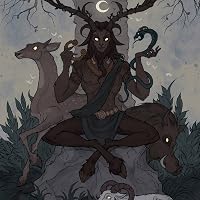
In this one-of-a-kind guidebook, award-winning Wiccan author and scholar Raven Grimassi presents an insightful portrait of the spirit of the Witch. He explores the spiritual element of the rituals, practices, and beliefs of Witchcraft, and how these elements apply not only to the seasons of nature, but also to the mystical seasons of the soul.
Literate and positive, Spirit of the Witch examines the oral tradition of Witches, as well as the cultural, literary, anthropological, and historical roots of Witchcraft. Revealed within these pages is the fascinating secret life of the Witch-guardian of the sacred mysteries, channel of magical forces, and keeper of the doorway between worlds.
Raven Grimassi was an American author of over 20 books, and a scholar of paganism with over 40 years of research and study in the genre of Wicca, Stregheria, witchcraft and neo-paganism.
This book is a primer for understanding spirituality in modern witchcraft traditions. However, in the usual style of Grimassi, it's not simplistic in tone or language. So this probably wouldn't be the right book for a dilettante (as so many new books seem to desire), but the reader who is seriously interested in a detailed view spanning many topics would love it.
Now, I am probably not the right person to write this review since I did not find it by choice. It was one of the terrific featured items in the first-hundred-in-the-door goodie bags at the Salem Witches Ball in 2010. I was very excited to meet Grimassi in person and overjoyed to see the gift bags contained a book of his I had not yet read. Due to my stack of books waiting to be read, "Spirit of the Witch" didn't see daylight until recently. Despite being written in his usual hefty style, I read this one rather quickly. I'm not one of those people who seeks out books that are "easy reads," but rather those with the most amount of information I want, no matter the effort. But it was quite refreshing to see that this book contains both substance and simplicity.
I am not a newbie so much of the information came as no surprise to me. But there were still a few passages that really affected me since they shed a different light on a topic I thought had been played out. I lead a coven, teach my own students, and have written two of my own manuscripts, so you can imagine what a nice surprise it is to be surprised!
In short, this would be a perfect book for one who wants inspiration on spirituality in witchcraft. I was inspired.
This book is full of history and reads like a text book. Meaning that sometimes it feels a bit overwhelming with information. While I did enjoy his writing I did not enjoy the name dropping of his previous works. This book seemed like an introduction to witchcraft but with references to most of his past works it was awkward. But I did learn a lot.
On another thing I noticed. For an author who talked so much about the feminine aspects of the witch he didn't write much about the maiden, mother and crone which I would have liked to learn about.
While this is a very clear, very straightforward and no-nonsense introduction to the novice, it is ultimately little more than a list, with none of the eloquence, poetry, or scholarship of Starhawk's "Spiral Dance" or Robert Graves, "The White Goddess." I was disappointed because I was hoping for a more sophisticated read on the unique history, metaphysics, and ethics of Neopagan spirituality. I enjoyed the last chapter on seasons and the metaphors of life's seasonality, but I was looking for a very different book. Also the author's style and constant referral to his own previous works was tediously unpolished. I wouldn't recommend this to any but the beginner or the teenager who would benefit from such simple clarity.
A POPULAR WITCH/AUTHOR ADDRESSES THE ‘SPIRITUALITY’ OF WITCHCRAFT
Raven Grimassi (born ‘Gary Charles Erbe,’ 1951-2019) was the author of many books on Witchcraft and neopaganism.
He wrote in the Introduction to this 2003 book, “I wrote this book to convey a sense of what is most noble and beautiful in the spirit of the Witch… The vast majority of Witches I’ve met over the years have been well-educated, intelligent and confident people who also possess a strong will and an independent nature. Witches are people who care about the planet we all live on, and who care about the communities in which they live. I’ve never met a Witch who did not have both an opinion and a desire to share it… Many Witches have remarked to me that there is an overabundance of books on magic, spell casting, and the fundamental practices of Witchcraft. They’ve often asked why we don’t have books written entirely on the topic of spirituality in Witchcraft… I had to concede that I knew of no single volume devoted to the topic… For the purposes of this book, I’ve tried to stay focused on what I believe are the common elements I’ve personally noted in the spirituality of Witches.” (Pg. xi-xii)
He continues, “This book covers a wide range of topics in an attempt to reveal both the religious elements of Witchcraft and the spiritual viewpoint of its practitioners. To that end I have included material related to the cultural, literary, anthropological, and historical connections. Additionally, I have presented material related to the oral traditions of Witches themselves… This book looks at the roots of Witchcraft as revealed in the etymology of the earliest references, as well as in the background elements of the earliest tales written about Witches, beginning as early as 700 BCE. Even though many of these tales are fictional, it must be noted that when a writer creates a fiction he or she typically uses facts in the general supporting background structure… Therefore, it is not unreasonable to assume that such valid elements exist within the tales of ancient writers on Witchcraft as well.” (Pg. xiii)
He goes on, “Ancient writings about Witches and Witchcraft contain a great deal of background material that reflects ethnographical bits and pieces that can be important in separating pertinent fact from intentional deception. I use this material to gain a clearer image of what the people who lived in such times believed concerning the incidental inclusions of specific common tools, props, clothing, expressions, and so forth. I have incorporated some historical … references related to the tools of Witchcraft throughout this book. My purpose was, in part, to bring to light the importance such elements have held for practitioners over countless centuries. Additionally I wished to demonstrate the antiquity and longevity of many components of Witchcraft that contemporary skeptics claim are nothing more than modern constructions.” (Pg. xiv)
He states, “The majority of Witches view divinity as being comprised of both male and female polarities, which they personify as ‘Goddess’ and ‘God.’ The ‘Source of All Things’ is considered to be essentially unknowable to the human intellect. To simplify it for human understanding, Witches personify the two aspects of the Divine Source. Therefore the Goddess and the God are the images of the creators of the Universe. The Goddess is the vehicle through which manifestation takes place and the God is the catalyst by which the womb of the Goddess is pregnant with the seed of creation.” (Pg. 28)
He outlines, “The Witches’ year is measured out in eight portions comprised of four quarter festivals and four cross-quarter festivals. The times that mark the exact midpoint between the equinox and solstice periods are called the cross-quarters… [which] fall in the months of February, May, August, and October. Together the eight celebrations, also known as the Sabbats, are referred to as the Wheel of the Year.” (Pg. 29-30)
He explains, “If you look up the word ‘Pagan’ you will find its origin in the Latin word ‘paganus,’ which meant ‘a country dweller’ and from the Latin ‘pagus,’ which indicated a person from a rural district. In later times Jews, Christians, and Moslems used the word ‘Pagan’ to indicate someone who did not believe in their view of God. Some people also used the word ‘Pagan’ to indicate a person who held no religious views, which has no basis in fact. Modern Witches use the word to indicate a person who believes in many gods and goddesses.” (Pg. 62)
He continues, “The roots of the word ‘heathen’ are derived from the Middle English word ‘heth,’ which refers to uncultivated land. Therefore a heathen was a person who lived away from the developed part of towns and cities. In this regard heathen and Pagan bear essentially the same meaning. During the early Christian period the word heathen was used to indicate the ‘unconverted people.’ The Church also placed anyone it viewed as unenlightened and/or uncivilized in this same category. In modern times the word heathen has come to mean a person who does not does not acknowledge God as viewed by the Jewish, Christian, or Moslem religions. The Witches’ view of deity is rooted in pre-Christian gods and goddesses associated with the woodlands, the moon, and sun, and the realm that lies behind the world of the living.” (Pg. 62-63)
He clarifies, “Many people have attempted to categorize Witches as white, gray, or black. For such people, white equates to good, black to evil, and gray a middle ground between the two concepts. Since Witches do not believe in the concept of evil as a thing in and of itself, these categories are not typically ones that Witches use to identify themselves and each other… we will examine the concepts in order to demonstrate the differences among those who call themselves Witches. A white Witch is essentially one who performs only positive works of magic and will not work against another for any reason. A gray Witch is one who blends both defensive and offensive magic into his or her Craft. Such a witch will cast a binding spell to prevent another from performing harmful acts. The so-called black Witch works magic for personal gain regardless of the consequences or the impact that may occur concerning other people. A black Witch is someone who would cast an offensive spell on an innocent person as readily as he or she would upon an enemy.” (Pg. 73-74)
He notes, “In some modern Witchcraft Traditions there is an adage known as the ‘Three-fold Law of Return.’ This principle is based upon an occult tenet of cause and effect. Essentially any act that a person performs effects him or her on three levels: the mind, body, and spirit.” (Pg. 93)
He says, “In Witchcraft, magic is defined as the art of causing one’s desires to manifest in accord with one’s envisioned will. This is first accomplished through exercises that are designed to strengthen the will and the person’s ability to visualize. Picture clearly in your mind exactly what you want and then focusing your will and determination on achieving it is the foundation of one’s magical ability. A popular concept in modern Witchcraft is that if you visualize your desire and believe you will achieve it, then it will manifest. Unfortunately, this is not enough to make your magic consistently successful.” (Pg. 119-120)
He reports, “Following a Witchcraft ritual, any leftover wine in the chalice is poured out on the earth. This act is called a libation, and constitutes an offering. Pouring the wine on the soil is an ancient act of veneration to both the spirits of Nature and Chthonic [underworld] entities.” (Pg. 199)
He concludes, “My best advice is to simply speak your own truths without ostentation. Avoid discussions involving character assassination… Devote your time instead to people who seem balanced, thoughtful, friendly, and helpful. This is a much more productive use of your time, and will help you sort out the true Witches from those who ‘talk the talk’ but don’t ‘walk the walk’ of our path.” (Pg. 213-214)
This book will appeal to some are studying Witchcraft, Wicca, and other kinds of paganism.
I like the writing style of this author, but the book seems too fractured. The author references his own work many times, as if trying to advertise previously published books, and that put me off, but more than that is how many actually interesting topics get touched on, and that's all. Several of the topics probably needed a book to themselves, but since they were lumped in with other topics, some of which also could have done with much larger sections to explain them properly, there isn't enough space without making this book into a huge volume.
I think I would like to read something else by this author and perhaps this wasn't a good place to start in regard to his work. I have heard good things about this particular author, and so when I found myself so disappointed, I was honestly surprised. But I won't let that disappointment cloud my opinion of him just yet. I'll try another book by him and see if I change my mind.
This book was very poorly written. It read like a list of random things related to witchcraft that the author threw together in a book. I was looking for a far more learned, eloquent, and sophisticated treatment of Paganism than this book provided.
There is a question modern Witchcraft periodically avoids because it is easier to buy another book of spells. What, exactly, do we think is sacred? Raven Grimassi spends much of Spirit of the Witch circling that question. Ritual, magic, seasonal observance, folklore, history, and tradition are all present, but he is interested in what makes any of them religious rather than simply occult activities performed by people who happen to call themselves witches. I found myself liking the book most whenever he stopped trying to explain where Witchcraft came from and started asking what kind of person a life within it might produce.
The idea of the Witch as guardian of mysteries and keeper of a doorway between worlds could become unbearably romantic very quickly, but Grimassi means something more substantial by it. A mystery is not simply secret information. It is something encountered through participation, something ritual and experience can reveal without reducing it to a proposition. His use of the natural seasons alongside what he calls the seasons of the soul is effective for the same reason. Spring and winter cease being decorative themes for sabbats and become ways of thinking about growth, decline, loss, renewal, and the periods in human life when nothing appears to be flowering at all.
I am less persuaded by portions of the cultural and historical framework. Grimassi remained deeply invested in tracing contemporary Witchcraft through older European religious and folkloric currents, and I would now draw much sharper lines between documented history, folklore, inherited Pagan ideas, and modern reconstruction. But the funny thing is that this book needs those claims less than some of his others do. The spirituality he describes does not collapse if Wicca is modern. Reverence for nature, relationship with deity, magical consciousness, ritual transformation, and a sense of responsibility toward the mysteries do not become counterfeit because historians can date the forms through which contemporary witches express them.
Perhaps that is why this particular Grimassi book has aged better for me than I expected. I have become less interested over the years in proving that Witchcraft is ancient and more interested in whether witches are doing anything profound with the religion we actually have. A tradition can possess a past and still fail to possess depth. It can also be comparatively young and confront people with questions about mortality, divinity, responsibility, transformation, and what it means to live in an ensouled world. Grimassi sometimes looked backward for validation when the strongest evidence was already sitting in front of him. The spirit of Witchcraft is ultimately found in what the practice does to the witch.
really enjoyed this one. raven grimassi spends less time teaching you how to cast spells and more time exploring what it actually means to live witchcraft as a spiritual path. he gets into witchcraft as religion, initiation, the mysteries of birth, life and death, gods and spirits, ritual, magical tools, the moon, the seasons, and the relationship between the witch and the natural world. i especially liked the emphasis on witchcraft as a worldview and way of moving through the world rather than simply a collection of magical techniques.
some of the historical claims should definitely be approached critically because grimassi sometimes presents folklore and older literary material as evidence for continuity more confidently than i would. that said, i think the book is much more interesting for its theology and philosophy than for trying to establish the historical antiquity of modern witchcraft. there are some genuinely beautiful ideas here about the witch as someone standing between worlds, participating in the cycles of nature, and approaching the mysteries of existence through direct experience. it’s also refreshing to read an older witchcraft book that spends this much time asking why we practice rather than giving you another hundred things to put in a spell jar. definitely worth reading for anyone interested in the spiritual and philosophical dimensions of the craft.
This is my third Raven Grimassi book. Though I still enjoy his writing and appreciate that he wrote an entire canon dedicated to the history, religion, worldviews, and practice of witchcraft, I have noticed that he did often repeat things across his body of work.
If you are on the path, I HIGHLY recommend this book as one to OWN. I learned more from it than almost any other in the years that I devoured material on the subject. I also keep my copy close by. It is one of the books that gets packed close in the times I have moved. It is also the one with coffee and bathwater stains...because I love it.
I want to not have to pack and move another book more than I want to finish this. So since someone on Paperback Swap has this on their wishlist, AWAY IT GOES.
Good historical information and well organized overview of the concepts within Witchcraft. The spiritual aspects didn't resonate with me so I ended up skimming some near the end.