

What do you think?
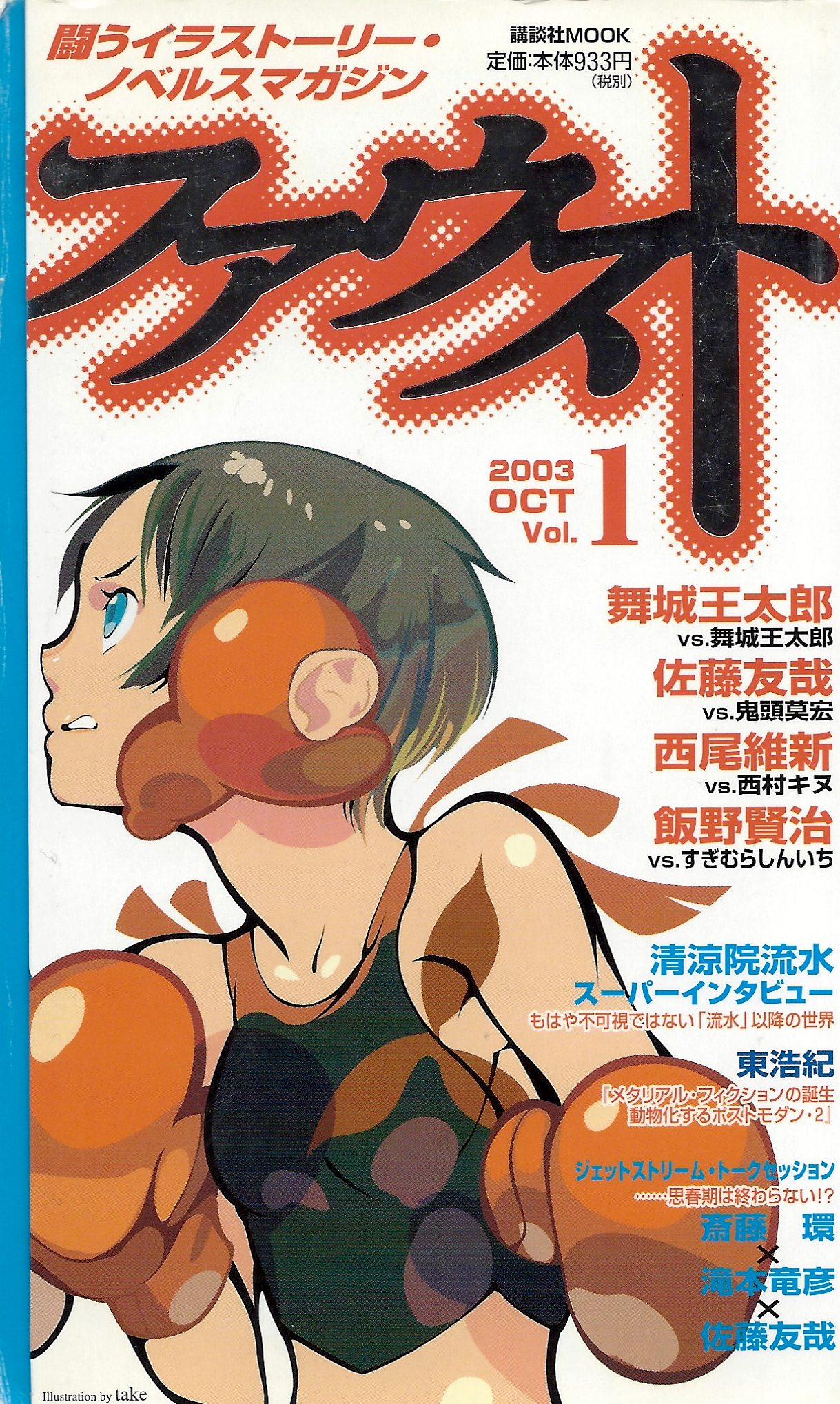
FAUST #1
ファウスト vol.1
・舞城王太郎VS.舞城王太郎
・佐藤友哉VS.鬼頭莫宏
・西尾維新VS.西村キヌ
・飯野賢治VS.すぎむらしんいち
・清涼院流水スーパーインタビュー――もはや不可視ではない「流水」以降の世界
・東浩紀――『メタリアル・フィクションの誕生 動物化するポストモダン・2』
・ジェットストリーム・トークミッション……思春期は終わらない!?
斎藤環×滝本竜彦×佐藤友哉
・佐藤友哉VS.鬼頭莫宏
・西尾維新VS.西村キヌ
・飯野賢治VS.すぎむらしんいち
・清涼院流水スーパーインタビュー――もはや不可視ではない「流水」以降の世界
・東浩紀――『メタリアル・フィクションの誕生 動物化するポストモダン・2』
・ジェットストリーム・トークミッション……思春期は終わらない!?
斎藤環×滝本竜彦×佐藤友哉
528 pages, Paperback
First published August 19, 2008
Ratings & Reviews
Friends & Following
Create a free account to discover what your friends think of this book!
Community Reviews
Displaying 1 - 10 of 10 reviews

April 20, 2018
It would be nice if there were more of these, but I don't feel like I want to learn Japanese just to read the original magazines, as interesting as 1000-page doorstopper-novel-shaped magazines of Japanese "light" prose sounds.
NISIOISIN's contribution, an excerpt from his prose spinoff of CLAMP's xxxHOLIC manga, AnotherHOLIC, is quite interesting, despite my lack of knowledge about the source material. What little I know of xxxHOLIC is that it concerns a teenaged boy working for a witch in something like an antiques shop, and that it crosses over with the battle shounen Tsubasa. I imagine the witch Yuuko does oddjobs relating to the supernatural, and it is this aspect that showcases a potential practice on Isin's part for his later Monogatari Series, insofar as his work with CLAMP's Yuuko character could form a basis for his original Meme Oshino character, though there are also similarities with Monogatari's Senjougahara, Hanekawa, and Shinobu, which may have branched from Isin's borrowing of CLAMP's property. Furthermore, the story flirts with the supernatural in a manner that is ultimately aborted in favor of the mundane, where the later Monogatari novels would use supernatural entities as a means of metaphorically explaining its teenage characters' emotional troubles, mixing the supernatural with the mundane. Lastly, Isin's prose is rather high-quality here, in such a way that is accurately reflected in Del Rey Manga's treatment of the first two Zaregoto novels, but not quite the same as in Vertical's publication of the Monogatari Series (I'm not sure how well the more recent versions of Zaregoto fare), so it is perhaps a little disappointing his writing seems better in a spinoff work of other people's creation than in his current flagship, at least as far as English translations go, at least.
I had some excitement for Kouhei Kadono's "Outlandos d'Amour," almost strictly because of Hajime Ueda's art, but also because of a personal interest in Kadono's Boogiepop series. I've not read the Boogiepop novels, nor have I seen the anime, but I have read that the works are presumably quite complex in structure in content, to a degree that seems to run contrary to their alleged popularity (Wikipedia notes Boogiepop as a major influencing force on the light novel craze of the past couple decades, which seems odd considering the apparent "difficulty" of its text). The only thing really "innovative" about Kadono's text here is that the bulk of the story concerns the protagonist in his middle-20s, instead of the teenage years common to most heroes of Japanese light fiction. And Ueda's art is dreadfully underutilized, drawing only a few flower petals and portraits of a handful of characters. His adaptation of FLCL holds a special place in my soul as a defining text for my Self, as silly as that may sound, placing such weight on a manga. Q-ko-chan was nice, as well, as were his illustrations for the Bakemonogatari anime (and I'd still like to buy the figures of Senjougahara and Hachikuji in Ueda's style).
Otaro Maijo's "Drill Hole in My Brain" is most certainly the highlight of this collection. The introduction's comparison to Georges Bataille and Bill Burroughs are not unfounded. I will say, however, that there are distinctions between comparison with Bataille and with Burroughs. The bizarre sexual content of this story has more in common with the avant-garde ultraviolence of "The Story of the Eye" and its fetishism, and not so much with the more mundane ass-focus of Burroughs's Naked Lunch. The flow of the narrative, however, has more in common with the surrealistic dream-flow of Naked Lunch's text, drifting from one absurd scene to the next, seemingly at random (if I recall correctly, Burroughs wrote the novel out of sequence). Likewise, where Naked Lunch's world was injected with elements of Burroughs's contemporary pulp sci-fi (the alien bugs of the Interzone), so too is Maijo's world crawling with commonalities to his time and space's light fiction, what with the supernatural battle scenes, straight from a Weekly Shounen Jump manga. Maijo does well to stamp his story with a uniqueness in the dueling p.o.v. of real protagonist Hideaki and the Makoto character of the world inside his head. Hideaki tries to keep control of his circumstances, but is quick to fall under the spell of this imagined world, allowing the Makoto personality to take over, especially when Makoto is possessed by his frenzied masturbation. I will say that I don't care too much for the very end, when Makoto begins to actively take over. Seems to "obvious" for light fiction.
Unfortunately, I'm not familiar enough with Doraemon to fully appreciate Otsuichi's "F-Sensei's Pocket," but I must say the frequent use of the series's gadgets made me yearn to experience this classic anime and manga (and regardless, I am going to buy some of Uniqlo's Doraemon shirts when they go on sale haha). I can likewise enjoy the "twist" usage of some of the gadgets, though obviously my weak awareness of the franchise makes their subversion less impactful. And overall, the story is kind of weak, with the antagonistic otaku girl being too easily swayed by the draw of the future devices' power, and the protagonist's final decision to side with her friend instead of giving her up to the authorities. That said, it is pretty cute that Doraemon makes an appearance himself, even if it is for the cliched action of undoing all previous events in the story in order to maintain status quo. Also the metafictional jokes to illustrator Takeshi Obata were a little grating.
My main interest in this volume was the official English translation of the first part of Kinoko Nasu's Kara no Kyoukai novels, presented here under the localized title of The Garden of Sinners. I have long been interested in Nasu's works, but I've only gotten as far as downloading Tsukihime and Fate/Stay night and not really playing either for very long at all, additionally getting quite far into the Fate/EXTRA game and its recent anime sequel, Last Encore, effectively making me something of a "tertiary" (for years I've been aware of the meme of calling fans of first DEEN's then ufotable's anime adaptations of Nasu's works as "secondaries," though I've more recently seen fans of the Grand Order mobage referred to as "tertiaries," so I'm not sure where fans of the older EXTRA subseries reside). I don't quite like how Nasu postpones Shiki's fight scene in favor of playing it as a flashback later in the story, but I did enjoy his use of multiple character perspectives, with much of the story alternating between Shiki and her boyfriend Mikiya, with a brief section told by antagonist Fujo, and the very end covered by Touko's narration. Nasu's visual novels seem almost hindered by their focus on one character's first-person perspective (though at least Tsukihime spends much of its time on Shiki's deteriorating psychological balance), so the change (well, KnK came first, I guess) is welcome.
The essays are alright, I guess. Takimoto's mainly just made me want to re-read Welcome to the NHK, which I plan on doing soon. The TYPE-MOON interview was kind of sad because it teases the Del Rey Manga publication of The Garden of Sinners, which was ultimately aborted due to the demise of Del Rey Manga. Now that Kodansha's USA branch rose from the ashes, it seems they have no interest in releasing The Garden of Sinners, likely due to that ship having sailed in favor of Fate dickriding to draw more players to spend money on F/GO.
The manga were also okay. It was nice to see NISIOISIN's major illustrators take and VOFAN do their own thing, but most of the manga here is utterly short, a handful of pages maximum, so we don't get to see as much take and VOFAN art as I would like. It doesn't help that take's art in Zaregoto is severely limited to small-ish character illustrations between chapters, nor that VOFAN's Monogatari art is mostly in black-and-white outside the book covers and first insert pages. The artwork in the Isin-penned story is pretty nice, though - by which I mean I liked the contrast of eyemask versus big cartoon titties and poofy hair of the Snowdrop character (and I suppose I'll blame NieR: Automata for making female characters with covered eyes sexier than they really should be).
NISIOISIN's contribution, an excerpt from his prose spinoff of CLAMP's xxxHOLIC manga, AnotherHOLIC, is quite interesting, despite my lack of knowledge about the source material. What little I know of xxxHOLIC is that it concerns a teenaged boy working for a witch in something like an antiques shop, and that it crosses over with the battle shounen Tsubasa. I imagine the witch Yuuko does oddjobs relating to the supernatural, and it is this aspect that showcases a potential practice on Isin's part for his later Monogatari Series, insofar as his work with CLAMP's Yuuko character could form a basis for his original Meme Oshino character, though there are also similarities with Monogatari's Senjougahara, Hanekawa, and Shinobu, which may have branched from Isin's borrowing of CLAMP's property. Furthermore, the story flirts with the supernatural in a manner that is ultimately aborted in favor of the mundane, where the later Monogatari novels would use supernatural entities as a means of metaphorically explaining its teenage characters' emotional troubles, mixing the supernatural with the mundane. Lastly, Isin's prose is rather high-quality here, in such a way that is accurately reflected in Del Rey Manga's treatment of the first two Zaregoto novels, but not quite the same as in Vertical's publication of the Monogatari Series (I'm not sure how well the more recent versions of Zaregoto fare), so it is perhaps a little disappointing his writing seems better in a spinoff work of other people's creation than in his current flagship, at least as far as English translations go, at least.
I had some excitement for Kouhei Kadono's "Outlandos d'Amour," almost strictly because of Hajime Ueda's art, but also because of a personal interest in Kadono's Boogiepop series. I've not read the Boogiepop novels, nor have I seen the anime, but I have read that the works are presumably quite complex in structure in content, to a degree that seems to run contrary to their alleged popularity (Wikipedia notes Boogiepop as a major influencing force on the light novel craze of the past couple decades, which seems odd considering the apparent "difficulty" of its text). The only thing really "innovative" about Kadono's text here is that the bulk of the story concerns the protagonist in his middle-20s, instead of the teenage years common to most heroes of Japanese light fiction. And Ueda's art is dreadfully underutilized, drawing only a few flower petals and portraits of a handful of characters. His adaptation of FLCL holds a special place in my soul as a defining text for my Self, as silly as that may sound, placing such weight on a manga. Q-ko-chan was nice, as well, as were his illustrations for the Bakemonogatari anime (and I'd still like to buy the figures of Senjougahara and Hachikuji in Ueda's style).
Otaro Maijo's "Drill Hole in My Brain" is most certainly the highlight of this collection. The introduction's comparison to Georges Bataille and Bill Burroughs are not unfounded. I will say, however, that there are distinctions between comparison with Bataille and with Burroughs. The bizarre sexual content of this story has more in common with the avant-garde ultraviolence of "The Story of the Eye" and its fetishism, and not so much with the more mundane ass-focus of Burroughs's Naked Lunch. The flow of the narrative, however, has more in common with the surrealistic dream-flow of Naked Lunch's text, drifting from one absurd scene to the next, seemingly at random (if I recall correctly, Burroughs wrote the novel out of sequence). Likewise, where Naked Lunch's world was injected with elements of Burroughs's contemporary pulp sci-fi (the alien bugs of the Interzone), so too is Maijo's world crawling with commonalities to his time and space's light fiction, what with the supernatural battle scenes, straight from a Weekly Shounen Jump manga. Maijo does well to stamp his story with a uniqueness in the dueling p.o.v. of real protagonist Hideaki and the Makoto character of the world inside his head. Hideaki tries to keep control of his circumstances, but is quick to fall under the spell of this imagined world, allowing the Makoto personality to take over, especially when Makoto is possessed by his frenzied masturbation. I will say that I don't care too much for the very end, when Makoto begins to actively take over. Seems to "obvious" for light fiction.
Unfortunately, I'm not familiar enough with Doraemon to fully appreciate Otsuichi's "F-Sensei's Pocket," but I must say the frequent use of the series's gadgets made me yearn to experience this classic anime and manga (and regardless, I am going to buy some of Uniqlo's Doraemon shirts when they go on sale haha). I can likewise enjoy the "twist" usage of some of the gadgets, though obviously my weak awareness of the franchise makes their subversion less impactful. And overall, the story is kind of weak, with the antagonistic otaku girl being too easily swayed by the draw of the future devices' power, and the protagonist's final decision to side with her friend instead of giving her up to the authorities. That said, it is pretty cute that Doraemon makes an appearance himself, even if it is for the cliched action of undoing all previous events in the story in order to maintain status quo. Also the metafictional jokes to illustrator Takeshi Obata were a little grating.
My main interest in this volume was the official English translation of the first part of Kinoko Nasu's Kara no Kyoukai novels, presented here under the localized title of The Garden of Sinners. I have long been interested in Nasu's works, but I've only gotten as far as downloading Tsukihime and Fate/Stay night and not really playing either for very long at all, additionally getting quite far into the Fate/EXTRA game and its recent anime sequel, Last Encore, effectively making me something of a "tertiary" (for years I've been aware of the meme of calling fans of first DEEN's then ufotable's anime adaptations of Nasu's works as "secondaries," though I've more recently seen fans of the Grand Order mobage referred to as "tertiaries," so I'm not sure where fans of the older EXTRA subseries reside). I don't quite like how Nasu postpones Shiki's fight scene in favor of playing it as a flashback later in the story, but I did enjoy his use of multiple character perspectives, with much of the story alternating between Shiki and her boyfriend Mikiya, with a brief section told by antagonist Fujo, and the very end covered by Touko's narration. Nasu's visual novels seem almost hindered by their focus on one character's first-person perspective (though at least Tsukihime spends much of its time on Shiki's deteriorating psychological balance), so the change (well, KnK came first, I guess) is welcome.
The essays are alright, I guess. Takimoto's mainly just made me want to re-read Welcome to the NHK, which I plan on doing soon. The TYPE-MOON interview was kind of sad because it teases the Del Rey Manga publication of The Garden of Sinners, which was ultimately aborted due to the demise of Del Rey Manga. Now that Kodansha's USA branch rose from the ashes, it seems they have no interest in releasing The Garden of Sinners, likely due to that ship having sailed in favor of Fate dickriding to draw more players to spend money on F/GO.
The manga were also okay. It was nice to see NISIOISIN's major illustrators take and VOFAN do their own thing, but most of the manga here is utterly short, a handful of pages maximum, so we don't get to see as much take and VOFAN art as I would like. It doesn't help that take's art in Zaregoto is severely limited to small-ish character illustrations between chapters, nor that VOFAN's Monogatari art is mostly in black-and-white outside the book covers and first insert pages. The artwork in the Isin-penned story is pretty nice, though - by which I mean I liked the contrast of eyemask versus big cartoon titties and poofy hair of the Snowdrop character (and I suppose I'll blame NieR: Automata for making female characters with covered eyes sexier than they really should be).

September 11, 2012
I really liked all the stories (Except the Drill Hole...). It's great that Del Rey started to pulblish the series (the unfortunate part that they stopped after the second volume).
If someone is interested in the light novel genre but unsure with which to start, this can be an ideal choise. (Just skip the Drill Hole... :) )
If someone is interested in the light novel genre but unsure with which to start, this can be an ideal choise. (Just skip the Drill Hole... :) )

December 13, 2022
While the actual stories and essays featured in this literary magazine-book are pretty hit-or-miss, the entire thing radiates with an unfettered, renegade optimism for Japanese media and pop culture that so permeated Manga & Anime fandoms in the mid-to-late 00s. Each piece is introduced with a palpable excitement for the niche, as though names like NisiOisiN and Nasu Kinoko would very soon explode into mainstream acclaim, with Faust's continued publication uplifting them and their contemporaries all the while.
Of course, the 2008 Recession would hit, the US edition of Faust would stop publishing after it's second issue, and several of the localizations hyped up here would remain unpublished indefinitely, but none of that keeps this from being a joyful, if not almost cringeworthy, celebration of a once rapidly expanding niche.
Also, when the short stories hit, they do be hittin' pretty hard tho. Most of them, particularly "Drill Hole in My Brain" and the Kouhei Kadono piece, gave me a whole lot to ponder on afterwards.
Of course, the 2008 Recession would hit, the US edition of Faust would stop publishing after it's second issue, and several of the localizations hyped up here would remain unpublished indefinitely, but none of that keeps this from being a joyful, if not almost cringeworthy, celebration of a once rapidly expanding niche.
Also, when the short stories hit, they do be hittin' pretty hard tho. Most of them, particularly "Drill Hole in My Brain" and the Kouhei Kadono piece, gave me a whole lot to ponder on afterwards.

Read
September 7, 2026read just drill hole in my brain by otaro maijō

December 10, 2008
Another anthology of short stories and comics. Predictably, it was a mixed bag. The short comics were too short to satisfy, as were the very short fictional/nonfiction? essays at the very end.
The first short story, an excerpt from Nisioisin's xxxHolic novel, was decent enough, though I think the animated episode that derives from it was a bit more effective if only because xxxHolic relies very heavily on the fantastic visuals to convey the atmosphere and supernatural.
The 2nd short story by Kouhei Kadono was awesome-- not distant the way many Japanese fiction is, with fast pacing without forgetting to delve where it needs to. Enjoyable and interesting. The only flaw is that I wish it didn't end. I'll definitely be checking out this author's other works.
The 3rd short story was ridiculous-- trotted out as a gem of "avant-garde", this story was essentially some weirdo monologuing without end his deviant sex dreams. The dreams themselves don't have any plot that I could tell (but I stopped reading halfway through); like real dreams, they make very little sense when spoken (or written) aloud, and get very tedious very fast. Just a lot of splashy, "cutting-edge", messed-up, sexed-up imagery.
The 4th story was boring. Heavy tie-ins with Doraeman, which I never watched, so I can't appreciate the nostalgia that the story was banking on. Takeshi Obata's art is very nice, but ya know...that's not enough.
The 5th story....yeah. >_> I lost interest in that point. It's too bad, I may have finished it if it was placed before the 4th story.
The first short story, an excerpt from Nisioisin's xxxHolic novel, was decent enough, though I think the animated episode that derives from it was a bit more effective if only because xxxHolic relies very heavily on the fantastic visuals to convey the atmosphere and supernatural.
The 2nd short story by Kouhei Kadono was awesome-- not distant the way many Japanese fiction is, with fast pacing without forgetting to delve where it needs to. Enjoyable and interesting. The only flaw is that I wish it didn't end. I'll definitely be checking out this author's other works.
The 3rd short story was ridiculous-- trotted out as a gem of "avant-garde", this story was essentially some weirdo monologuing without end his deviant sex dreams. The dreams themselves don't have any plot that I could tell (but I stopped reading halfway through); like real dreams, they make very little sense when spoken (or written) aloud, and get very tedious very fast. Just a lot of splashy, "cutting-edge", messed-up, sexed-up imagery.
The 4th story was boring. Heavy tie-ins with Doraeman, which I never watched, so I can't appreciate the nostalgia that the story was banking on. Takeshi Obata's art is very nice, but ya know...that's not enough.
The 5th story....yeah. >_> I lost interest in that point. It's too bad, I may have finished it if it was placed before the 4th story.

February 18, 2020
An interesting concept and experience, but suffers from the typical problems of translating text (that choppiness and awkwardness of word choice). I think I probably would've enjoyed this more back when it came out, but wasn't a bad experience.
October 15, 2025
(after i posted this review, i decided to knock the book down from 3 stars to 2, because the main reason i use starred ratings on goodreads is that they influence your book recommendations. i think from the recommendation-influencing standpoint, 2 stars is more correct. however, if Drill Hole In My Head were a standalone publication, i'd probably give that 5 stars and complain about not being able to give it 6)
i am giving a 3 star "i liked it" rating based on what i read. i adored one of the stories. some of the material really sucked but it can be interesting to read bad stuff (and i also think being badly let down by media sometimes is a worthwhile experience) so the overall impression i have of this collection is that "i liked (reading) it"
this is a collection of japanese pulp lit in translation. so, the prose stinks most of the time.
"Outlandos d'amour" was alright. it reminded me of my brother who likes shitty anime. i was surprised to learn after the fact that it's set in the world of Boogiepop Phantom, which I have heard is good and do intend to watch someday. i felt a little cheated after reading something supplementary and expecting it to be self contained. i am pretty much allergic to anything "set in the world of..."
Hajime Ueda's illustrations were just awful, and i say that as a fan. his name was one of the reasons i picked this up.
"Drill Hole In My Brain" was crazy. it started off embarrassing, i expected your average tryhard "so crazy" japanese stuff. before too long the corniness faded into the background and the allusions to bataille and burroughs in the preface were justified. my body ached for most of the time i was reading this, it was absolutely uncomfortable. absolutely the standout, no fucking question. this was also the only part that had illustrations that were in any way worth looking at.
"F-Sensei's Pocket" got pretty good by the end but I was not enjoying it in the beginning. The protagonist's cheeky, fourth wall breaking narration made it feel like I was watching Clueless (i kind of like that movie, by the way...) or even something aimed at savvy tweens. it's not endearing.
i would be willing to read some more of Otsuichi's work, as i am under the impression it is usually not so campy and self conscious.
i forget what the manga in the back were titled, and they weren't good enough to even bother flipping through the pdf again to find the titles. apparently they weren't even worth putting in the table on contents. nice.
the short "H People" was not compelling. this is somewhat concerning for me because its premise is very similar to an idea i had for a short story, myself. it's unlikely i will ever write a short story anyway, but hopefully if i do, it will be better executed.
the flash fiction "Yabai de Show" was straight up bad.
the "Counseling Session" pieces were so unfunny that i stopped both. i was disappointed that this was the case with Tatsuhiko Takimoto, since i was a fan of Welcome to the NHK when i read it a long time ago. his name was the name besides Hajime Ueda which inspired me to "pick up" (download) a copy of this last year. i tried to re-read NHK in the interim and found it pretty terrible. i don't know how the blame for that should be distributed between the author and the translator, but it did feel like actually crappy writing.
the essay "Approaching Twenty Years of Otaku" felt like it was going somewhere and then it abruptly ended. "From Japan to the World..." was an interesting read, not because i learned anything, but more because it's coming from an optimistic industry insider who aniticipates certain changes to be coming in the future. we are in that future, now. she was writing about 20 years after manga started showing up in the west and it's been about 20 years since she wrote it. did the feedback loop close like she predicted- did "manga-style" western comics make an impact on the japanese manga industry? i assume not, but i really wouldn't know. i thought it was pretty funny when she said she was excited that Megatokyo got published in Faust. i guess i had already learned earlier in this volume that their editorial department's sense of quality is a lot different than mine.
i skipped the CLAMP and TYPE-MOON stories because i hate that shit, even if they weren't excerpts from longer works (also an excellent reason to skip). i have less than zero interest in these people and their work. naturally, i also skipped the TYPE-MOON author guy interview section.
as far as i know, this volume was published in japan as-is, and then translated to english later. if someone had been tasked with selecting Faust pieces which would appeal to westerners, the collection might have been a lot different, and maybe a lot better.
i'm really happy i read Drill Holl In My Brain, and F-Sensei's Pocket was imaginative enough that i think it will stick with me. i feel like this review wasn't worth the time it took to write, but it was a pretty decent way to get my brain woken up this morning.
i am giving a 3 star "i liked it" rating based on what i read. i adored one of the stories. some of the material really sucked but it can be interesting to read bad stuff (and i also think being badly let down by media sometimes is a worthwhile experience) so the overall impression i have of this collection is that "i liked (reading) it"
this is a collection of japanese pulp lit in translation. so, the prose stinks most of the time.
"Outlandos d'amour" was alright. it reminded me of my brother who likes shitty anime. i was surprised to learn after the fact that it's set in the world of Boogiepop Phantom, which I have heard is good and do intend to watch someday. i felt a little cheated after reading something supplementary and expecting it to be self contained. i am pretty much allergic to anything "set in the world of..."
Hajime Ueda's illustrations were just awful, and i say that as a fan. his name was one of the reasons i picked this up.
"Drill Hole In My Brain" was crazy. it started off embarrassing, i expected your average tryhard "so crazy" japanese stuff. before too long the corniness faded into the background and the allusions to bataille and burroughs in the preface were justified. my body ached for most of the time i was reading this, it was absolutely uncomfortable. absolutely the standout, no fucking question. this was also the only part that had illustrations that were in any way worth looking at.
"F-Sensei's Pocket" got pretty good by the end but I was not enjoying it in the beginning. The protagonist's cheeky, fourth wall breaking narration made it feel like I was watching Clueless (i kind of like that movie, by the way...) or even something aimed at savvy tweens. it's not endearing.
i would be willing to read some more of Otsuichi's work, as i am under the impression it is usually not so campy and self conscious.
i forget what the manga in the back were titled, and they weren't good enough to even bother flipping through the pdf again to find the titles. apparently they weren't even worth putting in the table on contents. nice.
the short "H People" was not compelling. this is somewhat concerning for me because its premise is very similar to an idea i had for a short story, myself. it's unlikely i will ever write a short story anyway, but hopefully if i do, it will be better executed.
the flash fiction "Yabai de Show" was straight up bad.
the "Counseling Session" pieces were so unfunny that i stopped both. i was disappointed that this was the case with Tatsuhiko Takimoto, since i was a fan of Welcome to the NHK when i read it a long time ago. his name was the name besides Hajime Ueda which inspired me to "pick up" (download) a copy of this last year. i tried to re-read NHK in the interim and found it pretty terrible. i don't know how the blame for that should be distributed between the author and the translator, but it did feel like actually crappy writing.
the essay "Approaching Twenty Years of Otaku" felt like it was going somewhere and then it abruptly ended. "From Japan to the World..." was an interesting read, not because i learned anything, but more because it's coming from an optimistic industry insider who aniticipates certain changes to be coming in the future. we are in that future, now. she was writing about 20 years after manga started showing up in the west and it's been about 20 years since she wrote it. did the feedback loop close like she predicted- did "manga-style" western comics make an impact on the japanese manga industry? i assume not, but i really wouldn't know. i thought it was pretty funny when she said she was excited that Megatokyo got published in Faust. i guess i had already learned earlier in this volume that their editorial department's sense of quality is a lot different than mine.
i skipped the CLAMP and TYPE-MOON stories because i hate that shit, even if they weren't excerpts from longer works (also an excellent reason to skip). i have less than zero interest in these people and their work. naturally, i also skipped the TYPE-MOON author guy interview section.
as far as i know, this volume was published in japan as-is, and then translated to english later. if someone had been tasked with selecting Faust pieces which would appeal to westerners, the collection might have been a lot different, and maybe a lot better.
i'm really happy i read Drill Holl In My Brain, and F-Sensei's Pocket was imaginative enough that i think it will stick with me. i feel like this review wasn't worth the time it took to write, but it was a pretty decent way to get my brain woken up this morning.
November 1, 2022
Kouhei Kadono’s story, 1000% awesome
August 5, 2023
The concept alone is great, wished for more of Kouhei Kadono’s story

November 20, 2008
This book was really interesting and the first couple of stories caught my interest and kept it. After the third one, I got lost and never quite found myself again. At that point the cultural references and the vagueness of the plot confused me. I struggled through the last bit, not even sure if I was reading the story or the preface where they talk about the background of the writer and the story.
Displaying 1 - 10 of 10 reviews