Jump to ratings and reviews
Rate this book

Policing the City: An Ethno-graphic

Rate this book
Adapted from the landmark essay Enforcing Order, this striking graphic novel offers an accessible inside look at policing and how it leads to discrimination and violence.

What we know about the forces of law and order often comes from dramatic episodes that make the headlines, or from sensationalized versions for film and television. These gripping accounts can obscure a crucial aspect of police work: the tedium of everyday patrols and paperwork, under a constant pressure to meet numbers.

Around the time of the 2005 French riots, anthropologist and sociologist Didier Fassin spent fifteen months observing up close the daily life of an anti-crime squad in one of the largest precincts in the Paris region. His unprecedented study, which sparked intense discussion about policing in the largely working-class, immigrant suburbs, remains acutely relevant in light of all-too-common incidents of police brutality against minorities.

This new, powerfully illustrated adaptation clearly presents the insights of Fassin’s investigation, and draws connections to the challenges we face today.

112 pages, Hardcover

Published March 1, 2022

2 people are currently reading
250 people want to read

About the author

Didier Fassin

91 books112 followers
Didier Fassin is a French anthropologist and sociologist. He is currently the James D. Wolfensohn Professor of Social Science at the Institute for Advanced Study in Princeton and holds a Direction of Studies in Political and Moral Anthropology at the École des Hautes Études en Sciences Sociales in Paris.

Ratings & Reviews

What do you think?
Rate this book

Friends & Following

Create a free account to discover what your friends think of this book!

Community Reviews

5 stars
88 (37%)
4 stars
103 (43%)
3 stars
40 (16%)
2 stars
5 (2%)
1 star
0 (0%)
Displaying 1 - 30 of 42 reviews
Profile Image for Charlotte.
156 reviews7 followers
March 24, 2024
PASSIONNANT !!! Mais envie de tout brûler #ACAB
Profile Image for Rachel.
1,920 reviews39 followers
August 8, 2022
It's disheartening that racism and brutality in the police force in France looks so similar to that in the USA. The author was allowed to shadow various police and talk with administrators for about a year, and the police didn't clean up their act for him (or if they did, it's even scarier). He presents it straightforwardly, and is obviously quite dismayed at it. Excellent.
Profile Image for António Lima.
73 reviews4 followers
November 9, 2020
L'anthropologue Didier Fassin a passé 15 mois en accompagnement des Brigades Anti-Criminalité, une unité spéciale de la Police Française, habillée en civil et conduisant des voitures banalisées, créée dans les années 90 pour montrer aux populations que les politiciens se souciaient de leur sécurité et mettaient en place des moyens pour combattre la “voyoucratie” (si on emploie ici le mot proféré des années plus tard par le à l’époque ministre de l’intérieur Nicolas Sarkozy).
L’ouvrage résultant de cette recherche a été adapté cette année en bande dessinée et dresse le portrait d’une police mal préparée au contact des populations des quartiers démunis, en manque d’affirmation d’une virilité empruntée à Hollywood et envahie par des éléments d’idéologie extrême, infiltrée par le racisme, la xénophobie et l’aversion pour l'inconnu.
Si à ça on ajoute la culture organisationnelle d’une bureaucratie orientée chiffres et indicateurs où on mesure l’efficacité en nombre d’interpellations et de détentions plutôt qu’à l’objectif ultime d’une société pacifiée, voici le cocktail (d’ailleurs connu dans d’autres pays y compris le mien) qui mène à la discrimination, au traitement arbitraire des citoyens à couleur de peau plus foncée ou à des soupçons de pratiques réligieuses “minoritaires”.
Cela malgré l’existence de professionnels et même de dirigeants qui ne partagent ni la forme, ni les actes, ni les “résultats” de la plupart de ces équipes de policiers et qui demandent à être mutés pour ne pas participer à une forme de barbarie.
Le pouvoir judiciaire (et surement une certaine opinion publique) se montre en plus très réticent à punir les dérives des forces de l’ordre, ceci étant encore aussi vrai en France qu’en bien d’autres démocraties (pour ne pas parler de dictatures).
Si nous ajoutons à tout ça la caution donnée par les lois d’exception, comme suite aux attaques terroristes de Paris en 2015 ou même actuellement en réaction à la pandémie de coronavirus, le futur ne nous augure pas grand’chose de nouveau dans la relation entre la police et les citoyens.
Lire cette BD c’est mieux le comprendre, à travers une lecture claire et très pédagogique quoique pas toujours très légère (et pour cause).
Et... pardon my french...
Profile Image for Mélanie.
59 reviews5 followers
February 27, 2021
Je sors de cette lecture en colère, angoissée, triste, avec une question en tête : Mais où est-ce qu'on va ?
Profile Image for Nancy.
Author 4 books136 followers
May 20, 2022
“Authoritarianism thus emerges as the necessary counterpart to neoliberalism.”
~ Didier Fassin,
Policing The City
Profile Image for Vio Rlln.
186 reviews
January 15, 2023
Abus de pouvoir, racisme, inégalités. Un ouvrage inquiétant sur la tournure autoritaire des démocraties.
Profile Image for Dania.
69 reviews
December 18, 2025
Le travail de Didier Fassin sur l’institution policière est très bien documenté avec le format BD ça fait froid dans le dos mais c’est une lecture importante pour comprendre la xénophobie policière
309 reviews6 followers
August 10, 2022
Policing the City is an adaptation of a research text Didier Fassin did on the policing of the low-income neighborhoods in France. After being embedded with an anticrime squad for over a year along with a great deal of in-depth research Fassin attempted to pinpoint the growing divide between the police and racial and ethnic minorities.

Hoping to present his findings to an even larger audience the work is now in graphic novel form to provide clearer and more concise pictures of his findings with the help of artist Jake Raynal.

Much of the issues that face minority groups in France mirror that of the United States. A breakdown in community policing where the relationship between officers and the people is an adversarial one. Where the push to drive up arrests and reliance on stats leads to countless stop and frisks incidents. Bogus arrests are the norm in order to keep those in charge happy while those that are powerless are forced to suffer for the sake of politics.

This leads to an ever-increasing hostile environment that is looking for a reason to explode and often finds it. The accounts are vivid and effectively told as Fassin’s proximity to officers and their every day gives full insight into the breakdown of basic human decency.

Comics as a form of journalism may not be common but it can be so effective as this shows. The lack of a camera makes people honest to the level of arrogance. Being a visual medium the entire facede that has been sold becomes clear in a way text can cloud. If art is the pursuit of truth, what better subject to make your muse than Policing the City?
Profile Image for Maileen Hamto.
282 reviews17 followers
Read
October 17, 2022
Researcher Didier Fassin has partnered with writer Frédéric Debormy and artist Jake Raynal to deliver an eye-opening graphic novel tackling the issue of police brutality and harassment of immigrants, Blacks, Arabs, and Roma. "Policing the City: An Ethno-Graphic" exposes the key findings of a fifteen-month sociological study conducted by Fassin as he shadowed and interviewed members of an anti-crime squad that patrol low-income neighborhoods outside Paris.

Fassin’s interest in understanding how policing upholds systemic racism and discrimination is spurred by the killings of young Black men in Clichy-sous-Bois and Villiers-Le-Bel: tragic deaths that sparked widespread protests in France. Fassin’s work with police shows that unnecessary identity checks and body searches are far too common among the working class, while abuses of power by the police often go unchallenged.

Police breach drug and immigration laws as they enact racist and anti-immigrant policies by racially profiling young Black and Arab French nationals who live in housing projects. Using the graphic format is powerful, making Fassin’s study more engaging and accessible to communities of color who are most affected by the overreach of police power.

The English-language release of "Policing the City" is a crucial bridge for American readers to understand the increasing harassment of Black and immigrant communities. It’s an important read for anyone interested in learning about the parallels between right-wing movements in Europe and the U.S., and how nationalist sentiments have only amplified structural racism in the Western world.
Profile Image for Becky.
1,392 reviews11 followers
May 13, 2022
I picked up this ethno-graphic novel from the local library new release shelf. Though much of the content is from many years ago in France, the themes of police brutality, racial profiling and xenophobia ring true today in the US. The book does draw some parallels to the US (including a mention of George Floyd and BLM), but mainly focuses on French policing through the eyes of a researcher gathering observational field data. Aesthetically I didn’t love the illustrations because it was hard to tell what was going on some of the time and/or distinguish different people/characters. It’s a painful book to read in that the content is quite upsetting, but it’s also important to know that this was and is happening.
Profile Image for Blane.
706 reviews10 followers
March 18, 2022
As I read this graphic novelization of Fassin's study of heavy-handed policing tactics in the suburbs of Paris, I kept thinking of Justin Fenton's (inferior) 'We Own This City', which looks at similar abuses of power in Baltimore. It really does not matter where you are...something needs to change.
Profile Image for Dina Rahajaharison.
1,007 reviews17 followers
March 2, 2024
"Certains n'ont jamais affaire à la police. D'autres se savent toujours à sa merci. Chacun se voit ainsi rappeler sa place dans la société."
Profile Image for Ags .
316 reviews
January 29, 2024
I picked up this graphic novel interested in the topic (exploring police brutality within the context of often-mundane day to day work) and interested in this as an example of research communication (A graphic novel of an ethnography by an anthropologist/sociologist? Sign me up!).

Opening up with a short prologue very briefly introducing the study was a great idea. Here, I liked the idea of the ethnographer being presented as a silhouette- however, in practice, the ethnographer a silhouette ended up looking quite sinister to me. And, in some panels, when the back of a police officer was shown, I was very confused because I thought this was the ethnographer. Twas not! I was also consistently confused regarding if a scene was something the researcher had been present for, or had overheard. This seemed like an important confusion.

While I liked the color palette, I overall found the art a bit disturbing, and not in a way that seemed purposeful. The sketchy, bloby faces looked like burn victims? And, again, not in a way that I thought was illustrative of some theme/analysis.

Speaking of analysis, I most appreciated the broader summaries of the study's findings (e.g., identity-based harassment being fueled, in part, by quotas; the violent/incompetent realities of first time officers from conservative, rural, predominantly white areas being assigned to inner-city project settings; officers searching for the "thrill" of policing that they saw in media/TV growing up). However, it was strange that no theories were explicitly invoked. So, it's hard to think that this really captured the study? Or, maybe the study did not draw on/explicate theories? Either way, I'm a bit concerned.

Finally, given that this is an ethnography, the social location of the researcher felt really missing. We learn in the beginning that his son has experienced police harassment, and that his access to police work is unprecedented. Otherwise, we don't learn much about the methods, how the researcher got access, and/or how his identity played into his analysis. I honestly had to google him at the end to learn that he's white. This feels like important context?

All that being said: I am glad I read this. I learned a lot + was cool to see this translation of research.
Profile Image for Chris.
2,128 reviews78 followers
April 8, 2022
For a long time, two major models of policing contrasted with each other. In the United Kingdom it was the --bobby--, unarmed, often a beat officer, well integrated into his community and respected for his sense of civic duty. In the United States it was the --cop--, patrolling in a car, with a limited relationship with the public, and feared for his brutality and his racism. This is the model that has become established almost everywhere in the world.

This development has a human cost. In Britain, on average three people are killed by the police each year. In the United States, the average is three per day.

But more, perhaps, than the number of deaths, it is the police's daily harassment of low-income groups and racial minorities, and hence the experience of humiliation, discrimination, and violence, that leave the deepest marks in these communities.
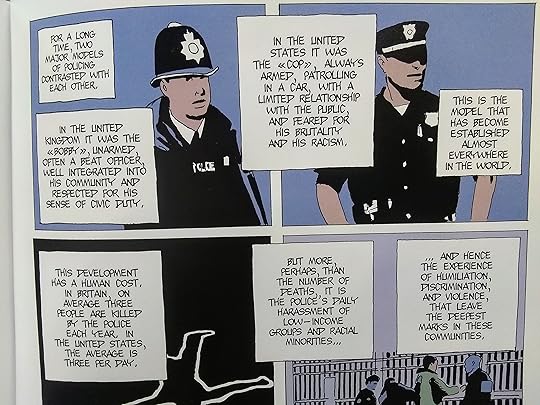


This is from the concluding parts of the book, after readers have joined Fassin for anecdotes and descriptions of his 15 months riding along with the special "anticrime squads" of the Paris police force in France. After readers have seen the harassment, humiliation, discrimination, and violence in action through the illustrations in this graphic novel adaptation of Fassin's 300-page academic report of his 15-month experience. He witnessed it. Constantly. daily. Reported and analyzed it. And now offers the most relevant and visceral parts of it in this gripping account. It is a highly effective vehicle for conveying the unique view he had of a hidden, objectionable system that seems to let the worst happen.

It is an accessible, powerful, urgent, and important book.
Profile Image for Rich.
828 reviews2 followers
July 23, 2022
"A nation that asks nothing of its government but the maintenance of order is already a slave at heart, the slave of its own well-being, awaiting only the hand that will bind it."

Based on a sociological study in France where the author rode along, interviewed, and studied police interactions with low income and immigrant citizens over the course of 15 months. It outlines the covert and overt racism and far-right sentiment of many working supposedly in the public interest, and how those that work to ensure fair-mindedness are often silent and overrun. None of this is surprising if you've been paying attention to the slide into authoritarianism ushered in by greater spending on law and order (which only leads to greater incarceration on a wider variety of violations, often inequitably applied among populations) and a movement away from rehabilitation and restorative justice. Why be fair when you can be heavy handed instead, eh?
Profile Image for Colin.
485 reviews4 followers
August 25, 2022
An important subject and an interesting primer on academic ethnography. The medium of graphic novel seems to be used with more courage in France and this is a good example of using the medium to explain fairly nuanced sociology to a broader audience. Although the book does a great job, in several spots it turns into text next to pictures, which can be tiring. Even so, overall, the people are real, the assessment is objective and it's clear the author wants the reader to learn. In particular, the author handles the police assessment with nuance, which is appreciated. As an American, it was revealing to see our own challenges with police brutality juxtaposed with France and their challenges. There are many common root causes, although France seems to be more tolerant of harsh solutions. This was an unusual and challenging subject to tackle and given how complex, I'm not sure how else I would have been exposed to it. Available at our library.
Profile Image for Keith Bowden.
311 reviews13 followers
August 29, 2022
If you're an American who's followed international news however remotely in the last 20 years, you're probably aware that France has had problems with their police that's similar to what we have had in the United States. It's disheartening and tragic to delve more deeply into the abuse and injustice there, and discovering that even fictional American crooked cops have been admired by the right wing fascists in French police uniforms - well, American police have become a model for much of the world, and not in a good way.

This graphic adaptation of Didier Fassin's 2011 (I think?) study on the BAC (French Anti-Crime Squads) is powerful, clear, and moving. It lets us know how truly universal our humanity - or inhumanity - is.
Profile Image for Matthieu.
58 reviews1 follower
February 6, 2024
Enquête ethnographique à la fois très instructive et très abordable de par son format sur le maintien de l'ordre au travers d'une brigade de la BAC et sur une doctrine du maintien de l'ordre qui se durcit -concomitamment à l'appauvrissement- depuis les années 1980, et qui se radicalise petit à petit via différents axes : politique du chiffre, déconnexion grandissante entre police et population, paliers sécuritaires (émeutes, attentats...), contrôles abusifs, parmi d'autres.
Ce sont là des choix politiques, qui forment une police qui se détache de plus en plus d'une institution républicaine de protection des citoyens.
Profile Image for dejah_thoris.
1,355 reviews23 followers
March 22, 2023
Bought for the library and I hope someone else reads it. The graphics are muted and the work is set in France, but there are clear parallels between the BAC and xenophobic policing in the United States. Bonus points for all the examples of scary division insignia. (Nothing says good policing like the grim reaper!)
Profile Image for Freja.
139 reviews3 followers
August 25, 2024
5 ⭐️: vanvittigt at den her bog eksisterer

Virkelig vigtig bog som forklarer hvordan politi vold ender med at eksistere og udvikle sig ud fra hvad en forsker der skyggede fransk politi observerede. Burde være obligatorisk læsning for alle der vil udtale sig om emnet (og som ikke tror politi vold kan eksistere i Danmark)🔥
Profile Image for Angela.
538 reviews14 followers
October 11, 2024
Really excellent analysis of French policing from the 2010s to the present. Don’t let the graphic novel approach fool you - these faced the stomach churning topic head on. So much so that there were points I was nauseous (re: slurs, scenes and general far right depictions)
However, the anthropological analysis is well done and makes me want to look into the essay this was based on
Profile Image for Nathan.
420 reviews7 followers
July 26, 2022
Art was ok. The concept and details given were great but the delivery sometimes felt off. I had no idea it was a book about French police when I reserved it and it’s a bit disconcerting that the same problems we face in the US are in Europe as well.
Profile Image for Cynthia.
1,326 reviews32 followers
September 18, 2024
Bon bah je vais clairement devoir trouver le livre lui-même plutôt que la BD. Je n'ai rien appris mais je ne m'y attendais pas - je ne souhaitais qu'en voir la réalité du terrain, ce que j'espère trouver plus en profondeur dans le livre.
Profile Image for Rayan F. Afif.
2 reviews
February 6, 2025
art styles incredible and concept is interesting but the idea that the ethnographer refused to get involved was hugely uncomfortable. what’s the line of morality in ethnographic work/anthropology? also soooo reformist
Profile Image for Carol.
Author 5 books9 followers
April 5, 2022
It's a shame to know black and brown people are treated poorly everywhere!
181 reviews2 followers
August 26, 2022
The book this is based on is great and a must-read for anyone interested in policing, and this graphic adaption is just perfect.
Displaying 1 - 30 of 42 reviews

Can't find what you're looking for?

Get help and learn more about the design.