Mary Lutyens (31 July 1908 – 9 April 1999) was a British author who is principally known for her biographical works on the philosopher Jiddu Krishnamurti.
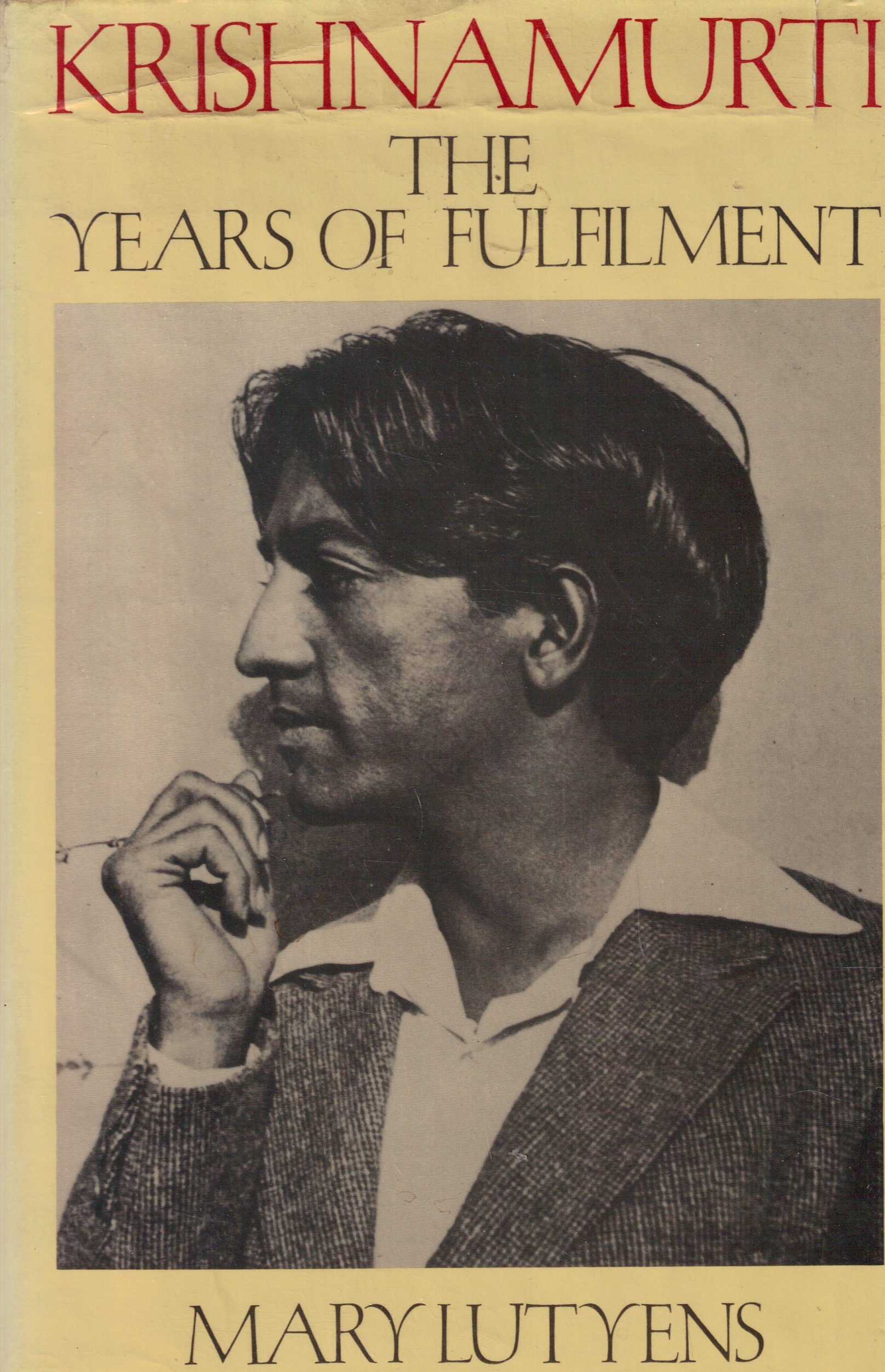
THE SECOND VOLUME OF THE ACCLAIMED BIOGRAPHY OF THE SPIRITUAL TEACHER
Jiddu Krishnamurti (1895-1986) was singled out by Charles W. Leadbeater, a leader of the Theosophical Society, as the coming "World Teacher"; and he was groomed for this role by Leadbeater and fellow TS head Annie Besant, who formed an organization, the Order of the Star, to support him in this role. However, in 1929 he famously rejected this role, and became an independent spiritual teacher for the rest of his life, writing many books such as 'Krishnamurti Reader: No. 1,' 'You are the World,' 'Commentaries on living.'
Mary Lutyens (1908-1999) was a British author best known for her three-volume biography of Jiddu Krishnamurti; the other volumes in this series are 'Krishnamurti: The Years of Awakening' and 'Krishnamurti: The Open Door.'
She wrote in the Foreword to this 1983 book, "This second volume of Krishnamurti's biography, which brings the story of his life up to 1980, like the first, has, like the first, been written at his suggestion and with his full co-operation. But, as before, he has not asked, nor been asked, to approve the text which is entirely my responsibility... I have not attempted to interpret him; nor do I make any apology for my presence in the book, for I have found it necessary to tell part of the story through my own experience."
She observes, "Mrs. [Annie] Besant trusted [George] Arundale so completely that during the Camp she publicly announced the names of ten of the twelve people who were to be the Lord's apostles when he came, according to information 'brought through' by Arundale. Among these were Mrs. Besant, [Charles W.] Leadbeater, Nitya, Lady Emily, Jinarajadasa, Wedgwood, Rukmini and Arundale himself." (Pg. 8-9)
She says, "K[rishnamurti] has often been asked about physical healing. He undoubtedly possesses a power of healing but has always played it down." (Pg. 22) She notes, "He disclaims ever having read the Bhagavad Gita or the Gospels." (Pg. 35) She points out, "This 'thinking,' going deeply into himself, was K's form of meditation." (Pg. 40) She adds, "'Choiceless awareness' were words that K was to use thereafter over and over again, and still uses... What K was talking about was awareness from moment to moment of all that was taking place inside oneself without any effort to direct or change it---a matter of pure observation, perception, which would result in change without effort." (Pg. 42)
She admits, "There is a contradiction here such as is often found in K's early pronouncements. He tells his listeners that the 'end must be sought after patiently and diligently' and then that 'What is sought after is self-created and so is not the Real.' The contradiction surely arises from words getting tangled in his unceasing efforts to express the inexpressible." (Pg. 63)
She adds, "This is a fundamental principle of K's teaching. Until one can get rid of one's old self one cannot begin to see truth." (Pg. 68) She points out, "For years K has done yoga every morning for the sake of his health, not as a spiritual practice to awaken higher energies. The yoga he does is Raja Yoga, king of yoga. K has explained it himself as 'part of a highly moral life---not to hurt, drink or drug yourself.' 'You will never awaken spiritual insight by exercises,' he maintains." (Pg. 135)
She wrote a summary of Krishnamurti's teaching, which he re-wrote; it included the following: "The core of Krishnamurti's teaching is... 'Truth is a pathless land.' Man cannot come to it through any organisation, through any creed, through any dogma, priest, or ritual, not through any philosophical knowledge or psychological technique. He has to find it through the mirror of relationship, through the understanding of the contents of his own mind, through observation and not through intellectual analysis or introspective dissection...
"Freedom is found in the choiceless awareness of our daily existence... When man becomes aware of the movement of his own consciousness he will ... discover that this division is an illusion. Then only is there pure observation which is insight without any shadow of the past. This timeless insight brings about a deep radical change in the mind." (Pg. 204-205)
Lutyens' sympathetic, yet detailed and critical biography is "must reading" for anyone wanting to know more about Krishnamurti.