Jump to ratings and reviews
Rate this book

Querieuze Vogels

Rate this book
Querieuze vogels voert een betoverende wereld op die bevolkt wordt door GoudSeksUEle BeELdjes, antidragkings, Gilbert & Georgeachtige lesbiennes, onorthodoxe detectives, een transgender leger met vraagtekenvormige helmen en vogels waar het dijkerige van afspat. Iedereen bemoeit zich met de plot. Niemand heeft controle over de plot. Van verrassingen kijkt niemand op: een fake onderzoeksproces leidt tot echte resultaten. Honderden lippenstiftafdrukken reanimeren een stervend lichaam. En de Onderhond-krijgt-Bovenhand-publieksprijs gaat naar de inzender die ervoor zorgt dat de Onderstehond de Bovenstehand krijgt. Querieuze vogels laat zien wat er gebeurt als rechteloze dingen het voor het zeggen hebben. Canaille heeft van meet af aan de teugels in handen.

128 pages, Paperback

First published May 14, 2017

9 people are currently reading
482 people want to read

About the author

Isabel Waidner

15 books133 followers
Isabel Waidner is a writer and critical theorist.

Their books include We Are Made Of Diamond Stuff (2019), Gaudy Bauble (2017) and Liberating the Canon: An Anthology of Innovative Literature (ed., 2018), published by Dostoyevsky Wannabe.

Waidner's critical and creative texts have appeared in journals including AQNB, Cambridge Literary Review, The Happy Hypocrite, Tank Magazine and Tripwire.

They are the co-founder of the event series Queers Read This at the Institute of Contemporary Art (with Richard Porter), and an academic at University of Roehampton, London.

Ratings & Reviews

What do you think?
Rate this book

Friends & Following

Create a free account to discover what your friends think of this book!

Community Reviews

5 stars
26 (22%)
4 stars
36 (31%)
3 stars
31 (26%)
2 stars
13 (11%)
1 star
10 (8%)
Displaying 1 - 30 of 42 reviews
Profile Image for Cecily.
1,345 reviews5,508 followers
June 12, 2020

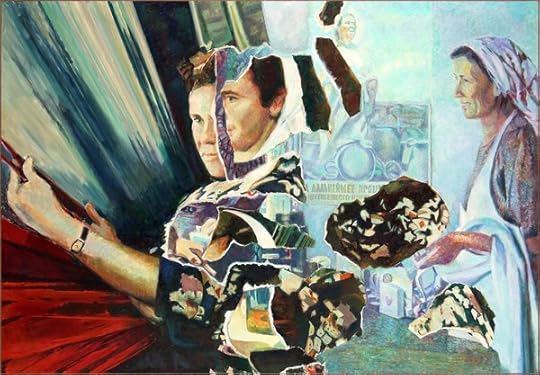
Illustration: The Collage of Spaces by Ilya and Emilia Kabakov

WTF do I write?

Some reviews are easy to write because I’ve had a strong reaction. If it was positive, the themes are usually clear, and if negative, criticism is easy.

This review was hard to write. I had a strong reaction, but I’m not sure if it’s positive or negative. I initially didn't give any stars, but Apatt thought that equated to zero. So I'm giving 3*, but please note my actual rating is anywhere between 1* and 5*.

Although the book could perhaps be described as a pretentious, confusing mess when compared with traditional narratives, here, it’s entirely deliberate, and probably very skillfully done.

WTF did Isabel Waidner write?

The opening lines give a taste:
"A formidable micro-horse sprang across a Formica tabletop. Ah, it’s Tulep. Tulep sprang across grassgreen Formica, grazing, apparently. Besides, a white plastic laptop stood on the tabletop. Someone was maltreating its keyboard, trailblazing, apparently. Trailblazer Belà Gotterbarm was wearing a chequered Beirendonck skirt, worse-for-wear trainers and tennis socks."

It continues in a bewildering and disorienting way, full of wordplay, implausible names with bizarre capitalisation (GoldSeXUal StatuEtte is a person), and detailed descriptions of strange clothes that rival those of Philip K Dick’s Ubik (see the “spoiler” in my review HERE).

To the extent there is a plot (and I’m not sure how relevant that is), Belà Gotterbarm, an "agender feminist, transgender activist" writes a "Querbird". It's a TV script of queer “awkwardgarde fiction”, but she goes missing before it's finished. A private investigator investigates… whatever. There's a summary of the TV episodes in an appendix: either irrelevant, or the magic key.

Explaining the gist of this novella is far trickier than assembling a 5000 piece jigsaw. It’s as if the box has no picture on it, and contains pieces from several utterly different puzzles, some tarot cards, bits of mirrors, Monopoly pieces, pom-poms, broken biscuits, stray teeth and feathers, random pages from an encyclopedia, and all sorts of other unidentifiable… stuff - and you have to put them all together before you can begin to work out what is relevant and what is not!

WTF is this about?

I’m really not sure, but it was fun. I think. It’s certainly unique. So far. Or maybe it’s a case of The Emperor’s New Clothes?

I think it's mainly about identity and labels: assigned and chosen, especially ones relating to gender and sexuality. But people don't always acknowledge who they are, even to themselves. There is (at least) one character who is looking for someone, unaware that they are that person.

Note: There's lots, indirectly, about sexuality, but no actual sex.

I’ve been wondering about labels lately. Some people fight against them, while others create ever more finely graded ones and embrace them. For example, how does “grey-ace” (grey/slightly asexual) differ from a lower than average sex drive, and why declare it?

This book is "pushing the sexual envelope, as well as the boundaries of performance art", like one of the characters, who is "post-binary, extra-individual, socio-biological sex and a transformative gender", WTF that means!

There are also passages of info dumps, including sea urchins, tooth development, Kaposi's Sarcoma, and the history of the development of artificial fibres.

Read it for yourself and let me know what you think it’s about. Certainly it is strong on queer taxonomies told in a po-mo way. QUILTBAG was new: Queer, Undecided, Intersex, Lesbian, Trans, Bi-sexual, Asexual, Gay.

And all the puns, some of which relate to body types/preferences: canaries/canines; butch putsch; ducks and dykes; significant otters; bears, ursine, and Ursula; PET plastics and pets.

WTF is the way read this?

I think this is best read in one sitting when highly caffeinated - or just high. (It may well have been written in one of those two states.)

I read it in two sittings, a week apart. It felt entirely appropriate that I read the first half in the members’ room of Tate Modern, after seeing Ilya and Emilia Kabakov’s moderately bewildering work.

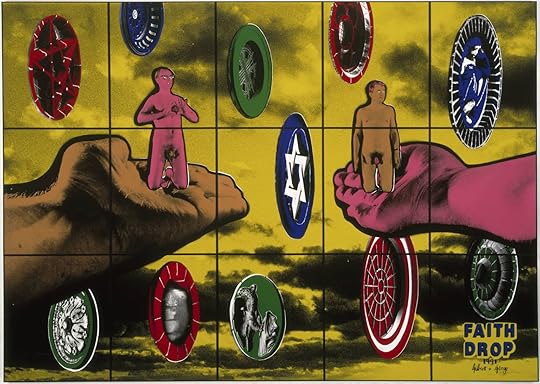
Gilbert and George are mentioned several times, reinforcing the queer modern art vibe.


Illustration: Faith Drop by Gilbert and George

Go to a gallery: look, read, ponder, and make up your own mind. If you can. Sometimes it’s more about the journey than the destination.

And remember:
"Sex-radical role play was better than cheap innuendo".
Profile Image for Paul Fulcher.
Author 2 books2,033 followers
February 28, 2023
Joint winner, in its translation by Ann Cotten, of the Internationaler Literaturpreis 2020 for the most outstanding work of contemporary international literature that has been translated into German for the first time.
https://www.hkw.de/en/programm/projek...

I was privileged to be part of the jury that selected this as part of our outstanding shortlist for the 2017 Republic of Consciousness Prize for 'gorgeous prose and hardcore literary fiction' from small, independent presses

Riffraff had been running the show from the word go, and they had no regard for the script. They were ever so cocky. They were so prolific. It was questionable whether Blulip’s production could ever return to a script.

Small independent publisher Doestevsky Wannabe’s mission statement is worthy quoting in full:
We publish and exhibit independent / experimental / underground things. We publish a lot of books, any types of books − short books, long books, flash fiction, poetry, anthologies, samplers, chapbooks, experimental things.

We're a zero budget operation. There's no money in this. We'd only spend it on things that are bad for us anyway.

Pretty much the only criteria that we have for writers or artists who want to work with us is that what they produce must be very good, very bad in a good way, or very cool.
If Isabel Waidner’s novella Gaudy Bauble is any guide, they should add ‘very different to anything else you’ve probably read before’ to that list – this was (for me at least) genuinely different and excitingly so.

The last novel I read was Salman Rushdie’s Golden House. The 70-year old male, heterosexual, privileged upper-middle class establishment author tried to explain gender identity and fluidity. As an almost-50 male, heterosexual, white, native English, banker I ended the book as ignorant as I began it, if not more so, and certainly unconvinced the author had anything of relevance to say. Reading Gaudy Bauble, my own limitations of a reader remained as a major constraint, but I certainly knew that the author genuinely had something striking, and challenging, to say.

The story begins:

A formidable micro-horse sprang across a Formica tabletop. Ah, it’s Tulep. Tulep sprang across grassgreen Formica, grazing, apparently. Besides, a white plastic laptop stood on the tabletop. Someone was maltreating its keyboard, trailblazing, apparently. Trailblazer Belà Gotterbarm was wearing a chequered Beirendonck skirt, worse-for-wear trainers and tennis socks. She was wearing her soft-cotton Pegasus print sweater. The Pegasus on Belà’s sweater reared and raised her wings. Pink flashes and green graffiti on extra soft cotton manifested Pegasus energy. On the other hand, Tulep was posturing atop the Formica tabletop like a formidable female stallion. Quite like the Pegasus on Belà’s sweater was a winged horse, Tulep was a budgerigar with atypical hooves. Heh, Peggy! Tulep, heh. Raised pinions, Tulep was pawing Formica. Was this territorial posturing? A mutual ‘Piss Off’? Or a macho stand-off? Heh, Pegface! Tuleper, heh. But this was not a territorial stand-off. This was not Highlander (1986), the British fantasy action film. This was a get-together of disenfranchised things. This was a faggoty social. A working class knees-up. A cocky conspiracy? From Hoofed Winged Thing to Hoofed Winged Thing. From one Hoofed Winged Thing to another. From mythological chimera to genetic chimerism. Peggy <3 Tulep. And Tulep <3 Peggy. They were giving each other ideas. And this was just the beginning.

Belà Gotterbarm wrote awkwardgarde fiction, potentially trailblazing.


Set in Socialist Britain in 201x, the story, in a conventional telling at least, concerns Blulip, a film-maker making a new series for Channel 4, and her search, assisted by a private investigator, for Belà Gotterbarm, her scriptwriter, who, immediately after the incident narrated above and just before filming is due to start, goes missing.

But, in the author’s words:
As a result of diverse cooperative actions and experimental activities (including transliteracy), an array of nonnormative characters, human and nonhuman, who the novella refers to as "riffraff", "disenfranchised things", or "≈∆≈", emerge and co-control the plot.
an immediate example being the pegasus from Bela’s shirt on page 1. And just when one of these "≈∆≈" (a symbol based on a pink gay-rights triangle and a waveform resembling wings, in allusion to a quote, featured in the book’s epigraph, from poet Jack Spicer that “[o]ne cannot, however, safely invent an angel") threatens to take over the narration, another emerges to seize the limelight.

Though only 80 pages along there is so much behind almost each sentence, even each symbol, that this is the sort of novella about which whole theses could be written - and indeed Waidner has written their own based around the book, in particularly explaining their new idea of transliteracy, combining the avant-garde (they acknowledge Ali Smith as pretty much the only mainstream novelist in the field) and the notions of gender identity and fluidity. Or as Waidner explains:
Transliteracy is a queer avant-garde writing method that enacts the assumption that distinctions between language as a material event and signifying function; form and content; authorship and process; subjectivity and objectivity; representations and entities represented; language and other material and semiotic apparatuses of production; fictions and facts; social constructions (gender, for example) and unconstructed materiality (biological sex, for example); and theory and practice do not precede, but are being produced, enacted and stabilised within diverse experimental practices, including transliteracy.
One of the book’s most striking and enjoyable features is the chains of association Waidner uses to develop their ideas. These are, they happily acknowledge, partially fed by Google research (“increasing the archive or pool of marginal actors increases the likelihood of fluke resonances and affinities between them, which in return facilitates the formation of performative agential assemblages in transliteracy”), searches their characters often re-enact or explain in the novel, making things much easier to follow than might be expected, although at the same time making a 80 page novel a surprisingly involving read.

An example has radical dental practioner Rocky Bobák carrying out research into the phenomena of why humans are only able to re-generate teeth once, while other species can do it multiple times, notably alligator’s whose dental anatomy most closely resembles the human’s. The alligator’s dental anatomy is practically humanesque. Alligators, however, make for impractical lab rats. Particularly in central Brixton. So instead Bobák conducts experiments on a sea-urchin called Colt – why?:

Odontogenesis, or tooth development, is a complex and species-specific process from initiation to eruption that depends on gene expression, protein signalling, cell functions, and unknown factors. “Growth and morphogenesis of human teeth,” for example, “are regulated by the Sonic Hedgehog protein” (Wiki). Discovered in 1980 in Heidelberg, Black Forest, the Sonic Hedgehog protein is encoded in the Sonic Hedgehog gene whose loss of function causes fruit-fly embryos to grow hedgehog-like spikey projections. Hence the name. Sonic Hedgehog, abbr. SHh. Shh! Say nothing but. Sonic Hedgehog’s centrality to human odontogenesis might have affected Rocky Bobák’s unorthodox choice of test organism. German for ‘sea urchin’ is ‘Seeigel’ which literally translates as ‘sea hedgehog’. Shh. Say nothing but. Bobák’s choice of test organism might have been based on a pun.

Waidner also cleverly employs German phrases throughout the book (their native language) to re-create “for the reader some of the semiotic blind spots or ambiguities I routinely experience as a nonnative English speaker” (again I quote as while I understood and appreciated the effect before reading their explanation, they still express it so much better than I could).

Overall: like nothing I’ve read before – albeit in part that may reflect my limited foray into this area of literature – highly enyoyable, eye-opening, intellectually stimulating and highly recommended.

Useful sources:

L.O.V.E. by Klang, a band Waidner formed with ex-Elastica member Donna Matthews – a great soundtrack to accompany the book.
https://www.youtube.com/watch?v=VVUnP...

Author’s website
https://waidner.org/

Author’s thesis:
https://pure.roehampton.ac.uk/portal/...

Interviews with the author:
https://www.swimmersclub.co.uk/munici...
https://www.swimmersclub.co.uk/sevenu...

Useful Reviews:
http://www.3ammagazine.com/3am/vangua...
Neil’s from Goodreads: https://www.goodreads.com/review/show...

Published excerpts to get a taste (but please do read it all):
http://www.berfrois.com/2017/05/gaudy...
http://thequietus.com/articles/22787-...
https://minorliteratures.com/2017/06/...
Profile Image for Hugh.
1,295 reviews49 followers
March 12, 2018
This is my final book from the excellent Republic of Consciousness prize shortlist, and is another revelation - the sheer variety and freshness of the list shows that our small independent presses are nurturing some very fine writers. Credit is also due to the judging panel - whatever the winner is, they have done a great job and produced a varied and stimulating list.

This one was perhaps the biggest surprise, perhaps because some of the reviews I have seen (not least those of my friends on the judging panel) led me to expect something much more forbidding. Yes, there are layers of subtext and plenty of obscure references for those who seek them, but at heart this book is a surreal comedy which is very funny, and as a white middle class heterosexual male, I should be just about the last person this would appeal to. I won't even attempt to describe the plot, which centres around a low budget internet performance series which maps the lives of an eccentric group of lesbians - this is anything but a simple narrative, but although I must have missed a lot, this remains a very entertaining read.
Profile Image for Gumble's Yard - Golden Reviewer.
2,293 reviews1,838 followers
January 18, 2024
NOW SHORTLISTED FOR THE REPUBLIC OF CONSCIOUSNESS PRIZE

This book is published by a small UK publisher, Dostoyevsky Wannabe who “publish and exhibit independent/experimental/underground things”

Given this aim it is far from a coincidence that Isabel Waidner is the ex-bassist of the indie, experimental group “Klang” – who struggled at times with matching their underground philosophy with the attention they gained from their lead singer being Donna Matthews of Elastica.

http://www.independent.co.uk/arts-ent...

Their main single was “L.O.V.E.” from their early post punk period

https://www.youtube.com/watch?v=VVUnP...

The author is now a research fellow in the Department of English and Creative Writing at the University of Roehampton, London, where she invites inquiries from prospective research students in “areas of innovative fiction, avant-garde writing, and creative writing at the intersections with cultural studies, gender studies, queer studies, body studies, subjectivity and independent publishing.”

https://pure.roehampton.ac.uk/portal/...

These research themes are key to the motivation behind this novel – even more so on the realisation that this novel was in fact an integral part of Waidner’s PhD Thesis.

https://pure.roehampton.ac.uk/portal/...

The reading of this was crucial to cementing and amplifying my (admittedly still limited) understanding of this hugely experimental book.

Attempting to put that understanding in my own words, I believe that Waidner’s key idea is to link two areas: conceptual art (something which she feels has only had limited cross over into literature) and post-identity gender fluidity – this leads to her concept of trans-literature.

Further a key element of the book is its rejection of the traditional novelistic structure featuring a main character, other key characters, minor characters and then passive objects with which they interact. I believe that Waidner implicitly equates this rigid and hierarchical structure with a traditional patriarchal, gender-rigid society.

In this book by contrast the dominant character is a fluid concept – and just as an hierarchy starts to form (often to the relief of the reader, who finally starts to be able to identify the book with conventional concepts of plot and character and feels they are returning to something they know), Waidner very deliberately overturns this hierarchy and introduces a new main character, including in many cases what initially seemed inanimate objects – often based around patterns or illustrations on clothing (clothing often described in detail, and all it seems based on items that Waidner or her friends have worn).

Another way of saying this is that just as we start to find some solid ground Waidner pulls the rug from under our feet – a cliché but one I have chosen deliberately as a key example of this idea (and one Waidner explains at length in her thesis) is when a pattern on a carpet suddenly emerges as the main protagonist of the book, only for just when the reader is starting to accept this, for the polyester-style material of the carpet to take over from the pattern as the protagonist.

Other thematic elements of the book which stood out to me on my initial read (and before reading the thesis) were: the clear use of Google as a tool to take an idea and extend in a kind of free-association exploration of an initial concept and a search for links or word plays that can be incorporated to alter the course of the novel or to facilitate the introduction of new protagonists; the slightly odd narrative which at times can read like a rather literal translation from German (an idea crystallised by the occassional insertion of German sentences). To my interest, both of these elements (which I may have regarded as criticisms) are dwelt on and examined in the thesis.

The actual style and plot (to the extent such reactionary concepts even have any validity in this ultra-progressive, post-everything novel) is best captured in my view by simply giving links to a number of websites that have published excerpts from the novel (others are embedded and conceptualised in the author’s PhD thesis).

http://www.berfrois.com/2017/05/gaudy...
https://minorliteratures.com/2017/06/...
http://thequietus.com/articles/22787-...

And this perhaps gets to the heart of my only possible challenge to this book – accessibility. I suspect for many readers, these excerpts are not going to encourage further engagement with this book. And I believe that this matters as I know that the author feels strongly that the literary mainstream urgently needs to move towards what are currently perceived as the margins (including opening up to more working class and gender queer voices)

One of the few mainstream authors that Waidner admires is Ali Smith, and in fact Smith’s partner Sarah Wood provides the photography for this book. However Smith has made a breakthrough into the literary mainstream. I was critical of elements of her latest book "Autumn", which I felt owed more to the absurdity of Harry Hill than cutting edge literature, but its clear from Goodreads reviews that its exactly those passages that have drawn many others into the book, giving them an entry point with which to engage with the more radical and experimental themes.

I suspect if Waidner wishes to really challenge the mainstream with her ideas, then she may need to think about this concept of allowing an entry point into her work.

However once engaged I found this a hugely fascinating novel.

My thanks to Dostoyevsky Wannabe for a review copy.
Profile Image for Neil.
1,007 reviews772 followers
October 2, 2017
UPDATE. After further consideration and some background research, I have changed the provisional rating below. The 4 stars reflects the genuine innovation in this novel and the amount of content there is in just 80-something pages. I have never read anything like this.

I had to read this book twice in order to get to a place where I thought I could write anything about it. Even now, with two readings and the second involving copious note taking, I am not sure I really know how to approach a review. Fundamentally, I am not sure that a 50-something, heterosexual male is in any place to understand many of the the things talked about here. But, I have to say that my lack of knowledge/experience did not stop the book from being fascinating to read, even if, at times, it is completely incomprehensible.

I acknowledge at the start of this that in contrast to my normal approach of writing reviews and then reading what others have to say, I have looked on the Internet for some support and clarification. Not many people have written about this book yet, though.

Gaudy Bauble is published by Dostoyevsky Wannabe (also a character in 1992 movie Slacker). On its website Dostoyevsky Wannabe says:

We publish and exhibit independent / experimental / underground things. We publish a lot of books, any types of books − short books, long books, flash fiction, poetry, anthologies, samplers, chapbooks, experimental things.

We're a zero budget operation. There's no money in this. We'd only spend it on things that are bad for us anyway.

Pretty much the only criteria that we have for writers or artists who want to work with us is that what they produce must be very good, very bad in a good way, or very cool.


After two readings, I still can’t work out which of those final three categories Gaudy Bauble falls into!

3:AM Magazine has published a review of Gaudy Bauble which starts like this (I’m not sure I understand it fully):

Playing with syntax and polysemy has long been the hallmark of narrative experimentation in a bid to subvert coherence and clear distinctions between various literary genres. In a similar shot, Isabel Waidner’s Gaudy Bauble juggles with dichotomies instead, somehow counterfeiting the ambiguities in the sexual identities we are so keen on wrapping and delivering as unitary, compact versions of ourselves. But as its sassy narrative zigzags, the trap of making such stereotypes or binary divides line up or, even worse, interchangeable is dodged.

You can read the whole article here: http://www.3ammagazine.com/3am/vangua...

Gaudy Bauble is partly an exploration of sexual identity. Specifically, it looks at the gay body types (named after animals such as Bear, Otter, Wolf and Cub) which the 3:AM article explains are used as shorthand for one’s sexual identity but also as a way of setting the terms of desire and attitude towards other gay bodies.

But it is a completely anarchic book. It feels like the author is (successfully, I think) attempting to herd cats. Almost anything can become a protagonist (including clothing imprints and fibreglass animals).

It all begins as Bela Gotterdarm attempts to write a script for a new experimental TV series. She is thwarted by a rebellion initiated by her pet bird and the Pegasus printed on her sweater. Yes, really. The bird escapes and the book becomes a sort of bizarre, surreal detective/chase thing involving a chalk outline called Orsun Ursol, a GoldSeXUal StatuEtte, a transgender army and numerous other things that are all equally strange. In the process, seven episodes of something call Tulep.tv are produced (Tulep is the name of the pet bird that started things off).

Honestly, you have to read it, probably at least twice, to get any of the sense (?) of it.

Right at the end of the book is an appendix where a detective who would prefer there to be a linear narrative and a proper plot takes the seven episodes of Tulep.tv and puts them in different orders to see what story they tell. And this is possibly one of the points of the book. The anarchy isn’t just in the writing but in the timeline, in the plot. And the question at the end is what do YOU make of it?

5. Does the truth lie at the bottom of a lake?
6. Is love the truth?
7. Is the truth haunting you, too?

1. The truth is the only thing left now. The truth ate everyone else alive.


What is difficult is to know how to rate this book. I have no frame of reference to compare it with anything else. I’ve put a provisional rating, but I need to think it through. The fact that I have read it twice and need to think about it may well mean it deserves more stars!

My thanks to Dostoyevsky Wannabe for a copy of this to read and review.
Profile Image for Jonathan Pool.
731 reviews138 followers
October 25, 2019
Gaudy Bauble (85 pages length) has taken up a full week’s reading, and then re-reading, and then re-reading. Some background work (not least Isabel Waidner’s doctoral thesis) was also needed in order to get some value from the experience.
For the most part I did not enjoy Gaudy Bauble, but I do appreciate the value of the book as an intellectual challenge.
1. As a university/ college exercise in creative thinking and expression I can imagine that it could be very stimulating, and helpful, for aspiring writers.
Is that reason enough to read this book as entertainment? Probably not.
The Republic of Consciousness Goodreads group that drew this book to my attention are the same group who have written extremely thoughtful reviews.(Neil; Paul; GY). For those readers who read extensively, across a wide range of genres and styles, I understand that Gaudy Bauble offers something new, something different.

2. Judging from the reviews I’ve read, and having cross referenced Waidner’s thesis, it seems that my attempt to review Gaudy Bauble formally, is to miss the point of the book? It’s a book written to challenge conventional interpretation- and by my setting out to do so I’m limiting the potential range of responses I might feel about Gaudy Bauble?

I did like Waidner’s tongue in cheek dig at conventional literature in Appendix 2. Private Investigator Loveday’s uses a typical detective wall chart Still invested in the idea of a linear plot.....”What’s wrong with a theme and a plot we can all follow?” (92)

While I was not unhappy to reach the end of the book there were some parts I did enjoy (I am conscious, again, that these are probably the parts that do not capture the essence of the book, and which reflect my more myopic critical skills, such as they are).

1. Transliteracy.
An avowed objective for Isabel Waidner. “Healthy- lips”, a totemic budgie; the GoldSeXUal StatuEtte, and Icy Pet, a polyester compound (invented by ICI plc)are just three hybrid personalities who appear in the book. The “riffraff” and “disenfranchised things” shift shape, and influence, throughout the book. Thought provoking stuff.

2. The Google Universe
Waidner takes and uses, mostly true, stories and events that are researchable on the Internet. Until I read Gaudy Bauble I had not known that with kidney transplants the damaged kidney mostly remains in the body. (77)

Irrelevant? Who cares? The writer needs to be able to weave such anecdotal facts into their own narrative- and Waidner does this well.

My particular favourite interwoven references are:

* George Mazzini’s 1979 Who’s Who At The Zoo? choosing animals, especially bears and assigning gay characteristics. Mazzini’s is a seminal work of its kind.

* The Samuda Estate in Canning Town, Isle of Dogs. This estate has a varied and interesting history. General Togo, Harvey Keitel, CCTV feature film- quite a triple bill:
(YHBW was a video-based art project made using cctv cameras which explored the presence of transgender bodies in public space. Inspired by the idea that transgender bodies are always under surveillance, the trilogy was filmed using the camera system in place on the Samuda Estate in east London in collaboration with the residents. In workshops carried out on the estate, a narrative structure was agreed and filmed in a one day shoot which interrupted the surveillance procedure of the cameras.) The set up for the filming of Querbird doesn’t seem so curious against this true life example.

*Rocky Bobak- a ‘radical dental practitioner’
Waidner goes into some detail about tooth development or odontogenesis. Earnest accounts of Maxillary First Bicuspids are accurately described.

*Lottie Hass German underwater diver (63/4). Lottie’s Story the perfect example of the objectification of women.

Having said all of the above, who am I to point out factual errors in a book whose style and subject matter was mostly alien to me?

I did pick up one inaccuracy:

The Hoofed Cygnet has been a themed pub in the Portsmouth area (Boscombe?)(14)
Boscombe is in an area of Bournemouth, not Portsmouth.

Addendum: For readers of Gaudy Bauble, the next instalment. We Are Made of Diamond Stuff, is now available.
Profile Image for Meike.
Author 1 book5,294 followers
March 3, 2018
Isabel Waidner's "Gaudy Bauble" is a highly experimental novel that breathes joy and playfulness, celebrates and expands the possibilities of language, and proudly throws its inherent weirdness into the faces of those who try to categorize this text or approach it with the holy seriousness of the conventional literary critic. Not that the story is the main point here, but it goes a little something like this: In Socialist Britain in 201x, Scriptwriter Belà Gotterbarm goes missing, so producer Blulip sets out to find Belà with the help of butch lesbian P.I. Belahg. We are reading a detective story that does not care about the conventions of the detective story. Not at all.

And this is the power of the book: It takes away the reference system that we usually have and immerses us into a world of its own, where every sentence and the matrix of sentences is full of references, wordplay, and meaning, where new expressions are invented, defined and brought into context - a context that did not exist before. Yes, this is queer avantgarde literature, but I do not feel like Waidner necessarily aimed to discuss or reflect the queer community (as I am not a part of this community, this is an outsider's perception though). I rather think that she wanted her readers to feel the joy that comes with leaving behind narrow defintions and conventional restrictions and by embracing the wild, the weird, and the free - a universal idea and a concept that almost everyone can relate to.

The discussion of topics like gender fluidity (link to Tim's arguments regarding this aspect below) are playfully interwoven into the narrative, to the effect that Waidner turns societal discourse into a narrative adventure. I do believe though that someone who is more knowledgeable about gender theory (let's face it: I know almost nothing about it) finds treasures in Waidner's writing that I was not aware of. Still I think everyone with the audacity to venture into the literary unknown will be impressed with this explosion of language and ideas. Or have you ever read a book that features characters like Rocky Bobák, "a radical gender practicioner" and "radical dental practicioner", or the GoldSeXUal StatuEtte, which combines "long-term queer actvisms", "queened-up agenderism" and "no-fucks-giving butchness"? Yes, this is "awkwardgarde fiction, potentially trailblazing".

I will not neglect to mention that the book is a little difficult to read due to its high-speed innovative character: Repeatedly, it made me realize that English is not my mother tongue, but my fourth language. Then again, German and French came in handy, as Waidner (who is also a native speaker of German) frequently crosses lingustic borders, which probably makes some readers go (to quote from the book) "(e)t zut alors, da haben wir den Salat."

There is so much to discover in this text, and I am certain that there is a lot that I missed. As promised, here's a link to Tim's review which made me want to read this novel in the first place (and thanks for sending me a copy, Tim!).
Profile Image for Tim.
70 reviews33 followers
February 21, 2018
Gaudy Bauble by Isabel Waidner is now deservedly shortlisted for the Republic of Consciousness Prize 2018.

In its most conventional form, one might (try to) classify Gaudy Bauble as a quirky, funny, joyful, surreal detective story. It is Socialist Britain in 201x, and Belà Gotterbarm, "agender feminist, transgender activist", and scriptwriter for a – "potentially trailblazing" – new TV show goes missing. Blulip, who commences production of said show in their* absence, tries to find Gotterbarm with the help of butch lesbian P.I. Belahg.

This however, does not even come close to describe what this novella is.

Isabel Waidner employs a wonderful language mix in her writing. Her own native language is German, which features heavily in this novella alongside the odd French and Italian words and phrases. She herself has explained that this is a tool for her to create the same blind spots for native English-speakers that she experiences living as a non-native speaker in Britain. I loved this aspect of the book, although Waidner's blind spots were lost on me as someone who grew up bilingually with German and English as my native tongues. Yet, this is exactly why to me this comes closest I've seen in fiction to how I grew up speaking, with German and English intertwined within sentences. I can only imagine how weird some of the phrases and words must look or sound to people without the connection to German. Waidner uses the same wit and linguistic flexibility in her German as in the rest of her text. Some passages had me snorting, like:

“Who are you, and in respect to recent debauchery, what are you? Sittenpolizei? Sittichpolizei?”

(To all the German-speakers out there: believe me, it makes sense within the context of the story. I KNOW!)


The story develops insane momentum. I found myself reading faster and faster, as the language dictated a fast pace. Yet, you are bound to trip over your own tongue due to the linguistic gymnastics Isabel Waidner performs. She plays with the sound of words (“Blulip sewed a daylight delight, a nifty bikini”), associating words that sound similar to one another resulting in the most wonderfully jumbled sentences. Waidner's writing is full of tangents into pop-culture, science, google searches, and much more. It resembles that night with your best friends when you all got drunk (/ insert drug of choice) and started talking, theorising, and googling simultaneously, acting silly yet serious at the same time – translated into avant garde literature.

Isabel Waidner wildly experiments with concepts of fluidity. Human characters, conventionally seen as the protagonists of most narratives, in Gaudy Bauble are on one level with anything and everything around them, with inanimate objects coming to life to drive the narrative forward, or backward, or sideways. Most interesting to me though was her approach to gender fluidity. Two characters morph into one or one character creates a new version of him/herself/themselves in the most fabulous crossdressing and gender-queer ways. In this way, it is very much a novel of our time, and maybe even more before its time, pushing the envelope with twenty-first century concepts of queerness translating into literature.

“As well as Les Oursins, the French haute-bourgois dramaturges had produced Cristaux Liquides (1978), and a film showing a male sea horse in labour pain, L'Hippocampe (1939). L'Hippocampe, Hypercamp. Painlevé Hypercamp just popped into existence. Shadow of her future self at this stage, Painlevé Hypercamp would become Blulip's future drag alter ego.”

“Not for nothing had she, Belahg, b. 1974, spent 1975-201x rejecting the bog-standard femininity epitomised in the item of clothing she found herself wearing. (Try to put a butch in a bikini.) Not for nothing had she, Belahg, spent 1975 to today rejecting the bog-standard, bikini-sporting, frock-donning femininity enforced by an autobiographical family, autobiographical paediatricians, autobiographical teachers, autobiographical schoolchildren, and an autobiographical public, in order of vehemence. At significant personal cost, Belahg had not gone near a bikini in living memory. There existed photographs of a ten-year-old in a variety of ill-fitting suits and incongruous cravats. A series of abortive hair-do and hair-dye experiments, 1981-1990, were archived photographically, epitomising the coming-of-age related crisis experienced by the genderqueer teenager.”


In the end, Gaudy Bauble is unique. I've never read anything like it, but I really want to again and again.
Profile Image for Doug.
2,632 reviews953 followers
March 10, 2018
3.5, rounded down.

Twenty-five years ago, as a PhD candidate, I had to sit through innumerable incomprehensible conference lectures by the Derrida-devotees and their like, minutely dissecting theatre texts according to the tenets of transliterary technique, intertextuality and gender/queer theory - so to say that Waidner's text brought all that back (this quasi-novel being in part her own PhD thesis) - and having taught university LGBT courses myself -meant that I did not find it quite as eye-opening or innovative as several GR friends have found it. Several of the items dwelled on at length (Mazzini's article on gay/animal archetypes; the Split Britches theatre troupe's oeuvre) that others struggled with, I am perhaps overly familiar with.

Therefor, at a scant 78 pages, although some of it was fun, I found much of it repetitious and a bit jejune, and rather than trying to go over it and over it to parse out meaning, I understood fairly quickly that in this case, the journey itself was more or less the destination, and as queer pioneer G. Stein (who was doing much the same thing as Waidner eight decades ago) once noted ... "There is no there there."
Profile Image for LindaJ^.
2,570 reviews6 followers
October 18, 2018
I'm giving this book 4* because it is so wildly different than anything I've ever read. It is short, more novella than novel. At first it made no sense. Then I started to get in the groove only to have the rug pulled out as it veered wildly off in another direction. Eventually, I just stopped trying to make sense of it and just went with the flow. There are two main human characters with a supporting cast of humans and non-humans. I had trouble keeping the non-human characters straight, including those that were printed on one of the human characters shirt. There are references to many things I have never heard of, some of which I looked up -- e.g., Gilbert & George, Bjorn Borg underwear, Helper Cell t-shirts, LQBTQI, Cadavre Exquis, and Nasir Mazhar caps.

This book was shortlisted for the Republic of Consciousness prize. It got some glowing reviews, some including cautions, from GR friends, so I had to read it myself.
Profile Image for Carla.
13 reviews8 followers
Read
November 30, 2022
Dieses Buch hat eine große Anzahl an Fragezeichen in meinem Kopf zurück gelassen.
Profile Image for Jackie Law.
876 reviews
November 13, 2017
“A placebo is a medically ineffectual substance. But ineffectuals had been running this show”

Gaudy Bauble, by Isabel Waidner, is described as queer avant-garde fiction. Its cast of characters would be QUILTBAG if they accepted labels. Reading this book it appears few labels can be applied.

The story opens in a small, 10th floor council flat in central London where Bela Gotterbaum has been tasked with writing the script for a new 8-part television series, working title Querbird. The flat is home and workshop for director/producer Tracey B. Lulip who is preparing to film a pilot for Channel 4. The TV broadcaster routinely commissions diverse producers to provide innovative and representative programming. Most of their advance has gone to the Bela, a feminist, transgender activist, who then disappears. Two PIs arrive to investigate. Mayhem ensues.

A nearby ethical recycling agency for dead pets is visited. An accident with a prop results in a dental repair shop becoming involved. As filming starts the idea for Querbird is abandoned. In its place an independently produced and broadcast TV series will be created with the content evolving from the protagonists misadventures.

Much of what is described is slapstick and surreal with clothes playing a role, not just as costume. More important is the play on language and the visuals evoked. The cast challenge concepts of what a book character can be. The writing embodies atypical scenes and structure.

The 8 part TULIP.TV series makes little sense but this doesn’t prevent it growing an audience. Linear plot-lines and classic narratives could possibly be interpreted, as one character attempts at the end. This reader finished the book without understanding much of what had gone on. Given the playful nature of the presentation perhaps this is the point – the next big thing often emerges from the unconventional.

Would I recommend? Possibly to those who enjoy the kooky and experimental.
547 reviews69 followers
October 21, 2017
A short book that moves at different speeds. There more self-consciously "experimental" sections drag, but when it goes nearer to simple social observational detail, of the sort that would drive a conventional satire, it is stronger: social media and YouTube self-promotion, the coding in various outfits, the varieties of gay culture, the loss of the secret history of old gay culture as it moved into official acceptance, "the context in which a bikini on a butch meant genderqueer camp rather than normative femininity" (pg 67). Brigid Brophy's "In Transit" is explicitly cited, which was the source of "butch putsch", though Brigid improved it as "butsch". But Isabel deserves some sort of prize for "QUILTBAG (Queer, Undecided, Intersex, Lesbian, Trans, Bi-sexual, Asexual, Gay)" (pg 21)
Profile Image for Joseph Schreiber.
601 reviews192 followers
April 27, 2018
Twenty-first century avant-grade queer-soaked craziness. If much avant-grade literature of the past century was soaked in disturbing somber tones, this work is fun, celebratory, but not without its own socio-political subtext.
More later.
Profile Image for Christina Dongowski.
263 reviews71 followers
August 16, 2019
Programmatisch avantgardistische o. konzeptuelle Prosa umweht zumindest in meiner Wahrnehmung oft der Hauch des Bemühten / Gewollten / Kunstliterarischen. Das hier dagegen ist ein wilder, sehr amüsanter Ritt durch die Fähigkeiten der englischen Sprache gender- anders queere Verwirrung zu stiften. Und das als Plot einer ... Ähm ... Krimiserie mit sich ständig vermehrenden & vertauschenden Protagonist*innen aus Sprache, zweifelhaften Inneneinrichtungsgegenständen, Motto-Tshirts & Christbaumschmuck. Zahnärzte & Haie kommen auch vor. Sowie Tönen von Abkürzungen & Akronymen.
Profile Image for Paul Dembina.
744 reviews173 followers
February 1, 2023
Having enjoyed the 2 novels Wiedner wrote after this one I was looking forward to Gaudy Bauble so it's a bit disappointing to give it just the 3 stars.
I was left bemused and a little confused by this short (90 pages) book.

There's inventiveness aplenty but I was left more than a little confused by the time I'd finished
Profile Image for Dickon Edwards.
69 reviews61 followers
July 22, 2019
My kind of fiction: original, inspired, funny, ambitious.
Profile Image for Tobias Hermansson .
129 reviews5 followers
December 23, 2025
Så jävla dryg läsning, men fnissade rätt så ofta igenom den.
Får nog läsa om boken nästa år.
Profile Image for Angie Dutton.
106 reviews1 follower
June 24, 2021
Waidner didn't immediately resonate with me in Diamond Stuff but here it falls into place better. Maybe it helps that I read a printed version of Gaudy Bauble, rather than an ebook, so it felt more legit somehow. Enjoyed this more than Diamond Stuff and it's actually made me feel inclined to reread that one.
Profile Image for Marc.
1,020 reviews140 followers
November 28, 2021
Incredibly smart. Quite funny. Inventive. And yet I seemed to lose interest/daydream around the 1/2 to 2/3 point. (Oh, that precarious balancing act on the fence where we GR reviewers spend a ridiculous amount of time deciding whether we'll fall to the 3- or 4-star side of things... and whether we need to qualify that with some sort of explanation of rounding up or rounding down! My scientific rating is probably pi to the 17th decimal place written in pink ink.)

I'm simply going to share my marginalia that I wrote while reading this book:

- Neo-liberal Britain just skips right over gay taxonomy.

- This dental aside is both fascinating and hilarious (written in response to odontogenesis and the sentence "Growth and morphogenesis of human teeth, for example, are regulated by the Sonic Hedgehog protein."

- Traditional femininity via the bikini recontextualized via lesbian dynamics?!!

- Microdance me to the end of love.

- Is polyculiarity a portmanteau? (either way, I like it)
Profile Image for Adrian.
879 reviews22 followers
October 9, 2021
My enjoyment of Isabel Waidner’s short surreal novels is directly proportional to my current level of patience. Currently on the low side.

This one is so mired in media and ‘London’ without recourse to any real life that I couldn’t get a grip.

And I have to deduct at least one star for the TERRIBLE Amazon Print-on-demand physical book with those awful covers that curl up as soon as you look directly at them.

I was getting David Foster Wallace vibes which might delight some.
Profile Image for Véra.
6 reviews
December 23, 2022
more installation than book
sehr sperrig to read und auch sehr fun
Profile Image for Sammy.
170 reviews
July 30, 2023
Intressant, språkligt besvärligt och konventionsbrytande. Även om jag inte känner att jag älskade boken var det en intressant upplevelse.
Profile Image for Tass.
101 reviews3 followers
August 26, 2025
language is a game and trans people will always win. can’t imagine reading this as a non-german speaker
Profile Image for Danny.
358 reviews12 followers
September 4, 2025
Fairly impenetrable, but still manages to be a lot of fun.
Profile Image for Sam.
108 reviews1 follower
June 12, 2021
Experimental excellent fun, loved it
Profile Image for Jacquie.
82 reviews2 followers
March 29, 2018
this book is not instantly easy to understand but if you let yourself go it is great fun. characters animate and inanimate with gloriously improbable names are involved in a mystery story, kind of
what it felt like were those games we played as girls where we and toys were all characters and we would spend longer planning what to act out than playing.
I was very taken with the frequent descriptions of what people were wearing and i loved the idea of a supra bikini - a bikini worn over clothes
Profile Image for Tori.
130 reviews13 followers
September 10, 2020
imo isabel waidner is one of the most important writers in english today, the main thing now is for everyone else to catch up to them

this book is about art and queerness and queer history, and it’s a detective novel and a kunstlerroman and a millenial disaffection narrative, and it’s hard to say what’s going on at any one time because every sentence is doing at least three things at once. i LOVE it
Displaying 1 - 30 of 42 reviews