

What do you think?

Catching Fire: A Translation Diary
In Catching Fire, the translation of Diamela Eltit's Never Did the Fire unfolds in real time as a conversation between works of art, illuminating both in the process. The problems and pleasures of conveying literature into another language--what happens when you meet a pun? a double entendre?--are met by translator Daniel Hahn's humor, deftness, and deep appreciation for what sets Eltit's work apart, and his evolving understanding of what this particular novel is trying to do.
193 pages, Kindle Edition
Published April 5, 2022
About the author
Daniel Hahn
133 books50 followersBritish writer, editor and translator; author of a number of works of non-fiction, including biographies, history, and reading guides and for children and teenagers.
His translation of The Book of Chameleons by José Eduardo Agualusa won the Independent Foreign Fiction Prize in 2007. He is also the translator of Pelé's autobiography, and of work by novelists José Luís Peixoto, Philippe Claudel, María Dueñas, José Saramago, Eduardo Halfon, Gonçalo M. Tavares and others.
A former chair of the Translators Association and national programme director of the British Centre for Literary Translation, he is currently chair of the Society of Authors and on the board of trustees of a number of organisations working with literature, literacy and free expression, including English PEN. He is one of the judges for the 2017 Man Booker International Prize.
adapted from Wikipedia.
His translation of The Book of Chameleons by José Eduardo Agualusa won the Independent Foreign Fiction Prize in 2007. He is also the translator of Pelé's autobiography, and of work by novelists José Luís Peixoto, Philippe Claudel, María Dueñas, José Saramago, Eduardo Halfon, Gonçalo M. Tavares and others.
A former chair of the Translators Association and national programme director of the British Centre for Literary Translation, he is currently chair of the Society of Authors and on the board of trustees of a number of organisations working with literature, literacy and free expression, including English PEN. He is one of the judges for the 2017 Man Booker International Prize.
adapted from Wikipedia.
Ratings & Reviews
Friends & Following
Create a free account to discover what your friends think of this book!
Community Reviews
Displaying 1 - 30 of 33 reviews

April 24, 2022
Translation is like copying a work of art in a different medium. We’re art forgers attempting to reproduce an oil painting using only pencils, but so skilfully you won't be able to tell the difference. Imagine copying a watercolour, but using pastels; or a charcoal picture, using only pen and ink. You want it to look the same, but you can't just copy brushstroke by brushstroke; different media, like different languages, have different strengths and facilities. Different ways of creating an impression of light, or perspective, or density, or texture; languages are just the same. When writing a piece of English you have recourse to a different set of tools from those used by the Spanish-language artist - but you want the impression, somehow, to be unchanged. That “somehow” is wherein lies the skill and the apparent mystery, of course.
Catching Fire: A Translation Diary is a diary of Daniel Hahn's process of translating Diamela Eltit's Jamás el fuego nunca into English, a book published simultaneously with this diary by Charco Press as Never Did the Fire. The translation of the title itself one of the many issues Hahn discusses ('Never Did the Fire Ever' would be perhaps closer, and is what Hahn uses in the poem from which the title is taken and which is the novel's epigraph, but carries connotations of a game in English which it doesn't in Spanish).
It is a fascinating read and an insight into a skill and an artform which is as important, if not more so, to literature as authors writing the original language novels in the first place. An example entry:
frente a
This is another of those wretched prepositions, I referred to on April 19. It can mean "in front of” in a literal physical sense, or figuratively — something like "faced with”.[37]. The latter is what I think is happening here: they are doing battle in the face of something-or-other. It’s worth noting, though, that the author/narrator has specifically chosen to use frente here, and repeatedly elsewhere, rather than one of several possible alternatives - and frente is a word that also means "front" in the sense of a political movement, just like the English usage. Judean People's Front, Popular People's Front of Judea, and so on.[38]. I don't know whether the effect is intended, and in any other text I'd assume the connection was entirely irrelevant, but given that this is a book in part about small sectarian political movements, this recurring theme needs thought.
Footnotes:
[37] The opening line of One Hundred Years of Solitude sees a man "frente a" a firing squad. The translator Gregory Rabassa didn't use a preposition at all, just recast it with a verb: "As he faced the firing squad...". One of the many things that makes the sentence brilliant.
[38] Splitters.
(postscript - a commentor pointed out my original review had a typo in the famous line "As he faced the firing squad...", except this wasn't a typo rather a optical reader mistake, as I didn't type the above quote but rather photo'd the page and fed the image into an online OCR. Rather like the issues than can arise from purely mechanical translation a la Google translate)
The diary was originally published as Hahn progressed as a blog on the Charco Press website (some entries are preserved here although most have been removed so as to avoid reducing demand for this book).
The process of rendering these near real-time blog entries in to a physical book published after the event, is in a sense akin to a translation, as it present the original in a different medium while trying to preserve its essence. And reflecting on my own experience, three crucial aspects of that speak to what is gained in translation ('lost in translation' being a highly misleading phrase for an art that is almost always additive):
One that preserved the spirit of the original as the diary of a translation work in progress:
The translation diary is only very lightly edited. A few, mostly humorous, footnotes aside (see [38] above), Hahn has resisted the temptation to edit what he wrote at the time and to:
- correct anything he later realised was a misfire;
- delete problems he raises and later couldn't solve (there's a whole entry about the issue with the opening chapter where the gender of the two main characters is immediately obvious to the reader in Spanish by gendered verbs and adverbs, whereas in English this isn't the case. Hahn gives some neat potential solutions but in the final version he appears to have realised that it's hard to solve elegantly, and for one of the characters, accepted the difference in reading experience);
- include the final decision he later took, but the reader does have the final English version now to check if they wish to do so (as well as recourse to the Spanish original if they wish).
One unavoidable change, that if anything added to my appreciation:
The original was, as stated an online blog, and indeed an interactive one with Hahn inviting comments and suggestions to his conundrums, e.g. via Twitter.
Here we have a static book published in physical form.
Personally, I found this book a better experience, indeed at the time I was a DNF on the blog. My Spanish language skills and linguistic knowledge generally didn't allow me to participate in the active discussion, and as a reader I'm much more comfortable with a physical book than reading in bits and pieces on a screen.
And one, accidental, that did mar my enjoyment;
My copy of the diary was one of a small number with a material production issue. It jumps from page 121 to page 179, then after the book finishes complete with index and end page (on page 209) jumps back to page 155 and repeats the end of the book again. Or, putting it another way, pages 179-210 have been included twice, once where pages 122-178 should be. From the index I learn that these pages, inter alia, cover Julian Fuks (an author Hahn has translated before, and he provides the foreword to the published translation), more on ambiguity (perhaps the diary's most common theme), the involvement of the author, and footnotes (and Hahn's refusal to use them), all of which sound interesting.
And if a translator simply cuts out passages from a book, for example because they add little to the story, or the translated book would otherwise be too long, or both- yes I'm talking about you The Wind-Up Bird Chronicle - then the reader of the translation feels cheated. Unless of course it is done with the author's agreement, in which case it becomes in a sense a translation of the novel the author wishes they had written with hindsight (Ruben points out in the comments the Wind Up Bird Chronicle is an odd middle ground where Murakami seems to have happily allowed the translators to edit).
Here I rather suspect Hahn was happy with the entries that are missed out, and not so proud of the closing pages and his index that he wanted them included twice, so I missed out on the desired experience of the author.
Overall - very worthwhile, and interesting to read alongside another blog entry by the editor Bill Swainson, on the work he did on Hahn's initial submission.
Catching Fire: A Translation Diary is a diary of Daniel Hahn's process of translating Diamela Eltit's Jamás el fuego nunca into English, a book published simultaneously with this diary by Charco Press as Never Did the Fire. The translation of the title itself one of the many issues Hahn discusses ('Never Did the Fire Ever' would be perhaps closer, and is what Hahn uses in the poem from which the title is taken and which is the novel's epigraph, but carries connotations of a game in English which it doesn't in Spanish).
It is a fascinating read and an insight into a skill and an artform which is as important, if not more so, to literature as authors writing the original language novels in the first place. An example entry:
frente a
This is another of those wretched prepositions, I referred to on April 19. It can mean "in front of” in a literal physical sense, or figuratively — something like "faced with”.[37]. The latter is what I think is happening here: they are doing battle in the face of something-or-other. It’s worth noting, though, that the author/narrator has specifically chosen to use frente here, and repeatedly elsewhere, rather than one of several possible alternatives - and frente is a word that also means "front" in the sense of a political movement, just like the English usage. Judean People's Front, Popular People's Front of Judea, and so on.[38]. I don't know whether the effect is intended, and in any other text I'd assume the connection was entirely irrelevant, but given that this is a book in part about small sectarian political movements, this recurring theme needs thought.
Footnotes:
[37] The opening line of One Hundred Years of Solitude sees a man "frente a" a firing squad. The translator Gregory Rabassa didn't use a preposition at all, just recast it with a verb: "As he faced the firing squad...". One of the many things that makes the sentence brilliant.
[38] Splitters.
(postscript - a commentor pointed out my original review had a typo in the famous line "As he faced the firing squad...", except this wasn't a typo rather a optical reader mistake, as I didn't type the above quote but rather photo'd the page and fed the image into an online OCR. Rather like the issues than can arise from purely mechanical translation a la Google translate)
The diary was originally published as Hahn progressed as a blog on the Charco Press website (some entries are preserved here although most have been removed so as to avoid reducing demand for this book).
The process of rendering these near real-time blog entries in to a physical book published after the event, is in a sense akin to a translation, as it present the original in a different medium while trying to preserve its essence. And reflecting on my own experience, three crucial aspects of that speak to what is gained in translation ('lost in translation' being a highly misleading phrase for an art that is almost always additive):
One that preserved the spirit of the original as the diary of a translation work in progress:
The translation diary is only very lightly edited. A few, mostly humorous, footnotes aside (see [38] above), Hahn has resisted the temptation to edit what he wrote at the time and to:
- correct anything he later realised was a misfire;
- delete problems he raises and later couldn't solve (there's a whole entry about the issue with the opening chapter where the gender of the two main characters is immediately obvious to the reader in Spanish by gendered verbs and adverbs, whereas in English this isn't the case. Hahn gives some neat potential solutions but in the final version he appears to have realised that it's hard to solve elegantly, and for one of the characters, accepted the difference in reading experience);
- include the final decision he later took, but the reader does have the final English version now to check if they wish to do so (as well as recourse to the Spanish original if they wish).
One unavoidable change, that if anything added to my appreciation:
The original was, as stated an online blog, and indeed an interactive one with Hahn inviting comments and suggestions to his conundrums, e.g. via Twitter.
Here we have a static book published in physical form.
Personally, I found this book a better experience, indeed at the time I was a DNF on the blog. My Spanish language skills and linguistic knowledge generally didn't allow me to participate in the active discussion, and as a reader I'm much more comfortable with a physical book than reading in bits and pieces on a screen.
And one, accidental, that did mar my enjoyment;
My copy of the diary was one of a small number with a material production issue. It jumps from page 121 to page 179, then after the book finishes complete with index and end page (on page 209) jumps back to page 155 and repeats the end of the book again. Or, putting it another way, pages 179-210 have been included twice, once where pages 122-178 should be. From the index I learn that these pages, inter alia, cover Julian Fuks (an author Hahn has translated before, and he provides the foreword to the published translation), more on ambiguity (perhaps the diary's most common theme), the involvement of the author, and footnotes (and Hahn's refusal to use them), all of which sound interesting.
And if a translator simply cuts out passages from a book, for example because they add little to the story, or the translated book would otherwise be too long, or both- yes I'm talking about you The Wind-Up Bird Chronicle - then the reader of the translation feels cheated. Unless of course it is done with the author's agreement, in which case it becomes in a sense a translation of the novel the author wishes they had written with hindsight (Ruben points out in the comments the Wind Up Bird Chronicle is an odd middle ground where Murakami seems to have happily allowed the translators to edit).
Here I rather suspect Hahn was happy with the entries that are missed out, and not so proud of the closing pages and his index that he wanted them included twice, so I missed out on the desired experience of the author.
Overall - very worthwhile, and interesting to read alongside another blog entry by the editor Bill Swainson, on the work he did on Hahn's initial submission.

May 15, 2022
Charco Press is an Edinburgh-based small UK press – they focus on “finding outstanding contemporary Latin American literature and bringing it to new readers in the English-speaking world”.
This is the third book of their sixth year of publication but perhaps the most different to date as unlike all their previous publications (translations of novels from Spanish) this is the first of their new “Untranslated” series of books written in English but still with the key idea of bridging Latin America and English culture by publishing authors who are also Spanish translators, and Latin American authors who choose to write in English.
This book is by Daniel Hahn – who is a prolific translator and also a great and generous (figurative and literally) champion of translation.
A few years back I attended a kind of translation duel he set up – one of a number I believe he ran where two translators both translated a famous piece of work and then bought their translations to compare/contrast/discuss.
Also a few years ago when joint winner of the lucrative IMPAC Dublin Literary Award (admittedly for the translation of a rather poor novel whose name has been thankfully generally obliterated from my memory) he used his share of the prize money to establish a new prize aimed at translators (rather than original authors) and also (which is I think even more unusual) for editors of translated fiction.
One of Charco’s distinguishing characteristics is the prominence they give to translation – translators are listed on the covers and given equal billing on their website to the original authors, and further a number of their books feature a short translator’s afterword, something I think adds a lot to a literary fiction translation as the translator discusses some of the most interesting challenges/key decisions made in their translation, the style of the author in their original language and perhaps also gives a perspective on/interpretation of the original novel.
And this book takes that idea to book length as it is a lightly edited compilation of a diary he published on the Charco Press website to live-blog his translation of Diamela Eltit’s “Never Did the Fire” – which Charco published alongside this.
I would say though that the diary is much stronger on the translation challenges (be it how to deal with the definite article or gendered nouns), and on the style of the author (with Eltit’s writing being particularly marked in a number of ways) than on interpreting the novel (in fact Hahn effectively admits that parts of the novel rather passed him by). And this was perhaps my only slightly disappointment with this book which otherwise was an enjoyable and easy read. My only other comment would be that as a complete non Spanish speaker I think I gained less from reading this than if I had even some ability to read (French) or even some limited/specialist knowledge (German/Italian/Dutch).
I have seen some debate about which order to read the two books in. I think optimal is probably to skim read the novel to get a feel for it, then read the translation diary and then read the novel properly (this matches in some ways Hahn’s own translation technique). Second best is perhaps more like my approach – read the first 50 or so pages of the novel until the prose becomes too dense/tortuous to be enjoyable, then skip to the diary for light relief and then return to the novel at intervals.
This is the third book of their sixth year of publication but perhaps the most different to date as unlike all their previous publications (translations of novels from Spanish) this is the first of their new “Untranslated” series of books written in English but still with the key idea of bridging Latin America and English culture by publishing authors who are also Spanish translators, and Latin American authors who choose to write in English.
This book is by Daniel Hahn – who is a prolific translator and also a great and generous (figurative and literally) champion of translation.
A few years back I attended a kind of translation duel he set up – one of a number I believe he ran where two translators both translated a famous piece of work and then bought their translations to compare/contrast/discuss.
Also a few years ago when joint winner of the lucrative IMPAC Dublin Literary Award (admittedly for the translation of a rather poor novel whose name has been thankfully generally obliterated from my memory) he used his share of the prize money to establish a new prize aimed at translators (rather than original authors) and also (which is I think even more unusual) for editors of translated fiction.
One of Charco’s distinguishing characteristics is the prominence they give to translation – translators are listed on the covers and given equal billing on their website to the original authors, and further a number of their books feature a short translator’s afterword, something I think adds a lot to a literary fiction translation as the translator discusses some of the most interesting challenges/key decisions made in their translation, the style of the author in their original language and perhaps also gives a perspective on/interpretation of the original novel.
And this book takes that idea to book length as it is a lightly edited compilation of a diary he published on the Charco Press website to live-blog his translation of Diamela Eltit’s “Never Did the Fire” – which Charco published alongside this.
I would say though that the diary is much stronger on the translation challenges (be it how to deal with the definite article or gendered nouns), and on the style of the author (with Eltit’s writing being particularly marked in a number of ways) than on interpreting the novel (in fact Hahn effectively admits that parts of the novel rather passed him by). And this was perhaps my only slightly disappointment with this book which otherwise was an enjoyable and easy read. My only other comment would be that as a complete non Spanish speaker I think I gained less from reading this than if I had even some ability to read (French) or even some limited/specialist knowledge (German/Italian/Dutch).
I have seen some debate about which order to read the two books in. I think optimal is probably to skim read the novel to get a feel for it, then read the translation diary and then read the novel properly (this matches in some ways Hahn’s own translation technique). Second best is perhaps more like my approach – read the first 50 or so pages of the novel until the prose becomes too dense/tortuous to be enjoyable, then skip to the diary for light relief and then return to the novel at intervals.

March 31, 2022
In his excellent introductory essay about the art of translation, Daniel Hahn explains the structure of this book:
It was originally published online, on the Charco Press website, even as the translation was underway, so it was written to be read entry by entry, in real time. It is best consumed, then, only in occasional bursts.
Well, all I can say is that if Mr Hahn wants us to read this book a few pages at a time, he should not make the thing so damned readable! I sat down with it yesterday and found myself several hours later saying to my wife “I’ll come up to bed in a while - I only have 20 pages left to read”. I mean, no one goes to bed with only 20 pages of a book left in their right hand. (Note the deliberate interplay of left and right here - the kind of thing a translator has to be aware of and find a solution for because it may well not work in any other language).
Prior to reading this diary, I read the book that it is about. This is Never Did the Fire by Diamela Eltit. Daniel Hahn translated this book into English for Charco Press and the diary published as “Catching Fire” is the diary he kept during that translation work.
I found it absolutely fascinating.
Reading these two books raises some interesting questions that I cannot answer. People who read the entries as they were published online read them well before the translation was published. Does reading the diary before the book it talks about work better than reading the book then the diary? I have no way to find out. I feel that reading the diary first would have made me concentrate too much on the translation as I read the book rather than on the actual book. But maybe it would have helped me get more out of the book because I understood a bit more of the background?
I made a note halfway through the book that I think electronic documents must have made it possible to get a much better translation of a work. Nowadays, if you want to make sure that every occurrence of a word is translated into the same word (which you might not sometimes, but some words might be important for that to happen), it is easy to see all the times it is used in the book you are translating so you can pick a word (or words) that fit for all occurrences. That’s just one thing that must be easier to do with electronic, searchable versions of the books being translated.
I don’t really speak languages other than my mother tongue (I probably don’t need to mention that that is English). I have a smattering of French gained from the Duolingo app over the last few years, but we English speakers are notoriously apathetic about learning other languages. To our detriment, I think. However, I have often thought that if I did know other languages then translation would be something I would be very keen to involved in: it sets up all the kinds of challenges that I find interesting (and I love words, so finding the right words and getting them in the right order is my idea of heaven, really). Here’s why, in Daniel Hahn’s own words from his introductory essay:
My own personal go-to metaphor? Translation is like copying a work of art in a different medium. We’re art forgers attempting to reproduce an oil painting using only pencils, but so skilfully you won't be able to tell the difference. Imagine copying a watercolour, but using pastels; or a charcoal picture, using only pen and ink. You want it to look the same, but you can't just copy brushstroke by brushstroke; different media, like different languages, have different strengths and facilities. Different ways of creating an impression of light, or perspective, or density, or texture; languages are just the same. When writing a piece of English you have recourse to a different set of tools from those used by the Spanish-language artist - but you want the impression, somehow, to be unchanged. That “somehow” is wherein lies the skill and the apparent mystery, of course.
After the introduction (which is a fascinating read for anyone interested in translated literature), the rest of the book is a series of diary entries discussing the challenges and rewards of translation. Some of it is stuff I have thought about before. For example, if a French book starts with the words “Je suis fatigué”, the most likely translation is “I am tired”, but a reader in the original would subconsciously know, with no words required, that the narrator is male. Do you need to convey that in the translation? And if you do, how do you do that? This, of course, works both ways: in English it is far simpler than in many other languages to write a book where gender is fluid or disguised. This is just one of the questions raised and there are many, many others, all of which I found completely absorbing.
Now to re-read “Never Did The Fire” and see how it feels now that I know a bit about what went into its translation.
It was originally published online, on the Charco Press website, even as the translation was underway, so it was written to be read entry by entry, in real time. It is best consumed, then, only in occasional bursts.
Well, all I can say is that if Mr Hahn wants us to read this book a few pages at a time, he should not make the thing so damned readable! I sat down with it yesterday and found myself several hours later saying to my wife “I’ll come up to bed in a while - I only have 20 pages left to read”. I mean, no one goes to bed with only 20 pages of a book left in their right hand. (Note the deliberate interplay of left and right here - the kind of thing a translator has to be aware of and find a solution for because it may well not work in any other language).
Prior to reading this diary, I read the book that it is about. This is Never Did the Fire by Diamela Eltit. Daniel Hahn translated this book into English for Charco Press and the diary published as “Catching Fire” is the diary he kept during that translation work.
I found it absolutely fascinating.
Reading these two books raises some interesting questions that I cannot answer. People who read the entries as they were published online read them well before the translation was published. Does reading the diary before the book it talks about work better than reading the book then the diary? I have no way to find out. I feel that reading the diary first would have made me concentrate too much on the translation as I read the book rather than on the actual book. But maybe it would have helped me get more out of the book because I understood a bit more of the background?
I made a note halfway through the book that I think electronic documents must have made it possible to get a much better translation of a work. Nowadays, if you want to make sure that every occurrence of a word is translated into the same word (which you might not sometimes, but some words might be important for that to happen), it is easy to see all the times it is used in the book you are translating so you can pick a word (or words) that fit for all occurrences. That’s just one thing that must be easier to do with electronic, searchable versions of the books being translated.
I don’t really speak languages other than my mother tongue (I probably don’t need to mention that that is English). I have a smattering of French gained from the Duolingo app over the last few years, but we English speakers are notoriously apathetic about learning other languages. To our detriment, I think. However, I have often thought that if I did know other languages then translation would be something I would be very keen to involved in: it sets up all the kinds of challenges that I find interesting (and I love words, so finding the right words and getting them in the right order is my idea of heaven, really). Here’s why, in Daniel Hahn’s own words from his introductory essay:
My own personal go-to metaphor? Translation is like copying a work of art in a different medium. We’re art forgers attempting to reproduce an oil painting using only pencils, but so skilfully you won't be able to tell the difference. Imagine copying a watercolour, but using pastels; or a charcoal picture, using only pen and ink. You want it to look the same, but you can't just copy brushstroke by brushstroke; different media, like different languages, have different strengths and facilities. Different ways of creating an impression of light, or perspective, or density, or texture; languages are just the same. When writing a piece of English you have recourse to a different set of tools from those used by the Spanish-language artist - but you want the impression, somehow, to be unchanged. That “somehow” is wherein lies the skill and the apparent mystery, of course.
After the introduction (which is a fascinating read for anyone interested in translated literature), the rest of the book is a series of diary entries discussing the challenges and rewards of translation. Some of it is stuff I have thought about before. For example, if a French book starts with the words “Je suis fatigué”, the most likely translation is “I am tired”, but a reader in the original would subconsciously know, with no words required, that the narrator is male. Do you need to convey that in the translation? And if you do, how do you do that? This, of course, works both ways: in English it is far simpler than in many other languages to write a book where gender is fluid or disguised. This is just one of the questions raised and there are many, many others, all of which I found completely absorbing.
Now to re-read “Never Did The Fire” and see how it feels now that I know a bit about what went into its translation.
August 30, 2022
The Naked Translator
Review of the Charco Press paperback (April 2022) based on the original online diary (January - May 2021)
Catching Fire is translator Daniel Hahn's observations recorded during his translation process of Chilean writer Diamela Eltit's novel Jamás el fuego nunca (2013) (the original Spanish title literally translates as Never the Fire Never) published later as Never Did the Fire (April 2022). It reveals all the uncertainties and possible inaccuracies of the translation process with Hahn being open enough to even display his own initial efforts where not all issues can be solved immediately, but for which many require additional research.
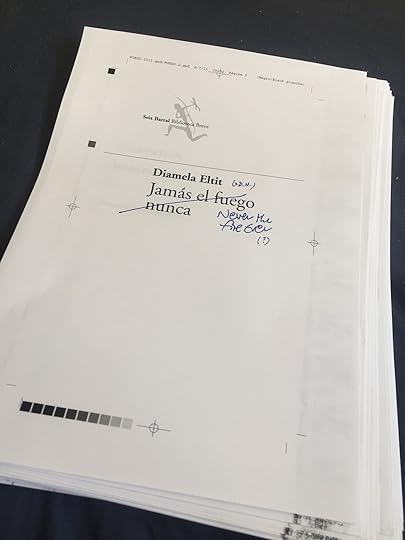
Title page of Daniel Hahn's rough draft translation of Diamela Eltit's "Never Did the Fire". Image sourced from Charco Press.
This research can entail everything from understanding the different possible usages and meanings of words in their original language (Spanish in this case) and then the nuances or possible idiomatic character of the locality (Chile in this case). It involves spotting areas where certain features of a writer's style become a recurring feature in a book and also where a particular word or phrase perhaps echoes throughout the book. It then requires turning all of that into a different language which perhaps does not share all of those usages and definitions, but for which you still have to make a decision on a best compromise.
I found this book to be completely intriguing. Partially this is because I dabble in translation myself, from my heritage language of Estonian into English. My experience is not extensive, it is mostly from poems or song lyrics and the occasional afterword, biography, or CD booklet note. There were still many recognizable aspects of the translation process which made me love Hahn's diary all the more. I think many readers of translations, and especially of Spanish to English translations, will be just as intrigued by it.
I read Catching Fire through my subscription to the Charco Press 2022 Bundle. Catching Fire is part of Charco Press' Untranslated series, a recent addition of original works in English alongside its base catalogue of translations of Latin American literature and its source language publications of Originales.
Review of the Charco Press paperback (April 2022) based on the original online diary (January - May 2021)
Doing that one chapter with much more care than my usual first drafts allowed me to learn things about the intensity of the writing, about the rhythms and repetitions and the precisions of the writing, which will help me to make my decisions as I go on. Well-written books teach you how to read them. How to translate them, too, I think.
[...]
One of the difficulties (as so often) is coming up with something that is helpfully familiar to the reader, so they understand the weight of what you're talking about, but also which isn't loaded with associations that are in fact un-helpful and potentially distracting.
Catching Fire is translator Daniel Hahn's observations recorded during his translation process of Chilean writer Diamela Eltit's novel Jamás el fuego nunca (2013) (the original Spanish title literally translates as Never the Fire Never) published later as Never Did the Fire (April 2022). It reveals all the uncertainties and possible inaccuracies of the translation process with Hahn being open enough to even display his own initial efforts where not all issues can be solved immediately, but for which many require additional research.
Title page of Daniel Hahn's rough draft translation of Diamela Eltit's "Never Did the Fire". Image sourced from Charco Press.
This research can entail everything from understanding the different possible usages and meanings of words in their original language (Spanish in this case) and then the nuances or possible idiomatic character of the locality (Chile in this case). It involves spotting areas where certain features of a writer's style become a recurring feature in a book and also where a particular word or phrase perhaps echoes throughout the book. It then requires turning all of that into a different language which perhaps does not share all of those usages and definitions, but for which you still have to make a decision on a best compromise.
I found this book to be completely intriguing. Partially this is because I dabble in translation myself, from my heritage language of Estonian into English. My experience is not extensive, it is mostly from poems or song lyrics and the occasional afterword, biography, or CD booklet note. There were still many recognizable aspects of the translation process which made me love Hahn's diary all the more. I think many readers of translations, and especially of Spanish to English translations, will be just as intrigued by it.
I read Catching Fire through my subscription to the Charco Press 2022 Bundle. Catching Fire is part of Charco Press' Untranslated series, a recent addition of original works in English alongside its base catalogue of translations of Latin American literature and its source language publications of Originales.

Read
August 28, 2025Admittedly only had to read the introduction for class. Enjoyed it, though. Writing clearly looks to speak to the reader and be understood, rather than intimidate/impress.
Solid ruminations on the translation process.
"People think about translating as a process of decoding, which it is; but it's also about reencoding. Not just deciphering the meaning, but reconstructing a new expression for it."
Solid ruminations on the translation process.

August 27, 2022
"Translation is the sum of its choices, choices that are more or less persuasive, more or less justifiable, but always subjective. Because translators are individual 𝘪𝘯𝘵𝘦𝘳𝘱𝘳𝘦𝘵𝘢𝘵𝘪𝘷𝘦 readers and individual 𝘤𝘳𝘦𝘢𝘵𝘪𝘷𝘦 writers, rather than just lexicographical datasets or collections of algorithms. So when we've done our reading, the real work is in the writing."
Hahn's translation diary, on the other hand, was a joy to read. I tried to read both of them nearly simultaneously, continuously shifting between the two after every few chapters/entries. It was, on my view, the best approach as each of them informed the other. Hahn goes into detail about all the challenges that a process of translation entails, generally as well as specific to Eltit, in its quest for perfection while it aspires towards the original. He illustrates his distinct method, an ordered chaos, with examples as he tries to capture "the interpretive element, the flexibility, the dependant relation to the source text, the impossibilities and opportunities" of this job.
(I received a finished copy from the publisher in exchange for an honest review.)
July 23, 2026
I enjoyed this so much. I do love a good bit of non-fiction writing and this diary about the process of translation really hit the spot for me. You might think translation is just about the content but it’s so much more - rhyme, rhythm and repetition (see what I did there). How do you translate a word that has a double meaning in the original but not in the new language? Can you capture onomatopoeia when the words are different? What do you do when the adjectives indicate the gender in Spanish but not in English and you need to find another way to drop that hint? And how can you capture the tone and style of the book so that it is in tune with the authors’ other books?
Now that I’ve read this I’m more or less a professional translator, not to mention basically fluent in Spanish.
Not sure what I thought about the book the author was translating tho. Did seem a bit odd. But maybe I’ll have to read the whole thing.
Now that I’ve read this I’m more or less a professional translator, not to mention basically fluent in Spanish.
Not sure what I thought about the book the author was translating tho. Did seem a bit odd. But maybe I’ll have to read the whole thing.
April 27, 2023
Banger especially if you like language and translated writing
March 22, 2025
So cool!
I think the idea animating this book is really interesting, but alone wouldn't have been able to sustain more than an essay alone. Hahn writes that essay, as the introduction to this book. Fascinating in its own right, it details everything that readers will see him grapple with through his translation of Diamela Eltit's novel. At its core lie the very things that animate good writing, the decisions authors make in constructing their stories, characters, and settings. He discusses how different languages tackle and create different problems, the need for a simultaneously ambiguity and clarity in writing (especially fiction), and how certain authorial tics can give rise to a specific creative voice. That essay is fantastic and worth the read. The rest, however, is just as good.
Instead of reiterating each of these ideas from this birds-eye view, Hahn gives a practical deep-dive into his process (which necessarily tackles the challenges he referenced in his introduction) as he works through one translation. The nitty-gritty details and iterations become windows into both his and the original author's language. He teases out the complexities and big questions of his original argument in specific examples. Each is giving as much weight as it takes for him to process it as he works. These little entries are so digestible, it was perfect for a quick Metro ride or the limnity (I am inventing a word) of waiting outside a musuem.
Nevertheless, this is still a book about big ideas. At the core, Hahn is helping himself and his readers make sense of good writing. The decisions, the assumptions, the idiosyncracies we often don't pay attention to are of utmost importance to him as a translator; it's of course his job to somehow recognize and capture and transform those things from one language to another. I think this teases them out so persuasively. It's not just that the curtains are blue, if you will, but rather why they are blue, or curtains, or mentioned at all. And how to restructure their effect when sentence structures in another language change how and when the information is conveyed.
Even with these deeply philosophical and existential questions about writing, Hahn's writing never takes on the academic esotericism they might suggest. His writing voice is so inviting and clear, always grounded in the text and work he was doing. I loved following along with his thoughts and insights. I puzzled out some of the decisions he made alongside him, weighing how I would have done things the same or differently.
I can't imagine how to better tackle this topic than this book, so 5 stars it is. Thanks to the New York Times Book Review for bringing this to my attention through some random article I clicked on. I had such a thoroughly good time reading this, even though it was so dramatically different than anything I'd normally choose for myself.
I think the idea animating this book is really interesting, but alone wouldn't have been able to sustain more than an essay alone. Hahn writes that essay, as the introduction to this book. Fascinating in its own right, it details everything that readers will see him grapple with through his translation of Diamela Eltit's novel. At its core lie the very things that animate good writing, the decisions authors make in constructing their stories, characters, and settings. He discusses how different languages tackle and create different problems, the need for a simultaneously ambiguity and clarity in writing (especially fiction), and how certain authorial tics can give rise to a specific creative voice. That essay is fantastic and worth the read. The rest, however, is just as good.
Instead of reiterating each of these ideas from this birds-eye view, Hahn gives a practical deep-dive into his process (which necessarily tackles the challenges he referenced in his introduction) as he works through one translation. The nitty-gritty details and iterations become windows into both his and the original author's language. He teases out the complexities and big questions of his original argument in specific examples. Each is giving as much weight as it takes for him to process it as he works. These little entries are so digestible, it was perfect for a quick Metro ride or the limnity (I am inventing a word) of waiting outside a musuem.
Nevertheless, this is still a book about big ideas. At the core, Hahn is helping himself and his readers make sense of good writing. The decisions, the assumptions, the idiosyncracies we often don't pay attention to are of utmost importance to him as a translator; it's of course his job to somehow recognize and capture and transform those things from one language to another. I think this teases them out so persuasively. It's not just that the curtains are blue, if you will, but rather why they are blue, or curtains, or mentioned at all. And how to restructure their effect when sentence structures in another language change how and when the information is conveyed.
Even with these deeply philosophical and existential questions about writing, Hahn's writing never takes on the academic esotericism they might suggest. His writing voice is so inviting and clear, always grounded in the text and work he was doing. I loved following along with his thoughts and insights. I puzzled out some of the decisions he made alongside him, weighing how I would have done things the same or differently.
I can't imagine how to better tackle this topic than this book, so 5 stars it is. Thanks to the New York Times Book Review for bringing this to my attention through some random article I clicked on. I had such a thoroughly good time reading this, even though it was so dramatically different than anything I'd normally choose for myself.

August 31, 2024
A fascinating glimpse into the world of translation. Hahn writes with humor and levity that makes the pages speed right on by. I especially appreciated that this was compiled from a real-time blog, so it gets even more self-referential and conversation-y than you might expect. I thoroughly enjoyed this and now intend to seek out Never Did the Fire for my own enjoyment (and curiosity).

April 22, 2022
I first started reading Daniel Hahn’s translation diary on translating ‘Never did the fire’ (Diamela Eltit) in Charco’s blog, and from the beginning I thought I needed to read this book. So, I was thrilled as soon as I knew Charco was publishing not only ‘Never did the fire’ itself, but also ‘Catching fire’, the said diary by Daniel Hahn. I read them both in two or three days, beginning with the diary, which is a great way to approach the book, in my opinion, because it creates a crescendo of expectation and excitement to actually get into the book.
My first thought after the reading was, wow, what a great, outstanding book, what a magnificent author who I didn’t know at all, and what a major work of translation! I wanted to tell everyone I know about it: hey, you must read this book, you must know this author, she’s marvellous, you must read this diary if you want to fully appreciate the work of translation before you. I even regretted I’m not Mexican or Chilean or Colombian so I could start a Spanish in Translation Book Club, only to be able to discuss this book! Hold on, I don’t need to be Spanish-native to do that… Well, let’s just say on that part I’ve got enough on my plate already!
For someone like me, who has always been fascinated by the art of translation, this book is a jewel. Not only does it enlighten the struggles and hassles of the job, but also actually teaches something about it, which proves extremely interesting when you know both languages, thus being able to follow the whole picture unfolding before you, with all its beauty, magic and delight. And when you go on reading the actual book, you find those bits of shiny jewels along the way, you recognise them from before and you find yourself appreciating in a much deeper sense the exquisite reading you have in hands, this magnificent author and her magnificent voice in English, the one Daniel has mastered to produce so clearly and distinctly. My final words are: thank you, Daniel, for writing this book, for your excellent translation of ‘Never did the fire’ and for introducing me to the brilliant Diamela.
My first thought after the reading was, wow, what a great, outstanding book, what a magnificent author who I didn’t know at all, and what a major work of translation! I wanted to tell everyone I know about it: hey, you must read this book, you must know this author, she’s marvellous, you must read this diary if you want to fully appreciate the work of translation before you. I even regretted I’m not Mexican or Chilean or Colombian so I could start a Spanish in Translation Book Club, only to be able to discuss this book! Hold on, I don’t need to be Spanish-native to do that… Well, let’s just say on that part I’ve got enough on my plate already!
For someone like me, who has always been fascinated by the art of translation, this book is a jewel. Not only does it enlighten the struggles and hassles of the job, but also actually teaches something about it, which proves extremely interesting when you know both languages, thus being able to follow the whole picture unfolding before you, with all its beauty, magic and delight. And when you go on reading the actual book, you find those bits of shiny jewels along the way, you recognise them from before and you find yourself appreciating in a much deeper sense the exquisite reading you have in hands, this magnificent author and her magnificent voice in English, the one Daniel has mastered to produce so clearly and distinctly. My final words are: thank you, Daniel, for writing this book, for your excellent translation of ‘Never did the fire’ and for introducing me to the brilliant Diamela.

May 19, 2024
I recently read essays by Lydia Davis on translating from Icelandic. This was similarly interesting, with the added bonus that I understand some Spanish and have previously noticed quirks of the language that don’t exactly correspond with English. I liked learning how he resolved them.

November 17, 2023
no rating bc it was nonfiction for school and idk how to rate something like this. really interesting look into his process though.
May 17, 2026
Hahn is such a witty, clever translator! I really love the way he consistently (albeit implicitly) talks about transcreation; that you cannot simply crudely 'translate' a word from language A to language B, such translation will inherently become something that is no longer resemble the original work, clumsily erasing contexts and deliberate words that are being chosen intentionally by the author to decipher a particular scene, feeling, or character. It's refreshing to know there are translators out there who are putting a genuine effort to preserve the original as much as possible, especially when it comes to authors from non-anglosphere world :-]

October 3, 2023
I read this for my Studies in Translation course in the Fall of ‘23, in tandem with Never Did the Fire.
I thoroughly enjoyed this translation diary and found many of Hahn’s thoughts insightful. I liked seeing a professional translator go through the same issues that I do as a novice (however, he overcomes them quicker), and I liked Hahn’s openness to mistakes and changes. While I didn’t like the finished product Never Did the Fire, I found the result of Hahn’s diary to be fascinating.
4.5 stars.
I thoroughly enjoyed this translation diary and found many of Hahn’s thoughts insightful. I liked seeing a professional translator go through the same issues that I do as a novice (however, he overcomes them quicker), and I liked Hahn’s openness to mistakes and changes. While I didn’t like the finished product Never Did the Fire, I found the result of Hahn’s diary to be fascinating.
4.5 stars.
April 11, 2022
I'll be tempted to buy this as a gift for anyone who's curious about what translators do (they should have diaries like this for all professions. I already know what a translator does, but plenty of jobs out there I need demystifying).

December 1, 2024
I really appreciate this kind of translation diary or blog, and the ongoing conversation with the readers is a bonus. "I don't think we talk about our processes enough," the author says, and many translators will agree that the dry abstractions of some "translatology" are practically useless in comparison with this hands-on, process-oriented approach. The "think-aloud" method is fine so long as the random, rambling thoughts are not too loud.
This diary/blog indeed has none of the stuffiness of some translation theory, but then again the author's musings sometimes struck me as so happy-go-lucky that they brought out the prig in me and I occasionally started yearning for a bit of intellectual rigour. :-) The author insists: "I was never really taught to translate, so any deliberate thinking I've done about it has been frankly pretty slapdash," and professes a "warts-and-all" approach supposedly with non-translators in mind, as he "imagined there wouldn't be much in [this book] that long-serving professionals would find new".
To my mind there is a lot of unnecessary modesty in this approach. The guy has won awards after all. He could have cut down on the warts a bit and focused more on some of the interesting translation issues that he does actually bring up. In any case, I cannot imagine many non-translators are going to enjoy wading through some of these minutiae any more than non-plumbers would want to do something analogous in their bathroom. :-) There is too much waffle IMO, e.g. "I prefer x to y, because... Actually I don't know why, but, well, this is my translation and I can do what I like. So there." Yeah right cool. :-)
His initial word count proved to be quite inaccurate because he forgot that an initial placeholder figure was just a rough guess - this does not augur well IMO for his system of leaving placeholders everywhere on the first pass, but there you go.
"Wherever possible I will build what I say not around ethereal abstract nouns but around concrete examples, made of solid, earthbound words." Just my cup of tea in Czechlist. Here are a few nuts-and-bolts issues that he deals with plus a sprinkling of eternal verities:
Should contractions (isn't, can't) be consistent? He chooses not to contract for greater emphasis. That is an area to be explored in detail IMO.
One sentence is referred to as sounding "like a badly tuned radio". "Sentences that are, you know, sort of there, but there's just a little bit of annoying interference to be eliminated.
"Our struggle, when we embark on this career, is not to find our voice, but to lose it." That is debatable -- I think a different voice needs to be found for each translation.
"All effective translation is also sleight of hand"
"On some level I want them [the readers] to think they are reading the original."
"Readers should feel they're getting unmediated access to a work of art even if they know [...] that they aren't."
That evergreen question: Read it through first? "The original writer didn't read it first either."
"Ambiguity can be the hardest thing to translate. I think some people imagine ambiguity as a kind of vagueness, but to my mind you might better consider it exactly the opposite, as an extreme sort of precision, and that's what makes it hard."
"Bread is, for a seemingly simple noun, surprisingly hard to translate." I think of pečivo.
"She uses unusual words, or common words in slightly unusual ways."
"Diamela's repeated usages are part of the deliberate texture of her Spanish prose, I'd like her English prose to have the same effect."
Combining sentences to avoid repetition of initial pronoun.
"The phrase 'on this occasion, possessed by' has become 'on this occasion, possessed as I was by'. The Spanish tells you that the possessed refers to the narrator because the word is gendered, so I need to smuggle in a few extra words to do that."
"Going for sentences with density rather than sprawl. This means sometimes using a single chunky Latinate word rather than a phrase made up of several shorter Anglo-Saxon words."
"It's very common for Spanish to testify explicitly to the intended recipient of every bit of dialogue in a way that we don't usually in English."
"Great precision of prose with significant, deliberate blurriness in the effect - might be the hardest thing of all to pull off, for writer as well as translator."
"I always tell early-career translators how essential it is to read their work out loud, yet do it myself embarrassingly rarely, but like many people, I do sort of read out loud in my head."
This diary/blog indeed has none of the stuffiness of some translation theory, but then again the author's musings sometimes struck me as so happy-go-lucky that they brought out the prig in me and I occasionally started yearning for a bit of intellectual rigour. :-) The author insists: "I was never really taught to translate, so any deliberate thinking I've done about it has been frankly pretty slapdash," and professes a "warts-and-all" approach supposedly with non-translators in mind, as he "imagined there wouldn't be much in [this book] that long-serving professionals would find new".
To my mind there is a lot of unnecessary modesty in this approach. The guy has won awards after all. He could have cut down on the warts a bit and focused more on some of the interesting translation issues that he does actually bring up. In any case, I cannot imagine many non-translators are going to enjoy wading through some of these minutiae any more than non-plumbers would want to do something analogous in their bathroom. :-) There is too much waffle IMO, e.g. "I prefer x to y, because... Actually I don't know why, but, well, this is my translation and I can do what I like. So there." Yeah right cool. :-)
His initial word count proved to be quite inaccurate because he forgot that an initial placeholder figure was just a rough guess - this does not augur well IMO for his system of leaving placeholders everywhere on the first pass, but there you go.
"Wherever possible I will build what I say not around ethereal abstract nouns but around concrete examples, made of solid, earthbound words." Just my cup of tea in Czechlist. Here are a few nuts-and-bolts issues that he deals with plus a sprinkling of eternal verities:
Should contractions (isn't, can't) be consistent? He chooses not to contract for greater emphasis. That is an area to be explored in detail IMO.
One sentence is referred to as sounding "like a badly tuned radio". "Sentences that are, you know, sort of there, but there's just a little bit of annoying interference to be eliminated.
"Our struggle, when we embark on this career, is not to find our voice, but to lose it." That is debatable -- I think a different voice needs to be found for each translation.
"All effective translation is also sleight of hand"
"On some level I want them [the readers] to think they are reading the original."
"Readers should feel they're getting unmediated access to a work of art even if they know [...] that they aren't."
That evergreen question: Read it through first? "The original writer didn't read it first either."
"Ambiguity can be the hardest thing to translate. I think some people imagine ambiguity as a kind of vagueness, but to my mind you might better consider it exactly the opposite, as an extreme sort of precision, and that's what makes it hard."
"Bread is, for a seemingly simple noun, surprisingly hard to translate." I think of pečivo.
"She uses unusual words, or common words in slightly unusual ways."
"Diamela's repeated usages are part of the deliberate texture of her Spanish prose, I'd like her English prose to have the same effect."
Combining sentences to avoid repetition of initial pronoun.
"The phrase 'on this occasion, possessed by' has become 'on this occasion, possessed as I was by'. The Spanish tells you that the possessed refers to the narrator because the word is gendered, so I need to smuggle in a few extra words to do that."
"Going for sentences with density rather than sprawl. This means sometimes using a single chunky Latinate word rather than a phrase made up of several shorter Anglo-Saxon words."
"It's very common for Spanish to testify explicitly to the intended recipient of every bit of dialogue in a way that we don't usually in English."
"Great precision of prose with significant, deliberate blurriness in the effect - might be the hardest thing of all to pull off, for writer as well as translator."
"I always tell early-career translators how essential it is to read their work out loud, yet do it myself embarrassingly rarely, but like many people, I do sort of read out loud in my head."

July 30, 2024
Wow, this was deeply reassuring and affirming! I mean you’re telling me that even some of the most seasoned and acclaimed literary translators in the game have messy first drafts and imposter syndrome too?!
I went to an author/translator talk for the release of this book and I remember part of the discussion centered around which way round to read the translation diary and the translation itself. Initially, I thought I’d read them semi-concurrently but I got wrapped up in the playful tone of the diary that I just kept on reading it and am yet to start the translation itself. As a comfortable-ish reader of Spanish, I really appreciated the inclusion of excerpts of the Spanish original as it allowed me to participate in the same process just in parallel: running my eyes over the excerpt, coming up with a messy first draft in my head in which there’s immediate words identified that will pose translation problems and then later on as Hahn edits, editing and editing thinking of possible solutions before reading Hahn’s solution. Relatedly, I particularly loved the remark Hahn made on reading some of Julián Fuks’ Portuguese translation of the novel: “I won’t necessarily be able to use any of his solutions, nor might I be inclined to, but using the translation essentially as a way of getting the insights of another close reader of the novel can’t hurt”. This attitude can also readily apply to reading a novel in its original for which there’s already a published translation in the language that you’re playing around with a translation of yourself as an exercise. It’s not about deference to the ‘answer’ but rather a this is A well-thought out solution that someone who has likely thought some time about it too.
A couple of other remarks: it’s also validating how annoying/tricky/difficult prepositions can be when translating from a Romance language to English or indeed vice versa. As someone whose English is not quite fully Scottish English but which definitely is influenced by it wrt to prepositions, that Hahn expressed a fondness for “outwith” made me smile. In a sample I submitted with a co-translator, for a German to English translation, I used “outwith” and had several conundrums about whether this marked the translation out as being in Scottish English whilst also feeling that no other preposition really worked either. Again, validating, validating!
(I slightly wish Danny Hahn realised that the book will also appeal to fellow translators (it’s mainly pitched for non-translators curious about the process) and this is recognised in the afterword. It would have been really insightful, as an early career translator, to have the curtain peeled back on the ‘official’ editorial process but I imagine doing so would pose an issue for contracts etc.)
Looking forward to reading Never Did The Fire for Women in Translation month!
I went to an author/translator talk for the release of this book and I remember part of the discussion centered around which way round to read the translation diary and the translation itself. Initially, I thought I’d read them semi-concurrently but I got wrapped up in the playful tone of the diary that I just kept on reading it and am yet to start the translation itself. As a comfortable-ish reader of Spanish, I really appreciated the inclusion of excerpts of the Spanish original as it allowed me to participate in the same process just in parallel: running my eyes over the excerpt, coming up with a messy first draft in my head in which there’s immediate words identified that will pose translation problems and then later on as Hahn edits, editing and editing thinking of possible solutions before reading Hahn’s solution. Relatedly, I particularly loved the remark Hahn made on reading some of Julián Fuks’ Portuguese translation of the novel: “I won’t necessarily be able to use any of his solutions, nor might I be inclined to, but using the translation essentially as a way of getting the insights of another close reader of the novel can’t hurt”. This attitude can also readily apply to reading a novel in its original for which there’s already a published translation in the language that you’re playing around with a translation of yourself as an exercise. It’s not about deference to the ‘answer’ but rather a this is A well-thought out solution that someone who has likely thought some time about it too.
A couple of other remarks: it’s also validating how annoying/tricky/difficult prepositions can be when translating from a Romance language to English or indeed vice versa. As someone whose English is not quite fully Scottish English but which definitely is influenced by it wrt to prepositions, that Hahn expressed a fondness for “outwith” made me smile. In a sample I submitted with a co-translator, for a German to English translation, I used “outwith” and had several conundrums about whether this marked the translation out as being in Scottish English whilst also feeling that no other preposition really worked either. Again, validating, validating!
(I slightly wish Danny Hahn realised that the book will also appeal to fellow translators (it’s mainly pitched for non-translators curious about the process) and this is recognised in the afterword. It would have been really insightful, as an early career translator, to have the curtain peeled back on the ‘official’ editorial process but I imagine doing so would pose an issue for contracts etc.)
Looking forward to reading Never Did The Fire for Women in Translation month!

completed
February 21, 2023It’s too bad that this book was not included in the same volume as the translation its author uses to talk about literary translation, Never Did the Fire. On Goodreads, there are four times as many reviews of the novel than of the translation “diary.” This is too bad, because the audience for the “diary” isn’t people like me who have done and/or thought a lot about literary translation. It’s the people who read literature in translation and don’t know much about the process (all those Goodreads reviewers who say “despite the fact that it’s in translation,” etc.). And yet these people are unlikely to fork out the money to buy Hahn’s book, as I did.
For me, the best thing about Hahn’s book is that it caused me to read his excellent translation of Eltit’s short fiction work. It’s an incredible book, and a great deal of the credit goes to Hahn. The prose is very dense and ambiguous, and the author plays a lot with time. In fact, my principal criticism of the book is that the ambiguity is taken too far, not at the linguistic level so much as at the plot level. The reader is kept too much in the dark, I think; it didn’t have to be so difficult to follow. I tried to read it like poetry, that is, go with the flow of the prose and not be too concerned about getting everything. This book begs to be read a second time, like good poetry.
As for Hahn’s book, it’s not a "diary," but a blog. That is, it’s written for an audience, not for the translator himself, as I would have preferred. But it’s done well, clearly, with good judgment, and in a nice, chatty style. It also deals with general translation matters as well as getting into the nitty gritty. I’m a big proponent of doing this sort of thing, to make the translator more invisible and to spread understanding of translation among readers. I’m just not the right audience for this particular example.
It’s worth noting that both books in ePUB format do not allow for changing the font or increasing the line spacing. The light, crowded type is not very easy on the eyes, especially older ones like mine.
For me, the best thing about Hahn’s book is that it caused me to read his excellent translation of Eltit’s short fiction work. It’s an incredible book, and a great deal of the credit goes to Hahn. The prose is very dense and ambiguous, and the author plays a lot with time. In fact, my principal criticism of the book is that the ambiguity is taken too far, not at the linguistic level so much as at the plot level. The reader is kept too much in the dark, I think; it didn’t have to be so difficult to follow. I tried to read it like poetry, that is, go with the flow of the prose and not be too concerned about getting everything. This book begs to be read a second time, like good poetry.
As for Hahn’s book, it’s not a "diary," but a blog. That is, it’s written for an audience, not for the translator himself, as I would have preferred. But it’s done well, clearly, with good judgment, and in a nice, chatty style. It also deals with general translation matters as well as getting into the nitty gritty. I’m a big proponent of doing this sort of thing, to make the translator more invisible and to spread understanding of translation among readers. I’m just not the right audience for this particular example.
It’s worth noting that both books in ePUB format do not allow for changing the font or increasing the line spacing. The light, crowded type is not very easy on the eyes, especially older ones like mine.
Want to Read
July 23, 2023I read about this book in the NYTimes. Thought it might be a good book for PT.
The cover of Daniel Hahn's "Catching Fire" shows pencil outlines of raised hands making various political gestures: fists, salutes, V-for-victory signs. The image echoes that found on the cover of Diamela Eltit's novel "Never Did the Fire," but in a rougher form and without any of the colors added.
The cover of Daniel Hahn's "Catching Fire" shows pencil outlines of raised hands making various political gestures: fists, salutes, V-for-victory signs. The image echoes that found on the cover of Diamela Eltit's novel "Never Did the Fire," but in a rougher form and without any of the colors added.
Last year, the independent Scottish publisher Charco Press, which specializes in Latin American literature, released an English translation of a novel they called “Never Did the Fire,” by the avant-garde Chilean writer Diamela Eltit. (It follows an aging couple who met as revolutionaries in the Pinochet era and are now mourning the death of their son.)
At the same time, intriguingly, they also published this behind-the-scenes diary by the book’s translator, the estimable Daniel Hahn, about his process and the art of literary translation in general. The diary was intended as a side course to the novel, but you know how sometimes the fries are more appealing than the burger? Hahn is so smart and neurotic and funny and clear about the challenges of his profession that, although it probably wouldn’t please him to hear it, I finally set the Eltit down and read Hahn strictly for himself.
“Translation is like copying a work of art in a different medium,” he writes in his introduction. “We’re art forgers attempting to reproduce an oil painting using only pencils, but so skillfully you won’t be able to tell the difference.”
The whole book is filled with similarly great metaphors and explanations and patiently worked-out solutions to some of the technical problems he faced. Bonus: The delightfully droll index, with entries including “deadlines (not met),” “first drafts, gruesome,” “words included just because the translator likes them” and “writers, annoying.”
The cover of Daniel Hahn's "Catching Fire" shows pencil outlines of raised hands making various political gestures: fists, salutes, V-for-victory signs. The image echoes that found on the cover of Diamela Eltit's novel "Never Did the Fire," but in a rougher form and without any of the colors added.
The cover of Daniel Hahn's "Catching Fire" shows pencil outlines of raised hands making various political gestures: fists, salutes, V-for-victory signs. The image echoes that found on the cover of Diamela Eltit's novel "Never Did the Fire," but in a rougher form and without any of the colors added.
Last year, the independent Scottish publisher Charco Press, which specializes in Latin American literature, released an English translation of a novel they called “Never Did the Fire,” by the avant-garde Chilean writer Diamela Eltit. (It follows an aging couple who met as revolutionaries in the Pinochet era and are now mourning the death of their son.)
At the same time, intriguingly, they also published this behind-the-scenes diary by the book’s translator, the estimable Daniel Hahn, about his process and the art of literary translation in general. The diary was intended as a side course to the novel, but you know how sometimes the fries are more appealing than the burger? Hahn is so smart and neurotic and funny and clear about the challenges of his profession that, although it probably wouldn’t please him to hear it, I finally set the Eltit down and read Hahn strictly for himself.
“Translation is like copying a work of art in a different medium,” he writes in his introduction. “We’re art forgers attempting to reproduce an oil painting using only pencils, but so skillfully you won’t be able to tell the difference.”
The whole book is filled with similarly great metaphors and explanations and patiently worked-out solutions to some of the technical problems he faced. Bonus: The delightfully droll index, with entries including “deadlines (not met),” “first drafts, gruesome,” “words included just because the translator likes them” and “writers, annoying.”
August 30, 2023
Hahn’s witty, and comedic voice in this tell-all memoir about the process of translation was the perfect companion to anyone interested in the industry, or any lover of world literature.
I appreciated his honesty when describing formality and registers, when to place contractions, and the dialectal differences both within the Spanish and English speaking worlds - and the idiolects of every author.
I am keen to go on to read Juan Pablo Villalobos, one of his recommendations that further explores inter-Hispanic language differences through a range of characters.
My favourite part of his narrative was probably the commentary on the differences between Latinate and Anglophone syntax and meter, including the potential for the monosyllabic erasure of the Chilean voice. I also enjoyed the description of the process of Spanish words meaning many different things - and then navigating the nuance of these meanings. Was it deliberately ambiguous? This omnipresent questions became quite hilarious after a while.
I appreciated his honesty when describing formality and registers, when to place contractions, and the dialectal differences both within the Spanish and English speaking worlds - and the idiolects of every author.
I am keen to go on to read Juan Pablo Villalobos, one of his recommendations that further explores inter-Hispanic language differences through a range of characters.
My favourite part of his narrative was probably the commentary on the differences between Latinate and Anglophone syntax and meter, including the potential for the monosyllabic erasure of the Chilean voice. I also enjoyed the description of the process of Spanish words meaning many different things - and then navigating the nuance of these meanings. Was it deliberately ambiguous? This omnipresent questions became quite hilarious after a while.

January 19, 2024
As a literary translator, this book was such a refreshing breeze. What, even seasoned translators like Daniel are prey to the impostor's syndrome ? I'm not the only one making horrible first drafts?
It has to be said : holding a translation diary is an extremely brave task. Instead of being shown only the final vernished printed version, Daniel Hahn takes us through his doubts, thought process and struggle to deconstruct a text and rebuild it in another language. One of the most painful and beautiful tasks one can accomplish (not being impartial here).
It has to be said : holding a translation diary is an extremely brave task. Instead of being shown only the final vernished printed version, Daniel Hahn takes us through his doubts, thought process and struggle to deconstruct a text and rebuild it in another language. One of the most painful and beautiful tasks one can accomplish (not being impartial here).
February 14, 2023
Fascinating book which somehow shouldn't be particularly interesting, but really is! I also loved the conversational tone the writer often used which kept the book light. A great read for anyone with a passing interest in literature, writing, translation, language, words, etc etc.

July 30, 2023
Loved the nitty-gritty exploration into the complex inter-workings and challenging decisions involved in translating literature. The book is not for everyone, but as a translator, I appreciated the depth given to our work/science/craft!
January 12, 2024
An enlightening, entertaining and interesting book which breaks down the process of literary translation. Hahn‘s narration is easy to read and at times funny but he provides good insights into the challenges of translating such a unique and difficult book.
May 16, 2022
The most brilliant - and honest - book on literary translation I've ever read.

September 17, 2022
Such an interesting read to get to know the process of a literary translator! Plus the author writes with a very light tone, which makes it great for translators and non-translator alike.
Read
December 16, 2022Fascinating book by a master on the art of translation!

October 27, 2023
Perhaps not a 5 as a "book to read" but certainly a 5 if you want to learn about translating.
Displaying 1 - 30 of 33 reviews