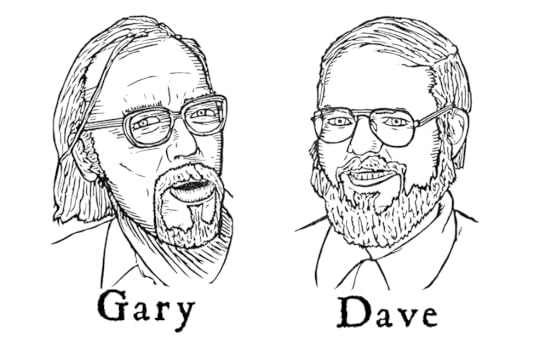
I first became aware of Jon Peterson* through references in Die interviews to his Playing At The World, a general history of RPGs and wargames which I've still yet to read. This, on the other hand, popped up on Netgalley so I thought I might as well. It zooms in on one strand of the previous book's big picture, the contested history of Dungeons & Dragons, and the rise and fall of its publisher TSR. As such, it's inevitably aimed at a niche within a niche; roleplaying, and even D&D specifically, may be more popular than ever before, but while an interest in that might be a necessary condition for reading this, I'm not sure it's a sufficient one. There's a certain amount of hand-holding to get the reader through some of the business with stock options and office politics on which the story turns, but again, that's going to winnow the audience further. Fundamentally, though, I suspect you need to be at least a bit of a grognard** to care about the history of a defunct games publisher, and in particular about the collaboration-turned-rivalry of Dave Arneson and Gary Gygax. Your classic Severed Alliance model, in other words, except imagine it as taking place in a world with the added stakes of the Smiths being the first ever indie band, set against the faint bathos of indie only tentatively becoming cool 30 years later.
As is usually the way in a dispute over rights, both Gygax and Arneson had their partisans, but what really comes across here is the degree to which a) D&D could never have happened without both of them and b) they were both absolute nightmares. Arneson could clearly run a table (and yes, it is entirely deliberate that I'm posting this exactly half a century since he first did just that), but every time he attempts to codify that as something other people could use, it sounds a lot like Homer Simpson's tax return. One of the most frustrating moments in the book comes when Peterson talks about the manuscript of Arneson's long-promised Blackmoor campaign finally being battered into shape by Tim Kask – "Decades later, he still seems traumatized by it", and as an editor myself I would love to know more of the gory details there. Equally, Gygax can codify, ramify, but that without the kernel is nothing. Yet once they fall out, each is happy to suggest the other deserves no credit whatsoever. Add in that both of them come across as very much the old-school, barely socialised flavour of nerd, the sort who'd say 'stout yeoman of the bar' while ordering a drink and think this absolutely brilliant, and as often as not I just wanted them both sent to their rooms to think about what they'd done.
Still, it is interesting to be reminded how much that very nerd stereotype was shaped by D&D. When its precursor Chainmail introduced fantasy elements to wargaming, this was regarded as an outlandish and suspect move by a hobby which at that point was all about historical re-enactment. And if it turned out there was a small audience, well, that still only made D&D, as per one early rights deal and a chapter title here, a $300 idea. Even that being a comparatively high number; at one point a licensing deal is made for miniatures based on Edgar Rice Burroughs' Mars stories, but nobody even bothered to consider money from the attendant rules, seen as pretty much promotional items – "They were one step up from packaging."
Equally, other people may have known, but I certainly didn't, that despite the Satanic panic which would do so much in bringing the game to prominence, both Arneson and Gygax were devoutly religious, the latter being a Jehovah's Witness. Which, alongside family, and work, was one of the reasons he mentioned in his many early attempts to step back from his hobby interests, worried they were taking too much of his time. Imagine if he'd ever been able to stick to that! But even on this tiny local scale, he was that bit too addicted to being king of the scene, just as Arneson was a little too fond of playing the malcontent. It's a classic example of fame not sending people wrong as such, just allowing them a far bigger platform on which to demonstrate everything they already were. In these early days, there are definitely times when Game Wizards felt like it was giving a little more detail than I wanted on the editions and allocations of their earlier work together, but I can hardly complain about that given the topic, and it does lay groundwork for the ensuing rupture. Before long we're into a fascinating tangle of geek pettiness (they name villains after each other in their scenarios!) and intellectual property law, which at one stage involves two descriptions of an owlbear being presented as legal evidence, something that couldn't help reminding me of South Park's Chewbacca defence. All of this turning on the fact that technically you can't copyright an idea, so what counts as the "set of game rules or game" from the 1975 royalty agreement? Just the original book, or supplements and revisions? Is Advanced Dungeons & Dragons the same game as Dungeons & Dragons? These are vexed questions even if you've played the damn things, never mind if you're some poor bloody legal professional suddenly hip-deep in kobolds. Nor does it help that by all accounts the very first version of the game was fine if you'd seen it played, but lacked explanation of the how and why if you just picked up the book – explaining decades of RPGs feeling obliged to explain that somewhat awkwardly in the intro ever since.
It's not all geek-specific stuff, of course. I'm sure some of it would be interesting to people who just like reading business stories, or at least as sure as I can be given people who read business books scare and confuse me. Like the way the company expands too fast, in too many directions, suddenly getting involved in everything from needlework to marine salvage, and most ruinously Hollywood. At one point the Dragonlands West outpost is costing $120,000 just for rent, never mind the lavish parties, while the firm's core is cutting employees. All this in pursuit of a film for which Gygax has such grand ambitions – complaining about what let-downs the animated LotR and Milius' Conan were, insisting that a D&D film should instead be fit to sit alongside Raiders or Star Wars. Which is even funnier if you've ever seen Jeremy Irons hamming his way through the one that eventually limped out many years later***. Still, they did have James Goldman of the incomparable Lion In Winter on board for a while, so I would love to get a copy from a world where that panned out.
Even what they did accomplish, though, however briefly, is quite something (one tragic sidenote in this is early partner Don Kaye, dead of a heart attack at 36, never living to see what TSR would become). Some of what goes wrong is absolutely elementary stuff, like Gygax' marriage breaking up over an affair with a secretary; the nepotism; or the employees cheated over stock options – just basic shabbiness which might tempt a fast-growing business in any sector. As also the way that Arneson, the ousted co-founder, is making more on his royalties than anyone else bar Gygax is making from the product, but still feels cheated; Gygax, meanwhile, is equally ungracious in victory, getting pissy about teenagers' fanzines and generally acting like the whole hobby only exists on his sufferance. The fall, though, is less down to the infamous lost teen in the steam tunnels (he wasn't), or any of the tendentious suicide cult scare stories, which served mainly to get TSR the Random House hook-up that really takes it overground, even if they did also oblige a couple of rewrites and redesigns around the edges. Nope: D&D's apparently unstoppable rise is halted less by god-botherers than the arrival of another revolutionary game, Trivial Pursuit - among whose many wrong answers was ascribing the creation of D&D to Gygax solo.
While all of this is going on, you'd think it would become easier to sympathise with Arneson when he does stuff like grab an industry award for D&D before TSR's representatives could get to the stage. Subsequent clarifications by the awarding body point out that a game is the work of many, so the award should go to the corporation which put it out - but equally, could you not say that of film awards? Which don't work that way. A certain creator rights muscle starts twitching on his behalf...but then a couple of years later, he's happy to accept a plaque for a board game his Adventure Games outfit had released, designed by a freelancer, without feeling a commensurate need to step aside and let any creator who isn't him have their due share of the glory. His post-D&D efforts in general sound like they were a right mess, especially the misbegotten Adventures In Fantasy, of which one early review said "The price is high, the graphics are terrible, the rules are worse, and many of the systems are overly complicated." And such small portions! At first I was put in mind of the career of another geek god whose own work I don't much rate, Jack Kirby, who would himself turn out some right nonsense after his similar break with company man Stan Lee. But say what you like about the Eternals or the New Gods, and I frequently do, at least Kirby kept plugging away, putting stuff out there, unlike Arneson's decades of blown deadlines and games that never quite cohered. Maybe a better comparison would be Siegel and Shuster's attempts to recapture the magic after they'd lost the rights to Superman, not least the abortive, appalling Funnyman.
I feel like I'm going in circles a little here, but part of that is trying to capture the very particular and peculiar thing this book is, something that a very small number of potential readers will absolutely lap up but most people probably shouldn't go anywhere near. What makes it stranger still is that D&D was never even really my game – and yet somehow, as the wellspring of the whole RPG field, I have a sort of osmotic connection to it nonetheless (and perhaps into the bargain feel some astrological significance to having been born the one year GenCon took place at the Playboy Club). There are other games that form part of this story of which I have literally never heard, like the long-delayed SF RPG Star Frontiers – and, though it missed its moment and came into a market already claimed by the likes of Traveller, this was a game which did well enough to be worth suing over in its own right. Despite all of which, there's a Venn of things that interest me in whose intersection this mess of flawed humans and ugly capitalism underpinning a whole new field of fantasy finds a definite place. And as someone who couldn't even currently lay hands on the fanzines and geek ephemera from my own past, I'm awed at the thoroughness with which Peterson has been able to excavate and reconstruct a decade plus of an entire scene.
Although, if I have successfully convinced you that this isn't the read for you, I can at least leave you with some comedy names. Several members of the Kuntz family play parts in TSR's early days, and there's also spokesman Dieter Sturm, whose splendidly improbable moniker may go some way to explaining the sort of 'European' names deemed acceptable for inhabitants of Ravenloft.
*If you were called that, wouldn't you be very wary of getting your RDA of vitamins &c, in case you suddenly started extruding weird screeds about lobsters and chaos?
**A term which Game Wizards does use once without glossing, something that probably says a fair amount about the likely audience. Equally – it is only used that once, in a quote, so you could probably get away without knowing it...
***Although I suppose there have been more Star Wars films since Gygax' promise, and the D&D film is ahead of 4/9 of the Skywalker Saga, so looked at that way...