

What do you think?

The Intelligent Brain
No feature of the mind is as important, controversial, and mysterious as intelligence. It is the epitome of brain function, and it has a powerful influence on success in life. And thanks to decades of research, we are closer than ever before to understanding it. Now in The Intelligent Brain, taught by one of the world’s foremost researchers on intelligence, Professor Richard J. Haier of the University of California, Irvine, you’ll trace the fascinating history of intelligence testing and its leading thinkers, as well as what brain imaging studies and the most recent research findings reveal about this most complex of human phenomena.
327 pages, Paperback
Published April 5, 2013
Ratings & Reviews
Friends & Following
Create a free account to discover what your friends think of this book!
Community Reviews
Displaying 1 - 16 of 16 reviews

December 5, 2018
It was a good course, if not for the fact that professor Haier seems to be obsessed with the outdated, controversial, simplistic G factor. However, almost every other aspect of the course seems to be good. There are good discussions that can give a primer for people who want to get into them.

September 4, 2019
This was an exceptional course. Professor Richard J. Haier has a great teaching style, and intersplices his lectures with many informative charts, diagrams, and animations. He has put together a well-researched and well-written course with "The Intelligent Brain".
He begins with talking about what intelligence is, and what it is not. He uses examples of autistic savants, who greatly excel in certain narrow fields, but are paradoxically unable to care for themselves or live on their own. As such, savants, although exceptionally talented - are not "intelligent".
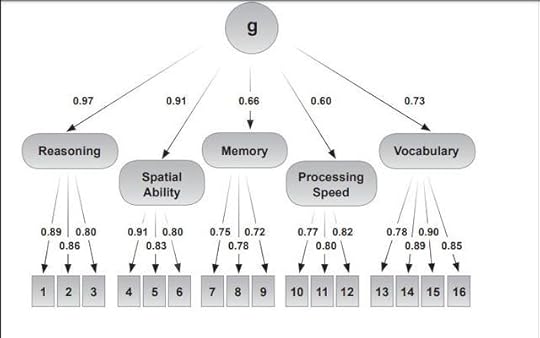
To this point, he introduces the concept of general intelligence, or "G Factor". "G" is established with a battery of tests, and breaks down into 5 main subcategories: Reasoning, Spatial ability, Memory, Processing speed, and Vocabulary. Each constituent of "g" has a different "g-loading", or correlative; the highest being reasoning, with a value of .97:
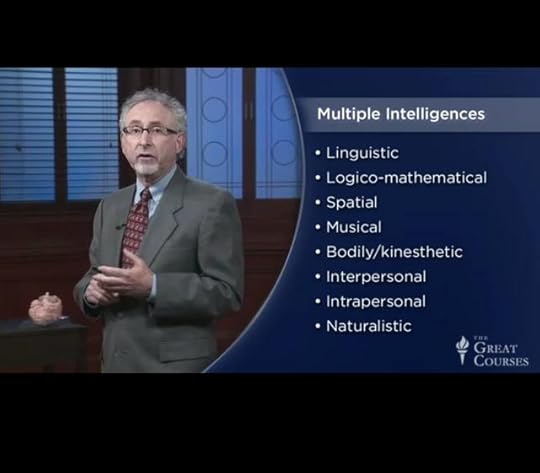
He then breaks down the different kinds of intelligence:
The course moves on with talk about PET scans on the brain, as well as the Efficient brain hypothesis, why theorizes that more intelligent brains don't have to "work" as hard at a given task, in relation to less intelligent ones.
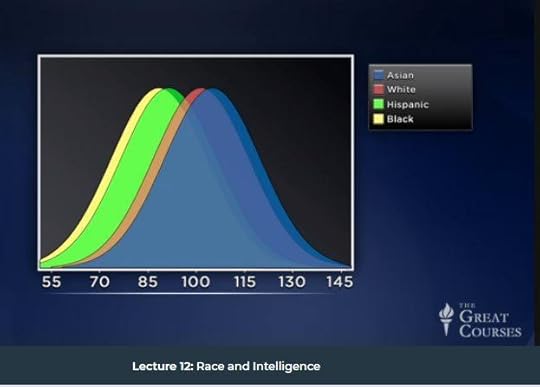
To his credit, he also tackles the most contentious issues related to intelligence research; sex and race differences. A course on intelligence would be remiss to not include these topics. Although the ultimate cause of group differences is up for debate, the fact that they exist is very well-documented. The average white/black difference in SAT performance and IQ tests is 1 standard deviation. These differences have persisted for decades, despite vast social programs aimed at reducing or eliminating them. He also mentions Charles Murray's "The Bell Curve", which deals with this issue in depth.
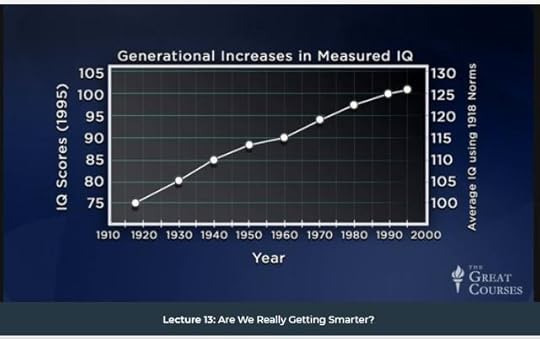
Lecture 13 talks about The Flynn Effect, which is a super-interesting trend:
The course continues on with discussing the research for increasing one's "g" factor, and examines the feasibility of doing so.
The lecture series concluded with Prof Haier postulating that we will one day understand the biological basis for intelligence, and will be able to enhance it. He then asks the viewer a moral question of whether they would want to enhance their or their children's intelligence if an "IQ pill" was available.
In closing, this was an excellent series from The Great Courses, that I would highly recommend to those interested in learning more about intelligence, and its relevant research. Professor Haier does an excellent job of teaching this lecture series.
He begins with talking about what intelligence is, and what it is not. He uses examples of autistic savants, who greatly excel in certain narrow fields, but are paradoxically unable to care for themselves or live on their own. As such, savants, although exceptionally talented - are not "intelligent".
To this point, he introduces the concept of general intelligence, or "G Factor". "G" is established with a battery of tests, and breaks down into 5 main subcategories: Reasoning, Spatial ability, Memory, Processing speed, and Vocabulary. Each constituent of "g" has a different "g-loading", or correlative; the highest being reasoning, with a value of .97:
He then breaks down the different kinds of intelligence:
The course moves on with talk about PET scans on the brain, as well as the Efficient brain hypothesis, why theorizes that more intelligent brains don't have to "work" as hard at a given task, in relation to less intelligent ones.
To his credit, he also tackles the most contentious issues related to intelligence research; sex and race differences. A course on intelligence would be remiss to not include these topics. Although the ultimate cause of group differences is up for debate, the fact that they exist is very well-documented. The average white/black difference in SAT performance and IQ tests is 1 standard deviation. These differences have persisted for decades, despite vast social programs aimed at reducing or eliminating them. He also mentions Charles Murray's "The Bell Curve", which deals with this issue in depth.
Lecture 13 talks about The Flynn Effect, which is a super-interesting trend:
"• Researchers have determined what the average IQ score would be for each year when the norms from 1918 are used to calculate the scores for all subsequent years. In 1918, the mean was 100, but the mean was 125 in 1995 using the old 1918 norms. In other words, it looks like people are getting smarter from generation to generation.
• If 1995 norms are used, the 1995 mean was 100, but the 1918 mean IQ for the population would have been 75 if 1995 norms were used. In other words, the average IQ in 1918 would have been in the mentally retarded range by the 1995 standard. Obviously, most people were not mentally retarded in 1918. This illustrates a serious problem with IQ scores if norms are not updated periodically.
However, when the same norms are used, it looks like IQ is increasing from decade to decade."
The course continues on with discussing the research for increasing one's "g" factor, and examines the feasibility of doing so.
The lecture series concluded with Prof Haier postulating that we will one day understand the biological basis for intelligence, and will be able to enhance it. He then asks the viewer a moral question of whether they would want to enhance their or their children's intelligence if an "IQ pill" was available.
In closing, this was an excellent series from The Great Courses, that I would highly recommend to those interested in learning more about intelligence, and its relevant research. Professor Haier does an excellent job of teaching this lecture series.

June 5, 2020
Review of part of audiobook:
I only have the audiobook version so I won't review it. I need to see the lecture series to give it a fair rating as he often mentions visual things he is showing like faces or maybe a sport event. For me it didn't really bother me too much because I already know a ton about this topic and knew all the people he was talking about. For a newcomer to this field it would be way better to watch the lecture. You have no chance to remember the names without some visual cues to guide you. At least if he shows the photos that is.
But it's not like it's bad in audiobook format. For me it's just way too simple and plain while the images could help me engage more with it and make it acceptable even for someone at my level.
The few episodes I listened too were good science but very basic. So on that front it's an even better intro scientifically than many books on IQ. Though he does have a tendency to be overly philosophical about environment effects as nearly all these books do. While talking about heritability he stays critical. But then he'll bring up some counterpoint about some random possible environment explanation for IQ and state that there is no evidence for it but... who knows? Well, if he was this loose with heritability findings this lecture would be 1000 hours long just to present the basic assumptions about the brain. There is a reason we try to stay critical. But I get why he is doing that. For a newcomer not being introduced to the environment theory alternatives may be somewhat jarring. Even if the researcher has to just find some random environment theory to make this happen. And personally I do enjoy that guesswork stuff. It's just not science of the same caliber.
From first glance it seems like an excellent intro for the absolute beginners who want to know about the very basics. But I'd probably recommend a short book instead as lectures do tend to be overly simplistic. Fun though, that's for sure.
Review of full video series - 1 month later:
I know quite a bit about g factor already so I'm reviewing this to see if it's a good intro on the topic of intelligence. I don't need this intro as such personally though it's always nice with a refresher.
01. What Is Intelligence
It starts out way too simple for my taste unfortunately. These The Great Courses lectures tend to start overly plain and simple and some stay this way.
But in the second part of this episode it gets going as we don't just hear about single human examples but instead get into brain scan studies. Haier's point of view are brain scans and a future potential improvement of g factor. So that's the unique thing about this lecture series.
02. Assessing Intelligence
Lecture 2 is about testing. It's the very basics and a letdown overall as I wish he had presented many more tests with 3D figures, reaction time, color spectrum perception, SAT. But this is because it's the very basics and we get to hear about many other tests later on. Besides the simplicity of it Haier asks questions and vaguely answers some of them. It's hard to understand why he asks questions. I just get irritated from hearing them as I want to either know the answer or get his estimated guess or something. Not just a question. Or maybe he asks questions he wants to answer in later lectures? If so it's not fully clear this is the case. He tries to play it safe but it comes out as him and the world at large being totally ignorant about these matters which is not the case. Many of these questions have simple answers.
This lecture episode is too basic. Yet it's fine for absolute beginners. I feel more confused now personally as there are many questions but very few big answers.
03. General Intelligence in Everyday Life
It's a good intro to the topic of g factor and how it's used in daily life. But yet again I do feel that level is too low. It's slow and simple. Mostly I just think it's because I know this stuff already. Of course it's essential that other people understand what a low IQ group can't do. I just wish it had a few more sources, papers, names, experiments. It's all very descriptive without really guiding people to seek out more of this specific info.
04. To g or Not to g—Is That the Question
There is a lot of good explanations of g factor here and he mentions scientists so I'm able to look this stuff up easily. I could look up the other stuff too as I already know about this field. But having clear sources makes me relax and accepting of claims. I trust that he has double-checked his sources when he mentions them.
There episode also has a great and respectful intro to multiple intelligences theories. I just call them out for being junk science but Haier rather compares them to Freud-like thinking where some scientists describe complicated concepts that people may feel are true but are just not seen in any data. This reminds me of Charles Murray's calm narration style and it illustrates why people like me are not teaching this stuff to the masses.
I liked this episode because it's more science focused. But I must add that Sherlock Holmes actually did have a great crystalized intelligence. He could for example remember all tobacco smells and various other small facts useful to him. He had a nearly savant-like memory in fact. He just had a narrow focus.
05. Intelligence and Genius over the Life Span
This is a good intro debunking the crazy genius claim that most people believe in. Mostly I didn't really care much for the famous people examples as anecdotes are silly. But I think this is essential info for newcomers as it does debunk the main false claims about IQ.
Yet again the lack of direct sources feels weird but we do hear about the people who did the studies.
06. Early Childhood Experience and Intelligence
This one is probably the most important lecture so far. No, we can't increase intelligence. I still very much dislike the question-asking lecture style. It's too much. He asks about 30 questions each episode. But I understand why it's needed when the topic is so personal and emotional for some people. I just wish he would lecture and let the viewer think up the questions.
I'm very impressed so far overall for sure. It's a bit low level but he did a bang job with these lectures for sure.
07. Genes and Intelligence
Unfortunately most gene databases and research funds don't really want to support or fund this area of research. So the front-runner here is likely China, not the West. Which means that we don't know too much about what specific genes increase IQ. Yet it's still a good episode as he gets into the heritability of IQ, which is very high.
08. Can We See Intelligence in the Brain
Haier finally lectures about his own area of research. And he presents some interesting findings showing that IQ levels can be seen in the brain and that women and men differ on how they think.
It's not my favorite part as I'm not really that knowledgeable on this area so I didn't quite get all of it. But it's still fascinating.
09. What Brain Imaging Reveals about Intelligence
Here we are getting into the theoretical and unclear area of this field. And it reveals why Haier mostly asks questions. Because in brain scan studies you mostly have questions and not many answers. It's the highest caliber science lecture so far but yet it's also the least important one.
10. Intelligence and the Brains of Children
Another brain scan episode. Yet again it feels less scientific and clear than the prior episodes. I get why Haier needs to talk about his own research but I wonder how essential this stuff is for laymen? It does feel like a new lecture series that I personally would love to watch by itself. But it feels slightly out of place here. I can't just mentally switch over to super hard science this fast.
11. Sex and Intelligence
The most hesitant and indirect episode yet. He does bring up a lot of interesting gender differences in intelligence. That's interesting. But he seems to use way more hesitant thinking here than he did on the much scientifically weaker brain scan studies episodes. For example, he mentions stereotype threat as something that may explain away some of the gender differences in intelligence. But while it's good that he is critical in this direction he doesn't seem to be critical of stereotype threats themselves even though it's one of the most criticised fields in modern psychology. You can always pull up some critical thinking but it's not often high quality rebuttals. And there are just very clear results on this area that he seems to ignore to make his point of view seem centrist between nature and nurture. I guess he's from a culture where you don't just freely blabber about sex differences. On the other hand he may just be super careful to not offend viewers and maybe just feel more unsure on this area of the field.
12. Race and Intelligence
Race IQ differences are real. I don't expect Haier to admit that most research we have shows them to be largely caused by heritability as that could lead to a firing. But yet again he does explain the research on a fairly fine intro level.
He dispels the test bias myth and presents a bit of Arthur Jensen history but it's largely a very short and bare intro. It's more direct than that sex differences lecture for some reason. This one is surely a more controversial topic? But then he doesn't use brain studies here and maybe that in itself would have shown a lot more than words can. This is probably as direct as a liberal researcher will be in this day and age in a widely sold lecture series. Hopefully in 2035 we can reveal the full scope of the research to the world instead of just a tiny bit of it. Because there are MUCH more data on this area.
13. Are We Really Getting Smarter
The Flynn effect is something people learn about before any of this other stuff as it's a critical look at the field. This episode is a great intro to the concept. He explains the basics and presents good charts. Probably the most expansive episode so far. This is more than any layman could even wish to know and way more detailed than anything else so far. It's weird that he uses so little evidence in the race episode and then so much evidence here. But it's probably because he doesn't have to apologize or explain himself here. He just jumps into the data.
14. The Mind in Milliseconds
10/10
The best episode so far. This one actually shows specific designs of IQ tests which is a huge deal as you were forced to imagine a lot of that prior stuff. Here you can directly see how the tests work. This is great. It's also an essential lecture and yet another good intro to the great work of Arthur Jensen who is the godfather of the field.
15. Creativity and Intelligence
This episode is essential to include but as creativity is hard to measure we don't know too much about it. So the lecture feels more flimsy and unfocused. But here it's a good thing because here the science really is weak. So questions and hesitant claims are perfect for such weak parts of the field. In other episodes it felt like he was just being too careful as a researcher.
16. Can Intelligence Be Enhanced
He's going back to his regular style where evidence and guesses are given similar levels of engagement and time. This makes it a bit hard to understand what are considered facts and what are unexplored areas of research. This leads me to think about the main negative thing of this series. It's too focused on guesses and vague claims. 20% of the series is stuff we could have been without while a ton of evidence and studies could have been presented in those parts instead.
No, intelligence cannot be enhanced. But obviously eugenics could make sure we don't have a need to increase intelligence after a human is born. He doesn't go into that though. He wants the IQ pill. That's 1000 times harder than eugenics.
17. Intelligence, Child Rearing, and Education
This feels the same as the last episode. It's the same type of ideas and thinking that isn't scientific. It's still interesting but I do miss the science. I guess this is essential knowledge for laymen as it's yet again practical.
18. The IQ Pill
Yet again he explores his own wants in the research area. He also states that laymen, compared to academics, don't seem to want to take any kind of future IQ pill.
These last episodes are still lectures that are some of the best The Great Courses has to offer even though they are flimsy. And you still won't find many YouTube videos close to this high quality. It's all very good. I just do see that there is a lot of loose talk about future science here that maybe could have been another lecture series. It feels weird that a great series has so many loose claims that may be proven wrong tomorrow or not be proven in the next 200 years. There is still more research to talk about on this topic. Maybe a more detailed series could be worked out.
Conclusion
I'll make this short as I already tried to point out everything in the review itself.
This is an excellent intro to g factor for beginners. Really good. Even for someone who reads papers on the area, like myself, this was very informative. Especially later on once the basic stuff was done with.
I strongly recommend it but not over a good intro book that still dares to explore sex and race differences like for example The Bell Curve. Nearly all intro books avoid these 2 or other controversial topics so very few go this indepth. This makes this lecture series stand out compared to most known books on IQ, such as:
"Intelligence: A Very Short Introduction"
and
"Intelligence: All That Matters"
They are both very good intro books on the very basics. But for any academic it will be a letdown to read a whole book about a topic and then see it ignore some of the most discussed data in the field. So yes, this lecture series is better. And there is a book too specifically for this lecture though I haven't read it. I glanced it over and it lacked clear sourcing. So yet again I was a bit frustrated.
I'll rate the series 5/5 but some episodes are better than others and I do wish it had a bit more videos, sources, charts and animations as someone with ADHD needs that stuff to keep full focus on the lecture. Watch the video over the audiobook for sure. And prepare for a few too simple episodes and then a ton of unanswered questions. This is the best video intro to IQ… so far.
I only have the audiobook version so I won't review it. I need to see the lecture series to give it a fair rating as he often mentions visual things he is showing like faces or maybe a sport event. For me it didn't really bother me too much because I already know a ton about this topic and knew all the people he was talking about. For a newcomer to this field it would be way better to watch the lecture. You have no chance to remember the names without some visual cues to guide you. At least if he shows the photos that is.
But it's not like it's bad in audiobook format. For me it's just way too simple and plain while the images could help me engage more with it and make it acceptable even for someone at my level.
The few episodes I listened too were good science but very basic. So on that front it's an even better intro scientifically than many books on IQ. Though he does have a tendency to be overly philosophical about environment effects as nearly all these books do. While talking about heritability he stays critical. But then he'll bring up some counterpoint about some random possible environment explanation for IQ and state that there is no evidence for it but... who knows? Well, if he was this loose with heritability findings this lecture would be 1000 hours long just to present the basic assumptions about the brain. There is a reason we try to stay critical. But I get why he is doing that. For a newcomer not being introduced to the environment theory alternatives may be somewhat jarring. Even if the researcher has to just find some random environment theory to make this happen. And personally I do enjoy that guesswork stuff. It's just not science of the same caliber.
From first glance it seems like an excellent intro for the absolute beginners who want to know about the very basics. But I'd probably recommend a short book instead as lectures do tend to be overly simplistic. Fun though, that's for sure.
Review of full video series - 1 month later:
I know quite a bit about g factor already so I'm reviewing this to see if it's a good intro on the topic of intelligence. I don't need this intro as such personally though it's always nice with a refresher.
01. What Is Intelligence
It starts out way too simple for my taste unfortunately. These The Great Courses lectures tend to start overly plain and simple and some stay this way.
But in the second part of this episode it gets going as we don't just hear about single human examples but instead get into brain scan studies. Haier's point of view are brain scans and a future potential improvement of g factor. So that's the unique thing about this lecture series.
02. Assessing Intelligence
Lecture 2 is about testing. It's the very basics and a letdown overall as I wish he had presented many more tests with 3D figures, reaction time, color spectrum perception, SAT. But this is because it's the very basics and we get to hear about many other tests later on. Besides the simplicity of it Haier asks questions and vaguely answers some of them. It's hard to understand why he asks questions. I just get irritated from hearing them as I want to either know the answer or get his estimated guess or something. Not just a question. Or maybe he asks questions he wants to answer in later lectures? If so it's not fully clear this is the case. He tries to play it safe but it comes out as him and the world at large being totally ignorant about these matters which is not the case. Many of these questions have simple answers.
This lecture episode is too basic. Yet it's fine for absolute beginners. I feel more confused now personally as there are many questions but very few big answers.
03. General Intelligence in Everyday Life
It's a good intro to the topic of g factor and how it's used in daily life. But yet again I do feel that level is too low. It's slow and simple. Mostly I just think it's because I know this stuff already. Of course it's essential that other people understand what a low IQ group can't do. I just wish it had a few more sources, papers, names, experiments. It's all very descriptive without really guiding people to seek out more of this specific info.
04. To g or Not to g—Is That the Question
There is a lot of good explanations of g factor here and he mentions scientists so I'm able to look this stuff up easily. I could look up the other stuff too as I already know about this field. But having clear sources makes me relax and accepting of claims. I trust that he has double-checked his sources when he mentions them.
There episode also has a great and respectful intro to multiple intelligences theories. I just call them out for being junk science but Haier rather compares them to Freud-like thinking where some scientists describe complicated concepts that people may feel are true but are just not seen in any data. This reminds me of Charles Murray's calm narration style and it illustrates why people like me are not teaching this stuff to the masses.
I liked this episode because it's more science focused. But I must add that Sherlock Holmes actually did have a great crystalized intelligence. He could for example remember all tobacco smells and various other small facts useful to him. He had a nearly savant-like memory in fact. He just had a narrow focus.
05. Intelligence and Genius over the Life Span
This is a good intro debunking the crazy genius claim that most people believe in. Mostly I didn't really care much for the famous people examples as anecdotes are silly. But I think this is essential info for newcomers as it does debunk the main false claims about IQ.
Yet again the lack of direct sources feels weird but we do hear about the people who did the studies.
06. Early Childhood Experience and Intelligence
This one is probably the most important lecture so far. No, we can't increase intelligence. I still very much dislike the question-asking lecture style. It's too much. He asks about 30 questions each episode. But I understand why it's needed when the topic is so personal and emotional for some people. I just wish he would lecture and let the viewer think up the questions.
I'm very impressed so far overall for sure. It's a bit low level but he did a bang job with these lectures for sure.
07. Genes and Intelligence
Unfortunately most gene databases and research funds don't really want to support or fund this area of research. So the front-runner here is likely China, not the West. Which means that we don't know too much about what specific genes increase IQ. Yet it's still a good episode as he gets into the heritability of IQ, which is very high.
08. Can We See Intelligence in the Brain
Haier finally lectures about his own area of research. And he presents some interesting findings showing that IQ levels can be seen in the brain and that women and men differ on how they think.
It's not my favorite part as I'm not really that knowledgeable on this area so I didn't quite get all of it. But it's still fascinating.
09. What Brain Imaging Reveals about Intelligence
Here we are getting into the theoretical and unclear area of this field. And it reveals why Haier mostly asks questions. Because in brain scan studies you mostly have questions and not many answers. It's the highest caliber science lecture so far but yet it's also the least important one.
10. Intelligence and the Brains of Children
Another brain scan episode. Yet again it feels less scientific and clear than the prior episodes. I get why Haier needs to talk about his own research but I wonder how essential this stuff is for laymen? It does feel like a new lecture series that I personally would love to watch by itself. But it feels slightly out of place here. I can't just mentally switch over to super hard science this fast.
11. Sex and Intelligence
The most hesitant and indirect episode yet. He does bring up a lot of interesting gender differences in intelligence. That's interesting. But he seems to use way more hesitant thinking here than he did on the much scientifically weaker brain scan studies episodes. For example, he mentions stereotype threat as something that may explain away some of the gender differences in intelligence. But while it's good that he is critical in this direction he doesn't seem to be critical of stereotype threats themselves even though it's one of the most criticised fields in modern psychology. You can always pull up some critical thinking but it's not often high quality rebuttals. And there are just very clear results on this area that he seems to ignore to make his point of view seem centrist between nature and nurture. I guess he's from a culture where you don't just freely blabber about sex differences. On the other hand he may just be super careful to not offend viewers and maybe just feel more unsure on this area of the field.
12. Race and Intelligence
Race IQ differences are real. I don't expect Haier to admit that most research we have shows them to be largely caused by heritability as that could lead to a firing. But yet again he does explain the research on a fairly fine intro level.
He dispels the test bias myth and presents a bit of Arthur Jensen history but it's largely a very short and bare intro. It's more direct than that sex differences lecture for some reason. This one is surely a more controversial topic? But then he doesn't use brain studies here and maybe that in itself would have shown a lot more than words can. This is probably as direct as a liberal researcher will be in this day and age in a widely sold lecture series. Hopefully in 2035 we can reveal the full scope of the research to the world instead of just a tiny bit of it. Because there are MUCH more data on this area.
13. Are We Really Getting Smarter
The Flynn effect is something people learn about before any of this other stuff as it's a critical look at the field. This episode is a great intro to the concept. He explains the basics and presents good charts. Probably the most expansive episode so far. This is more than any layman could even wish to know and way more detailed than anything else so far. It's weird that he uses so little evidence in the race episode and then so much evidence here. But it's probably because he doesn't have to apologize or explain himself here. He just jumps into the data.
14. The Mind in Milliseconds
10/10
The best episode so far. This one actually shows specific designs of IQ tests which is a huge deal as you were forced to imagine a lot of that prior stuff. Here you can directly see how the tests work. This is great. It's also an essential lecture and yet another good intro to the great work of Arthur Jensen who is the godfather of the field.
15. Creativity and Intelligence
This episode is essential to include but as creativity is hard to measure we don't know too much about it. So the lecture feels more flimsy and unfocused. But here it's a good thing because here the science really is weak. So questions and hesitant claims are perfect for such weak parts of the field. In other episodes it felt like he was just being too careful as a researcher.
16. Can Intelligence Be Enhanced
He's going back to his regular style where evidence and guesses are given similar levels of engagement and time. This makes it a bit hard to understand what are considered facts and what are unexplored areas of research. This leads me to think about the main negative thing of this series. It's too focused on guesses and vague claims. 20% of the series is stuff we could have been without while a ton of evidence and studies could have been presented in those parts instead.
No, intelligence cannot be enhanced. But obviously eugenics could make sure we don't have a need to increase intelligence after a human is born. He doesn't go into that though. He wants the IQ pill. That's 1000 times harder than eugenics.
17. Intelligence, Child Rearing, and Education
This feels the same as the last episode. It's the same type of ideas and thinking that isn't scientific. It's still interesting but I do miss the science. I guess this is essential knowledge for laymen as it's yet again practical.
18. The IQ Pill
Yet again he explores his own wants in the research area. He also states that laymen, compared to academics, don't seem to want to take any kind of future IQ pill.
These last episodes are still lectures that are some of the best The Great Courses has to offer even though they are flimsy. And you still won't find many YouTube videos close to this high quality. It's all very good. I just do see that there is a lot of loose talk about future science here that maybe could have been another lecture series. It feels weird that a great series has so many loose claims that may be proven wrong tomorrow or not be proven in the next 200 years. There is still more research to talk about on this topic. Maybe a more detailed series could be worked out.
Conclusion
I'll make this short as I already tried to point out everything in the review itself.
This is an excellent intro to g factor for beginners. Really good. Even for someone who reads papers on the area, like myself, this was very informative. Especially later on once the basic stuff was done with.
I strongly recommend it but not over a good intro book that still dares to explore sex and race differences like for example The Bell Curve. Nearly all intro books avoid these 2 or other controversial topics so very few go this indepth. This makes this lecture series stand out compared to most known books on IQ, such as:
"Intelligence: A Very Short Introduction"
and
"Intelligence: All That Matters"
They are both very good intro books on the very basics. But for any academic it will be a letdown to read a whole book about a topic and then see it ignore some of the most discussed data in the field. So yes, this lecture series is better. And there is a book too specifically for this lecture though I haven't read it. I glanced it over and it lacked clear sourcing. So yet again I was a bit frustrated.
I'll rate the series 5/5 but some episodes are better than others and I do wish it had a bit more videos, sources, charts and animations as someone with ADHD needs that stuff to keep full focus on the lecture. Watch the video over the audiobook for sure. And prepare for a few too simple episodes and then a ton of unanswered questions. This is the best video intro to IQ… so far.

December 11, 2024
Buyer beware: This is the audio from a video lecture. This is true for a lot of newer Great Courses, but this one especially leans into practical demonstrations of tests you can't replicate and where the pdf is no help. There's also a lot of referencing graphs so you need to consult the pdf to understand the point being made.
The content is very good though. The lecturer takes intelligence and the hunt for g seriously, which is something a lot of social science and other psychological niches abhor - this despite intelligence testing producing some of the strongest statistically significant material in psychological research. I think everyone is aware of the morally abhorrent crossovers prevalent in the beginning of intelligence research at this point, and the lecturer covers it but does not get stuck letting the historical misapplication drown the research being made. Of those determined to tar the field of research as taboo because of this history, I wonder if they similarly seek to eliminate abortion access because some of the early proponents saw it as an eugenicist tool? Probably not.
Everything you encounter here you'll find in an introductory psychology textbook, with a few deep dive additions. The lecturer covers key studies like the Scottish Mental Survey and how they've been used, the technological development of brain imaging and the impact on research, the unresolved debates about the limits of childhood educational programs and their benefits, as well as the twin studies looking at a genetic basis for intelligence - and the problem with them as well. There's more of an open debate when it comes to the most controversial topics like gender gaps.
The most interesting deep dives concerns the practical demonstrations of various tests, which is also where the course falls over as an audiobook. Get the video version instead.
The content is very good though. The lecturer takes intelligence and the hunt for g seriously, which is something a lot of social science and other psychological niches abhor - this despite intelligence testing producing some of the strongest statistically significant material in psychological research. I think everyone is aware of the morally abhorrent crossovers prevalent in the beginning of intelligence research at this point, and the lecturer covers it but does not get stuck letting the historical misapplication drown the research being made. Of those determined to tar the field of research as taboo because of this history, I wonder if they similarly seek to eliminate abortion access because some of the early proponents saw it as an eugenicist tool? Probably not.
Everything you encounter here you'll find in an introductory psychology textbook, with a few deep dive additions. The lecturer covers key studies like the Scottish Mental Survey and how they've been used, the technological development of brain imaging and the impact on research, the unresolved debates about the limits of childhood educational programs and their benefits, as well as the twin studies looking at a genetic basis for intelligence - and the problem with them as well. There's more of an open debate when it comes to the most controversial topics like gender gaps.
The most interesting deep dives concerns the practical demonstrations of various tests, which is also where the course falls over as an audiobook. Get the video version instead.

November 22, 2023
One of the worst audiobooks I’ve ever listened to. The audiobook is a collection of lectures meant to be video lectures, but from an audiobook, you only get the audio, no images or videos. The speaker often refers to images shown during those lectures, with phrases such as: “as you can see here”, “in the graph”, “look at the following image”, “the video shows that…”, etc… This annoyed me a lot, and since I wasn’t able to always picture in my mind what the speaker was talking about, I feel like I missed out a lot of concepts or didn’t understand them as well as I could have if I followed the video lectures. The only interesting thing that really resonated with me was towards the end of the book when the authors mention the Flynn Effect.

October 6, 2025
2016.04.22–2016.05.24
Contents
Haier RJ (2013) (18 x 00:29) Intelligent Brain, The
01. What Is Intelligence?
02. Assessing Intelligence
03. General Intelligence in Everyday Life
04. To g or Not to g—Is That the Question?
05. Intelligence and Genius over the Life Span
06. Early Childhood Experience and Intelligence
07. Genes and Intelligence
08. Can We See Intelligence in the Brain?
09. What Brain Imaging Reveals about Intelligence
10. Intelligence and the Brains of Children
11. Sex and Intelligence
12. Race and Intelligence
13. Are We Really Getting Smarter?
14. The Mind in Milliseconds
15. Creativity and Intelligence
16. Can Intelligence Be Enhanced?
17. Intelligence, Child Rearing, and Education
18. The IQ Pill
Contents
Haier RJ (2013) (18 x 00:29) Intelligent Brain, The
01. What Is Intelligence?
02. Assessing Intelligence
03. General Intelligence in Everyday Life
04. To g or Not to g—Is That the Question?
05. Intelligence and Genius over the Life Span
06. Early Childhood Experience and Intelligence
07. Genes and Intelligence
08. Can We See Intelligence in the Brain?
09. What Brain Imaging Reveals about Intelligence
10. Intelligence and the Brains of Children
11. Sex and Intelligence
12. Race and Intelligence
13. Are We Really Getting Smarter?
14. The Mind in Milliseconds
15. Creativity and Intelligence
16. Can Intelligence Be Enhanced?
17. Intelligence, Child Rearing, and Education
18. The IQ Pill

November 5, 2022
A great introductory course, but I think it should have been a little bit less superficial.
And I think Prof. Haier leaves things a bit too inconclusive at times. I appreciate that he is trying to leave it for our own interpretations, but sometimes it's not enough. For example, he cites a study that tried to game a test in order to prove that you can improve intelligence, but that's just using the measure as a target/objective, not the original objective (intelligence) itself.
And I think Prof. Haier leaves things a bit too inconclusive at times. I appreciate that he is trying to leave it for our own interpretations, but sometimes it's not enough. For example, he cites a study that tried to game a test in order to prove that you can improve intelligence, but that's just using the measure as a target/objective, not the original objective (intelligence) itself.
February 17, 2020
Great lecture. Cleared up some myths about intelligence. Showed research on what can improve Intelligence, whether you should spend money on these. Should you feel guilty that you didn't do enough to boost your kids intelligence.
Only negative I have is that this was not very well suited for Audible. There are many illustration and video you have to refer to.
Only negative I have is that this was not very well suited for Audible. There are many illustration and video you have to refer to.

March 12, 2019
Flying start and then. Pfftt... OK intro and nothing more. Referencing a lot of old data and statements. Gives and states that the intelligence field is lagging decades behind general psych and neuroscience. Which is true. Still, it's possible to offer it in a more consistent and fresh package.
August 4, 2019
Background on IQ, not much content.
August 20, 2019
Doesn't shy away from the uncomfortable issues.

January 23, 2022
Don't bother with this course. Aggravating.

July 6, 2022
An eye opening audiobook on intelligence.

July 27, 2022
3.5 stars

July 27, 2022
Really nice round-up with a lot of scientific insight!
March 15, 2024
They guys knows his stuff
Displaying 1 - 16 of 16 reviews