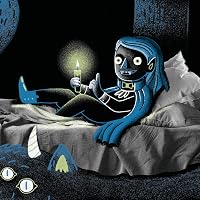
A twist on the Irish literary classic Ulysses, told through Nicolas Mahler’s distinctive graphic novel style.
Dublin, 16 June 1904: through a day in the life of the advertising agent Leopold Bloom and the sensations of the ordinary, James Joyce created a maximal book from a minimum of matter. Ulysses, the most important novel of modernity, is a defining book of the twentieth century. Joyce’s creation—also spectacularly innovative in form—inspired Nicolas Mahler to attempt a literary retelling that is not a mere illustration or adaption of the novel but an independent and equally as inventive work. Using comics, Mahler transforms the various literary techniques of the original. He assembles his images with humorous and philosophical verve, quoting and rambling along in the spirit of Joyce.
With this graphic interpretation of the modern classic, which also constitutes a homage to the golden era of the newspaper comic strip, Ulysses can be newly discovered in a delightfully unexpected form.
Austrian author and illustrator Nicolas Mahler has illustrated numerous school books and worked on several animated films, shown at festivals throughout Europe. Known for his striking minimalist drawing style and sardonic deadpan wit, Mahler's graphic novels have been published in France, Spain, the Czech Republic, Poland, Canada, and the United States as well as his native Austria. He has published over 20 books and created drawings for international magazines, newspapers, and anthologies.
This is my second encounter with the art and wit of Austrian illustrator and author Nicolas Mahler. The first was his delightful take on fellow Austrian Thomas Bernhard's Old Masters; this time he is transporting one of the great Modernist classics, James Joyce's Ulysses from Dublin to Vienna. This is a retelling "after Joyce" as liberally inventive as the original. The medium necessitates some focusing of the story, so Stephan Dedalus is left out and the key scenes in which he appears in the library and brothel are reimagined in a wild exposition of Leopold Wurmb's (our German Bloom) sexually frustrated, guilt-ridden fears and obsessions. Of course, many of the key events of our hapless hero's day (June 16. 1904) are reproduced with liberal use of visual material, newspaper offsets and creative design. As Mahler explains in his notes, character names were drawn from news material of the day while certain characters themselves were adopted from cartoon characters popular at the time of the first publication of Ulysses, 1922, a high point in the history of newspaper comics. So, his secret penpal is Olive Oyl and the sailor he meets at the bar is Popeye. If some of the fun of reading Joyce's novel is looking for the echoes of Odysseus' journey in the narrative, some of the fun here is marveling at how cleverly Mahler manages to echo key features of Bloom's journey in his characteristically minimalist Austrian tribute. Complete review can be found here: https://roughghosts.com/2022/12/02/a-...
Nicholas Mahler’s Ulysses – his interpretation of the 1922 classic, and perhaps the most inventive book ever written is topsy-turvy, mind-boggling at times, and absolutely surreal to boot, and all of this in a graphic format.
I haven’t read Ulysses. I have been meaning to for a while now, and maybe will – very soon, but for now the status remains unchanged. Reading Mahler’s interpretation though, managed to surface all that I had heard about the book – what it’s about – three people trying to make sense of life – as events unfold on a single day – the 16th of June 1904.
Mahler sets his Ulysses in Vienna. Leopold Bloom becomes Leopold Wurmb, as he roams around the city, attends the funeral of a friend, gets to know of the impending affair of his wife Molly, ruminates about his child, no longer alive, and just walks along.
You don’t need to read Joyce’s Ulysses to read this one. Both the translator, Alexander Booth and Mahler ensure that the text and the pictures tell if not a different story – then the most inspired version. Mahler makes this Ulysses his – varied graphic forms with every chapter that is titled as per the name Ulysses, he takes us on this fascinating journey of less words, and more emotion, through simple illustrations – making us collectively feel so much. I would most certainly have to read Ulysses now.
Dieses Buch war ein Geschenk meiner Eltern. An "Ulysses" habe ich mich davor nie herangetraut, weil ich Angst hatte, dass ich nicht mitkommen würde.
Nun, ich kann nicht beurteilen, wie originalgetreu dieses Graphic Novel ist. Ich kenne ja das Original nicht und selbst wenn, wäre ein Vergleich schwer, da dieses Buch mit wenig Text auskommt. Auf vielen Seiten ist nur ein Satz. Der Autor hat die Frage nach der Originaltreue auch selbst am Ende des Buches reflektiert: Der Tag ist derselbe, der Handlungsort ist nicht Dublin, sondern Wien. Der Nachname des Protagonisten ist anders und der Name der Zeitung, für die er arbeitet. Außerdem werden mehrere Bücher zitiert, die am Ende brav aufgelistet werden.
Die Bilder sind einfach gehalten und ohne viele Details. Nach einer kleinen Eingewöhnungsphase hielt ich das für passend. Schön finde ich, dass die Bilder scheinbar nicht recycelt wurden. Das hätte ich nämlich fast verstanden, immerhin dauern manche Szenen teils mehrere Seiten lang. Da sprechen also die gleichen Figuren miteinander und der Ort bleibt gleich. Trotzdem konnte ich immer irgendein kleines Detail finden, das mir zeigte, dass da nicht einfach Copy und Paste verwendet wurde. Eine Nase, die ein bisschen anders aussieht, ein Blatt Papier, bei dem die Linien anders sind oder ein Haus, bei dem man unterschiedlich viel von der Fassade sieht.
Die meiste Zeit habe ich mit den Zeitungsinseraten verbracht. Natürlich wollte ich die alle lesen! Wenn ich diese alte Schrift schon lesen kann, dann will ich dieses Wissen auch nutzen. Spannend finde ich, dass diese Inserate echt sind – sie stammen aus dem Neuigkeits-Welt-Blatt vom 16. Juni 1904.
Mein Fazit? Ein toller Einstieg in diesen großen Klassiker. Bei einem Graphic Novel ist die Hemmschwelle geringer als beim "echten" Klassiker. Gleichzeitig macht dieses Buch Lust auf mehr. Ich möchte jetzt auf jeden Fall den Originaltext lesen - und gerne auch noch mehr von Mahler!
I got this book last year, because I thought it will be interesting to read a graphic novel adaptation of James Joyce's classic. But after browsing it, I put it aside, because it didn't look convincing. I thought that whenever I read it, I'd find the experience underwhelming and maybe I might even say not-so-nice things about it. I picked it up yesterday and I finished reading it today. I've to say that I was surprised. The book is interesting and fascinating! Not at all like I imagined! First appearances can be deceptive. The artwork style is minimalistic, I think the adaptation conveys the existential crisis that is probably featured in Joyce's original, and Nicolas Mahler does his own thing by moving the story to Vienna and borrowing stuff from newspaper comics and the Viennese newspapers from that time. There is a lot to think about and discuss about in this adaptation – every page can be analyzed and discussed, probably. It is a great companion read with Joyce's original. Unfortunately, I haven't read Joyce's original classic yet, and so I might have missed out on some of the nuances and the subtext. But this adaptation made me want to read Joyce's book soon and then I'll come back and read this again to experience more literary pleasure. I'm sharing a couple of pages from the book to give you a feel for its artwork.
This graphic novel adaptation was originally written in German by Nicolas Mahler and has been translated into English by Alexander Booth.
Have you read this book or James Joyce's original? What do you think about them?
Ik heb de origenele Ulysses van James Joyce nog niet gelezen (twee keer na de eerste pagina opgegeven, zo erg zelfs), dus vergelijken of beoordelen hoe waarheidsgetrouw deze graphic novel is, kan ik niet. Mahler geeft mij alleszins wel zin om Joyce toch nog eens een kans te geven, wat al een prestatie op zich is ;-) Fascinerend verhaal, waarin soms pagina's lang amper iets lijkt te gebeuren, om dan weer in een stroomversnelling te komen. Het gaat van compleet absurd naar meelijwekkend naar grappig. Op de pagina's met gotisch schrift was ik blij dat ik dat in mijn vorige job regelmatig kon oefenen en het dus vrij vlot kon lezen, maar zeker bij de tijdschriftpagina's paste het perfect (heel fascinerende pagina's trouwens, die!). Wel even in de war toen Popeye plots ook mee bleek te doen, maar daar zorgde het nawoord van de tekenaar voor de nodige en fijne verduidelijking. Benieuwd naar meer werk van Mahler, die blijkbaar ook al A la recherche du temps perdu en Der Mann ohne Eigenschaften als graphic novels tekende.
I’ve actually started the original novel twice but never managed to finish it, whereas I got through this graphic novel pretty quickly =D I love Mahler’s style, though I’m not quite sure whether I like Ulysses itself…
This caught my eye at the library and I’m glad I checked it out. I’m hoping to tackle the real Ulysses over winter break so this should hopefully be good background although I still don’t entirely understand what happened in that whole court part. Cook illustrations!
I haven’t read James Joyce’s Ulysses just yet (will I ever pull this one?) but I still wanted to give this graphic novel a try, would it be only to get a rough feel for what Joyce MIGHT be about. This might have been the worst reason for approaching this book, the original being infamously dense and impossible to adapt. Still: the book intrigued me, and it ultimately entertained me and made me think.
First, I must mention the graphics themselves. The minimal, caricatural style, interspersed with clippings from actual 1914 Austrian newspapers and vintage cartoon characters, captures the humor and the searing social criticism of the original. The central character, who is NOT named the same as Joyce’s protagonist, and the action, which takes place in Vienna rather than Dublin, also do a great job distancing themselves from the original source material, while retaining its rambling style, crude descriptions, and stream of consciousness.
Still: I walk away with a big question mark in the back of my mind, wondering how much an author can get away with, and how far away a voice can depart from portraying a viable reality before completely alienating its reader. I didn’t exactly feel shut out, but I couldn’t quite remain absorbed by what I was reading because it made little sense. It eventually turned into a big mushy dream with no rime or reason, and I felt confused, distracted and frustrated.
The book can be ‘read’ in an hour, relying on very little text, and its use of typography in itself is clever and meaningful, but it seems to be ‘format over function’, words over storytelling, so much so that I closed the book wondering if this is what Joyce is all about, painstakingly capturing the capitalist cacophony while leaving its reader dejected, disillusioned and depressed.
Der Comiczeichner Nicolas Mahler hat sich ein weiteres Werk der Weltliteratur vorgenommen. Nachdem er schon „Auf der Suche nach der verlorenen Zeit“ und „Der Mann ohne Eigenschaften“ in eine Comic-Version verwandelt hat, wagt er sich nun an eins der größten literarischen Werke des 20. Jahrhunderts: James Joyces „Ulysses“.
Nach Mahlers freien Übersetzung wird die Handlung des „Ulysses“ von Dublin nach Wien verlegt und Leopold heißt in seiner Version mit Nachnamen nicht Bloom, sondern Wurmb. Der Tag an dem Mahlers Version spielt, ist aber nach wie vor der 16. Juni 1904. Die Figuren von Mahler sind langnasige Strichmännchen ohne jede Mimik und sehr geradlinig gemalt.
Das Jahrhundertwerk "Ulysses" von James Joyce als Comic-Adaption herauszubringen, stellt ein praktisch unmögliches Unterfangen dar. Sodass Mahler Joyces Werk stark vereinfacht und gekürzt hat, ohne dabei die Quintessenz des Originals zu verlieren. Das Buch enthält viele Motive des Originals, manchmal auffälliger, manchmal etwas versteckt. Was Mahlers Buch aber definitiv vom Original abhebt, sind die Referenzen zu anderen Comics, die berühmteste dürfte Popeye sein.
Mahlers Version von Ulysses war anspruchsvoll, aber sehr unterhaltsam. Bei der Lektüre eines James Joyces Werkes habe ich noch nie so gelacht wie bei der Lektüre der Comic-Adaption. So macht große Literatur manchmal auch Spaß.
Doch muss ich das Original gelesen haben und Mahlers Adaption zu lesen?
Müssen nicht, aber schaden wird es auf keinen Fall. Wer mit Joyce und seinem Kosmos nicht vertraut ist, wird mit diesem Buch sehr wahrscheinlich nicht ganz so viel Freude haben wie alle, die das Original kennen. Doch auch wenn man den Ulysses nicht kennt, bietet das Buch vielleicht den nötigen Einstieg, um sich in die Welt von Leopold Bloom und James Joyce zu verlieben.
Happy 100th Bloomsday. Couldn't make myself reread the original this June, so this'll have to do. And it's a fun idea; translate/transplant Ulysses from Dublin to Vienna and from prose to graphics, see how that changes the accents of the story. Is it a perfect translation? Obviously not. Does it contain all of Ulysses? Obviously not. But not even Ulysses contains all of everything people have put into it over the years, and there's definitely room in it for this one too.