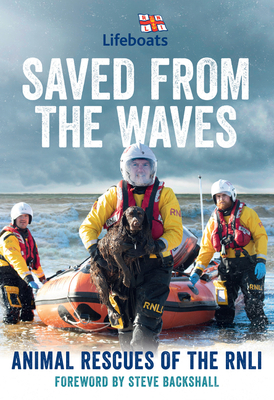
She has to be OK , I pleaded silently to myself. She has to be . ‘We’ve alerted the RNLI and they’re sending a lifeboat out.’ ‘The RNLI?’ I said, surprised. ‘They do that?’ Saved from the Waves is a heart-warming collection of first-hand accounts from RNLI volunteers of the myriad dangers they face during each mission to save beloved pets, wildlife and livestock. This remarkable book shines a light on the bravery of the volunteers, and the necessity of these rescues – not only to save animals at risk of drowning, but to prevent people putting themselves in danger when trying to save a cherished furry friend. Each mission requires courage, determination and an unrelenting commitment to helping those in danger. Each day brings a new challenge for the extraordinary volunteer crews who are the lifeblood of the RNLI.
I loved this book so much. Reading about each of these animal rescues has given me a increased sense of respect for everyone involved with the RNLI. Their dedication in serving communities across the UK and Ireland, and working tirelessly to rescue all creatures in trouble, human or not, is incredible. Each account was heartwarming, humorous and emotional. What a pawsome book! 🐾
While this is undeniably a collection of heart warming stories about animal rescues, it is also something significantly more than that. It is a story of the RNLI - its ethos, its professionalism and (in these troubled turbulent times) what the RNLI can tell us about humanity in its widest sense.
The book's multiple contributors, each giving their own recollections and perspectives on technically challenging rescues, make for a varied read and a very collective feel to the anthology. It makes a nice change from single protagonist driven tales and emphasises how in so many different ways each of us can play a part in doing a little good in the world. Even within each story, the narrator is constantly, but quite naturally, emphasising how they are part of a team - a group with pooled expertise, shared responsibilities, clear roles and a keen awareness of risk and risk amelioration.
These real life accounts are the antithesis of the kind of stories that Hollywood blockbusters give us, with their single action heroes finding every stroke of luck falls their way. Perhaps we need more of these kind of tales of dogged (no pun intended) effective collective team heroism. That might wean us off the expectation that some individual hero will arise to solve all our problems (be they political, personal, environmental or medical)
There is something about animal rescues that inspires more public sympathy - more of an 'aah' response - than human predicaments. As one contributor, Ed Thomas put it in his account about rescuing a lost dog in 2021,
When it comes to humans, people seem to find it easier, rightly or wrongly, to make judgements and assign blame for others getting into trouble. Animals are innocent and vulnerable, and when we rescue one, we tend to get behind it together, while human rescues sometimes divide people.
He's not wrong. After all - I picked this book up in the Port rush RNLI shop, rather than an alternative volume about human rescues.
Thomas may perhaps have been thinking of the Farage inspired furore over RNLI rescues of endangered small boats refugees. To my mind the RNLI epitomises everything that Farage and his fellow right wing hate mongers are not. In the organisation's care for all life, in its understanding of human relationships with nature, in the self-sacrifice and commitment of its volunteer workforce, in its financial independence from billionaire agendas and political interference, and even in the democracy of each crew's election of a coxswain, it is the ultimate in a community organisation. It is proof of what can be created when you realise that all people are people and all life is valuable.
To be fair, the book repeatedly makes the point that the animal rescues were not simply acts of fluffy indulgence - that often the imperative in animal rescues was to avoid human disaster. Without the RNLI (and the coastguard) to deal professionally and expertly with dangerous situations, there was always a risk of worried pet owners attempting their own amateur rescue and ending up in even more peril than their pets.
This has a certain resonance for me when Ash and I were walking our four Cavalier King Charles spaniels by the Medway shore and rashly thought it safe to let them off the lead. Immediately Jemima the smallest and the lightest of the four set charging across the exposed mudflats for the river, sinking deeper with each tread. We at least realised the danger in following her and I tried to commandeer a motor boat we'd passed to attempt an impromptu rescue, but no sooner was I on the water than Jemima had made her own way back - as many pets do. However that experience came back to me as I read of how Emily Jones and others were engaged in rescuing Bobby the horse stuck up to his armpits in mud after a shoreline hacking trip went awry.
One can rest assured that all the endangerments in the book had satisfactory outcomes, emphasised by lovely colour plate images of rescued and rescuers.
Possibly the human capacity for more empathy with animals than with their fellow humans explains how these animal rescues and the media interest surrounding them often proved great stimulus to the organisations fund raising. For example where one sheep rescue described by John McCarter led to farmers holding a charity auction of three sheep to raise funds. As McCarter put it
I mentioned that our service received no financial government support or other funding. Every single one of them looked stunned. It was the same everywhere. No matter how many places I went to speak about the RNLI, no matter how many individuals I spoke to, they never fully understood just how important donations were to keep this emergency service running.
As people who have lived with and by the sea for so long, RNLI expertise is not simply seafaring but ion climate and nature awareness. As Phil John, in his account of the Walrus that grew fond of basking on RNLI launching slipways
Throughout the whole thing, it struck me that Wally's arrival in Tenby was indicative of climate change in action. Both theories about how he'd got here supported that entirely. One was that he'd fallen asleep on an iceberg that had broken away and floated off, leaving him lost. the other was that he'd had to travel this far to find food.
This anthology, with its simple tales of synergy between humanity and animal welfare made a refreshing change from the doom-scrolling through social media of recent times. Perhaps that is why - not just in its many positive animal outcomes, but in its celebration of the good good people can do - I found it the most tear inducing read since The Book Thief
I absolutely loved this book and cannot recommend it enough! It's full of heartwarming rescues (some of which will stay with me for a long time) and gives you an interesting insight into the amazing work that the RNLI do. One thing I particularly liked was that each animal had their own chapter so it was almost like a book of short stories that you could pick up and read whenever you had a spare 5 or 10 minutes.
The animal version of the TV show Saving Lives at Sea which I'm a fan of. Pretty simply told stories but sweet accounts of animals being rescued. Some cute photos in the centre and the little illustrations of the animal at the beginning of each chapter were a nice touch.