

What do you think?

Devenir Japonaise
En 1995, Mari, 22 ans, sort d’une longue relation sentimentale et décide de déménager à San Jose, en Californie. Elle y découvre des communautés asiatiques bien plus importantes que dans sa ville natale de Mill Valley et choisit de se connecter avec une culture qui lui a échappé depuis son enfance : la culture japonaise. Alors qu’elle commence une nouvelle relation amoureuse, elle trouve un emploi dans un bar à hôtesses pour les expatriés japonais. Un périple qui va l’emmener de San Jose et Tokyo et qui va lui permettre peut-être de faire connaissance avec ses grands-parents japonais.
Racontant ses expériences dans des bars à hôtesses à San Jose et Tokyo tout en essayant de se connecter avec une culture qui lui avait échappé depuis son enfance, Devenir Japonaise rappelle la capacité de MariNaomi à naviguer habilement sur des terrains émotionnels et culturels complexes tout en interposant des rythmes de légèreté. Ce troisième roman graphique de MariNaomi marque une nouvelle étape clé dans l’évolution de l’une des auteures les plus talentueuses de sa génération.
Racontant ses expériences dans des bars à hôtesses à San Jose et Tokyo tout en essayant de se connecter avec une culture qui lui avait échappé depuis son enfance, Devenir Japonaise rappelle la capacité de MariNaomi à naviguer habilement sur des terrains émotionnels et culturels complexes tout en interposant des rythmes de légèreté. Ce troisième roman graphique de MariNaomi marque une nouvelle étape clé dans l’évolution de l’une des auteures les plus talentueuses de sa génération.
220 pages, Hardcover
First published September 30, 2016
About the author
MariNaomi
35 books439 followersMariNaomi (they/them) is the SPACE award-winning, Eisner-nominated author and illustrator of Kiss & Tell: A Romantic Resume, Ages 0 to 22 (Harper Perennial, 2011), Dragon’s Breath and Other True Stories (2dcloud/Uncivilized Books, 2014), Turning Japanese (2dcloud, 2016, Oni Press 2023), I Thought YOU Hated ME (Retrofit Comics, 2016), the Life on Earth trilogy (Graphic Universe, 2018-2020), Dirty Produce (Workman Publishing, 2021), and the collage-comics memoir I Thought You Loved Me (Fieldmouse Press, 2023). Their work has appeared in over a hundred print publications and has been featured on websites such as The New Yorker’s Daily Shouts, The Washington Post, LA Times, The Rumpus, LA Review of Books, Midnight Breakfast and BuzzFeed. Their comics have been translated into French (Devenir Japonaise, Editions IMHO, 2021), German, and Russian.
MariNaomi’s comics and paintings have been featured in the Smithsonian, the de Young Museum, the Cartoon Art Museum, the Asian Art Museum, and the Japanese American Museum.
In 2011 and 2018, Mari toured with the literary roadshow Sister Spit. They are the founder and administrator of the Cartoonists of Color Database, the Queer Cartoonists Database, and the Disabled Cartoonists Database. They have taught classes for the California College of the Arts Comics MFA program, and was guest editor for PEN Illustrated. They were cohost of the Ask Bi Grlz podcast with author Myriam Gurba, and the California Leader of Authors Against Book Bans.
MariNaomi lives in Northern California with their spouse and a menagerie of beloved rescue animals.
MariNaomi’s comics and paintings have been featured in the Smithsonian, the de Young Museum, the Cartoon Art Museum, the Asian Art Museum, and the Japanese American Museum.
In 2011 and 2018, Mari toured with the literary roadshow Sister Spit. They are the founder and administrator of the Cartoonists of Color Database, the Queer Cartoonists Database, and the Disabled Cartoonists Database. They have taught classes for the California College of the Arts Comics MFA program, and was guest editor for PEN Illustrated. They were cohost of the Ask Bi Grlz podcast with author Myriam Gurba, and the California Leader of Authors Against Book Bans.
MariNaomi lives in Northern California with their spouse and a menagerie of beloved rescue animals.
Ratings & Reviews
Friends & Following
Create a free account to discover what your friends think of this book!
Community Reviews
Displaying 1 - 30 of 220 reviews
April 27, 2023
I feel like I've been starting all of my reviews this way, but I'm not usually a fan of graphic novels. I'm not here to police what anyone is reading, but for myself, going outside of my comfort zone is an added way to further educate myself.
I greatly enjoyed this one. I will admit I chose this book because MariNaomi is non-binary. I had hoped to see some of that representation in the book.
We do get some mixed race representation, which I think is important. I can't personally speak on this, but from what I've heard secondhand, it's hard for mixed race Asian Americans growing up, because they feel like they have to defend their Asian identity. I can't remember who it was now, but I remember someone once saying that they weren't half of one thing and half of another, but the whole of both. That stuck with me.
This is a curious story about being Japanese American without speaking Japanese, hostess bars, and mediocre boyfriends. The concept of hostess bars has interested me ever since reading and watching the historically incorrect Memoirs of a Geisha. I'm not here to judge. I'm just here to learn.
Another thing I found interesting was that while Mari didn't grow up speaking Japanese, she (mc not author) clearly understood some, because once she moved to Japan she began to pick up bits and pieces faster than her mediocre boyfriend. I'm just going to keep calling him that. It's fine.
📱 Thank you to NetGalley and Oni Press
I greatly enjoyed this one. I will admit I chose this book because MariNaomi is non-binary. I had hoped to see some of that representation in the book.
We do get some mixed race representation, which I think is important. I can't personally speak on this, but from what I've heard secondhand, it's hard for mixed race Asian Americans growing up, because they feel like they have to defend their Asian identity. I can't remember who it was now, but I remember someone once saying that they weren't half of one thing and half of another, but the whole of both. That stuck with me.
This is a curious story about being Japanese American without speaking Japanese, hostess bars, and mediocre boyfriends. The concept of hostess bars has interested me ever since reading and watching the historically incorrect Memoirs of a Geisha. I'm not here to judge. I'm just here to learn.
Another thing I found interesting was that while Mari didn't grow up speaking Japanese, she (mc not author) clearly understood some, because once she moved to Japan she began to pick up bits and pieces faster than her mediocre boyfriend. I'm just going to keep calling him that. It's fine.
📱 Thank you to NetGalley and Oni Press

March 10, 2015
Hello, I hope you like my book! Also, you are pretty.

May 22, 2016
I love the title of this book, which also reminded me to read David Mura's book by the exact same name. I love the square size of it, the color and design of it. I have read three books by MariNaomi now and have liked them all. Kiss and Tell, her first, is the really fun story of every single sexual experience she has had in her life up to the age of 22. It's not offensive at all; rather, MariNaomi's charming and startling personality come through clearly.
Dragon's Breath is the other book I read, also memoir comics, and in it you can see a leap in artistic quality, maybe something you should expect from someone approaching her late thirties, having been in the comics game for a long time. I saw MariNaomi at the recent alt-comics convention here in Chicago, CAKE, smiling whenever I saw her; she was one of the older artists there, a kind of sensei of memoir comics for the younger artists there.
Turning Japanese has an interesting and intriguing topic. About forty, she decides to write about a time in her early twenties when she made a decision to explore her Japanese heritage. She's a "hafu," half Japanese, and had not been raised to speak the language or know that much about Japan. This was true for me as a Dutch-American, discouraged from being Dutch by my assimilating parents, so I had some empathy for her looking-back-at-decades-ago project. To "turn Japanese" she decides to first work in a hostess bar for Japanese expats in the US, where she intends to learn the Japanese language and culture. This leads her to go with her cabdriver boyfriend to live and work for a time in Tokyo, where she also does hostess work (which is like being assigned to a table to help a group have a bit more fun; it's not sex work).
The art in Turning Japanese is terrific, a master's project of design, and her personality comes through, her humor, her honesty. We get to know her mother, her boyfriend, her grandmother, a few co-workers, and a few customers through her amused lens. We don't really find anything that interesting about hostess work, though. Some odd customers and co-workers, I guess. And Tokyo seems pretty cool. It's basically a travelogue, Americans surfing the culture. Wow! This cool toy store! Wow, this array of fresh veggie foods available to us!
MN somewhat amusingly can't learn Japanese very well at all there--she uses squiggles to represent so much of what confuses her when Japanese locals talk with her. So in spite of her wanting to "turn Japanese," the story seems to me like any traveling cultural clash. There's not that much memorable in the details, but the overall effect is pleasant and fun and inviting. The thing I recall days later about the book is MariNaomi, and that's a good thing.
Dragon's Breath is the other book I read, also memoir comics, and in it you can see a leap in artistic quality, maybe something you should expect from someone approaching her late thirties, having been in the comics game for a long time. I saw MariNaomi at the recent alt-comics convention here in Chicago, CAKE, smiling whenever I saw her; she was one of the older artists there, a kind of sensei of memoir comics for the younger artists there.
Turning Japanese has an interesting and intriguing topic. About forty, she decides to write about a time in her early twenties when she made a decision to explore her Japanese heritage. She's a "hafu," half Japanese, and had not been raised to speak the language or know that much about Japan. This was true for me as a Dutch-American, discouraged from being Dutch by my assimilating parents, so I had some empathy for her looking-back-at-decades-ago project. To "turn Japanese" she decides to first work in a hostess bar for Japanese expats in the US, where she intends to learn the Japanese language and culture. This leads her to go with her cabdriver boyfriend to live and work for a time in Tokyo, where she also does hostess work (which is like being assigned to a table to help a group have a bit more fun; it's not sex work).
The art in Turning Japanese is terrific, a master's project of design, and her personality comes through, her humor, her honesty. We get to know her mother, her boyfriend, her grandmother, a few co-workers, and a few customers through her amused lens. We don't really find anything that interesting about hostess work, though. Some odd customers and co-workers, I guess. And Tokyo seems pretty cool. It's basically a travelogue, Americans surfing the culture. Wow! This cool toy store! Wow, this array of fresh veggie foods available to us!
MN somewhat amusingly can't learn Japanese very well at all there--she uses squiggles to represent so much of what confuses her when Japanese locals talk with her. So in spite of her wanting to "turn Japanese," the story seems to me like any traveling cultural clash. There's not that much memorable in the details, but the overall effect is pleasant and fun and inviting. The thing I recall days later about the book is MariNaomi, and that's a good thing.

August 23, 2016
Just finished this book and it was great! I go to Japantown in San Jose almost every week and I had no Idea what was going on behind closed doors! MariNaomi deals with the challenge of working in a hostess bar for Japanese expats while trying to learn Japanese. Her keen cultural observations are both funny and reveling at the same time. Her trip to Japan and her attempt to "use" the Japanese she learned is a classic example of how much cultural nuance and language are connected. Read this book if you are planning on taking a trip to Japan...you will be glad you did!

Read
May 21, 2016The great thing about Turning Japanese is that Mari Naomi does not romanticize or demonize the Japanese/East Asian culture, which happens very rarely (unfortunately) in Western arts & culture. It does not mean that she only talks about easy topics. It is rather the opposite: she worked at the hostess bar! As a guilt-driven Eastern Asian myself, it is incredible to see someone who is not afraid to try anything she wants.
Her architecture drawings are incredible.
Her architecture drawings are incredible.

January 2, 2017
Nice, minimalist art, and sweet, meandering story. Another reader called it a "book of moments," and that's how I remember it also: MariNaomi working as a hostess at a club for Asian businessmen, MariNaomi and her boyfriend shopping at cute stores in Tokyo, MariNaomi fighting with her rural grandparents and then sneaking out for a smoke and a walk.
We did some thematic food at club: matcha Kit-Kats, red bean cake, and a huge bowl of seaweed salad:

We did some thematic food at club: matcha Kit-Kats, red bean cake, and a huge bowl of seaweed salad:

August 26, 2018
An excellent read!
I ordered this immediately after completing "Kiss & Tell" as I very much enjoyed that graphic memoir. Also, in-between I'd listened to an interview she done on a podcast discussing this book which made me anticipate my reading before the book arrived.
Well, my excitement to read was pleasantly rewarded. Mari does such a wonderful job laying out her story with regards to pacing. She also is very good at comedic timing and weaving in the dramatic moments. There is several times I found myself chuckling out-loud and rereading that page and laughing again at the same thing, but then shortly after would feel my eyes swell up at a dramatic moment. Which by the way, there is a portion of this book where tears were flowing. This happened because she set her self up in the beginning of her book for me (the reader) to care about her from reading that point forward. Also, I feel it helped I had previously read "Kiss & Tell" so I was already empathetic towards her.
I had mentioned comedic moments above. So far, for me at least, she is the best at "profiles" for characters/scenarios. Reminds me a lot of what Wes Anderson does in his films. I personally LOVE these and have not came across anyone else who does this in the graphic novel format.
I also had mentioned this in my review of "Kiss & Tell", but I'd like to say again how much I admire her bravery for sharing such personal memories and life events with the reader. There are many times when I was reading that I just sighed "wow" to myself. This sort of inspired me to share some very private things with some friends at a gathering this weekend. I definitely would not have had the courage to have done that if it wasn't for reading these 2 books so much that I now consider her to be a hero of mine.
Thank you MariNaomi!
I've ordered Dragon's Breath and will be very excited to read that when it arrives.
Other thoughts
I loved the design/shape of this book. The size was perfect as I was able to sit/lay in any position while reading the book and be comfy.
She has her podcast "Ask Bi Grlz", which is nice as each episode has certain topics they discuss/cover. I've listened to a couple and I believe this made my personal read more entertaining because I could "hear" her voice while reading which wasn't the case for "Kiss & Tell".
I ordered this immediately after completing "Kiss & Tell" as I very much enjoyed that graphic memoir. Also, in-between I'd listened to an interview she done on a podcast discussing this book which made me anticipate my reading before the book arrived.
Well, my excitement to read was pleasantly rewarded. Mari does such a wonderful job laying out her story with regards to pacing. She also is very good at comedic timing and weaving in the dramatic moments. There is several times I found myself chuckling out-loud and rereading that page and laughing again at the same thing, but then shortly after would feel my eyes swell up at a dramatic moment. Which by the way, there is a portion of this book where tears were flowing. This happened because she set her self up in the beginning of her book for me (the reader) to care about her from reading that point forward. Also, I feel it helped I had previously read "Kiss & Tell" so I was already empathetic towards her.
I had mentioned comedic moments above. So far, for me at least, she is the best at "profiles" for characters/scenarios. Reminds me a lot of what Wes Anderson does in his films. I personally LOVE these and have not came across anyone else who does this in the graphic novel format.
I also had mentioned this in my review of "Kiss & Tell", but I'd like to say again how much I admire her bravery for sharing such personal memories and life events with the reader. There are many times when I was reading that I just sighed "wow" to myself. This sort of inspired me to share some very private things with some friends at a gathering this weekend. I definitely would not have had the courage to have done that if it wasn't for reading these 2 books so much that I now consider her to be a hero of mine.
Thank you MariNaomi!
I've ordered Dragon's Breath and will be very excited to read that when it arrives.
Other thoughts
I loved the design/shape of this book. The size was perfect as I was able to sit/lay in any position while reading the book and be comfy.
She has her podcast "Ask Bi Grlz", which is nice as each episode has certain topics they discuss/cover. I've listened to a couple and I believe this made my personal read more entertaining because I could "hear" her voice while reading which wasn't the case for "Kiss & Tell".

February 25, 2023
I absolutely devoured this!
Entertaining, atmospheric, immersive and so so special.
Mari takes us into the subculture of hostess bars and the idiosyncrasies that come with it. They journey to Japan determined to learn the language, not only to compliment their job, but to understand and converse with their family.
With the harmony of their adroit illustrations and bubbles of dialogue, I feel like I know these characters and could relate to Mari and Giuseppe’s frustrations in their relationship, whilst finding pockets of belonging - in places, people and language.
Turning Japanese is a (re)turning to who we have been despite who we think we are, and in spite of what we think we know.
I can’t wait to get my hands on everything else they’ve published. Graphic memoirs need more hype for sure!
Entertaining, atmospheric, immersive and so so special.
Mari takes us into the subculture of hostess bars and the idiosyncrasies that come with it. They journey to Japan determined to learn the language, not only to compliment their job, but to understand and converse with their family.
With the harmony of their adroit illustrations and bubbles of dialogue, I feel like I know these characters and could relate to Mari and Giuseppe’s frustrations in their relationship, whilst finding pockets of belonging - in places, people and language.
Turning Japanese is a (re)turning to who we have been despite who we think we are, and in spite of what we think we know.
I can’t wait to get my hands on everything else they’ve published. Graphic memoirs need more hype for sure!

June 4, 2023
[5.4/10]
Thank you Oni Press and NetGalley for the ARC in exchange for a fair and honest review
Turning Japanese is a memoir about MariNaomi’s experience as a mixed-race Japanese-American trying to connect with her Japanese roots. I enjoyed the whimsical art style and the chapters were overall enjoyable. However, this book didn’t feel very cohesive at all. It felt like we were jumping from anecdote to anecdote with very little introspection, something that I enjoy in memoirs. I wish the book contained more introspection and reflection rather than random memories of the author’s time in Japan and working at a host bar. I usually enjoy this format of memoir but this fell flat with me.
Thank you Oni Press and NetGalley for the ARC in exchange for a fair and honest review
Turning Japanese is a memoir about MariNaomi’s experience as a mixed-race Japanese-American trying to connect with her Japanese roots. I enjoyed the whimsical art style and the chapters were overall enjoyable. However, this book didn’t feel very cohesive at all. It felt like we were jumping from anecdote to anecdote with very little introspection, something that I enjoy in memoirs. I wish the book contained more introspection and reflection rather than random memories of the author’s time in Japan and working at a host bar. I usually enjoy this format of memoir but this fell flat with me.

January 15, 2017
This was seriously so inspiring. After reading this book I just wanted to make my own autobio comics! Inspiring books are my favorites. If a book can make you feel inspired to create, it's 5/5!

June 10, 2016
I liked this better than her other book that I've read, Kiss and Tell, but I still felt similarly that some kind of emotional significance or impact was missing. It might also be something about narrative that is not quite there; less so than Kiss and Tell, but Turning Japanese is more a series of moments rather than a seamless story whose parts are linked. But they're not really episodes either. Sometimes I read a page and thought: why is this included? How does this relate to the rest of the story? Because it's not remarkable on its own. Or maybe there was something lacking in characterization? I never really felt like I understood who her boyfriend Giuseppe was or why she liked him. Hmm, I can't quite put my finger on what didn't totally do it for me.
That said, I love her drawings. There were also some powerful parts of her trying to connect with a culture that was never passed down to her and frustration of trying to learn a language so different from what she grew up speaking. I imagine the parts about being mixed race and neither one or the other will resonate with lots of readers, especially ones who have mixed backgrounds themselves. I found it moving and fascinating when the memoir addressed those things directly. A few parts were quite funny too! Sometimes moving/painful and funny at the same time. Like here:
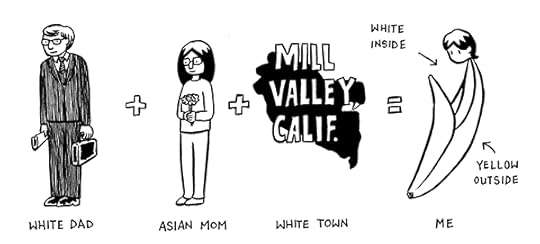
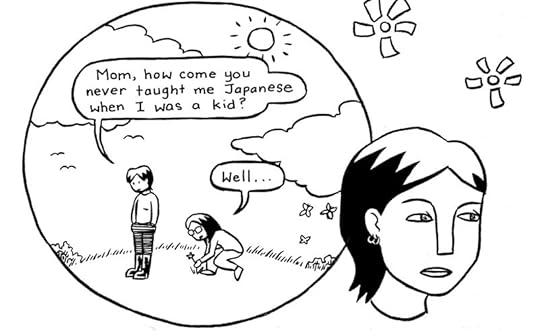
That said, I love her drawings. There were also some powerful parts of her trying to connect with a culture that was never passed down to her and frustration of trying to learn a language so different from what she grew up speaking. I imagine the parts about being mixed race and neither one or the other will resonate with lots of readers, especially ones who have mixed backgrounds themselves. I found it moving and fascinating when the memoir addressed those things directly. A few parts were quite funny too! Sometimes moving/painful and funny at the same time. Like here:

March 14, 2015
Mari's third graphic novel memoir to date is a series of vignettes exploring her Japanese roots and cultural identity (she's mixed race). It's a beautiful, insightful and rich piece of work, and guess what, I love it–I actually made myself read it slowly over the weekend to make it last longer. Five stars, and def get this.
Update: I interviewed Mari for The Comics Journal and it went up 6/30/16: http://bit.ly/295ca8a
Update: I interviewed Mari for The Comics Journal and it went up 6/30/16: http://bit.ly/295ca8a

July 26, 2016
This one meandered around the surface level unsure of whether it was a travelogue or an detailed examination into the author's distance from her heritage. It's a bit of both would have been stronger had it settled on being one or the other (or maybe I was looking for a little more emotional resonance). That could have been a product of the long-form graphic novel, and I'm still curious to check out MariNaomi's short-form stuff.
July 22, 2024
Around the Globe in 52 Books
[Prompt: A Book by an American Written While Living Abroad
I love stories like this that capture what its like to grow up in a mixed culture setting. I really related to Mari's desire and struggle to learn her mother's native language of Japanese, and her desire to be closer to that culture. And I also really just loved the storytelling in this. There was some great artwork that really pops from panel to panel, and overall, it was a really pleasant story to read.
[Prompt: A Book by an American Written While Living Abroad
I love stories like this that capture what its like to grow up in a mixed culture setting. I really related to Mari's desire and struggle to learn her mother's native language of Japanese, and her desire to be closer to that culture. And I also really just loved the storytelling in this. There was some great artwork that really pops from panel to panel, and overall, it was a really pleasant story to read.

March 30, 2023
I have wanted to read this for years! And my first reading was of the new expanded edition!
The themes of culture clash are so poignant in this book, never more so when it comes to women's choices, bodies and autonomy. I love how MariNaomi depicts their relationship with their ex, and that relationship's deterioration throughout the timeframe of the book. Family expect them to have kids, family all the way out in Japan expect them to have kids, and a boyfriend who was supposed to want the same things... reveals he doesn't really? Gender politics across American and Japanese culture are explored subtly and with a lot of compassion here.
The expanded edition includes extra pages, bringing us up to date with MariNaomi's relationship to Japan and the Japanese language now. As well as a new afterward, which I think pulls out the themes in the book with interesting hindsight. It's also so exciting to see how their art style has developed over the years!
Many thanks to Oni Press for the review copy of this title.
The themes of culture clash are so poignant in this book, never more so when it comes to women's choices, bodies and autonomy. I love how MariNaomi depicts their relationship with their ex, and that relationship's deterioration throughout the timeframe of the book. Family expect them to have kids, family all the way out in Japan expect them to have kids, and a boyfriend who was supposed to want the same things... reveals he doesn't really? Gender politics across American and Japanese culture are explored subtly and with a lot of compassion here.
The expanded edition includes extra pages, bringing us up to date with MariNaomi's relationship to Japan and the Japanese language now. As well as a new afterward, which I think pulls out the themes in the book with interesting hindsight. It's also so exciting to see how their art style has developed over the years!
Many thanks to Oni Press for the review copy of this title.
This entire review has been hidden because of spoilers.

September 23, 2016
Great art, and an interesting premise. Because I speak Japanese and have lived in Japan, I felt like I understood the context of where she was coming from really well. I appreciate that she was honest even when it wasn't flattering to herself. The story is interesting and worth telling--being Hapa in Japan and in the US is something you don't read about often. Learning a foreign language that you are personally connected to but struggle to master is REAL. Identity/language are all wrapped up in each other and it breaks my heart how it's depicted here--brilliantly.
I was a little disappointed in some aspects of the story, (like wanted to know more about a few threads that weren't picked up) but read it in one sitting...similar to Persepolis in the simplicity/beauty of the drawings and introspective nature of the text.
Mari, if you ever read this, I just want to let you know that it's こんにちは not こんにちわ. Sorry to be annoying.
I was a little disappointed in some aspects of the story, (like wanted to know more about a few threads that weren't picked up) but read it in one sitting...similar to Persepolis in the simplicity/beauty of the drawings and introspective nature of the text.
Mari, if you ever read this, I just want to let you know that it's こんにちは not こんにちわ. Sorry to be annoying.

May 14, 2016
Mari Naomi has risen to the top of a populous and diverse group of comic artists contributing to the rise of autobiographical comics. Her work is very honest, appearing to leave no corner of her life unexamined. Her skillful storytelling allows a glimpse into her life while causing you to reflect on your own past. Ever since my first encounter with her work I've continued to come back for more and she has delivered. It is a credit to how she has lived her life that in volume after volume we never tread the same ground as a reader. Wether we are asked to explore the themes of childhood,race, gender, sexuality or combinations of the same we see it all through the complex and delicate lens of her unflinching eye. By the end of these stories she may own your heart or break it but you will know what it is to live a full and beautiful life even as
you are encouraged to examine your own.
you are encouraged to examine your own.

January 19, 2018
Open-hearted, sweet, and frank, Turning Japanese was a true joy to read. MariNaomi’s attention to detail made this book feel intimate and relatable. For example, I loved noticing Mari’s roots growing in, just one of the tiny subtleties the author included that breathed life into the characters.
On more than one occasion, I found myself laughing aloud at the lighthearted situations Mari and her partner found themselves in (wish I could give a sixth star just for incense toes!). I look forward to everything MariNaomi makes next!
On more than one occasion, I found myself laughing aloud at the lighthearted situations Mari and her partner found themselves in (wish I could give a sixth star just for incense toes!). I look forward to everything MariNaomi makes next!

January 22, 2018
This books is divided in two, Mari living in San Jose with her boyfriend and working at an illegal hostess bar, and Mari and her boyfriend's sojourn in Japan for three months, where she also worked at a hostess bar. The first half in San Jose dragged and was kind of weird, the second half was great, with the traveling and seeing her family. While the first half was needed, a good editor would have had her shore it up. Also the drawing style is very inconsistent, from stick figures to detailed drawings of shrines I felt that a middle ground should have been used consistently.
March 31, 2019
I thought your book was so good! I am also Japanese but in my case, I am adopted. I have been to japan before but unfortunately haven’t met my birth parents yet. My English teacher suggested this book to me in my senior year of high school (I am now 20). Going back to japan it was very hard to communicate with locals because I knew very little Japanese and regret not learning enough before I go. Pretty soon I’ll get the chance to go back with my mom so I’ll definitely learn more then.

March 10, 2017
Young Japanese American girl experiences romance, works in an American hostess bar, goes to Japan with the fiance and upon returning gently breaks up. Fairly low key with OK art, probably a bit too soap operary for me.

June 1, 2016
An engrossing graphic memoir about the author's visit to Japan with her boyfriend as she tries to find herself in Japan as well as in her own Asian-American culture.

June 3, 2016
3.5
good
read in 2hours
lots o boobies
good
read in 2hours
lots o boobies

July 8, 2016
3 ½ stars

March 27, 2023
i definitely recommend this graphic novel, it’s a quick and engaging read and it’s written by a non-binary author so it’s perfect to add to your tbr for the trans readathon this week!the characters were all very well developed and i could really feel their personalities through how the author wrote about and drew them. i also was never bored, the illustrations and dialogue as well as the general storyline were all very entertaining and kept me hooked. i think i read this in only one or two sittings because i didn’t want to put it down!the novel was humorous but at the same time told an important story about the experience of being japanese-american. as someone who grew up in japan, i especially loved when the main character went to japan and showed their experiences with the culture there. it definitely made me very homesick!

June 30, 2023
Marinaomi weaves together multiple layers of identity, language, travel, family, spirituality, and human relationships (romantic and business) into this decade-spanning epic by composing short vignettes. Like the fabric of our lives, where minutiae cumulates into days and years, Marinaomi’s panels represent only the necessary details of expression and dialogue that add up to show growth and development, personal, linguistic, and other wise as they traverse continents in search of connection to family and understanding. As a reader, I appreciate the artistic variety of page layouts and panel sizes and shapes Marinaomi uses, approaching each page as a fresh opportunity to experiment with the storytelling opportunities comics present. I highly recommend this graphic memoir to anyone curious about the potential of comics to tell a deep and engaging story. Marinaomi connects many seemingly separate aspects of selfhood to form a single narrative of self-determination.

February 24, 2023
Something about this book make me think of Socrates’ line “an unexamined life is not worth living.” That’s sort of the importance that Mari put on examining the whole half of her heritage that she felt was being kept from her: her Japanese side. So it was a good memoir as she was determined to take the situation into her own hands to immerse herself (and Giuseppe!) in the culture in a bare and fearless way. Good b/w mono-lined art-easy to follow mostly, although the timeline tripped me up a time or two.

September 28, 2024
This was right up my alley for all kinds of reasons.
March 1, 2023
Read via NetGalley.
This is an autobiography of Mari, the author. They narrate their quest to learn Japanese as a half Japanese-half American 20-something living in California. It is an interesting glimpse into how it felt for them growing up "yellow outside and white inside" in America, with a mother that didn't speak Japanese at home and almost no chance to learn her language growing up. At 22, Mari enters a new relationship and starts a new job as a hostess at a bar for Japanese expats: they hope working there will help them learn the language, and it will be a way for them to connect with the culture. After a while they decide to go to Japan for three months with their boyfriend, as a chance to meet with the rest of their family and find ways to become "more" Japanese.
The style is simple and clear, black and white with no shadings, something I enjoy. I found the story a bit slow, but kept reading for the interesting and new perspective portrayed in it. I also found the main character and the boyfriend a bit relatable but mostly annoying
This is an autobiography of Mari, the author. They narrate their quest to learn Japanese as a half Japanese-half American 20-something living in California. It is an interesting glimpse into how it felt for them growing up "yellow outside and white inside" in America, with a mother that didn't speak Japanese at home and almost no chance to learn her language growing up. At 22, Mari enters a new relationship and starts a new job as a hostess at a bar for Japanese expats: they hope working there will help them learn the language, and it will be a way for them to connect with the culture. After a while they decide to go to Japan for three months with their boyfriend, as a chance to meet with the rest of their family and find ways to become "more" Japanese.
The style is simple and clear, black and white with no shadings, something I enjoy. I found the story a bit slow, but kept reading for the interesting and new perspective portrayed in it. I also found the main character and the boyfriend a bit relatable but mostly annoying

December 14, 2023
A graphic novel in flat black and white with simple but energetic lines and a playful use of perspective, this memoir is made up of little vignettes that form a picture of MariNaomi in their early twenties as they get a job in a Japanese hostess bar in San Jose, try to learn Japanese in order to reconnect with their heritage, and then spend three months in Japan.
Japanese hostess bars are bars that hire women to entertain male clients, making them feel, I guess, important and valued by chatting with them, drinking with them, dancing with them, and singing karaoke for them. These bars are, as you might imagine, a hotbed of misogyny and social (and sometimes sexual) coercion. It is not a good time, and Mari comes out of the experience a bit shook. That doesn't stop them from taking another job at a hostess bar in Japan, though.
Mari is a bit opaque to the reader. Their relationship with their partner felt more like inertia than a partnership. I had no sense of why they were together or what they liked about each other. We don't even see Mari studying Japanese. This is very much a this happened, that happened, this happened form of storytelling, with very little personal reflection, but even if I didn't get a good sense of who Mari was as a person, I was interested in their experiences, and the art makes this very enjoyable to read.
While the book is populated with squirmy, diseased looking kanji that indicate Japanese inscrutable to the author, there is very little actual Japanese. Instead, in true comic book fashion, dialogue translated from another language is shown in angle brackets. And here, MariNaomi does something interesting with their own attempts at Japanese, translating it literally and giving the impression that their Japanese is weird and stilted because the English translation is, but if you know Japanese, you know that Mari is probably speaking grammatically correct, if perhaps overly self-conscious Japanese, just without the confidence and style of someone more familiar with the language. So you get translations like, "As for me, I am chilly." Weird in English. Perfectly fine in Japanese. Same goes for their response of "No. Stomach full!" when asked if they want something to eat. That is literally how you express hunger in Japanese, by stomach contents. Mari doesn't do this with the Japanese of native speakers, translating those sentences more naturally, and this conceit even falls away somewhat in their own Japanese as they get more comfortable with the language. It's a neat way of showing facility with a language without being overly cartoonish about it, and I appreciated the thought that went into it and was happy (through my own rudimentary Japanese) to recognize the joke they were making at their own expense.
The author includes their own content notes on the verso page, which I love to see, though they aren't very detailed ("mental health"??) and also leave out some major themes.
Contains: sexual assault (groped by a customer); racist language, attitudes, and slurs (though they're blacked out); panic attacks and anxiety; fear of needles; disordered eating; illness; depictions of a drastically underweight nude body.
Japanese hostess bars are bars that hire women to entertain male clients, making them feel, I guess, important and valued by chatting with them, drinking with them, dancing with them, and singing karaoke for them. These bars are, as you might imagine, a hotbed of misogyny and social (and sometimes sexual) coercion. It is not a good time, and Mari comes out of the experience a bit shook. That doesn't stop them from taking another job at a hostess bar in Japan, though.
Mari is a bit opaque to the reader. Their relationship with their partner felt more like inertia than a partnership. I had no sense of why they were together or what they liked about each other. We don't even see Mari studying Japanese. This is very much a this happened, that happened, this happened form of storytelling, with very little personal reflection, but even if I didn't get a good sense of who Mari was as a person, I was interested in their experiences, and the art makes this very enjoyable to read.
While the book is populated with squirmy, diseased looking kanji that indicate Japanese inscrutable to the author, there is very little actual Japanese. Instead, in true comic book fashion, dialogue translated from another language is shown in angle brackets. And here, MariNaomi does something interesting with their own attempts at Japanese, translating it literally and giving the impression that their Japanese is weird and stilted because the English translation is, but if you know Japanese, you know that Mari is probably speaking grammatically correct, if perhaps overly self-conscious Japanese, just without the confidence and style of someone more familiar with the language. So you get translations like, "As for me, I am chilly." Weird in English. Perfectly fine in Japanese. Same goes for their response of "No. Stomach full!" when asked if they want something to eat. That is literally how you express hunger in Japanese, by stomach contents. Mari doesn't do this with the Japanese of native speakers, translating those sentences more naturally, and this conceit even falls away somewhat in their own Japanese as they get more comfortable with the language. It's a neat way of showing facility with a language without being overly cartoonish about it, and I appreciated the thought that went into it and was happy (through my own rudimentary Japanese) to recognize the joke they were making at their own expense.
The author includes their own content notes on the verso page, which I love to see, though they aren't very detailed ("mental health"??) and also leave out some major themes.
Contains: sexual assault (groped by a customer); racist language, attitudes, and slurs (though they're blacked out); panic attacks and anxiety; fear of needles; disordered eating; illness; depictions of a drastically underweight nude body.
Displaying 1 - 30 of 220 reviews