Jump to ratings and reviews
Rate this book

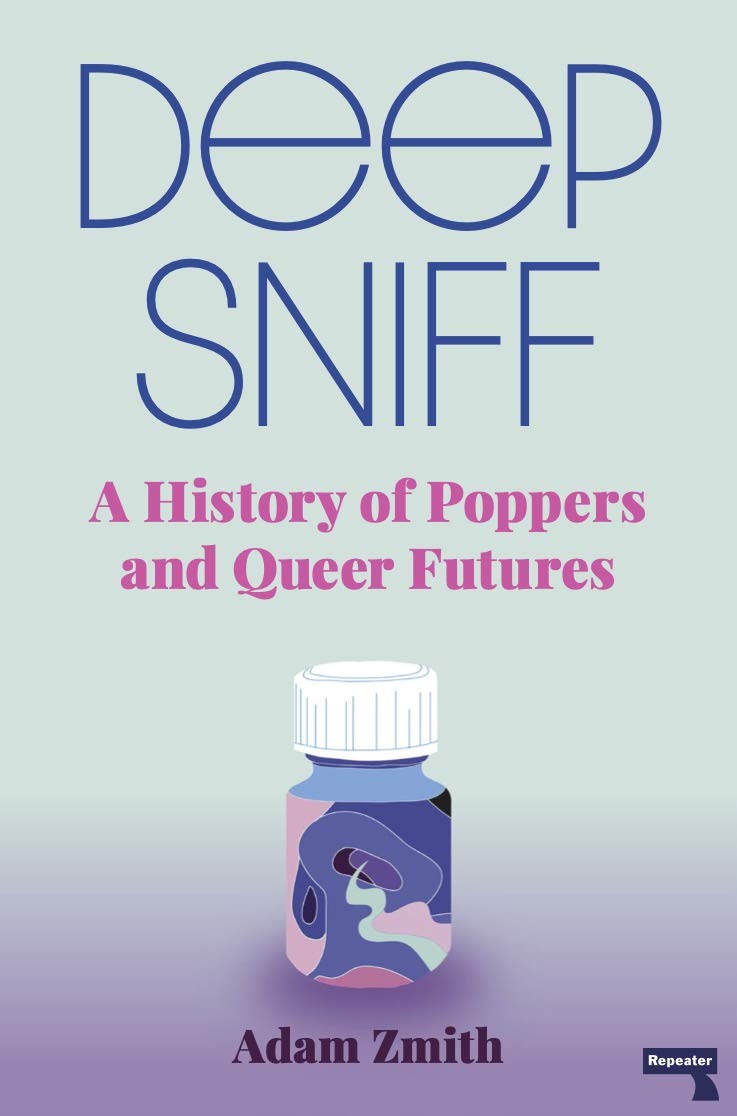
Deep Sniff: A History of Poppers and Queer Futures

Rate this book
Adam Zmith reveals the long history of the quick rush from sniffing poppers.

3, 2, 1... inhale, deep. From the Victorian infirmary and the sex clubs of the 1970s, poppers vapour has released the queer potential inside us all.

This is the intriguing story of how poppers wafted out of the lab and into gay bars, corner shops, bedrooms and porn supercuts. Blending historical research with wry observation, Adam Zmith explores the cultural forces and improbable connections behind the power of poppers. What emerges is not just a history of pub raids, viral panics and pecs the size of dinner plates. It is a collection of fresh and provocative ideas about identity, sex, utopia, capitalism, law, freedom and the bodies that we use to experience the world.

In Deep Sniff, what starts as a thoughtful enquiry into poppers becomes a manifesto for pleasure.

Kindle Edition

First published December 1, 2021

47 people are currently reading
1567 people want to read

About the author

Adam Zmith

8 books21 followers
Adam Zmith is the recipient of the London Writers Award 2019-20, and is the author of several shortlisted and published short stories. He is also one of the producers of The Log Books podcast, winner of Gold in the Best New Podcast category at the British Podcast Awards 2020.

Adam Zmith's work includes fiction and journalism, films and podcasts, talks and thoughts. His themes are bodies and sex, media and tech, power and community.

At The Economist, he helped to establish and run the editorial social media team over nearly four years. He led the newspaper's practice in hosting civil conversation online and involvement in the Trust Project, a consortium of publishers committed to raising levels of trust in the media.

Ratings & Reviews

What do you think?
Rate this book

Friends & Following

Create a free account to discover what your friends think of this book!

Community Reviews

5 stars
94 (16%)
4 stars
206 (36%)
3 stars
189 (33%)
2 stars
70 (12%)
1 star
11 (1%)
Displaying 1 - 30 of 101 reviews
Profile Image for Alexis Hall.
Author 59 books14.9k followers
Read
December 18, 2021
This book is right: you never forget your first time.

Despite having access to precisely zero queer culture where I grew up, I did weirdly have access to poppers. Nobody knew it was a gay thing because see above re access to queer culture. Also gay wasn’t so much an identity so much as a word to applied to something bad or wrong. Y’know, like me.

Anyway, one afternoon in the middle of the summer holiday when I was about … I’m going to say 14 … I had idled along to hang out with one of my few friends, a girl I shall call L. I liked L and, surprisingly enough, L liked me—although girls tended to like me more than boys than I was growing up. Such is the traditional queer narrative. Anyway, I will confess that part of my liking for L was for her older brother, A.

He was legitimately tall, dark and handsome. And he had his own car, which I wanted him to whisk me away in. Not for any sexual purposes. I just very much wanted to leave where I was growing up. Anyway, he was more interested in his younger sister’s friend than—looking back—he probably should have been? But he’s actually a good memory. He’s since come out. Has married. Has his own business. We haven’t spoken since I left, but he seems happy. I’m happy for him.

Anyway, he had obtained a small brown glass bottle of … something. That people were apparently sniffing because … reasons? So we sniffed it. Two fourteen year olds and a seventeen year old (with a car) in a chintzy conservatory in the north east of England. I remember a rush of well-being—of abstract connectedness—that flashed like wasabi. Presumably our buttholes relaxed? But nobody mentioned this.

Anyway, being kids, this temporary rush of well-being was not enough. We wanted more. Thankfully nobody thought to drink it, because then we’d be dead. But L and A’s mother (who was very house proud) had recently invested in an essential oil burner. A very sophisticated piece of making-your-house-smell-nice technology for the northeast of England in the early 90s. I mean, sheesh woman, were you too good for a Glade plugin like anyone else?

Still riding the memory of the pleasurable poppers high, we approached the precious oil burner—which was occupying pride of place on a sideboard—and dumped the entire bottle of poppers into the holder. For a minute or so, nothing happened. Then we lay on the floor, with no memory of actually lying down, half-giggling, half-passing out. Then we had terrible headaches.

Then L and A’s mum came home.

In a moment of genius resourcefulness, L upended some patchouli oil into the pool of poppers in the oil burner. We got into some trouble for using the cherished oil burner without permission. But from that day forth the oil burner achieved almost mystical significance in the household for its capacity to improve one’s mood. And I keep thinking of L and A’s mother’s visitors, sitting in the best room, sipping tea, with their arseholes unaccountably receptive, gently soothed by unearned queer pleasure.

I hadn’t thought of that in years; not until I read this book. And it’s a good book for that—ostensibly charting a sort of cultural history of poppers, with a focus on the liminality of queer bodies and queer identity, it creates a space to let you wander through your own private history, your unique experiences of queerness. It’s transitions from personal reflection to historical accounting to attempts to … I guess … re-envision a future in which the pleasure-potential of queer bodies opens up avenues to new experience. I mean, I will be honest, the book kind of lost me at this point, because while I appreciated the fluidity of the style, and the blending of past, present and future, the factual and the subjective—and I’m a big fucking fan of Star Trek—its self-conscious artiness reached a point of incoherence to me.

And I feel bad saying that because I did enjoy this book a lot. And I did very much appreciate what it was doing, or trying to do, because queer history feels so much like a lost thing – and this explores so many aspects of queerness and queer identity: from clubbing to masturbation to the HIV/AIDs crisis to the conception of masculinity to pop culture to Victorian chemists who apparently just went about sniffing shit?

Seriously there’s a throwaway line near the beginning at the book (which is about the initial discovery of amyl nitrate) that was so fascinating to me I found it actually quite of distracting:

“Not everyone who sniffed [Benjamin Ward] Richardson’s amyl nitrate was a willing research subject. One friend saw a bottle of the stuff on Richardson’s shelf while the scientist was out of the room briefly, and took a whiff. When Richardson returned, the returned was inhaling more and more deeply, and his face and neck had turned the colour of raw beef. Richardson tried to wristle the bottle from him. The man, perhaps the world’s first poppers pig, eventually gave it up, suddenly speechless and needing support from a nearby table.

SERIOUSLY, WHO IS THIS LEGEND? Who is this man who goes to visit his friend, the notable chemist, and just starts … like … randomly picking up bottles from the guy’s shelves and sniffing them? History has lost you, hero. BUT I SHALL REMEMBER THEE.

Anyway, despite occasionally falling victim to its own deliberately anarchic style, this book was such a unique celebration and exploration of queerness, past and future, that I found reading it a genuinely joyous experience.
Profile Image for Alwynne.
935 reviews1,596 followers
September 14, 2021
Writer and activist Adam Zmith attempts a cultural history of poppers (Amyl Nitrate), particularly in relation to gay male culture, that also connects to a vision of a different future. One that might grow in response to a plea for pleasure opening up a route to fresh, radically different perceptions of queer bodies and their potential. It’s an ambitious project, and a challenging one, that never really comes together. But at the same time, Zmith’s book can be quite compelling, highlighting a number of fascinating, important stories. Zmith’s detailed account of the moral panic around poppers during the 80s, the attempts to link this to AIDs and justify horrific police crackdowns on the queer community’s just one example; as is the surprisingly lyrical discussion around poppers, masturbation and porn. The detailed description of the development of poppers as a product aimed specifically at gay men, the marketing campaigns constructing poppers as a signifier of a particular version/vision of gay masculinity also stood out. Later sections that veer off into ideas about literature, science fiction and identity display promise but stray into the blandly descriptive when a more coherent, analytical stance is desperately needed.

Zmith concludes his idiosyncratic survey of poppers through space and time with Odo, from Star Trek: Deep Space Nine. Odo was a Changeling, a non-solid entity, able to mimic objects or creatures in their surroundings, and merge with others of their kind, possessing an identity poised between singular and plural, resisting fixity. For Zmith Odo points towards an idea of queer utopia, a space free of rigid identity categories. Odo’s also useful as a way of thinking about Zmith’s book. He’s continually shapeshifting, going back and forth between cultural and general histories of poppers, scatterings of memoir, analysis, and manifesto. The impression’s of someone free associating: abrupt segues, unexpected imaginative leaps and tangents. Zmith’s writing style’s similarly fluid, the numerous sudden changes in register can be jarring: highly subjective, passionate polemic tangled up with the more muted and formal. In many ways Zmith’s free-form style mirrors what he’s trying to formulate here. But the result is fragmented, an awkward patchwork of material. Part of the problem's space constraints, Zmith’s messy, sprawl of facts and concepts are confined to less than 180 pages. Zmith’s publisher’s Repeater Books, an innovative, indie outfit tracing back to writer and theorist Mark Fisher. Zmith’s technique sometimes reminded me of Fisher's. Fisher also mixed elements of history, cultural analysis and texts from popular culture but his ideas were firmly grounded in rigorous, theoretical frameworks. Zmith's work lacks Fisher's underlying discipline and theoretical sophistication. Zmith's an interesting, often provocative, writer but he's juggling too many disparate components, ideas spilling out at a fast and furious pace, and the end result’s more than a bit bewildering.

Thanks to Netgalley and Repeater Books for an arc.

Rating: 2.5/3
Profile Image for Gerhard.
1,299 reviews881 followers
June 3, 2022
I stumbled across Adam Zmith’s intriguingly titled book after I saw it listed as a finalist in the LGBTQ Nonfiction category of the 2022 Lambda Literary Awards (the winners will be announced on 11 June.) Which just goes to show what an invaluable resource Lambda Literary is for discovering exciting new books and authors!

Off the bat, ‘Deep Sniff’ is deeply weird and deeply intriguing. An entire book about that smelly but electrifying genie lurking in a little brown bottle? Well, yes and no. A passage to illustrate:

We inhale from our little bottles because we just want to be free of our bodies. We know deep down a truth about our bodies: they are the material that gives other people a hundred reasons to categorise us. Really we want to be vapour, like Odo in their most transcendental moment.

Firstly, this is remarkably philosophical for a book that has ‘history’ in its title and, secondly, what on (or off) earth does a character from Star Trek: Deep Space Nine have to do with poppers? Here Zmith quotes So Mayer: “What drew (and draws) me to science fiction is simple: bending.” To which Zmith adds the addendum: “I stand, and mince and flow, with Mayer, inhabiting the ‘bending time, bending bodies’.”

In terms of Odo, Zmith firmly berates the makers of Deep Space Nine for missing the boat “to create the first non-solid gender-neutral-multi-sex couple on television.” And yes, he does refer approvingly to Adira Tal in Star Trek: Discovery (2020). But if you think the Star Trek musings are weird in terms of ‘queer futures’, you ain’t seen nothing yet. The strangest part of the book is Chapter 7: HIT / HOLD / RELEASE.

“Time to train your cock,” says one of the video’s first commands. “All hits are mandatory. Inhale poppers on HIT. Hold in breath on HOLD. Exhale breath on RELEASE. This is the intro to a 2015 video by marcotureno called ‘Trainer compilation for popperbators (only male)’. Zmith explains:

A bator is a person who wanks a lot, especially one who sees wanking as its own activity. It is not just a way to climax or release. If you think about wanking, if you make plans for it, if you dedicate time to exploring yourself, to trying new pleasures – you are a bator. If you sniff poppers while you wank, as part of your solo practice – you are a popperbator.

It doesn’t end there though:

Bators also often like to edge themselves close to climax and then stop. Edgers repeat this pattern over and over in order to intensify their eventual orgasm. If you are a bator or an edger who also uses lots of porn, you may be a gooner.

Uh oh.

So: a bator may edge his way through a session by gooning out on compilation porn and poppers. “Can’t wait to get home this eve and find a bro to cam with, huff deep together, encourage each other to go deeper and deeper until we’re both a gooning drooling mess,” posted one user of popperbator.com, a website for people of the same interests.

They have a website? ”In fact, we often see wanking as anti-social. It is even more solitary than reading because at least with reading you can acceptably discuss your favourite book with a colleague.” Zmith imagines a porno-topia of literally thousands upon thousands of people inhabiting and giving life and meaning to an online video-room community. Of course, this is nothing more than a virtual simulation of the dark rooms and sex clubs of the 1970s. Or is it?

Poppers has always been uniquely associated with gay identity, and in particular the form of ‘homomasculinity’ as portrayed by the Village People and Tom of Finland. Zmith dives deep into the history and marketing behind brands like Rush and Locker Room that are still very much prevalent today. (Pacific Western Distributing Corporation [PWD] was established in 1976, the same year as Microsoft, Apple, and Starbucks. It truly is the American Dream.)

Zmith explains how amyl nitrite was discovered and adopted in the Victorian era as an angina cure by Brunton, noting that “researchers made no mention of sexual arousal or the sudden need to be fucked.” Brunton published a paper on “the exact effects on blood vessels and muscles” in the same year that Karl Heinrich Ulrichs published two revelatory pamphlets about urning (men who desire men), dioning (people attracted to the opposite sex), and urninden (women who desire women.)

Over the next five years, Ulrichs continued to develop his theories that same-sex desires were innate, and that gender and sexuality were interconnected. Among his ideas was the notion of a third gender, with the physical body of a man but the spirit of a woman – and made it clear that this was how he, the anonymous author, thought of himself.

That original pamphlet was entitled … ‘Raging Sword’. Not even ‘The X-Files’ can come up with a story like that! Unfortunately for Ulrichs, sodomy was declared illegal in May 1870. “It would take one hundred and twenty-four years, until 1994, for this paragraph to be removed from German law entirely.” Which means that Ulrichs, unlikely as it seems, was “the first public advocate for the legal emancipation of gay bodies.”

Zmith recounts how Howard Breese Fonda (yes, of the acting dynasty Fondas) invented an inhaler for sniffing amyl nitrite in the form of an ampoule that when opened made a ‘pop’ sound, hence the name ‘poppers’. He points out that “it is impossible to pinpoint exactly when amyl nitrite became a recreational drug…” The Stonewall Inn uprising of 1969 was accompanied by the FDA decision to introduce a prescription requirement for amyl nitrite.

So although gay culture was creating a new kind of gay identity, it still relied heavily on conventional ideas of what it meant to be a man. Poppers were both countercultural, simply by being gay, and also deeply conventional in how they were marketed.

Hence of the apocryphal Gay White Male, Zmith predicts:

Whatever his show of gender, his aim was freedom. Poppers were just the potion.
Profile Image for Erik.
331 reviews279 followers
October 13, 2021
Adam Zmith's Deep Sniff is one part history, two parts queer imaginary.

Poppers, like homosexuality, were products of the Nineteenth Century Victorian era. Born at the same time, these two things - ideas - would develop together, representing liberation and freedom as they aged. Zmith traces this history - of both - and takes rest stops of memories along the way to tell the story a tiny little chemical that has meant to much to queer culture.

The points in Deep Sniff that focus on the history of poppers really are something else: unique, interesting, and well-written. This book tells stories of queer history that have sadly been untold, and even as a frequent reader of queer history, I learned new things. But unfortunately this history is only a small part of the book. Easily half of the book is taken up with odd ramblings about queerness and the future. All of this commentary has roots in queer theory and history, but wasn't particularly interesting or novel. Pick this up for the history, skim the rest.
Profile Image for Bill Hsu.
991 reviews221 followers
July 1, 2022
I don't know what target audience the author has in mind, or who's the "we":
We take sex far too seriously. We agonise instead of enjoy. We measure more than we pleasure. We judge how others do it, when we might learn from them. We also pretend sex is everything else but sex, by converting fast cars, deodorants, salad, even poppers into sex in order to sell these products.

My friends certainly do more enjoying than agonizing, pleasuring more than measuring etc etc. And they don't need to have the motivations of police raids explained to them:
Exactly what were the police officers doing? They might say they were enforcing the law. But if they wanted to protect people from harmful substances, they should have removed the cigarette machine.

And it keeps going. Also, do we need to be told at least twice that Frank Pakenham was "also known as" the Earl of Longford?
Profile Image for Siobhan.
Author 3 books119 followers
August 18, 2021
Deep Sniff is an exploration of the history of poppers through the lens of the reality of identity and freedom and possible queer futures, starting with their Victorian discovery and moving into gay culture both face to face and online. The book moves between history, a bit of science, some science fiction, and a manifesto for the future, blending topics to show how intertwined the body, identity, pleasure, sex, politics, and history really are.

This is a multi-faceted book, telling what starts as a history of science and rapidly moves into a history of culture, politics, and sex, whilst also looking at some of the pop culture mentions and depictions of poppers. I found a lot of the history very interesting, told in an engaging way with anecdotes, and I felt like I learned a lot from it. The later part of the book focuses more on the idea of queer futures and imagining futures, looking to sci-fi and previous writing on various utopian dreams, and it had more of a call to imagine new futures than I expected, emphasising the importance of looking forward rather than back (which is quite funny for a book with 'history' in the subtitle). The queer utopia stuff was particularly interesting, though there was a lot about Star Trek and as someone who knows nothing about it, I did get a bit lost at times.

A short and readable exploration of poppers and pleasure, Deep Sniff is a deep dive into not just a particular substance and its cultural impact, but also wider implications and futures. Also, it ends with a playlist of tracks that I'm listening to whilst I'm writing this review, which is fun too, and underscores the way in which histories and futures are all tied to so many things, and looking at the future through the lens of a cultural item (e.g. poppers) can bring with it a lot of different ideas, connotations, and (in this case) music.
Profile Image for Jason Pettus.
Author 20 books1,449 followers
January 10, 2024
2024 reads, #1. For my review to make sense, let me confess that bottles of amyl nitrate, known slangily as "poppers," were a regular part of my sex life during my "swinging" years of my youth 25 years ago, back during the so-called "alt dot sex years" of the early 2000s; and that the drug has a particularly profound effect on me when combined with cannabis, a combination I used to do all the time when heading off to my latest orgy or other opportunity to have sex with a complete stranger. So I had been hoping that this new book on the subject would shed some light on what poppers actually are, and why they seem to have such a profound mental effect on some people when it comes to lowering inhibitions yet no effect on others. Unfortunately, this isn't the book Adam Zmith has written, but rather he's given us yet another history of the male gay community, only this time as filtered through the rise of poppers as a recreational drug in the "cruising" community of the 1960s onward, using the drug simply as a symbol and coat rack off which to hang a bunch of dry, tedious, academic writing about "queerness" and "belonging" and a bunch of other ten-dollar grad-school words. That's fine, but not the book I was expecting, and not in any way at all a book I'm interested in actually reading, which is why it's getting such a low score from me in particular. Your results may vary, though, so you might want to give it a try anyway.
Profile Image for Daniel Ronan.
203 reviews
May 16, 2025
Originally heard about this book when listening to The Savage Lovecast, and at the same time I've been getting into Australian punk band Amyl and the Sniffers, so I decided to read this book about the gay sex drug.

I want to rate it higher. The history of poppers could actually be covered in about 30 pages. Amyl Nitrate was first produced in the 1800s, it was eventually used as a drug for people suffering from Angina. It was originally stored in glass capsules that made a popping sound when you opened them, hence the name, and sniffing it lowers blood pressure by expanding capillaries, making it easier for the heart to pump blood. Some people always found it fun to sniff, and eventually gay guys discovered it made sex feel better, and it's been advertised and used off label. It's not quite legal but not quite illegal, it's been demonized because a marginalized group likes to use it for evil sex stuff, and occasionally as a party drug, but it doesn't seem to be used much outside of those groups, so it never quite goes mainstream.

The more interesting part of the book is all the queer history. It's must more a queer history book using poppers as a backdrop. I was aware of some of the history but never read about it in this way or to this degree. However, I wouldn't say the book went' totally off the rails, but the last couple chapters, especially the last chapter, were just so out there and barely related to the subject, it's hard to give it a higher rating.

My other big gripe with the book is that it didn't even really give an overview of how poppers work and how safe they are to use. Multiple times the book talks about how drinking the liquid will almost surely kill you, but for a book about the scary gay sex drug, I was expecting at least part of it to focus on how poppers actually expand capillaries. It's hard to believe that there's no health risks associated with the drug. I already have a very low resting heart rate and I easily pass out, so I image there are edge cases where an otherwise healthy person should probably avoid poppers. It just felt like there should have been a boring but necessary science-y chapter instead of a half of the last chapter discussing an obscure Star Trek character.

I'm curious if poppers would be useful for people who have raynaud's disease. It would be pretty funny to see somebody with numb white fingertips pull out a bottle of SUPER RUSH or Jungle Juice for a quick sniff.

Also, "bumhole" is the grossest word in the English language. Let's call them assholes like adults.
332 reviews44 followers
August 20, 2021
Thanks to Repeater Books + NetGalley for the e-ARC.

This book combines medical history, social and cultural history and a vision of the future, to help us understand what poppers can teach us. It’s an interesting subject, and one I’m not particularly well versed in, but I loved the first half of this book - the medical and cultural history of how poppers came to be. The chapters on poppers emerging at a similar time to outspoken queerness, changing masculinity, marketing to gay men and poppers during the early HIV/AIDS crisis were all fantastic.

The second half of the book looks more at queer life now and Zmith’s vision of how the future could be, studied alongside cultural references to Star Trek and Iain Bank’s Culture novels (bit weird to read about my dads favourite books alongside a lot of sexually explicit analysis). Not being super familiar with either, this didn’t interest me as much as the earlier chapters but I liked and agreed with a lot of Zmith’s musings on identity and utopias.

Also included in this book: Jane Fonda, Poirot, Housmans bookshop, the Combahee River Collective and many other fun shout outs! Pick it up if it sounds like your very niche kind of thing.
Profile Image for Mitchell Clifford.
353 reviews20 followers
August 11, 2021
Thank you to NetGalley, Repeater Books, and Adam Zmith for the ARC of Deep Sniff: A History of Poppers and Queer Futures. I voluntarily read and reviewed an advanced copy of this book. All thoughts and opinions are my own.

Wow, this book was so well researched and so well done. The archival work and storytelling intertwined into this book to illustrate queer past, present, and future through the object of something as simple as poppers was really fascinating and easy to read.

It should also be noted how short this book is, being under 200 pages and yet how the other still packs such a punch in this text, never mincing or wasting a single word.

I can’t wait to purchase this book when it comes out next month and add it as a necessary text in my queer nonfiction collection. Also look forward to being on the lookout to read more from Zmith’s works as well!
45 reviews1 follower
August 26, 2023
i love poppers but this is probably the worst book I've ever read lmao this one should've stayed on the drafts xxx

cons:
this book could've been 100 pages shorter
there was no need for me to know this guy's wanking habits
at the beginning he says this book is not pro or anti poppers and yet spends 150 pages saying why poppers can change the world
i find it so cringe when people write about chemistry incorrectly sorry
doesn't tell how gay people started taking poppers in the first place??
hated the writing style some sentences made no sense
its all about gay men and their sexuality..... more people im the community take poppers......could've done at least a chapter not focused on gay men

pros:
i did learn some fun facts i can use next time i take poppers
Profile Image for Tony.
43 reviews3 followers
February 27, 2023
There’s a lot going on here, and a lot of it is very interesting and enjoyable, but it doesn’t quite cohere as much as I wanted it to.
Profile Image for Britton.
67 reviews2 followers
May 10, 2022
I like what this book was trying to do, and I really appreciate the history it explores and Zmith’s ruminations on identity and pleasure. And I appreciate how accessible Zmith makes all of this information. But there are a few moments scattered throughout where his phrasing of certain sentences makes his writing needlessly difficult to parse. Not that his writing is overly erudite or anything. Like this passage for example: “The [British] government had printed twenty-three million copies of a leaflet, one for every household in the country, ready for mailing. The leaflet would explain candidly how HIV was transmitted, how condoms would protect sex partners from it, and where people could find more information.” The tense he uses here is so fucking confusing. Like he says that the leaflets were “ready for mailing” and “would explain” how HIV is spread, but does this mean that they were actually mailed? Did they explain how HIV is spread? Was there something that prevented these leaflets from being mailed, explaining why he says they were “ready for mailing” and why he doesn’t say that they “were mailed”? Why the fuck is he using future tense here? This seems nit picky, but there are little moments like this at least once in every chapter that made me question what the hell he was saying. Four pages after this passage, he does elucidate that these pamphlets were indeed mailed by writing that “the phone lines at the Switchboard were overloading due to the surge in calls from people who had seen the number on the government HIV/AIDS leaflet.” But why couldn’t he have just used a different tense when he first brought up the leaflets?

3.5 stars because (despite these aforementioned moments) this book was really insightful and made me think critically about pleasure and identity all while also giving fun facts about poppers I’ll likely endlessly bring up anytime anyone says the word “poppers”. Like did you know that the name “poppers” refers to the original device used to inhale it because users had to pop a ball of glass and quickly inhale the amyl nitrite within? Or that Jane Fonda’s distant cousin patented a poppers device that prevented that shattered glass from hurting the user? OR that JFK (during his presidency!) made his mistress Mimi Alford sniff poppers at a party hosted by Bing Crosby? +0.5 stars because like ten pages of the final chapter are dedicated to talking about the Star Trek: Deep Space Nine shapeshifter character Odo and using his plot arc to explain queer future theory.
Profile Image for Dylan Nicol.
61 reviews2 followers
March 23, 2024
Interesting read there were some moments I was bored but overall a fun read and learned a lot! I loved all of the references and have added multiple references from the book to my watchlist and reading list!
11 reviews
February 12, 2024
It's a quick read and fairly entertaining, even if the thematic throughline from poppers to other history is a little fragile at times. In fact, poppers seem to become mostly a metaphor by the last chapters, but the book still expresses a nice sense of community and resistance.

So, overall pretty interesting, though more conversational than academic---like a blog post or YouTube video rather than a paper or history book. Stylistically and content-wise it honestly feels like something James Somerton would rip off. Is that too mean?

Continuation after thinking about it more: The discussion of the commercialisation/commodification of poppers, masculinity, and gay culture into a narrow capitalist view was what stuck with me the most. So did the history of police using poppers as ab excuse to harass gay people, especially with its false connection to HIV/AIDS, and the general panic about gay people surrounding that.

It's also interesting that Germans invented homosexuality and then immediately banned it. That's so us.

I do have to glance a little side-eyed at making Odo from DS9 out to be a queer icon because of his shapeshifting considering 1) the show rarely if ever treats him as anything but a straight (arguably cis) man, and 2) he's a fascist-collaborator cop who worked for not one but two imperialist regimes and froths at the mouth at any chance to increase his powers of surveillance and repression. Also Dax was right there as an alternative queer icon who actually has explicitly inhabited differently gendered and sexed bodies and whose attraction to others isn't (entirely) bound by gender. Even Quark was a woman more prominently than Odo. And Chief O'Brien is lesbian to me. And Ezri should've been a man so Dax could be shown "transitioning" and as a bonus Worf would get a gay arc. I'm getting a little off-topic.
Profile Image for Courtney.
7 reviews2 followers
September 5, 2021
This is a book about poppers, but it’s also about historical and contemporary conceptions of identity, queerness, and pleasure. The writing falters at times, and is strongest when the writer uses his own experiences and identities to tie in to the broader point he is making. I’m excited that someone has written something so thorough and celebratory about this piece of queer culture.
Profile Image for Lily.
41 reviews1 follower
March 20, 2024
2.5/5

The first half is an interesting exploration of poppers and their evolving uses and perception through history. Sometimes, it feels as if the chapters were written independently of each other, with each chapter ending with the author's attempts to summarise its contents and their place in queer histories and Fisheresque 'futures'. This felt a bit like I was being led towards the predetermined conclusion of the book that never really manifested and made a lot of chapters feel like they covered the same ground.

The topics explored are worthwhile reads, but it feels like the core thesis of possible futures never quite coalesces into something tangible.

Getting further into the latter half of the book is where things begin to fall apart. The use of QUILTBAG as the acronym of choice seems strange until it is later met with the affirmation/conclusion that queerness is about 'how you feel on the inside'. This highlights to me the fundamental failure of the book to understand the politicisation of our bodies and their experiences, along with a failure to properly diagnose the political basis for the persecution of queer people beyond vague references to "capitalism" that do little to explore how this power manifests (or even link it to poppers!!!).

The final part that really derailed this to me was the weird detour into colonialism by way of Star Trek, that ends with a strange moment where British colonialism, revolutionaries in Russia and France, and the Nazis are equated in a paragraph that is wholly unequipped to deal with this assertion. It feels to me like Deep Sniff ends up dressing up some quite liberal conclusions in the clothes of a more radical mode of analysis.

Had this stayed on explorations of poppers and their history through the lens of gay male culture, as opposed to trying to tie both wider political analysis and a broader history of queerness and gender I think it would have succeeded far more. (By the time SOPHIE arrived in this to be an example of Queer Utopias, I couldn't keep my eyes from rolling dramatically).
Profile Image for Chase.
90 reviews122 followers
Read
September 28, 2021
I have to start by saying I quite enjoyed Deep Sniff. This book is packed with fantastic snippets of historical analysis, cultural criticism, and personal anecdotes that, I'm going to take a leap and suggest, José Esteban Muñoz would appreciate. Deep Sniff takes a broad approach to tell the history of poppers - an inhalant stimulant commonly used among men who have sex with men and, in the 1970s, avid disco dancers - by weaving together medical history from the 19th and 20th centuries (for instance, accounting for the pathologisation of homosexuality, transformations in heart-related research, and gay health politics from the mid-20th century onwards) and queer theoretical aspirations for social cultures in which non-heterosexual communities flourish.

It's very clear that Zmith did an immense amount of research, pulling from literature, art, film, history, and philosophy of science to proclaim the unity of gay-male sexual experiences through the use of poppers and also the political and scientific controversies associated with drug consumption and government responses to both disease outbreak (e.g. HIV/AIDS in the 1980s) and the war on drugs (especially in the US). The book excels at acknowledging a heterogenous audience, arguing for greater understanding of how poppers might have been used by people other than gay men (a point, fortunately, that is not belaboured, only reflected upon). Indeed, the queer-inclusive term QUILTBAG was a surprising and new way for me to think about queer politics - so the book certainly did its job in thinking about how to reinvent identity politics through the writing of history.

I don't have much criticism to levy against Deep Sniff other than the lack of full engagement with queer and sociological theory (the inclusion of 'biopolitical power' left me chuckling for a moment). But given the book was written as a form of cultural criticism for a wide audience - and not for academics - I won't hold this against Zmith. Nonetheless, I hope this book will inspire other researchers to undertake ethnographic research about the role of poppers in sexual life broadly, raising concerns about determinist approaches to drug policy and, as critical drug scholarship tells us, finding ways to liberate the voices of those who use poppers in order to make consumption safer, better understood from a scientific perspective (let's have some big-ass RCTs to get a bigger picture of poppers' short- and long-term effects), and more accessible and regulated from an economic perspective.

Deep Sniff is funny, creative and well researched. I highly recommend this campy and engaging work of cultural criticism.
Profile Image for Jenn.
519 reviews8 followers
September 29, 2023
A nonfiction book ostensibly about the intersectional history of poppers and queer culture. The first part was this and it was good. In the second part the author got personal and now I know way more about his masturbatory habits than I ever wanted to. The third part is a utopian popper-baiter's fantasy manifesto. Boring. Overall this book was just sort of eh. And the author wasn't a great narrator either - kind of monotone.
Profile Image for Pia.
117 reviews63 followers
October 12, 2021
This was a well-written read that dances through the history of poppers, queer culture, gay men, commercialism, and a great deal more. It does so with a lovely sense of place, grounded in nightclubs, Gay Switchboards, bator Zoom chats, even giving the sense of what it might be like to watch a popperbator video on xtube. No chapter feels superfluous, and all the information is deeply interesting. Zmith jumps from queer history, to queer theory, to queer media studies, to queer commercialism, and a great deal more besides with deft aplomb, realising his vision from start to finish, both simultaneously evoking the past, the present, and the future.

This book is tightly written, with an open focus, it's sensual, grounded, but also transcendent, seeking to transcend the concept of labels while also being completely dependent on labels throughout. Zmith seems to have a tense relationship with labels and categories, both advocating for doing away with them (from the very beginning, we can tell he is not quite comfortable with either 'gay' or 'man' despite then settling into 'gay man' as the perspective from which the book is written - though 'white gay man' would have been more honest), while being unable to do away with them. The future he envisions is one that seems to want to embrace the open, dizzying, pleasurable seconds that poppers create in the mind and body, which is admirable, but I don't know if it's one I want as a fellow queer, which makes the experience of reading this review copy really fascinating, rewarding, and thought-provoking.

I will say two things that jumped out at me as being either significant omissions or inclusions. This book has a kind of timidity when approaching the subject of poppers and people of colour. I have no idea how people of colour - even gay men of colour - engaged with poppers because this book doesn't really go there. People of colour *are* mentioned, and always respectfully, but it makes up what feels like less than 1% of the book. So if that's the queer history you're looking for, you won't find it here.

The second is that if you're familiar with BDSM, you will read an extremely narrow and limited viewpoint of what it means to be dominant and submissive, which is fine if you think 'this is autobiographical and not trying to reflect the community' and less fine when you realise that's not what Zmith is trying to do. A one-dimensional idea of domination as objectification and denigration only (sigh) suggests a real absence from the actual BDSM community, or a limited idea of what this is. Just as some people think poppers are only something that 'deviants' use, I fear Zmith might need to have his mind blown open on just how diverse BDSM can actually be, especially once you realise that it doesn't just belong to leathermen communities, and that leathermen communities themselves have embraced different manifestations of dominance and submission. Thankfully that's only a small part of one chapter, but to me it detracted from the open-mindedness of the book overall, since that section read as closed-minded and myopic.

Overall Deep Sniff is an encouragement to get you thinking about drugs and drug use, why we push pleasure and the pleasure principle down in our list of priorities and what that might mean for us as individuals and communities, the commercialisation of machismo and how that creates the idea that certain drugs 'belong' to certain communities when they don't (poppers can be used and enjoyed by anyone, but they're largely associated with white gay male communities, and marketing - as well as gatekeeping - is a huge part of that). It's an embrace of the other, and the arts. I was delighted to see Zmith referring to 'people who have periods' instead of the incorrect 'women who have periods.' And though this book is more a history of (white) gay men and poppers than it is anything else (it's honest about this from the beginning), I still felt seen and included as a nonbinary transmasc kinkster, simply because of the awareness of the QUILTBAG community, the queerness that leapt from the pages, and the familiarity of the way we sometimes end up thinking about sensuality, pleasure, drugs, relating, connection, and our future.

A must read for anyone who is interested in poppers for a start, but also for many in the QUILTBAG community who wish to know more about their history (and their futures). There's a lot of lovely knowledge in here, much of it presented with the spirit of curiosity, and not coercion. Zmith wants you to think about your own queerness and connection to the world, and your connection to others, and what queerness might come to mean going into a queerer future, and that's the kind of thing I enjoy thinking about, so I'm extremely happy to have read this.
Profile Image for Connor Girvan.
266 reviews2 followers
October 27, 2021
4 / 5 stars

Deep Sniff tells the story of how Poppers got their name from Amyl Nitrite which was sold in sealed glass ampules to be crushed by users. Upon being crushed to release the vapour, the action would result in a 'pop' hence the name. Amyl Nitrite was originally sold in ampules to prevent people from drinking the substance, but crushing glass wasn't the safest either. Therefore, Howard Breese Fonda invented an inhaler for sniffing Amyl Nitrite.

However, Thomas Lauder Brunton was the man who effectively popularised Poppers. He was born in Scotland and completed his medical training at Edinburgh Royal infirmary.

Companies began successfully marketing Poppers to the gay community after noticing their success rather than the original use which was for relief for patients suffering angina pectoris. Other uses suggested were to aid menstrual camps and heavy bleeding after birth, asthma, migraines and sea sickness. The marketing of poppers relied heavily on conventional ideas of masculinity to sell their product and often featured campaigns with muscled men.

In 2016, the Home Office drugs misuse report found that one in twelve people had used amyl nitrite or a substitute.

The book also touched on poppers relevance during the AIDs crisis. Poppers were believed to be a potential cause of HIV/AIDs and it was queried whether they were an immunosuppressor. This link came about as poppers were used during sex which was the cause of HIV transmission and most cases of the novel virus had previously partook in popper usage.

There were also several periods of poppers being banned. After realising that Amyl Nitrite was being sold without a prescription, pharmacies tightened their rules to prevent scrutiny. This meant that substitute substances became available as a way to get around the FDA decision to ban. Additionally, a judge called for poppers to be banned after a young man sniffed them and killed a fourteen year old; the newspaper headline read "sex potion turned a well behaved teenager into a crazed knife man".

The book largely speaks about pleasure and the denial of pleasure/how poppers are linked with pleasure. There is the discussion of popperbators (those who masturbate with poppers present often following videos others have created which instruct when to masturbate and when to sniff), disco clubs spraying the dance floor of poppers, and the use of poppers in popular culture (Sherlock Holmes, Pose etc).

Figures like Karl Heinrich Ulrichs and Frank Kameny are discussed with regards to their activism as gay individuals and the raid on the Royal Vauxhall Tavern receives a sizeable portion of the book.

All in all - a very good book and would recommend.
This entire review has been hidden because of spoilers.
Profile Image for Leoniepeonie.
166 reviews6 followers
April 4, 2022
I loved how playful and hopeful this was. That really felt like the point of the book: that poppers can be about escapism and pure pleasure and that's GOOD; that queer utopias are *possible*; and that poppers themselves can be a gateway into imagining, enjoying and creating those futures right now. Zmith explored the history of poppers themselves, through their scientific and medicinal roots into their lives as consumerist products and icons of (almost uniquely male) gay culture. Zmith looked at representations of poppers in popular culture too, in what was a really rich and interesting deep dive. At times I found the extended explorations of writing and films and side stories felt like a bit of a deviation from the main points, and made points on their own that felt a bit separate from the discussion of poppers, but I enjoyed the whole vibe of the book and felt that above all the narrative Zmith wove was a really positive and thoughtful and thought-provoking one, and I enjoyed the ride. More of a memoir and long-form essay by the end than a pure history of poppers, but I think it still has a place.
Profile Image for Chloe.
249 reviews1 follower
January 11, 2024
I was excited to see how this topic was explored since I love material histories, but this book never analyzed the points it brought up enough for me to be satisfied with them. I loved the prose the author included and the self-reflective, memoir-esque parts were the strongest sections but the book seemed confused about how much authority to give itself on the topic. Still enjoyable!

////////
It feels like grabbing something from the future, grabbing a few seconds of who we want to be. We become our potential. No suffering, only pleasure. The sensation is so, so brief.


Done well, sex can feel like the opposite of death. Done among a community of similarly maligned people, it can feel like a shared future.

Queer utopia is the feeling that your body is yours, it’s free and full of potential, and it’s not poisoned by anyone or their ideas.

Sometimes I think about that decade between knowing what my body wanted in the car that night and doing what it did much later. But facing forwards is better. I don’t want to dream in reverse.
205 reviews11 followers
September 17, 2021
A short book about the cultural meaning of poppers and their relationship to pleasure and gayness. They’re apparently still widely available in the UK and the USA, “thanks to a pact between authorities and sellers. Everyone agrees to say that these products are not for human consumption, which means they are labelled with fake uses like ‘room odouriser’ and ‘boot cleaner.’” Interestingly, unlike with opiates, pharmacos apparently were actually worried that people—that is to say, young gay men—were using the product for pleasure and reported that to the FDA. I guess pleasure that makes you want to have sex (Zmith repeatedly emphasizes how poppers can be used to relax physically for anal sex) is more morally concerning than pleasure that just makes you happy. Zmith also argues that popper marketing participated in the promotion of a muscular, aggressive gay masculinity, e.g., an ad for Locker Room poppers “showed a butch superhero with a six-pack, cape and battering-ram thighs leaning against a locker door beside the words ‘Purity power potency.’” Thus poppers “were both countercultural, simply by being gay, and also deeply conventional in how they were marketed.” Zmith also discusses how moral panics over poppers were intertwined with moral panic over AIDS—indeed, one contrarian insisted for many years that it was poppers, and not HIV, that caused AIDS. I loved the bit about disputes at a gay hotline over what to say about poppers—one volunteer wrote, “People who sniff poppers need an extra physical kick from sex as they get no emotional satisfaction,” while another responded, “You sanctimonious tie-wearer.” The bit on popper vids—clips from multiple porn videos edited together with a soundtrack and instructions about when exactly to sniff—was also very “through a glass darkly” from my own fannishness.
Profile Image for J Earl.
2,334 reviews111 followers
September 18, 2021
Deep Sniff by Adam Zmith is a fun and fascinating trip through the history of poppers and into an idealized queer future. Whether you're familiar with poppers or have just heard of them, this will be the kind of read that surprises you as you go.

I read another review and found it interesting that we saw many of the same qualities yet interpreted them differently. It is a good review, doesn't trash the book, but sees disjointed jumping between product history, cultural history, memoir, and speculation where I see the weaving of these into a whole. Albeit an imperfect whole, but not nearly as disjointed as that person sees. That may be because of my past, most of my study and research was interdisciplinary and I am accustomed to reading accounts that weave different threads into a new cloth.

I do think that some readers may only find certain aspects interesting, maybe the cultural/social history and memoirish parts because of the nostalgia (good or bad) or the history of the product itself, which is part basic science and part marketing/PR history. I also believe that the aspect that may miss some readers is also the part that I think Zmith is still likely forming, namely the speculation about some better, or at least different, queer future. Like any speculative theorizing this is a work in progress, so readers should read this as a contribution to the discussion, not the entire discussion.

I would recommend this is those interested in queer studies, as well as those who simply want to know more about a common pleasure enhancer.

Reviewed from a copy made available by the publisher via NetGalley.
Profile Image for Sam Ostrowski.
29 reviews2 followers
December 9, 2021
A valiant effort and a largely fearless embrace of topics that are still, at times, not necessarily embraced in open dialogue in the queer community leave me feeling like I have to go three stars, but the actual text is a two for me. The concept is strong: view queer culture past, present, and future through an iconic device that brings people together in platonic and sexual ways—poppers. It’s just, unfortunately, too varied in topic and theses to really nail the landing. Zmith at once embraces kink culture for allowing people to fully connect through certain labels and then does a 180 expressing a disappointment in queer culture for needing to always find ways to label ourselves, shutting us off from an open soul. I felt stuck in the “Cha Cha Slide” hearing “reverse-reverse!” over and over again as I progressed through the chapters. Zmith seems a great mind to add to queer discourse, I just hope they connect with a strong editing team next time to cut, hone, and refine.
Profile Image for Michael Hurlimann.
145 reviews17 followers
January 31, 2022
*Rounded up from a 4.5*

Zmith's book is not so much a dry history of this fascinating substance as it is an exploration of its influence and of how it interacted with queerness since its invention.
His prose is lucid, poetic at times, and moving. Occasionally I found the tangents a bit long (i am not a huge sci-fi nerd, so the long Star Trek discussion in the last chapter felt a tiny bit over the top), but other than that, i found this to be a thoroughly intriguing work that sits nicely on a shelf with Muñoz's Cruising Utopia.
Profile Image for Tom McIntyre.
11 reviews20 followers
November 18, 2025
Entertaining, but sometimes cloyingly poetic about a utopia ushered in by poppers, gooning, and queerness. “The future is like a poppered up body’s bumhole: open.”

I burned through the first half, but kept putting the book down / forgetting about it in the back half. Still fun, though!
Profile Image for Fern.
17 reviews
September 24, 2021
I've used and been around poppers since I was about sixteen, and then later sold them when I worked in a sex shop, but I've never even considered where they came from! It's so fascinating, part science, part history, part sociology. I'm learning a lot! It's so impressive to me how you can take something so every day and then analyse its history, present, and future, and make it so interesting. It's also brilliant to see more queer writers and academics explore parts of our culture that are less palatable to the cis&hetronormative gaze.
Displaying 1 - 30 of 101 reviews

Can't find what you're looking for?

Get help and learn more about the design.