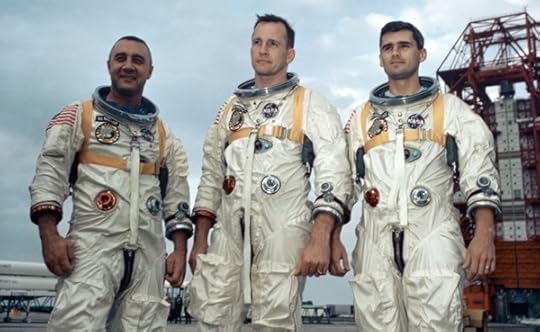
On January 27, 1967, astronauts Gus Grissom, Ed White, and Roger Chaffee climbed into a new spacecraft perched atop a large Saturn rocket at Kennedy Space Center in Florida for a routine dress rehearsal of their upcoming launch into orbit, then less than a month away. All three astronauts were experienced pilots and had dreams of one day walking on the moon. But little did they know, nor did anyone else, that once they entered the spacecraft that cold winter day they would never leave it alive. The Apollo program would be perilously close to failure before it ever got off the ground.
But rather than dooming the space program, this tragedy caused the spacecraft to be completely overhauled, creating a stellar flying machine to achieve the program’s primary putting man on the moon.
Apollo 1 is a candid portrayal of the astronauts, the disaster that killed them, and its aftermath. In it, readers will
Apollo 1 is about America fulfilling its destiny of man setting foot on the moon. It’s also about the three American heroes who lost their lives in the tragedy, but whose lives were not lost in vain.
On January 27, 1967, astronauts Gus Grissom, Ed White, and Roger Chaffee climbed into a new spacecraft perched atop a large Saturn rocket at Kennedy Space Center in Florida for a routine dress rehearsal of their upcoming launch into orbit, then less than a month away. All three astronauts were experienced pilots and had dreams of one day walking on the moon. But little did they know, nor did anyone else, that once they entered the spacecraft that cold winter day they would never leave it alive. The Apollo program would be perilously close to failure before it ever got off the ground. Apollo 1: The Tragedy That Put Us on the Moon ~~~ Ryan S. Walters
Ryan S. Walters' Apollo 1: The Tragedy That Put Us on the Moon tells the tragic story of the fire aboard Apollo 1 causing the deaths of astronauts Gus Grissom, Ed White, and Roger Chaffee on January 27, 1967 during testing of the Apollo space capsule. The subsequent investigation into the flaws of the capsule and the general mismanagement of the Apollo program led to significant changes in the overall space program, leading to the subsequent success of NASA putting men on the moon in 1969.
Walters’ book also includes a well written overview of the Cold War space race between the Soviet Union and the United States, the evolutionary of the Mercury and Gemini space programs leading into the amazing achievements of the Apollo programs. Walters takes and in depth look at allegations of government corruption that led to the awarding of contracts to the builder of the hugely flawed initial effort that led to the deaths of the three astronauts.
Walters concludes that this tragedy led to the ultimate triumph of the Apollo Space Program and that heroes, Grissom, White, and Chaffee did not die in vain. Recommended to those interest in space exploration.
First part of the book was, understandably, a review of the origins and state of the space race. I enjoyed the recap of how astronauts were chosen and their personalities, families and relationships. The author did a nice job explaining the doomed astronauts backgrounds and impressive credentials, which made listening to the chapter on the accident itself that much more tragic and sad. What follows is a capsule review of the remainder of the journey to the moon. Really enjoyed the book and learned a lot, although it was way too complimentary to president Johnson, who was a terrible person and president. It also ignored the Soviets attempts late in the space race to launch their moon rocket and orbit cosmonauts around the moon.
This entire review has been hidden because of spoilers.
Although I've already read plenty of books on Project Apollo, all of which include details on the Apollo 1 fire, this book still provided a lot of new information. Interestingly, its chief goal is to place the Fire within a political context, which proves relevant in the dynamics of the Space Race and the pursuit of John F Kennedy's lunar landing challenge that led to the tragedy, the investigations that followed, and the questionable dealings that led to North American Aviation winning the contract to build the Apollo spacecraft. To this end, the chapters leading up to the Fire provide a summary of the Space Race going back to the launch of the first satellites, yet this doesn't feel unnecessary; it provides appropriate setup for the political narrative and makes sure to place focus on the roles of Gus Grissom, Ed White and Roger Chaffee, giving detailed profiles for the three men at the centre of the story. Certainly worth a read for those interested in the subject.
This was a very informative book about the Apollo 1 tragedy. It explains in great detail the political corruption, kickbacks, and more than 100 faulty components that caused the fire killing astronauts Grissom, White and Chaffee. It was finally explained that the cause of the fire was faulty wiring manufactured by North American Aviation. North American Aviation and NASA shared equally in the blame, but tried to deflect the reason for the fire as being the fault of astronaut Gus Grissom in that he somehow kicked a wire by moving his foot to cause a spark. This was disproved and his name cleared. I learned things from this book that I never knew before and I highly recommend this to anyone who has an interest in the space program.
This entire review has been hidden because of spoilers.
I rarely give a book five stars but this one honestly rates it. Thorough research, accessible explanations of complex science and engineering, and plenty of primary sources make for an absorbing story of one of the most tragic events in space exploration. The book does not soften the horror of the event but it ends on an optimistic note: because of the Apollo 1 fire, new protocols were put into place, political boondoggles were reined in (companies and politicians made millions off of the space program) and space exploration became a better balance of human endeavor and international cooperation, less of an expensive, political "space race". Highly recommend this one.
Wasn't bad, but the inclusion of "Whitey on the Moon" was unnecessary. While I do not doubt that the Al Sharpton crowd were upset that the U.S. Government spent money on space exploration that could of went to welfare; I am not the least bit concerned with the endless complaints of parasites.
Ryan Walters has written a book on the space race and the Apollo 1 tragedy that is largely a rehash of what has been published in previous books. I think he could have added more to the existing literature through original research, whether through interviews or archived documents (he does include some insights from an interview he did with Lowell Grissom, brother of the Apollo 1 commander, and a few others). But he has presented the life stories of Gus Grissom, Ed White, and Roger Chaffee in an engaging way, offered a thorough account of the tragic events of January 27, 1967, and explained the investigation into the fire and changes to the Apollo spacecraft that followed. I learned some details concerning the investigation, such as the warnings that NASA's Joe Shea had received concerning the use of pure oxygen in the Apollo spacecraft, the efforts by some astronauts and engineers to call for an easier to open hatch in the spacecraft, and the political machinations that resulted in North American Aviation receiving the spacecraft contract despite this company originally being ranked second in NASA's evaluation of proposals. All of this happened years in advance of the fire on the launch pad, meaning that readers will wonder what might have been if decision makers in the government or private sector had gone in a different direction. Yet readers will also understand one critical point: that even as tragic as the fire was, the Apollo program may well have not succeeded if it had not happened. As Walters documents very well in the book, the spacecraft contained major flaws as of January 1967. If the program had continued with them in place, there could have been a tragedy during a mission that would have left investigators unable to examine the vehicle as they could the Apollo 1 spacecraft after a pre-launch test. But because the missions stopped for many months after the fire, engineers had the time and half a billion dollars of funding to make what became 1,341 separate changes to the spacecraft. This became the vehicle that voyaged to the Moon and back nine times, and if it were not for Grissom, White, and Chaffee, that vehicle would not have reached fruition. I recommend Walters's treatment of the tragedy and its aftermath, while adding that experienced readers of the Apollo program will probably already be familiar with much of what is in the book.
I've been reading a lot about the Apollo program lately, and this book was immensely disappointing. It reads like a hagiography of the American space program, and regularly repeats urban legends about the scientific and engineering aspects of space. I had hoped that a full-length book on the Apollo 1 fire would be able to discuss the leadup and causes of the fire as an interesting narrative, the way it does with the astronauts who perished in the disaster. Instead, barely a handful of pages are dedicated to the engineering disaster itself.
The greatest summary of this book is when, in the span of three pages, Walters dismisses the spacewalk on Voskhod 2 as a PR stunt (Fair, true) and arguing the spacecraft was primitive in comparison to the Gemini capsule because of the use of an airlock (These are differences in design philosophy) before discussing how the Gemini suits needed to withstand micrometeoroid impact as the smallest hole would kill the wearer in a matter of seconds. Anyone with a passing familiarity of the Voskhod 2 mission would know that Leonov had to puncture his own suit in order to fit back in the spacecraft, exposing himself to rapid decompression in a scramble to get into the airlock. Walters prefers to get a cheap shot in at the Soviet space program without discussing its actual shortcomings, before being factually wrong about basic facts.
I was hoping for a more digestible discussion of one of the greatest engineering failures in NASA's history, with some added context, but instead got a regurgitation of half-truths and idolization which litter the public memory of the American Space program. If you're actually interested in what happened with Apollo 1 and its aftermath, there's greater depth in tangentially-related books, or a quick glance at Wikipedia.
Ryan Walters has written an informative and interesting book on one of the great tragedies of the drive toward landing a man on the moon--the Apollo 1 disaster. Three astronauts, in a flight simulation on the ground, were killed when a flash fire dashed through the Command Module. The astronauts could not get out quickly because of the old-fashioned hatch that took minutes to unlock. No one person was at fault, but a series of well-meaning people cut corners to save money; bureaucratic maneuvering also prevented the company with the highest rating from getting the contract to built the spaceship.
Walters details the space program from its beginnings, through Projects Mercury and Gemini, and finally into Project Apollo. He makes a strong case that without the disaster, the United States would not have had a ship safe enough to get astronauts to the moon before 1070. NASA's response then was not the same as NASA's response to more recent disasters (and this is my point, not Walters') due to Americans' growing fear of risk. The three astronauts who died wanted NASA to succeed, and the 1969 landing of Apollo 11, as Walters notes, is a fitting tribute to their sacrifice. Would that the changes could have occurred another way.
Apollo 1: The Tragedy That Put Us on the Moon, by Ryan S. Walters (2021, audiobook 9+ hrs). This is the story of the tragic deaths of astronauts Gus Grissom, Ed White, and Roger Chaffee who died on January 27, 1967 during testing of the Apollo space capsule. The subsequent investigation into the flaws of the capsule and the general mismanagement of the Apollo program led to significant changes in the overall space program, leading to the subsequent success of NASA, including putting men on the moon in 1969. This story includes a well written overview of the Cold War space race between the U.S.S.R and the United States, the evolutionary Mercury and Gemini programs, and the subsequent achievements of the Apollo programs. It includes a look at allegations of government corruption that led to the awarding of contracts to the builder of the hugely flawed initial effort that arguably led to the deaths of the three astronauts. Great book!
I was cleaning out some stuff the other day and discovered several newspapers I saved the day men stepped on the moon on Apollo 11 in July 1969. I didn’t save newspapers that reported the deaths of the Apollo 1 crew 29 months earlier. But author Ryan Walters shows in this book how critical, yet tragic, the loss of Grissom, White and Chaffee in the launch pad “plugs-out” test ultimately proved to be. The 12 Americans who walked on the moon, did so in great measure due to the lessons learned in the aftermath of the fire. I’ve read a lot about this tangentially in other books by astronauts and NASA staffers. This book brings this important history together in one place. If you admire our space program, or even if you are critical of it, this is an important book.
Awesome read. A German scientist(van Braun) with missile experience always wanted to do space program inspired by Jules verne comes to America and become part of NASA space program. The book sheds light on project mercury, Gemini and Apollo also revolves around the Apollo 1 tragic loss of 3 scientists. The clock ticks from the moment Sputnik went in to orbit from then on it’s about how Russia and USA went toe to toe on the mission to moon. So much of engineering details about space craft rendezvous docking , orbit change , maneuvering . The description of Saturn 5 rocket (most powerful engine built ever with 160 million pounds of thurst and guzzle a pool size fuel in under 3 mins). This is a treasure in every fronts and fast read . ✈️👌
This is an excellent book. It features, cutting edge exploration by true American heroes and technological breakthroughs in early space exploration. The book takes us from the early days of Mercury and Gemini up through the beginning of the Apollo mission. It also discusses the importance of the Space Race in the context of the time. The book also provides background information on the pilots that died an insight into their thinking. It places Gus Grissom in his proper place as an American hero. Finally, the book discusses the accident, design, flaws, and politics that led to the disaster.
I strongly recommend the book for anyone interested in the NASA moon landing program or dirty politics in the 1960s during the Johnson administration.
Should be a mandatory read for anyone in engineering! Not heavy on technical details but gave a good overview of Apollo and the projects leading up to Apollo 1 and beyond. The book's final chapters on LBJ's corruption in awarding the Apollo project were news to me. The author leaves the question hanging what if the contract would have been awarded to the winner of the committee hearings instead - would the accident have happened? We will never know. The author gave an explanation of why MKARNS came into being - the system puzzled us while in Oklahoma. Too bad it wasn't used for the intended purpose.
Excellent details about the lives of the three men who gave their lives to make the Apollo spacecraft the great machine it became after this tragedy. I have read a lot of books about astronauts but this is one of the few that really delved into the history of all three. I loved the details of the politics of Apollo. Getting such a huge endeavor pushed through government in a short time frame inevitably created an environment ripe for backroom deals and sketchy side deals.
I liked the author’s approach of talking about the early events in the Space program thru the three Astronauts’ lives and briefly describing the fire. I learned a lot, which is the desired result. I have known a lot of the information covered in the book from other sources but it was the first time I came across something that connected the contract with the tragedy.
An amazing insight into how the tragedy which cut short the lives of astronauts Grissom, White and Chaffee revealed that the accident was not only preventable, but anticipated.
While the death of the three brave souls was a national tragedy, it brought NASA to the point of the Moon landing in 1969.
I am a sucker for books about the Apollo program, but this one was a bit of a hot mess for me. The actual subject matter that the title would suggest was about 1/8th of the book, and not very well done. The rest was just a poor attempt to make a narrative out of what felt like a regurgitation of the authors favorite facts.
The author makes an excellent case that it was the tragedy of the Apollo 1 fire that made the triumph of Apollo 11 possible. If you are a fan of the space program, this book makes for an excellent read, however, the level of detail may not appeal to those who only have a casual interest in the subject. I however really enjoyed this book.
A good, solid 4.5 stars. Interesting and just informative enough to make the reader angry about cronyism and money in politics. Almost half of the book is biographies of the three astronauts who died in the Apollo 1 fire.
A 9hr audio book. This is a great history book about the start of the Apollo program and NASA starting from project Mercury and Gemini. I grew up hearing of these three Heroes and it is nice to hear a little more in depth story of what happened.
Money, politics, and human negligence all come together to destroy the lives of three men and their families, in an event that ultimately led to the success of the American space program. Godspeed, Apollo 1.
An amazing story of brave and talented astronauts and engineers and the fatal flaws that likely saved the Apollo program but claimed the lives of three American heroes.
The tragic fire during what was supposed to be a routine test in preparation of the upcoming launch of Apollo 1 which killed its three crew members does, of course, receive mention in every single book ever written about the early space programme. However, this was the first book I've read that focused solely on this tragedy and its consequences, including the overhaul of various components of the Apollo spacecrafts without which the moon missions might never have gotten off the ground. A detailed, engrossing account - though the endless denigrations of the Soviet space programme felt rather gratuitous. Apparently nobody ever told Walters that it's entirely possible to celebrate the achievements of his precious American heroes without going out of his way to minimize those of the competition...