

What do you think?
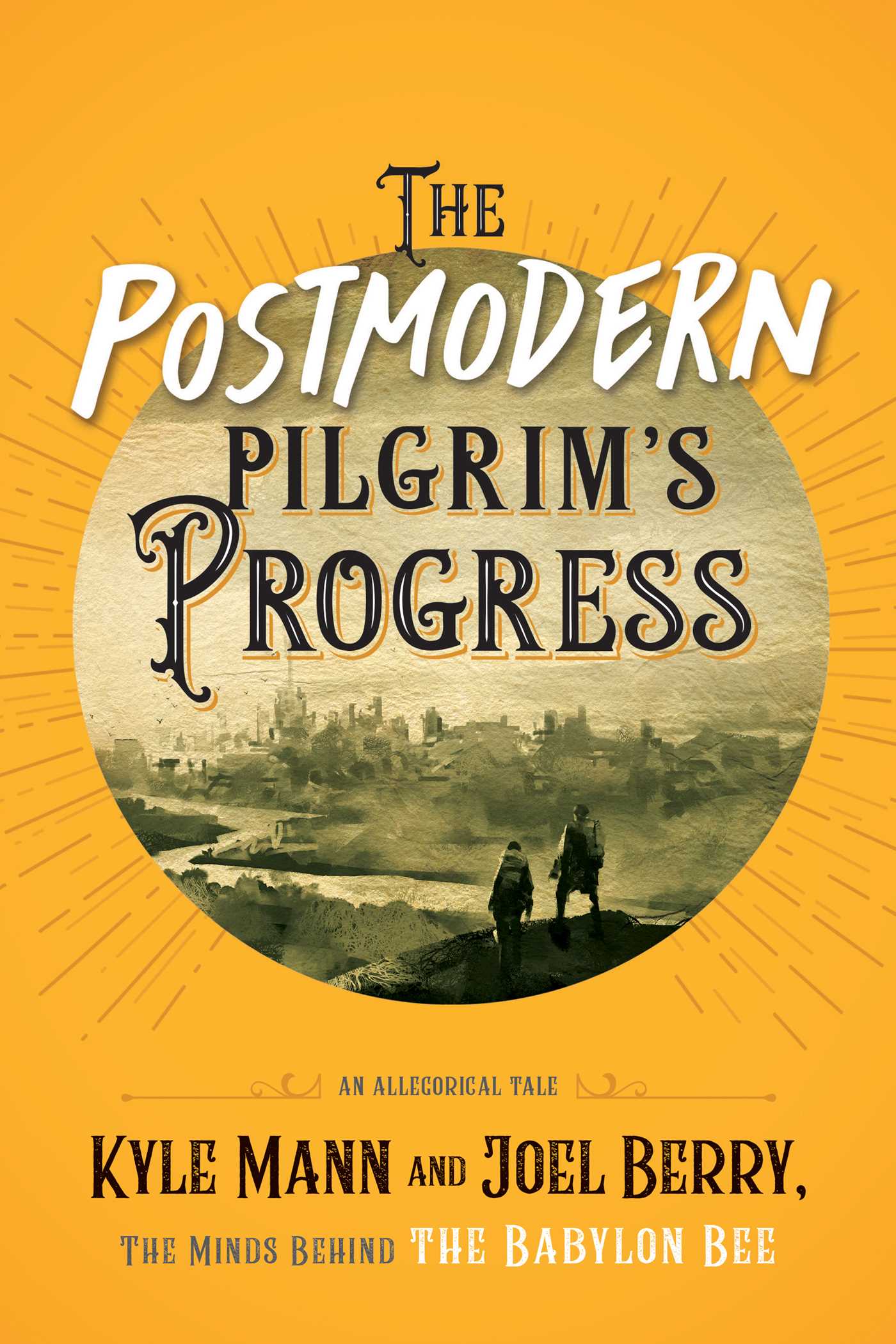
The Postmodern Pilgrim's Progress: An Allegorical Tale
From the editor-in-chief and managing editor of the Babylon Bee! A millennial seeker travels through a twenty-first century take on The Pilgrim's Progress with allegorical versions of all our modern vices tempting him along the way—as well as a few timeless personified virtues that just might see him through. Biting satire and uncommon wisdom from the creators of the internet's most influential comedy site, and an author of national bestsellerThe Babylon Bee Guide to Wokeness!
Ryan Fleming is a young agnostic reeling from his brother’s death. Though he is deeply angry with God, he makes good on a promise he made to his brother in the final moments of his life: to visit a church at least once. But shortly after his arrival, the slick megachurch’s shoddily installed video projector falls on his head—sending Ryan through a wormhole into another world.
After a narrow escape from the City of Destruction, where the comfortably numb townspeople are oblivious to the fire and brimstone falling like bombs in their midst and destroying their homes, Ryan finds himself on a quest: To make it back to his own universe, he must partner with a woman named Faith to awaken a long-sleeping King—the World-Maker who can make all things new.
Replete with characters ripped straight from the twenty-first century American church—including Radical, Mr. Satan, the Smiling Preacher, and others—this sometimes-humorous, always-insightful trek parallels Christian’s fictional journey in Pilgrim’s Progress. Prepare to laugh, cry, cringe, feel convicted, and ultimately be changed by the time the story ends.
Ryan Fleming is a young agnostic reeling from his brother’s death. Though he is deeply angry with God, he makes good on a promise he made to his brother in the final moments of his life: to visit a church at least once. But shortly after his arrival, the slick megachurch’s shoddily installed video projector falls on his head—sending Ryan through a wormhole into another world.
After a narrow escape from the City of Destruction, where the comfortably numb townspeople are oblivious to the fire and brimstone falling like bombs in their midst and destroying their homes, Ryan finds himself on a quest: To make it back to his own universe, he must partner with a woman named Faith to awaken a long-sleeping King—the World-Maker who can make all things new.
Replete with characters ripped straight from the twenty-first century American church—including Radical, Mr. Satan, the Smiling Preacher, and others—this sometimes-humorous, always-insightful trek parallels Christian’s fictional journey in Pilgrim’s Progress. Prepare to laugh, cry, cringe, feel convicted, and ultimately be changed by the time the story ends.
224 pages, Paperback
Published June 7, 2022
Ratings & Reviews
Friends & Following
Create a free account to discover what your friends think of this book!
Community Reviews
Displaying 1 - 30 of 220 reviews

May 30, 2022
This book though! I've already started a list of people who I want to buy it for. It's written so well for the casual and non-reader; I love that! And as an avid reader I also enjoyed reading it. It's lessons are well-placed and relatable in today's society.
The main characters are great and the notable caricature characters are spot on.
I'm definitely going to have my older gent read it and discuss it with me. He has already read the Bunyan classic. I'm currently reading Helen Taylor's classic 'Little Pilgrims Progress' aloud to his little brother and he's listening, too. Thank you for writing this book for the modern casual reader, Kyle and Joel!
PS. How IS one supposed to pronounce Evangelion?! 🤔
The main characters are great and the notable caricature characters are spot on.
I'm definitely going to have my older gent read it and discuss it with me. He has already read the Bunyan classic. I'm currently reading Helen Taylor's classic 'Little Pilgrims Progress' aloud to his little brother and he's listening, too. Thank you for writing this book for the modern casual reader, Kyle and Joel!
PS. How IS one supposed to pronounce Evangelion?! 🤔
May 10, 2022
After reading some of the previous comments I have come to the reality that I read for a completely different reason than these commenters. I have very little spare time so when I signed up to early read this book it was because it interested me.
The world needs satire. The Postmodern pilgrim’s Progress: An Allegorical Tale was a fun read in light of the times. I am not an English Major or a professional literary analyst, but the authors were able to take a classic and tweak it forward. In my humble opinion they nailed it with their allegory considering the times in which we live. From my perspective being pulled into a wormhole where relativism rules, bad actors dressed as good people, and personal pleasure is the common goal, doesn’t seem any different than our reality.
I am a Christian, and I live my life based on the Holy Bible. I identified with Faith; neither hers nor Matty’s deaths were particularly sad because they were Christians, just pilgrims passing through this world.
Bottom line is I loved the book!
The world needs satire. The Postmodern pilgrim’s Progress: An Allegorical Tale was a fun read in light of the times. I am not an English Major or a professional literary analyst, but the authors were able to take a classic and tweak it forward. In my humble opinion they nailed it with their allegory considering the times in which we live. From my perspective being pulled into a wormhole where relativism rules, bad actors dressed as good people, and personal pleasure is the common goal, doesn’t seem any different than our reality.
I am a Christian, and I live my life based on the Holy Bible. I identified with Faith; neither hers nor Matty’s deaths were particularly sad because they were Christians, just pilgrims passing through this world.
Bottom line is I loved the book!
This entire review has been hidden because of spoilers.

May 8, 2022
Being familiar with Kyle and Joel's output in The Babylon Bee, I came in with low expectations and honestly, this book failed to dissappoint.
I'm not sure how to classify this book - it riffs on the essential storyline of John Bunyan's classic tale, but is it a parody? An homage? Whatever it is, it does a poor job.
Interestingly, the authors are very much aware of the low-effort and poor-quality nature of the work: the book opens with "An Introduction by the Narrator", an angel who introduces themself by apologising for their lack of skill with the English language. In the following chapter they also observe their lack of empathy whilst treating a teenager's horrific death by cancer with callous indifference. The death scene in particular sets the tone: it's horrific, made worse by the insertion of the child's youth pastor who blunders in throwing around worthless platitudes. I assume the intended tone is one of horror, but the ridiculousness of the characters and the wooden dialogue comes across as a poorly considered attempt at comedy. That this bizarre mood confusion is repeated mere pages later when our protagonist engages in an angry and understandable rant against an overblown parody of a megachurch preacher moments before a Panasonic (why the brand callout? Is there an undisclosed sponsorship deal, or this perhaps some sort of in-joke?) LCD projector falls on his head, resulting in the dream that makes up the narrative to follow.
From here the story places Ryan in the position of Christian, the protagonist of the original Pilgrim's Progress. Awakening in "the city of destruction" shortly prior to the arrival of a meteor, he sets out on a quest mirroring the locations of the original novel, albeit with a new and changed cast of archetypes. An interesting stylistic choice of note is that Kyle and Joel chose not to mimic the scripted dialogue format of the original book - perhaps recognising that such didactic writing is beyond their ability, they choose instead to follow a more conventional style of the sort found in common fantasy parodies. Unfortunately this also results in a loss of clarity - whereas Bunyon's characters are clear and identifiable archetypes, Mann and Berry's are often not entirely clear as to the targets of their ire.
The more generous reviewer might suggest that this poorness of English is that point - that the "postmodern" of the title refers specifically to the genre of literature, and that the use of a dislikable narrator who regularly breaks the fourth wall, the footnotes referencing random facts on a wider world (bringing to mind an unfunny Douglas Adams) and drawing attention to film references, and the general ambiguity of the alleged allegory being an intentional stylistic choice. If so, the authors should be applauded for such a daring break from the usual texts expected by their target audience.
Whether this suggestion is correct or over generous, the point stands that it is unclear who this book is aimed at: much of the narrative relies on hewing closely to the plot of the original book, at least enough to reference it in a way that will be familiar to fans. The bulk of the text, however, is made up of references to pop culture, to various 20th and 21st century subculutres, and to a very specific American conservative evangelical worldview. The authors seem to believe that they're sharing a teachable moment or an important message, yet it seems that to fully grasp that message requires one to already be in the camp that agrees with it. If nothing else, that the "praise" at the beginning from various individuals often emphasises how funny they found the book, I suspect the target audience includes those with a very poor sense of humour.
2 stars because there are occasional sparks of "this was a good idea or had potential but shame about the execution".
I'm not sure how to classify this book - it riffs on the essential storyline of John Bunyan's classic tale, but is it a parody? An homage? Whatever it is, it does a poor job.
Interestingly, the authors are very much aware of the low-effort and poor-quality nature of the work: the book opens with "An Introduction by the Narrator", an angel who introduces themself by apologising for their lack of skill with the English language. In the following chapter they also observe their lack of empathy whilst treating a teenager's horrific death by cancer with callous indifference. The death scene in particular sets the tone: it's horrific, made worse by the insertion of the child's youth pastor who blunders in throwing around worthless platitudes. I assume the intended tone is one of horror, but the ridiculousness of the characters and the wooden dialogue comes across as a poorly considered attempt at comedy. That this bizarre mood confusion is repeated mere pages later when our protagonist engages in an angry and understandable rant against an overblown parody of a megachurch preacher moments before a Panasonic (why the brand callout? Is there an undisclosed sponsorship deal, or this perhaps some sort of in-joke?) LCD projector falls on his head, resulting in the dream that makes up the narrative to follow.
From here the story places Ryan in the position of Christian, the protagonist of the original Pilgrim's Progress. Awakening in "the city of destruction" shortly prior to the arrival of a meteor, he sets out on a quest mirroring the locations of the original novel, albeit with a new and changed cast of archetypes. An interesting stylistic choice of note is that Kyle and Joel chose not to mimic the scripted dialogue format of the original book - perhaps recognising that such didactic writing is beyond their ability, they choose instead to follow a more conventional style of the sort found in common fantasy parodies. Unfortunately this also results in a loss of clarity - whereas Bunyon's characters are clear and identifiable archetypes, Mann and Berry's are often not entirely clear as to the targets of their ire.
The more generous reviewer might suggest that this poorness of English is that point - that the "postmodern" of the title refers specifically to the genre of literature, and that the use of a dislikable narrator who regularly breaks the fourth wall, the footnotes referencing random facts on a wider world (bringing to mind an unfunny Douglas Adams) and drawing attention to film references, and the general ambiguity of the alleged allegory being an intentional stylistic choice. If so, the authors should be applauded for such a daring break from the usual texts expected by their target audience.
Whether this suggestion is correct or over generous, the point stands that it is unclear who this book is aimed at: much of the narrative relies on hewing closely to the plot of the original book, at least enough to reference it in a way that will be familiar to fans. The bulk of the text, however, is made up of references to pop culture, to various 20th and 21st century subculutres, and to a very specific American conservative evangelical worldview. The authors seem to believe that they're sharing a teachable moment or an important message, yet it seems that to fully grasp that message requires one to already be in the camp that agrees with it. If nothing else, that the "praise" at the beginning from various individuals often emphasises how funny they found the book, I suspect the target audience includes those with a very poor sense of humour.
2 stars because there are occasional sparks of "this was a good idea or had potential but shame about the execution".

June 1, 2022
Between 1672 - 1677, John Bunyan penned a book in the confines of a jail cell. Pilgrim’s Progress saw the light of day in 1678 and has since been translated into at least 200 languages and is arguably the best-selling book of all time (behind the Bible of course). Bunyan’s allegory is a theological tour de force that touches on a wide variety of topics from evangelism, to justification by faith alone, sanctification, temptation, discouragement, and our battle with sin.
Spurgeon drove this point home in one well-known remark about John Bunyan: “Why, this man is a living Bible!” Prick him anywhere; and you will find that his blood is Bibline, the very essence of the Bible flows from him. He cannot speak without quoting a text, for his very soul is full of the Word of God.”
Almost 350 later, the minds behind the Babylon Bee, Kyle Mann and Joel Berry have endeavored to write a new book that explores similar themes that were important to John Bunyan. The Postmodern Pilgrim’s Progress is a book for our times. Mann and Joel skillfully utilize the framework first created by Bunyan and manage to build a new story that addresses sin, anger, hypocrisy, discouragement, hope, fear, and the scourge of social justice - among other things.
The Postmodern Pilgrim’s Progress tackles subject matter that is unique to our day including the prosperity gospel, humanism, evolution, skepticism, and abortion.
The writing is typical Babylon Bee - witty, creative, and sarcastic. The authors demonstrate a good working knowledge of Bunyan’s work but are quick to draw the attention of readers to specific contemporary concerns that relate to postmodernism.
As usual, the Babylon dudes have written a real winner. My hope is that young readers will gobble up The Postmodern Pilgrim’s Progress and move on to read the original.
Spurgeon drove this point home in one well-known remark about John Bunyan: “Why, this man is a living Bible!” Prick him anywhere; and you will find that his blood is Bibline, the very essence of the Bible flows from him. He cannot speak without quoting a text, for his very soul is full of the Word of God.”
Almost 350 later, the minds behind the Babylon Bee, Kyle Mann and Joel Berry have endeavored to write a new book that explores similar themes that were important to John Bunyan. The Postmodern Pilgrim’s Progress is a book for our times. Mann and Joel skillfully utilize the framework first created by Bunyan and manage to build a new story that addresses sin, anger, hypocrisy, discouragement, hope, fear, and the scourge of social justice - among other things.
The Postmodern Pilgrim’s Progress tackles subject matter that is unique to our day including the prosperity gospel, humanism, evolution, skepticism, and abortion.
The writing is typical Babylon Bee - witty, creative, and sarcastic. The authors demonstrate a good working knowledge of Bunyan’s work but are quick to draw the attention of readers to specific contemporary concerns that relate to postmodernism.
As usual, the Babylon dudes have written a real winner. My hope is that young readers will gobble up The Postmodern Pilgrim’s Progress and move on to read the original.

May 28, 2022
What a fun book! I have read the original Pilgrim’s Progress several times. It is after all the second most read book ever after the Bible. I always wondered what it would have been like to read Pilgrim’s Progress when it first came out, and this would be close to what it must have been like. The author’s of the BabylonBee have written this version, it’s similar in the allegorical style like the original, but goes in directions that match the world we live in today.
This book was very enjoyable. I especially liked the second half where the allegory really takes off. I can see how some people would get frustrated with how straight and to the point this book is. Maybe upset by some of the things that it calls out. But that is where the genius of the book lies; calling out things that need to be called out. And I am sure the original was received this way as well.
Highly recommended
This book was very enjoyable. I especially liked the second half where the allegory really takes off. I can see how some people would get frustrated with how straight and to the point this book is. Maybe upset by some of the things that it calls out. But that is where the genius of the book lies; calling out things that need to be called out. And I am sure the original was received this way as well.
Highly recommended

February 9, 2025
I love Pilgrim’s Progress. I like the Babylon Bee. So a modern day remake should be right up my alley. But this book ain’t it. Sure, it has its bright spots (Radical and Mrs. Deconstruction come to mind), but overall the book fails on so many levels. I could forgive the silly writing style and the unlikable main character, but I can’t forgive such a low and debased view of the church. Christian made it to the Celestial City because of the all the help he encountered on the way (think of Evangelist, Help, Mr. Goodwill, The Interpreter, Discretion, Watchful, Piety, Prudence, Charity, Faithful, and Hopeful to name a few). But in this version, Ryan survives with just him and his “Faith.” Nothing else is needed it seems. In fact, in this story the church is a hindrance and blockade to arriving at the Golden City. Even the Pastor who helped at one point of the story turns out to be a serial adulterer who doesn’t make it in the end. I’m sure the writers didn’t intend this disparagement of Christ’s Church (at least I hope not), but that’s the way the book reads. Disappointed.

May 18, 2022
Think Pilgrim's Progress meets The Hitchhiker's Guide to the Galaxy! I laughed, I cried - it was better than Cats! haha! A sense of humor and an appreciation for satire are rare traits these days, but are helpful when enjoying this book. Thinly veiled references to Joel Osteen as the Smiling Preacher and typical mega churches with lyric screens and smoke machines had me laughing out loud! But it is also poignant and deals with deeper subjects such as suffering, loss, grief, crisis of faith, objective truth, etc. I classify it as "satirical allegory" and I thoroughly enjoyed the post-modern update to Pilgrim's Progress.
May 17, 2022
I am a regular guy who tries not to think he’s smarter than he actually is, who doesn’t want to bore you with a long drawn out review where I make it clear that I’m some type of snobbish book aficionado that uses big words and proper punctuation here is my full review:
I enjoyed it, you should read it. I think you will enjoy it as well. This is high praise.
This book conveys the core message of the original Pilgrims Progress in a way that people who aren’t regular readers can relate to and understand. It also brings the message across in a way that people who take themselves too seriously can enjoy, if they let their guard down a bit. It’s fun, easy to read, and written in a way that makes you want to keep reading it.
Stop reading this review and go read this book.
I enjoyed it, you should read it. I think you will enjoy it as well. This is high praise.
This book conveys the core message of the original Pilgrims Progress in a way that people who aren’t regular readers can relate to and understand. It also brings the message across in a way that people who take themselves too seriously can enjoy, if they let their guard down a bit. It’s fun, easy to read, and written in a way that makes you want to keep reading it.
Stop reading this review and go read this book.
May 30, 2022
A decent attempt but just too corny for my taste.
May 17, 2022
The book is a fast and fun read. Kyle Mann and Joel Berry bring a lot of wit and humor to this contemporary take on Bunyan’s classic Pilgrim’s Progress. I enjoyed it as a casual solo read but I think it would serve well as a book club read with any friends who may be interested in discussing how to press on a through the problems and pitfalls of this postmodern era.
May 29, 2022
The two things that interested me about this book was that it’s the retelling of an iconic Christian story, and it was written by the masterminds of The Babylon Bee. I joined the launch team promptly and had a wonderful week reading this book.
The Postmodern Pilgrim’s Progress: An Allegorical Tale is certainly an entertaining read, with funny references and witty undernotes that kept me peeking at the next page! The story is captivating, insightful, and made more relatable to the generation that needs this story the most.
One thing I will say about this book is that it strays away from the original Pilgrim’s Progress by John Bunyan. The Postmodern Pilgrim’s Progress: An Allegorical Tale covers all the important areas of the original story, but I thought it to be out of order, when comparing the two.
Nevertheless, this story makes up in other areas where I can recommend it to anyone. The allegory of The Postmodern Pilgrim’s Progress: An Allegorical Tale was pleasing to see. It wasn’t “overly religious”, but it was easy to understand and grasp. It is a reminder for Christian readers to faithfully stay on the path the Lord has made for them. This story can easily serve all readers and hopefully penetrate the hardest of hearts.
The Postmodern Pilgrim’s Progress: An Allegorical Tale is a book that I will be rereading! Thank you, Kyle Mann and Joel Berry for bringing this book to life!
The Postmodern Pilgrim’s Progress: An Allegorical Tale is certainly an entertaining read, with funny references and witty undernotes that kept me peeking at the next page! The story is captivating, insightful, and made more relatable to the generation that needs this story the most.
One thing I will say about this book is that it strays away from the original Pilgrim’s Progress by John Bunyan. The Postmodern Pilgrim’s Progress: An Allegorical Tale covers all the important areas of the original story, but I thought it to be out of order, when comparing the two.
Nevertheless, this story makes up in other areas where I can recommend it to anyone. The allegory of The Postmodern Pilgrim’s Progress: An Allegorical Tale was pleasing to see. It wasn’t “overly religious”, but it was easy to understand and grasp. It is a reminder for Christian readers to faithfully stay on the path the Lord has made for them. This story can easily serve all readers and hopefully penetrate the hardest of hearts.
The Postmodern Pilgrim’s Progress: An Allegorical Tale is a book that I will be rereading! Thank you, Kyle Mann and Joel Berry for bringing this book to life!
May 10, 2022
What a fascinating book! I encourage you to read it. As the title indicates, it is a modern retelling of the allegory Pilgrim’s Progress. The temptations along the way include: the Smiling Preacher who only has positive news to share, the House of Prosperity, Health & Wealth, Mr. Legalist, Mr. Political Engagement, Deconstruction, the Pleasure District, the Slippery Slope, the Valley of Doubt, Mr. Humanist, Mr. Loved-by-the-World, and Mr Theology, who spends all his time discussing and debating and never stepping into the community around him. This is a fun read, with many literary and cultural allusions, and laugh-out-loud jokes. But not to worry, the point is clearly and impactfully made about our culture and the many ways that it influences us. Have we lost our way to the Golden City? Can we make it through the pitfalls and dangers that beset us almost every step of the way?
May 11, 2022
The Postmodern Pilgrim’s Progress tells the story of an everyday schmuck who has suffered too much to believe in the existence of God. Rather than give up on him and let him fail, God sends an important vision into his life to teach him that our life on earth is a journey that is way too much for us to handle. The only way through it is to continue putting one foot in front of the other with God’s Word as your guide and faith that your Savior already did it all for you.

July 26, 2022
A bit cheesy (it's written by Babylon Bee editors, after all!) but overall a worthwhile read. Hits a lot of "modern vices" with humor and profundity. This postmodern pilgrim encounters contemporary issues: Chesterton's fence, slippery slopes, Systems, health and wealth, The Ivory tower, and much more.

October 5, 2024
I'm a fan of the Babylon Bee, but this didn't work for me. DNF
May 26, 2022
Since the price of gas is out of sight for your summer vacation, sit back and enjoy a journey so exciting and fun, you will want to make sure there are no sharp objects nearby. You'll be captivated by the story's life-like characters and settings. It may even read like your own personal biography. Like eating a mustard dog with relish for a change, appreciate the luck of a reading a heart-warming tale of pain and suffering, doubt and remorse and finally a few cries and laughter. It might help if you wore a helmet while reading this epic tome, because laughter can hurt if you express it too much. Plus it protects from falling objects. If you think that is enough of a story for you, you've got another thing coming. No good book leaves a mark on you unless it has a message, especially one so needed in today's world. It even reads like that other Good Book you may have heard about, except for the laughing parts. But we all need this message in these darkest of dystopian-filled times, er, I mean, the Biden presidency. So enjoy this message of ?, hope and even love. It may just empower you to go on a journey and live happily ever after. It might even give you the courage to ask that girl in the church parking lot for a date. There's just too many other virtues to highlight from the book that we'd have to write a book on them. Everyone needs to read this book to be reminded of God's love for all of us, even when we are lost or forget to wear a helmet.

Read
July 25, 2023Make some interesting and timely points about Christianity's relationship with today's world in a creative and insightful way. My fellow nerds may appreciate the multitudinous references to other theological, sci-fi, and fantasy works as well as current pop culture.
May 17, 2022
OK - I signed up to review this as an avid Babylon Bee fan, and a person that enjoyed Pilgrim's Progress with my kids and Sunday School class. If you're a sci-fi fan who'd read Hitchhiker's Guide to the Galaxy, this also has a familiar feel as being similar in some respects.
This is billed correctly as an updated, post-modern take on Pilgrim's Progress with recognizable current day religious pitfalls personified in its pages. The narrator "angel" does modern film references that are fun and recognizable overall and the footnote commentary is enjoyable. The story at times feels a bit disjointed as it jumps forward, but it is not overly so that it is hard to read. I found myself laughing out loud and unable to stop reading in some spots. Having read Pilgrim's Progress a few times, this is an easier read, more enjoyable and less heavy handed in its tone.
For me it was a great read, and I highly recommend it especially for your teen reader who is very quick to recognize and call out the stereotypes when they see them in the church universal. The snarky tone is less pronounced here than in some of the Bee's posts, but very mild sarcasm underneath, which for me makes it a better read. It must be written by a Gen-X'er as they speak "my language".
I am not what I consider a theological book snob so am not too concerned if they are exact with Pilgrim's Progress every nuance. I believe this is a fun modern take to make it an easier read for current generations so that they will actually pursue reading it for the meanings within. It is a worthwhile pursuit to engage generations going forward in faith and I applaud them for it. Thanks for a fun read, and now I'll have to order to some to give to my church friends who dearly love Pilgrim's Progress! But for now, I just need to finish reading it for myself! Back into it I go.
This is billed correctly as an updated, post-modern take on Pilgrim's Progress with recognizable current day religious pitfalls personified in its pages. The narrator "angel" does modern film references that are fun and recognizable overall and the footnote commentary is enjoyable. The story at times feels a bit disjointed as it jumps forward, but it is not overly so that it is hard to read. I found myself laughing out loud and unable to stop reading in some spots. Having read Pilgrim's Progress a few times, this is an easier read, more enjoyable and less heavy handed in its tone.
For me it was a great read, and I highly recommend it especially for your teen reader who is very quick to recognize and call out the stereotypes when they see them in the church universal. The snarky tone is less pronounced here than in some of the Bee's posts, but very mild sarcasm underneath, which for me makes it a better read. It must be written by a Gen-X'er as they speak "my language".
I am not what I consider a theological book snob so am not too concerned if they are exact with Pilgrim's Progress every nuance. I believe this is a fun modern take to make it an easier read for current generations so that they will actually pursue reading it for the meanings within. It is a worthwhile pursuit to engage generations going forward in faith and I applaud them for it. Thanks for a fun read, and now I'll have to order to some to give to my church friends who dearly love Pilgrim's Progress! But for now, I just need to finish reading it for myself! Back into it I go.

May 30, 2022
This book is packed with wit, intrigue, and humor while addressing how to live life. The references are brilliant and include quotes, songs, books, and movies from a wide variety of genres and time periods, from CS Lewis to the Holy Grail’s Black Knight to Charlie Daniels. I often catch myself having to go back and re-read to catch the deep threaded humor!

May 11, 2022
If you're looking for a book that follows literary norms then this allegory set in a fictional multiverse reality narrated by an alien-like creature who condescendingly critiques human nature and humbly expresses a lack of familiarity with human expressions, emotions, and experiences, then this one probably isn't for you.
If you're looking for a funny and imaginative analysis of many pitfalls American Christianity falls into, this might grab you and leave you confident in The One who works all things for your good.
*Spoilers below*
I appreciated how as the characters came closer to The King, The (capital B) Book's references became more solidly scriptural. I enjoyed the recasting of biblical stories in a different world and felt they were not forced. What good is Faith without works after all?!
The presentation of modern fallacies of both Christian and American culture in the fictional world caricatured in a eye opening way the ends to which wrong paths lead. In my opinion the allegory did a fair job of critiquing not only society but the many iterations of the modern Christian faith and it's notable failures as I know then.
I struggled at times to see the needed work of The King in the story but I wonder if that was on purpose as we don't always get to know how God works things toward His purposes. The ending does bring this home pretty well. If I could change one thing I would want the allegory to push the great exchange (forgiveness of all human sin by Christ's undeserved death on the cross) imagery further. But that may just be the Evangelion leaning in me.
This book might be best received by Christians who are familiar with Bunyan's Pilgrims Progress and Lewis' Pilgrim's Regress but it's been a long time since I read either and I believe the story stood well enough alone. But I feel any thinking Christian would benefit from reading this. I don't believe this book would serve as a good evangelism tool for a non-Christian, but perhaps for those who have lost the primacy of faith in their life this could serve as a good wake-up call.
I am glad to see this creative work. The church needs to lean into its imagination more, that is the mind's imaging of the realities revealed to us in The Book.
If you're looking for a funny and imaginative analysis of many pitfalls American Christianity falls into, this might grab you and leave you confident in The One who works all things for your good.
*Spoilers below*
I appreciated how as the characters came closer to The King, The (capital B) Book's references became more solidly scriptural. I enjoyed the recasting of biblical stories in a different world and felt they were not forced. What good is Faith without works after all?!
The presentation of modern fallacies of both Christian and American culture in the fictional world caricatured in a eye opening way the ends to which wrong paths lead. In my opinion the allegory did a fair job of critiquing not only society but the many iterations of the modern Christian faith and it's notable failures as I know then.
I struggled at times to see the needed work of The King in the story but I wonder if that was on purpose as we don't always get to know how God works things toward His purposes. The ending does bring this home pretty well. If I could change one thing I would want the allegory to push the great exchange (forgiveness of all human sin by Christ's undeserved death on the cross) imagery further. But that may just be the Evangelion leaning in me.
This book might be best received by Christians who are familiar with Bunyan's Pilgrims Progress and Lewis' Pilgrim's Regress but it's been a long time since I read either and I believe the story stood well enough alone. But I feel any thinking Christian would benefit from reading this. I don't believe this book would serve as a good evangelism tool for a non-Christian, but perhaps for those who have lost the primacy of faith in their life this could serve as a good wake-up call.
I am glad to see this creative work. The church needs to lean into its imagination more, that is the mind's imaging of the realities revealed to us in The Book.
This entire review has been hidden because of spoilers.

May 22, 2022
The Postmodern Pilgrim’s Progress is a joyous and thought provoking re-imagining of the classic work by John Bunyan. And I must say, it was time for a tale of this sort, grounded in the reality of the modern church experience and addressing the pitfalls of walking (or slogging) through the Christian life today. I think my favorite thing about the book is the interaction between Ryan (or Christian) and Faith, his helper and fellow traveler. We need the prodding and encouragement of fellow believers on our journey, and their relationship is a beautiful picture of how we should help and challenge our brothers and sisters in Christ. Each character and each temptation make a deep point, but with much humor. And of course, the narrator is another favorite. This delightfully written, fast paced tale is one I will read again and again - for enjoyment and edification. Enjoy!
May 18, 2022
I highly recommend this book especially for this point in time. I found that reading three other books made this much easier for me. The first was the original by Bunyon, A Pilgrim's Progress, the second a book by C. S. Lewis of his own journey, A Pilgrim's Redress and finally, the one that made the "narration" and the "narrator" much easier to embrace, A Hitchhiker's Guide to the Galaxy.
I quite literally could not put this book down and every time there was a short "lull" in the day's activities, I went back to it. It is easy to read and understand and the points it makes regarding our own situation in these very dark days are a "must" for all who do not wish to be destroyed in what is coming . . .
I quite literally could not put this book down and every time there was a short "lull" in the day's activities, I went back to it. It is easy to read and understand and the points it makes regarding our own situation in these very dark days are a "must" for all who do not wish to be destroyed in what is coming . . .
May 17, 2022
This illustration of what we all go through in our lives is an entertaining read. The story highlights the doubts, struggles, and temptations people go through on our search for truth, hope, light and our path to God and His kingdom. The road is not easy but rewarding for the hero of the story, Ryan. He successfully fights through hardships and near death as he journeys toward meeting our maker. The book is written with humor and intrigue - enjoyable for Junior High and up. I highly recommend this tale of struggle, realization, and succeeding.
May 19, 2022
An entertaining read that will open your eyes about the state of the world we currently live in. From people gleefully sliding down the slippery slope to the devil whispering that "you are not good enough", it is an accurate portrayal of the Christian journey during these crazy times. The King knows we are not good enough to complete the journey. All he asks is that we are faithful, don't look back and keep moving forward.
May 17, 2022
I was thoroughly impressed with this book; it's the first time in a while a book has managed to make me cry. I love the "postmodern" spin on the original story - it makes the concepts even more relatable to the forces at play in today's world that a pilgrim is more likely to encounter. The humor provided by the narrator is excellent as well, I laughed far more than I expected.

May 17, 2022
Very clever take on the 400 year old Pilgrim's Progress. I read the whole book in a Toyota dealership and didn't put it down. Compelling.
May 10, 2022
Should you read it? Yes you should. Entertaining and thought provoking. Not great ‘literature’ but what can you expect from a celestial being not that familiar with, but learning about, earth culture. Good job, guys.
May 21, 2022
Truthfully accurate, yet satirical & comical read (like only BB writers can do;)— includes many of the trials & falsehoods of current culture against today’s King followers; all set against the classical background of original text from Bunyan. BB Mann and Berry cover the many questions everyone faces like: why does a good God allow evil, are there many roads are to God, the prosperity promise movement, & mankind’s born good/evil debate— all the while reminding readers of truth, reality, and hope found in the King alone.

June 18, 2024
The Postmodern Pilgrim’s Progress is a retelling of John Bunyan’s classic allegory The Pilgrim’s Progress, set in our modern world. Ryan, to fulfill a promise to his dead brother, goes to the church nearest him. While there, after screaming at the prosperity-gospel pastor, a projector falls on his head and knocks him into another world.
Ryan and his sidekick Faith go on an epic adventure to find a king, ring a bell, and save The Dying Lands.
When I was a kid, my favorite book was The Pilgrim’s Progress. I read and re-read it, pretended I was Christian (I always made my little sister the villains), and longed for a time when I could go on a quest as amazing as Christian’s.
I also love The Babylon Bee, though they push the sarcasm limits sometime. I was excited to read this book, but I didn’t have high hopes. I was pleasantly surprised. It is hilarious without being overly sarcastic and crude.
"Projectors are like hymn books, except they are an average of 123,400 percent more expensive. They are used to help humans follow along with the music because their memories are very poor. The only thing worse than a human’s memory is his attention span, which the projector remedies by adding flashing lights and pictures of clouds to the worship lyrics. It’s odd that they even need this, considering the song that morning consisted of a single line sung forty-eight times. Humans are such limited creatures."
Oh, that’s so true. Ouch.
Ryan wasn’t a very interesting MC, and his character arch was a little cliché, but I liked that he was just an ordinary guy. Nothing special. No “chosen one”. He had no clue what he was doing. He didn’t want to find himself in the situation he was in. He was a failure, he wanted to quit, he wanted to walk away from it all. There is something comforting about un-heroic heroes.
Faith was also a bit of the faithful, loyal, can-do-no-wrong, cliché sidekick. I wish they had included more of her backstory, but she was a cute character and I loved how similar she was to Faithful in Pilgrim’s Progress.
The Narrator is an otherworldly being who works writing and archiving stories from the various universes and galaxies. He was given the task of writing down Ryan’s story. I love the touch; it is so funny! He says so many great, hilarious things. He was my favorite character.
This book followed the storyline of The Pilgrim’s Progress closely. It is “updated” for our modern world, but the truths that were in the original story are still here in this book. It is a hard-hitting novel that should wake us up to the reality of the Dying Lands that we live in today.
CW: violence (goring, slashing, cutting, burning, people being flattened with stones, etc.) It’s not graphic or gory, but there is a lot of violence. Death. Alcohol, drug, and porn use mentioned in passing.
Ryan and his sidekick Faith go on an epic adventure to find a king, ring a bell, and save The Dying Lands.
When I was a kid, my favorite book was The Pilgrim’s Progress. I read and re-read it, pretended I was Christian (I always made my little sister the villains), and longed for a time when I could go on a quest as amazing as Christian’s.
I also love The Babylon Bee, though they push the sarcasm limits sometime. I was excited to read this book, but I didn’t have high hopes. I was pleasantly surprised. It is hilarious without being overly sarcastic and crude.
"Projectors are like hymn books, except they are an average of 123,400 percent more expensive. They are used to help humans follow along with the music because their memories are very poor. The only thing worse than a human’s memory is his attention span, which the projector remedies by adding flashing lights and pictures of clouds to the worship lyrics. It’s odd that they even need this, considering the song that morning consisted of a single line sung forty-eight times. Humans are such limited creatures."
Oh, that’s so true. Ouch.
Ryan wasn’t a very interesting MC, and his character arch was a little cliché, but I liked that he was just an ordinary guy. Nothing special. No “chosen one”. He had no clue what he was doing. He didn’t want to find himself in the situation he was in. He was a failure, he wanted to quit, he wanted to walk away from it all. There is something comforting about un-heroic heroes.
Faith was also a bit of the faithful, loyal, can-do-no-wrong, cliché sidekick. I wish they had included more of her backstory, but she was a cute character and I loved how similar she was to Faithful in Pilgrim’s Progress.
The Narrator is an otherworldly being who works writing and archiving stories from the various universes and galaxies. He was given the task of writing down Ryan’s story. I love the touch; it is so funny! He says so many great, hilarious things. He was my favorite character.
This book followed the storyline of The Pilgrim’s Progress closely. It is “updated” for our modern world, but the truths that were in the original story are still here in this book. It is a hard-hitting novel that should wake us up to the reality of the Dying Lands that we live in today.
CW: violence (goring, slashing, cutting, burning, people being flattened with stones, etc.) It’s not graphic or gory, but there is a lot of violence. Death. Alcohol, drug, and porn use mentioned in passing.
June 2, 2022
This book is worth your time and money. If you've read Bunyan's Pilgrim's Progress, or CS Lewis' The Pilgrim's Regress, then you're familiar with the basic thrust of Postmodern Pilgrim's Progress (except that Postmodern is easier and faster to read). It's an allegory, a form which is more difficult to do well than most people realize. And sometimes this book bogs down in humor too cute for words, or is a little heavy-handed (a common trait of allegory), but it still makes its point well. My gut feeling is that this book is far more accessible to moderns than the other two, and for that reason I'm glad it was written. Plow through the first third of the book, even if it seems a little overdone, and you will be rewarded. By the time you get to the final chapters, you won't want to put it down -- even though you're pretty sure you know how it's going to end. I think that's the mark of a good book.
One device I thoroughly enjoyed is the 1-2 quotes that head up each chapter. It's worth reading the book just to see how these are employed; really pithy and just might introduce you to some new authors.
I would have no trouble handing this book to a child in upper elementary grades; the material covered would be acceptable to mainstream Christian religions and would probably spark some really good conversation. Definitely would be useful in high school religion classes. At the same time, I didn't feel that it was talking down to me as an adult, and I would be comfortable recommending it to my contemporaries. The descriptions of the protagonist's anger at God were fairly raw but easy to identify with, and set the stage for all that follows.
The book gets 4 stars because 5 stars are for authors like CS Lewis, and this book's not quite at that level. Some of the asides of the narrator get a little annoying, but that's just me; others will find them really hilarious or sometimes thought-provoking.
It's a great book for summer reading especially, since it goes quickly yet still gives you a lot to think about. I suspect everyone who reads it will find at least one scene which sticks in the memory because it mirrors a personal struggle. If you're a fan of the Babylon Bee, the depth of this book might surprise you, but you'll recognize the humor. Happy to add this one to my bookshelf of Christian fiction.
One device I thoroughly enjoyed is the 1-2 quotes that head up each chapter. It's worth reading the book just to see how these are employed; really pithy and just might introduce you to some new authors.
I would have no trouble handing this book to a child in upper elementary grades; the material covered would be acceptable to mainstream Christian religions and would probably spark some really good conversation. Definitely would be useful in high school religion classes. At the same time, I didn't feel that it was talking down to me as an adult, and I would be comfortable recommending it to my contemporaries. The descriptions of the protagonist's anger at God were fairly raw but easy to identify with, and set the stage for all that follows.
The book gets 4 stars because 5 stars are for authors like CS Lewis, and this book's not quite at that level. Some of the asides of the narrator get a little annoying, but that's just me; others will find them really hilarious or sometimes thought-provoking.
It's a great book for summer reading especially, since it goes quickly yet still gives you a lot to think about. I suspect everyone who reads it will find at least one scene which sticks in the memory because it mirrors a personal struggle. If you're a fan of the Babylon Bee, the depth of this book might surprise you, but you'll recognize the humor. Happy to add this one to my bookshelf of Christian fiction.
Displaying 1 - 30 of 220 reviews