

What do you think?

Chronicles of Brother Cadfael #18
Lato Duńczyków
Cadfael jest zachwycony, mogąc towarzyszyć swemu młodemu przyjacielowi, bratu Markowi, w kościelnej misji dyplomatycznej do swej rodzinnej Walii. Niestety, wkrótce po przybyciu na miejsce obaj zakonnicy zostają uwikłani w waśń domową: walijski książę Owain Gwynedd skazał na wygnanie swego brata Cadwaladra, oskarżając go o zdradzieckie zamordowanie sprzymierzeńca. Nieustępliwy Cadwaladr odpowiada sprowadzeniem armii duńskich najemników, by najechać Walię i odzyskać swe utracone ziemie.
Gdy dwie armie stają w obliczu krwawej wojny domowej, Duńczycy biorą do niewoli Cadfaela. Jego towarzyszką jest młoda kobieta uciekająca przed zaaranżowanym małżeństwem i być może wplątana w morderstwo na dworze Owaina. Zanim jednak Cadfael zdoła rozwikłać splot namiętności, które doprowadziły do tej śmierci, musi przetrwać ów braterski spór, który może pogrążyć całą Walię w chaosie...
Gdy dwie armie stają w obliczu krwawej wojny domowej, Duńczycy biorą do niewoli Cadfaela. Jego towarzyszką jest młoda kobieta uciekająca przed zaaranżowanym małżeństwem i być może wplątana w morderstwo na dworze Owaina. Zanim jednak Cadfael zdoła rozwikłać splot namiętności, które doprowadziły do tej śmierci, musi przetrwać ów braterski spór, który może pogrążyć całą Walię w chaosie...
320 pages, Paperback
First published April 1, 1991
About the author
Ellis Peters
177 books1,185 followersA pseudonym used by Edith Pargeter.
Edith Mary Pargeter, OBE, BEM was a prolific author of works in many categories, especially history and historical fiction, and was also honoured for her translations of Czech classics; she is probably best known for her murder mysteries, both historical and modern. Born in the village of Horsehay (Shropshire, England), she had Welsh ancestry, and many of her short stories and books (both fictional and non-fictional) were set in Wales and its borderlands.
During World War II, she worked in an administrative role in the Women's Royal Naval Service, and received the British Empire Medal - BEM.
Pargeter wrote under a number of pseudonyms; it was under the name Ellis Peters that she wrote the highly popular series of Brother Cadfael medieval mysteries, many of which were made into films for television.
Edith Mary Pargeter, OBE, BEM was a prolific author of works in many categories, especially history and historical fiction, and was also honoured for her translations of Czech classics; she is probably best known for her murder mysteries, both historical and modern. Born in the village of Horsehay (Shropshire, England), she had Welsh ancestry, and many of her short stories and books (both fictional and non-fictional) were set in Wales and its borderlands.
During World War II, she worked in an administrative role in the Women's Royal Naval Service, and received the British Empire Medal - BEM.
Pargeter wrote under a number of pseudonyms; it was under the name Ellis Peters that she wrote the highly popular series of Brother Cadfael medieval mysteries, many of which were made into films for television.
Ratings & Reviews
Friends & Following
Create a free account to discover what your friends think of this book!
Community Reviews
Displaying 1 - 30 of 368 reviews

May 8, 2021
It is 1144 and the civil war in England continues between King Stephen and the Empress Maud. As for myself, I am a bit sad knowing that these chronicles of the Benedictine Abbey of Saint Peter and Saint Paul and of one of its brothers, Cadfael, are coming to an end.*
Cadfael is not affected by my mood. On this day in Spring, he is “full of mild good intentions to all men” and “cautious optimism” concerning his world. Though, “(it) is a blessed thing, on the whole, to live in slightly dull times, especially after disorder, siege, and bitter contention. But there was still a morsel somewhere in Cadfael that itched if the hush continued too long. A little excitement, after all need not be mischief…”
Cadfael, if this is your first encounter with him, is Welsh and a former Crusader who chose the life of the Abbey rather late in life. He tends his garden (which contains as many plants useful to medicants as he can find). And, when the situation demands, he can help determine the cause of death and even the culprit or culprits responsible. This particular installment gives us a big addition to Cadfael’s early youth in Wales.
In this historically accurate series, we benefit from the author’s skill at description and characterization. Here is a sample, though not of Brother Cadfael:
“A little man, of slender bones and lean but wiry flesh, as diminutive as a sixteen-year-old boy and looking very much like one, until discerning attention discovered the quality and maturity of the oval, beardless face. A Benedictine like these his brothers, tonsured and habited, he stood erect in a dignity of his office and the humility and simplicity of his nature, as fragile as a child and as durable as a tree. His straw-colored ring of cropped hair had an unruly spikiness, recalling the child. His grey eyes, formidably direct and clear, confirmed the man.”
Peters is a great demonstrator of the maxim: action derives from character. This book is as good an example of this as we have. The above description is of Brother Mark, a former member of this abbey’s brotherhood but now representing the higher ecclesiastical powers. The initial mission is to fortify ties between the English church and those bishops in Wales. However, the focus changes when the leader of the Welsh and his estranged brother come into conflict (albeit with an obligatory murder to add to the tension). This is a study of fealty and loyalty played out among several individuals.
I would like to note that Peters provides descriptions of the countryside (and towns) that are equally helpful and delightful.
“They emerged into the green, undulating meadows and bushy coverts along the riverside, the Dee (river) beside them reflecting back orange gleams from the west. Beyond the water a great grassy hill soared, crowned with the man-made contours of earthworks raised ages ago, and under the narrow wooden bridge the Dee dashed and danced over a stony bed…On the following day they crossed the river and climed over the treeless uplands from the valley of the Dee to the valley of the Clwyd, and there followed the stream at ease the length of the bright morning and into an afternoon of soft showers and willful gleams of sun…”
This book, unlike most of the series is not reflective of the civil war in England but focused on the events, politics, and personalities of Wales.
I read and enjoy the pace of other historical novelists such as Bernard Cornwell. But, if you are prepared to journey slowly and note everything that is there to experience, I believe that these Cadfael novels are some of the best ways to immerse oneself in that particular time and place. Having put this down, I am inclined to qualify it as follows: The story is not without action and the tension is ramped up nicely as we readers cannot be sure whether matters will be resolved by battle or by less bloody means. The exchanges between the characters reflect a wide range of emotions and we are left with a satisfying resolution. 4.5
*The author would likely have written more if she had lived longer.
Cadfael is not affected by my mood. On this day in Spring, he is “full of mild good intentions to all men” and “cautious optimism” concerning his world. Though, “(it) is a blessed thing, on the whole, to live in slightly dull times, especially after disorder, siege, and bitter contention. But there was still a morsel somewhere in Cadfael that itched if the hush continued too long. A little excitement, after all need not be mischief…”
Cadfael, if this is your first encounter with him, is Welsh and a former Crusader who chose the life of the Abbey rather late in life. He tends his garden (which contains as many plants useful to medicants as he can find). And, when the situation demands, he can help determine the cause of death and even the culprit or culprits responsible. This particular installment gives us a big addition to Cadfael’s early youth in Wales.
In this historically accurate series, we benefit from the author’s skill at description and characterization. Here is a sample, though not of Brother Cadfael:
“A little man, of slender bones and lean but wiry flesh, as diminutive as a sixteen-year-old boy and looking very much like one, until discerning attention discovered the quality and maturity of the oval, beardless face. A Benedictine like these his brothers, tonsured and habited, he stood erect in a dignity of his office and the humility and simplicity of his nature, as fragile as a child and as durable as a tree. His straw-colored ring of cropped hair had an unruly spikiness, recalling the child. His grey eyes, formidably direct and clear, confirmed the man.”
Peters is a great demonstrator of the maxim: action derives from character. This book is as good an example of this as we have. The above description is of Brother Mark, a former member of this abbey’s brotherhood but now representing the higher ecclesiastical powers. The initial mission is to fortify ties between the English church and those bishops in Wales. However, the focus changes when the leader of the Welsh and his estranged brother come into conflict (albeit with an obligatory murder to add to the tension). This is a study of fealty and loyalty played out among several individuals.
I would like to note that Peters provides descriptions of the countryside (and towns) that are equally helpful and delightful.
“They emerged into the green, undulating meadows and bushy coverts along the riverside, the Dee (river) beside them reflecting back orange gleams from the west. Beyond the water a great grassy hill soared, crowned with the man-made contours of earthworks raised ages ago, and under the narrow wooden bridge the Dee dashed and danced over a stony bed…On the following day they crossed the river and climed over the treeless uplands from the valley of the Dee to the valley of the Clwyd, and there followed the stream at ease the length of the bright morning and into an afternoon of soft showers and willful gleams of sun…”
This book, unlike most of the series is not reflective of the civil war in England but focused on the events, politics, and personalities of Wales.
I read and enjoy the pace of other historical novelists such as Bernard Cornwell. But, if you are prepared to journey slowly and note everything that is there to experience, I believe that these Cadfael novels are some of the best ways to immerse oneself in that particular time and place. Having put this down, I am inclined to qualify it as follows: The story is not without action and the tension is ramped up nicely as we readers cannot be sure whether matters will be resolved by battle or by less bloody means. The exchanges between the characters reflect a wide range of emotions and we are left with a satisfying resolution. 4.5
*The author would likely have written more if she had lived longer.

February 24, 2026
Every series should have a least favourite, and in the Cadfael Chronicles, it is the eighteenth. The Summer of the Danes is more of a historical fiction than a historical mystery. It rather concerns a battle between two royal brothers of Wales, where the younger one has sought the assistance of the Irish Danes to make demands on the ruling elder brother, who had fallen from favour due to his treachery. As a historical fiction, since the characters truly existed and a battle between the Welsh and Danes actually took place, this is a good story, even interesting. However, this Cadfael series is of the mystery genre, so we expect a mystery. And that was the major issue in this particular installment.
The mystery in The Summer in the Danes is too weak to the point of non-existence. A murder takes place mysteriously, of course. But except for a few thoughtful references to it now and then by Brother Cadfael and Brother Mark (yes, he returns for an adventure with Cadfael), there is no proper investigation into it until the criminal accepts his guilt in the last chapter. In truth, the murder-mystery felt at odds with the historical theme, in my opinion.
Cadfael plays a limited role in this chronicle. Since Peters had not worked much on the mystery, there was no active role for him to play. It is a personal preference, but I don't like Cadfael in a secondary assisting role. The action takes place in Wales, so we don't get to associate the recurring characters much except at the beginning. I didn't mind that so much because I enjoyed meeting some of the newcomers. But the inadequacy of Cadfael's participation in the story irked me a little.
Peters' writing also came as a big blow. Her easy and graceful flow of words was notably replaced by tedious repetitions. The same expressions were used again and again, which made me question whether she truly wrote it. I know she did, but I felt that way.
On a positive note, the story is brilliant as historical fiction. As a lover of history, I was so pleased to read of a past that I knew next to nothing about. It is this historical element that interested me and helped me through to the end. A few of the characters (historical and otherwise, especially the girl) also contributed to holding my interest in the story.
So you understand why I have mixed feelings about this particular chronicle in the series. In light of what the series stands for, The Summer of the Danes is my least favourite. Still, I enjoyed it as a good historical fiction.
More of my reviews can be found at http://piyangiejay.com/
The mystery in The Summer in the Danes is too weak to the point of non-existence. A murder takes place mysteriously, of course. But except for a few thoughtful references to it now and then by Brother Cadfael and Brother Mark (yes, he returns for an adventure with Cadfael), there is no proper investigation into it until the criminal accepts his guilt in the last chapter. In truth, the murder-mystery felt at odds with the historical theme, in my opinion.
Cadfael plays a limited role in this chronicle. Since Peters had not worked much on the mystery, there was no active role for him to play. It is a personal preference, but I don't like Cadfael in a secondary assisting role. The action takes place in Wales, so we don't get to associate the recurring characters much except at the beginning. I didn't mind that so much because I enjoyed meeting some of the newcomers. But the inadequacy of Cadfael's participation in the story irked me a little.
Peters' writing also came as a big blow. Her easy and graceful flow of words was notably replaced by tedious repetitions. The same expressions were used again and again, which made me question whether she truly wrote it. I know she did, but I felt that way.
On a positive note, the story is brilliant as historical fiction. As a lover of history, I was so pleased to read of a past that I knew next to nothing about. It is this historical element that interested me and helped me through to the end. A few of the characters (historical and otherwise, especially the girl) also contributed to holding my interest in the story.
So you understand why I have mixed feelings about this particular chronicle in the series. In light of what the series stands for, The Summer of the Danes is my least favourite. Still, I enjoyed it as a good historical fiction.
More of my reviews can be found at http://piyangiejay.com/

June 11, 2020
This is more an adventure story than the usual quiet world of Cadfael’s Shrewsbury monastery, as he sets out with Brother Mark on ecclesiastical business to Wales, adds in a search for a missing beautiful young woman, all three are captured and held hostage by Danes invading Wales and Cadfael is in prime position to observe all the negotiations between rival princes that may or may not lead to war.
Yes, there is a murder near the beginning of the story but, unusually, Cadfael isn’t actively engaged in finding the murderer who confesses near the end. The real driver of the story is the rivalry between Welsh princes and brothers, and there’s a predictable ending for the beautiful girl who ran away to avoid being married to a man she hadn’t chosen.
Yes, there is a murder near the beginning of the story but, unusually, Cadfael isn’t actively engaged in finding the murderer who confesses near the end. The real driver of the story is the rivalry between Welsh princes and brothers, and there’s a predictable ending for the beautiful girl who ran away to avoid being married to a man she hadn’t chosen.

January 23, 2022
Many years ago, there was a small bookstore on the North Shore of Chicago called Scotland Yard Books, specializing in mysteries. While this is not a genre where I spend a lot of reading time, I was able to meet a few prominent mystery writers there, Colin Dexter & Ellis Peters among them, listening to the authors talk about the gestation of their mystery tales, read from their books & then autographing copies for those in the audience.

This is how I came to own a copy of The Summer of the Danes. And while I have watched the Brother Cadfael mysteries countless times, featuring Derek Jacobi as the 12th century Benedictine monk, Cadfael, it seems to have taken me 30 years to finally get around to reading this particular tale in the anthology of Cadfael books by the late Ellis Peters. Alas, it was worth the wait!
At least for me, The Summer of the Danes began slowly with a conglomeration of medieval terminology & Welsh names. Once I printed out a map of Shropshire/Shrewsbury & the area west into Wales, following the action within the book was simplified, though I had to build a glossary of Welsh & other terms, as Bro. Cadfael, of Welsh origins, is enlisted by a young cleric named Mark on a mission away from his monastic community & into Welsh territory to Gwynedd & the coast, a sort of homecoming that Cadfael very much savors.
The Summer of the Danes is in fact far more a tale based on Welsh history than a typical Brother Cadfael "mystery tale", as it lacks an ongoing crime solution by Cadfael, or the implementation of his skill as the Benedictines' resident apothecary practitioner. Instead, Cadfael is primarily an observer, even while taken as a hostage in the midst of a fraternal & almost tribal Welsh struggle for control of the land, with one brother having opposed another by hiring Danish mercenaries based in Ireland.
However, as always, Bro. Cadfael acts as a kind of Greek chorus, commenting on life as he rides west from the monastery, even while a semi-willing & not mistreated hostage. This book is exceedingly well-phrased, as I trust is true of all of Ellis Peters' tales, with uplifting descriptions of people & their connections to each other, as well as the landscapes traversed.
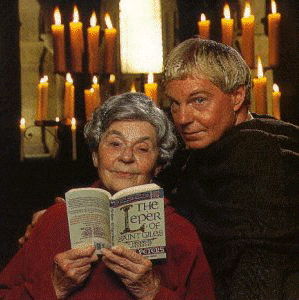
At one point, Cadfael comments: "the subtleties of the Welsh are probably wasted on a forthright & devout Norman." Later, he asks: "who could guess what might happen between bishop & bishop, stranger & native, between here & Bangor, one town & the next, between the ecclesiastical & the secular or between two feuding brothers." Every scene seems well-painted by the author, as in "with a courtesy so elaborate that it glittered into insolence." Early on, there is almost constant verbal jousting by the various characters, in a manner that foreshadows later violence.
The reader learns that many people encountered en route are "freeborn men of the tribe who own their land but not to do with it as they please, with the land descending within the family by a strict law of inheritance & with all paying communal dues." In fact, Cadfael himself was due to inherit Welsh land:
I don't wish to offer a recitation of the bad blood that exists between Owain & his brother Cadwaladr, with incidental skirmishes leading to battles, as rivalries unfold & alliances change shape but always, Ellis Peters makes her characters seem very tangible, including a woman named Heledd, the daughter of a priest no less, of whom it is said that "she loves her father as much as she hates him."
In fact, Heledd, a kind of Calamity Jane force within the novel & a member of the hostage party that includes Cadfael & his fellow monk, captured by Otir & the Danes, merely wants to choose her own destiny. To no one's surprise, Cadfael is very much with her in spirit.

And as always, Brother Cadfael, if not all-knowing, is constantly perceptive & the conveyor of a kind of moral code that the author seems to portray in each of her tales. Cadfael wryly acknowledges that "these Irish Danes have more of the Irish than the Dane in them after this time & Otir strikes me as Christian as most that inhabit England or Wales, even a good deal more Christian than some."
But just a hint of the novel's resolution:
Admittedly, books set in the 12th century that focus on a charming Benedictine monk with a fascinating, rather complex past are not for every reader but I found The Summer of the Danes a rather magical tale!
*Within my review are images of the author, Ellis Peters; the author with Derek Jacobi as Brother Cadfael; and a quote from Cadfael, taken from The Summer of the Danes. **I have found the 13 segment filmed encapsulation of the Cadfael tales & starring Derek Jacobi quite memorable.
This is how I came to own a copy of The Summer of the Danes. And while I have watched the Brother Cadfael mysteries countless times, featuring Derek Jacobi as the 12th century Benedictine monk, Cadfael, it seems to have taken me 30 years to finally get around to reading this particular tale in the anthology of Cadfael books by the late Ellis Peters. Alas, it was worth the wait!
At least for me, The Summer of the Danes began slowly with a conglomeration of medieval terminology & Welsh names. Once I printed out a map of Shropshire/Shrewsbury & the area west into Wales, following the action within the book was simplified, though I had to build a glossary of Welsh & other terms, as Bro. Cadfael, of Welsh origins, is enlisted by a young cleric named Mark on a mission away from his monastic community & into Welsh territory to Gwynedd & the coast, a sort of homecoming that Cadfael very much savors.
The Summer of the Danes is in fact far more a tale based on Welsh history than a typical Brother Cadfael "mystery tale", as it lacks an ongoing crime solution by Cadfael, or the implementation of his skill as the Benedictines' resident apothecary practitioner. Instead, Cadfael is primarily an observer, even while taken as a hostage in the midst of a fraternal & almost tribal Welsh struggle for control of the land, with one brother having opposed another by hiring Danish mercenaries based in Ireland.
However, as always, Bro. Cadfael acts as a kind of Greek chorus, commenting on life as he rides west from the monastery, even while a semi-willing & not mistreated hostage. This book is exceedingly well-phrased, as I trust is true of all of Ellis Peters' tales, with uplifting descriptions of people & their connections to each other, as well as the landscapes traversed.
At one point, Cadfael comments: "the subtleties of the Welsh are probably wasted on a forthright & devout Norman." Later, he asks: "who could guess what might happen between bishop & bishop, stranger & native, between here & Bangor, one town & the next, between the ecclesiastical & the secular or between two feuding brothers." Every scene seems well-painted by the author, as in "with a courtesy so elaborate that it glittered into insolence." Early on, there is almost constant verbal jousting by the various characters, in a manner that foreshadows later violence.
The reader learns that many people encountered en route are "freeborn men of the tribe who own their land but not to do with it as they please, with the land descending within the family by a strict law of inheritance & with all paying communal dues." In fact, Cadfael himself was due to inherit Welsh land:
Would you believe it now?--I did not want it. Good Welsh earth & I felt nothing for it. When the wool merchant from Shrewsbury offered me work that would give me license to see at least a few more miles of the world, I jumped at that open door, as I've jumped at most others that ever came my way. I was off as far as the world would take me & could not sit on one strip of earth lifelong.And with Bro. Cadfael's admission, I was reminded of T.S. Eliot's poetic statement that..."at the end of all our journeys, we will return to the place where we began but know the place for the first time." Amen to that & amen to Bro. Cadfael!
It took me half across the world before I understood. Life goes not in a straight line but in a circle. The first half we spend venturing as far as the world's end from home & kin & stillness, and the latter half brings us back, by roundabout ways but to the state from which we set out. So I end bound by a narrow vow to one narrow place.
I don't wish to offer a recitation of the bad blood that exists between Owain & his brother Cadwaladr, with incidental skirmishes leading to battles, as rivalries unfold & alliances change shape but always, Ellis Peters makes her characters seem very tangible, including a woman named Heledd, the daughter of a priest no less, of whom it is said that "she loves her father as much as she hates him."
In fact, Heledd, a kind of Calamity Jane force within the novel & a member of the hostage party that includes Cadfael & his fellow monk, captured by Otir & the Danes, merely wants to choose her own destiny. To no one's surprise, Cadfael is very much with her in spirit.
And as always, Brother Cadfael, if not all-knowing, is constantly perceptive & the conveyor of a kind of moral code that the author seems to portray in each of her tales. Cadfael wryly acknowledges that "these Irish Danes have more of the Irish than the Dane in them after this time & Otir strikes me as Christian as most that inhabit England or Wales, even a good deal more Christian than some."
But just a hint of the novel's resolution:
The Welsh who left their expendable homesteads for the hills at the approach of an enemy, left them only to return & rebuild, the husbandman would come back to his farmhouse, bringing his beasts with him, returning imperturbably, as always having outwaited, outrun & outlasted the marauding enemies.Upon returning home, Bro. Cadfael, who had once participated in a Crusade to the Holy Land, is asked if after a week of strict observance at the monastery, his feet might again "set out for nearby Saint Giles & end up in Jerusalem". He responds: "Oh no, not that!" And looking deep within himself, where old memories had survived but were never to be repeated & were no longer desirable, Cadfael adds with profound content: "When it comes down to it, as roads go, the road home is as good as any."
Admittedly, books set in the 12th century that focus on a charming Benedictine monk with a fascinating, rather complex past are not for every reader but I found The Summer of the Danes a rather magical tale!
*Within my review are images of the author, Ellis Peters; the author with Derek Jacobi as Brother Cadfael; and a quote from Cadfael, taken from The Summer of the Danes. **I have found the 13 segment filmed encapsulation of the Cadfael tales & starring Derek Jacobi quite memorable.

April 30, 2019
After a month of rereading various books in this series, not in order, I have come across the first that I gave 3 stars to originally, and I'm not surprised since it was the same this time. I enjoy the series, of course, but didn't enjoy this book as much as many others. I would even venture to say that I enjoyed it more the first time I read it, but it's still a 3 star like overall for me. There were one or two things I thought that weren't as well developed as in most of the others, but since this book has an average rating of over 4 stars I'm clearly in the minority. Plus I really didn't care to miss some of the regular characters (it's happened in other books that I've liked better, of course) in this installment because there just wasn't anyone I liked as much outside of Brothers Cadfael and Mark.
Original Review:
Brother Cadfael travels back to Wales to serve as translator for the young Brother Mark, a former helper of his. Cadfael ends up a prisoner of the Danes along with a young Welsh woman in a dispute between a pair of Welsh brothers. I will say no more since there is a book description, but to say that even at book number 18 I'm still enjoying these novels. The setting and story make for a different type of story than most as well.
Original Review:
Brother Cadfael travels back to Wales to serve as translator for the young Brother Mark, a former helper of his. Cadfael ends up a prisoner of the Danes along with a young Welsh woman in a dispute between a pair of Welsh brothers. I will say no more since there is a book description, but to say that even at book number 18 I'm still enjoying these novels. The setting and story make for a different type of story than most as well.

July 27, 2026
4.5, rounded up.
There is quiet at the moment between Stephen and Maude, and the Archbishop has appointed a new bishop at St. Asaph that sits astride the English-Welsh border. Brother Mark is sent by his bishop to deliver gifts of support to his new peer, and requests and is granted that Cadfael accompany him as a translator.
The new bishop, Gilbert, at St. Asaph is attempting to restore order to a religious area that has not had any for some time. Canon Meirion, Bishop Gilbert's right hand man, has not observed celibacy, which is not uncommon among the Welsh brothers, but has married and has a daughter. This is unacceptable to Gilbert. The wife has died, but the daughter is now an impediment to her father's service, so she is to be given in marriage to a man she has never seen–out of sight, out of mind.
What can go wrong? The fighting is at a stand-still, the problem of the canon should be shortly solved. Ah, but Cadfael’s path is never smooth, so when he and Mark arrive at St. Asaph, intrigues are already afoot, and murder is on the doorstep. Not to mention the beautiful daughter has no desire to marry a man she has never even seen.
This is one of the best Cadfael’s I have read. I did not solve the mystery of who committed the murder and why before it was revealed in the final chapter. The romance element is just perfectly done. As always, the characters elicit all the proper emotions. Everything does not always go the way I would wish, but it goes as it probably would have gone in the reality of medieval times. If I had any complaint, it would be there is not enough of Cadfael himself; I am already longing for more.
There is quiet at the moment between Stephen and Maude, and the Archbishop has appointed a new bishop at St. Asaph that sits astride the English-Welsh border. Brother Mark is sent by his bishop to deliver gifts of support to his new peer, and requests and is granted that Cadfael accompany him as a translator.
The new bishop, Gilbert, at St. Asaph is attempting to restore order to a religious area that has not had any for some time. Canon Meirion, Bishop Gilbert's right hand man, has not observed celibacy, which is not uncommon among the Welsh brothers, but has married and has a daughter. This is unacceptable to Gilbert. The wife has died, but the daughter is now an impediment to her father's service, so she is to be given in marriage to a man she has never seen–out of sight, out of mind.
What can go wrong? The fighting is at a stand-still, the problem of the canon should be shortly solved. Ah, but Cadfael’s path is never smooth, so when he and Mark arrive at St. Asaph, intrigues are already afoot, and murder is on the doorstep. Not to mention the beautiful daughter has no desire to marry a man she has never even seen.
This is one of the best Cadfael’s I have read. I did not solve the mystery of who committed the murder and why before it was revealed in the final chapter. The romance element is just perfectly done. As always, the characters elicit all the proper emotions. Everything does not always go the way I would wish, but it goes as it probably would have gone in the reality of medieval times. If I had any complaint, it would be there is not enough of Cadfael himself; I am already longing for more.

April 8, 2019
The Brother Cadfael mysteries may be my current favorite set of mysteries. The Summer of the Danes is the 18th in the series – although I haven't read all of the previous books and certainly am not attempting to read them in order. They are not roller coaster thrill rides, as modern mysteries often are; they are more easily described as historical fiction (this one is set in the summer of 1144), during which one or more unexplained deaths happen. Those deaths are rarely the central focus of the story.
In fact, there is rarely a single focus to the story. In this case, Brother Mark is sent on a diplomatic mission to Wales. He asked Brother Cadfael, who speaks Welsh, to join him. Of course, Cadfael does: It is a blessed thing, on the whole, to live in slightly dull times, especially after disorder, siege and bitter contention. But there was still a morsel somewhere in Cadfael that itched if the hush continued too long. (Loc. 46-47).
Their first stop was to see Bishop Gilbert, a newly-installed Norman bishop in Welsh territory, who doesn't understand Welsh rules or cultural norms. They picked up Heledd and her father, Meirion, who was canon to a Norman bishop. Imagine the discomfort to most that Meirion had had a wife and family – as had been acceptable. Canon Meirion apparently loved Heledd – and she him – but she was, erm, inconvenient, so he had decided to marry her off. He apparently found a worthy choice for her, but then as now, not everyone wants their father's choices.
The storm builds slowly, but it does not explode. Although there were several battles, probably fewer than ten soldiers died. It was a kinder and gentler time.
And so it goes: a murder, war, kidnappings, betrayals, an escape, some answers. But these are only the stage for Cadfael to observe and to muse. These are opportunities for us to consider human nature and life:
In fact, there is rarely a single focus to the story. In this case, Brother Mark is sent on a diplomatic mission to Wales. He asked Brother Cadfael, who speaks Welsh, to join him. Of course, Cadfael does: It is a blessed thing, on the whole, to live in slightly dull times, especially after disorder, siege and bitter contention. But there was still a morsel somewhere in Cadfael that itched if the hush continued too long. (Loc. 46-47).
Their first stop was to see Bishop Gilbert, a newly-installed Norman bishop in Welsh territory, who doesn't understand Welsh rules or cultural norms. They picked up Heledd and her father, Meirion, who was canon to a Norman bishop. Imagine the discomfort to most that Meirion had had a wife and family – as had been acceptable. Canon Meirion apparently loved Heledd – and she him – but she was, erm, inconvenient, so he had decided to marry her off. He apparently found a worthy choice for her, but then as now, not everyone wants their father's choices.
The storm builds slowly, but it does not explode. Although there were several battles, probably fewer than ten soldiers died. It was a kinder and gentler time.
And so it goes: a murder, war, kidnappings, betrayals, an escape, some answers. But these are only the stage for Cadfael to observe and to muse. These are opportunities for us to consider human nature and life:
“He meant nothing but good. He is a good man.”Ms. Peters' world is not a dichotomous one peopled by pure good and pure bad. The "enemy," at least those we meet, were wise and acted with honor. Some of the "good guys" were disloyal, expedient, and foolish; others were loyal, but had their values misaligned. Cadfael – and Peters – enjoy watching events roll out in a somewhat unpredictable manner, although step in as needed. Will, for example, Heledd marry Ieuan ab Ifor, one of the other men interested in her, or choose her own destiny? Will Owain Gwynedd reconcile with Cadwaladr, his charismatic and disloyal brother? Is Meirion so power hungry that he will fail to acknowledge and appreciate his so-deserving daughter? Wait and see.
“But not a wise one.” (Loc. 679-680)

December 21, 2020
It is early summer, 1144, and Cadfael is off on an adventure. He is accompanying young Brother Mark, who is being sent into Wales as Bishop de Clinton's emissary to the newly installed Bishop Gilbert of Llanelwy. Cadfael's role on the mission of ecclesiastical diplomacy is that of translator and assistant. Cadfael is always happy for an excuse to visit his beloved homeland; this trip should be a nice jaunt. What could go wrong?
As this series has progressed the author has given her readers a good look at the civil war being waged for the English crown. In this book, we are treated to the complexities of Welsh royal politics. Owain Gwynedd had previously banished his brother Cadwaladr for inciting the murder of an ally. Cadwaladr, who is prone to act first and worry about the consequences later, has hired a band of Ireland-based Danes, to support him in his attempt to recover his forfeited lands. Can we count the ways that this can (and does) go wrong?
Through various plot twists Cadfael and Brother Mark get caught up in murder, mayhem, and Danish 'invasion'. Also swept up in all this to-do is Heledd, a young Welsh woman looking to secure her future on her own terms.
The story ends on a very satisfactory note. I was quite happy with how it all turned out. Cadfael doesn't have much to do; but that doesn't stop him from observing everything and commenting there on. I enjoyed this episode very much.
As this series has progressed the author has given her readers a good look at the civil war being waged for the English crown. In this book, we are treated to the complexities of Welsh royal politics. Owain Gwynedd had previously banished his brother Cadwaladr for inciting the murder of an ally. Cadwaladr, who is prone to act first and worry about the consequences later, has hired a band of Ireland-based Danes, to support him in his attempt to recover his forfeited lands. Can we count the ways that this can (and does) go wrong?
Through various plot twists Cadfael and Brother Mark get caught up in murder, mayhem, and Danish 'invasion'. Also swept up in all this to-do is Heledd, a young Welsh woman looking to secure her future on her own terms.
The story ends on a very satisfactory note. I was quite happy with how it all turned out. Cadfael doesn't have much to do; but that doesn't stop him from observing everything and commenting there on. I enjoyed this episode very much.

August 20, 2026
I never managed to finish Ellis Peters’ The Summer of the Danes (her 18th Brother Cadfael mystery) when I tried to read The Summer of the Danes in 1991 (when it was first published), mostly because the story dragged and often really bored me, and even now in 2026, I am truly only able and willing to skim Peters’ text (because tedious stories are kind of a waste of my reading time and much too frustrating). For yes, while Peters sense of time and place is still absolutely delightful as well as historically and religiously accurate in and throughout The Summer of the Danes, that I also do not really mind the shift of historical focus from the Civil War between King Stephen and the Empress Maud to Wales and the Danes of Ireland and that Ellis Peters certainly writes nicely descriptively, sorry, but there are two for me pretty much major textual issues regarding The Summer of the Danes which simply do not really work for me at all and indeed and in fact also rather majorly rub me the wrong proverbial (and verbal) way so to speak (and as such also makes my rating for The Summer of the Danes only two stars, and indeed, that along with the first Brother Cadfael novel, along with A Morbid Taste for Bones, The Summer of the Danes is my least enjoyable series novel to date).
For one, I am sorry to say, and Peters’ lyrical penmanship and style notwithstanding, I was sadly quite as bored with The Summer of the Danes in 2026 as I was in 1991 (although in 2026 I have actually managed to finish The Summer of the Danes albeit mostly through much skimming) and mostly because the themes and the contents Ellis Peters presents with The Summer of the Danes, they are simply way way too longwinded, too twisty and too drawn-out for me personally (and that while the intricate and involved descriptions throughout The Summer of the Danes sure are interesting, as well as being textually enchanting, coming across as verbally marvellous, they also and indeed regularly just do not feel all that smoothly incorporated into the storyline proper of The Summer of the Danes either). And two, yes, I do not (and as already stated above) have major issues with Ellis Peters shifting from England to Wales (and to the Danes of Dublin, Ireland) in and for The Summer of the Danes. But just to proclaim rather pointedly and firmly that I do indeed mind more than a bit, more than somewhat how The Summer of the Danes is more of an adventure tale instead of a true whodunit type of mystery and that it in fact bothers and frustrates me even more how both Brother Cadfael and Hugh Beringar are not main characters and primary amateur sleuths in The Summer of the Danes, with Brother Cadfael still being present throughout The Summer of the Danes but mostly on the periphery so to speak, (quasi as a not all that developed observer and translator) and Hugh Beringar being almost non existent at all for The Summer of the Danes. And yes, Hugh’s absence hugely and massively textually infuriates me to no end, since I totally adore Hugh Beringar as a character and indeed have also always had a massive literary crush on him as well, so that any or at least most Brother Cadfael novels, where Ellis Peters does not have a very active role for Hugh, for the sub-sherif and later the sheriff of Shrewsbury (like is definitely the case with The Summer of the Danes), sorry, but I just do not enjoy these accounts, these tales all that much if indeed at all.
For one, I am sorry to say, and Peters’ lyrical penmanship and style notwithstanding, I was sadly quite as bored with The Summer of the Danes in 2026 as I was in 1991 (although in 2026 I have actually managed to finish The Summer of the Danes albeit mostly through much skimming) and mostly because the themes and the contents Ellis Peters presents with The Summer of the Danes, they are simply way way too longwinded, too twisty and too drawn-out for me personally (and that while the intricate and involved descriptions throughout The Summer of the Danes sure are interesting, as well as being textually enchanting, coming across as verbally marvellous, they also and indeed regularly just do not feel all that smoothly incorporated into the storyline proper of The Summer of the Danes either). And two, yes, I do not (and as already stated above) have major issues with Ellis Peters shifting from England to Wales (and to the Danes of Dublin, Ireland) in and for The Summer of the Danes. But just to proclaim rather pointedly and firmly that I do indeed mind more than a bit, more than somewhat how The Summer of the Danes is more of an adventure tale instead of a true whodunit type of mystery and that it in fact bothers and frustrates me even more how both Brother Cadfael and Hugh Beringar are not main characters and primary amateur sleuths in The Summer of the Danes, with Brother Cadfael still being present throughout The Summer of the Danes but mostly on the periphery so to speak, (quasi as a not all that developed observer and translator) and Hugh Beringar being almost non existent at all for The Summer of the Danes. And yes, Hugh’s absence hugely and massively textually infuriates me to no end, since I totally adore Hugh Beringar as a character and indeed have also always had a massive literary crush on him as well, so that any or at least most Brother Cadfael novels, where Ellis Peters does not have a very active role for Hugh, for the sub-sherif and later the sheriff of Shrewsbury (like is definitely the case with The Summer of the Danes), sorry, but I just do not enjoy these accounts, these tales all that much if indeed at all.

September 4, 2008
“I do not spoil what I wish to sell,” agreed Otir. “And when I collect what is due me, it will be from the debtor.”
Outside the Main Sequence of Cadael stories, but a rollicking good tale. Whenever Cadfael has leave to get close to his Welsh roots, murder and mayhem are sure to follow. Here Cadfael must solve a crime with international implications or what passes for order in northern Wales may be overturned.
“Wonderful what riches a man can bestow who by choice and vocation possesses nothing!”
Many of the usual suspects—in type, if not in person—inhabit this chapter of the chronicles. If anything, the tale is populated with too many characters too similar. In addition to the usual murder mystery and romance, Pargeter reflects on matters of humility, duty and honor. A strong female caught between conflicting and unbidden expectations blazes her own course.
“There is no one who cannot be hated, against whatever odds. Nor anyone who cannot be loved, against all reason.”
Though maps are provided, a good map of northern Wales would be a handy supplement for those readers who wish to track the tale. The descriptions are such that no ones gets lost, who doesn’t want to.
“But when it comes down to it, as roads go, the road home is as good as any.”
Cadfael series: excellent historical fiction. Ellis Peters draws the reader into the twelfth century with modern story telling but holds us there with a richness of detail which evokes a time and place which might as well be mythic. Though the foreground of each chronicle is a murder mystery, behind it a nation and a culture are woven in a wondrous tapestry.
Outside the Main Sequence of Cadael stories, but a rollicking good tale. Whenever Cadfael has leave to get close to his Welsh roots, murder and mayhem are sure to follow. Here Cadfael must solve a crime with international implications or what passes for order in northern Wales may be overturned.
“Wonderful what riches a man can bestow who by choice and vocation possesses nothing!”
Many of the usual suspects—in type, if not in person—inhabit this chapter of the chronicles. If anything, the tale is populated with too many characters too similar. In addition to the usual murder mystery and romance, Pargeter reflects on matters of humility, duty and honor. A strong female caught between conflicting and unbidden expectations blazes her own course.
“There is no one who cannot be hated, against whatever odds. Nor anyone who cannot be loved, against all reason.”
Though maps are provided, a good map of northern Wales would be a handy supplement for those readers who wish to track the tale. The descriptions are such that no ones gets lost, who doesn’t want to.
“But when it comes down to it, as roads go, the road home is as good as any.”
Cadfael series: excellent historical fiction. Ellis Peters draws the reader into the twelfth century with modern story telling but holds us there with a richness of detail which evokes a time and place which might as well be mythic. Though the foreground of each chronicle is a murder mystery, behind it a nation and a culture are woven in a wondrous tapestry.

November 17, 2014
Not much of a mystery for Cadfael here, but those interested in Welsh history will enjoy.

September 17, 2024
This is the 18th in the Brother Cadfael mystery series set in 12th Century England. This one involves a dispute among two royal Welsh brothers, Cadwaladr and Prince Owain as Cadwaladr takes matters with another Welsh prince into his own hands.
This starts out as a standard Cadfael murder mystery when an ally of Cadwaladr is killed while spending the night in Aber, Prince Owain’s royal seat. Cadfael is there as he has been assigned by Abbot Radulfus to escort Deacon Mark on his diplomatic mission to reinforce the Roman rites with two bishops in Wales. The murder and Mark and Cadfael’s mission get mixed with interlocking plots involving:
- The attempts to marry off a spunky young Welsh woman named Heledd, who is in a dispute with her father, the once married now-widowed priest Canon Meirion. Cadfael and Mark get involved as they aid a search for both the murderer and Heledd, who disappeared the night of the murder.
- The conflicts caused by Cadwaladr, who enlists the aid of Danes from Dublin to seek the return of lands that his brother Owain took back from him as punishment for Cadwaladr taking matters with the rival Welsh prince into his own hands.
Things start getting exciting with the arrival of the Danes and soon, resolution of the murder fades into the background. In fact, by the time it reappears toward the end I had forgotten there had even been a murder.
But I had no problem with putting the murder mystery aside, which was satisfactorily resolved by the way. By the 18th volume in this series, I was looking for a nice change of pace. And this story did supply that. There is a Welsh setting, Danish and Welsh warriors, hand-to-hand combat, royal feuds, interesting church doctrinal conflicts and dynamic romantic hijinks involving the attractive and spunky Heledd. I didn’t even mind that this book didn’t advance any of the usually satisfying series-long stories involving King Stephen and Empress Maude, Hugh Beringar and family, Cadfael’s ‘close relative,’ and Cadfael’s relations with his fellow clerics at the Abbey. Despite this absence, I found this to be a very pleasing above-average Cadfael that I rate as 4+ stars.
This starts out as a standard Cadfael murder mystery when an ally of Cadwaladr is killed while spending the night in Aber, Prince Owain’s royal seat. Cadfael is there as he has been assigned by Abbot Radulfus to escort Deacon Mark on his diplomatic mission to reinforce the Roman rites with two bishops in Wales. The murder and Mark and Cadfael’s mission get mixed with interlocking plots involving:
- The attempts to marry off a spunky young Welsh woman named Heledd, who is in a dispute with her father, the once married now-widowed priest Canon Meirion. Cadfael and Mark get involved as they aid a search for both the murderer and Heledd, who disappeared the night of the murder.
- The conflicts caused by Cadwaladr, who enlists the aid of Danes from Dublin to seek the return of lands that his brother Owain took back from him as punishment for Cadwaladr taking matters with the rival Welsh prince into his own hands.
Things start getting exciting with the arrival of the Danes and soon, resolution of the murder fades into the background. In fact, by the time it reappears toward the end I had forgotten there had even been a murder.
But I had no problem with putting the murder mystery aside, which was satisfactorily resolved by the way. By the 18th volume in this series, I was looking for a nice change of pace. And this story did supply that. There is a Welsh setting, Danish and Welsh warriors, hand-to-hand combat, royal feuds, interesting church doctrinal conflicts and dynamic romantic hijinks involving the attractive and spunky Heledd. I didn’t even mind that this book didn’t advance any of the usually satisfying series-long stories involving King Stephen and Empress Maude, Hugh Beringar and family, Cadfael’s ‘close relative,’ and Cadfael’s relations with his fellow clerics at the Abbey. Despite this absence, I found this to be a very pleasing above-average Cadfael that I rate as 4+ stars.

July 11, 2010
This is the eighteenth book in the Chronicles of Brother Cadfael, of the Benedictine Abbey of Saint Peter and Saint Paul in Shrewsbury, in the England of the twelfth century. Cadfael lived a full life before becoming a monk, having been to the Crusades; he has now been a monk for well over twenty years, and is sincere about his faith, his obligations to the Benedictines, and his maintenance of the monastery herb gardens. However, his intellect is always piqued by mysteries, especially concerning young people. These are fun little mystery novels. My first recorded reading of this book was in 2010.
In April of 1144, a young deacon from Bishop Roger de Clinton arrives at the Abbey; he is the erstwhile Brother Mark, an old friend to Cadfael. He is on a mission from the Archbishop to two Bishops in Wales, to one to welcome him as a Bishop in a newly set up Diocese, and to the other as a gesture of good will. His situation may be complicated by the fact that Cadwaladr, the brother of Prince Owain of Gwynedd, had his men assassinate the Prince of Deheubarth, who was betrothed to Owain’s daughter; Owain promptly took over all of Cadwaladr’s lands and effectively exiled him. Deacon Mark knows no Welsh, so he takes Brother Cadfael with him to Wales. At Llanelwy, the seat of the newly installed Bishop Gilbert (a Norman, who knows no Welsh), they find the court of Prince Owain on a visit; they also meet Heledd, the daughter of Canon Meirion. She is an embarrassment to her father, as under the Welsh rules he was married, but Bishop Gilbert is determined to have the Roman rule of no married priests. She is engaged to a man she has never met. Everyone travels with Owain’s court to his royal seat of Aber. In fairly short order, we have a murder, an abscondment, and an invasion of dragon longboats from Danish Dublin engineered by Cadwaladr.
This was a different sort of story, although we have a murder, and we have Brother Cadfael investigating the murder and helping young people get together. As the series winds down, I am enjoying all of these books in the series.
------------------------------------------------
1st Recorded Reading: July 25th, 2010
Yet another Brother Cadfael mystery; but this one is set mostly in Wales, which suits Brother Cadfael (born Cadfael ap Meilyr ap Dafydd, in the Welsh Kingdom of Gwynedd) just fine. This mystery also introduces Brother Mark, once the protegé of Brother Cadfael in the Abbey, and now deacon to Roger de Clinton, the Bishop of Coventry. Deacon Mark has been sent to Wales as an envoy to other bishops, and naturally invites Brother Cadfael to come along as companion and translator. Naturally, this gets the two involved in international relations, one murder, and young love blooming (once again). And naturally, I loved the book.
Mark is taking gifts and greetings from Bishop de Clinton to Gilbert, the newly-enthroned Norman Bishop of St Asaph, and to Meurig, the Welsh Bishop of Bangor. Owain Gwynedd, the ruler of Gwynedd, does not trust Gilbert; and when Cadfael and Mark arrive at the bishop’s court, they find it quite augmented by the presence and retinue of Owain, who has come to see how this new Norman bishop deals with the Welsh. Among Bishop Gilbert’s priests is Canon Meirion, who is in disfavor because (being Welsh), he had been a married priest. His wife is now deceased; and he has made plans to marry off his inconvienent daughter Heledd to one of Owain’s landed men in an arranged marriage, which puts him in disfavor with his daughter; she agreed because her only alternative was an English nunnery. A haughty and arrogant man named Bledri ap Rhys is admitted to the hall where Owain and Gilbert are holding their joint feast, and makes a plea to Owain for Cadwaladr ap Gruffydd’s lands to be restored, clearly with Bishop Gilbert’s encouragement. (The younger brother of Owain, Cadwaladr was dispossessed and exiled by his brother for his part in the murder of Anarawd ap Gruffydd, the ruler of Deheubarth in west Wales.)
The next day, Owain and his retinue, with Canon Meirion, Merion’s daughter Heledd, Bledri, and Cadfael and Mark, journey to Owain’s home court of Aber, near Bangor. At midnight, a messenger arrives from Caernarfon and arouses the court with the news that a Danish fleet from the Kingdom of Dublin has been sighted west of Abermenai and that Cadwaladr is with them, having enlisted their aid in restoring him to his lands. In short order, there is the discovery of a murder and of a disapparance; and Cadfael and Mark, after journeying to Bangor to deliver greetings and messages to Meurig, the Welsh Bishop of Bangor, decide that they should investigate the disappearance more carefully.
By the end of the book, Cadfael has found out all that was previously not known, more by being at the right place at the right time than by any more definite measures; and the reader has learned a lot about Wales in the 12th century. (For the historical framework for this book, set in April of 1144, is quite accurate; Owain did exile his brother, who did then enlist the aid of the Danes in Dublin to help him get back his rank and lands.)
All in all, this was a somewhat different Cadfael book, and one that was a pleasure to read.
In April of 1144, a young deacon from Bishop Roger de Clinton arrives at the Abbey; he is the erstwhile Brother Mark, an old friend to Cadfael. He is on a mission from the Archbishop to two Bishops in Wales, to one to welcome him as a Bishop in a newly set up Diocese, and to the other as a gesture of good will. His situation may be complicated by the fact that Cadwaladr, the brother of Prince Owain of Gwynedd, had his men assassinate the Prince of Deheubarth, who was betrothed to Owain’s daughter; Owain promptly took over all of Cadwaladr’s lands and effectively exiled him. Deacon Mark knows no Welsh, so he takes Brother Cadfael with him to Wales. At Llanelwy, the seat of the newly installed Bishop Gilbert (a Norman, who knows no Welsh), they find the court of Prince Owain on a visit; they also meet Heledd, the daughter of Canon Meirion. She is an embarrassment to her father, as under the Welsh rules he was married, but Bishop Gilbert is determined to have the Roman rule of no married priests. She is engaged to a man she has never met. Everyone travels with Owain’s court to his royal seat of Aber. In fairly short order, we have a murder, an abscondment, and an invasion of dragon longboats from Danish Dublin engineered by Cadwaladr.
This was a different sort of story, although we have a murder, and we have Brother Cadfael investigating the murder and helping young people get together. As the series winds down, I am enjoying all of these books in the series.
------------------------------------------------
1st Recorded Reading: July 25th, 2010
Yet another Brother Cadfael mystery; but this one is set mostly in Wales, which suits Brother Cadfael (born Cadfael ap Meilyr ap Dafydd, in the Welsh Kingdom of Gwynedd) just fine. This mystery also introduces Brother Mark, once the protegé of Brother Cadfael in the Abbey, and now deacon to Roger de Clinton, the Bishop of Coventry. Deacon Mark has been sent to Wales as an envoy to other bishops, and naturally invites Brother Cadfael to come along as companion and translator. Naturally, this gets the two involved in international relations, one murder, and young love blooming (once again). And naturally, I loved the book.
Mark is taking gifts and greetings from Bishop de Clinton to Gilbert, the newly-enthroned Norman Bishop of St Asaph, and to Meurig, the Welsh Bishop of Bangor. Owain Gwynedd, the ruler of Gwynedd, does not trust Gilbert; and when Cadfael and Mark arrive at the bishop’s court, they find it quite augmented by the presence and retinue of Owain, who has come to see how this new Norman bishop deals with the Welsh. Among Bishop Gilbert’s priests is Canon Meirion, who is in disfavor because (being Welsh), he had been a married priest. His wife is now deceased; and he has made plans to marry off his inconvienent daughter Heledd to one of Owain’s landed men in an arranged marriage, which puts him in disfavor with his daughter; she agreed because her only alternative was an English nunnery. A haughty and arrogant man named Bledri ap Rhys is admitted to the hall where Owain and Gilbert are holding their joint feast, and makes a plea to Owain for Cadwaladr ap Gruffydd’s lands to be restored, clearly with Bishop Gilbert’s encouragement. (The younger brother of Owain, Cadwaladr was dispossessed and exiled by his brother for his part in the murder of Anarawd ap Gruffydd, the ruler of Deheubarth in west Wales.)
The next day, Owain and his retinue, with Canon Meirion, Merion’s daughter Heledd, Bledri, and Cadfael and Mark, journey to Owain’s home court of Aber, near Bangor. At midnight, a messenger arrives from Caernarfon and arouses the court with the news that a Danish fleet from the Kingdom of Dublin has been sighted west of Abermenai and that Cadwaladr is with them, having enlisted their aid in restoring him to his lands. In short order, there is the discovery of a murder and of a disapparance; and Cadfael and Mark, after journeying to Bangor to deliver greetings and messages to Meurig, the Welsh Bishop of Bangor, decide that they should investigate the disappearance more carefully.
By the end of the book, Cadfael has found out all that was previously not known, more by being at the right place at the right time than by any more definite measures; and the reader has learned a lot about Wales in the 12th century. (For the historical framework for this book, set in April of 1144, is quite accurate; Owain did exile his brother, who did then enlist the aid of the Danes in Dublin to help him get back his rank and lands.)
All in all, this was a somewhat different Cadfael book, and one that was a pleasure to read.

April 30, 2015
Unusually for Brother Cadfael, he takes a backseat here and lets events unfold rather than be in the midst of it as an amateur sleuth. If anything, his former apprentice, young Brother Mark, takes centre stage here, being on a diplomatic mission of some importance. Author Ellis Peters presents us with an adventure story, a head-to-head of two Welsh princes who have the power to plunge Wales into civil war. Both are very different men, one wise, brave and honourable, the other impulsive, proud and foolish, something of a coward, too.
Although a murder occurs fairly early on, the foul deed takes a backseat here in favour of the stalemate between the two Welsh princes, Owain Gwynedd and his treacherous brother Cadwaladr. The latter has invited Danes from Dublin to force his brother Owain into submission. Will the Danes rape, plunder and pillage the Welsh countryside, come to the aid of Cadwaladr and take back what he believes his rightfully his?
The sub plot involves a young woman called Heledd, who is being forced into an arranged marriage by her horrible priest father. Hoping for clerical advancement at a time when the Church has changed its mind yet again about celibacy for churchmen, Heledd's father wants rid of her, for she is a thorn in the flesh of the new breed of churchmen who frown upon married priests of the old order.
Counting the days until his wife dies, Canon Meirion, Heledd's father, discusses shipping his daughter off into a convent with his superiors. However, Prince Owain intervenes for the sake of the girl, but the best the Prince can do at short notice is to recommend marriage to a good and comely young man from Angelsey. Heledd, however, has other ideas and runs away in the middle of the night, the very evening when a supporter of Prince Cadwaladr is murdered in the camp of his liege's brother, Prince Owain. Did she have a hand in the killing or her father Canon Meirion, who was none too pleased about the attention the murder victim paid to beautiful Heledd?
Before Brothers Cadfeal and Mark can complete their diplomatic mission, before a fleeing Heledd can reach her mother's relatives, everybody gets kidnapped by the Danish fleet that has arrived at the Welsh shores near Angelsey.
Not a murder mystery then, but a lesson in the right type of kingship, one that is honourable in all its dealings, even with its enemies. It is also an interesting study into loyalty: while some are fanatical fans, utterly blind to the follies of their adored leaders, others keep their wits about them and only give loyalty and respect where it's due.
The Summer of the Danes is one of my favourite Cadfael chronicles, even if it's not a typical murder mystery. A thought-provoking summer adventure at the lovely Welsh coast. Brother Cadfael and his favourite apprentice Brother Mark reunited. Heaps of frightfully good-looking Vikings. What more could you wish for?
Although a murder occurs fairly early on, the foul deed takes a backseat here in favour of the stalemate between the two Welsh princes, Owain Gwynedd and his treacherous brother Cadwaladr. The latter has invited Danes from Dublin to force his brother Owain into submission. Will the Danes rape, plunder and pillage the Welsh countryside, come to the aid of Cadwaladr and take back what he believes his rightfully his?
The sub plot involves a young woman called Heledd, who is being forced into an arranged marriage by her horrible priest father. Hoping for clerical advancement at a time when the Church has changed its mind yet again about celibacy for churchmen, Heledd's father wants rid of her, for she is a thorn in the flesh of the new breed of churchmen who frown upon married priests of the old order.
Counting the days until his wife dies, Canon Meirion, Heledd's father, discusses shipping his daughter off into a convent with his superiors. However, Prince Owain intervenes for the sake of the girl, but the best the Prince can do at short notice is to recommend marriage to a good and comely young man from Angelsey. Heledd, however, has other ideas and runs away in the middle of the night, the very evening when a supporter of Prince Cadwaladr is murdered in the camp of his liege's brother, Prince Owain. Did she have a hand in the killing or her father Canon Meirion, who was none too pleased about the attention the murder victim paid to beautiful Heledd?
Before Brothers Cadfeal and Mark can complete their diplomatic mission, before a fleeing Heledd can reach her mother's relatives, everybody gets kidnapped by the Danish fleet that has arrived at the Welsh shores near Angelsey.
Not a murder mystery then, but a lesson in the right type of kingship, one that is honourable in all its dealings, even with its enemies. It is also an interesting study into loyalty: while some are fanatical fans, utterly blind to the follies of their adored leaders, others keep their wits about them and only give loyalty and respect where it's due.
The Summer of the Danes is one of my favourite Cadfael chronicles, even if it's not a typical murder mystery. A thought-provoking summer adventure at the lovely Welsh coast. Brother Cadfael and his favourite apprentice Brother Mark reunited. Heaps of frightfully good-looking Vikings. What more could you wish for?

April 5, 2008
Really more adventure than mystery, I struggled to get into this one or keep track of who was on which side.
There was a murder near the beginning, but Cadfael didn’t really get a chance to investigate. He was accompanying Brother Mark on a diplomatic mission to Wales as interpreter. There’s some sort of feud between princes going on, our monk heroes land in the middle of it, and are taken hostage by the Danes, invading from Dublin. The Welsh names of the feuding princes and their entourages were hard to keep straight. There are a pair of young lovers as always.
I love this series, but this wasn’t a favorite. I was content for this reread to just listen to the abridged audiobook with Sir Derek Jacobi’s beautiful narration!
There was a murder near the beginning, but Cadfael didn’t really get a chance to investigate. He was accompanying Brother Mark on a diplomatic mission to Wales as interpreter. There’s some sort of feud between princes going on, our monk heroes land in the middle of it, and are taken hostage by the Danes, invading from Dublin. The Welsh names of the feuding princes and their entourages were hard to keep straight. There are a pair of young lovers as always.
I love this series, but this wasn’t a favorite. I was content for this reread to just listen to the abridged audiobook with Sir Derek Jacobi’s beautiful narration!

November 19, 2017
More historical fiction than mystery, November 18, 2017
Verified Purchase(What's this?)
This review is from: The Summer of the Danes (The Chronicles of Brother Cadfael Book 18) (Kindle Edition)
This one is more historical fiction than mystery. I enjoy such fiction more than I do pure mysteries so I found this to be one of the more enjoyable Brother Cadfael novels. I thought at first that I had finally found a Cadfael story in which he did not abet a wayward lady in disobedience of her family or other authorities. But no, this one too features an appealing wilful young woman.
Verified Purchase(What's this?)
This review is from: The Summer of the Danes (The Chronicles of Brother Cadfael Book 18) (Kindle Edition)
This one is more historical fiction than mystery. I enjoy such fiction more than I do pure mysteries so I found this to be one of the more enjoyable Brother Cadfael novels. I thought at first that I had finally found a Cadfael story in which he did not abet a wayward lady in disobedience of her family or other authorities. But no, this one too features an appealing wilful young woman.

May 11, 2017
"'You, foreswear the world? And you just back from gallivanting to the farthest western edge of Wales? Now and again I've wondered if some day you wouldn't set out for Saint Giles and end up in Jerusalem.'"
This is the best Cadfael so far. It is a treat from beginning to end. Sweet, saintly Brother Mark is back on a mission for the Bishop of Shropshire and has conspired to bring Cadfael along for a jolly. "Mark's 'we' had signified himself and Cadfael, as if they were two ventures keeping each the other's back against the world." They plunge off into Wales with the innocent intent of just delivering some letter and a fancy cross to a newly installed bishop ...
"Mark stood gazing before him with pleasure at the preparations for departure, his face flushed and bright, a child embarkning on an adventure."
Within moments of entering Wales, Mark and Cadfael are mired in courtly politics. A young girl called Heledd whose father is literally a clerical Father, is desperately trying to escape an arranged marriage. "A pleasure to behold, Cadfael thought, watching her approach." "'I am a reminder of a marriage the bishop says was unlawful and sacreligious.'" Obviously, they want to help. While distracted with this, the prince of northern Wales Owain Gwynedd arrived to intimidate the bishop with his whole court. "'Just no word of brothers!'" Oh, yes, and they discover a murdered man. "'He did not go far, nor did he need a horse for the journey, thought it is the longest a man can undertake.'"
Does this sound action-packed enough? When Heledd runs off, and Mark and Cadfael go after her, Cadfael gets captured by mental Welsh princeling Cadwaladr's army of Danish mercenaries. Yeah.
Cadwaladr (is that not just the greatest name of all time?) has been up to his usual as an entertaining historical court figure, murdering allies for no apparent reason, pulling massive bluffs, betraying his own followers, and trying to get his brother Owain killed. "'Lands can be restored, if restoration is deserved. Life once lost is past restoration. My mind is not closed against restoration. It is proof against threats.'" Too bad that Cadwaladr's own diplomat has been stabbed to death, his loyal prisoner is conniving a battle against Owain, marked by a one-armed man "'A one-armed man is still good for something.'", and Cadwaladr has decided to insult and dismiss his Danish mercenaries without paying them. Again, for no reason at all. "'You will get no more from me while there's a Dane uninvited on Welsh ground.'"
Cadfael and Mark travel to Wales, a world almost beyond recognition compared to the solid order of Norman England. Here the church is based around the Celtic class, priest are married with sons succeeding them in roles, the sparsely populated countryside can be evacuated to the hills in hours at threat from the sea, and breaking an oath the worst crime of all. "'Giants made this,' said Brother Mark in awe. 'Men made it,' said Cadfael." I learned a lot from this book!
This was loads of fun, but the sheer density of excitement meant that the plot become somewhat fragmented and the convolutions of mental conniving present in some of the other Cadfael novels. However, I would read anything about Cadwaladr, he is just mad. Brilliantly mad.
"'What are we waiting for?' demanded Mark, and turned his horse westward."
This is the best Cadfael so far. It is a treat from beginning to end. Sweet, saintly Brother Mark is back on a mission for the Bishop of Shropshire and has conspired to bring Cadfael along for a jolly. "Mark's 'we' had signified himself and Cadfael, as if they were two ventures keeping each the other's back against the world." They plunge off into Wales with the innocent intent of just delivering some letter and a fancy cross to a newly installed bishop ...
"Mark stood gazing before him with pleasure at the preparations for departure, his face flushed and bright, a child embarkning on an adventure."
Within moments of entering Wales, Mark and Cadfael are mired in courtly politics. A young girl called Heledd whose father is literally a clerical Father, is desperately trying to escape an arranged marriage. "A pleasure to behold, Cadfael thought, watching her approach." "'I am a reminder of a marriage the bishop says was unlawful and sacreligious.'" Obviously, they want to help. While distracted with this, the prince of northern Wales Owain Gwynedd arrived to intimidate the bishop with his whole court. "'Just no word of brothers!'" Oh, yes, and they discover a murdered man. "'He did not go far, nor did he need a horse for the journey, thought it is the longest a man can undertake.'"
Does this sound action-packed enough? When Heledd runs off, and Mark and Cadfael go after her, Cadfael gets captured by mental Welsh princeling Cadwaladr's army of Danish mercenaries. Yeah.
Cadwaladr (is that not just the greatest name of all time?) has been up to his usual as an entertaining historical court figure, murdering allies for no apparent reason, pulling massive bluffs, betraying his own followers, and trying to get his brother Owain killed. "'Lands can be restored, if restoration is deserved. Life once lost is past restoration. My mind is not closed against restoration. It is proof against threats.'" Too bad that Cadwaladr's own diplomat has been stabbed to death, his loyal prisoner is conniving a battle against Owain, marked by a one-armed man "'A one-armed man is still good for something.'", and Cadwaladr has decided to insult and dismiss his Danish mercenaries without paying them. Again, for no reason at all. "'You will get no more from me while there's a Dane uninvited on Welsh ground.'"
Cadfael and Mark travel to Wales, a world almost beyond recognition compared to the solid order of Norman England. Here the church is based around the Celtic class, priest are married with sons succeeding them in roles, the sparsely populated countryside can be evacuated to the hills in hours at threat from the sea, and breaking an oath the worst crime of all. "'Giants made this,' said Brother Mark in awe. 'Men made it,' said Cadfael." I learned a lot from this book!
This was loads of fun, but the sheer density of excitement meant that the plot become somewhat fragmented and the convolutions of mental conniving present in some of the other Cadfael novels. However, I would read anything about Cadwaladr, he is just mad. Brilliantly mad.
"'What are we waiting for?' demanded Mark, and turned his horse westward."

July 20, 2012
This is one of the most memorable of the Cadfael series because it's such a departure: set deep in Wales, far from the abbey, and the plot revolves around historical events in that region rather than the Anarchy (King Stephen vs. Empress Maud) in England. And there are Vikings! Ok, not actually Vikings. The titular Danes are Irish Danes from Dublin, but I always picture them as Vikings.
The novel inserts Cadfael into an feud between Owain Gwynedd, ruler of North Wales (a historical figure who has appeared in the series before), and his brother Cadwaladr. In 1143 Cadwaladr's men murder Anarawd ap Gruffydd of Deheubarth and Owain responds by sending his son Hywel to strip Cadwaladr of his lands. Cadwaladr scampers off to Ireland and in 1144 returns to Wales with a hired Danish fleet in an attempt to force Owain to return Cadwaladr to his former place.
There is the ubiquitous love story, but this time it's not the centerpiece of Cadfael's interest. There's also a murder (of course) but it also eventually takes a back seat to Cadwaladr and his invading Danes. Other subplots involve religious politics and an exploration of loyalty to one's lord. There's a lot going on and it's very well woven together. Plus, it's a joy to see Brother Mark again!
I really wish there was a pronounciation guide for the Welsh names and places.
The novel inserts Cadfael into an feud between Owain Gwynedd, ruler of North Wales (a historical figure who has appeared in the series before), and his brother Cadwaladr. In 1143 Cadwaladr's men murder Anarawd ap Gruffydd of Deheubarth and Owain responds by sending his son Hywel to strip Cadwaladr of his lands. Cadwaladr scampers off to Ireland and in 1144 returns to Wales with a hired Danish fleet in an attempt to force Owain to return Cadwaladr to his former place.
There is the ubiquitous love story, but this time it's not the centerpiece of Cadfael's interest. There's also a murder (of course) but it also eventually takes a back seat to Cadwaladr and his invading Danes. Other subplots involve religious politics and an exploration of loyalty to one's lord. There's a lot going on and it's very well woven together. Plus, it's a joy to see Brother Mark again!
I really wish there was a pronounciation guide for the Welsh names and places.

December 1, 2017
This is a refreshingly different adventure for Brother Cadfael. Normally he doesn't roam too far from home in Shrewsbury, but in this book he is chosen to accompany another Brother on a mission to a newly appointed Bishop in Wales. Since Cadfael is Welsh, he is the logical one to serve as interpreter. What is supposed to be a 10-day or less journey becomes much more complicated, as they learn of a new conflict between the Welsh Prince and his brother. They also have to deal with the suspicion aroused by an outsider being chosen as their bishop rather than a Welshman. In addition, the Prince's brother has enlisted the aid of the Dublin Danes (sounds like a good name for a sports team....), who sail up from their territory to assist in the rebellion. Of course, amidst all this action, there is murder, romance, and intrigue.
I especially enjoyed this book with all the extra history dealing with Wales, the Danes, Church conflict as the Roman Church assimilates the Celtic Church.....all sorts of fascinating subplots! Absolutely one of the best series ever written!
I especially enjoyed this book with all the extra history dealing with Wales, the Danes, Church conflict as the Roman Church assimilates the Celtic Church.....all sorts of fascinating subplots! Absolutely one of the best series ever written!

March 15, 2008
Cadfael gets the opportunity to return to Wales again, this time in the company of his former novice Mark, now a cleric on an embassy between bishops. As always, there's soon a murder to unravel and this time a war to get involved in. However England, Wales and Ireland of the 12th century is a kinder gentler place under the hand of Ellis Peters and both warring princes are wise and noble men, looking to minimize the body count and restore peace.
This is another great installment in the Cadfael saga and contains all of the hallmark elements of this series. It's once again a pleasant way to spend some hours in a place that this reader loves to visit.
Another great read.
This is another great installment in the Cadfael saga and contains all of the hallmark elements of this series. It's once again a pleasant way to spend some hours in a place that this reader loves to visit.
Another great read.
May 28, 2013
This is one of my three most appreciated of the incredible Brother Cadfael series. The characterization of the young girl, wary of her father's forcing her into an arranged marriage, set in an era of invading Danes is fascinating. This is true both from the historical standpoint and the interactions of the various characters. The Welsh royalty comes into focus here as well, and characterizes two well-known princes of the time. The weaving of the different story lines into one, and the humane yet stark treatment of the ways of warfare of the time are amazing.

May 11, 2015
Beautifully written, featuring a trip across Wales, strife between brothers, encounters with Danes and their sleek boats, giving Cadfael a break from his garden at Shrewsbury into his home country where he plays useful role with his Welsh tongue. One charming love story thrown in for good measure, and, of course, a murder and solution.

November 26, 2019
As always, I enjoyed this next book in the Brother Cadfael series. This one was a bit different in that Brother Cadfael is on the road into Wales & the murder isn’t really the story. I continue to appreciate the author’s skill in developing the story in the context of time & place.
February 26, 2018
One of the best!

June 20, 2019
I didn’t enjoy this one as much as others; Cadfael spends the majority of the story out of the monastery, in the Welsh countryside, finding himself part of negotiations with invading Danes!!

Want to Read
August 19, 2022Book Order and Availability:
*A Morbid Taste for Bones (1) 3 stars
*One Corpse Too Many (2) 5 stars
*Monk's Hood (3) 4 stars
*St. Peter's Fair (4) 4 stars
*The Leper of St. Giles (5) 5 stars
*The Virgin in the Ice (6)3 stars
*The Sanctuary Sparrow (7) 4 stars
*The Devil's Novice (8) 3 stars
*Dead Man's Ransom (9) TBR
*The Pilgrim of Hate (10) TBR
*An Excellent Mystery (11) TBR
*The Raven in the Foregate (12) 4 stars
*The Rose Rent (13) TBR
*The Hermit of Eyton Forest (14) TBR
*The Confession of Brother Haluin (15) unavailable
*The Heretic's Apprentice (16) 3 stars
*The Potter's Field (17) unavailable
*The Summer of the Danes (18) TBR
*The Holy Thief (19) TBR
*Brother Cadfael's Penance (20) TBR
*A Morbid Taste for Bones (1) 3 stars
*One Corpse Too Many (2) 5 stars
*Monk's Hood (3) 4 stars
*St. Peter's Fair (4) 4 stars
*The Leper of St. Giles (5) 5 stars
*The Virgin in the Ice (6)3 stars
*The Sanctuary Sparrow (7) 4 stars
*The Devil's Novice (8) 3 stars
*Dead Man's Ransom (9) TBR
*The Pilgrim of Hate (10) TBR
*An Excellent Mystery (11) TBR
*The Raven in the Foregate (12) 4 stars
*The Rose Rent (13) TBR
*The Hermit of Eyton Forest (14) TBR
*The Confession of Brother Haluin (15) unavailable
*The Heretic's Apprentice (16) 3 stars
*The Potter's Field (17) unavailable
*The Summer of the Danes (18) TBR
*The Holy Thief (19) TBR
*Brother Cadfael's Penance (20) TBR

September 28, 2022
Although not my favorite, still, it is a Brother Cadfael mystery. The Summer of the Danes is quite a departure from Ms. Pargeter’s usual novels. In fact, this one is more historical fiction, and far less mystery, as the murderer is only revealed at the end, almost as an afterthought, and not by our intrepid sleuth. I suspect, with the series winding down, the author wanted to make a last nod towards the Cadfael’s Welsh heritage, around which so much of this novel, and the series, surrounds, and not one set against the background of the civil war between Maud and Stephen, but the strife between the historical Welsh princes Owain and Cadwaladr. And by doing so, the author adds yet another layer of historicity to her novels, as the episode is rooted in fact.
When Cadfael escorts his onetime apprentice Mark, now risen high in the service of Bishop Roger de Clinton as a deacon, on a mission into Wales to two new bishops to reinforce the Roman rite over the Celtic, both clerics soon become embroiled in the intrigues of Welsh court of Owain Gwynedd when a warning from an emissary from Owain’s brother demands the surrender his forfeited lands back to him. Chaos ensues, one in which the said emissary is found dead, but by whose hand? Into the mix of this travel adventure comes a beautiful, young, and spirited woman fleeing a marriage she does not wish named Heledd, who, with Cadfael, is captured by Danish mercenaries in the service of the renegade Cadwaladr. Three separate plotlines—Mark’s mission; Heledd’s flight from a forced marriage; and the strife between the Welsh princes—all converge in a corner of Wales. This is a novel unlike any other in the series, but it does not disappoint, and we get a look at the politics and customs and history of Wales in this time period far beyond Shrewsbury as Cadfael seeks to protect his and Heledd’s lives as well as help prevent civil war in the land of his birth.
Only four stars—only because there are so many better ones in the series—but four stars for a Brother Cadfael mystery novel is like offering ten for any other book!
When Cadfael escorts his onetime apprentice Mark, now risen high in the service of Bishop Roger de Clinton as a deacon, on a mission into Wales to two new bishops to reinforce the Roman rite over the Celtic, both clerics soon become embroiled in the intrigues of Welsh court of Owain Gwynedd when a warning from an emissary from Owain’s brother demands the surrender his forfeited lands back to him. Chaos ensues, one in which the said emissary is found dead, but by whose hand? Into the mix of this travel adventure comes a beautiful, young, and spirited woman fleeing a marriage she does not wish named Heledd, who, with Cadfael, is captured by Danish mercenaries in the service of the renegade Cadwaladr. Three separate plotlines—Mark’s mission; Heledd’s flight from a forced marriage; and the strife between the Welsh princes—all converge in a corner of Wales. This is a novel unlike any other in the series, but it does not disappoint, and we get a look at the politics and customs and history of Wales in this time period far beyond Shrewsbury as Cadfael seeks to protect his and Heledd’s lives as well as help prevent civil war in the land of his birth.
Only four stars—only because there are so many better ones in the series—but four stars for a Brother Cadfael mystery novel is like offering ten for any other book!
September 30, 2025
This is supposed to be an entry in a mystery series, set in Albion during the Middle Ages, but this is not a mystery, it's a romance.
There's a spat between royal brothers. One of them hires some Danes to get his lands back. Things don't go as anyone hoped. There's a pretty lame non-romantic romance. The murder only gets solved because of a deathbed confession.
I think the author forgot what she was doing.
There's a spat between royal brothers. One of them hires some Danes to get his lands back. Things don't go as anyone hoped. There's a pretty lame non-romantic romance. The murder only gets solved because of a deathbed confession.
I think the author forgot what she was doing.

September 19, 2021
This one is unusual in that it is barely a detective story at all - Cadfael doesn't solve the crime (which we have almost forgotten about by the time the solution is revealed) and indeed barely even has a chance to investigate it. The book is basically a straight historical novel; there's a sideline of historical romance, but it's really more interested in questions of loyalty and allegiance than anything else, and Cadfael is little more than an observer.

January 23, 2026
I did reallyyy enjoy that Cadfael was just wandering around getting to witness historical events and happenings in this one, delightful. The murder barely signifies but that's okay because we are here for the DANES (actually Irish? I wasn't wholly clear on this) in their LONGSHIPS and the WELSH KING and his DISSOLUTE BROTHER. Peters' hard on for Honour really comes through in this one too, obviously part of the fantasy of these books... that you can give your word and your worst enemy will still trust it & you and you can negotiate as two men of honour, good stuff.
Displaying 1 - 30 of 368 reviews