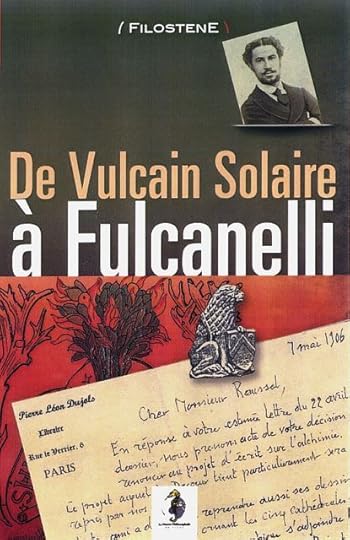
The alchemist Fulcanelli was the most famous adept of the 20th century, the man who achieved the Great Work less than 100 years ago, but his true identity has always been shrouded in myth and uninformed speculation...until now. Patrick Rivière reveals with profuse documentary evidence the true identity of the enigmatic and prestigious author of The Mystery of the Cathedrals and The Dwellings of the Philosophers. Beginning with an overview of French alchemical life at the turn of the 20th century, Rivière carefully builds his case step-by-step with facts, documents, and photographs, introducing us to the well-known physicist who was known as Fulcanelli. Rivière also demolishes the scurrilous hypotheses that suggest Fulcanelli never existed. Rivière is uniquely suited to solving this mystery as his teacher was Fulcanelli's sole student, Eugène Canseliet.
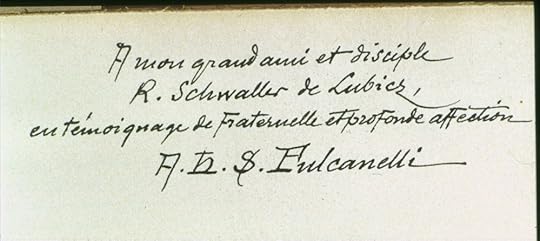
Aside his books, and signature…and descriptions made by his friendships, there’s not a single footage or photo to tell about him.
Once, a French writer called Henri Loevenbruck embarked on this enterprise, throughout the “four corners” of France, to know who this so-called alchemist was. Next, the data the writer assembled.
Fulcanelli last public appearance had been in 1924, on Anatole France’s obsequies.
It is assumed Fulcanelli was born in 1839. He participated in the defense of Paris against the Prussian invasion, in 1870; he got a medallion for that.
In 1905 he met with painter Julien Champagne; who later would illustrate his books. On his graveyard is written: “Apostolous Hermetic Scientie”.
In 1915, he gets to know Eugene Conseliet, then 16 year old. Fulcanelli was then a friend of the family Lesseps, living at the Bertrand hotel in 1916. Maybe he lived near the Temple D’Amitié.
In 1922 he manages to perform a transmutation in a place called “usine a gas de Sarcelles”. In that same year he hands to Conseliet (“his disciple”) some manuscripts and assigns him the task of publishing 3 books. Only 2 were published. In the words on EC: “he withdrawn from me the third book”, whose title was meant to be Finis Gloriae Mundie. So, only “Le mystère des cathedrales” (1926) and “Les demeurs philosophales” (1930) came to light.
Some described him as having: “a clear and penetrating gaze”; a great handsome man…”of white beard”.
Henri Loevenbruck concluded his search wondering: was he a single man, or a collective pseudonym?
His list of suspects included: (1) the astronomer C. Flammarion; (2) the alchemist François Jollivet; (3) the Egyptologist René Lubicz; (4) the academician Jules Violle; (5) Paul Decoeur, according to the book by Walter Grosse. …;
(French physicist Jules Violle, also known as the alchemist Fulcanelli... ?)
English-speaking students of alchemy and related subjects will welcome this translation of alchemist Patrick Riviere's original work in French published in 2000. The author, a student of Eugene Canseliet, brings to this carefully written book both the knowledge and experience to discover the man behind the Fulcanelli pseudonym.
In recent years, a fair number of authors have speculated about Fulcanelli's real name and occupation. In surveying the literature, Riviere even applauds those authors who got in wrong but who respected the master alchemist and his work. Likewise, Riviere laments the fact that some authors wandered into labyrinthine errors because they had no idea what the Great Work was about.
True students who, perhaps, were introduced to Fulcanelli through Mary Sworder's English translation of the "Mystery of the Cathedrals," will be interested to know that Fulcanelli was a highly respected physicist with an exceptional knowledge of mainstream science. Aficionados who, perhaps, were introduced to Fulcanelli 40 years ago via the English translation of "The Morning of the Magicians" will find here the long-awaited clarification of ideas presented there in error.
Knowing the man behind the mask is interesting and helps us more thoroughly understand (to the extent that that's possible) the great French alchemist. More importantly, in closing off the mystery of the alchemist, Riviere allows those interested in the Great Work to pursue the true natures of their inviolate quest rather than endlessly speculating about their teacher's name.