Jump to ratings and reviews
Rate this book

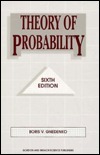
Theory of Probability

Rate this book
This book is the sixth edition of a classic text that was first published in 1950 in the former Soviet Union. The clear presentation of the subject and extensive applications supported with real data helped establish the book as a standard for the field. To date, it has been published into more that ten languages and has gone through five editions.
The sixth edition is a major revision over the fifth. It contains new material and results on the Local Limit Theorem, the Integral Law of Large Numbers, and Characteristic Functions. The new edition retains the feature of developing the subject from intuitive concepts and demonstrating techniques and theory through large numbers of examples. The author has, for the first time, included a brief history of probability and its development. Exercise problems and examples have been revised and new ones added.

520 pages, Hardcover

First published April 1, 1970

3 people are currently reading
30 people want to read

About the author

(Boris Vladimirovich Gnedenko)
Советский математик, специалист по теории вероятностей, математической статистике, вероятностным и статистическим методам, член-корреспондент (1945) и академик (1948) АН УССР.

Родился 1 января 1912 в Симбирске. Отец, Владимир Васильевич, окончил землеустроительное училище и работал землемером, мать, Марья Степановна, окончила прогимназию по музыкальной специализации. В 1915 семья переехала в Казань, где отец с осени 1916 обучался на физико-математическом факультете Казанского университета. Здесь же осенью 1918 Борис поступил в школу. В сентябре 1922 семья переехала в Галич, здесь Борис с братом после годового домашнего обучения поступили в шестой класс школы. После переезда в 1925 в Саратов у братьев обнаружилось отставание по химии и математике, при подготовке к переэкзаменовке Борис глубоко освоил курс математики и выдвинулся по ней в первые ученики.
С большим трудом (из-за возраста) удалось поступить на физико-математическое отделение педагогического факультета Саратовского университета, который окончил в 1930 году. В 1930—1934 годы работал на кафедре математики Текстильного института в Иваново-Вознесенске, здесь были написаны первые работы по теории массового обслуживания (для расчёта нагрузки работницы, обслуживающей несколько станков), здесь увлёкся теорией вероятностей.
В 1934 году поступил в аспирантуру Московского университета, научными руководителями стали Хинчин и Колмогоров. Участвовал в еженедельных общегородских семинарах по теории вероятностей, где с новыми результатами выступали А. Н. Колмогоров, Е. Е. Слуцкий, Н. В. Смирнов, А. Я. Хинчин, а также аспиранты, молодые физики, биологи и инженеры. Особый интерес проявлял к предельным теоремам для сумм независимых случайных величин. В июне 1937 года защитил кандидатскую диссертацию «О некоторых результатах по теории безгранично-делимых распределений», с осени 1938 доцент кафедры теории вероятностей мехмата МГУ, работает над задачами построения асимптотических распределений максимального члена вариационного ряда и создания теории поправок к показаниям счётчиков Гейгера-Мюллера. В начале июня 1941 года — защитил докторскую диссертацию, состоящую из двух частей: теории суммирования независимых случайных величин и теории максимального члена вариационного ряда.
В ноябре 1937 был призван в армию, где был арестован по обвинению в контрреволюционной деятельности, но в мае 1938 был освобождён.
В годы Великой Отечественной войны принимал участие в решении задач, связанных с обороной страны[уточнить].
В 1945 году избран членом-корреспондентом Академия наук Украинской ССР и направлен во Львовский университет. Во Львове читал различные курсы: математический анализ, вариационное исчисление, теорию аналитических функций, теорию вероятностей, математическую статистику. Среди научных результатов этого периода — доказательство в окончательной формулировке локальной предельной теоремы для независимых, одинаково распределённых решётчатых слагаемых (1948), также в этот период начаты исследования по непараметрическим методам статистики, написан учебник «Курс теории вероятностей» (первое издание вышло в 1949 году) и монография «Предельные распределения для сумм независимых случайных величин». В 1948 становится академиком АН УССР.
В 1950 году переведён в Киев в Институт математики АН УССР, где возглавил отдел теории вероятностей и математической статистики. Одновременно, заведовал кафедрой математического анализа в Киевском университете. В Киеве учениками Гнеденко стали В. С. Королюк и В. С. Михалевич.
В 1953—1954 годы работал в ГДР, где читал лекции в университете имени Гумбольдта (Берлин), а по возвращении в Киев возглавил группу по организации Вычислительного центра, ядром группы были сотрудники академика С. А. Лебедева, руководил работами по проектированию универсальной машины «Киев» и специализированной машины для решения систем линейных алгебраических уравнений. Одновременно разработал курс по программированию для ЭВМ, который начал читать с

Ratings & Reviews

What do you think?
Rate this book

Friends & Following

Create a free account to discover what your friends think of this book!

Community Reviews

5 stars
2 (66%)
4 stars
0 (0%)
3 stars
0 (0%)
2 stars
0 (0%)
1 star
1 (33%)
Displaying 1 of 1 review
Profile Image for Douglas.
57 reviews34 followers
March 5, 2016
This is a preliminary review. First, B. V. Gnedenko is a hero of mine, having opposed the Soviet regime and put himself at great personal risk on that account. According to one short biography Gnedenko was,
"...denounced by one of the members of the [Mathematics Institute of Moscow State University]...[and]...was imprisoned with 120 other prisoners in a cell built for six people and was constantly interrogated about statements he had made on the summer trip. His interrogators demanded that he...confirm that Kolmogorov was the ringleader of a group of "enemies of the people" centred in the mathematics department. Though interrogated daily over a six-month period, held in grim condition, and promised his release if he cooperated, he refused to admit even the possibility of such an interpretation, knowing that there could be no hard evidence, and that the fate of all, himself included, depended on his resolution."

In other words, Gnedenko wouldn't rat out his colleagues--in this case Kolmogorov. Okay!, so this guy is no ordinary mathematician of the white wine and brie sort; the types found in nice little college towns such as Ann Arbor, Madison or Berkeley. This suggests an interesting perspective that might flow over into his view of mathematics and, specifically probability theory. I believe this is the case and the reader will learn for himself.


Gnedenko was committed to teaching mathematics and writing popular and semi-popular renditions of mathematical topics. The Theory of Probability is an obvious product of his commitment and, as has been noted by a reviewer at Amazon, is suitable for independent study.


Gnedenko first introduced me to the notion that all which is random is not necessarily probability. That is, a random event may only be an event whose outcome, given a set of conditions, is not determinate; one cannot say certainty whether, under the specified conditions, it will occur or not. But the generality Gnedenko's notion of randomness is not sufficient to assign a probability to the event. For that to be the case one must specify a "sufficiently definite set of external conditions". Gnedenko seems to have an experimental viewpoint in mind as he mainly cites examples from physical science. It is pure mishmash to demand a probability for an event under any set of conditions. This leads me to wonder whether, outside physical science--to include the laws or ordinary gambling--it is possible to establish sufficiently specific conditions? I know this is a pretty sweeping question but I have in mind disciplines like economics, sociology and psychology where probability theory has been increasingly invoked in recent decades. The idea that mass behavior is related to what Gnedenko calls mass events has been debated ever since the first applications of probability to these areas.


All physical laws require, what are sometimes called constitutive relationships. That is, there must be some way to determine the constants which occur in the relationship. One cannot say that all the symbols occurring in a mathematical formula are "variables". Without these constants or relationships tantamount to constants, there is too much generality and meaningful solutions cannot be found. I'm thinking at present of Maxwell's equations, for example. And, in fact, it is the constitutive relationships which tie the equations to matter and reduce the generality of the mathematical relationships.


It has been argued by many that the (meaningful) application of mathematics to economics, for example, is hampered because there exist no real constants. All of the symbols in a mathematical expression in economics are variables. For example, a quick web search turned up this,
New York University economist Paul Romer -- hardly a lightweight when it comes to equations -- recently complained about how economists use math as a tool of rhetoric instead of a tool to understand the world. http://www.bloombergview.com/articles...

Reading on in the article we find that economics tends the put evidence--read results from experiments--behind theory. Now, a mathematical expression in a theory without evidence contains only variables (excluding, naturally, purely mathematical constants such as pi and e). This reversal of evidence and theory is not surprising because, when it comes down to cases, what is an economics experiment? A social experiment to say the least, and that raises a nest of problems outside of science.

Generally, the use of mathematics in the behavioral sciences must be accomplished by minimizing or explaining away volition. And this is fatal to a science which claims to have something meaningful to say about volitional creatures i.e., men. Physics, on the other hand, excludes volition altogether. The earth revolves around the sun and it is possible to summarize this geometrically precisely because both bodies lack volition; though Dirac once complained to Heisenberg that at the sub-atomic or quantum level, it would seem that volition is almost the only thing left which could give continuity to events.

Displaying 1 of 1 review

Can't find what you're looking for?

Get help and learn more about the design.