From “choreomania” to coronavirus: an utterly original graphic novel about a newly urgent subject
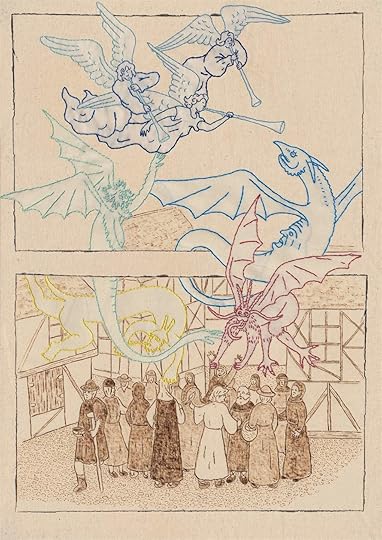
Set in 1518, and told from the imagined perspective of Mary, one of the witnesses, The Dancing Plague tells the true story of when hundreds of Strasbourg’s inhabitants were suddenly seized by the strange and unstoppable compulsion to dance. Prone to mystic visions as a child, betrayed in the convent to which she flees, then abused by her loutish husband, Mary endures her life as an oppressed and ultimately scapegoated woman with courage, strength, and inspiring beauty. As difficult to interpret now (as a psychological reaction to social injustice?) as it was then (as a collective demonic possession?), the story of the “Dancing Plague” finds suitably extraordinary expression in the utterly unique mixed-media style Gareth Brookes has devised to tell it. The pioneering blend of his trademark “pyrographic” technique with sumptuously colorful—and literal—embroidery perfectly reflects, in a beautiful work of art, the enduring fragility of our human condition—from “choreomania” to coronavirus.
“The most visually stunning quarantine comic I’ve seen is THE DANCING PLAGUE by the British artist Gareth Brookes . . . With fire and needle, Brookes crafts a book the likes of which we’ve never seen before.” – The New York Times
Gareth Brookes is a graphic novelist, print maker, textile artist, small press publisher, teacher, event organiser and researcher. He graduated from the Royal College of Art in London in 2003. He makes experimental graphic novels and handmade comics utilising unusual materials such as embroidery, pressed flowers and fire. In 2012 Brookes won the First Graphic Novel Prize. His teaching experience includes being a tutor in Foundation Studies at City & Guilds of London Art School and a visiting lecturer in Illustration at the University of Lincoln. Brookes organised the South London Comics and Zine Fair in 2017-18. He is currently a PhD candidate at University of Arts London researching materiality and metaphor in comics.
Brookes' comics are usually made using some very labour intensive process, which is interesting in itself. But this is the icing on the cake. The stories are usually strange, funny, full of pathos and intrigue - and The Dancing Plague is no exception. Strange cavorting demons twist and twine around the medieval figures, who spend their days cursing and shitting. Every page is either beautiful or has a funny character detail.
I had to read this through 2.5 times to fully understand it but once I did I loved it. I read it through once on my own but was not paying careful attention to the timeline so I was not noticing what was a flashback and what was happening to Mary vs to Frau Troffea. The characters all look similar so that has something to do with it.
When I read Matrix by Lauren Groff, which is set about 400 years before the events of this book, I wondered why it is that some women get to be seen as holy mystics with visions from Jesus, and some women who have the same visions get called devil witches. It probably has to do with the perceived morality of the woman in question and the general climate of her community. Mary insisted her visions were heavenly, but no one believed her. This book did a wonderful job exploring how terrified people are of women stepping out of line, the fear of women’s sexuality becoming unbridled and out of control, the horror of the monstrous mother! I also learned about mother Jesus. The book itself is stunning and I am obsessed with the embroidered celestial/cthonic beings that can permeate the boundaries of the panels. Embroidery is a traditionally feminine art form. Many “feminine” art forms like textiles are devalued and seen as crafts instead of ~art~. I love when women go Berserk / Feral and the sky falls down like when Eva 01 goes berserk or the end of Carrie. The form and story worked so well together. Fantastic, creative, never seen anything like it, etc etc.
The intro makes mention of the Covid plague, but I felt the modern day pertinence had more to do with the right wing terror of boundary dissolution. The desire to enforce stricter laws/rules around women’s control over their own bodies, all the anti trans legislation, the “save the children” moral panic that is well underway, at least in the US. Everyone's brains are scrambling.
The main reason I write reviews is that they really help me remember what I read, and sometimes if something was confusing I write out a whole summary to make sure I got everything, so the rest of this is just a summary.
I started reading this out loud with Kai, but we put it down for like a month and then forgot so we started over at the beginning again. This time I actually kept track of what was happening. Mary is a mother and long-suffering wife in 1518. Since her childhood she’s had holy visions. There was a flashback that was basically the plot of The VVitch. Her father tried to kill her and dump her in the river. She stayed submerged for several days and Jesus saved her. She emerged a bride of christ and joined a convent. The clergy throughout this story are corrupt and committing the 7 deadly sins any chance they get. Mary’s visions get her into trouble in the convent. She has one friend named Agatha who believes these visions are from God, but everyone else seems to think the visions are from the Devil. Mary gets locked in a cell at the abbey. She’s told that it’s for “solitary contemplation” or whatever but it’s clearly imprisonment. Lucky for Mary the lord is on her side so she turns into a bird and flies out the window. She tries to go back home. Her family is understandably spooked, because to their knowledge she drowned in the river years before. Honestly, I can’t blame the family. If I were a peasant farmer in 1518 and I killed my beloved daughter because she was possessed by demons, and then a few years went by and she showed up on my doorstep very much alive, my belief in the devil would be completely vindicated. They make her sleep in the pig pen smh. Eventually, her family arranges a marriage for her so that she’ll have somewhere to go, because they don’t want her under their roof. Her husband is a drunkard loser and he sucks. Mary continues life as a housewife/mother. One day she runs into her old friend Agatha from the convent. Agatha has also left the convent because of some shady business there. (we know the clergy is corrupt, but we later find out that after Mary escaped everyone went crazy and the nuns started trying to drown themselves etc. Again, I can’t blame everyone for freaking out when the girl they think is having Devil Visions disappears from a stone cell.) Mary tells Agatha she’s still having her visions but has no one to talk to. Agatha says she has a confessor she’s been loving, so Mary starts meeting with Father Puttock. He says that they’ll both do some rituals so she can be free from the visions. He tells her she’s not allowed to have sex with her evil husband to which Mary is like oh noooo I’m sooooo upset about that lol. Father Puttock will help out by doing his own suffering project of sleeping cold and naked on a stone floor. God loves to see his children Suffer I guess. However, that night Mary visits Father Puttock in the form of a succubus and fucks him. This bitch is an absolute Demonette in the sack, literally!
Mary’s whole backstory is interspersed with an account of the Dancing plague of 1518. A woman named Frau Troffea starts dancing one day and can’t stop. The dancing is contagious and people don’t stop dancing until their feet bleed or they die of exhaustion. Mary’s husband and children get caught up in the fuss. To everyone else the dancing looks like dancing, but Mary is able to see the demons devils & angels moving everyone’s limbs. The most striking aspect of this book is that all the earthly aspects of the book are drawn in pencil/ink, but the angels and demons and occasionally Mary are **EMBROIDERED** in bright colorful threads. The demons/angels are also allowed to exist outside of the panels anywhere on the page while the earthly beings are constrained to their boxes. The pages themselves look like cloth and are occasionally burned. After the Succubus situation, the timelines converge. The dancers, who have been dancing in the town square for maybe a month at this point, are carted (literally in those plague body carts) to a shrine in hopes that the holiness of the area will cure the dancing once and for all. They all get little red booties. During the latter quarter of this book all hell breaks loose and we have an epic Demonic/Angelic/dancing LCL soup that reaches End of Evangelion proportions. After everyone calms down, Mary returns to town. The town is eerily quiet. She still hasn’t found her children. She goes to Father Puttock again. She tries to tell him that her visions are from Jesus but he obviously is like Bitch you’re nothing but a disgusting Eve you Women all have the Devil in you!!! Mary despairs and jumps into the fireplace. We see her burn up and the story ends. But we know that she was able to survive a drowning and escape a stone room, so we the reader know that Jesus will not allow her to die so easily.
The epilogue is 10 years later. A scholar has been commissioned to write an account of what happened. Of course, he only interviews “learned men” to get a narrative. His explanation is basically that the “whores” of the city were up to no good and weak men followed. The scholar’s assistant is like “hey I found this woman who wanted to be interviewed, seems like she knows a lot about what happened….” and the scholar says “No doubt this hag was one of those original harlots. Think you my understanding will be clearer for speaking with her? Mark me well. The understanding of men can only be CORRUPTED by the words of women!” Who records the history and who is allowed to speak? How does that impact the stories that survive into the future?
The weird, arty historical fiction of this graphic novel, illustrated with pyrography and embroidery on fabric, is exactly my wheelhouse. Brookes does a great job portraying the average people's feelings of helplessness and paranoia in the face of a mysterious plague.
I loved this. So funny and weird. I feel like I learnt some historical stuff too, actually. The artwork is unique and impressive. An embroidered comic? I mean... I can't even imagine making that. I hope Gareth Brookes had a thimble.
Gareth Brookes combines pyrography and embroidery to create sublime and visceral depictions of the dancing plague that began in 1518. This book has everything - gender dynamics, devout spiritualism, blood, madness, twisting bodies and demons! I loved Dancing Plague and its art so much that I am now a proud owner of an original panel from the book. Thank you Mother Jesus!
Look theres people that can describe what makes this so great. So read them. But its good you like to hear about weird times in history then give it a good. Middle ages and all that was a crazy time. Boy does this book make you feel for women that lived in that time. And its very unique with the art that fits right into the time period imo.
I honestly grabbed The Dancing Plague by Gareth Brookes on a complete whim. I've enjoyed learning about the titular subject in the past and earlier this year I really enjoyed reading another book set in medieval Alsace (The Alewives, set in Colmar, was fantastic), although this was set in a different city (Strasbourg). It just happened to be on the library shelf when I was skimming, and between the cover and the subject? I was interested.
First of all, the art was extremely cool. The book is done entirely in pyrography and embroidery, which is a perfect choice for its medieval setting, but is also striking to look at. I was especially keen on the embroidery and its vibrant colours, but I did enjoy the pyrography, and thought it was especially appropriate for some of the scenes.
The story itself is really interesting. There's a great historical note to open the book, which explains some of the influences, especially those outside of the history of dancing plagues, such as the women mystics of the era, like Margery Kempe and St Christina the Astonishing. These historical notes helped me to better appreciate the story that unfolds throughout the nonlinear narrative surrounding Mary, a woman who has had religious visions since childhood and is living as a wife and mother in Strasbourg when the dancing plague breaks out, although there are numerous chapters of her past that delve into this. Honestly, I picked this up for dancing plague content, but Mary's story is what made me enjoy this book the most.
I do wish that the book had been longer to give us more time in the medieval setting and to explore both parts of the plot, but I did very much enjoy it as is.
Overall, I really enjoyed this one, and it's honestly a one of a kind graphic novel. I hope I get the chance to read more from the author in the future (and I would read his previous books immediately if I had access to them, but the local library and the digital services I use don't have any of them and I'm too poor to buy anything at the moment). I honestly hope to reread this as well at some point, and I would definitely recommend checking it out, especially for anyone looking for books with a vivid medieval setting.
The "dancing plague" was an unexplained event that happened several times in Medieval Europe: those people struck with it would dance uncontrollably for days or weeks on end, sometimes leading to their death by exhaustion. It was also known as St. Vitus's Dance In Brookes' The Dancing Plague, a graphic novel, mystical Christianity symbols and demons are combined with scenes of peasants lives to tell a story of a town that start dancing. What is really extraordinary here is the art. Using both a technique known as "pyrography," or a method of making drawings through heat, and embroidery, Brookes combines both with the use of photoshop. The result is breathtaking and definitely worth a read!
I heard about this book through a list posted by Florence Welch, my favorite singer. The story inspired a song off her latest album. For all my love of history, my knowledge of medieval history is very basic, so I was intrigued to enter into this lesser known chapter through a graphic novel format. Overall, it was oddly relatable after living through the coronavirus pandemic; indeed, the author cites the pandemic as something of an inspiration.
I read this book as a part of the Dance Fever reading list created by Florence + The Machine and it did not disappoint.
I have been fascinated by the dancing plague of 1518 for years and this book was a brilliant commentary not just on how conservative Christians (primarily men) tried to explain away the plague by blaming it on women, but also how conservatives reacted to the very real coronavirus outbreak of 2020 that continues to this day.
The illustrations were designed to look like medieval artwork you might see on tapestries which I think was a brilliant choice.
The main character of Mary was iconic.
Read this in one sitting and will definitely be rereading it in the future.
This was a one afternoon read on a much forgotten subject. The subject itself, the dancing plague of 1518, is a bleak one because it really did depict the utter miserable lives of the people afflicted with this mania and the torments they suffered. That wouldn't have been a bad thing, but I felt like there wasn't enough of the story in there. This was a really interesting moment in history, despite it being brought about by utterly terrible circumstances, and I found that the story did little to really talk about it. The art is a difficult point because, on one hand, the drawings were all very crude and sometimes it was difficult to pick out what was going on and you could even lose the main character for how similar they all looked. On the other hand, the art direction with the burnt edges and the embroidery was really creative and it clearly took a lot of designing talent to include these details. It's still worth it to pick it up, if only to take a look at it, but if you were hoping for more information on the plague itself, or even a depiction of the events of that summer, it lacks there and you would be better to read a more dedicated history book.
A story set around the phenomenon of dancing mania. I really enjoyed the art and interspersed with pages appearing to originally be done through embroidery is a great touch.
Harvinaisen kauniisti kuvitettu sarjakuva kertoo Strasbourgin tanssimaniasta 1500-luvulla. Kauniin kuvituksen lisäksi pitää aina välillä pysähtyä ihailemaan, miten hyvin Brookes on osannut elävöittää 1500-luvun elämänmenon sanoin ja kuvin.
Pieni kauneusvirhe kokonaisuudessa on se, että kiinnostavan historiallisen tapahtuman ja ajankuvan ympärille kehitetty tarina ei oikein kanna ja tuntuu vähän hätiköiden läpijuoksutetulta. Pienistä puutteistaan huolimatta tämä on nautittava sarjakuvakokemus.
incredible, i hate that i kept saying "yooo this reminds me of berserk" every 10 seconds tho, amazing illustration with the embroidery and cloth motif, great use of the medium and playing with its/ breaking free of its constraints in intentional and thematically consistent ways, obviously excellent choice of content/ story, excellent
Graphic nonfiction. The story of a medieval plague, written during the current one. Brown ink on brown pages, with simple yet detailed drawings. Restrained use of vivid needlepoint and embroidery to illustrate key elements.
Really, really good! The artwork is fantastic and adds so much to the story (my only qualm was that it was sometimes difficult to tell the protagonist apart from the crowd). AND the story is thought-provoking and paced well.
This feels like more a quirky curiosity than an actual fully fledged story. Based on historical events and characters, this explores the blurred lines between divine inspiration, demon possession and madness to a backdrop of sexism and corruption. The various mediums used to portray different elements of the art was, for me, the highlight. Weird, but really well done.
This author's books are just so weird that I have to give them a ton of credit for the unique artistic merit, even when I have trouble with some of the storylines a bit.
Read this in less than an hour, but think I will return for the art, for it is something wild. The stitching seems otherworldly, as I think it is intended to - and while it first felt weird, now I can’t imagine any other way to tell this story. Although you wouldn’t need a story to justify the art, if we’re honest. But there was a story, and it was sadly familiar despite the newness.
Can recommend if you like comic novels, or the Middle Ages, or embroidery.