Jump to ratings and reviews
Rate this book

Palliser #4

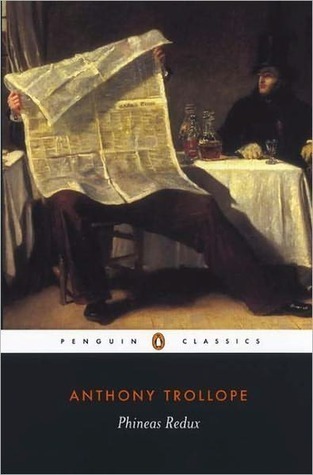
Phineas Redux

Rate this book
In the fourth of the 'Palliser' stories, Trollope follows Phineas Finn's return to the dangerous world of Westminster politics. When his political rival is murdered, Phineas is thrown under suspicion and eventually finds himself standing trial at the Old Bailey. The situation is complicated by the presence of two women in his life: his old flame Lady Laura, whose estranged husband is determined to destroy Phineas's reputation, and the wealthy and enimgatic widow, Madame Max.

This Folio Society edition is printed on high quality paper, quarter bound in buckram with three quarter paper sides. It is liberally sprinkled with monochrome illustrations.

628 pages, Hardcover

First published January 1, 1874

117 people are currently reading
2290 people want to read

About the author

Anthony Trollope

2,281 books1,755 followers
Anthony Trollope became one of the most successful, prolific and respected English novelists of the Victorian era. Some of Trollope's best-loved works, known as the Chronicles of Barsetshire, revolve around the imaginary county of Barsetshire; he also wrote penetrating novels on political, social, and gender issues and conflicts of his day.

Trollope has always been a popular novelist. Noted fans have included Sir Alec Guinness (who never travelled without a Trollope novel), former British Prime Ministers Harold Macmillan and Sir John Major, economist John Kenneth Galbraith, American novelists Sue Grafton and Dominick Dunne and soap opera writer Harding Lemay. Trollope's literary reputation dipped somewhat during the last years of his life, but he regained the esteem of critics by the mid-twentieth century.
See also http://en.wikipedia.org/wiki/Anthony_...

Ratings & Reviews

What do you think?
Rate this book

Friends & Following

Create a free account to discover what your friends think of this book!

Community Reviews

5 stars
1,093 (36%)
4 stars
1,243 (41%)
3 stars
508 (17%)
2 stars
80 (2%)
1 star
48 (1%)
Displaying 1 - 30 of 319 reviews
Profile Image for Diane Barnes.
1,612 reviews446 followers
April 13, 2022
"A drunkard or a gambler may be weaned from his ways, but not a politician."

Some things never change, no matter the country or the times. This 4th installment of the Palliser series brings Phineas Finn back into the British House of Commons after a 2 year absence. We get to catch up with some old friends, and even Lizzie Eustace reappears briefly. As is always the case with Trollope, politics, love and money are in constant peril, and most things are concluded satisfactorily by the end, by hook or by crook, and sometimes with the help and interference of Lady Glencora Palliser.

Lord knows I am a commoner through and through, but Trollope affords me the opportunity to mix with the aristocracy, attend their house parties, dine at their sumptuous dinners, and listen in to their conversations. It all seems to be quite wearing, so I'm happy to return to my little cottage and peasant meals at novel's end.

And of course, as always in this series, Lady Glencora (now the Duchess of Omnium) is a particular favorite of mine. She always gets what she wants. To quote the last two sentences of the book:

"Of the Duchess, no word need be said. Nothing will ever change the Duchess."

Amen to that.
Profile Image for Sara.
Author 1 book933 followers
August 6, 2025
I can imagine that one complaint readers might have against Anthony Trollope is that his books are long and his plots are very detailed. We are more into instant gratification these days–get it said, get it done. But, I find this is what I love the most about him. He immerses you in the world these characters inhabit. You know their habits, their anxieties and their faults. You watch them struggle, often even those who have wealth and position, to just hold on to their place in society or their reputations.

When we left poor Phineas Finn in the original book that bears his name, he was out of London and Parliament, but when we find him again, he is stepping back into the fray. I dare say I like him in the first book, but love him in the second. Who cannot feel a rush of sentiment for a man so conscientious in his pursuits and so ill-fated in their outcomes. He is impetuous at times, but one cannot help but feel it is his very charm and appeal that makes him so reviled by some of the men around him. How dare he be so fine when he has no title or high position to back him up? He is remarkable in his speaking abilities and quick wit, but he is a man without money who is unwilling to play the game of pursuing it through marriage, so he will not do.

I will not divulge the plot twists that take place, but I will say Trollope kept me on the edge of my seat through most of the novel. The twist that comes at about the halfway mark is totally unexpected (if you avoid reading blurbs) and sets up a tense and gripping denouement. We are reintroduced to many familiar faces, including Lizzie Eustace, who I thought we were well done with, Lady Laura, Marie Max Goesler, and Glencora Pallister. Of course, the men are there, as well, but Trollope’s women steal the show.

The Pallister series is proving to be a confirmation for me that there is no Trollope one would wish to miss. I’m finding that the political scene and the shenanigans behind the curtain are as interesting and complex as those regarding the church that were visited in the Barsetshire novels. I cannot help wondering what Trollope would think of the present-day political environment. I think he would say not as much has changed as you might think.
Profile Image for Classic reverie.
1,833 reviews
January 27, 2019
The more I read Anthony Trollope's stories the more I see the masterful genius of this author. Last year I started his Barestshire series and loved it, so that it seemed natural to read his next series, Palliser. Are these series connected? Yes, because certain characters come pay their visit to this political minded series from the religious centered Barsetshire series. Of course, you don't need to read the stories in order because he gives his reader enough knowledge to understand but even with that you are limited to a full understanding which is so deliciously wonderful! He does not forget his characters and what purpose they serve to the story, the stories are entwined together. He also makes one wonder if the Gresham character from the Barestahire series is the Prime Minister, in this series but nothing is conclusive and I kept wondering. I absolutely loved all so far and "Phineas Redux" is my favorite so far.

I have said it before and I will say it again, Trollope has all the societies interactions of the characters as like Jane Austin and all the societies woes as Charles Dickens, especially his love of the law and other social issues.


In "Phineas Redux" Trollope shows us how politics never changes though the issues maybe different. The Party on my side is right and your side is wrong, I can do it better than you, so I will disregard all you have done and dismiss it, which is shown to perfection in this story. I am totally disgusted with politics, though I know government is needed to govern people and people are far from perfect. In The Palliser series you get a taste of how Trollope views politics and the hypocrisy of it. He does not portray it as all evil but brings out it's faults.


The Church and State issue is the crux of this story. In the Barsetshire series, we are introduced to the structure of government paid clergyman and the the rise and fall of these men. The issue brought forward in The House of Commons is changing of the whole Church and State structure. I know that a separation is a good thing but looking ahead about 160 years after this was written, I wonder if going the other way has actually been detrimental for society and loss of faith, social mores. Not saying a Church-Government system but having nothing to do with religion in government, is that the way either? As I read Trollope, I noticed his criticism of religious figures, some are no good, others human but yet he does have some really exceptional clergymen.


Another thing Trollope exposes is the court and legal system, that circumstantial evidence can be detrimental to a man's life. How public opinion can be swayed, for a trial is commenced.

It is quite clear that having read many of Trollope's novels is he is not a fan of the Jewish people and depicts them quite unfavorably; knowing it was the times, I don't let it spoil my read.


I did not read this edition but a Delphi Collection of his works where my nights and highlights can be seen if interested. Quotes are from there.


"I don’t think that I believe any more in the party; — or rather in the men who lead it. I used to have a faith that now seems to me to be marvellous. Even twelve months ago, when I was beginning to think of standing for Tankerville, I believed that on our side the men were patriotic angels, and that Daubeny and his friends were all fiends or idiots, — mostly idiots, but with a strong dash of fiendism to control them. It has all come now to one common level of poor human interests. I doubt whether patriotism can stand the wear and tear and temptation of the front benches in the House of Commons. Men are flying at each other’s throats, thrusting and parrying, making false accusations and defences equally false, lying and slandering, — sometimes picking and stealing, — till they themselves become unaware of the magnificence of their own position, and forget that they are expected to be great."


The story given by my edition -

"The fourth novel of the Palliser series was first published in 1873 as a serial in The Graphic. The story tells how Phineas Finn finds Irish society and his occupation as a Poorhouse Inspector dull and unsatisfying after the excitement of his former career as a Member of Parliament. Back in England, the Whigs are determined to overturn the Tory majority in the Parliament of the United Kingdom. As Finn had been considered the most promising of the younger set, he is encouraged to stand for office again. "


The story in brief- If you read "Phineas Finn" you can learn about Phineas' start, this story continues for Phineas as a member in Parliament and his friends. Lady Eustace from Palliser #3 makes an appearance which is not extensive but makes the story more intriguing. I could tell you more but rather you read and enjoy this wonderful novel, which is a favorite. When I was 50% in I wished that I could just sit down and read until the final page because I no longer succumb to peeking at the end. There are so many twist that made this a wonderful adventure. I felt like I was there in London seeing Trollope's world not just in fiction but how life was then. We get a sense of the past from novels of other times.


I am looking forward to reading Trollope again and learning more of Palliser 5 & 6!💖💖💟💟 Once again, I say Trollope was a master story teller!


*****"Spoiler***
For those who have read this, Phineas and others calling Kennedy insane. I don't think I would have called him that because he certainly was deceived by Laura who certainly tried him and brought the jealousy to the couple which certainly was justifiable from the way that Laura rejected him, though his way of life different from hers. She closed her heart to him
Profile Image for Anne .
459 reviews467 followers
January 31, 2023
With the return of Phineas Finn and his world from book 2 this novel has all of the same Trollope virtues; fabulous writing, humor and wit and, above all, the shenanigans and dealings of love, money and politics in Parliament and Lady Glencora's drawing room. I have to admit that the minutiae of politics in this novel were deadly at times but when the pain became too great I just forwarded ahead. I freely admit to appreciating the character who said:

"What a pleasure! To hear a man speak for two hours and a half about the Church of England. One must be very hard driven for amusement!"

An absolutely fabulous read. The final third of this novel became a page turner. I could not tear myself away until the end.
Profile Image for Jane.
820 reviews781 followers
November 26, 2014
I really didn’t mean to read Phineas Redux quite yet, I intended to give some other classic authors some time, after spending so much time with Trollope this year, but my fondness for Phineas and my curiosity to know what was happening in an a world full of so many characters I have come to love …..

I just had to know!

The story begins a few years after ‘Phineas Finn’ and a few months after ‘The Eustace Diamonds’. I’ve seen suggestions that you could read the two Phineas novels back to back, but if you did that there are things that you might not appreciate in this book, because it picks up a few threads and a few characters from ‘The Eustace Diamonds’.

Phineas Finn is living in Dublin, alone, since his wife has died, and though he has a good job and a healthy income he is bored. He misses parliament, he misses his London life, and so, when he sees a chance to return, he decides to risk everything , hoping that he will be able to pick up the threads of his old life.

He’s still the same Phineas, as charming, as straightforward as ever, but time and experience has made his just a little jaded.

He finds that some things have changed and some things are still the same.

Madam Max had turned down a proposal from the Duke of Omnium; she had hoped to win Phineas, not knowing that he had already decided that his future lay with Mary Flood-Jones. She remained a good friend to the Duke, whose health was failing, and whose death would bring her a bequest that she was not prepared to accept. And she proved to be the best of friends to Phineas.

That death meant that Plantagenet Palliser was the new Duke of Omnium. Lady Glencora was in her element; I love that was so passionate about her causes, and her friendship with Madame Max is a delight. Her husband, on the other hand, was concerned that he would be ineligible to be chancellor of the exchequer again, and that he may not be able to see his work to reform the currency through to the end.

Lord Chilton and Violet Effingham had married and were happily settled. They had house-guests, and that set off a subplot – a love triangle that had echoes of one from an earlier book and yet was quite different. Trollope does see to have lots of variants on the love triangle, and I have to say that he does them very well. It was a little strange, moving from characters I knew so well to brand new characters, but I understood why they were there. One of the reasons was to keep the Chilterns in the story – as he still refused to have anything to do with politics – I loved that Lord Chiltern had grown from an angry young man into a comfortable curmudgeon, that Violet had found her niche as a wife and mother, and that the two of the understood each other so well.

Lady Laura Kennedy had fled to the continent, to escape her cold, unsympathetic husband. Her situation was dreadful, because, if she returned to England her husband could compel her return to him, as she had no grounds for divorce. The shift in her relationship with Phineas was interesting – in the first book he wanted more of her than she would give, and in this book that reversed. The arc of her story was inevitable and it was heart-breaking;

Of course Phineas became part of all of their lives again, and he regained his seat in parliament.

But it wasn’t all plain sailing. Robert Kennedy objected to Phineas visititing his wife, and it became horrible clear that he was beginning to lose his reason. And Mr Bonteen, his greatest political foe, and maybe the next chancellor of the exchequer, is determined that Phineas will be kept from high office.

The consequence of all of this is that Phineas must fight, first against a terrible slander, and then against a charge of murder.

There’s a great deal going on, and inevitably there are highs and lows. There’s quite a bit of politics to wade through at the beginning of the book, there are quiet spells between that great dramas, and it has to be said that Trollope is not a great crime writer.

But the two great dramas, and the human dramas that spin around them, are wonderful.

It works so well because – I think – Trollope was what my mother would call a people person.

He understood his characters, how their relationships worked, how life and events would change them.

He understood how their world worked; he may or may not of liked that, but he presented it, clear-sightedly, as it was.

He cared and he made me care; it’s as simple as that.
Profile Image for Caroline.
910 reviews310 followers
December 22, 2015
Now look here, Trollope, you gave me your word that there would be less fox-hunting in this novel and instead I find just the opposite to be the case. As your publisher I am compelled to tell you that you are sure to lose sales unless you cut some of it out. There are characters nattering on about cover and vixens on almost every page.

Some of the vixens are human, .

The devil they are. Lizzie Eustace was in the last book, but surely you don’t expect me to consider Lady Laura a vixen? Or Madame Goestler? And that Adelaide Palliser is just a wan nothing of a girl, she can’t hold a candle to Lady Glencora.

The Duchess of Omnium.

Oh, bother, Duchess then. Now you’ve got capital new men here, Gerard Maule is a great twit, and Squire Spooner is a marvelous buffoon. But the scenes with the dogs, and the letters to the Duke about his obligations as a landowner, and the spinnies and the ditches, they just won’t do. At least we’re back in Parliament. That’s wonderful stuff about the Dobney double-cross of proposing to disestablish the Church of England so the Tories can stay in power during the debate over the bill. Great sly versions of the speeches, I must say.

At least they’ll never disestablish fox hunting.

And if we’re talking about revisions, does Lady Laura really have to behave with such complete disregard of propriety when she goes into hysterics and makes her love for Finneas so plain? Makes me want to leave the room, it really does.

One can’t make you happy. You said people wanted women with more backbone.

Well, yes, but spirited women, women who give one a laugh at the same time. I don’t think Lady Laura has made me laugh once in all these Palliser books. Now Madame Goestler, there’s a woman who knows how to back her man and slip in a dig at a pompous suitor in the same scene. We need more Madame Goestler.

But the contrast between Lady Laura and Madame Goestler is the whole point. I have to make Lady Laura pathetic and annoying to drive Finneas into Madame Max’s arms.

Surely there’s a less annoying way to make a woman annoying. You made the reader laugh in scenes with Lady Eustace while hoping she got her come-uppance. All right, Lady Laura can stay, but I do insist, Trollope, less hunting.

Well, you know, some days I have a post-office scheme on my mind, so when I sit down at 4 am to write for the day I just can’t come up with anything. You want copy, so I just go on for a few pages describing what happened over the weekend down in the country.

Well, give it up for the day then.

Sorry old chap. Part of my reputation is going to rest on writing for three hours every day before work for forty years, no matter what. You’re just going to have to put up with a few hounds.

Better that they should celebrate you for the great insights into the human soul that make Lady Laura persist so selfishly in creating disaster on every side, and Robert Kennedy ignore his own or anyone else’s humanity in his rigidity, and Phineas suffer so when his sensitive nature is assaulted by press and prejudice.

[sigh]

Very well then. At any rate, you’ve said that the next book is all about the Duke as Prime Minister, and as he doesn’t hunt and the Trumperton Wood controversy has been settled, I venture to say we won’t have this conversation again. He won’t even have time to fret about decimal coinage—he’ll have much bigger matters flying at him from all directions, eh?

Oh, he certainly won’t be able to indulge himself with 14 hours a day on that question. I think we can safely say, my friend, that farthings and shillings will be safe as long as there’s an England.
Profile Image for Katie Lumsden.
Author 3 books3,768 followers
June 29, 2019
An enjoyable read, though not my favourite Palliser. Funny and compelling, especially in the middle section, with usual wonderful Trollope writing and insight - though the ending was perhaps not precisely what I wanted!
Profile Image for Kerri.
1,100 reviews462 followers
October 14, 2022
The welcome return of my beloved Phineas, starting over both professionally and personally. This time around there are more characters than ever to catch up, and Phineas marries the woman I myself had chosen for him, though I wasn't confident his own choices would align with mine! That they did made me almost unreasonably happy!

The conclusion to this book is more satisfying that his first, and feels well earned.

My heart still breaks for Lady Laura, and I still admire Lady Glencora-- now Duchess of Omnium. And the Duke had grown on me too, and to my surprise, I approve, even like, his marriage to Glencora, despite it's complicated, rocky start.
This entire review has been hidden because of spoilers.
Profile Image for Buck.
157 reviews1,037 followers
November 18, 2016
A guest on some podcast I was half-listening to the other day brought me up short with this arresting prophecy: “I feel like 2016 is that moment just before an earthquake when dogs are barking like crazy, rats are fleeing the cities and gerbils are eating their young.” I may be paraphrasing slightly, but that was the gist of it. As a rule, I’m morally allergic to such talk: unless you’re St John or Yeats—and even then—the apocalyptic mode comes off as overwrought. Worse, it’s almost always wrong. “It’s closing time in the gardens of the West,” Cyril Connolly famously said. “Bollocks,” said the West, less famously.

But lately my sunny, Whiggish outlook has soured into a shitty buzz. And yes, it’s partly the fact that the GOP has bodied forth the Stay Puft Marshmallow Man and sent him stomping his way across the American political landscape. But it’s also Orlando, Nice, Istanbul, Dallas, Dhaka…a decade’s worth of bad news packed into one tweaky summer. On top of everything else, they say the new Suicide Squad movie sucks balls, but then what were you expecting? Autumn Sonata?

So plunging into a Trollope novel at a time like this has to be seen as a more or less desperate evasion of reality. And I accept that. Millions of people are now using Pokemon Go for similar purposes; others have TM or rough sex or Magic: The Gathering to fall back on. No judgment here. We’re all guilty in the eyes of God. Spark one up.

Trollope’s books have always appealed to scared fuddy-duddies like me because they seem to project an ideal, unchanging universe of curates and duchesses and stately country houses. But this view depends on a slight misreading of Trollope and a massive misreading of the 19th century. If you think about it, Victorian England really isn’t the place for a nice, nostalgic wallow. That pose of unflappable sanity maintained by Trollope and his peers had to outface slums, dead babies, disenfranchisement, venereal disease and the stench of excrement pretty much everywhere. Trollope is too much of a gentleman to mention most of these horrors by name, but you can’t help sensing them at the back of things, and you sort of have to keep them in mind if you want to read him with any intelligence.

Even on its own terms, though, Phineas Redux is a total downer. True, the hero gets married off to a rich and sexy lady at the end, but along the way the meandering plot touches on madness, murder and shady politics. It also includes a sympathetic portrait of a woman stuck, hopelessly and tragically, in what we’d now call the friend zone, and this subplot has an almost unbearable emotional realism that affects the whole tone of the book. In general, Trollope is pretty smart about sex, even if he’s never explicit about it: his men and women are constantly circling each other, wary but fascinated, and when they finally pair off, the luckier couples find their way to a grim Clintonian accomodation. The rest are simply doomed. Which seems about right.

Phineas Redux isn’t a great novel. It isn’t even one of the better novels in the Palliser series. As usual with Trollope, there’s too much fox-hunting, too much sitting around in drawing rooms and too many damn letters. Maybe the most debilitating flaw is a dull and superfluous romance between two supporting characters, both of whom deserved to slip under the wheels of a hansom cab and die like the pretentious poodles they are. But I’ll save that for my fan fic.

Still, you go on reading somehow, getting caught up in this misshapen old triple-decker banged out by a long-dead postal worker. The gentle irony seeps into your soul, and for a while you can almost ignore the vast Gathering of the Juggalos that is going on out there, somewhere far away and mostly on Twitter.
Profile Image for Nigeyb.
1,474 reviews405 followers
December 11, 2023
After reading, and loving, Can You Forgive Her? (1865) (Palliser #1) in July 2023, I started working my way through the Palliser series.

After the slight detour of The Eustace Diamonds (1873), we are back with Phineas Finn who we first met in the the second book, Phineas Finn (1869).

Phineas Redux (1874) picks up the tale. It's my favourite book in the series so far.

Phineas returns to politics but to say things don’t go smoothly would be an understatement. Throughout the book we discover more about the lives of Mr Emilius and his wife Lady Eustace, Madame Max Goesler, Lady Laura Kennedy and her austere husband, Lord and Lady Chiltern, Plantagenet Palliser, Lord Fawn, and the rest of the crew. It's sublime stuff.

A genuinely thrilling plot aligned to the usual insights into 19th century British politics and human nature more generally. This must surely be Anthony Trollope at the peak of his powers.

I eagerly await the penultimate book in the series The Prime Minister (1876)

5/5


Phineas Redux, the fourth of Trollope's Palliser novels, this one tells the story of Phineas Finn, who returns to politics only to find that a series of quarrels hamper his progress. The beautiful and enigmatic Madame Max Goesler, familiar from earlier political novels, plays her part in this tale


Profile Image for David.
638 reviews129 followers
September 17, 2011
You shouldn't read Trollope for suspense. But with the other books I enjoyed being as concerned as the characters about the silly bullshit of their privileged lives. Will Phineas be made an Under-Secretary of State at the Colonial Office? Will Madame Max marry the Duke of Palliser? Who is Lizzie Eustace shagging next? It's not important, very predictable, but fun!

The second half of 'Phineas Redux' is a murder trial, and I don't think it works with the "not important, very predictable, but fun!" formula. If Phineas had been a bit darker and there was a chance that he might be guilty... But he's boring in his innocence. And the trial then changes Phineas so that he no longer cares for a life on the Treasury bench! What is the point of Phineas Finn if he isn't grasping for office?

The subplots are ok. Adelaide Palliser is a bit boring, but I like her snubbing Mr Spooner. It all ends happily for Adelaide and Gerard when ... the Duchess of Palliser gets them lots of lovely money. Not a very sophisticated resolution, but effective. Armfuls of cash bringing happiness to all, even Gerard's father is delighted. This is what I want from Trollope! Not people sobbing about nearly being hanged.

I love Lady Laura. She needs an orgasm or a hobby, STAT. She spends her time dry-humping Phineas and panting things like "I'm your elder sister. Treat me like an elder sister." Poor old, mad old cow.

I liked all the hunting in the other books, but in 'Redux' the focus is Lord Chiltern wanting something done about the foxes in Trumpeton Woods. This would be the dullest thing in the book but for the Parliamentary debates on the disestablishment of the Church of England.

In summary, not enough froth and too much angst about being hanged for murder.


Lady Gelncora on proposals:
"'Any man who is privileged to sit down to table with you is privileged to ask,"

"'The grace and beauty of life will be gone when we all become useful men.'"

Madame Max knows the score:
"'What a pleasure! To hear a man speak for two hours and a half about the Church of England.'"

"'What there is of him comes chiefly from the tailor.'"

"There is nothing that a man should fear so much as some twist in his convictions arising from a personal accident to himself."
Profile Image for Dana Loo.
767 reviews6 followers
February 13, 2023
Grandissimo narratore Trollope che, personalmente, mi crea dipendenza. Più di 900 pagine e non sentirle mentre le vicissitudini politiche e sentimentali quanto mai movimentate e amare dell'eroe trollopiano per eccellenza, il già conosciuto e amato Phineas Finn, si dipanano in un ginepraio di gelosie e maldicenze, condite da una buona dose di acredine giornalistica. Se poi ci scappa anche il morto il successo è assicurato!...
Profile Image for Petra.
860 reviews135 followers
October 30, 2022
Phineas Redux is probably my least favourite Palliser novel so far. In the course of too many months I started this book several times and finally managed to get through it this October. The ending really saved this book for me as the things didn't turned out to be solved the way I feared they would. I loved many of the old characters we met in the series before and am excited to continue finishing the series eventually in 2023. Now I need a Trollope break, though.
Profile Image for Anastasia Fitzgerald-Beaumont.
113 reviews729 followers
October 3, 2011
Here I am at the top of another mountain, having climbed Phineas Redux, the forth in Anthony Trollope’s Palliser series. It’s really the sequel to Phineas Finn, the second in the set, though it follows on from The Eustace Diamonds, its immediate predecessor.

It was suggested that I read the Phineas novels back to back. But, closely related as they are, I preferred to follow the author’s own footsteps. I’m glad that I did because there is a reasonably important overlap with The Eustace Diamonds, one arising from the disreputable love life of Lizzie Eustace, which has a fairly significant impact on the fate of Finn!

The further I travel the more I warm to Trollope. I’ve come quite a way now from Can You Forgive Her?, the first in the set, where the author came across to me as something of an obsessive eccentric, particularly concerning the question of electoral reform. The ballot, oh the ballot, how tired I was of the ballot! With each step he seems to me to have become progressively more relaxed, less intrusive, more inclined to allow his characters to work out their own destiny in their own way, characters that have become ever more fully rounded.

And what characters they are. What a wonderful schemer Glencora Palliser is, generous to her friends but cat-like in the defence of her own interests, in the interests of her family and the inheritance rights of her son. Yes, Phineas Redux is a political novel, far more so than its predecessor, but it’s increasingly obvious to me that the politics of power and the politics of property, essentially the main theme of The Eustace Diamonds, are intimately related in Trollope’s mind, as they were intimately related in the mind of the Victorian upper classes. Wealth, political power, love, marriage, property and ambition are all dimensions of a complicated game of social advancement.

So, act two: enter Phineas, stage left. That is to say he has returned from Ireland, where his inconvenient wife has conveniently died. Sorry, that sounds a little more cynical than I had intended. ‘Our hero’, as the author refers somewhat irritatingly to his character, though not as much as the first time around, is suitably sobered, and matured, by the experience. The young man in a hurry is no longer in quite such a hurry.

Altogether he is more sober, more reflective, than he was in Phineas Finn, though to begin with no less ambitious. In the course of the novel he is destined to become more reflective still, being caught up in a personal crisis that bring a significant shift in his perceptions of political advancement.

I’m being cryptic but I think the point of a review is to whet the appetite of a potential reader rather than précis the plot! Let me just say that ‘our hero’ finds a way back into political life at a time when politics was money. Finn has no money but he has charm, he has good looks, he has intelligence and, most important of all, he has connections, particularly with the most politically influential people in the novel – the women! Most important of all there is Lady Glencora, now the Duchess of Omnium, and her circle, which includes the talented and enigmatic Madame Max Goesler.

In climbing the greasy pole one can scarcely avoid attracting enemies along the way, those who wish to climb faster. Finn’s enemy, and his potential nemesis, is Mister Bonteen, notwithstanding the fact that they both belong to the Liberal Party. Actually I think that it’s a general truism in politics: one’s opponents are on the other side; one’s enemies are on the same side. Rivalry, after all, rather than principle, makes for a deadlier hatred. Finn’s rivalry with Bonteen has the effect of frustrating his desire for office, undermined by a whispering campaign over his ‘soundness’. It was to be potentially even more deadly when Bonteen is found murdered and Finn finds himself in the dock of the Old Bailey on trial for his life.

It is not just ‘our hero’ who is brought back in Phineas Redux; all of the characters familiar from Phineas Finn are there. Apart from Glencora and Madame Max there is the Lord Chiltern, now married to Violet Effingham, once the subject of Finn’s own amorous interest; Lady Laura Kennedy, living apart from Robert, her morbidly religious husband, an archetype dour Scot, who descends steadily into madness and death as the novel proceeds; and Quintus Slide, the slimy editor of The People’s Banner, who attempts to destroy Finn with a series of insinuations about his relationship with Lady Laura.

The bond between Laura and Phineas, strong and stronger, on the one side, weak and weakening on the other, is one of the central tensions of the novel. He once loved her; he once proposed to her, a proposal that was rejected, though she loved him, in favour of wealth, wealth that was to be accompanied by misery. But just as Finn has outgrown her she has not outgrown him, descending into morbid forms of attraction, a contrast in every way with the practical Madame Max, who performs an invaluable service for him in his hour of greatest need.

I enjoyed this novel tremendously; I enjoyed the political and personal nuances and the interplay between them both. Trollope is a master of words, of character, of simple descriptive power, which shows in all sorts of ways, even so far as his treatment of the hunting themes, in which he excels. Come to think of it that’s another way of reading this book, as kind of fox hunt, with Phineas Finn at one point as the bigger quarry. He makes it safely to the covert - I don’t think I’m giving too much away in saying that - safe in the arms, and the wealth, of Madame Max.

So, yes, another literary Munro bagged; two more to go – The Prime Minister and The Duke’s Children. Beyond that range I can detect The Chronicles of Barsetshire in the distance, another dimension of Trollope’s oeuvre and another dimension of Victorian politics.

But I’m going to take time out. I have a trip to Egypt coming up, so all of my extra mural reading is shifting in that direction. From a serial by Anthony Trollope I’m now beginning a serial by Naguib Mahfouz, taking me from nineteenth century England to twentieth century Egypt in one swift step. The road goes ever on. :-)
Profile Image for Jo.
681 reviews79 followers
July 25, 2021
After the disappointing The Eustace Diamonds, Trollope utterly redeems himself with the second novel featuring Phineas Finn. Phineas isn’t quite as endearing as in the novel bearing his name, probably because some rather serious events take place in his life but as so often in this series it is the supporting cast who provide much of the delight. Madame Max, Lord and Lady Chiltern and of course, Lady Glencora, are all here and while there is a subplot with a Palliser cousin that I couldn’t get enthusiastic about and Lady Eustace rears her irritating head, they can’t detract from the delight of the main characters. There’s politics and marriage plots, hunting drama and newspaper slander and so much more I wouldn’t want to give away but Phineas and his female supporters are the real heart and joy of the story for me.
Profile Image for Elizabeth.
1,575 reviews182 followers
Read
October 24, 2024
The last line is perfect. I think this was my favorite Palliser novel yet, largely because so many characters from Phineas Finn return and are developed so well and fully. (It reminds me of Angela Thirkell's Barsetshire novels which, of course, are based on Trollope's novels!) I have more to say about the novel, but am going to let my thoughts rest overnight.

First read during Victober 2020. For my first time through the Palliser series, I'm glad I read Eustace Diamonds in between Phineas Finn and Phineas Redux. The characters in The Eustace Diamonds are essential to Phineas Redux. But I think in the future, I would read Phineas Finn and Phineas Redux back to back. There is so much character development between the two books that it would be fascinating to read the two as one novel. I have to admit that I had forgotten some things about the characters from Phineas Finn, so it would be even better to read them closer together.

Spoilers ahead!

Phineas Finn is such an interesting character. I'm not always clear what his motivations are for being in Parliament. Power? Prestige? Simply a way to a livelihood? (He is not independently wealthy.) I think a re-read would help clear this up. Regardless, he has enough personal merit and charm to end up being well connected in London political society with both men and women. In fact, at the beginning of this novel, he is lured back to London from Dublin by his political party because he was regarded so highly by some movers and shakers in his party (Barrington Erle, Mr. Monk, Lord Cantrip, etc.). The first half of the novel is about Phineas' return to London to stand for a seat in Parliament and his reacquaintance with his friends after a two years' absence in Dublin. It also introduces the political conflict in the House of Commons about Disestablishment--separating the Church of England from the State.

After the change of power from the Conservative party (Mr. Daubeny/Disraeli) to the Liberal party (Mr. Gresham/Gladstone), Phineas is denied a place in the government (which means he would earn a salary and thus be able to support himself) through the libel of a fellow Liberal party member Mr. Bonteen. And then things get complicated and interesting and Phineas finds out how many friends he has (a lot) and also experiences some real trauma that Trollope handles so well.

Back to Phineas. He does have a fine sense of duty and honor. In a sense, this is also his Achilles' heel. His behavior (though very upright) to Lady Laura is what prompts the libel from Mr. Bonteen because it can be easily misconstrued into scandal. His sense of honor is what sent him back to Ireland at the end of Phineas Finn after his first five years in Parliament because he voted his conscience against his party. He cares so much for his own uprightness that he can't bear to be thought of as guilty in the murder of Mr. Bonteen and almost tanks his own political career because of it at the end of Phineas Redux. Fortunately, he is able to move through the depression that he experienced after being on trial for his life and listens to the counsel of his friends to once again take on his duties in the House of Commons and move back into political life.

The other key point about Phineas Finn is that he is very attractive. Trollope often describes his "manly beauty and grace". This means that some very powerful, wealthy women love him and look after him, like Lady Laura Standish (then Kennedy after her unfortunate marriage), Madame Max Goesler (a very Miss Dunstable-like character which means I love her), Violet Effingham (later Lady Chiltern), and the Duchess of Omnium (that most excellent Lady Glencora). So much of the story revolves around these characters' relationships with Phineas and how he falls in and out of love. The tragedy of the story is Lady Laura Kennedy when she marries for money (which is ironically what Phineas also tries to do in Phineas Finn to secure his own political career).

It works out for Phineas at the end of Phineas Redux to marry Madame Max. (Whereas Laura's marriage to Robert Kennedy is an unmitigated disaster.) By the end of this second book, Phineas' trials have made him seriously consider why he wants to be in Parliament. He is finally offered a government job, so he can "make it" on his own without marrying an heiress. But in a sense, his sufferings have made him free. He can freely choose to marry Madame Max because he is less driven by a desire for a career that will make a splash. He has already made a splash by being on trial for murder and so being popular for its own sake has lost its appeal. By asking Madame Max to marry him, he has a stable place to build a good future. Madame Max will make him an excellent wife. She's sensible, smart, conscientious, and also has a fine sense of honor as evidenced in her behavior with the old Duke of Omnium. It's a true match of equals, both in love and in character. I really liked this end. This is the comedy end.

The tragic end is Lady Laura Kennedy. Her character is so complicated. I don't really like her, even though she is good to Phineas in her own way. She reminds me a lot of Marianne Dashwood from Sense and Sensibility. In a sense, she is trapped in her marriage to Robert Kennedy by social conventions of the time, but she seeks to defy social convention in a way that hurts herself and those she loves. I think Phineas Redux handles her storyline really well. She comes to some painful self knowledge. Her story isn't a happy one, but I do believe there is hope for her to grow through her suffering, as Marianne did. Madame Max is more like Elinor Dashwood in how she bears her love for Phineas. She holds onto it truly, but she doesn't let it rule her as Lady Laura does. If she hadn't married Phineas, she would still live a good life.

As always, Lady Glencora is a force to be reckoned with. Another touching storyline is the old Duke of Omnium's death and Planty Pall's assuming his title. I loved how grieved Plantagenet is at leaving behind his beloved House of Commons. I look forward to getting to know him more in the next two books.

All told, a masterful book and one I look forward to reading again in the future.
Profile Image for Karin.
1,823 reviews33 followers
February 29, 2020
Phineas is back--one of my favourite characters in the Palliser novels. His first wife, Mary, who I was rooting for him to marry all along in Phineas Finn, dies in the first chapter, but all is not lost for Phineas although he is most certainly grieving for his wife and infant child. There are some interesting new characters along with old favourites and a few nefarious repeats such as that nasty journalist (Snipes is it?) and that potential bigamist, Emelius who married the beautiful but nasty Lizzie in the previous installment.

There is insightful character development, romance, there is politcs, there is humour, there is conflict--in essense there are are all of the things that make the Palliser novels, even though I didn't like this one quite as much as the previous three (but certainly loved parts of it). I wasn't as keen on the secondary romance story (there are generally two in each of these, at least in the first four book) and in no way could feel any empathy for those trying to preserve foxes only to engage in the fox hunt. While I am not averse to hunting for food if the animal is not endangered, I disagree with hunting for sport. Perhaps it's partly because the surname Maule made it difficult for me to conjure up a handsome, lovable lazy gentleman who could win the heart of one of Planty's poor first cousins, although it was easy to see how obnoxious her other suitor was.
Profile Image for Sarah Magdalene.
32 reviews11 followers
December 4, 2013
Phineas Redux - Anthony Trollope

Ahhhh Phineaaassss!!!
He suffers much more this time. But it’s good for him. He wakes up out of his dream as a result. This was a really subtle piece of emotional manipulation. I cried when the crusty old lawyer fell for his lovely client (well, the keyword here is subtle), I cried when all his friends stood up for him in court. But it’s been raining non stop, and somehow Phineas’ trial seem to mirror my own trial.

Its a classic piece on scapegoating and jealousy. Phineas is a man whose feminine qualities make him (too) beloved of women. He is kind and gracious to all, but here he realizes the hard way that only a few people will return that favour in his darkest hour. He learns that it is only the few who can judge character accurately, and those few are mostly women. I don’t think most men even register each other as individuals…you know what I mean? They lack the feminine skills Phineas is gifted with of sensitivity and observation. This is really why women love him, well, that and him being gorgeous :) But gorgeous on the outside is not enough, and Phineas is both.

There are some men who do realize though, and that is the most powerful thing emotionally…like the crusty old lawyer.

I suppose it’s obvious I loved this book?
Profile Image for Paul.
1,471 reviews2,167 followers
January 16, 2012
The fourth of the six Palliser novels revisits Phineas Finn and looks at the political stage in Victorian England. It is wide ranging and Trollope is at his best. He had recently stood for Parliament (unsuccessfully) and his disenchantment with politics shines through. The is a level of cynicism here not present in the first outing of Phineas Finn. Trollope dwells on the intricacies of elections and the party system and the towering political figure, Daubeney is clearly based on Disraeli.
Our hero goes through the mill a bit, with a trial for murder, the death of his wife at the very beginning and two women in love with him. There are some wonderful hunting types and well crafted sub plots to divert and entertain. Trollope ties up the loose ends neatly, well almost. As one reviewer points out one character dissents form the general happiness (like Festse and Malvolio in Twelfth Night). Trollope at his best; if you like him you'll love this.
Profile Image for Gwynplaine26th .
682 reviews75 followers
January 10, 2023
Phineas redux/Il ritorno di Phineas Finn come ci aspettavamo è il sequel di "Phineas Finn" e il quarto dei romanzi del ciclo Palliser di Anthony Trollope, che oramai Sellerio ha quasi finito di pubblicare.

La narrazione inizia in solitudine per Finn, essendo rimasto prematuramente vedovo rispetto a dove lo avevamo lasciato. Uomo etico e gentile, riprende la sua carriera politica e viene nuovamente coinvolto sentimentalmente con Lady Laura Standish (ora Kennedy) e Madame Marie Max Goesler, finché non viene falsamente accusato di un crimine gravissimo.

La serie di libri ambientati nell'immaginaria contea inglese del Barsetshire rimane, a detta di molti, la sua opera più amata e famosa, ma devo dire di essere molto affezionata anche ai convincenti romanzi di vita politica di questo ciclo. Uno dei maggiori punti di forza di Trollope, infatti, è una visione molto coerente delle strutture sociali dell'Inghilterra vittoriana, trasposta nei suoi libri con piacevole solidità.

Questa autenticità li rende spesso molto più scorrevoli di quanto non ci si aspetterebbe dalla mole (quasi tutti i suoi romanzi sono belli panciuti). Nel caso dei romanzi Palliser, questi sono spesso uniti dalla preoccupazione per le questioni politiche e sociali e dal personaggio Plantagenet Palliser, che appare in ciascuno con altri personaggi che ricorrono periodicamente.

Che dire, quasi arrivati dopo anni e anni alla fine di questo viaggio Trollopiano, suggestivo e intenso, attendiamo l'ultimo volume, suppongo entro un paio di anni: Duke's children. È un gruppo di libri importante come spazio da dedicarvi in casa, ma ne vale assolutamente la pena. Un Trollope è per sempre.

CRONACHE DEL BARSETSHRE, ciclo religioso/rurale (sei romanzi: L’amministratore, Le torri di Barchester, Il dottor Thorne, La canonica di Framley, La casetta ad Arlington, Le ultime cronache del Barset ).

SERIE PALLISER, ciclo politico/londinese (sei romanzi: Potete perdonarla, Phineas Finn, I diamanti Eustace, Il ritorno di Phineas Finn, Il primo ministro, Duke's Children).
Profile Image for Ruthiella.
1,843 reviews69 followers
May 4, 2019
He’s baaaack! Phineas Redux is book number four in the Palliser series and a sequel to both Phineas Finn and The Eustace Diamonds. Phineas, newly widowed, returns from Ireland to try his hand at getting a seat in Parliament again.

There was ever so much description of fox hunting and parliamentary procedures, both which were like Greek to me. But let’s forget about all that. The real crux of this book, despite the death of the old Duke of Omnion, a thrilling murder trial and romantic subplot of Planty Pall’s young cousin Adelaide Palliser, is will Phineas choose Lady Laura if she ever becomes free of her estranged husband, Robert Kennedy or will he return to Madam Max Goesler, who possibly may still hold a candle for Finn.

Phineas can still be a rather frustrating hero, but I do think that he is able to remain true to his convictions and come off well generally. As in the first book, Phineas is irresistible to women. He hasn’t become any less handsome or gallant since the reader last met him three years prior. His innate ability to charm the fairer sex is his Achilles heel but also maybe his secret superpower. I think Trollope was a little in love with P.F. himself, to be honest.
Profile Image for Nente.
509 reviews68 followers
November 29, 2018
The Adelaide part was just so much filler, only flimsily tied to the main plot, and completely uninteresting both as a story and as a character exploration. Why was it put in at all?
Profile Image for Carol Bakker.
1,541 reviews137 followers
September 10, 2021
First off: Redux = brought back. This is Phineas Finn's second novel in which to shine.

The story line was a bit ho-hum, but reading Trollope almost guarantees some laughter, some delightful turns-of-phrase, and appreciation for human foibles. Here are a few:

• He is chewing the cud of his unhappiness in solitude.

• Could it be that any human being really preferred a long sermon to a short one, — except the being who preached it or read it aloud?

• When a man annoys you, keep out of his way. It is generally the best thing you can do.

Profile Image for Kristen.
673 reviews46 followers
March 10, 2024
Distance in time and place, but especially in time, will diminish friendship. It is a rule of nature that it should be so, and thus the friendships which a man most fosters are those which he can best enjoy. If your friend leave you, and seek a residence in Patagonia, make a niche for him in your memory, and keep him there as warm as you may. Perchance he may return from Patagonia and the old joys may be repeated.


So Trollope reflects on Phineas's return to London and Parliamentary life after the death of his young wife in Ireland. These sentiments also applied to me as a reader. There's a rush of warmth and familiarity in reuniting with a cast of characters you have known and enjoyed and finding out what has happened to them over the course of a couple years. The early portion of Phineas Redux, picks up pretty much where the first novel left off, with Phineas hustling for a seat, engaging with allies and foes, and navigating a central political conflict.

The conflict relates to a bill to abolish state sponsorship of the Church of England. What's interesting is that it's a bill that the Liberals planned to introduce with an expectation of Conservative opposition. But when the Conservative prime minister unexpectedly introduces the bill, everyone is forced to rethink their positions, not on the merits of the bill itself, but in light of party loyalty and electoral strategy. As always when reading Trollope, I'm impressed by how little human behavior has really changed in 150 years, and partisan politics is no exception.

The second half of the book takes a twist when Phineas's political rival Mr. Bonteen is found murdered and Phineas is accused of the crime. I was honestly surprised by this turn of events, and I think this may be the first murder I've come across in Trollope. This is no detective story, as Trollope cheerfully announces early on that Phineas is not guilty and that the obvious suspect is. Rather, this part of the novel is about the pathos we feel as we watch Phineas suffer and see the ways that the affair takes a permanent toll on him.

There's also a romantic element, as Phineas navigates relationships with two old flames, Lady Laura and Madame Max, with a very satisfactory outcome. I felt a little disappointed by the conclusion of the first Phineas novel, as if Trollope felt that having Phineas renounce his political life in favor of domestic happiness with his simple hometown sweetheart was somehow the morally required choice. Phineas Redux feels like a second chance for Trollope to give Phineas the ending that we wanted for him all along.
Profile Image for Daniel Sevitt.
1,419 reviews137 followers
June 19, 2022
Probably my least favourite Trollope so far. There is a lot of rehashing of everything that has gone before. This is fine at the start of the novel but soon becomes annoying throughout, flagging up the original serialization. Phineas himself is far less heroic and engaging than first time around and the parliamentary dealings are all a little less thrilling. All the women are so devoted to Phineas, but we can no longer quite understand why.

The second half of the book turns into an extended murder trial with Phineas in the dock. There is never more than circumstantial evidence and more circumstantial evidence is used to acquit him. It's all rather melodramatic and silly. Of course it's revealed early on that the real murderer is that rotten deceitful Jew. This is Trollope's most spectacularly antisemitic outing to date although I guess I have to brace myself for more given that I'm only 10 books in to his output. Ugh.
Profile Image for Douglas.
Author 8 books15 followers
March 22, 2018
My third reading of Phineas Finn and Phineas Redux confirms my belief that these novels show Trollope to be at the height of his craft.
Profile Image for Laurel Hicks.
1,163 reviews124 followers
July 11, 2018
Phineas Finn, Phineas Finn! What would you do without a bevy of beauties to guide you and love you? In the end, you made up your own mind, though.
Profile Image for Suzannah Rowntree.
Author 34 books593 followers
May 13, 2023
At the end of PHINEAS FINN, our favourite Golden Retriever of an Irish Catholic trying to make a career in English politics had torpedoed his own career on a scruple before retiring to Ireland to marry his childhood sweetheart, rather than any of the glamorous society women whom he had pursued. At the start of this book, we find Phineas once again arriving in London as an eligible bachelor, determined to take up a career in English politics. Right from the outset, I wondered how this second novel about the same man doing the same things was going to justify itself. Sure, there's a comical subplot about a young and impecunious Palliser cousin having to fend off the attentions of a distressing suitor while trying to figure out a way to marry the man she really loves on an annual income of about sixpence, but this isn't the main meat of the novel, which is about Phineas Finn's adventures in love and politics.

The political elements of the story worked far better for me than they did in the first book, as it presents us with a satirical parliamentary imbroglio only too familiar today. The Conservative Prime Minister unexpectedly presents the nation with a bill for church disestablishment. The Liberal Opposition is absolutely irate, because church disestablishment is THEIR cause, dash it, and how dare the Conservatives imagine that they can introduce such a bill when it's the rightful property of the Liberals? Political tribalism does the rest. It's painfully funny and all too relatable.

This sets the scene for a story which, at bottom, is about disillusionment with politics, especially as a route to power. I particularly loved that in this book we get to see a lot more of Plantagenet Palliser and Lady Glencora, who were one of my favourite things about CAN YOU FORGIVE HER? Plantagenet acts as a foil to the social climbers around him in that doesn't care about holding office at all; he just wants to restructure the entire British monetary system to be more *efficient*, and he doesn't give a hoot that as the Duke of Omnium such work is now beneath him. He's a very lovable character.

Phineas Finn himself goes through a lot in this book, and towards the end I was surprised and touched to find a really sympathetic and extremely insightful treatment of trauma. While I would strongly disagree with the author on certain things (for instance, it irritates me to be told, off-handedly, that women as a rule naturally desire to be mastered), the passage in which Trollope discusses the way in which his hero is thought to be "unmanly" because of his trauma response to suffering is extremely good, and involves some extraordinarily shrewd insights into the way that a certain view of masculinity can become a laborious performance. With all these added elements, I thought that the political plot of this book was far more substantial and meaningful than the one in PHINEAS FINN.

The romantic elements have left me with a lot to chew over, also. Two of Phineas' old flames are still about in this book. Madame Max Goesler is just as rich, handsome, and clever as ever, but Lady Laura, once Phineas' self-appointed political patroness and advisor, is now separated from her husband and living a lonely and utterly miserable life in hiding. Much is made of how haggard and prematurely aged Lady Laura has become, and it's clear that Phineas, whom she still loves better than ever, is the one ray of sunshine in her life. Naturally, I spent the entire book trying to bring the two of them together by sheer efforts of willpower. But no, it isn't to be: Trollope instead sets up his hero with the still beautiful Madame Max.

Honestly, I'm still trying to figure out how I feel about this. I'm not among those readers who respond to THE SMALL HOUSE AT ALLINGTON by assuming that, in keeping Lily Dale single, Trollope is insisting that having lost her first love, a heroine should forever remain faithful to his memory and never cheapen herself by loving again. It's so eminently clear from that book that Lily would have been quite happy to love again if Johnny Eames had not been such an ass. The point of the book is that young men ought not to be asses, not that ladies should never fall in love twice. However, I AM finding it difficult to feel as sure that Trollope doesn't think Lady Laura committed an unforgiveable sin by turning down the man she did love, to marry the man she didn't. It's clear that she made the choice she did out of straitened financial circumstances, and she suffers very horribly for it, but Trollope still seems to think that she should acknowledge her own fault instead of just blaming her husband for the failure of her marriage, and it's hard not to feel that she's packed off to a hopelessly miserable future as a form of poetic justice for her sin. Looking at the story through modern eyes, it's pretty clear that Lady Laura is in an abusive marriage, and one of the hallmarks of an abusive relationship of any kind is that the victim CANNOT fix the relationship by changing. You can't have a successful marriage with an abuser merely by being careful not to provoke his jealousy.

I don't want to oversalt this. The book never suggests that Lady Laura should go back to her abusive husband and try to change to suit him. But, it does doom her to a ruined life of hopeless misery and loneliness, in a way that suggests it might be her own fault, and I just don't know how to feel about that. I get that this is not a perfect character. I didn't want Phineas to marry her in the first book, and in this one, when she starts insulting Madame Max Goesler in front of him because she fears that he might be falling for her rival, I felt that this was the old Lady Laura I was encouraging Phineas to run away from in PHINEAS FINN. I think Madame Max is a great character and a lovely person, and only her being described as a "German Jewess" [sic] saved the book from being worryingly antisemitic (as regards the Josef Emilius character). So, I'm not mad that Phineas ends up with her. But the sheer amount of misery Lady Laura goes through, and the pains Trollope takes to tell us that her beauty has faded (is this to explain why it's impossible for Phineas to love her as he used to?) made me ready to take up the cudgels for the character.

In sum, Madame Max will be just fine if she doesn't end up with Phineas, but I'm really worried for Lady Laura. And maybe that's in the end a testament to Trollope's powers as a novelist, that I feel for his characters as strongly as though they are real people.
This entire review has been hidden because of spoilers.
Profile Image for Hilary.
27 reviews11 followers
March 22, 2017
I have only read two of the Pallisers series and not in order. The books are quite stand-alone though by the time I came to the end of Redux I realised that I had been better reading the series straight through as there were more and more references back to previous characters with whom I had not been acquainted.
Profile Image for Susan in NC.
1,079 reviews
February 4, 2017
Phew - well that took forever...I started this book months ago to check back in with the Palliser series, which I am slowly working my way through. I have found this series much slower than the Barsetshire novels, which were much more Austenesque as a wise book friend observed, partly due to all the parliamentary politics - being an American I'm not terribly familiar with that system, but heck even our system is as clear as mud (and getting weirder by the day). I also managed to forget the book at the beach, so I switched between the Audible recording and the e-book - both were excellent, and I can highly recommend Timothy West as a reader. He makes the pages fly by and is delightful for very long drives and while knitting!

What really irked me with this series is the minutiae of this law or that law and the subsequent debates around the issues; they may have been hot topics back in the Victorian age, and I know these books were serialised so had to be timely for a contemporary audience (and hence the heft and page count!) but tough to grasp the importance of now - and of course with Trollope you always wonder is he serious about the importance of the issue or using his dry, gentle humor to chide his characters for their breathless preoccupation with a less than monumental issue - like our beloved Plantagenet and his lifelong quest to resolve the decimal coinage.

Trollope also wastes his time with a superfluous love triangle that while very entertaining (frankly moreso than all the time spent in the House of Commons, and much more reminiscent of the Barsetshire novels with their meditations on love, money and property and their vital role in Victorian marriages), really does nothing to forward the adventures and fortunes of our hero Phineas, as he is only peripherally even familiar with the three star-crossed lovers. I can only assume Trollope was inevitably drawn back to the English country setting of hunting and good families and matchmaking that served him so well, and he portrays flawlessly with gentle yet perceptively sharp humor.

Reading the POVs of Adelaide Palliser, the hapless and bumbling Mr. Spooner and the pretty-faced empty suit Gerard Maule as they navigate the choppy waters of courtship with money and property vs. none, I was truly entranced with Trollope's brilliant portrayals of each character, so witty, so nuanced, picking apart their foibles mercilessly but with benevolent understanding of their motives and desires - the thud back to earth as the next chapter started back in the House or with the hijinx of the truly scurrilous newspaper editor Quintus Slide was harsh indeed! So as much as I enjoyed their romance, it truly was superfluous to Phineas's story and a cruel distraction.

There, those are my frustrations - now for what I loved about this novel. Up to halfway through this novel, I still wasn't really sure how I felt about Phineas; I felt slightly ridiculous having spent so much time with him! But I was fascinated by the women who play such a major role in his life, women who Trollope writes so well - Madam Max Goesler, Lady Laura Kennedy, Lady Violet Chiltern and of course the incomparable Lady Glencora Palliser. Madam Max and Violet are portrayed most sympathetically (or should I say, favorably), as women to admire and emulate - the first, strong, charming, beautiful and wise, the second beautiful, loving friend, devoted and idealized wife and sister-in-law. Lady Laura becomes gradually unhinged from her miserable marriage, the loneliness of isolation from the society she loves due to her separation from her overly religious, rigid and unloving husband, and bitterness over her loss of Phineas' love. Glencora is played almost totally for comic relief with her boundless energy and desire to interfere and tidy up the lives of all the lesser mortals who come within her orbit - a truly delightful character! I can't wait to further my acquaintance with her (and her husband, an increasingly fascinating character emerging there).

As for Phineas, he and Lady Laura are the two characters most altered; she for the reasons stated above, and he for his unjust arrest and trial for a murder he didn't commit (which also drags on waaaaay too long). Trollope writes very touchingly about the emotional and mental effect of Finn's incarceration and the humiliation of standing in the dock, day after day, stared at like an animal in a cage, wondering which of the friends who come to support him really believe in his innocence. Our hero is forced to question all that he thought he held dear and desired - wealth, position in society, power in government; his breakdown is truly heartbreaking to read, and his emergence at the end of this long, dark night of the soul and "choosing freedom" as Madam Max so eloquently calls it, is
redemptive.

Altogether a wonderful, delightful, enthralling read providing brilliant insight into Victorian upperclass society and power politics, as all of his books I've read have been - even the ones that could be shaved of a couple of hundred pages - but oh, the supplementary characters and storylines he stuffs into those superfluous pages - pure gold!
Displaying 1 - 30 of 319 reviews

Can't find what you're looking for?

Get help and learn more about the design.