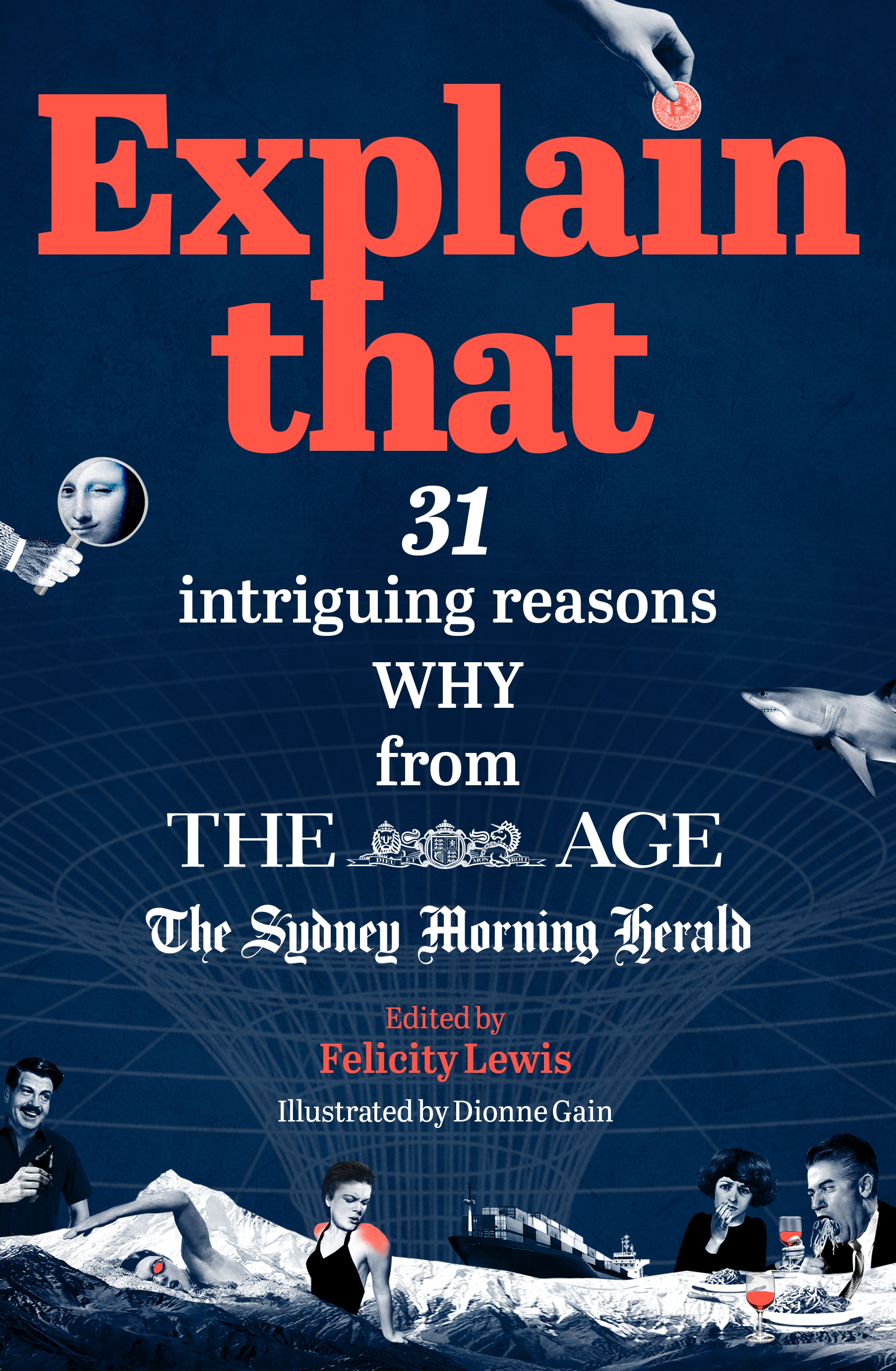
From the nation's most trusted news outlets comes an entertaining and authoritative look at the world around us.
Have you ever wondered if time travel is actually possible? Or where the Australian accent came from? Or what it feels like to have dementia? If you’re an inquisitive person who likes to understand how things came to be the way they are, this collection of thought-provoking explainers from The Age and The Sydney Morning Herald has got you covered.
Explain That answers some of the year’s – and life’s – most baffling questions. Thoroughly researched and eloquently set out by some of Australia’s finest journalists, it provides nourishment for curious minds and fun facts to share with friends and family. What do sharks want (and why do they bite)? How do you win an Oscar? Who thought up table manners? Funny, weird and insightful topics are inventively illustrated and embellished with diagrams, pictures and factoids.
If you like to learn new things, if you enjoy trivia or you want to reflect on some of the big questions, this is the book for you. Absorbing, illuminating and always engaging, Explain That is for anyone who has ever asked how and why?
This book was tricky to rate because I have taken so long to read it and also because of the concept behind the book. The time taken to read the book is not a reflection on the book at all but rather I was using it as my 'in between books' book. I was able to dip in and read an explainer or two before bed if I wasn't in the mood to start a new book or still wanted to sit with characters I wasn't ready to say goodbye to just yet. Explainers is a series of articles that appear in The Age and The Sydney Morning Herald and are usually topical eg how did break dancing end up in the Olympics? And in some ways this was a bit of a problem because by the time I had gotten around to reading these explainers the reason for why they needed to be explained had elapsed. Such as the break dancing. When it was originally published our delightful contribution to Olympic breakdancing had not occurred. It was a simpler time. I did enjoy learning about things that I hadn't actually really thought about such as how to become an Olympic swimmer (not happening in my case) or why so many Russians get poisoned (don't drink the tea!).
Recommended but suggested you just read the ones you are interested in or look for a more recent explainer book
Hard to rate because each chapter is so different. Some were really interesting in and a couple I didn't finish. Also one of the narrators had a bit too much of a presenter voice which was off-putting. I liked that the audiobook came with a pdf though of maps and graphics so listeners didn't miss out.
Disappointing. I was so excited to read this but the journalism is once again so unreliable that I can’t take the book seriously. For example, I was interested in the Sistergirls as I was hoping to read about how First Nations people embrace the LGBQTIA community but actually they just face the same problems as everywhere else. I’m not a member of that community myself so I don’t take it personally but I felt that article was misleading. The Australian language came from a melting pot of dialects - amazing. Don’t buy original artwork from from anyone who lives in western Sydney- thanks for the advice. This book made me lose my faith in journalism.
I really wanted to enjoy this. The concept is excellent. A collection of long form articles, or essays by journos on a variety of topics.
I think my struggle is actually the sheer variety. From the origins of the Australian accent, to dementia, to how to win an Oscar, to exhibition sports at the Olympics, to Australian political factions and many more topics. It was all just too different and so for me, disjointed as a collection.
I listened to this on audiobook format. Overall very interesting though there were some topics that I didn’t have as much interest in. There was plenty of content that was new to me, which was welcomed. Some of the topics veered into quite grim themes. Less of those would have made this collection more enjoyable.
I enjoyed some articles in the book such as the one about sharks and sun damage, though found some articles needing more depth in research and data to add credibility to the topic at hand - otherwise felt like i was reading a TedTalk in book format - you are left feeling more curious though without much substance to start a meaningful conversation about the topic.