

What do you think?

Boy on Fire: The Young Nick Cave
The first volume of the long-awaited, near-mythical biography of Nick Cave, by award-winning writer Mark Mordue.
An intensely beautiful, profound, and poetic biography of the formative years of the dark prince of rock 'n' roll, Boy on Fire is Nick Cave's creation story, a portrait of the artist first as a boy, then as a young man.
A deeply insightful work that charts his family, friends, influences, milieu, and, most of all, his music, the book reveals how Nick Cave shaped himself into the extraordinary artist he would become.
A powerful account of a singular, uncompromising artist, Boy on Fire is also a vivid and evocative rendering of a time and place, from the fast-running dark rivers and ghost gums of country-town Australia to the torn wallpaper, sticky carpet, and manic energy of the nascent punk scene which hit staid 1970s Melbourne like an atom bomb.
Boy on Fire is a stunning biographical achievement.
An intensely beautiful, profound, and poetic biography of the formative years of the dark prince of rock 'n' roll, Boy on Fire is Nick Cave's creation story, a portrait of the artist first as a boy, then as a young man.
A deeply insightful work that charts his family, friends, influences, milieu, and, most of all, his music, the book reveals how Nick Cave shaped himself into the extraordinary artist he would become.
A powerful account of a singular, uncompromising artist, Boy on Fire is also a vivid and evocative rendering of a time and place, from the fast-running dark rivers and ghost gums of country-town Australia to the torn wallpaper, sticky carpet, and manic energy of the nascent punk scene which hit staid 1970s Melbourne like an atom bomb.
Boy on Fire is a stunning biographical achievement.
418 pages, Paperback
First published November 18, 2020
About the author
Mark Mordue
16 books35 followersMark Mordue is a writer, journalist and editor working internationally. He won the 2010 Pascall Prize for Australian Critic of the Year. Previously he has received a 1992 Human Rights Media Award for his journalism, as well as the 1994 Women and the Media Award. His travel book Dastgah: Diary of a Headtrip was published in both Australia (Allen & Unwin, 2001) and the USA (Hawthorne Books, 2004). Film director Wim Wenders acclaimed it as the first book of its kind to take the road genre “into the 21st century”. Mark was 2001 Asialink Australian Writer-in-Residence at Beijing University and has taught narrative writing and literary journalism at the University of Sydney and the University of Technology, Sydney (UTS) over the past decade. He was Guest Editor of the literary journal Meanjin's 'On Rock ‘n’ Roll' issue (November 2006) and recently completed a draft novel for his M.A. in Writing (by Research) at UTS. He is currently developing a major biographical work on Nick Cave for international publication.
Ratings & Reviews
Friends & Following
Create a free account to discover what your friends think of this book!
Community Reviews
Displaying 1 - 30 of 62 reviews

January 23, 2022
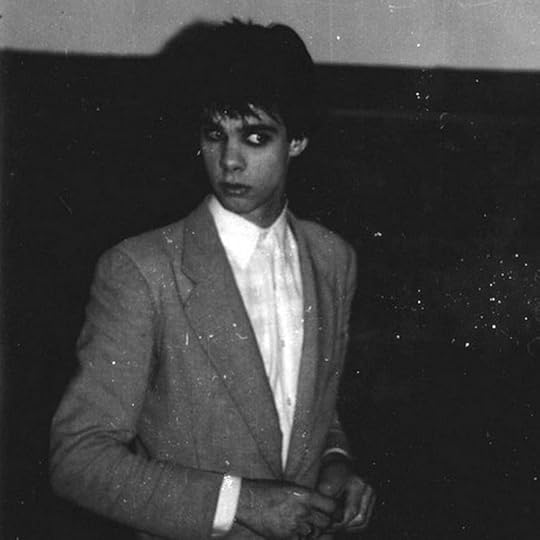
I was incredibly impressed with this biography. I'm by no means an expert on Nick Cave - I'm fairly new to his music and have only listened to a fraction of it. I haven't read any other biographies or watched any documentaries, so I can't make comparisons. The cover is striking and I'm glad the book lives up to it.
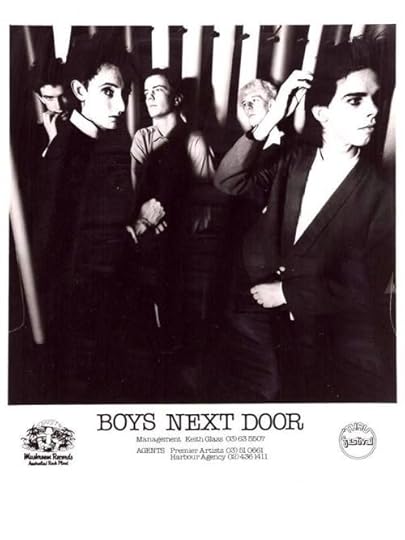
My copy is full of page markers indicating parts I especially enjoyed. I used unicorns and I think they are weirdly suited to the book. There was a lot of information about Cave, The Boys Next Door, The Birthday Party and the people around them, as was expected, but I also learned a great deal about the music scene in Melbourne at that time, which was quite riveting. To be frank, I don't think I would have enjoyed actually being there, but reading about it decades after the time was brilliant. Young Nick Cave would not have found me cool, and that's something of a relief really. I'm not sure I would have liked him or that scene, but there is something epic and entrancing about it nonetheless. A delightful highlight was that they once shared a bill with my absolute favourite band "Split Enz" sharing nothing in common but a mutual love of pancake makeup!
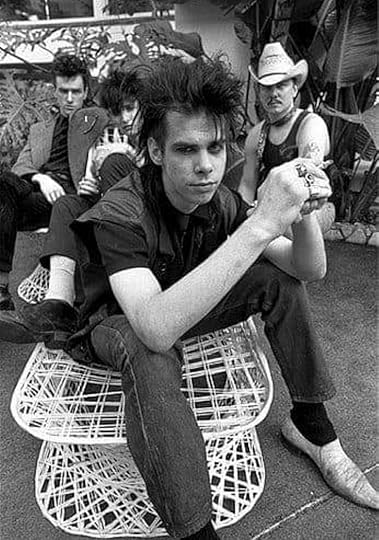
I don't know if Mark Mordue is planning another volume (or volumes) or not. Given how much I loved this I hope he does -- he could keep chronicling Nick Cave's career, book after book, and I think I would read it all. But if he doesn't want to, he has succeeded in writing one of the best biographies I have read in a long time, and I am very glad he did.


May 15, 2021
First book I've given top marks to for many a volume! A really in-depth study of Nick Cave's early career up to the departure of the Boys next door for London in early 1980 which, apparently, was originally intended as a career- length biography of Cave. I only hope that this will be followed by (at least!) a volume covering the seismic career of the Birthday Party because the structure and detail in Mordue's (First?) book is excellent!
Mark Mordue has access to a wide range of contributors , from Dawn Cave to Ron Rude, who help to construct the development, both chronological and influential, of Cave's artistry However, (and Nick Cave deserves credit for this!), he doesn't hold back from analysing the influence of other Australian mid-70s musicians and concluding that, to a degree, Nick Cave's early work is fairly derivative.
The key figures in the book, (apart from Nick himself), are Colin Cave and Anita Lane. However, the transitional power of the late lamented Rowland S Howard cannot be overstated. Nor can the steadfastness of the ever loyal Mick Harvey. However, the unpredictability of the pre- ten gallon hatted Tracey Pew is one of the most memorable take aways from this engrossing read. 35 years!!!
What a story! Well recommended.
Mark Mordue has access to a wide range of contributors , from Dawn Cave to Ron Rude, who help to construct the development, both chronological and influential, of Cave's artistry However, (and Nick Cave deserves credit for this!), he doesn't hold back from analysing the influence of other Australian mid-70s musicians and concluding that, to a degree, Nick Cave's early work is fairly derivative.
The key figures in the book, (apart from Nick himself), are Colin Cave and Anita Lane. However, the transitional power of the late lamented Rowland S Howard cannot be overstated. Nor can the steadfastness of the ever loyal Mick Harvey. However, the unpredictability of the pre- ten gallon hatted Tracey Pew is one of the most memorable take aways from this engrossing read. 35 years!!!
What a story! Well recommended.

December 16, 2020
Loved the concept. I wanted to read about the life of one of my favourite performers.
I’ve since acquired a copy from the library and finished reading it. I am not quite as enthusiastic as I was before Christmas. I really like most of Nick Cave’s work, and have done pretty much since he started out. We used to live in his neighbourhood in Melbourne. And I have been to a number of live performances. It’s unremarkable that I like him as his preferred performers pretty much echoed mine at the time (Bowie for instance). But I felt some of the writing let it down. It was a bit all over the place — not that I expect bios to be linear necessarily, but I felt this one started heading off in a particular direction but then lost its focus. Perhaps I’m being unfair.
I’ve since acquired a copy from the library and finished reading it. I am not quite as enthusiastic as I was before Christmas. I really like most of Nick Cave’s work, and have done pretty much since he started out. We used to live in his neighbourhood in Melbourne. And I have been to a number of live performances. It’s unremarkable that I like him as his preferred performers pretty much echoed mine at the time (Bowie for instance). But I felt some of the writing let it down. It was a bit all over the place — not that I expect bios to be linear necessarily, but I felt this one started heading off in a particular direction but then lost its focus. Perhaps I’m being unfair.

January 29, 2022
Mark Mordue’s masterful biography of Nick Cave covers his early years growing up in rural Victoria to his departure to England in 1980 with this band the Boys Next Door (BND).
In the preface Mordue indicates that this was originally intended to form part of a ‘mega-biography’ of NC, however the sheer quantity and depth of the entire body of Cave’s work ‘overwhelmed’ him. How fortunate we are that Mordue chose to salvage and publish the story of this part of Cave’s life which charts his development as a performer and creative artist and the wild and, lets-be-honest, low-level criminal excesses of his early adult life.
One of the strengths of this work is that while Mordue himself is an excellent writer and an astute critic, the family, friends and enemies that he spoke to are themselves extremely smart, witty and insightful. Look at how Bronwyn Bonney brilliantly dissects the many factors that make NC successful (p296). This layer of additional insight means that the book is much more than one author’s critical assessment.
Unlike the UK, or for that matter Brisbane, Melbourne’s ‘punk’ scene was born in our leafy middle-class eastern suburbs, and fostered in a social climate of free tertiary education, cheap rent, cheap drugs and a social welfare system that provided a living income that enabled creative types to experiment, fail and improve. No wonder millennials hate us!
Mordue absolutely nails the low-rent glamour, cattiness and drug-use that was the pervasive atmosphere of the Crystal Ballroom in the late ‘70s. In the early ‘80s I was a regular at the Seaview Ballroom (as it was then) and it was clear that one’s place in the pecking order was determined by your proximity to the inner circle of The Birthday Party and (to a lesser extent) The Models.
As someone who was ‘around’ then, it was great to see Mordue acknowledge many of the artists that influenced Cave. Although it eluded me at the time, the impact of the brilliant early Pere Ubu albums on NC’s vocal styling and the Boys Next Door sound now seems self-evident. Mordue also recognises many of the people that provided support to the BND. Stephen Cummings was an early advocate of the band, regularly asking them to support The Sports. And how good was it to see the Peter Lillie namechecked! Finally, where would Australian music be without the remarkable contributions of Tony Cohen and Keith Glass. While Tony Cohen’s contribution to Melbourne’s independent music scene has been noted in many books and documentaries, Keith Glass’s encouragement, management, and financing of the BND (and many other Australian independent bands via his Missing Link record label) came at a watershed moment in their career. Although the Birthday Party fell out with Glass for reasons not made entirely clear in this book, he was instrumental in the BND recording three amazing singles for Missing Link, ‘Happy Birthday’, ‘Mr Clarinet’ and the amazing ‘The Friend Catcher’. These three singles are my personal favourites from the entire BND/BP/NC catalogue. Phill Calvert, who comes across as the sweetest guy, certainly the sweetest of the surviving BND said ‘…There wouldn’t be the Nick Cave that we know today, if it wasn’t for Keith. Thank you, Keith Glass’ (p351)
Like Mordue I only saw the band’s reincarnation after they returned from the UK as ‘The Birthday Party’ in the early ‘80s. I saw them three or four times and Mordue’s description of his reaction to seeing them for the first time is exactly now I felt ’…I hated them, Nick most of all, whom I regarded as a poseur and someone who held the audience in contempt.’ (p363). I remember one BP gig at the Seaview Ballroom where NC mocked the support band for engaging in audience participation and followed up by humiliating a punter who had been naïve and uncool enough to actually participate.
However, again like Mordue, I saw them in 1982 on the back of the release of ‘Prayers on Fire’ and they had reinvented themselves again. MM describes their performance at the San Miguel Inn in Sydney as ‘demonic’ (p364) but on this tour they demonstrated that they could be a formidable live act. While Cave has had many career highlights since the demise of The Birthday Party, if you want to listen to NC at his anarchic best I recommend ‘Drunk on the Pope’s Blood’ (aptly subtitled ’16 minutes of Sheer Hell’) a live recording of four songs from this time. The Bad Seeds and Nick Cave’s solo work seem anaemic by comparison.
In the preface Mordue indicates that this was originally intended to form part of a ‘mega-biography’ of NC, however the sheer quantity and depth of the entire body of Cave’s work ‘overwhelmed’ him. How fortunate we are that Mordue chose to salvage and publish the story of this part of Cave’s life which charts his development as a performer and creative artist and the wild and, lets-be-honest, low-level criminal excesses of his early adult life.
One of the strengths of this work is that while Mordue himself is an excellent writer and an astute critic, the family, friends and enemies that he spoke to are themselves extremely smart, witty and insightful. Look at how Bronwyn Bonney brilliantly dissects the many factors that make NC successful (p296). This layer of additional insight means that the book is much more than one author’s critical assessment.
Unlike the UK, or for that matter Brisbane, Melbourne’s ‘punk’ scene was born in our leafy middle-class eastern suburbs, and fostered in a social climate of free tertiary education, cheap rent, cheap drugs and a social welfare system that provided a living income that enabled creative types to experiment, fail and improve. No wonder millennials hate us!
Mordue absolutely nails the low-rent glamour, cattiness and drug-use that was the pervasive atmosphere of the Crystal Ballroom in the late ‘70s. In the early ‘80s I was a regular at the Seaview Ballroom (as it was then) and it was clear that one’s place in the pecking order was determined by your proximity to the inner circle of The Birthday Party and (to a lesser extent) The Models.
As someone who was ‘around’ then, it was great to see Mordue acknowledge many of the artists that influenced Cave. Although it eluded me at the time, the impact of the brilliant early Pere Ubu albums on NC’s vocal styling and the Boys Next Door sound now seems self-evident. Mordue also recognises many of the people that provided support to the BND. Stephen Cummings was an early advocate of the band, regularly asking them to support The Sports. And how good was it to see the Peter Lillie namechecked! Finally, where would Australian music be without the remarkable contributions of Tony Cohen and Keith Glass. While Tony Cohen’s contribution to Melbourne’s independent music scene has been noted in many books and documentaries, Keith Glass’s encouragement, management, and financing of the BND (and many other Australian independent bands via his Missing Link record label) came at a watershed moment in their career. Although the Birthday Party fell out with Glass for reasons not made entirely clear in this book, he was instrumental in the BND recording three amazing singles for Missing Link, ‘Happy Birthday’, ‘Mr Clarinet’ and the amazing ‘The Friend Catcher’. These three singles are my personal favourites from the entire BND/BP/NC catalogue. Phill Calvert, who comes across as the sweetest guy, certainly the sweetest of the surviving BND said ‘…There wouldn’t be the Nick Cave that we know today, if it wasn’t for Keith. Thank you, Keith Glass’ (p351)
Like Mordue I only saw the band’s reincarnation after they returned from the UK as ‘The Birthday Party’ in the early ‘80s. I saw them three or four times and Mordue’s description of his reaction to seeing them for the first time is exactly now I felt ’…I hated them, Nick most of all, whom I regarded as a poseur and someone who held the audience in contempt.’ (p363). I remember one BP gig at the Seaview Ballroom where NC mocked the support band for engaging in audience participation and followed up by humiliating a punter who had been naïve and uncool enough to actually participate.
However, again like Mordue, I saw them in 1982 on the back of the release of ‘Prayers on Fire’ and they had reinvented themselves again. MM describes their performance at the San Miguel Inn in Sydney as ‘demonic’ (p364) but on this tour they demonstrated that they could be a formidable live act. While Cave has had many career highlights since the demise of The Birthday Party, if you want to listen to NC at his anarchic best I recommend ‘Drunk on the Pope’s Blood’ (aptly subtitled ’16 minutes of Sheer Hell’) a live recording of four songs from this time. The Bad Seeds and Nick Cave’s solo work seem anaemic by comparison.
This entire review has been hidden because of spoilers.

May 29, 2021
Mark Mordue's biography of Nick Cave was a long time coming, but it's everything I hoped it would be. A work of biography that is deeply researched and filled with first-hand accounts of Nick, the era and the scene but with a poetic sensibility throughout that keeps the narrative humming along as Nick's (self-)mythologisation progresses. I could have kept reading right up to the present day, but this is a terrific and comprehensive account of Nick's childhood, adolescence and The Boys Next Door years that concludes perfectly as the band boards a flight to the UK on the precipice of metamorphosing into The Birthday Party. Hoping I will one day be able to devour volume 2 (and all those that follow it).

January 19, 2021
Beautifully written biography that focuses on the young Nick Cave, up to the point where him and the Boys Next Door depart for the UK in about 1980. What's amazing about this level of focus is that the book begins with him being born and ends up him really being an artist - you see everything that happens in-between. I was a bit surprised to learn that when he got his start, him and his bandmates simply weren't very good. But you see the changes that took place in-between, including immersion in new music, an iron-clad work ethic, and playing close to 200 gigs a year with his band. That's part of what led to the rapid, rapid changes that were taking place in his music - Door Door and Hee Haw were less than a year apart, and yet they sound like they're from completely different time periods.
I also loved learning about the other members of the band. Tracy Pew used to steal cars, go on joyrides, and crash them in random places. Mick Harvey slowly developed into a very mature arranger and was very content to take a backseat to newcomer Rowland S Howard's fierce guitar playing because it made them a better band. Phil Calvert was a phenomenal musician from day one, easily the best in the band. Rowland S Howard was only 17 when he joined the band and was miles ahead - he could write, play, and dressed well, but Nick and Mick were quick to catch up with him.
I'm not even a huge Nick Cave fan, and this still managed to be an absolutely engrossing read. I learned a lot about Melbourne in the mid to late 70's. At the beginning of the decade, almost all of the music was fairly boring covers of old standards. By the end, each suburb had its own thriving scene, with the Boys Next Door dominating the Crystal Ballroom in St Kilda (which were both respectively like the CBGB and Bowery of Melbourne), the little band scene in Fitzroy, and singer songwriters popping up in Carlton.
I also loved learning about the other members of the band. Tracy Pew used to steal cars, go on joyrides, and crash them in random places. Mick Harvey slowly developed into a very mature arranger and was very content to take a backseat to newcomer Rowland S Howard's fierce guitar playing because it made them a better band. Phil Calvert was a phenomenal musician from day one, easily the best in the band. Rowland S Howard was only 17 when he joined the band and was miles ahead - he could write, play, and dressed well, but Nick and Mick were quick to catch up with him.
I'm not even a huge Nick Cave fan, and this still managed to be an absolutely engrossing read. I learned a lot about Melbourne in the mid to late 70's. At the beginning of the decade, almost all of the music was fairly boring covers of old standards. By the end, each suburb had its own thriving scene, with the Boys Next Door dominating the Crystal Ballroom in St Kilda (which were both respectively like the CBGB and Bowery of Melbourne), the little band scene in Fitzroy, and singer songwriters popping up in Carlton.
April 24, 2022
This book took me by surprise, though I expected it to be good, I liked it more than I thought I would.
It was a great journey the writer takes us on, with a high amount of detail on early influences, happenings, debauchery, losses and love. The relevant musical, artistic and literary context’s discussed are quite insightful. I hadn’t known a lot about him oddly or much about the Melbourne scene before reading this book but different things I had been told over the years all fit together now. The Boys Next Door should have a statue in St Kilda made of them! Some great quotes, a lot more humour and jest than anticipated, which I liked. It made me reflect on my art school days, where people were full of revolt and passion to express themselves. I lost my momentum.. but I loved that creative freedom.
Nick Cave’s story continues. .
The kind of book worth re-reading in ten years I reckon!
It was a great journey the writer takes us on, with a high amount of detail on early influences, happenings, debauchery, losses and love. The relevant musical, artistic and literary context’s discussed are quite insightful. I hadn’t known a lot about him oddly or much about the Melbourne scene before reading this book but different things I had been told over the years all fit together now. The Boys Next Door should have a statue in St Kilda made of them! Some great quotes, a lot more humour and jest than anticipated, which I liked. It made me reflect on my art school days, where people were full of revolt and passion to express themselves. I lost my momentum.. but I loved that creative freedom.
Nick Cave’s story continues. .
The kind of book worth re-reading in ten years I reckon!

September 5, 2021
I love a good music book and this is a very good music book.
Details the early life of Nick Cave, the childhood in a country town in Victoria to his emergence on the scene in St Kilda as part of the punk explosion of the late 1970's. It finishes with the fateful plane trip from Melbourne to London in 1980 (a month before i was born incidentally) that led to the band changing their name to The Birthday Party.
I am keen to read the next volume of this as and when it comes out.
Details the early life of Nick Cave, the childhood in a country town in Victoria to his emergence on the scene in St Kilda as part of the punk explosion of the late 1970's. It finishes with the fateful plane trip from Melbourne to London in 1980 (a month before i was born incidentally) that led to the band changing their name to The Birthday Party.
I am keen to read the next volume of this as and when it comes out.

Read
January 18, 2022Wow, this is a deeply researched look at his early years. Obviously for super fans as it’s 370 pages that stops at 1980. Personally I loved reading about the timeline of the Boys Next Door and their trajectory amongst the other new bands of the time. I can’t get enough of that era, love reading about all the influences being shared and realizing it’s all a bunch of kids figuring stuff out that changed the world.

December 9, 2024
An astonishing feat that feels complete inasmuch as an assessment of a fraction of a life to represent the whole ever can, despite only taking us a far as 1980 and departing Melbourne for London. It does this by seeding contemporary asides and observations by Nick Cave from the time of writing, which inform the era under discussion while also reflexively inviting us to compare the influence of that era on the man of today. All the while, Mordue’s personal response as he wrestles with undertaking such a labyrinthine task underpin the need for an ostensibly narrow focus. The writing is profound and lyrical, the input from key players illuminating, the sense of place richly detailed. An insightful patchwork of influences on a life that is probing and well rounded.

March 18, 2021
Mark Mordue was at work on a complete biography of Nick Cave when events in both of their lives around 2015 caused the ambitious project to fizzle out. 'I'm a different person now,' Cave said, seeming to draw a line under his long-standing co-operation. Mordue has since returned to his extensive research, but now he zooms in on Cave's formative years. Boy On Fire looks in detail at every fad and phase, every side of Cave that can be traced prior to him leaving Australia in February 1980. These include the tearaway schoolboy, the dreaming junkie, the tyrannical frontman and the sensitive young soul blindsided by the death of his father. There are other dimensions to the young Nick we might not immediately recognise.
Mordue finds so much that connects with the Nick Cave of 2021, including how he uses imagination to reckon with personal tragedy. In fact, everything is grist to his mill. His early collaborator and girlfriend Anita Lane once told him, 'If you were hit by a car, you'd reach for your pencil and try to write what it was like before you died.'
For fans it's thrilling to read of moments and images from Cave's early days that will surface in his songs years, even decades, later. A very particular stretch of the Ovens River flows from Wangaratta into multiple lyrics, most notably Sad Waters. The hopeful wisdom of Colin Cave underpins Nature Boy.
A good music bio has you constantly looking up the tracks and bands it mentions. This one also directs you toward painters (Matthias Grünewald, Egon Schiele, Sidney Nolan, the Dadaists) and writers (Dostoevsky, Alfred Jarry, Nabokov, Flannery O'Connor). It's a soup of reference that thickens as Cave assimilates culture like there's no tomorrow, and feeds it all back into his nascent band, The Boys Next Door.
Mordue has aimed for Boy On Fire to show Cave at the centre of 'a kaleidoscope of people and stories'. He's particularly strong on the subculture that congregated in the Crystal Ballroom (a legendary venue in St Kilda, then Melbourne's bohemian-attracting red light district) to watch post-punk bands in the late 70s.
In one interview excerpt, Brownyn Bonney provides a perceptive account of why it is Nick Cave who became a star, whilst other gifted artists from the time faded into obscurity. She carefully lists all the crucial things that he possessed, and notes that 'everyone else lacked two or three of those ingredients'. In a single page, she threatens to render the rest of the book redundant, so complete is her sense of the young Cave, and so neatly does it tally with the same artist who has just put out Carnage at 63. Work ethic is again and again pinpointed by Cave's contemporaries as his great advantage. 'He works like a demon. He deserves his success,' insists Bonney. In issue #138 of The Red Hand Files, Cave concurs that it's mainly that surfeit of sheer energy – 'a shameless and pathological belief in my own awesomeness' – that has sustained his long career, above any talent he may have had.
Other participants in the scene that whirled around The Boys Next Door and their clique are more blunt in their assessment, less prepared to balance Cave's virtues against his vices. 'I thought they were dickheads,' remarks fashion designer Alannah Hill.
The books ends with Cave and his cohort aboard a flight to London, to them the promised land of indie music, as the 80s dawn. During the flight they elect to change their name to The Birthday Party. I was reminded of Tune In , the first volume of Mark Lewisohn's mammoth Beatles bio, which also chooses to stop with its subject airborne and on the cusp of something bigger (the soon-to-be Fab Four flying home from Hamburg for the last time, in December 1962).
If Mordue goes beyond that long-haul cliffhanger and does continue with his epic biography of Cave after all, there are four full decades of restless creativity left to cover, as Cave moves through multiple cities and scenes, collects and discards muses and collaborators, and emerges from addictions and complex private torments. It's a staggering challenge. Such is the artistic depth and international breadth of that story, the ongoing work could end up akin to John Richardson's all-consuming multi-volume biography of his friend Picasso. But Boy on Fire's brief flashes forward into the 2000s only confirm that Mordue is the man to document the Bad Seeds years — the brilliant biographer Nick Cave deserves.
Mordue finds so much that connects with the Nick Cave of 2021, including how he uses imagination to reckon with personal tragedy. In fact, everything is grist to his mill. His early collaborator and girlfriend Anita Lane once told him, 'If you were hit by a car, you'd reach for your pencil and try to write what it was like before you died.'
For fans it's thrilling to read of moments and images from Cave's early days that will surface in his songs years, even decades, later. A very particular stretch of the Ovens River flows from Wangaratta into multiple lyrics, most notably Sad Waters. The hopeful wisdom of Colin Cave underpins Nature Boy.
My father said, don’t look away
You got to be strong, you got to be bold, now
He said, that in the end it is beauty
That is going to save the world, now
A good music bio has you constantly looking up the tracks and bands it mentions. This one also directs you toward painters (Matthias Grünewald, Egon Schiele, Sidney Nolan, the Dadaists) and writers (Dostoevsky, Alfred Jarry, Nabokov, Flannery O'Connor). It's a soup of reference that thickens as Cave assimilates culture like there's no tomorrow, and feeds it all back into his nascent band, The Boys Next Door.
Mordue has aimed for Boy On Fire to show Cave at the centre of 'a kaleidoscope of people and stories'. He's particularly strong on the subculture that congregated in the Crystal Ballroom (a legendary venue in St Kilda, then Melbourne's bohemian-attracting red light district) to watch post-punk bands in the late 70s.
In one interview excerpt, Brownyn Bonney provides a perceptive account of why it is Nick Cave who became a star, whilst other gifted artists from the time faded into obscurity. She carefully lists all the crucial things that he possessed, and notes that 'everyone else lacked two or three of those ingredients'. In a single page, she threatens to render the rest of the book redundant, so complete is her sense of the young Cave, and so neatly does it tally with the same artist who has just put out Carnage at 63. Work ethic is again and again pinpointed by Cave's contemporaries as his great advantage. 'He works like a demon. He deserves his success,' insists Bonney. In issue #138 of The Red Hand Files, Cave concurs that it's mainly that surfeit of sheer energy – 'a shameless and pathological belief in my own awesomeness' – that has sustained his long career, above any talent he may have had.
Other participants in the scene that whirled around The Boys Next Door and their clique are more blunt in their assessment, less prepared to balance Cave's virtues against his vices. 'I thought they were dickheads,' remarks fashion designer Alannah Hill.
The books ends with Cave and his cohort aboard a flight to London, to them the promised land of indie music, as the 80s dawn. During the flight they elect to change their name to The Birthday Party. I was reminded of Tune In , the first volume of Mark Lewisohn's mammoth Beatles bio, which also chooses to stop with its subject airborne and on the cusp of something bigger (the soon-to-be Fab Four flying home from Hamburg for the last time, in December 1962).
If Mordue goes beyond that long-haul cliffhanger and does continue with his epic biography of Cave after all, there are four full decades of restless creativity left to cover, as Cave moves through multiple cities and scenes, collects and discards muses and collaborators, and emerges from addictions and complex private torments. It's a staggering challenge. Such is the artistic depth and international breadth of that story, the ongoing work could end up akin to John Richardson's all-consuming multi-volume biography of his friend Picasso. But Boy on Fire's brief flashes forward into the 2000s only confirm that Mordue is the man to document the Bad Seeds years — the brilliant biographer Nick Cave deserves.

January 19, 2021
This is indeed a very comprehensive look at Nick Cave's early years from childhood through to the Boys Next Door leaving for London. Mark Mordue has obviously put a lot of time, thought and care into crafting this book and he certainly managed to convey the atmosphere of the time and place where young Nick was growing up and coming of age.
It seemed to end all of a sudden though, knowing that there is so much more to the story of Nick Cave's work, it would be interesting to know if there are further volumes planned to make a set, I seem to recall reading somewhere that this may be the case. I hope so, as it would be a shame to leave all of the research and background work, that would have obviously covered the later years as well while putting this book together, with no further outlet.
It seemed to end all of a sudden though, knowing that there is so much more to the story of Nick Cave's work, it would be interesting to know if there are further volumes planned to make a set, I seem to recall reading somewhere that this may be the case. I hope so, as it would be a shame to leave all of the research and background work, that would have obviously covered the later years as well while putting this book together, with no further outlet.
August 12, 2021
I've been a Nick Cave fan for over 35 years. I've read umpteen features and interviews, plus several books about him, but this is by far the best account of his early years. The quality of the writing is excellent, as is the analysis of the people, music and times. A fantastic book. If there's subsequent books by Mark Mordue about Nick Cave, I expect they'll be outstanding reads as well.

May 30, 2022
Rollicking and interesting enough, but when we’re told that “Sid Vicious was found dead from a heroin overdose at the Chelsea Hotel” (p. 275) -- he wasn’t; he died blocks away, in a flat on Bank Street -- I’m left questioning the veracity of the rest of the book, having to assume much of the content is questionable at best and dubious at worst.

March 11, 2022
4.5 stars. I thought this book was really well done. It really brought the personality of the young Nick Cave to life. I’ve heard that this is the first in a series of Nick Cave biographies by this author—if that’s true I look forward to reading future volumes.
December 28, 2020
Enchanting tale, exquisitely told.
Tremendous.
Tremendous.
June 10, 2025
I do not like nick cave
November 5, 2023
Oh my gosh I just wrote my biggest GRs review yet, quotes and all typed up and then I accidentally swiped up and lost everything….. typical.
Well. well. Can I be bothered saying anything else to the void.
This book was both great and disappointing. It’s only on Nick Caves youth to early twenties, before he blew up globally before he shot up to the point of full blown addiction. Before the central drama of his life.
The angsty anarchistic anti-establishment teen driven hubris exuuuudes from these stories and highlights. But it’s not enough. The author admits he saw Cave’s life in phases characterised by hues and textures, noting his intention to capture the artists whole life. But alas I believe he got swept up in the complexity of this mans character.
My lost review said something like- thank you to this book for the boredom, laughter, darkness, terror and tenderness.
I’ll leave with this Nick Cave quote from the epilogue on life and the nature of time.
“…the idea that we live life in a straight line, like a story, seems to me to be increasingly absurd and more than anything a kind of intellectual convenience. I feel that the events in ours lives are like a series of bells being struck and the vibrations spread outwards, affecting everything, our present and our futures, of course, but our past as well. Everything is changing and vibrating and in flux.”
Well. well. Can I be bothered saying anything else to the void.
This book was both great and disappointing. It’s only on Nick Caves youth to early twenties, before he blew up globally before he shot up to the point of full blown addiction. Before the central drama of his life.
The angsty anarchistic anti-establishment teen driven hubris exuuuudes from these stories and highlights. But it’s not enough. The author admits he saw Cave’s life in phases characterised by hues and textures, noting his intention to capture the artists whole life. But alas I believe he got swept up in the complexity of this mans character.
My lost review said something like- thank you to this book for the boredom, laughter, darkness, terror and tenderness.
I’ll leave with this Nick Cave quote from the epilogue on life and the nature of time.
“…the idea that we live life in a straight line, like a story, seems to me to be increasingly absurd and more than anything a kind of intellectual convenience. I feel that the events in ours lives are like a series of bells being struck and the vibrations spread outwards, affecting everything, our present and our futures, of course, but our past as well. Everything is changing and vibrating and in flux.”

January 24, 2026
Ultimately a little disappointing. All credit to the author, this is a well-researched biography, and I found the first half (dealing with aspects of the time Mordue spent with Cave, how the book came to be written, and the subject's childhood) interesting and insightful. The book focussing as much as it does on The Boys Next Door, late 1970s precursor to The Birthday Party, it lost my interest. Far too much was just tales of immature 'punk' debauchery, anecdotes and 'music journo' history that didn't actually tell us a lot about Cave.
I'm much more of a fan of Cave's late 90s to mid 2000s albums ('The Boatman's Call' is among my favourite five or ten LPs ever), much more of an appreciator of his lyrical and balladic tracks than the shrieking and chaotic ones, I hoped for more of an insight into the man and his art. This probably would be appreciated much more by those who are fans of his earlier work and/or super-obsessive fans of the man. I also struggled a little with the nature of this as a biography - having read many more autobiographies than those not written by the subject, I found the tone a touch fawning in places in a manner that one wouldn't get from a self-penned memoir.
I'm much more of a fan of Cave's late 90s to mid 2000s albums ('The Boatman's Call' is among my favourite five or ten LPs ever), much more of an appreciator of his lyrical and balladic tracks than the shrieking and chaotic ones, I hoped for more of an insight into the man and his art. This probably would be appreciated much more by those who are fans of his earlier work and/or super-obsessive fans of the man. I also struggled a little with the nature of this as a biography - having read many more autobiographies than those not written by the subject, I found the tone a touch fawning in places in a manner that one wouldn't get from a self-penned memoir.

November 21, 2022
Even better than I expected. Meticulously research and detailed without being ponderous or slow. Mordue occasionally spends a bit too much time pontificating on the artistic significance of the Boys Next Door without advancing the narrative, but we can forgive him. Great anecdotes abound: Nick staring in a mirror the whole time they were filming the Shivers video to make sure he was getting his poses right, Nick drunkenly assaulting Rowland at a party before the latter joined the band, Tracy’s endless series of petty crimes, etc. It is, for the most part, a not very flattering portrait of Nick (or any of the band, for that matter), and I appreciate the sometimes brutal honesty of the thing.
I will, however, be very, very frustrated if there are no sequels. It stops just as the band is getting good. I’m desperate for a more detailed account of the rest of the Birthday Party’s story, the Bad Seeds, etc. Mordue spends a lot of time foreshadowing, so he damn well better deliver on what he’s promising!
I will, however, be very, very frustrated if there are no sequels. It stops just as the band is getting good. I’m desperate for a more detailed account of the rest of the Birthday Party’s story, the Bad Seeds, etc. Mordue spends a lot of time foreshadowing, so he damn well better deliver on what he’s promising!
July 28, 2022
Very good. As an avid fan of The Birthday Party (and less of Cave's solo stuff) this was a very informative and entertaining read. My only complain is that the author should have covered all of BP's career instead of leaving the reader in suspension when the band left for London.

May 12, 2024
Covering up to the moment The Boys Next Door left for London and became The Birthday Party, this exhaustive biography of a young Nick Cave is an utterly fascinating portrait of one of my favorite artists of all time.
August 31, 2024
I'm only reading biographies of Nick Cave because there isn't one dedicated to Rowland S. Howard, so I have to pick through for scraps. This one had some good insights and was well annotated. Still hate endnotes instead of footnotes, but at least this time they were worth the flip.

February 18, 2026
so fitting that in a work based so wholly on the prince of darkness / one of most violent bands in the world, the final word is ‘tenderness’.
i was constantly battling myself going ‘i wish i had been there’ and ‘thank god i wasn’t there’.
so well written. chop chop mark you have 45 more years to cover!! can’t wait for volume 2.
i was constantly battling myself going ‘i wish i had been there’ and ‘thank god i wasn’t there’.
so well written. chop chop mark you have 45 more years to cover!! can’t wait for volume 2.

August 16, 2021
As a huge fan of Nick Cave I was absolutely ripe for the picking with this one. I’m still relatively new to the biography world, but this one definitely helped to persuade me further in! It is SO well researched, with thoughts and anecdotes from his close friends and family as well as from the King of gothic rock himself.
Originally planned to be a comprehensive biography of Cave’s whole life to date, this changed in 2015 after the loss of his son, the author writes ‘Nick felt he had been changed entirely. There was only before and after. “I’m a different person now”, he said to me on a few occasions. In his opinion, this rendered what had been said in our conversations “entirely redundant”. And so, it was decided instead, to take the deepest of dives into his early life, from childhood, through his school years, detailing his mythical rise to stardom in the Australian punk scene with The Boys Next Door and ending as the band boards a flight to the UK in the eighties, where they would emerge as The Birthday Party and the next phase of Nick Cave’s metamorphosis into the artist we know today.
Not only did I love reading about him as a person and an artist, but I was fully immersed in the place and time as I read. From the dry and savage heat of the Australian outback where Nick lived as a child, through the dirty gutters of the 1970’s Melbourne punk scene, to the decaying elegance of the Crystal Ballroom where the dark prince of rock and roll held audiences in the palm of his hand.
Mordue has such a way with words, his passion for the music and dedication to showing his subject in an honest light, even when that light isn’t always flattering, really shone through. I can’t wait for the next instalment. This is a must-read for any fan of Nick Cave or for fans of punk, rock and roll, or just generally fucking great music.
Originally planned to be a comprehensive biography of Cave’s whole life to date, this changed in 2015 after the loss of his son, the author writes ‘Nick felt he had been changed entirely. There was only before and after. “I’m a different person now”, he said to me on a few occasions. In his opinion, this rendered what had been said in our conversations “entirely redundant”. And so, it was decided instead, to take the deepest of dives into his early life, from childhood, through his school years, detailing his mythical rise to stardom in the Australian punk scene with The Boys Next Door and ending as the band boards a flight to the UK in the eighties, where they would emerge as The Birthday Party and the next phase of Nick Cave’s metamorphosis into the artist we know today.
Not only did I love reading about him as a person and an artist, but I was fully immersed in the place and time as I read. From the dry and savage heat of the Australian outback where Nick lived as a child, through the dirty gutters of the 1970’s Melbourne punk scene, to the decaying elegance of the Crystal Ballroom where the dark prince of rock and roll held audiences in the palm of his hand.
Mordue has such a way with words, his passion for the music and dedication to showing his subject in an honest light, even when that light isn’t always flattering, really shone through. I can’t wait for the next instalment. This is a must-read for any fan of Nick Cave or for fans of punk, rock and roll, or just generally fucking great music.
February 1, 2021
This good but frustrating biography covers Nick's life in Australia up until the start of The Birthday Party, finishing with the band heading to London.
As an Australian reader, there is a lot to like. The regional/urban divide is explored, along with class and cultural progress, as well as Nick's own story, obviously. The frustration comes in as there's very little resolution to what's discussed throughout, so feels like the first volume of a set. We don't find out how Nick's relationships with his father, son or Tracy - all of whom passed prematurely - affected him, or much about how his secondary relationships with Rowland, Mick and Phil ended. (Rowland could easily be the subject of his own volume). Nonetheless the writing's intimate and feels 'authorised'.
I'd recommend it absolutely for a Nick fan (though truth be told he does come across as a pretentious bellend), or for those interested in Australia's cultural history.
PS One shouldn't judge a book by its cover, but the cover and book itself is beautiful.
As an Australian reader, there is a lot to like. The regional/urban divide is explored, along with class and cultural progress, as well as Nick's own story, obviously. The frustration comes in as there's very little resolution to what's discussed throughout, so feels like the first volume of a set. We don't find out how Nick's relationships with his father, son or Tracy - all of whom passed prematurely - affected him, or much about how his secondary relationships with Rowland, Mick and Phil ended. (Rowland could easily be the subject of his own volume). Nonetheless the writing's intimate and feels 'authorised'.
I'd recommend it absolutely for a Nick fan (though truth be told he does come across as a pretentious bellend), or for those interested in Australia's cultural history.
PS One shouldn't judge a book by its cover, but the cover and book itself is beautiful.

May 4, 2021
As a borderline obsessed fan of Nick Cave, I was really excited to read this. And it was good.... it just left me wanting more. I loved learning so much about his years growing up and his early years with The Boys Next Door... but now I need sequel books so I can follow him through The Birthday Party and onward! :)

September 23, 2021
The story of how Nick was front and centre stage in the Australian punk and post punk scene in Melbourne's Crystal Ballroom and the gritty reality of the St Kilda underground. This is a precious documentation of an incredibly creative and artistic period in Australia's musical and cultural history and of how Nick Cave's success was born ultimately due to the people that surrounded him.
January 19, 2021
A very clever way to tell an epic story by focusing on a relatively short time period. It makes you want the rest but at the same time doesn’t need the next chapter. Well done Mark Mordue.
January 25, 2021
Well-researched from original and secondary sources, sensitively written, non-linear, vividly evocative, semi-autobiographical. Awesome work, Mr Mordue. Congratulations!
Displaying 1 - 30 of 62 reviews