

What do you think?

Crude: A Memoir
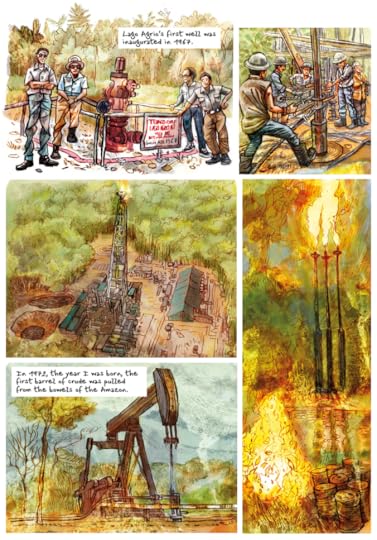
In 1972, the American oil company Texaco, now known as Chevron, extracted its first barrel of crude oil from Amazonian Ecuador. By the time it pulled out of the region some twenty years later, Texaco had extracted oil from at least three hundred wells and left behind nearly sixteen million gallons of spilled oil and more than eighteen million gallons of toxic waste.
Ecuadorian lawyer and activist Pablo Fajardo gives this first-hand account of Texaco's involvement in the Amazon, as well as the ensuing legal battles between the oil company, the Ecuadorian government, and the region's inhabitants. As a teenager, Fajardo worked in the Amazonian oil fields, where he witnessed the consequences of Texaco/Chevron's extraction work there--the pools of waste that polluted the land and waterways, contaminated food sources, and caused cancers, birth defects, and deaths. Fajardo mobilized with his peers to seek reparations and studied to become a lawyer. In time, he became the lead counsel for the UDAPT (Union of People Affected by Texaco), a group of more than thirty thousand small farmers and indigenous people from the Northern Ecuadorian Amazon who continue to fight for reparation and remediation to this day.
Crude brings to light one of the least understood and most important cases of environmental and racial injustice of our time.
Ecuadorian lawyer and activist Pablo Fajardo gives this first-hand account of Texaco's involvement in the Amazon, as well as the ensuing legal battles between the oil company, the Ecuadorian government, and the region's inhabitants. As a teenager, Fajardo worked in the Amazonian oil fields, where he witnessed the consequences of Texaco/Chevron's extraction work there--the pools of waste that polluted the land and waterways, contaminated food sources, and caused cancers, birth defects, and deaths. Fajardo mobilized with his peers to seek reparations and studied to become a lawyer. In time, he became the lead counsel for the UDAPT (Union of People Affected by Texaco), a group of more than thirty thousand small farmers and indigenous people from the Northern Ecuadorian Amazon who continue to fight for reparation and remediation to this day.
Crude brings to light one of the least understood and most important cases of environmental and racial injustice of our time.
135 pages, Kindle Edition
Published April 29, 2021
Ratings & Reviews
Friends & Following
Create a free account to discover what your friends think of this book!
Community Reviews
Displaying 1 - 30 of 62 reviews

June 5, 2021
Texaco started extracting oil from deep in the Equadorian Amazon in the 70's. For over 20 years they left their waste all over the jungle poisoning the land and people, causing cancer and miscarriages. In the 90's the people of the area finally sued. 25 years later, the legal battle is still ongoing as Texaco / Chevron does everything with their power to keep from paying knowing it would set a precedence throughout the world for other lands they've also ruined in their greed. It's a sad story of corporate malfeasance on an epic scale. One still going on to this very day.
Received a review copy from Graphic Mundi and Edelweiss.
Received a review copy from Graphic Mundi and Edelweiss.

February 28, 2021
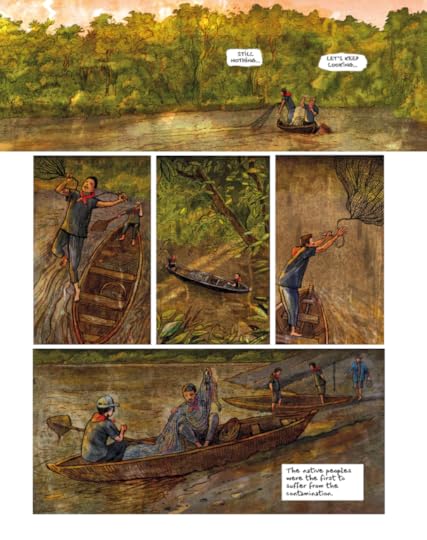
Texaco started extracting oil from deep under the Equadorian Amazon in the 70s, and Texaco did not give a care for the indigenous people who lived there. Oil spills were everywhere, contaminating the wildlife and especially the water, which the indigenous people bathed in and drank from. The people got sick, children died, people contracted stomach cancer and women had miscarriages.
The idea was to make Texaco pay (or Chevron, who later bought up Texaco), through a seemingly endless legal battle - it basically is still going. This story is told through the eyes of Pablo Fajardo, an activist turned lawyer.
It's an astounding story, of a ruthless corporation that tries to avoid acknowledging any wrong doing on their part, a small group of Equadorians who try to get some form of justice, of corrupt judges and corrupt lawyers, of an Equadorian government that is easily bought, of a UN that is beholden to the corporations.
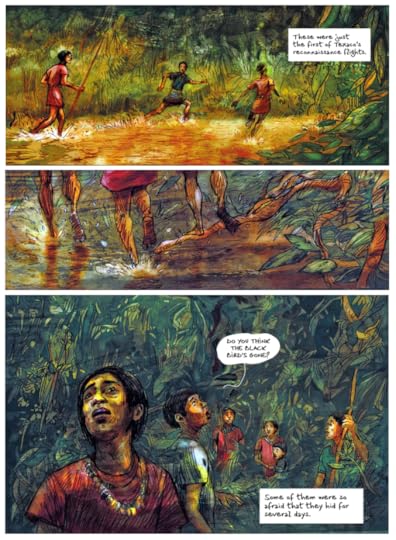
It's shocking, it's moving, and the art is quite beautiful.
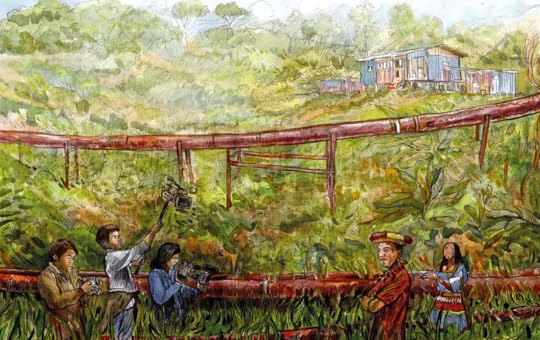
At the back of the book are supplemental materials, further showing how large corporations like Chevron try to get away with whatever they want.
On the one hand it is depressing, on the other hand there are still activists fighting them.
(Thanks to Graphic Mundi for providing me with an ARC through Edelweiss)
The idea was to make Texaco pay (or Chevron, who later bought up Texaco), through a seemingly endless legal battle - it basically is still going. This story is told through the eyes of Pablo Fajardo, an activist turned lawyer.
It's an astounding story, of a ruthless corporation that tries to avoid acknowledging any wrong doing on their part, a small group of Equadorians who try to get some form of justice, of corrupt judges and corrupt lawyers, of an Equadorian government that is easily bought, of a UN that is beholden to the corporations.
It's shocking, it's moving, and the art is quite beautiful.
At the back of the book are supplemental materials, further showing how large corporations like Chevron try to get away with whatever they want.
On the one hand it is depressing, on the other hand there are still activists fighting them.
(Thanks to Graphic Mundi for providing me with an ARC through Edelweiss)

May 17, 2021
An Ecuadorean man recounts -- with the help of a French journalist and artist -- his early life working for Texaco, helping to pollute the Amazon rainforest with oil extraction wastes, and how he later became a lawyer and sued Texaco/Chevron on behalf of the indigenous people who were harmed by the toxic pollution left in the water and soil. That kind of muddled message continues throughout the book as a major victory in a court in Ecuador is basically left unenforceable and allegations of various sorts have been leveled against judges and the plaintiff attorneys.
It's a legal mess of epic proportions that creates such a show as to distract from the victims of corporate malfeasance and Texaco/Chevron's indifference to human suffering. They get a little lost in Fajardo's memoir as he flies around the country and the world for court and media appearances, à la Erin Brockovich, but he does manage to refocus and tell at least a portion of their story amidst his own.
It's a legal mess of epic proportions that creates such a show as to distract from the victims of corporate malfeasance and Texaco/Chevron's indifference to human suffering. They get a little lost in Fajardo's memoir as he flies around the country and the world for court and media appearances, à la Erin Brockovich, but he does manage to refocus and tell at least a portion of their story amidst his own.

April 17, 2024
An exceptional graphic novel! Tour de force of heroism and resilience of the indigenous of the Amazona.
Pablo Fajardo shows the reader the tragic and disastrous abuse of Texaco towards the Amazon and the indigenous peoples. This abuse starts from 1964 in Ecuador and pummels all through today. A gross display of corruption, denial, and ecological destruction is common through Texacos treatment of the innocent. This is a worthy and necessary read especially for awareness of climate change and for environmental rights.
Beautiful art panels besides the heavy themes.
Pablo Fajardo shows the reader the tragic and disastrous abuse of Texaco towards the Amazon and the indigenous peoples. This abuse starts from 1964 in Ecuador and pummels all through today. A gross display of corruption, denial, and ecological destruction is common through Texacos treatment of the innocent. This is a worthy and necessary read especially for awareness of climate change and for environmental rights.
Beautiful art panels besides the heavy themes.

January 2, 2022
If Van Gogh was a comic artist, I believe that his graphic novels would look like Crude: A Memoir.
Beautifully impressionistic art and a succinctly delivered story of Ecuador’s Chernobyl: the toxic environmental poisoning of Amazonian Ecuador by Texaco/Chevron and a local Ecuadorian petroleum company.
Focused mostly on the life of a young idealistic Ecuadorian man affected by the pollution in his community, who was encouraged and bankrolled to attend law school by his local Catholic parish, only to witness deep-seated graft and corruption as Chevron noxiously and viciously fought their $9 billion dollar fine.
Well done with art notes and extensive resources to learn more about the continuing defense on this case, as well as its use as precedent for other international environmental and human rights violations crimes.
Beautifully impressionistic art and a succinctly delivered story of Ecuador’s Chernobyl: the toxic environmental poisoning of Amazonian Ecuador by Texaco/Chevron and a local Ecuadorian petroleum company.
Focused mostly on the life of a young idealistic Ecuadorian man affected by the pollution in his community, who was encouraged and bankrolled to attend law school by his local Catholic parish, only to witness deep-seated graft and corruption as Chevron noxiously and viciously fought their $9 billion dollar fine.
Well done with art notes and extensive resources to learn more about the continuing defense on this case, as well as its use as precedent for other international environmental and human rights violations crimes.

August 30, 2021
This was FANTASTIC. The art was absolutely luscious, with color blending to die for. The story was heartbreaking but extremely necessary, something I believe everyone should be aware of, considering this fight has been going on for most of my life. This story also shows how the US justice system is far from exempt when it comes to corruption, especially when large multinationals with seemingly endless resources are concerned. Even if you aren't normally a fan of graphic novels, do yourself a favor and pick this one up!

October 4, 2021
Important read. Made me mad.
September 24, 2024
An important story we all must read about an Ecuadorian activist’s ongoing fight against the oil company Texaco/Chevron. This has been the recurring ugly story that happens all over the third world which the mainstream media seldom reports. Underlying theme has been always the remorseless exploitation and pollution of the environment by multinational corporations driven by globalizations. These behemoths don’t have any accountability in way whatsoever and operate with ultimate impunity. The story is the same starting from Bhopal, Sterlite, Nigerian Delta, Cote d’Ivoire and the list goes on.
Armed with thousands of lawyers and millions of dollars at their disposal, in a legal system where you can wiggle your way out of accountability like a slippery eel by unethical practices, it has been always a futile war for the victims. This is the story of one such group, the indigenous people of Ecuadorian Amazon who lost their everything due to 20 years of oil drilling operation by Chevron. When the company wrapped up its operation after 20 years ,it left the lungs of the earth so polluted by crude oil, the local tribes lost everything . Their source of food and clean water got polluted to a point of no return. So many deaths due to the health issues caused by the crude in the soil and water.
This group of indigenous people lead by a lawyer “Pablo Fajardo”, has been fighting their case against Texaco/Chevron for 25 years with absolute resolute even though they were harassed, bullied and intimidated. Also, the Ecuadorian court ruled against Chevron and asked the company to pay 9 billion dollars as reparation. But the victims did not see a penny of it till this day.
This is one of the stories of victims of a ruthless practice called globalization across the world. This is a story of utter disregard for the environment, corruption, human rights violation. This is a story of how corporations get their way by manufacturing the local countries political agenda by buying their leaders and distorting the truth by portraying the activist as an anti-development group.
A powerful tale told with powerful illustrations.
A must read for anybody mildly interested in the future of the earth and/or for everybody innocently contributing and enhancing these unethical companies as a consumer like me.
Armed with thousands of lawyers and millions of dollars at their disposal, in a legal system where you can wiggle your way out of accountability like a slippery eel by unethical practices, it has been always a futile war for the victims. This is the story of one such group, the indigenous people of Ecuadorian Amazon who lost their everything due to 20 years of oil drilling operation by Chevron. When the company wrapped up its operation after 20 years ,it left the lungs of the earth so polluted by crude oil, the local tribes lost everything . Their source of food and clean water got polluted to a point of no return. So many deaths due to the health issues caused by the crude in the soil and water.
This group of indigenous people lead by a lawyer “Pablo Fajardo”, has been fighting their case against Texaco/Chevron for 25 years with absolute resolute even though they were harassed, bullied and intimidated. Also, the Ecuadorian court ruled against Chevron and asked the company to pay 9 billion dollars as reparation. But the victims did not see a penny of it till this day.
This is one of the stories of victims of a ruthless practice called globalization across the world. This is a story of utter disregard for the environment, corruption, human rights violation. This is a story of how corporations get their way by manufacturing the local countries political agenda by buying their leaders and distorting the truth by portraying the activist as an anti-development group.
A powerful tale told with powerful illustrations.
A must read for anybody mildly interested in the future of the earth and/or for everybody innocently contributing and enhancing these unethical companies as a consumer like me.
May 25, 2023
2.5 Stars!
Texaco (now owned by Chevron), the American oil company exploited the region in the Ecuadorian Amazon from 1967 to 1993, building 300 oil wells, and then left behind almost 16 million gallons of crude and 18.5 millions of toxic residues. This remains one of history’s largest cases of oil pollution, 30 times the oil spill of the Exxon Valdez in Alaska.
After tireless fighting Chevron were fined $9 billion, but they refused to pay and to avoid having its assets frozen the company pulled all of its money out of Ecuador, refusing to recognise the country’s verdict. This is known as corporate gratitude, American style!
This kind of art work does very little for me personally, and there were some issues with dates like wrongly claiming that Exxon Valdez was 1986 rather than 1989 and inconsistencies with other years which really gave this an amateur feel. This also struggled to maintain clarity and focus, but overall the campaign is admirable and the circumstances beyond tragic.
Texaco (now owned by Chevron), the American oil company exploited the region in the Ecuadorian Amazon from 1967 to 1993, building 300 oil wells, and then left behind almost 16 million gallons of crude and 18.5 millions of toxic residues. This remains one of history’s largest cases of oil pollution, 30 times the oil spill of the Exxon Valdez in Alaska.
After tireless fighting Chevron were fined $9 billion, but they refused to pay and to avoid having its assets frozen the company pulled all of its money out of Ecuador, refusing to recognise the country’s verdict. This is known as corporate gratitude, American style!
This kind of art work does very little for me personally, and there were some issues with dates like wrongly claiming that Exxon Valdez was 1986 rather than 1989 and inconsistencies with other years which really gave this an amateur feel. This also struggled to maintain clarity and focus, but overall the campaign is admirable and the circumstances beyond tragic.
August 15, 2025
5✨ for the art and 4✨ for the story, but overall a 5 simply for being a good introduction to a really important topic.
Crude tells the story of what Texaco/Chevron did to the Amazonian rainforest in Ecuador (at one point it's called the Chernobyl of the Amazon), and the Ecuadorian lawyer who won a historic lawsuit but is still fighting for justice today. I had no idea about any of this. In fact besides knowing a lot of oil comes from Texas and the Middle East... This book made me realize how little I actually know about the way oil has been extracted around the world.
I will say the history is recounted pretty bare bones, and I was left wanting more, but I also understand it's just a graphic novel (lol) and it seems I have more reading to do.
Crude tells the story of what Texaco/Chevron did to the Amazonian rainforest in Ecuador (at one point it's called the Chernobyl of the Amazon), and the Ecuadorian lawyer who won a historic lawsuit but is still fighting for justice today. I had no idea about any of this. In fact besides knowing a lot of oil comes from Texas and the Middle East... This book made me realize how little I actually know about the way oil has been extracted around the world.
I will say the history is recounted pretty bare bones, and I was left wanting more, but I also understand it's just a graphic novel (lol) and it seems I have more reading to do.

May 16, 2021
god, what a devastating story. it's sickening to realize how much power these companies have, and how little they care for human lives.

June 16, 2021
Beautiful. Depressing. Necessary.
January 23, 2026
shiv rating: 3.75 stars
lush, stunning illustrations, a really enlightening story (fuck chevron lol), and actually quite a fast read once you get into it!!! and also fuck chevron
lush, stunning illustrations, a really enlightening story (fuck chevron lol), and actually quite a fast read once you get into it!!! and also fuck chevron

July 23, 2022
Trying to figure out if we can have an electric car without a driveway.

May 6, 2022
Twenty-five years. Twenty five years the people of Ecuador have been fighting for Texaco and Chevron to clean up their environmental devastation. This is the story of how multinational corporations are emboldened by international law and how everyday people stay in the fight against them.

August 6, 2022
It is a very important story and this is a beautiful medium to narrate a biographical account of a lawyer trying to protect his home.

February 18, 2022
Crude is a real-world graphic narration of Ecuadorian lawyer Pablo Fajardo's long running battle against oil giant Chevron's polluting of the Amazon river through the 60's and beyond. What makes it so heart-wrenching is its simplistic artwork which depicts the trials and travails of the poverty stricken South American indigenous tribes taking on one of the world's largest giants. A must read immersion in the world of corporate greed and its inimical affects.

November 13, 2025
“Must we accept that everything will be destroyed? Must we accept that not a single inch of our shared Earth can escape exploitation?” - Fabrice Nicolino
“Crude: A Memoir” tells the disappointing and irresponsible practices of oil companies, specifically of Texaco, in the Amazon rainforest of Ecuador. The contamination of the Amazon river, not only damaged the rainforest, but also killed and drove out its wildlife and its inhabitants. Seeking justice, Fajardo becomes an activist then a lawyer to help sue the giant oil corporation that is Texaco. Working with other activists, lawyers, Franciscan fathers, and victims of the contaminated waters, Fajardo gains international attention to this case. However, the legal battle would be a long and arduous one. One that is still ongoing today…
I really appreciated Fajardo’s attempt at shedding light on this unfortunate incident. However, I don’t think this should have been done in a graphic memoir format. Don’t get me wrong, I loved the artwork! But, trying to summarize such a complicated legal battle lasting over twenty years, while sharing stories of the victims, while exposing corruption in government, while also sharing his story of farmer turned activist turned lawyer, is a lot to take on in this format. Some things felt rushed and/or vague. Fajardo did mention another book (“Amazon Crude” by Judith Kimerling) and a documentary (“Crude” by Joe Berlinger) that may delve deeper into this environmental crisis more than this book does. Those, I’m definitely checking out, too!
4 ⭐️
“Crude: A Memoir” tells the disappointing and irresponsible practices of oil companies, specifically of Texaco, in the Amazon rainforest of Ecuador. The contamination of the Amazon river, not only damaged the rainforest, but also killed and drove out its wildlife and its inhabitants. Seeking justice, Fajardo becomes an activist then a lawyer to help sue the giant oil corporation that is Texaco. Working with other activists, lawyers, Franciscan fathers, and victims of the contaminated waters, Fajardo gains international attention to this case. However, the legal battle would be a long and arduous one. One that is still ongoing today…
I really appreciated Fajardo’s attempt at shedding light on this unfortunate incident. However, I don’t think this should have been done in a graphic memoir format. Don’t get me wrong, I loved the artwork! But, trying to summarize such a complicated legal battle lasting over twenty years, while sharing stories of the victims, while exposing corruption in government, while also sharing his story of farmer turned activist turned lawyer, is a lot to take on in this format. Some things felt rushed and/or vague. Fajardo did mention another book (“Amazon Crude” by Judith Kimerling) and a documentary (“Crude” by Joe Berlinger) that may delve deeper into this environmental crisis more than this book does. Those, I’m definitely checking out, too!
4 ⭐️

August 30, 2023
In this French graphic album, Sophie Tardy-Joubert & Damien Roudeau adapt the story of Pablo Fajardo, a Ecuadorian lawyer who has been fighting oil giants Texaco and Chevron to repair the environmental damage they inflicted on the jungles of his country. Roudeau’s watercolor-style illustrations are a nice way to present this topic, which is for the most part told in a very straightforward, almost dry, manner. That said, the machinations that the oil giant resorts to in order to escape accountability are breathtaking. After they’re found liable, they refuse to pay, flee the country, and countersue the Ecuadorian lawyers in US court for fraud, and, most startlingly, win. At this point, I wished for a more objective viewpoint to pick apart such an outcome, but you only get the point of view of the Ecuadorians here, which is fine, as it’s a memoir, and it doesn’t hide that fact. I wish I could say this was great, but the writing never rises above workmanlike. It’s the art that elevates it up to 4 stars.
All in all this beautifully packaged volume (down to the maps on the endpapers!) is worth a look, as this legal struggle, which caught the eyes of the West about a decade ago has largely disappeared from US media since then, even though the fight very much continues.
All in all this beautifully packaged volume (down to the maps on the endpapers!) is worth a look, as this legal struggle, which caught the eyes of the West about a decade ago has largely disappeared from US media since then, even though the fight very much continues.

October 23, 2023
Visually striking and conceptually direct, this graphic novel is the story of Ecuadorian activist Pablo Fajardo, who for decades worked to call massive multinational oil conglomerates to account for their despoliation of the Amazon.
It's a striking tale that has been committed to word and image, and it works exceptionally well as a graphic novel. The art style and color palette are impressionistic and vivid, lushly watercolor and alive. The paneling, effective and similarly expressive.
Fajardo's telling rises strongly from the visceral grassroots leftism of South America, one that is shaped less by the semiotics of academic publishing and more by the depredations of corporations that have obliterated an entire way of life. It's both progressive and populist, which makes for a peculiar encounter in the US, where progressivism and "peoples movements" are congenitally unable to speak the common tongue.
It is clearly rhetoric intended for particular effect, but...as much as leftism sometimes feels lost in dreams of what is not, like the imaginary courts of "international law"...it is impossible not to hear and honor Fajardo's lament over all that was taken from his people.
It's a striking tale that has been committed to word and image, and it works exceptionally well as a graphic novel. The art style and color palette are impressionistic and vivid, lushly watercolor and alive. The paneling, effective and similarly expressive.
Fajardo's telling rises strongly from the visceral grassroots leftism of South America, one that is shaped less by the semiotics of academic publishing and more by the depredations of corporations that have obliterated an entire way of life. It's both progressive and populist, which makes for a peculiar encounter in the US, where progressivism and "peoples movements" are congenitally unable to speak the common tongue.
It is clearly rhetoric intended for particular effect, but...as much as leftism sometimes feels lost in dreams of what is not, like the imaginary courts of "international law"...it is impossible not to hear and honor Fajardo's lament over all that was taken from his people.

June 23, 2021
Environmental racism and corporate/governmental corruption continue to rear their horns in this graphic memoir. To think the Amazonian and Ecuadorian people continue to fight after 25 years- where is our dignity and integrity?
Northern Americans often see Latin America as third world, or less civilized. (Generalizing here…) In truth, the US and the corporate greed made this so. Our corporations eradicate innocent people, destroy nature and do squat to own up to anything.
As you can tell, the situation itself compels this budding environmentalist to say something, but the artwork itself tells a story. The colour choices showcase the beauty of the Amazon vs the industrialized world and our crude oil.
While the illustrations portray such beauty, the back-matter’s lacking in visual evidence of Chevron’s destruction. Not to mention, how can the reader support the UDAPT and Affectado’s efforts - there’s no concrete call to action here!
Northern Americans often see Latin America as third world, or less civilized. (Generalizing here…) In truth, the US and the corporate greed made this so. Our corporations eradicate innocent people, destroy nature and do squat to own up to anything.
As you can tell, the situation itself compels this budding environmentalist to say something, but the artwork itself tells a story. The colour choices showcase the beauty of the Amazon vs the industrialized world and our crude oil.
While the illustrations portray such beauty, the back-matter’s lacking in visual evidence of Chevron’s destruction. Not to mention, how can the reader support the UDAPT and Affectado’s efforts - there’s no concrete call to action here!

January 31, 2023
Reading 2023
Book 3: Crude: A Memoir by Pablo Fajardo
Found this looking for nonfiction GNs this past November.
Synopsis: In 1972, the American oil company Texaco, now known as Chevron, extracted its first barrel of crude oil from Amazonian Ecuador. By the time it pulled out of the region some twenty years later, Texaco had extracted oil from at least three hundred wells and left behind nearly sixteen million gallons of spilled oil and more than eighteen million gallons of toxic waste.
Review: What an interesting book. Maybe I had heard an inkling of this suit later on in the process, but certainly did not know near the extent of it all. Loved the art in this book, and the persistence/perseverance of the people of Ecuador that are affected. My rating 4⭐️.
Book 3: Crude: A Memoir by Pablo Fajardo
Found this looking for nonfiction GNs this past November.
Synopsis: In 1972, the American oil company Texaco, now known as Chevron, extracted its first barrel of crude oil from Amazonian Ecuador. By the time it pulled out of the region some twenty years later, Texaco had extracted oil from at least three hundred wells and left behind nearly sixteen million gallons of spilled oil and more than eighteen million gallons of toxic waste.
Review: What an interesting book. Maybe I had heard an inkling of this suit later on in the process, but certainly did not know near the extent of it all. Loved the art in this book, and the persistence/perseverance of the people of Ecuador that are affected. My rating 4⭐️.
October 6, 2021
This covers Pablo’s Fajardo’s struggles fighting against oil companies like Texaco for the damage they caused to the Amazon rainforest and to the Ecuadorian people. It’s a type of story that is going to make you angry over the lack of consequences for immense greed, and how the richest most powerful people in the world bend the rules in ways that benefit them and destroy others. The choice to use oil-type paint to construct the visuals to this tale was an apt one. It showcases the lush nature of this land and how that pristine beauty was tainted and destroyed so recklessly. How the poignant greens make way from dark browns and blacks as the entire land loses its health and wellbeing.

December 23, 2020
Won this digital copy via Publisher's Weekly's Galley Grab.
Loved the artwork! Such a treat! It made the setting, as it should be, a character.
The story itself is a hard one to read. It feels there is no end to corporate corruption and what Texaco/Chevron has done in the Amazon and elsewhere is reprehensible. It's sad what money and a large legal team (and a lack of morals) can accomplish.
I do hope the people's lives, cultures, and land get the monetary compensation they deserve and a proper cleanup.
Loved the artwork! Such a treat! It made the setting, as it should be, a character.
The story itself is a hard one to read. It feels there is no end to corporate corruption and what Texaco/Chevron has done in the Amazon and elsewhere is reprehensible. It's sad what money and a large legal team (and a lack of morals) can accomplish.
I do hope the people's lives, cultures, and land get the monetary compensation they deserve and a proper cleanup.
September 5, 2022
I love how the graphic nonfiction genre brings new information to people who may not have experienced it otherwise. It's such an approachable medium for presenting new stories and, in this case, raising awareness for a cause many readers may not know much about.
Although I had a vague notion going in, I'm one of those readers who was ignorant of the specifics and I'm so glad I picked up this book and experienced the life stories within. I'll definitely be researching further, especially considering where the book leaves us on the current events side of the tale.
Bonus that the art style in this one is really neat and fits the content of the book perfectly.
Although I had a vague notion going in, I'm one of those readers who was ignorant of the specifics and I'm so glad I picked up this book and experienced the life stories within. I'll definitely be researching further, especially considering where the book leaves us on the current events side of the tale.
Bonus that the art style in this one is really neat and fits the content of the book perfectly.

Read
March 22, 2023This graphic novel is the memoir of Pablo Fajardo, an activist lawyer from Ecuador, who details here the tragic aftermath of Texaco and Chevron's despoilment of a portion of Ecuador's Amazon rainforest. Indigenous people lost their ability to live off the land and suffered many physical ailments, including miscarriage and death. Although they eventually won a court case against Chevron, (which purchased Texaco) and were awarded $9 billion in damages, Chevron has yet to pay up and actually countersued. The case continues.

January 29, 2024
16 million gallons of crude; 18.5 million gallons of toxic reside left in the Amazon - and no one is responsible for it. I find myself in the very strange position of (almost) not recommending an excellent GN; because it is so depressing - because it is surreal - because it illustrates the difference between law and ethics so clearly. She is blind for a reason - and she welds her sword for someone - but just focus on the scales...see if they ever balance out...for the common people. Highest recommendation.

August 12, 2025
This is a wonderful graphic memoir of the lawyer representing Indigenous Ecuadorians impacted by Chevron's/Texaco's horrendous environmental damage while drilling for oil in the Amazon rainforest. As a teen in a large family in Ecuador, Pablo worked the oil fields to bring in extra money, but saw the damage it was doing. He began meeting with a religious activist group, who helped him train to become a lawyer. He's been fighting this case for decades now, and the case is still ongoing. The art is gorgeous. There's apparently a documentary that I'll try to watch!

June 17, 2021
This one of the most beautifully-rendered graphic novels I have ever read. It is also a very depressing, yet essential read. Multinational corporations are evil. As the immortal Ned Beatty famously put it in Sidney Lumet's 1976 film classic, 'Network': "There is no America. There is no democracy. There is only IBM and ITT and AT&T and DuPont, Dow, Union Carbide, and Exxon. Those are the nations of the world today."

July 15, 2024
Well if that isn't one of the saddest things I've read recently.
I was ignorant of the extent to which oil companies get away with in terms of exploiting resources abroad. Completely devastating ecosystems with their constructions and poisoning indigenous peoples with the run off.
And even when the people when in court, the oil companies find ways to not pay the $9 billion, for example. Sheesh!
Recommended for budding environmental activists.
I was ignorant of the extent to which oil companies get away with in terms of exploiting resources abroad. Completely devastating ecosystems with their constructions and poisoning indigenous peoples with the run off.
And even when the people when in court, the oil companies find ways to not pay the $9 billion, for example. Sheesh!
Recommended for budding environmental activists.
Displaying 1 - 30 of 62 reviews