

What do you think?

A Matter Of Trust: India-US Relations from Truman to Trump
FINALIST FOR THE 2022 ARTHUR ROSS AWARD 'I thought India was pretty jammed with poor people and cows wandering around the streets, witch doctors and people sitting on hot coals and bathing in the Ganges, but I did not realize that anybody thought it was important.' -- PRESIDENT TRUMAN TO AMBASSADOR CHESTER BOWLES, 1951 From Truman's remark to now, it has been a long journey. India and the US, which share common values and should have been friends, found themselves caught in a dysfunctional cycle of resentment and mistrust for the first few decades following Indian independence. In A Matter of Trust , author Meenakshi Ahamed reveals the personal prejudices and insecurities of the leaders, and the political imperatives, that so often cast a shadow over their relationship. The cycle began with India's first prime minister, Jawaharlal Nehru, who viewed Americans as naive and insular, but it was under Indira Gandhi that India entered the darkest phase of its relations with the US. President Truman decided Nehru was a communist, and the White House tapes reveal Nixon's hatred towards Mrs Gandhi and Indians. It was only after India undertook major economic reforms in the 1990s that the relationship improved. The transformation occurred when President George W. Bush signed the historic nuclear deal in 2008 with Prime Minister Manmohan Singh. Meenakshi Ahamed draws on a unique trove of presidential papers, newly declassified documents, memoirs and interviews with officials directly involved in events on both sides to put together this illuminating account of their relationship that has far-reaching implications for the changing global political landscape. ------------------------------------------------------------------------------- 'Meenakshi Ahamed has brought us a brilliant, important, sparkling and definitive study of a part of American history that is growing more crucial by the day. A Matter of Trust is essential reading at a moment when the United States and India are all the more central to each other, and when valiant democracies around the world are in danger.'
-- Michael Beschloss, New York Times bestselling author and NBC News Presidential Historian 'Meenakshi Ahamed has, brilliantly, combined her talent as an accomplished journalist with her assiduous historical research to tell the tale of two great democracies. She brings to life the leaders in both counties, with their views and prejudices. A masterpiece.'
-- Strobe Talbott, Former Deputy Secretary of State and President of The Brookings Institution 'Meenakshi Ahamed has given us an authentic, thoughtful and accessible account of a relationship characterized by paradox and progress. She tells the tale of the highs and lows of that relationship in all its drama, with strong and idiosyncratic personalities on both sides. Today's transformed India-US relations could determine the future not only of one-fifth of humanity but of the Asian Century. This is a book with a serious message- one to read and savour.'
-- Shivshankar Menon, Former National Security Advisor, Ambassador to China and Foreign Secretary 'In this world of growing great power competition, the Indian-American relationship has become one of central, strategic importance to the two nations. In her history of the relationship, Meena Ahamed has given us a timely, lively and captivating account of the road India and the United States have travelled and a compelling insight into what lies ahead.'
-- Frank G. Wisner, Former United States Ambassador to India 'Meenakshi Ahamed's labour of love is a real tour de force covering the long tortuous history of the often-troubled relationship of the world's two largest democracies since India's independence. The book is at once scholarly, deeply researched and yet down to earth. It brings to life the prickly personalities on both sides, and their sensitivities, that often bedevilled the evolving bilateral relationship. As a new era of competitive geopolitics pits West versus East, what lies ahead for this unusual relationship? To prepare ourselves this book is a must-read.'
-- Dr Rakesh Mohan, Former Deputy Governor Reserve Bank of India
-- Michael Beschloss, New York Times bestselling author and NBC News Presidential Historian 'Meenakshi Ahamed has, brilliantly, combined her talent as an accomplished journalist with her assiduous historical research to tell the tale of two great democracies. She brings to life the leaders in both counties, with their views and prejudices. A masterpiece.'
-- Strobe Talbott, Former Deputy Secretary of State and President of The Brookings Institution 'Meenakshi Ahamed has given us an authentic, thoughtful and accessible account of a relationship characterized by paradox and progress. She tells the tale of the highs and lows of that relationship in all its drama, with strong and idiosyncratic personalities on both sides. Today's transformed India-US relations could determine the future not only of one-fifth of humanity but of the Asian Century. This is a book with a serious message- one to read and savour.'
-- Shivshankar Menon, Former National Security Advisor, Ambassador to China and Foreign Secretary 'In this world of growing great power competition, the Indian-American relationship has become one of central, strategic importance to the two nations. In her history of the relationship, Meena Ahamed has given us a timely, lively and captivating account of the road India and the United States have travelled and a compelling insight into what lies ahead.'
-- Frank G. Wisner, Former United States Ambassador to India 'Meenakshi Ahamed's labour of love is a real tour de force covering the long tortuous history of the often-troubled relationship of the world's two largest democracies since India's independence. The book is at once scholarly, deeply researched and yet down to earth. It brings to life the prickly personalities on both sides, and their sensitivities, that often bedevilled the evolving bilateral relationship. As a new era of competitive geopolitics pits West versus East, what lies ahead for this unusual relationship? To prepare ourselves this book is a must-read.'
-- Dr Rakesh Mohan, Former Deputy Governor Reserve Bank of India
556 pages, Paperback
Published May 24, 2022
Ratings & Reviews
Friends & Following
Create a free account to discover what your friends think of this book!
Community Reviews
Displaying 1 - 5 of 5 reviews

April 8, 2023
Meenakshi Ahamed's A Matter of Trust: India-U.S. Relations from Truman to Trump (2021) is a kaleidoscopic history of modern Indian history and India-U.S. diplomatic relationship since Indian Independence in 1947. She has given us an extremely well-written tale, jam-packed with information about a region of the world that few of us know or understand. And we've had a peek behind the veil of diplomacy into a very complicated region and the dark edges of diplomacy.
If there is one overarching message in this deeply researched history, it is that British colonialism offered little benefit to either the occupied or the occupiers. It was an expensive undertaking, the source of long-lasting and severe geopolitical tensions, and it ended with long-lasting explosive results when the pressures blew the lid off the box.
We also learn that human nature, from the very top down to the boots on the ground, is often antithetical to successful diplomacy. We watch as some U. S. Presidents (Nixon in particular, with his sidekick Kissinger) display an open dislike for India, while some Indian politicians (Prime Minister Indira Nehru Gandhi, 1966-77, 1980-84) return it in spades. One wonders how diplomacy can resolve disputes. The problem is not just that the disputes are too large, but also that sometimes the diplomats are too small.
Some of the diplomats on both sides were detestable creatures who only replaced problems with other problems. In short, few characters come off well in this tale. Most show some mix of incompetence, indifference, or dislike in their dealings with other world leaders. Exceptions are Jawarhlal Nehru and Ravi Ghandi—Nehru's grandson—on the Indian side, and J.F.K, H.W. Bush and Bill Clinton in the U.S. camp. Ahamed refers to H.W.Bush as ". . . one of the most underrated U.S. Presidents of the Twentieth Century."
The history of India as a British colony began in 1600 with the formation of the East India Company, a joint stock company formed during India's Mughal Empire to manage the lucrative trade between East Asia and Britain. The Company's products ranged from Asian tea, spices, and to Britain and Asian opium to China. Over time, the Company's mission morphed into the full administration of the Indian government, including an army fielded by the Company to quell unrest.
The 1857 Sepoy Rebellion marked a sea change in Britain's largest colony. The East India Company was disbanded and the British Crown assumed full control over Indian affairs. Thus began the "British Raj," which lasted until 1947 when the British government, now in severe financial straits from WWII, agreed to the partition of India into two independent and autonomous nations: India and Pakistan.
Oddly, Pakistan would be formed as two regions separated by 1,000 miles—from the Indian state of Uttar Anschal in India's north-west, through Nepal, and to East Pakistan in India's north-eastern corner. These two divisions would have little in common except Muslim majorities. Initially named East and West Pakistan, in 1971 Pakistan would agree to separation into Pakistan (the former West Pakistan) and Bangladesh (the former East Pakistan).
This proliferation of independence resulting from the end of the Raj had a predictable legacy of still-unresolved border disputes between India, Pakistan and China. Pakistan's primary dispute was, and remains, over its border with two areas: the Indian state of Jammu and Kashmir, and a separate region of Kashmir (called Ladakh), China's dispute is at the border between India and the China-held Tibetan Region.
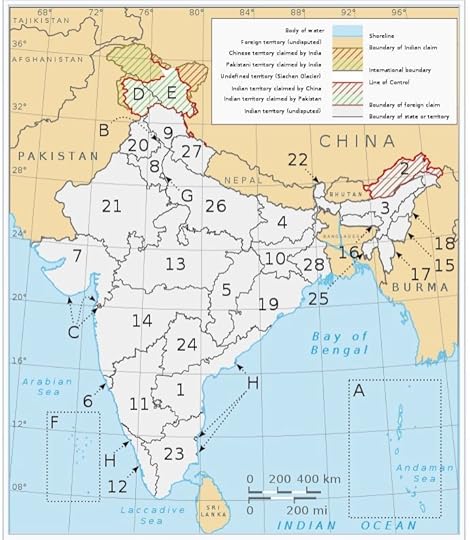
Contested Areas: D - Ladakh; E -Jammu and Kashmir; /// - /// - Arunachal Pradesh
In 1947 Jawaharlal Nehru, the leader of the Nationalist Movement and head of the Congress Party, was elected India's first Prime Minister in a democratic election, serving in that position for 17 years until his natural death in 1964.
Nehru was the gem on the back of the toad of Indian leadership. Realizing that India was sandwiched between the nearby totalitarianism of Russia and China, and the distant democracies of Britain and the U.S. Nehru was determined that India remain independent. Nehru adopted a policy of strict non-alignment and he skillfully navigated between the Scylla of the West and the Charybdis of his northern neighbors. This was a wise policy but inevitably it led each bloc to point the finger at India as a handmaiden of another bloc.
Nehru understood the power of India's religious divisions–Buddhism, Hinduism, and Sikhism. He knew the historical, religious, cultural, and philosophical idiosyncrasies of each understood the Indian states, a knowledge that made him better prepared for the broad domestic consequences of the New Delhi government's decisions.
In 1966, Two years after Nehru's death, his daughter, Indira Nehru Gandhi – wife of Mahatma Gandhi's son, Feroze – was elected Prime Minister. She also served for 17 years during two terms, (1964-1977, 1980-84) that ended with her assassination by her bodyguards. Her son, Rajiv Gandhi—trained as an airline pilot and with no political aspirations—became Prime Minister in 1984, serving until he also was assassinated by a suicide bomber in 1989. Thus, the Nehru line defined India's political leadership for 38 of India's first 42 years of independence.
During her 17 years as Prime Minister, Indira Gandhi departed from her father's script. She showed little allegiance to his open and democratic style, and she made no secret of her leanings toward socialism and Russia. This made the U.S. suspicious of her agenda, and her actions and behavior made the only nation capable of giving substantial assistance–the U.S.¬–into a distant friend reluctant to provide needed assistance whenever India faced one of its famines or other economic problems
India: The Vale of Tears
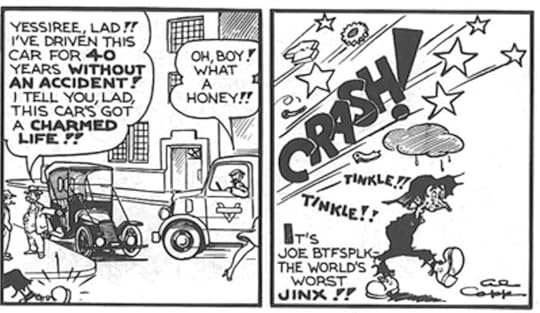
India was a land of perpetual crisis. An apt metaphor is Joe Btfsplk, Al Capp's comic character dubbed "the world's worst jinx." You might recall Joe: he's the character sneaking around with a perpetual thundercloud hanging over him.
In 1943, during WWII and before Independence, the Bengal Famine arrived when the monsoons didn't; with a death count of three million, this is still by far India's greatest famine. At that time WWII was underway and the West was focused on its own existential and financial problems: Britain was expending its wealth on Europe, and the U.S. was supporting Britain with aid, loans, and Lend-Lease of military items. Merited or not –the debate goes on – this episode has remained a black mark in India's view of the West, particularly of the British Crown. but also of the U.S.
The list of India's travails since 1947 is long. A very partial list tells the story.
° The First Kashmir War with Pakistan: When Pakistan was ° Uncertain Boundaries: The British Authority that drew the India-Pakistan boundaries for Indian and Pakistani Independence affected India's future relations with countries other than Pakistan. They failed to consult with China, which abutted the new East Pakistan. This created a contested area between India and Chinese-controlled Tibet. In 1962 China invaded the disputed territory area with a 20,000-man force. After a month of fighting against an 80,000-man Indian force in the Himalayas, the Chinese declared a cease-fire. Both sides suffered several thousand casualties, the result was a stalemate, and the issue remains unsettled.
° In 1965 Pakistan entered Jammu and Kashmiri—more an infiltration than an invasion—hoping to set off an anti-India insurgency among its Muslims. This 17-day contest ended in defeat for Pakistan, which lost its some of the area of Kashmir that it had been given to it in 1947. That land was returned in a 1972 treaty.
° A 1974 reprise of the 1943 Bengal Famine, though on a much smaller scale.
° An Independence movement in East Pakistan that ended in 1971 with its independence from Pakistan and its reformation as the nation of Bangladesh.
° A full-scale India-Pakistan War in 1999 when Pakistan crossed the Line of Control –- then and now the official border established by Britain — and occupied NW India. This was a decisive defeat for Pakistan, which lost additional Kashmiri territory to India.
° India's development of a nuclear weapons program with testing beginning in 1974, an act that predictably led to a Pakistani nuclear weapons program with testing in 1998. This raised the stakes of Indian-Pakistan disputes.
° The Viet-Nam war on India's eastern border, bringing China's influence closer to India.
° A series of economic and financial difficulties arising sometimes from external forces (climate-driven crop failures, rising oil prices, balance-of-payments crises) other times from internal forces, including the adverse impact of Indira Gandhi's socialist policies on the vitality of Indian industry.
India-U.S. Diplomatic Relations
Indian Independence occurred during Truman's presidency, and the early omens were poor. Nehru's nonalignment policy was taken by Truman as a leaning toward Russia and socialism, a view reinforced by Nehru's urging that China become a UN member and by Nehru's government-controlled industrialization program: Nehru correctly saw that India's future was in industry, not agriculture, and he initiated a government program to create and manage a range of new heavy industries. This was perceived as an application of the Soviet industrialization model, and it had long-lasting effects on Western perceptions of India's model of economic development.
Indian Independence exacerbated the tensions between India, Britain and the U.S., tensions that soared when China and the Soviet Union were interested in an issue. The British did not depart with humility, and their attempts to run India from behind a veil were difficult to combat. India was constantly at the center of a geopolitical dispute, whether over its borders, its policies, or its allegiances.
The tensions in East Asia were increased by the poor diplomatic relations between the interested parties. In too many cases, the diplomats selected to represent India in foreign affairs were sometimes far from diplomatic. Indira Gandhi gets low marks, but far above V.K. Krishna Menon, a long-time advisor to Nehru (1947-1962) whom Nehru "released" from office during the 1962 Sino-Indian War. Menon was described as "eloquent and brilliant with a highly abrasive manner."
To be fair, the U.S. had its own diplomatic ogres. Nixon and Kissinger top Ahamed's list top. However, there were bright spots among the U.S. representatives and officials. JFK visited India with a very positive effect that Ahamed attributes to Jackie's charm. And, as noted, H.W. Bush and Bill Clinton receive high marks.
If there is one overarching message in this deeply researched history, it is that British colonialism offered little benefit to either the occupied or the occupiers. It was an expensive undertaking, the source of long-lasting and severe geopolitical tensions, and it ended with long-lasting explosive results when the pressures blew the lid off the box.
We also learn that human nature, from the very top down to the boots on the ground, is often antithetical to successful diplomacy. We watch as some U. S. Presidents (Nixon in particular, with his sidekick Kissinger) display an open dislike for India, while some Indian politicians (Prime Minister Indira Nehru Gandhi, 1966-77, 1980-84) return it in spades. One wonders how diplomacy can resolve disputes. The problem is not just that the disputes are too large, but also that sometimes the diplomats are too small.
Some of the diplomats on both sides were detestable creatures who only replaced problems with other problems. In short, few characters come off well in this tale. Most show some mix of incompetence, indifference, or dislike in their dealings with other world leaders. Exceptions are Jawarhlal Nehru and Ravi Ghandi—Nehru's grandson—on the Indian side, and J.F.K, H.W. Bush and Bill Clinton in the U.S. camp. Ahamed refers to H.W.Bush as ". . . one of the most underrated U.S. Presidents of the Twentieth Century."
The history of India as a British colony began in 1600 with the formation of the East India Company, a joint stock company formed during India's Mughal Empire to manage the lucrative trade between East Asia and Britain. The Company's products ranged from Asian tea, spices, and to Britain and Asian opium to China. Over time, the Company's mission morphed into the full administration of the Indian government, including an army fielded by the Company to quell unrest.
The 1857 Sepoy Rebellion marked a sea change in Britain's largest colony. The East India Company was disbanded and the British Crown assumed full control over Indian affairs. Thus began the "British Raj," which lasted until 1947 when the British government, now in severe financial straits from WWII, agreed to the partition of India into two independent and autonomous nations: India and Pakistan.
Oddly, Pakistan would be formed as two regions separated by 1,000 miles—from the Indian state of Uttar Anschal in India's north-west, through Nepal, and to East Pakistan in India's north-eastern corner. These two divisions would have little in common except Muslim majorities. Initially named East and West Pakistan, in 1971 Pakistan would agree to separation into Pakistan (the former West Pakistan) and Bangladesh (the former East Pakistan).
This proliferation of independence resulting from the end of the Raj had a predictable legacy of still-unresolved border disputes between India, Pakistan and China. Pakistan's primary dispute was, and remains, over its border with two areas: the Indian state of Jammu and Kashmir, and a separate region of Kashmir (called Ladakh), China's dispute is at the border between India and the China-held Tibetan Region.
Contested Areas: D - Ladakh; E -Jammu and Kashmir; /// - /// - Arunachal Pradesh
In 1947 Jawaharlal Nehru, the leader of the Nationalist Movement and head of the Congress Party, was elected India's first Prime Minister in a democratic election, serving in that position for 17 years until his natural death in 1964.
Nehru was the gem on the back of the toad of Indian leadership. Realizing that India was sandwiched between the nearby totalitarianism of Russia and China, and the distant democracies of Britain and the U.S. Nehru was determined that India remain independent. Nehru adopted a policy of strict non-alignment and he skillfully navigated between the Scylla of the West and the Charybdis of his northern neighbors. This was a wise policy but inevitably it led each bloc to point the finger at India as a handmaiden of another bloc.
Nehru understood the power of India's religious divisions–Buddhism, Hinduism, and Sikhism. He knew the historical, religious, cultural, and philosophical idiosyncrasies of each understood the Indian states, a knowledge that made him better prepared for the broad domestic consequences of the New Delhi government's decisions.
In 1966, Two years after Nehru's death, his daughter, Indira Nehru Gandhi – wife of Mahatma Gandhi's son, Feroze – was elected Prime Minister. She also served for 17 years during two terms, (1964-1977, 1980-84) that ended with her assassination by her bodyguards. Her son, Rajiv Gandhi—trained as an airline pilot and with no political aspirations—became Prime Minister in 1984, serving until he also was assassinated by a suicide bomber in 1989. Thus, the Nehru line defined India's political leadership for 38 of India's first 42 years of independence.
During her 17 years as Prime Minister, Indira Gandhi departed from her father's script. She showed little allegiance to his open and democratic style, and she made no secret of her leanings toward socialism and Russia. This made the U.S. suspicious of her agenda, and her actions and behavior made the only nation capable of giving substantial assistance–the U.S.¬–into a distant friend reluctant to provide needed assistance whenever India faced one of its famines or other economic problems
India: The Vale of Tears
India was a land of perpetual crisis. An apt metaphor is Joe Btfsplk, Al Capp's comic character dubbed "the world's worst jinx." You might recall Joe: he's the character sneaking around with a perpetual thundercloud hanging over him.
In 1943, during WWII and before Independence, the Bengal Famine arrived when the monsoons didn't; with a death count of three million, this is still by far India's greatest famine. At that time WWII was underway and the West was focused on its own existential and financial problems: Britain was expending its wealth on Europe, and the U.S. was supporting Britain with aid, loans, and Lend-Lease of military items. Merited or not –the debate goes on – this episode has remained a black mark in India's view of the West, particularly of the British Crown. but also of the U.S.
The list of India's travails since 1947 is long. A very partial list tells the story.
° The First Kashmir War with Pakistan: When Pakistan was ° Uncertain Boundaries: The British Authority that drew the India-Pakistan boundaries for Indian and Pakistani Independence affected India's future relations with countries other than Pakistan. They failed to consult with China, which abutted the new East Pakistan. This created a contested area between India and Chinese-controlled Tibet. In 1962 China invaded the disputed territory area with a 20,000-man force. After a month of fighting against an 80,000-man Indian force in the Himalayas, the Chinese declared a cease-fire. Both sides suffered several thousand casualties, the result was a stalemate, and the issue remains unsettled.
° In 1965 Pakistan entered Jammu and Kashmiri—more an infiltration than an invasion—hoping to set off an anti-India insurgency among its Muslims. This 17-day contest ended in defeat for Pakistan, which lost its some of the area of Kashmir that it had been given to it in 1947. That land was returned in a 1972 treaty.
° A 1974 reprise of the 1943 Bengal Famine, though on a much smaller scale.
° An Independence movement in East Pakistan that ended in 1971 with its independence from Pakistan and its reformation as the nation of Bangladesh.
° A full-scale India-Pakistan War in 1999 when Pakistan crossed the Line of Control –- then and now the official border established by Britain — and occupied NW India. This was a decisive defeat for Pakistan, which lost additional Kashmiri territory to India.
° India's development of a nuclear weapons program with testing beginning in 1974, an act that predictably led to a Pakistani nuclear weapons program with testing in 1998. This raised the stakes of Indian-Pakistan disputes.
° The Viet-Nam war on India's eastern border, bringing China's influence closer to India.
° A series of economic and financial difficulties arising sometimes from external forces (climate-driven crop failures, rising oil prices, balance-of-payments crises) other times from internal forces, including the adverse impact of Indira Gandhi's socialist policies on the vitality of Indian industry.
India-U.S. Diplomatic Relations
Indian Independence occurred during Truman's presidency, and the early omens were poor. Nehru's nonalignment policy was taken by Truman as a leaning toward Russia and socialism, a view reinforced by Nehru's urging that China become a UN member and by Nehru's government-controlled industrialization program: Nehru correctly saw that India's future was in industry, not agriculture, and he initiated a government program to create and manage a range of new heavy industries. This was perceived as an application of the Soviet industrialization model, and it had long-lasting effects on Western perceptions of India's model of economic development.
Indian Independence exacerbated the tensions between India, Britain and the U.S., tensions that soared when China and the Soviet Union were interested in an issue. The British did not depart with humility, and their attempts to run India from behind a veil were difficult to combat. India was constantly at the center of a geopolitical dispute, whether over its borders, its policies, or its allegiances.
The tensions in East Asia were increased by the poor diplomatic relations between the interested parties. In too many cases, the diplomats selected to represent India in foreign affairs were sometimes far from diplomatic. Indira Gandhi gets low marks, but far above V.K. Krishna Menon, a long-time advisor to Nehru (1947-1962) whom Nehru "released" from office during the 1962 Sino-Indian War. Menon was described as "eloquent and brilliant with a highly abrasive manner."
To be fair, the U.S. had its own diplomatic ogres. Nixon and Kissinger top Ahamed's list top. However, there were bright spots among the U.S. representatives and officials. JFK visited India with a very positive effect that Ahamed attributes to Jackie's charm. And, as noted, H.W. Bush and Bill Clinton receive high marks.

October 21, 2023
I wish I could give two reviews to this book - one without the footnote on page 233 and one with the footnote on page 233. Without the footnote, I probably would have rated the book 3-stars. However, Ms. Ahamed included the footnote and Goodreads will only allow me to assign one rating to the book.
The footnote in question reads "The US had many Jewish members of Congress who were committed to a pro-Israel policy." The footnote comes in context of a discussion of one of the many friction points the US and India had in the 1960s. Israel was an ally of the US and India was a sharp critic of Israel. In truth, the footnote is completely unnecessary to Ms. Ahamed's narrative or thesis. It is simply gratuitous. Of course, it repeats an old antisemitic trope dating all the way back to the Bible (Exodus 1:9-10). Ms. Ahamed does not cite a source for the proposition that the US had a close relationship with Israel because of Jewish members of Congress, but she might as well have put the Protocols of the Elders of Zion. Ms. Ahamed does not consider that the US may have had a close relationship with Israel because the US felt it was in its geopolitical interests to do so. After all, Israel proved to be a more reliable partner than India. By my count, there were 3 of 100 Jewish Senators and 15 of 435 Jewish Representatives in 1967. I am uncertain how 3% of each body could perversely convince a majority of their colleagues to support a policy not in the best interest of the US - unless you have really strong faith in Jewish powers of persuasion and Christian gullibility.
Outside of the offending footnote, Ms. Ahamed has written an interesting history of the tortured relationship between India and the US between 1947 (Indian independence) and the start of the Biden administration. The topic is very interesting and probably not that familiar to the general American public and Ms. Ahamed does a very good job of discussing political trends within India and the US that affected how each country saw the other. Ms. Ahamed puts a little more emphasis on personal relationships between leaders (Nixon and Indira Ghandi apparently hated each other) than I think is warranted. However, Ms. Ahamed has clearly done a lot of primary research and the stories are entertaining and enlightening. The book is an easy to read chronicle of diplomatic relationships between the US and India and an understanding of how those relationships have changed as India developed over the last 75 years.
I just wish Ms. Ahamed had not published that footnote.
The footnote in question reads "The US had many Jewish members of Congress who were committed to a pro-Israel policy." The footnote comes in context of a discussion of one of the many friction points the US and India had in the 1960s. Israel was an ally of the US and India was a sharp critic of Israel. In truth, the footnote is completely unnecessary to Ms. Ahamed's narrative or thesis. It is simply gratuitous. Of course, it repeats an old antisemitic trope dating all the way back to the Bible (Exodus 1:9-10). Ms. Ahamed does not cite a source for the proposition that the US had a close relationship with Israel because of Jewish members of Congress, but she might as well have put the Protocols of the Elders of Zion. Ms. Ahamed does not consider that the US may have had a close relationship with Israel because the US felt it was in its geopolitical interests to do so. After all, Israel proved to be a more reliable partner than India. By my count, there were 3 of 100 Jewish Senators and 15 of 435 Jewish Representatives in 1967. I am uncertain how 3% of each body could perversely convince a majority of their colleagues to support a policy not in the best interest of the US - unless you have really strong faith in Jewish powers of persuasion and Christian gullibility.
Outside of the offending footnote, Ms. Ahamed has written an interesting history of the tortured relationship between India and the US between 1947 (Indian independence) and the start of the Biden administration. The topic is very interesting and probably not that familiar to the general American public and Ms. Ahamed does a very good job of discussing political trends within India and the US that affected how each country saw the other. Ms. Ahamed puts a little more emphasis on personal relationships between leaders (Nixon and Indira Ghandi apparently hated each other) than I think is warranted. However, Ms. Ahamed has clearly done a lot of primary research and the stories are entertaining and enlightening. The book is an easy to read chronicle of diplomatic relationships between the US and India and an understanding of how those relationships have changed as India developed over the last 75 years.
I just wish Ms. Ahamed had not published that footnote.

May 19, 2021
Interesting book on ups and downs of India.'s relations with US over the years 1947 till now

July 29, 2025
A solid, leadership-centric history of foreign policy between the U.S. and India, this book is a useful entry point for those new to the shared context of the two nations.
While long and certainly oriented more toward the individual leaders (and not the other aspects of foreign relations), it is a useful launchpad from which many other subjects can be explored.
Recommend.
While long and certainly oriented more toward the individual leaders (and not the other aspects of foreign relations), it is a useful launchpad from which many other subjects can be explored.
Recommend.

January 19, 2022
Independent
Really good lay down of the history of India juxtaposed against US relations. A great regional snap shot over the years highlights India’s pursuit of independence from outside influence and control. India walks a fine line between the powers of the Cold War while asserting itself regionally and in some cases on the world stage. Perhaps a better name for the book would be A Matter of Respect.
Really good lay down of the history of India juxtaposed against US relations. A great regional snap shot over the years highlights India’s pursuit of independence from outside influence and control. India walks a fine line between the powers of the Cold War while asserting itself regionally and in some cases on the world stage. Perhaps a better name for the book would be A Matter of Respect.
Displaying 1 - 5 of 5 reviews