In the same manner you have to obey the warning labels on cigarette boxes concerning the damaging of your health, you need to obey the author’s warning at the beginning of this book. The reason for that is that the in-depth reading and/or personification with any of its characters may damage your health or of those around you.
The necessity for this warning is revealed at the very beginning of the novel. Already in the first paragraph there are expressions such as a fanatic bewildered assassin or a bloody vengeance and even more so on the second page with the beginning of the juicy details; suddenly we are in a middle of a battlefield where we stumble in a pool of blood, we are burnt by a blazing arrow coming from the left from the main hero, and we unawarely collide with the main heroine of our two stories, just as she is running out of a burning building. And if we manage to survive a redheaded giant who tries to split our crotch with an axe, we then realise that we are in a comic book entitled Heavy Metal, where the central motive is the war waged between the free Stedingers and the merciless genocide-thirsty crusaders.
Soon we are introduced with the third main character of our book. She is a metalhead Miriam, wearing nothing but thong and leather. It is actually her story in which we found ourselves at the beginning, and it is her imagination that pushes us into the third story, taking place in the future in contradiction to the first two tales.
This is a sort of a Mad-Max-post apocalyptic future with a constant struggle for survival. The majority of people live in a wall enclosed metropolis somewhere in the barren wasteland where the survival is dictated by constant battles. Every twenty-one years the clan games are arranged with which the population of the metropolis is decimated in order to prevent its overgrowth. These games take the proportions of genocide, a crusade, or present a mere entertainment for the citizens. The heroine which we meet in the first story reappears here. Asynja, transformed in Miriam’s mind, the heroine which is a skilled female warrior, trained in this very city, is defeated in the games and is bound to exile to the desert. Prior to this she is brutally mutilated – more so in the psychological sense, but the pain is the same.
And then we are returning to the story of Miriam. Piece by piece we get to know her own difficult life and the secrets she must live with. Her story takes place in the present, somewhere in Ljubljana. She herself is a rebel – problematic at school and at home, troubled by the sense of responsibility for the death of her cousin, who died during the war in Bosnia. She spends most of her time reading cousin’s comic books named Heavy Metal from which the first story is taken from. Unfortunately the collection is not complete and she never gets to know the real ending which she must invent on her own but she continues it as well. Asynja hence becomes a heroine with an erotic desire over killing and Miriam is her lover (the same Miriam who narrates the story). Their tale is very exciting, full of sex and blood.
Through the whole novel all the three stories intertwine and towards the end merge into one. Miriam visits ‘a metal guru Bertolomeo’ who can connect himself with the world of the dead. Here Miriam comes into contact with her dead cousin who tells her he is in the afterlife realised as her invented stories. He apologises to her for what he had done and gives her a few pieces of advice for her future life. Miriam can now live up to a happy ending. Asynja materialises as her own daughter, finally joining them together. Ghosts of the past stop haunting her and her conscience is clear and she may finally head towards a happier life.
This is a short summary of Hevimetal – the third novel by Lenart Zajc. It could be easily labelled as fantasy or science fiction, with certain moments (but only then) of the psychological. It is a kind of Scorsese amongst Slovene genre novels. Parallels can be found in Tarantino’s Kill Bill or perhaps Miller’s comics like Sin City, or better 300, with gallons of blood, corpses, carnage and muscle bound male and female warriors.
The quick pace of action and brutality will definitely place this novel on the reading list of many readers – primarily the young and the rebellious, and among fantasy readers who might complain that 220 pages are not enough. But the gory scenes of cruel and demented – yet real – torture and massacre will bring a considerable amount of appalled and opposing audience.
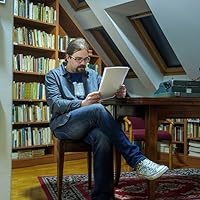
Lenart Zajc, the son of much more acknowledged Dane Zajc, born in 1967 is a member of Slovene writers society. In 1998 he published his debut novel 5 do 12 with which he won the award for the best debut novel from Slovene book fair. It was soon followed by a sequel Zguba. Both novels are written with a taste of autobiographical, describing a life of a Ljubljana skinhead, during his high school and adult life. In 2002 he published a collection of short stories Zgodbe iz teme, a kind of preparation for the subject dealt in Hevimetal. In 2005 he published the novel Mustang in cooperation with another Slovene writer, Maja Martina Merljak. The content much reminds of Burgess’ Clockwork Orange or Welsh’s Trainspotting.
Hevimetal is definitely one of the better genre novels in Slovene writing production. This smooth-reading material is a great beach reading for all who enjoy bathing in rivers of blood or drowning in their own sweat. This novel will give you the experience of both.
This entire review has been hidden because of spoilers.