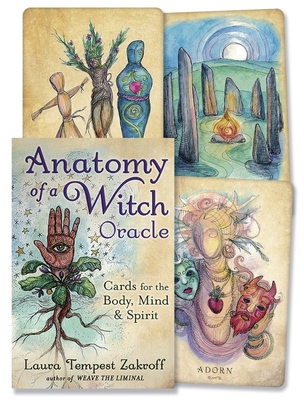
This stunning 48-card oracle celebrates the Witch’s body and how it unites the material and metaphysical worlds. Check the pulse on different areas of your life with cards featuring systems of the magical body, lunar and solar events, senses, and more. This deck helps you pinpoint what needs your attention most while the full-color companion offers new perspectives and directs you toward action. With the Anatomy of a Witch Oracle, you can explore the full power of your Witch body―the most magical tool in your possession.
Laura Tempest Zakroff (she/they) is a professional artist, author, performer, and Modern Traditional Witch based in New England.
She holds a BFA from the Rhode Island School of Design, and her artwork has received awards and honors worldwide. Her work embodies myth and the esoteric through her drawings and paintings, jewelry, talismans, and other designs.
Laura is the author of several bestselling Llewellyn books including Weave the Liminal, Sigil Witchery, Visual Alchemy, and Anatomy of a Witch, as well as the artist and author of the Sigil Witchery Oracle, Anatomy of a Witch Oracle, The Liminal Spirits Oracle. Laura edited The New Aradia: A Witch’s Handbook to Magical Resistance, The Gorgon's Guide to Magical Resistance, and Serpents of Circe: A Manual to Magical Resilience from Revelore Press.
Laura is the creative force behind several community events and teaches workshops online and worldwide.
This is a beautiful and resonant deck. I’ve just finished the Anatomy of a Witch book and this is an excellent companion tool (although the deck is totally accessible if you haven’t read it). Highly recommend.
Most divination systems encourage me to ask what is happening around me. Anatomy of a Witch Oracle keeps turning the question around. What is happening in me? That sounds terribly therapeutic until Laura Tempest Zakroff starts handing you cards involving senses, bodily systems, elements, solar and lunar events, magical actions, and ritual objects, at which point the body begins looking less like the patient on the examining table and more like the instrument doing the examining. I liked that reversal immediately.
There are forty-eight cards, and the companion book does something I wish more oracle guides would do. Instead of ending with a paragraph explaining what a card supposedly means, Zakroff gives you somewhere to go with it. The messages, keywords, and prescriptions turn divination toward response. A reading can therefore become less about receiving a pronouncement and more about discovering where attention is needed. That makes particularly good sense for a deck rooted in embodiment. Bodies are forever giving information that becomes useful only when we notice it and decide what to do next.
I also enjoy how unapologetically peculiar some of the categories become. Hands and senses can coexist with lunar phenomena, spellcraft, poppets, adornment, elemental forces, and the magical anatomy Zakroff developed in the original book. It should feel incoherent, but it doesn't, because all of these things eventually meet at the practitioner. The hand draws the sigil. The eyes perceive the omen. Breath changes consciousness. Skin receives touch. A ritual object only becomes part of witchcraft when somebody physically encounters it. The deck quietly undermines the idea that magic is something consciousness performs while the body waits nearby to carry the supplies.
The artwork helps enormously because Zakroff understands symbolic economy. She does not crowd every card with enough occult imagery to decorate a Victorian séance parlor. The images give the eye somewhere to enter, and because she is both the artist and the system's creator, the visual language feels inseparable from the divinatory one. I found myself wanting to look at a card for a while before consulting the book, which is generally how I know an oracle deck has enough life of its own to survive repeated use.
I liked Anatomy of a Witch when it argued that the witch's body is already part of the magical apparatus. The oracle may actually make that idea easier to practice. Pulling a card turns embodiment from a philosophy into a recurring question. What am I sensing? What needs attention? Where am I depleted, overextended, receptive, blocked, changing, or ready to act? After enough occult work aimed at leaving the body, transcending the body, traveling beyond the body, or perceiving invisible worlds somewhere else, there is something wonderfully grounding about a divination deck that keeps pointing back at the witch holding the cards.