This deeply personal perspective from a human rights lawyer—whose work on the front lines of the fight against family separations in South Texas intertwines with his own story of immigrating to the United States at thirteen—reframes the United States' history as a nation of immigrants but also a nation against immigrants.
In the summer of 2018, Efrén C. Olivares found himself representing hundreds of immigrant families when Zero Tolerance separated thousands of children from their parents at the U.S.-Mexico border. Twenty-five years earlier, he had been separated from his own father for several years when he migrated to the U.S. to work. Their family was eventually reunited in Texas, where Efrén and his brother went to high school and learned a new language and culture.
By sharing these gripping family separation stories alongside his own, Olivares gives voice to immigrants who have been punished and silenced for seeking safety and opportunity. Through him we meet Mario and his daughter Oralia, Viviana and her son Sandro, Patricia and her son Alessandro, and many others. We see how the principles that ostensibly bind the U.S. together fall apart at its borders.
My Boy Will Die of Sorrow reflects on the immigrant experience then and now, on what separations do to families, and how the act of separation itself adds another layer to the immigrant identity. Our concern for fellow human beings who live at the margins of our society—at the border, literally and figuratively—is shaped by how we view ourselves in relation both to our fellow citizens and to immigrants. He discusses not only law and immigration policy in accessible terms, but also makes the case for how this hostility is nothing new: children were put in cages when coming through Ellis Island, and Japanese Americans were forcibly separated from their families and interned during WWII. By examining his personal story and the stories of the families he represents side by side, Olivares meaningfully engages readers with their assumptions about what nationhood means in America and challenges us to question our own empathy and compassion.
This is a hard one. Enlightening, eye opening, raw, frustrating, heartbreaking, deep, honest. A read that will make you want to change everything around you. Lights a fire that needs to be lit.
I thought by watching the news in 2018 and being on Twitter that I knew a good bit about the Trump Administration's Zero Tolerance immigration and family separation policy, but I didn't know hardly enough. In My Boy Will Die of Sorrow, Olivares describes what it was like on the front lines, fighting to make sense of a senseless policy, document parent and child separations, and later, reunify families that the government had no intention of ever bringing back together. While it's not necessarily surprising to hear about the cruel and coercive conditions in which government agencies separated children from their parents, it is heartbreaking.
But, more than just an account of 2018 and what it was like to be a civil rights lawyer at the border in McAllen, TX, this book is also part memoir with alternating chapters that chronicle Olivares's personal experiences with immigration to the United States, and provide personal anecdotes on separation from culture and family, assimilation into white society, and belonging (or a lack thereof) in a society that rejects difference.
I found this book to be incredibly moving. It took me about a month to get through, but it feels like something everyone should read at some point in their lives. The cases of specific families Olivares shares helps crystalize his message on human rights and human dignity. I also like the way he considered the history of immigration *and* forced migration to the United States, and discussed the fact that borders are politically man-made. Olivares is vulnerable and unapologetic in his storytelling. This book is both a reminder of what not to take for granted and an inspiring call to action.
Beautifully written, heart wrenching and achingly honest. It got hard to read sometimes. The title is gripping and what intrigued me into reading, then when you understand the context it means so much more. It becomes that much more sad. Olivares’ sensitivity to this subject is so important, not only in discussion his work but his own family. This is really incredible and I think a lot of people will benefit from reading it.
Thank you to NetGally and Hachette books for this arc in exchange for my honest review.
My boy will die of sorrow, a heartbreaking story that will open your eyes to the truth of what is happening and has happened in the US during the Trump administration on the southern border with Mexico.
This is a very heartbreaking book, I have read thousands of books about WWII and when I started to read My boy will die of sorrow, I felt like I was reading another story of that time, especially how the US border patrol and CBP started to separate the children from their parents, while arriving to the border, separating families, not telling them any news about them not knowing if they will ever meet or see again, at all times I felt like I was reading a WWII book all over again.
You do have to be immersed in the WWII era to really understand what I'm talking about but this was an atrocity that was permitted and was even seen as something normal in the eyes of the political parties until the last years that everything came to the light and the evilness of the situation started to be seen on the news and yet still nothing has been solved, they keep throwing the blame to one administration and then to another and meanwhile, people and families still are suffering.
This book is about the hard fight migrants have to face while looking for a better chance to live and hope. Yes, this is about dreams, hope, and wanting to give the best to your family only to encounter evilness all over, from the moment they set out seeking their dream, out from South America, til the end of their journey when they face the US Border.
The cartels, the maras, and even the Mexican police all of them put over and over obstacles to stop them from reaching their goal of having a safe place to live where their family can live in peace and their kids grow safe far away from this evilness only to encounter the same at their footsteps.
This is the story not only about one or two families but many more who encounter over and over again the same situation and the same unkind inhumane treatment.
The fact there are still many kids not knowing when they will meet their parents again speaks very loudly about the broken "humanity" in these people. I will never call it a system because we're talking about kids and humans who deserve more than a bunch of people who could care less about anything aside from themselves and the eternal craving of being in power.
This does not reflect the good attitude and education or even advancement of a first-world country, this only reflects how low and ignorant every party and person involved in this situation is.
Hard to read but I think is necessary to sometimes read things that will wake you and open your eyes, to be a better human, a kind person someone who brings and lift the world to a higher frequency.
Thank you, NetGalley and Hachette books for the advanced copy of My Boy Will Die OF Sorrow in exchange for my honest review.
In the newest Thor movie, Thor makes a really insensitive joke about children in cages and I physically flinched. A quick Google search will show you this is still happening. Let us not forget J.Lo’s 2020 Super Bowl halftime show either.
This book does a great job of explaining how children are separated from their parents. I wasn’t entirely clear on the process before. The most gut wrenching story is about the Mam speaker separated from his daughter due to a lack of language access. I had no idea that there was such a large population of Mam speakers in Guatemala still, and don’t believe I’ve ever met anyone that speaks Mam. This story will stick with me.
I wish this book had less filler and more substance. The book jacket tells us that the author’s organization wins their landmark petition to the Inter-American Commission on Human Rights. How?! Was it effective? Is this Commission largely toothless? What about the pandemic updates? What abuse are adults and children suffering during detention? There were so many ways to expand the book but we just get a truncated 2-3 months.
Overall, I was left with feelings of frustration. The Biden administration still has hundreds of children that cannot be reconnected to their parents and never will be. The book’s appendix has a list of organizations you can support but beyond being a lawyer and taking a pro bono case, monetary donations seem to be the only way if you don’t live near a detention center.
P.S. I grew alarmed at the author’s lack of work-life balance and vicarious trauma he was experiencing. Anyone will tell you this work isn’t sustainable without some compartmentalizing and boundaries. I’m sure he does, but in the book we only see a snippet of time and clearly, he’s still doing this work. As a public interest lawyer, I would have liked seeing what it takes to do this long-term without burning out.
This book was incredibly slow, especially during the even chapters when the author talked about his childhood. Incredibly unnecessary details (I don’t care that you first learned the alphabet on a green chalkboard). I understand that this is a memoir but it felt like a diary. It picked up a lot more during Olivares’ reflection on his work, which was incredibly moving and upsetting.
"The U.S.-Mexico border, wrote Gloria Anzaldua in the opening chapter of Borderlands/La Frontera, is open wound, "una herida abierta where the Third World grates against the first and bleeds. And before a scab forms it hemorrhages again."
"Like millions before us, we migrated out of economic necessity, in search of work and a better future. We were not fleeing violence, death threats, or persecution. To the extent migrating to the United States was a choice, it could be said that my family chose to be separated. The circumstances pushed us to migrate, and the law forced us to be separated, but if it was a choice at all, we had the "privilege" of choosing to be apart."
"THis book is about the suffereing and resilience of those who find themselves separated by a border. My hope is that it will stir us to question the foundation of our immigration laws, and push us to reimagine our understanding of political borders and those who cross them into one that is more humane for individuals, for families, and for communities on both sides."
"For years, I had argued forcefully with immigration hardliners that crossing the border without authorization was a civil, not criminal, violation. Now I was learning that I had been mistaken all along. This law made it a federal misdemeanor to swim across the Rio Grande."
"Time and again, immigrants have been forcibly kept out, and those who manage to make it in, especially those who are not white, have been blamed for the country's problems, from unemployment to upticks in crime. The data does not bear out those accusations, but brown immigrants have been the constant scapegoat nonetheless."
"We speak so much of the parents, mostly men, who head north to the U.S. to work and send money home, but so little is said about the women and children they leave behind."
"Experts have shown that the rise in gang-related violence can be traced back to the deportation of prison gang members from the United States to Central America in the 1990s, which contributed to the criminal organizations becoming transnational, more resourceful, and more sophisticated. Members of gangs that had never had a presence outside of the United States were exported en masse, giving those gangs unprecedented international reach."
"In its early days, in 1790, Congress limited naturalization to white people: "any Alien being a free white person, who shall have resided within the limits and under the jurisdiction of the United States for the term of two years, may be admitted to become a citizen." In the decades that followed, immigration into the country was largely unregulated in a formal sense, but this provision meant that Native Americans, free Blacks, Asian immigrants, and any other non-white person could not aspire to the rights that citizenship conferred."
"Meanwhile, the Immigration Restriction League, a group founded in 1894 by Harvard graduates, pushed for restrictions on immigration from Eastern and Southern Europe, arguing that those immigrants would lower "the mental, moral, and physical average of our people. Similarly, the Asiatic Exclusion League sought to restrict immigration from Japan, Korea, and India, advocating for segregation in schools and restricting the ability of immigrants from these countries to acquire land."
"In the words of President Woodrow Wilson during the years leading up to the enactment of the National Origins Act, "the whole question is one of assimilation of diverse races. We cannot make a homogenous population out of people who do not blend with the Caucasian race." The assumption of others blending into a white majority-if it was a majority at all-was an explicit attempt to erase anyone who was not white. Critically, thought, these laws did not apply to immigrants coming by land from within the Western Hemisphere; so people coming from countries in the Americas continued to come. Mexican laborers were still able to fulfill the demands for cheap labor, particularly in the Southwest."
"During the years and decades taht followed the adoption of the National Origins Act, various immigration enforcement and administration agencies were created and centralized, first within the Department of LAbor and later within the Department of Justice. Throughout this process, immigration law and policy became a constant push and pull between the nativist forces intent on maintaining the dominanace of the "Great Race," and the business interests that rely on the availability of inexpensive labor coming across the border to support their economic models,w hich in turn, help support said dominance."
"Since 2009, Congress explicity and repeatedly mandated increase in the number of "beds" available for immigration detention; the bed became a proxy for a person behind bars for having crossed the border."
"In early 2018, ICE expanded its use of arrangements known as Basic Ordering Agreements (BOAs). Under BOAs, ICE pays sheriff's offices and other local law-enforcement entities $50 for every immigrants they hold and turn over to ICE, putting a price tag on every person detained."
"According to the U.S. Census Bureau, the net migration to the United States in 2018 fell to 2010 levels, and yet the enforcement agencies' budgets ballooned. When the Attorney General annoounced Zero Tolerance in April of that year, it was a quintessential example of a solution looking for a problem: Even though the Administration presented the policy as a response to a "crisis at the border," there was no real crisis at the time, and in fact the policy created one."
"Is there a single, true, real United States of America? Or are there multiple facets of it that rise to the forefront at different points in time? A faction, wrote James Madison famously in Federalist Paper No. 10, is a number of people "who are united and actuated by some common impulse of passion, or interest, adverse to the rights of other citizens, or to the permanent and aggregate interests of community." It was human nature to devolve into factions, Madison reasoned, so it was not possible to eradicate them completely."
"Thousands of failies try to come to the United States from all over the world every year, leaving everything behind, some fleeing violence or persecution, others in search of a better future, like us. In many ways, merely contemplating the possibility of visting family, remainging connected to our roots and our loved ones, was a privilege that most immigrants do not enjoy and that I did not appreciate at the time. Most have no choice but to forgo their families and life as they know it, leaving their birthplaces never to return, often with no real plan and very little notice. I had no idea how intimately familiar I would become with that reality years later."
"These uos and downs in the number of people crossing the southwest border are more reflective of the cyclical nature of immigration flows and the conditions in the immigrants' countries of origin, than of any reaction to the U.S. immigration policy."
"At different times and using different laws and policies as justification, immigrant children in cages have been more commonplace in the United States that many would like to acknowledge."
"The only other country in the world that I am aware of," I said, at the end of my remarks, "the only other country that punishes children for what their parents do-in addition to the United States today-is North Korea."
"Expedited removal has become such a pervasive method to expel hundreds of thousands of immigrants and asylum seekers every year with no process at all that it's easy to forget it has been around for less than two decades in its current form."
"Zero Tolerance had never been about "securing" our borders or about protecting children from smugglers and human traffickers. Like many other immigration policies, Zero Tolerance was not about national security or "protecting" jobs or public safety. These justifications were a facade. Zero Tolerance was always about "deterrence"-about inflicting the greatest amount of pain possible on asylum seekers, adults and children alike, as a way to discourage future immigrants from coming to the United States."
"It was as if the time when a person migrates across a border creates a sort of moral legitimacy over membership in a community, and those who come later can no longer join on the same terms."
"I feel as if in my attempt to show that I belonged that night, I left part of me behind. What else have I left behind along the way without even realizing it? Must all immigrants give something up in order to be fully accepted?"
"Since its founding in 2003, at least 214 people have died in ICE custody, and reports of physical and sexual abuse number in the thousands, prompting calls to dismantle the agnecy altogether in recent years. after a Border Patrol agent in El Paso shot and killed fifteen-year-old Sergio Hernandez Guereca while he stood across the border in Ciudad Juarez in 2010, the Supreme Court ruled that the boy's family had no right to bring a lawsuit in part because the boy did not have sufficient ties to the United States. Even today, the ruling and the reasoning in that case are the law of the land, and a Border Patrol agent may shoot an unarmed child across the border with impunity."
"Overt racism and white supremacist views have been part and parcel of immigration law and pollicy in the United States for more than two centuries."
"While U.S. history contains multiple "success stories" of individual immigrants, that history is also replete of instances when its laws and instiitutions have deliberately rejected non-white immigrants-from the Nationality Act of 1790 to the National Origins Act of 1924, to Zero Tolerance in 2018."
"Despite the atypical feel-good story, perhaps including my own, border communities continue to exist at the margins."
"Leaving life as you know it at an early age, moving to a country whose culture and language you are not familiar with, and being away from family in the process can create a particular consciousness about being part of a "nation."
"Agian, as with most other separated families, coordinating the logistics of the reunification fell on nonprofits and volunteers, while the government agencies ad agents who perpetrated the separation-traumatizing mother and child and upending their lives, from Washington to McAllen-carried on with their reliable routines at their jobs."
"Along with the torture of hundreds of Muslim detainees in Guantanamo Bay, the family separation policy was one of the most abhorrent policies the United States Government has pursued in the twenty-first century. It is estimated that the total number of separated families surpassed five thousand-nearly a fifth of them separated in McAllen."
"When I think of the sacrifices immigrant parents make so that their children may aspire to a better life, I think of my own mother and father. Was I sussessful because I attended Yale Law School after having grown up in povert in Mexico? Was my immigrant father successful because his son achieved that, even though he never attained economic stability or enjoyed a day od retirement, going literally from driving a school bus one day to the hospital the next?"
"Do immigrants give their life to this country, or does this country squeeze the life out of immigrants? Is that the price we expect people to pay for being here?"
BOOK REVIEW - My Boy Will Die of Sorrow, A Memoir of Immigration From the Front Lines, by Efrén C. Olivares (05.31.25)
Efrén C. Olivares’ has written a deeply personal and searingly honest memoir that offers an unflinching look at America’s immigration system from the perspective of a human rights lawyer, a son of immigrants, and a father. As both participant and observer in the battles over border policy and human dignity, Olivares bridges the abstract political debates with the devastating human costs that unfold in migrant detention centers, courtrooms, and separated families.
The title, My Boy Will Die of Sorrow, comes from the anguished words of a Guatemalan father detained and forcibly separated from his child during the Trump administration’s 2018 “zero tolerance” policy. This cry of desperation not only captures the profound pain felt by immigrant parents but also echoes the author’s own fears and emotional reckonings—as both a parent and a son. It serves as a thematic centerpiece of the book, illustrating the psychological trauma and generational damage inflicted by punitive immigration policies.
Olivares, who emigrated from Mexico to Texas at age 13, is uniquely positioned to tell this story. He is now a civil rights lawyer with the Southern Poverty Law Center, but his journey from undocumented child to Ivy League-educated attorney is itself a testament to the resilience and contributions of immigrants in the US. His personal story—particularly his long separation from his father, who remained in Mexico for years while Olivares and his mother struggled to build a life in Texas—mirrors the same cruel dislocations he later fought against in court.
Throughout the memoir, Olivares describes in heartbreaking detail the suffering endured by undocumented migrants: children housed in chain-linked “cages,” parents misled or simply never told when or if they would see their children again, and asylum seekers treated not as victims fleeing danger but as criminals. He writes movingly of the families he represented, many of whom endured not only state-sanctioned violence and trauma but also the daily indignities of a system designed to deter rather than protect.
His own family’s story—especially his mother’s tireless work and his father's long absence—adds another layer of moral urgency to the narrative. The sacrifices they made are mirrored in those of the families he now advocates for, drawing a powerful connection between personal history and professional calling. In a dedicated section of the memoir, Efrén C. Olivares outlines his vision for a more humane and just U.S. immigration system. He calls for an end to policies rooted in deterrence and punishment—such as family separation and prolonged detention—and instead advocates for reforms that prioritize dignity, due process, and compassion. Olivares recommends expanding legal avenues for asylum and residency, reducing the use of incarceration in immigration proceedings, and investing in alternatives to detention that keep families together. He stresses the importance of legal representation for migrants, especially children, and urges policymakers to recognize the systemic injustices and international crises that often drive migration. Fundamentally, Olivares argues for an immigration system that acknowledges the humanity of those who seek refuge, centers their stories in policymaking, and views migration not as a threat to be managed but as a reality to be addressed with empathy and fairness. My Boy Will Die of Sorrow is an essential read for anyone who wants to understand the human cost of America’s broken immigration policies. Efrén C. Olivares has given voice to those too often silenced and has illuminated, with grace and pain, the urgent need for reform. The book is not only a memoir—it is a call to conscience. We must remember that behind every border policy are families, sacrifices, and hopes that deserve dignity, not despair.
Quotes:
“They weren’t just crying for their children—they were crying for their dignity, for their right to be seen as human beings in a system that treated them like shadows.”
“The government took their children, but it also took their hope—and for some, that loss was even harder to survive.”
I read 👆 that comment in response to an article by some self-imagined Gatekeeper of Brooklyn years ago, and I’ve since commandeered it to sum up the shitty views of people who think America is now full, thanks.
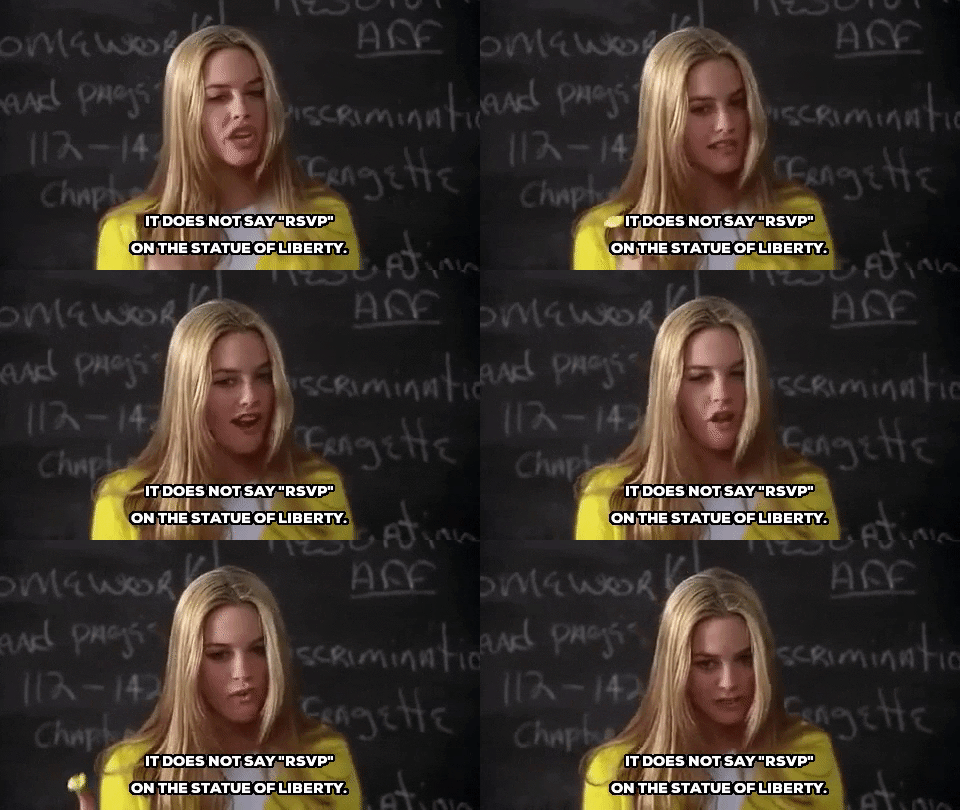
Funny how the overlap of those people with people who proclaim themselves to be Patriots and Defenders of the Constitution is pretty much 100%, based on my scientific research of scrolling through Internet comments. Guess they weren’t paying attention when Cher Horowitz reminded us that
When the Trump administration began clawing scared babies away from their scared parents, some people who surely fancy themselves Bold Hard-Asses loved to blather on about how if they didn’t want to lose their children, they shouldn’t have crossed the border illegally. We’re full, thanks.
I remember once seeing someone with a username of MamaBear something or other comment as such, and I had a few immediate reactions:
1. Stop using the term “Mama Bear.” 🤮
2. Since she *did* use it, this is where we are in life, and I presume she wants the world to know how much she loves her kids. She’d do anything for them, right? She’s here to keep them safe, get them the best salmon, catch all the good hikers — anything. That’s what Mama Bears do.
Do you think she’d cross a river to find safety? Do you think she’d enter a new territory, maybe one occupied by some other bear population, if it meant her cubs might have a chance of survival, a chance at life?
You see where I’m going with this.
Third thought: fuck that woman. I know that’s not thoughtful and nuanced, but these people aren’t arguing for thoughtful and nuanced immigration policies. They just don’t like poor brown people. We’re full, thanks.
Also, this book only has 159 ratings?? Message to humanity: Read This Book.
This is an emotional and honest look at the devastating results of the U.S. government's Zero Tolerance program. Separating children as young as two years of age from their parents to deter them from crossing the border illegally was the government's inhumane way of stopping mainly brown-skinned people from entering the U.S. Olivares tells the heartbreaking stories of only a few of the men and women he interviewed to help find their children who sometimes ended up hundreds of miles away.
These people risked their lives to go to the U.S. to better their lives; instead, they were shackled, kept in freezing cells, unable to speak English, and unsure of what was happening to them and their children. Their children, meanwhile, were snatched away from them immediately and placed in other refugee centers. After the audio was taken secretly of the agonizing cries of the children and played for the general public, the outcry was taken seriously, finally ending the government's practice of removing children from their parents. However, some parents ended up deported, never seeing their children again.
Shocking and horrifying, the stories of these people and what they went through will leave readers emotionally spent.
Thank you to Netgalley, publisher, and Olivares for this ARC.
Thank you to Hachette Books for a finished copy of My Boy Will Die of Sorrow: A Memoir of Immigration from the Front Lines, available everywhere now.
Told from the perspective of a human rights lawyer in Texas, this deeply personal account gives voice to the families impacted by the separations at the border while reflecting on his own personal immigrant experience. 25 years earlier, the writer's father frequently traveled between Mexico and Texas for work, leaving the family behind for stretches of time. Eventually, the family is able to settle permanently in Texas, where the writer and his brother learned a new language and culture. The writer himself remarks on the various privileges he had access to that differentiated his experience from others crossing the border. As he points out, his family was fortunate to be moving to pursue better economic opportunities and fleeing from violence, death threats, or persecution. Other families, like Mario and his daughter Oralia, Viviana and her son Sandro, Patricia and her son Alessandro, had no choice but to leave their homelands and risk their lives in pursuit of safety. Instead, the families end up brutally separated under the Zero Tolerance policy. As the writer details, there is nothing new about the harshness of this policy. Interwoven with historical data and background, the writer asks us to re-consider the United States' attitude towards immigrants and instead, consider the possibility that it's not the land of the free for everyone either.
Educational, inspirational and, at times, truly heartbreaking. I like to imagine a world where we could all take a moment to understand, to be curious and to see the human behind the fear and prejudice…what a world it would be, devoided of pesky dividing algorithms that monetize humanity’s most despicable, adrenaline based instincts lurking in our limbic brains. A world immune to hatred cunningly spread by greedy, senseless, honorless, immoral politicians.
The quote: „Those cries were more effective at evoking widespread indignation than a video or a still image would have been. And as much as it pains me to admit it, that is because when we hear those children cry, we cannot see the color of their skin.” will stay with me forever.
My Boy Will Die of Sorrow gives an important, inside look at the effects of the Trump’s zero tolerance party that goes beyond the headlines. Olivares shows what was going on both before and after the headlines made people aware of the situation unfolding on the border. The family’s stories that he highlights are of course heartbreaking, and maybe even more heartbreaking are the stories that will never be told given how many people slipped through the cracks their fates unknown. The inside look into lawyers fighting the good fight was really interesting to me.
I loved the parts about Olivares’s childhood and family and I did want more storytelling like that from this book. Overall, a little too much show versus tell, but still an important read.
A new book that weaves together the author's own story about migrating to America as a child and his work as a human rights lawyer as one of the first to discover and help families separated at the border by the Zero Tolerance policy.
He weaves together his experience and the stories of the separated families beautifully. I thought I knew about the Zero Tolerance and Family Separation policies before, but given he was on the front lines as it happened, he knew way more and I learned a lot about what happened...
This book mixed memory, legality, humanity, and more in a way that allows the reader to truly see another level of the Zero Tolerance Policy. I have gained a new understanding of the policy as well as a much more realistic illustration of what the experience was for those directly affected.
This is a eye opening book of what happened and the accounts of behind the scenes of the impact of our immigration system by Efren C Olivares A human rights Laywer who worked on the first lines in south Texas
Very informative book. It emotionally packs a wallop to the ❤️ and hits gut level at the inhumane treatment imposed upon people during their most vulnerable times. Someone should hang 'The Golden Rules' of moral behavior we learned in kindergarten on the gates at the detainee center!
Such an important read but intense when couple with my day job. A beautiful blend between the author’s story and family separation. I do wish he had discussed more about the family separation that happens beyond this time period and discussed how the United States immigration policies have historically separated families.
**This book was provided to me by the publisher via NetGalley in exchange for a fair and honest review**
3.5 stars
A well written political reflection from an immigration lawyer with memoiristic elements, clearly intended for a layman audience with no knowledge of legal practice in general or immigration law in particular.
On the whole, I thought that the relation of the author’s legal navigations, conversations with immigrants and asylum seekers, and personal immigration story were well woven-together and presented a compelling perspective on the U.S. immigration system. Some of the personal stories were a tad irrelevant (the author’s memories of learning the alphabet, for example), but were usually worthwhile.
One thing that got a bit annoying was how often Olivares would relate conversations with people who held more critical opinions of immigrants and asylum seekers from south of the border; he continually wrote “I did not tell them X, I did not tell them Y” (X and Y representing compelling data or arguments in favor of Olivares’ position). I continually wanted to ask why, if he felt these were important facts for the reader to know, he didn’t ever see fit to share them during in-person conversations with people he was trying to convince.
I think this book will resonate with anyone who wants to learn more about just who is making up the so-called “border crisis” and what asylum seeking and “illegal immigration” actually entail. It’s not a book meant to persuasively argue about border policy, but it does make a strong humanistic plea for compassion towards those who seek entry into the U.S.
The fury and heartbreak that I experienced while reading this book is only exacerbated by the knowledge that it was published in 2022, and documents events that took place in 2018, before the problem grew even more serious in 2025. What a flawed justice system, and what flawed people we are, to believe that there is any justification for these violations of human rights. How cynical we must seem to other countries, to believe that we live in the greatest one of all, when we repeatedly commit such atrocities toward black and brown children and their families, and use the ‘law’, backed by God’s will, to defend these actions. All it would take is an effort on the part of the ignorant to get to know and understand an immigrant before passing such harsh judgement and spreading harmful narratives. Sadly, it seems too much to ask. Efren Olivares explains the struggles of immigrants and the flaws in our democracy so beautifully through the true stories of these separated families. His persistence, despite the obstacles, to assist these families along the way is so inspiring, as is his vulnerability in describing his own struggles with his identity as a teen immigrant.
A very difficult read at times, but a must-read, nonetheless.
Efren Olivares is a human rights lawyer in southern Texas. In 2018 when Trump imposed the Zero Tolerance policy for illegal immigrants crossing the border into the U.S., Efren was appalled at the way parents were separated from their children. Each were locked up in detention centers sometimes miles apart. They were treated inhumanely and lied to about what would happen to them. The parents were handcuffed, shackled and taken to court where Olivares and others he worked with would interview them in an attempt to find out where their children had been taken and to try to reunite them.
This is a very brutal story about an embarrassing time in our country's history. Efren combines this story with his own personal story of moving from Mexico to McAllen, Texas with his family at the age of thirteen and how he went on to graduate from Yale Law School. He has dedicated his career to helping others who are wanting to make a better life for themselves and their families. He points out that we are all here in America because of immigrant ancestors who came before us. The difference in the way you are treated is often the color of your skin.
What a gripping and perspective changing account that chronicles the author's personal journey and the experiences of those he has worked with. Olivares's narrative is rich in detail, vividly painting the realities faced by immigrants with children as they navigate the complexities of borders, detention centers, and legal battles. What sets this memoir apart is Olivares's ability to humanize the individuals behind the headlines, allowing readers to connect on a deeply personal level with their stories. His empathetic approach fosters understanding and empathy, challenging readers to confront the harsh realities of our immigration system while highlighting the strength and resilience of those who navigate it. My Boy Will Die of Sorrow is a masterfully crafted memoir that leaves a lasting impact. It is a testament to the power of storytelling to illuminate the human experience and provoke meaningful dialogue about some of the most pressing issues of our generation.
This is a must read! There is so much misinformation and racist policy in America that takes away basic human rights for asylum seekers and this book shines a light on the traumatic practice of separating children from their parents as they’re seeking asylum. The author does a great job of explaining the racist laws that have been in America for the last hundred years and all the new ones since. He highlights his job in 2018 when the “Zero Tolerance” laws forced apart parents and their children…one as young as 2 years old and his fight to reunify them…and his experience as an immigrant to America. Breaking the book up this way made it easier chunks to absorb, because some of it is really disturbing!
Part memoir, part history and part what is happening at the border now. The author discusses our terrible immigration process of detaining immigrants and separating them from their children. The author is an attorney who fights for reuniting parents and children at the Texas border. He also shares his experience of immigrating to the US when he lived in Mexico as a child with his mother and his father working in the US as an American citizen. It’s heartbreaking what we’re doing to human beings and the unnecessary trauma that is being caused by the US system.