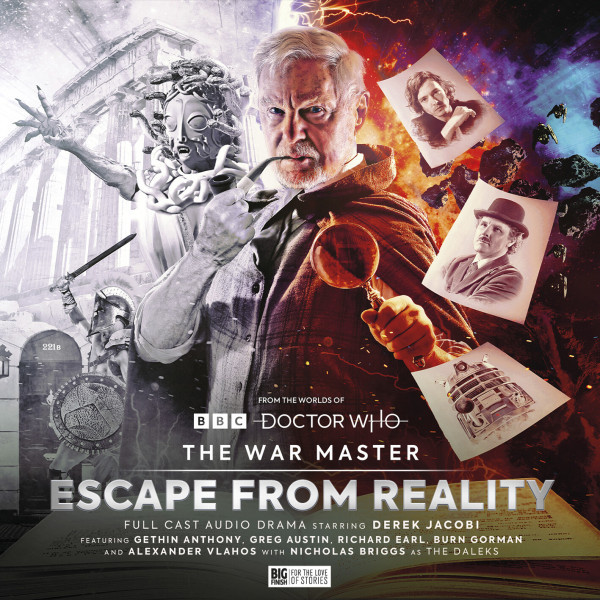
Pursued by a squadron of Dalek assault ships, the Master's only hope is to abandon the space-time vortex and flee into an altogether different reality: a realm of fiction. Confronted with creatures of myth and figures from folklore, the Master sees an opportunity to scavenge a universe of impossible artefacts and use them against his enemies. But first, he must face off against a host of legendary monsters, literary heroes and embody fiction’s greatest consulting detective: Sherlock Holmes.
8.1 The Wrath of Medusa by Rochana Patel Crashing into a universe of fiction, the Master finds himself lost in a world of Greek mythology… with a Dalek assault squad close behind.
8.2 The Shadow Master by Lizzie Hopley As the Master plunders inconceivable artefacts from an impossible universe, he encounters a figure that may prove his greatest threat: his own Shadow.
8.3 The Adventure of the Deceased Doctor by Alfie Shaw When Dr John Watson is informed of his own murder, only the world’s greatest consulting detective can assist. He just happens to come from a different world.
8.4 The Master of Dorian Gray by David Llewellyn Seeking the power of immortality, the Master works himself into the life of Dorian Gray. But can he change how the story ends?
To escape the Daleks, The Master flees into the The Land of Fiction (as previously seen in Doctor Who: The Mind Robber):
8.1 The Wrath of Medusa - The Master gets pulled into the quest of Perseus to kill Medusa. And everyone gets used up in The Master’s plans. Everyone. No one escapes The Master, be they hero, monster, or god. A fascinating look at how a modern villain would unravel the threads of destiny, legend, and myth simply to serve his own purposes (4/5).
8.2 The Shadow Master - Wonderfully fun. Deliciously intriguing. But sadly, infinitely hollow. Derived from the Hans Christian Andersen story about The Shadow. While it’s well produce, the structure of the story itself didn’t really work for me, as it’s narrated by the shadow of The Master (3/5).
8.3 The Adventure of the Deceased Doctor - Never get your expectations set too high. Seriously. I had really high hopes for this one. I was expecting a brilliant case that would pit Holmes vs The Master. Instead we’ve got The Master literally stepping into the shoes of Sherlock Holmes. It’s good, just not at all what I was either expecting, hoping, or anticipating (3/5).
8.4 The Master of Dorian Gray - As Alexander Vlahos is here recreating his portrayal of Dorian Gray (do check out The Picture of Dorian Gray and the entire series which begins with The Confessions of Dorian Gray: Series 1-2), I had very high expectations. And it’s an interesting idea, pitting The Master against Dorian Gray. Unfortunately, this is not what I was hoping for. I suppose I was looking for a Dorian Gray adventure with The Master, and instead what is delivered, as it should be, is an adventure of The Master with guest-star Dorian Gray. So my astronomical expectations were not met. Maybe when I get around to listening to it again, I’ll enjoy it more. (3/5).
I have to admit I was really looking forward to this one. And I’ve got absolutely nothing to complain about the performances, these are brilliant. I was just disappointed in how these narratives play out. Maybe I’ll be able to appreciate them more when I get around to going through it a second time and I won’t have such inflated expectations.
Bit of a mixed bag. Going into this, it's worth knowing that the "Land of Fiction" is a Doctor Who thing, stretching back to the first Doctor's adventures. In this alternate universe, works of fiction are reality. Wasn't sure whether this was going to work for the War Master, or flop. I'll say it's half-good.
The Wrath of Medusa: Escaping the Daleks, the Master flees into the Land of Fiction, beginning his adventures there with figures from Greek mythology. This episode is actually pretty good, with the Master apparently collecting some mythological weapons to use against the Daleks.
The Shadow Master: A bit confusing, and maybe worth a second listen because of that. Here the focus seems to be on Hans Christian Andersen, and specifically a little-known story called "The Shadow." I had a hard time figuring out what the Master's purpose was here, and so . . .
The Adventure of the Deceased Doctor: Obviously we're into Sherlock Holmes territory here, which is a little weird since Sherlock Holmes has appeared in Doctor Who before, making Holmes and Watson part of the same "real" universe as the Master. That is, not fictional. However, the clever conceit here is that because there are so many people writing so many Sherlock Holmes pastiches, there are multiple versions of Doctor Watson wandering around the land of Fiction. And so . . . why not kill off a few of them? This one actually gets kind of dark by the end.
The Master of Dorian Grey: And I'm sure that because BF has a long-running Dorian Grey series, why not bring the two together? And I seem to recall that, like Sherlock Holmes, Dorian Grey has also appeared in the Whoniverse, so what's the deal here? Well, it pretty much sticks to the actual novel to start with. And then . . . it doesn't. And I have no idea what the point of this was at all. Maybe the Master was trying to get the infamous painting and steal the secret of immortality? I think? I wasn't quite sure.
So, the first and third episodes, pretty good. The second kind of confusing, and the fourth kind of . . . pointless. The real trouble is that there's no real resolution to this four-episode arc. At the beginning it seemed like he was in the Land of Fiction to gather weapons against the Daleks. And I seem to recall this being stated rather plainly at one point. But at the end he just sort of . . . leaves. No mention of the Daleks, or the weapons he's collected -- or any kind of wrap-up. And that's a failure.
Escape from Reality really gets off to an incredible start with The Wrath of Medusa. A nice Dalek cameo as they chase the Master into the Land of Fiction, followed by the Master wasting no time in manipulating fictional elements to his own ends. It’s hard to NOT to be familiar with the source material in this story; who hasn’t learned about the Greek gods? There are some truly incredible scenes with Master intimidating gods, and manipulating the stories many listeners learned as children to benefit him. Derek Jacobi gives an effortless performance of patient evil, it really is him that makes even the most rubbish or average stories marvellous. The only problem with the story for me is that it really is just talking. There’s the short chase at the beginning but it mostly is people standing in these places that admittedly amazing visuals, alas just for conversation upon conversation. Greg Austin is marvellous in this, playing timid yet blossoming so well, without drawing complete focus from the Master’s machinations. The lack of action did make this feel a longer listen that it was but thanks to Rochana Patel’s fantastic dialogue; it was very entertaining.
⭐️⭐️⭐️
The Shadow Master -
I think my enjoyment of The Shadow Master was really amplified by the fact I haven’t actually read the Hans Christian Anderson books. Concepts such as the goblins and certainly the Shadow are fresh ideas (to me) and that allows for the simplest of plot devices to be entertaining. The story is full of poetry and poetic imagery, which really made for some fantastic visuals in the most climactic of moments. Those reasons alone are why I loved it, and I’d struggle to see fault with a plot such as this. The cast do a marvellous job, with Derek Jacobi taking on a menacing background presence role, supporting the cast while still leading the narrative. The shadow is chilling presence and is so well performed that his moments of plot narration really do increase the intensity of scenes as well as his the fairytale horror that is malignant presence that comes with the Hans Christian Anderson characters. The plot has a clear plot that follows a simple narrative route, with the aesthetics of the imagery and the horror concepts to be vividly pictured as the leading idea in this story. Admittedly the plot doesn’t do anything groundbreaking and you get a pretty standard climax, as ever though it really is a case of it being about how you get to your story end not about just getting there itself. My final thought on this story is that it is quintessential War Master with a dash of dark magic thrown in.. fab!
⭐️⭐️⭐️⭐️
The Adventure of the Deceased Doctor -
The Adventure of the Deceased Doctor really does the unexpected with the Sherlock Holmes theme at its possession. Here Sherlock Holmes is certainly different, and there are multiple John Watsons dying all over the London. This story draws out its essential conceit to a fantastic length while filling the story with lots of drama and lots of comedy. There are explosive moments they would certainly darker than you’d expect for Doctor Who and then there are moments of comedic relief where someone was just saying something funny or there’s a comedic background subplot. I really thought that this story would be a bit more traditional in its approach (having Nick Briggs being in it for 95% of it). It was a big surprise then that we follow different characters, my favourite of all I have to mention being Burn Gorman almost stealing the show with his clever performance. Granted the writing helped there but his acting ability complimented Derek Jacobi’s so well as his equal yet opposite. The boxset arc is present and the ending does focus on it but on the whole it takes a rest for this story. As much as that was great as I was engrossed in the plot, it did lead to a few plot threads of said arc being rushed or ended sooner than they should’ve for idea with that potential. On the whole, the second best so far.
⭐️⭐️⭐️⭐️
The Master of Dorian Gray -
The Master of Dorian Gray concludes the set with a highly entertaining story, if not a hasty resolution to the boxsets’ story arc. The Dorian Gray Big Finish series is my favourite thing they make so I am or course biased, and that meant I found the recreation of Dorian’s life tranfixing; before the Master is even introduced. The performances are great and there are a few scenes that have the most dramatic weight of the set, ones that were delivered with such conviction and intensity. The way the Master’s plans are scuppered is brilliant and really entertaining, but it did feel as if it came about really rather quickly with little provocation. The story is full of plenty of action that really has some shocking moments at the ready, yet another aspect of the narrative that gives the story its ‘War Master’ feel. I did feel like the story was scrabbling for a direction though slightly as there were strange choices of scenes from the book (The Picture of Dorian Gray) that were extended or focused on too long to the detriment of doing other things with the runtime. Of course some people don’t know the book and need an introduction but at the expense of a good 1/4 of the runtime was odd to me at least. That summarises my thoughts on the story really, a fascinating ploy by the Master to benefit himself that gets ruined suddenly thanks to a conveniently timed callback to earlier in the set. Derek Jacobi and Alexander Vlahos are marvellous in this and really hold the story together, with supporting performances providing ample input to provoke the crazier moments of the plot.
The War Master range is as I said in my last review, my favorite spinoff alongside the likes of Jago & Litefoot. So to hear they were going to do a story where he escapes into the land of fiction from The Daleks, admittedly I was apprehensive but I knew if it was done really well, then it could be incredible so I was excited about it all the same!
The Wrath of Medusa: On the run from The Daleks, The Master arrives in the land of fiction, however, he has a plan in mind and he needs the help of a famous Greek legend, Perseus fight against Medusa, but the tale won't unfold in a way we understand it.
I'm not aware of Rochana Patel's work, as she's a very new writer to the company, but here she's written a terrific script that's bonkers, bizarre, humorous, and yet with that familiar darkness we love about this range. It's an off-the-wall type of story that you don't usually see in this range so for that it comes across as a fairly unique story in that regard. It's great to see Derek Jacobi's Master alongside these greek gods and myths and honestly, it's a lot of fun. 9/10
The Shadow Master: The Master is causing havoc in the land of fiction, trying to find fictional toys/weapons to help him in The Time War. However a shadow of his has begun to form and soon he begins to realize that he might have finally come across his maker, for his shadow is a new man, who could end his existence.
Lizzie Hopley has written an incredibly clever, beautiful, and heartbreaking script of a good man being created in the shadow of an evil one, there is so much to unpack here because it's a love story, a tale about finding one's self and a tragedy. A terrific and genius script by one of the finest writers Big Finish has brought on board in the last few years. 10/10
The Adventure of the Deceased Doctor: When Lestrade comes running to Bakers Street he's in for a fright to discover that Doctor John Watson is still alive, for he's just come back from seeing his dead body. Soon Sherlock Holmes and Watson embark on their most complicated mystery yet, which will shatter their lives forever. But this Sherlock seems oddly out of place, who he is really?
Alfie Shaw has written an incredible story that's extremely clever, meta, fun, and disturbing! The first half of this begins a very engaging and complicated mystery, but when the pieces start coming together in the second half, we get to see just how evil this Master is and it's absolutely frightening, this episode ends on a really bleak note that had me shaking! 10/10
The Master of Dorian Gray: Dorian Gray has met Sibyl Vane, the most beautiful and talented woman he has ever bestowed his eyes upon, but after she angers him at a play with his friends watching, she goes to commit suicide having lost her one true love. However, with The Master around, all similarities to the tale end there for Dorian Gray isn't the villain of this tale anymore but someone from beyond his realm.
I was a little apprehensive about this story because whilst David Llewellyn is a really good writer, his first War Master story is my least favorite in the range, his other stories were much better and I actually really enjoyed them but The Coney Island Chameleon just really disappointed me in a way that no other story in this range has. However here he has written an amazing script that flips The Picture of Dorian Gray on its head, giving us a very interesting alternative ending of sorts to the famous story and it's brilliant! 10/10
Four hour-long episodes of a story which sees the War Master escape from the Daleks by entering a universe similar to the Land of Fiction. Its effectiveness, or otherwise, relies on the listener knowing the works being subverted, which probably explains why two of these episodes worked for me and the other two did not.
The Wrath of Medusa – The first story in the collection is set in the world of Greek myth, specifically the myth of Perseus and Medusa. At least to begin with, this seems like it could have been a regular story with the Doctor, except that the Master’s motivations are different. That changes as things go on, with the Master ruthlessly changing things to get the outcome he wants and musing on the follies of heroism. It’s a less dark story than many Master stories, perhaps because so many of the characters are larger than life, but the body count remains high. The strongest story in the set, here the Master is antihero rather than villain, and much of the fun comes from the twisting of familiar tales. 4.5 stars.
The Shadow Master – Next we move to something that owes more to Hans Christian Andersen, albeit one of his more obscure later stories. It’s mostly narrated, and so may appeal to those more used to regular-style audiobooks than I am, but arguably also suffers from the unfamiliarity of the original. To be fair, that is addressed, with a summary of the original plot, and the point here is that the Master is dealing with the issue from a much earlier stage than the original protagonist. But what we end up with, beyond musings on literary inspiration more generally, is a choppy story with a relatively uninteresting viewpoint character that serves as a bridge from the mythic starting to the Victorian fiction of the later episodes but that, while it just about works, does little on its own. 3 stars.
The Adventure of the Deceased Doctor – The third story is based on the Sherlock Holmes stories, and is told primarily from the perspective of Doctor Watson. The meta-fictional nature of the narrative naturally leaves it feeling quite unlike Conan Doyle’s actual works, but here, the characters and setting are familiar enough that that isn’t an obstacle. For the most part, we get a fun pastiche of the originals, although there is one pointlessly gruesome scene that seems intended purely for shock value. The plot twists and turns, and, while you’re never in any doubt that the Master is the villain, quite what he’s up to doesn’t become apparent until towards the end. 4 stars.
The Master of Dorian Gray – Unfortunately, for me at least, the final story in the collection really doesn’t work. The inspiration is, of course, obvious, but without a reasonably detailed knowledge of the plot and characters of the original, the fact that they’re being subverted isn’t apparent. Quite possibly, if you do have that familiarity, the plot turns in this will be more effective than I found them, but I ended up more confused than anything else and the ending felt unsatisfying. In fact, while I think I understand what the Master was trying to do, it was not terribly clear how he was trying to do it, or what the point of the story was, since it just ends without doing anything with the larger concept of the collection. 2 stars.
Okay, okay, okay.. this is definitely my favourite box set in the War Master range. The Master travels to the Land of Fiction (a place I’ve longed for Doctor Who as a show to return to) and meets Greek Gods, Sherlock Holmes and Dorian Gray! Also, Sherlock, Watson and Dorian are all played by the same actors as their Big Finish series, so this box set is technically a double crossover for Big Finish!
Episode 1 - The Wrath of Medusa - 5 stars Oh my word, someone actually understands Greek mythology properly! I actually can’t believe it, and I’m so happy with the events of this adventure! I can’t say what I’m referring to, as that contains spoilers, but I will at least say that the Master is a genuine hero in this story! (Well, sort of 😅) Overall, this was a terrific adventure. Loved it!
Episode 2 - The Shadow Master - 5 stars This was a really interesting story. The Master’s own shadow becomes the antagonist of this one. And how can the Master fight a shadow? Well, the same way he fights all of his enemies. Using his amazing brain. This one is based on a lesser-known Hans Christian Anderson fairytale, and actually made for a really great story. This one also shows the depths of the Master’s cruelty.
Episode 3 - The Adventure of the Deceased Doctor - 5 stars So, this started out as a strange Sherlock Holmes adventure, featuring the Master as Sherlock Holmes… but as the mystery unravels… my god, the Master is depraved!!! When a certain truth gets revealed, I actually had to pause to digest what he’d actually done… and I now realise what a terrible choice of words that was. This story was good, but oh dear lord, that one moment threw me for a massive loop, before I could get back to the episode. It also gets incredibly meta near the end.
Episode 4 - The Master of Dorian Gray - 4 This episode wasn’t as strong as the previous ones, which was a little disappointing after the brilliance of the rest of this box set. I will say that I’m not much of a fan of the story of Dorian Gray, so that may have something to do with it. But generally, I feel like this story was just a little too bland to stand up against the other three episodes. I also feel like the ending to the story of the box set as a whole, by that I mean the Master’s leaving of the Land of Fiction, was a tad underwhelming.
Overall, as I have said, this was a truly brilliant box set and I loved every story! (Almost.) Whatever genius at Big Finish dreamt up this collection of stories needs to become a showrunner of Doctor Who asap! The Master is at his most callous and cruel in this set, and one thing in particular is, I would say, the single most vile thing he has ever done. His actions just got worse and worse with each episode. This set was fabulous.
Very entertaining premise and set-up, and I love the actions The Master took during this, but it kind of followed the exact path I thought it would. Don't get me wrong, it's full of twists and turns that I couldn't really predict, but generally, while bumpy, it was a pretty straight line to the end.
The Shadow Master: 5/10 Verdict: Not Recommended
The premise for this one is amazing, but I really didn't like what was done with it. While listening to this the main thing I was thinking about was how I would have used this premise, and once I started on that path everything that the story actually was felt terrible. I wouldn't have minded if this was even a two parter, with the first half leading to the reveal of who the narrator actually is, but instead I got a story about The Master making a very off the cuff plan that feels made up as he goes along where most of it happens 'off-screen' while we instead focus our attention on a rushed and pretty dull romance story that is so obviously leading to a tragedy that I can't even consider that a spoiler. Not a fan of this one and can't recommend it.
The Adventure of the Deceased Doctor: 4/10 Verdict: Not Recommended
Here's the thing about plot twists, you kind of need to give it enough breathing room both before and after for it to have an actual effect. This story had like 7 major twists that all happened fairly close to each other without a good amount of build up. By the end of the story I was feeling as fatigued as the characters. There is one stand out reveal in this story that involves Mrs Hudson, but other than that, this story feels like it wasted a hundred good ideas on a story that wasted practically all of them.
The Master of Dorian Gray: 6/10 Verdict: Optional
Had a decent amount of fun with this one, I would say it's equal to the first story in this set. It's decently straight forward but The Master is very good in this, however his plan coming to an end because he underestimated someone, while fitting, does feel a little cheap. It's worth a listen but not a lot is missed by skipping it.
I’ve been marathoning through every single release in the War Master range and I cannot overstate enough how much I thoroughly enjoyed this boxset. This is my favorite release since Anti-Genesis. Derek Jacobi’s iteration of the Master is the character at his most cunning, vile, and deadly. He’s also the most entertaining.
In this release, the War Master takes a break from the Time War to go on holiday in the Land of Fiction, a pocket dimension in the Doctor Who universe where fictional characters are alive. The Master proceeds to interact with various literary icons and disrupt their stories, just because he can.
There were parts where I kept rewinding the audio to hear certain bits of dialogue over again and laugh or murmur to myself, “You bastard!”😂 You can hear how much fun Sir Jacobi is having with the material, which enhances the listening experience. “The Wrath of Medusa” is my personal favorite of the four stories included in this release, but the highlight is “The Adventure of the Deceased Doctor” which gets really meta with its storytelling and exhibits the Master at his most cruel and petty at the same time. The final story ends on a somewhat underwhelming note, but the strengths of the rest of the boxset more than make up for it. Highly recommend.
I found The Master of Dorian Gray a bit dull to be honest, I'm sure it would have helped immensely if I had a familiarity with the Big Finish audio series, but I don't, and it didn't work for me very much. The rest are fantastic! A brilliant deconstruction of greek mythology in The Wrath of Medusa, an inspired twist in the old Christian Andersen tale in The Shadow Master and a really great Sherlock Holmes mystery in The Adventure of the Deceased Doctor. All combined result in a great story of the Master taking control of yet another realm by being his usual genius evil puppeteer, but in an unusual fashion this time.
A really good concept well executed. A really nice way of putting a fresh spin on our famous literary characters, and Derek Jacobi is clearly having a ball navigating this way through fiction. The Sherlock Holmes story is just brilliant - a rare fresh take on these characters. It clearly benefits from the writers' and Jacobi's love for those stories. The Dorian Grey episode is good too, however maybe the Ancient Greek episode is a little weaker and a poor story to open the set with. Overall, 4 stars.
The Master in his Derek Jacobi form spends some time in the land of fiction, manipulating and betraying some classic characters; Dorian Grey, Perseus and Sherlock Holmes to name a few. Audio is the right format for these stories where the imagination can fill in the blanks and make the incredible more credible. Most of the fun of this box set is trying to work out what the Master is planning as his motivations are constantly shrouded in mystery. It’s a little flimsy but quite fun.
I have been enjoying the war Master series so far Book 1 the wrath of Medusa I liked this one. Greek mythology being another universe Book 2 the shadow master I didn't like this one. It was like a 3rd person perspective. Book 3 the adventure of the deceased doctor This one was okay. Again a alternative universe idea of Holmes and Watson Book 4 the master of Dorian Gray Another story based in mythology Interesting ending. Master defeated
First story was fantastic, second was good (but predictable), and the last 2 were okay... but it also didn't really make sense for the Master to just ; felt like it was just written that way because he needed to get back to reality without breaking later continuity... 😅🤷♀️
Les histoires 2 et 3 étaient terriblement glaçantes et incroyables. Les premières et dernières histoires m'ont moins intéressés, autant la première avait l'excuse de lancer le boxset, autant la dernière n'était clairement pas à la hauteur de ce qui se passait au milieu. Still très bien cela dit !!
What can I say. The war Master as Sherlock, hanging out with Dorian Gray, and rubbing elbow with the Greek gods. What more can you want? Derek Jacobi, as always douse an amazing job in this rule.
“The Wrath of Medusa” is a good story. Just not as good as some of the other stories. It’s enjoyable to listen to, but it doesn’t really make much sense. “The Shadow Master” is a wonderful story though. I like the disturbing idea of what happens to the fictional characters and ideas that authors forget about and don’t pursue. The idea of each person having a sentient shadow that follows you around and thinks for itself is creepy as well. And what the Master does to the shadow is of course, demented. My least favorite story in the set is “The Master of Dorian Gray.” It just follows the story of Dorian Gray word-for-word, but just with the Master in it. And I think the way that he’s outwitted in the end is stupid. My favorite story is “The Adventure of The Deceased Doctor.” It’s an interesting mystery, and the way the Master outwits everyone is fascinating, and the way he defeats Sherlock Holmes is…rather fascinating in a different sort of way.