

What do you think?

Το τούνελ
Ο αφηγητής είναι ένας διακεκριμένος άντρας στα πενήντα του, ο Γουίλιαμ Φρέντερικ Κόλερ, καθηγητής πανεπιστημίου κάπου στις μεσοδυτικές πολιτείες των ΗΠΑ. Το βασικό θέμα που τον απασχολεί είναι το Τρίτο Ράιχ. Έχει μόλις ολοκληρώσει το μεγάλο του έργο, μια μελέτη με τίτλο "Ενοχή και αθωότητα στη χιτλερική Γερμανία". Το μόνο που του απομένει είναι μια εισαγωγή. Κάθεται, λοιπόν, να γράψει το σχετικό κείμενο, αλλά πολύ σύντομα διολισθαίνει σε ένα ανεξήγητο αδιέξοδο. Αντί για εισαγωγή, αρχίζει να γράφει ένα άλλο βιβλίο, μιαν άλλη ιστορία – την ιστορία του ίδιου του ιστορικού.
Αυτό είναι το εντελώς αντίθετο από τη σαφώς τεκμηριωμένη και αιτιοκρατικά προσδιορισμένη ιστορία του Ράιχ. Είναι κάτι υποκειμενικό και ιδιωτικό, που δεν έχει σχήμα ούτε κίνηση, ενώ η Ιστορία είναι αντικειμενική και δημόσια, διαθέτει τάξη και κατεύθυνση. Αυτό που γράφει ο Κόλερ είναι κάτι χαοτικό, σκοτεινό, γεμάτο ψέματα και αποκρύψεις, κενά και επαναλήψεις. Μάλιστα η εισαγωγή του είναι τόσο προσωπική που φοβάται μήπως την ανακαλύψει η γυναίκα του, κι έτσι κρύβει αυτές τις σελίδες ανάμεσα στις σελίδες του βιβλίου του, εκεί που ξέρει ότι δεν θα εντοπιστούν.
Ταυτόχρονα, ο Κόλερ ξεκινά να σκάβει ένα τούνελ στο υπόγειο του σπιτιού του. Το συγκριμένο τούνελ αντικατοπτρίζει και την ανασκαφή που επιχειρεί μέσα στην ίδια του τη ζωή – στα συναισθήματά του, στο παρελθόν του, στις λίγες αγάπες και στα πολλά μίση του. Το γράψιμο, το σκάψιμο, η δική μας ανάγνωση συνεχίζονται μαζί, ανοίγοντας μια τρύπα στη γλώσσα και στον χρόνο, μια τρύπα που πλησιάζει και παράλληλα απομακρύνεται από τα μυστικά που διέπουν τον πυρήνα αυτού του μυθιστορήματος – τον φασισμό της καρδιάς.
Το "Τούνελ", ένα βιβλίο που διαμορφωνόταν επί τριάντα χρόνια, εμφανίστηκε στο λογοτεχνικό προσκήνιο το 1995 και αμέσως χαιρετίστηκε ως ένα αδιαμφισβήτητο αριστούργημα των σύγχρονων γραμμάτων.
«Το πιο όμορφο, το πιο πολυσύνθετο, το πιο συνταρακτικό μυθιστόρημα της εποχής μας».
Μάικλ Σίλβερμπλατ, The Los Angeles Times
«Το Τούνελ είναι ένα εντυπωσιακό επίτευγμα, ένα λογοτεχνικό δώρο που κρύβει συγκλονιστικά τεχνάσματα. Επί εκατοντάδες σελίδες, ένας από τους πλέον επιδέξιους μάγους της γλώσσας βγάζει λαγούς μέσα από προτάσεις και δημιουργεί σπινθηροβόλες αλληγορίες μπροστά στα μάτια μας».
Μάικλ Ντίρντα, The Washington Post
«Οι ανεξίτηλα χαραγμένες αναμνήσεις μιας επαρχιακής παιδικής ηλικίας είναι τόσο πλούσιες σε αίσθηση και λεπτομέρεια, που η γραφή γίνεται ενίοτε σαγηνευτική, υπνωτιστική... Το Τούνελ έρχεται αντιμέτωπο με το ερώτημα κατά πόσο η αγριότητα του 20ού αιώνα μπορεί να ενσωματωθεί σε μια τέχνη πρόθυμη να σκάψει αρκετά βαθιά».
Κρίστοφερ Λέμαν-Χάουπτ, The New York Times
«Ο Γουίλιαμ Χ. Γκας έχει γράψει ένα βιβλίο που σκάβει βαθιά μέσα μας και μετά ουρλιάζει σαν ζώο, ένα βιβλίο που μας χώνει τον τρόμο ενός ολόκληρου αιώνα σαν ένεση απευθείας στο μυαλό».
Άλμπερτ Μομπίλιο, The Voice Literary Supplement
Αυτό είναι το εντελώς αντίθετο από τη σαφώς τεκμηριωμένη και αιτιοκρατικά προσδιορισμένη ιστορία του Ράιχ. Είναι κάτι υποκειμενικό και ιδιωτικό, που δεν έχει σχήμα ούτε κίνηση, ενώ η Ιστορία είναι αντικειμενική και δημόσια, διαθέτει τάξη και κατεύθυνση. Αυτό που γράφει ο Κόλερ είναι κάτι χαοτικό, σκοτεινό, γεμάτο ψέματα και αποκρύψεις, κενά και επαναλήψεις. Μάλιστα η εισαγωγή του είναι τόσο προσωπική που φοβάται μήπως την ανακαλύψει η γυναίκα του, κι έτσι κρύβει αυτές τις σελίδες ανάμεσα στις σελίδες του βιβλίου του, εκεί που ξέρει ότι δεν θα εντοπιστούν.
Ταυτόχρονα, ο Κόλερ ξεκινά να σκάβει ένα τούνελ στο υπόγειο του σπιτιού του. Το συγκριμένο τούνελ αντικατοπτρίζει και την ανασκαφή που επιχειρεί μέσα στην ίδια του τη ζωή – στα συναισθήματά του, στο παρελθόν του, στις λίγες αγάπες και στα πολλά μίση του. Το γράψιμο, το σκάψιμο, η δική μας ανάγνωση συνεχίζονται μαζί, ανοίγοντας μια τρύπα στη γλώσσα και στον χρόνο, μια τρύπα που πλησιάζει και παράλληλα απομακρύνεται από τα μυστικά που διέπουν τον πυρήνα αυτού του μυθιστορήματος – τον φασισμό της καρδιάς.
Το "Τούνελ", ένα βιβλίο που διαμορφωνόταν επί τριάντα χρόνια, εμφανίστηκε στο λογοτεχνικό προσκήνιο το 1995 και αμέσως χαιρετίστηκε ως ένα αδιαμφισβήτητο αριστούργημα των σύγχρονων γραμμάτων.
«Το πιο όμορφο, το πιο πολυσύνθετο, το πιο συνταρακτικό μυθιστόρημα της εποχής μας».
Μάικλ Σίλβερμπλατ, The Los Angeles Times
«Το Τούνελ είναι ένα εντυπωσιακό επίτευγμα, ένα λογοτεχνικό δώρο που κρύβει συγκλονιστικά τεχνάσματα. Επί εκατοντάδες σελίδες, ένας από τους πλέον επιδέξιους μάγους της γλώσσας βγάζει λαγούς μέσα από προτάσεις και δημιουργεί σπινθηροβόλες αλληγορίες μπροστά στα μάτια μας».
Μάικλ Ντίρντα, The Washington Post
«Οι ανεξίτηλα χαραγμένες αναμνήσεις μιας επαρχιακής παιδικής ηλικίας είναι τόσο πλούσιες σε αίσθηση και λεπτομέρεια, που η γραφή γίνεται ενίοτε σαγηνευτική, υπνωτιστική... Το Τούνελ έρχεται αντιμέτωπο με το ερώτημα κατά πόσο η αγριότητα του 20ού αιώνα μπορεί να ενσωματωθεί σε μια τέχνη πρόθυμη να σκάψει αρκετά βαθιά».
Κρίστοφερ Λέμαν-Χάουπτ, The New York Times
«Ο Γουίλιαμ Χ. Γκας έχει γράψει ένα βιβλίο που σκάβει βαθιά μέσα μας και μετά ουρλιάζει σαν ζώο, ένα βιβλίο που μας χώνει τον τρόμο ενός ολόκληρου αιώνα σαν ένεση απευθείας στο μυαλό».
Άλμπερτ Μομπίλιο, The Voice Literary Supplement
944 pages, Paperback
First published February 21, 1995
About the author
William H. Gass
71 books774 followersWilliam Howard Gass was an American novelist, short story writer, essayist, critic, and former philosophy professor.
Gass was born in Fargo, North Dakota. Soon after his birth, his family moved to Warren, Ohio, where he attended local schools. He has described his childhood as an unhappy one, with an abusive, racist father and a passive, alcoholic mother; critics would later cite his characters as having these same qualities.
He attended Wesleyan University, then served as an Ensign in the Navy during World War II, a period he describes as perhaps the worst of his life. He earned his A.B. in philosophy from Kenyon College in 1947, then his Ph.D. in philosophy from Cornell University in 1954, where he studied under Max Black. His dissertation, "A Philosophical Investigation of Metaphor", was based on his training as a philosopher of language. In graduate school Gass read the work of Gertrude Stein, who influenced his writing experiments.
Gass taught at The College of Wooster, Purdue University, and Washington University in St. Louis, where he was a professor of philosophy (1969 - 1978) and the David May Distinguished University Professor in the Humanities (1979 - 1999). His colleagues there have included the writers Stanley Elkin, Howard Nemerov (1988 Poet Laureate of the United States), and Mona Van Duyn (1992 Poet Laureate). Since 2000, Gass has been the David May Distinguished University Professor Emeritus in the Humanities.
Earning a living for himself and his family from university teaching, Gass began to publish stories that were selected for inclusion in The Best American Short Stories of 1959, 1961, 1962, 1968 and 1980, as well as Two Hundred Years of Great American Short Stories. His first novel, Omensetter's Luck, about life in a small town in Ohio in the 1890s, was published in 1966. Critics praised his linguistic virtuosity, establishing him as an important writer of fiction. In 1968 he published In the Heart of the Heart of the Country, five stories dramatizing the theme of human isolation and the difficulty of love. Three years later Gass wrote Willie Masters' Lonesome Wife, an experimental novella illustrated with photographs and typographical constructs intended to help readers free themselves from the linear conventions of narrative. He has also published several collections of essays, including On Being Blue (1976) and Finding a Form (1996). His latest work of fiction, Cartesian Sonata and Other Novellas, was published in 1998. His work has also appeared in The Best American Essays collections of 1986, 1992, and 2000.
Gass has cited the anger he felt during his childhood as a major influence on his work, even stating that he writes "to get even." Despite his prolific output, he has said that writing is difficult for him. In fact, his epic novel The Tunnel, published in 1995, took Gass 26 years to compose. An unabridged audio version of The Tunnel was released in 2006, with Gass reading the novel himself.
When writing, Gass typically devotes enormous attention to the construction of sentences, arguing their importance as the basis of his work. His prose has been described as flashy, difficult, edgy, masterful, inventive, and musical. Steven Moore, writing in The Washington Post has called Gass "the finest prose stylist in America." Much of Gass' work is metafictional.
Gass has received many awards and honors, including grants from the Rockefeller Foundation in 1965, the Solomon R. Guggenheim Foundation in 1970. He won the Pushcart Prize awards in 1976, 1983, 1987, and 1992, and in 1994 he received the Mark Twain Award for Distinguished Contribution to the Literature of the Midwest. He has teaching awards from Purdue University and Washington University; in 1968 the Chicago Tribune Award as One of the Ten Best Teachers in the Big Ten. He was a Getty Foundation Fellow in 1991-1992. He received the Lannan Lifetime Achievement Award in 1997; and the American Book Award for The
Gass was born in Fargo, North Dakota. Soon after his birth, his family moved to Warren, Ohio, where he attended local schools. He has described his childhood as an unhappy one, with an abusive, racist father and a passive, alcoholic mother; critics would later cite his characters as having these same qualities.
He attended Wesleyan University, then served as an Ensign in the Navy during World War II, a period he describes as perhaps the worst of his life. He earned his A.B. in philosophy from Kenyon College in 1947, then his Ph.D. in philosophy from Cornell University in 1954, where he studied under Max Black. His dissertation, "A Philosophical Investigation of Metaphor", was based on his training as a philosopher of language. In graduate school Gass read the work of Gertrude Stein, who influenced his writing experiments.
Gass taught at The College of Wooster, Purdue University, and Washington University in St. Louis, where he was a professor of philosophy (1969 - 1978) and the David May Distinguished University Professor in the Humanities (1979 - 1999). His colleagues there have included the writers Stanley Elkin, Howard Nemerov (1988 Poet Laureate of the United States), and Mona Van Duyn (1992 Poet Laureate). Since 2000, Gass has been the David May Distinguished University Professor Emeritus in the Humanities.
Earning a living for himself and his family from university teaching, Gass began to publish stories that were selected for inclusion in The Best American Short Stories of 1959, 1961, 1962, 1968 and 1980, as well as Two Hundred Years of Great American Short Stories. His first novel, Omensetter's Luck, about life in a small town in Ohio in the 1890s, was published in 1966. Critics praised his linguistic virtuosity, establishing him as an important writer of fiction. In 1968 he published In the Heart of the Heart of the Country, five stories dramatizing the theme of human isolation and the difficulty of love. Three years later Gass wrote Willie Masters' Lonesome Wife, an experimental novella illustrated with photographs and typographical constructs intended to help readers free themselves from the linear conventions of narrative. He has also published several collections of essays, including On Being Blue (1976) and Finding a Form (1996). His latest work of fiction, Cartesian Sonata and Other Novellas, was published in 1998. His work has also appeared in The Best American Essays collections of 1986, 1992, and 2000.
Gass has cited the anger he felt during his childhood as a major influence on his work, even stating that he writes "to get even." Despite his prolific output, he has said that writing is difficult for him. In fact, his epic novel The Tunnel, published in 1995, took Gass 26 years to compose. An unabridged audio version of The Tunnel was released in 2006, with Gass reading the novel himself.
When writing, Gass typically devotes enormous attention to the construction of sentences, arguing their importance as the basis of his work. His prose has been described as flashy, difficult, edgy, masterful, inventive, and musical. Steven Moore, writing in The Washington Post has called Gass "the finest prose stylist in America." Much of Gass' work is metafictional.
Gass has received many awards and honors, including grants from the Rockefeller Foundation in 1965, the Solomon R. Guggenheim Foundation in 1970. He won the Pushcart Prize awards in 1976, 1983, 1987, and 1992, and in 1994 he received the Mark Twain Award for Distinguished Contribution to the Literature of the Midwest. He has teaching awards from Purdue University and Washington University; in 1968 the Chicago Tribune Award as One of the Ten Best Teachers in the Big Ten. He was a Getty Foundation Fellow in 1991-1992. He received the Lannan Lifetime Achievement Award in 1997; and the American Book Award for The
Ratings & Reviews
Friends & Following
Create a free account to discover what your friends think of this book!
Community Reviews
Displaying 1 - 30 of 410 reviews

May 19, 2016
There are so many possible ways of existence…
“We have not lived the right life…” But is there the right life to be lived?
The Tunnel belongs among those books one drowns in like in the deluge.
The protagonist and narrator is a historian but he is a mountebank, a quack scientist, fake Faust. He wants to make a pact with the devil but Mephistopheles can’t buy his soul because he is a fraud as well.
Consequently, the hero of the novel is nothing but a worm and a worm needs a wormhole… And he starts digging the tunnel – a private passage to his personal hell… And the worm creature hates the light, the world and everyone in this world…
“Love has its limits but hatred is boundless.”
In order to exist hate must, like a worm, devour everything on its way… And hate slowly devours the hater too.
“We have not lived the right life…” But is there the right life to be lived?
The Tunnel belongs among those books one drowns in like in the deluge.
The man of action has a destiny, a star he follows, and it draws him on like the Magi, or so it’s said; the taillight of a car, it’s said; the flag of a deer. The creator courts the muse, pays tribute and pursues: sucks, sips, sniffs, puffs, pops, screws – for the favor of his Fancy. The visionary sees the future like a dream-draped dressmaker’s dummy, as silks pinned to the canvas skin of a shameless wire-veined manikin. But we historians, we poets of the past tense, we wait for our tutelary spirits to find us; we sit in one place like the spider; and until that little shiver in the web signals the enmeshment of our prey, we look within for something to lighten our nightmare, the weight of our patience: the fluorescent face of a bedside clock, for example, enamel nailshine, bleached sheet.
The protagonist and narrator is a historian but he is a mountebank, a quack scientist, fake Faust. He wants to make a pact with the devil but Mephistopheles can’t buy his soul because he is a fraud as well.
…because heroes are creatures created by ignorance; like infatuations, they are born of hype, of superstition, fraud, as are gods, saints, and movie stars; and they all pass into legend, myth, romance, still further fictions, like clouds into clouds.
Consequently, the hero of the novel is nothing but a worm and a worm needs a wormhole… And he starts digging the tunnel – a private passage to his personal hell… And the worm creature hates the light, the world and everyone in this world…
“Love has its limits but hatred is boundless.”
In order to exist hate must, like a worm, devour everything on its way… And hate slowly devours the hater too.

January 1, 2018
O William Gass
Such a pain in the ass
His difficult prose
Gets right up my nose
Note : I've been reading this novel on & off for about 6 months. But not no more.
IT’S YOUR FAULT, CLEAR AS DAY
The Tunnel comes to you with the maximum number of intellectual endorsements possible for a novel that isn’t James Joyce’s Ulysses. Before you pick it up you’ve been beaten into submission by the priestly class of all that is good and holy in modern literature. You are acutely aware you’re in the Presence of a Masterpiece. So let it be as clear as possible : if you don’t like The Tunnel by William Gass, it’s your fault. You aren’t bright enough, we’re so sorry. It’s not for you. Here’s your money back. Go and play with Jonathan Franzen or Joyce Carol Oates or David Mitchell. Don’t bother us up here in the Gassosphere.
THE CLASS SYSTEM OF NOVELS
There’s a class system in the happy world of the novel like there is everywhere else. And there’s almost no social mobility. This is the thing I mean :
The highbrow canon : Proust, Flaubert, Joyce, Nabokov, Gaddis, Gass, Thomas Mann, Pynchon, DFW, Bolano, Faulkner, Dostoievsky, Bernhardt, Alexander Theroux, Saramago, Kafka, Virginia Woolf, Flaubert etc etc. Also Flaubert. Don’t forget him.
Middlebrow : Jonathan Franzen, Cormac McCarthy, Joyce Carol Oates, Philip Roth, Martin Amis; all those Booker prize winners and losers; F Scott Fitzgerald, Raymond Chandler, D H Lawrence, Charles Dickens, Jane Austen, etc etc
Lowbrow : Everything else, starting off with Fifty Shades of Grey; all genre fiction except that written by Ursula le Guin, Neil Gaiman and David Mitchell
Hey, don’t frown, I didn’t make the rules. This is not an anti-elitist rant. I think Ulysses is the greatest ever novel! I love Virginia Woolf! Don’t shoot! I’m coming out with my hands up.
THE CASE OF WILLIAM GASS
It’s both strange and not strange that William Gass is in the Highbrow section.
The not strange part is that William Gass can write many terrific sentences, those ones where you feel the top of your brain lifting up up up. Many sentences you just want to bequeath to posterity or have Beethoven set to music or make your kids marry them or make them Pope. Also, he loves his stream of consciousness and his chaotic make-of-this-what-you-will torrential form of writing. All expository material is removed. All indications of who is speaking and why is ejected with a clip round the earhole. This stuff is for people who can cope. All that plotty stuff and indentations and quotation marks are for dweebs who can’t cope. Gass takes no prisoners. And I don’t mind that too much – I gave Omensetter’s Luck a whole 3 stars!
The strange part, where it seems that the literary elite which clutches The Tunnel to its bosom should actually be throwing it up over the side of the bridge over the troubled water of bad literature, is that everything you can identify as character or incident or major theme in The Tunnel is tired, cliched and monotonously foghorned about like Gass thinks he has invented this stuff.
There’s a fat white middle aged tenured professor who hates himself and his wife (also fat) and his kids.
There’s an awful lot about the disappointment of middle age, esp. as regards sex.
He’d like to diddle his teenybop students.
He’s written a big book on the German population under the Nazis and the big issue of guilt and innocence under the Nazis is, he has found, ambiguous, imagine that.
He is in the process of digging a literal tunnel out from the cellar in his house! Like you do.
Which is a metaphor I guess for Gass trying desperately to find a way out of his own novel.
Which for the first 200 pages is peppered with really very lame post-modish typographical amusements; these will make any reader of House of Leaves or The Familiar or the works of Alasdair Gray sneer mightily
Our professor bangs on forever about his midwestern childhood, like about 500 other novels do that I could refer to.
He is also obsessed with a previous great mentor-teacher of his, and bores on for pages about him.
All of this is very groanworthy. We’ve been here before so many many times. Another microscopic self-flagellation by a male person revealing the true repulsiveness of male persons? Great.
Then there’s the tone, which is unremitting. Our professor has woken up on the wrong side of the bed on page one and doesn’t stop spraying bile and dripping venom on everybody and everything until the final page 652. How do I know this, given that I ran out of puff and the will to live just before page 200?
THE TUNNEL : A SCIENTIFIC CORE SAMPLE
I took a core sample. Here are the results.
Page 99 : I hate all soft pillows; they close over you like soft fat walls.
Page 199 : It’s Lacelli’s strut that gets me; it’s his dimpled dandification I can’t abide.
Page 299: The Fascist salute looks borrowed from one of Karl May’s awful books about American Indians. “How” and “Heil” are harmonious.
Page 399 : His accent is substandard suburban, Jersey Shorish, and ugly in every way, but not overly voweled and wavy; he does not speak, to sum the situation, any more miserably than most; nevertheless, what a wop! Mama mia and more so – what a wop!
Page 499: I had to lecture on the Treaty of Versailles, or on some other sublime-silliness of so-called human society; I had to listen to student excuses; I had to mark exams as if I cared whether the dumb klutzes lived or died.
Page 599 : I hate that pork-faced picture.
THE GASS OVEN
The highbrow canon is full of miseryguts like Bernhardt and Theroux, so Gass fits right in. Some fans might say well, you know, this is all black humour, doncha geddit. It probably is, but it wears you down. It’s the same tone of voice page after page. The same guy with not a good word to say for anybody. Hey, Gass fans, doesn't it ever wear thin?
But in fact liking or disliking The Tunnel is a complicated business, as is everything to do with this monstrous puthering bloviation because The Tunnel is both brilliant and awful at the same time. Page by page, line by line, it’s fabulous and loathsome. Wonderful and horrible, searingly intelligent, beautiful and repulsive, all at the same time.
I found that I didn’t want to stick my head in this Gass oven any more so, this being the first day of a new year, my first resolution was to give up digging.
I’m left with the thought, heresy to Gass fans, that all the time and effort Gass took on this novel was perhaps could be just maybe a hideous misuse of his brains and time in the same way that Joyce wasted his last 18 years with the unreadable Finnegans Wake.
FURTHER READING FOR THE CURIOUS
For a brilliant demolition of The Tunnel here’s a 1995 review
https://newrepublic.com/article/14616...
For a great evenhanded and mostly positive Goodreads review here’s this from Ian Graye :
https://www.goodreads.com/review/show...
Such a pain in the ass
His difficult prose
Gets right up my nose
Note : I've been reading this novel on & off for about 6 months. But not no more.
IT’S YOUR FAULT, CLEAR AS DAY
The Tunnel comes to you with the maximum number of intellectual endorsements possible for a novel that isn’t James Joyce’s Ulysses. Before you pick it up you’ve been beaten into submission by the priestly class of all that is good and holy in modern literature. You are acutely aware you’re in the Presence of a Masterpiece. So let it be as clear as possible : if you don’t like The Tunnel by William Gass, it’s your fault. You aren’t bright enough, we’re so sorry. It’s not for you. Here’s your money back. Go and play with Jonathan Franzen or Joyce Carol Oates or David Mitchell. Don’t bother us up here in the Gassosphere.
THE CLASS SYSTEM OF NOVELS
There’s a class system in the happy world of the novel like there is everywhere else. And there’s almost no social mobility. This is the thing I mean :
The highbrow canon : Proust, Flaubert, Joyce, Nabokov, Gaddis, Gass, Thomas Mann, Pynchon, DFW, Bolano, Faulkner, Dostoievsky, Bernhardt, Alexander Theroux, Saramago, Kafka, Virginia Woolf, Flaubert etc etc. Also Flaubert. Don’t forget him.
Middlebrow : Jonathan Franzen, Cormac McCarthy, Joyce Carol Oates, Philip Roth, Martin Amis; all those Booker prize winners and losers; F Scott Fitzgerald, Raymond Chandler, D H Lawrence, Charles Dickens, Jane Austen, etc etc
Lowbrow : Everything else, starting off with Fifty Shades of Grey; all genre fiction except that written by Ursula le Guin, Neil Gaiman and David Mitchell
Hey, don’t frown, I didn’t make the rules. This is not an anti-elitist rant. I think Ulysses is the greatest ever novel! I love Virginia Woolf! Don’t shoot! I’m coming out with my hands up.
THE CASE OF WILLIAM GASS
It’s both strange and not strange that William Gass is in the Highbrow section.
The not strange part is that William Gass can write many terrific sentences, those ones where you feel the top of your brain lifting up up up. Many sentences you just want to bequeath to posterity or have Beethoven set to music or make your kids marry them or make them Pope. Also, he loves his stream of consciousness and his chaotic make-of-this-what-you-will torrential form of writing. All expository material is removed. All indications of who is speaking and why is ejected with a clip round the earhole. This stuff is for people who can cope. All that plotty stuff and indentations and quotation marks are for dweebs who can’t cope. Gass takes no prisoners. And I don’t mind that too much – I gave Omensetter’s Luck a whole 3 stars!
The strange part, where it seems that the literary elite which clutches The Tunnel to its bosom should actually be throwing it up over the side of the bridge over the troubled water of bad literature, is that everything you can identify as character or incident or major theme in The Tunnel is tired, cliched and monotonously foghorned about like Gass thinks he has invented this stuff.
There’s a fat white middle aged tenured professor who hates himself and his wife (also fat) and his kids.
There’s an awful lot about the disappointment of middle age, esp. as regards sex.
He’d like to diddle his teenybop students.
He’s written a big book on the German population under the Nazis and the big issue of guilt and innocence under the Nazis is, he has found, ambiguous, imagine that.
He is in the process of digging a literal tunnel out from the cellar in his house! Like you do.
Which is a metaphor I guess for Gass trying desperately to find a way out of his own novel.
Which for the first 200 pages is peppered with really very lame post-modish typographical amusements; these will make any reader of House of Leaves or The Familiar or the works of Alasdair Gray sneer mightily
Our professor bangs on forever about his midwestern childhood, like about 500 other novels do that I could refer to.
He is also obsessed with a previous great mentor-teacher of his, and bores on for pages about him.
All of this is very groanworthy. We’ve been here before so many many times. Another microscopic self-flagellation by a male person revealing the true repulsiveness of male persons? Great.
Then there’s the tone, which is unremitting. Our professor has woken up on the wrong side of the bed on page one and doesn’t stop spraying bile and dripping venom on everybody and everything until the final page 652. How do I know this, given that I ran out of puff and the will to live just before page 200?
THE TUNNEL : A SCIENTIFIC CORE SAMPLE
I took a core sample. Here are the results.
Page 99 : I hate all soft pillows; they close over you like soft fat walls.
Page 199 : It’s Lacelli’s strut that gets me; it’s his dimpled dandification I can’t abide.
Page 299: The Fascist salute looks borrowed from one of Karl May’s awful books about American Indians. “How” and “Heil” are harmonious.
Page 399 : His accent is substandard suburban, Jersey Shorish, and ugly in every way, but not overly voweled and wavy; he does not speak, to sum the situation, any more miserably than most; nevertheless, what a wop! Mama mia and more so – what a wop!
Page 499: I had to lecture on the Treaty of Versailles, or on some other sublime-silliness of so-called human society; I had to listen to student excuses; I had to mark exams as if I cared whether the dumb klutzes lived or died.
Page 599 : I hate that pork-faced picture.
THE GASS OVEN
The highbrow canon is full of miseryguts like Bernhardt and Theroux, so Gass fits right in. Some fans might say well, you know, this is all black humour, doncha geddit. It probably is, but it wears you down. It’s the same tone of voice page after page. The same guy with not a good word to say for anybody. Hey, Gass fans, doesn't it ever wear thin?
But in fact liking or disliking The Tunnel is a complicated business, as is everything to do with this monstrous puthering bloviation because The Tunnel is both brilliant and awful at the same time. Page by page, line by line, it’s fabulous and loathsome. Wonderful and horrible, searingly intelligent, beautiful and repulsive, all at the same time.
I found that I didn’t want to stick my head in this Gass oven any more so, this being the first day of a new year, my first resolution was to give up digging.
I’m left with the thought, heresy to Gass fans, that all the time and effort Gass took on this novel was perhaps could be just maybe a hideous misuse of his brains and time in the same way that Joyce wasted his last 18 years with the unreadable Finnegans Wake.
FURTHER READING FOR THE CURIOUS
For a brilliant demolition of The Tunnel here’s a 1995 review
https://newrepublic.com/article/14616...
For a great evenhanded and mostly positive Goodreads review here’s this from Ian Graye :
https://www.goodreads.com/review/show...

Read
January 24, 2018The second dig is done. Video available on Leaf by Leaf: http://www.youtube.com/watch?v=HYOR62...
——————
Original 2018 review:
After twenty-four days of finally working my way through William H. Gass's masterpiece, I can say that my nails feel as besmirched as Herr I'm-Not-German Kohler's. Gass, in his highly entertaining notes to the editors of the book, states that "[t]he reader is to feel, as he or she doubtless will, as if they are crawling through an unpleasant and narrow darkness." Quite right. And in his interview with Michael Silverblatt (whose blurb adorns the cover of my Dalkey Archive paperback), Gass makes no qualms about the aspirations and demands of his book. Silverblatt, an avid and insightful reader if there ever was one, even confesses to swaying--yet not faltering--under the heft of the first 90 pages. The Tunnel is deliberately large, complex, and difficult. How else shall we, as readers, grow?
The novel is meant to present the interleaving of William Frederick Kohler's massive academic study, Guilt & Innocence in Hitler's Germany, and his diverting attempts to write the study's introduction. But Kohler does not like introductions; he likes endings; so his stops and statrts end up churning out a heap of pages about his own life. To say that it is confessional literature is an understatement--Kohler's level of baring it all puts Dostoyevsky to shame. So searing and intimate are the pages he turns out that he takes to hiding them within the pages of his historical study. What we, the readers, then have is the stack of interleaved pages. But although, to the reader who has not yet read The Tunnel, this could sound like something akin to Burroughs's cut-ups, I found the text fairly linear and readable. Perhaps, though, this is indicative of the warping I've undergone from the ilk of books I invite into my mind.
Without a doubt William Kohler is the most embittered, angriest, loneliest man in all of literature. As much as I stay away from such superlative statements--for I haven't, of course, read all of literature--I feel confident in my assertion. Kohler will upset you if you have at least a paucity of a moral code. He resents everyone and everything around him and holds nothing back in his telling us so. A principal target of his bitterness and resentment is the female, especially his wife Martha. This is a bold move on Gass's part, delivering a novel in 1995 while the women's lib movement of the 70s and 80s was still targeting WASP writers (or what David Foster Wallace called "Great Male Narcissists") for their base misogyny. But Gass has a trick up his sleeve. Kohler, in his monumental attacks against the feminine, is not very...endowed. Yes, and it consumes him, as the reader will find. What is interesting here it that, one of the invectives against WASP mega-novels is that it is a way of asserting the phallus on the world. We are thus forced to look for something beyond this easy way out; and, in the end, Gass will begin to bring us to an understanding and, just possibly, to sympathize with Kohler.
In the midst of all this anger, all this loneliness, however, is a deeply poetic language. Indeed, Kohler states many times that he gave up poetry and took on history. So we know he has poetic tendencies. Gass, of course, is a master of the metaphor. The style and language used throughout The Tunnel will singe even the densest eyebrows. Your toes will curl at some of the sentences he pulls off. Yes, this incongruity of pulchritude and grotesquerie is what causes the reader to latch onto the text both against and out of the will. It is hard to stave off my inclination to list out all of the sentences I highlighted in orange (my designated color for passages that stylistically dazzle me), but to do so would be to reprint the book and invite copyright trouble.
The book is not a direct meditation on Hitler's Germany; it is not Kohler's scholarly thesis. It is, rather, the confessions of a brilliant yet embittered madman, struggling to make some sense of life. His myriad propositions about what history is are sometimes profound and sometimes bathetic. For me, the most striking meditation concerns what Kohler phrases "life in a chair." For anyone with an academic, bookish, intellectual bent, Gass perfectly captures the pleasures and the pains of such a life. But, make no mistake, this is a sprawling, dense book that requires more than just the bedtime reader. It is a project that invites you to explore your own self, to examine the soft, vulnerable underbelly of life that we'd rather keep hidden.
——————
Original 2018 review:
After twenty-four days of finally working my way through William H. Gass's masterpiece, I can say that my nails feel as besmirched as Herr I'm-Not-German Kohler's. Gass, in his highly entertaining notes to the editors of the book, states that "[t]he reader is to feel, as he or she doubtless will, as if they are crawling through an unpleasant and narrow darkness." Quite right. And in his interview with Michael Silverblatt (whose blurb adorns the cover of my Dalkey Archive paperback), Gass makes no qualms about the aspirations and demands of his book. Silverblatt, an avid and insightful reader if there ever was one, even confesses to swaying--yet not faltering--under the heft of the first 90 pages. The Tunnel is deliberately large, complex, and difficult. How else shall we, as readers, grow?
The novel is meant to present the interleaving of William Frederick Kohler's massive academic study, Guilt & Innocence in Hitler's Germany, and his diverting attempts to write the study's introduction. But Kohler does not like introductions; he likes endings; so his stops and statrts end up churning out a heap of pages about his own life. To say that it is confessional literature is an understatement--Kohler's level of baring it all puts Dostoyevsky to shame. So searing and intimate are the pages he turns out that he takes to hiding them within the pages of his historical study. What we, the readers, then have is the stack of interleaved pages. But although, to the reader who has not yet read The Tunnel, this could sound like something akin to Burroughs's cut-ups, I found the text fairly linear and readable. Perhaps, though, this is indicative of the warping I've undergone from the ilk of books I invite into my mind.
Without a doubt William Kohler is the most embittered, angriest, loneliest man in all of literature. As much as I stay away from such superlative statements--for I haven't, of course, read all of literature--I feel confident in my assertion. Kohler will upset you if you have at least a paucity of a moral code. He resents everyone and everything around him and holds nothing back in his telling us so. A principal target of his bitterness and resentment is the female, especially his wife Martha. This is a bold move on Gass's part, delivering a novel in 1995 while the women's lib movement of the 70s and 80s was still targeting WASP writers (or what David Foster Wallace called "Great Male Narcissists") for their base misogyny. But Gass has a trick up his sleeve. Kohler, in his monumental attacks against the feminine, is not very...endowed. Yes, and it consumes him, as the reader will find. What is interesting here it that, one of the invectives against WASP mega-novels is that it is a way of asserting the phallus on the world. We are thus forced to look for something beyond this easy way out; and, in the end, Gass will begin to bring us to an understanding and, just possibly, to sympathize with Kohler.
In the midst of all this anger, all this loneliness, however, is a deeply poetic language. Indeed, Kohler states many times that he gave up poetry and took on history. So we know he has poetic tendencies. Gass, of course, is a master of the metaphor. The style and language used throughout The Tunnel will singe even the densest eyebrows. Your toes will curl at some of the sentences he pulls off. Yes, this incongruity of pulchritude and grotesquerie is what causes the reader to latch onto the text both against and out of the will. It is hard to stave off my inclination to list out all of the sentences I highlighted in orange (my designated color for passages that stylistically dazzle me), but to do so would be to reprint the book and invite copyright trouble.
The book is not a direct meditation on Hitler's Germany; it is not Kohler's scholarly thesis. It is, rather, the confessions of a brilliant yet embittered madman, struggling to make some sense of life. His myriad propositions about what history is are sometimes profound and sometimes bathetic. For me, the most striking meditation concerns what Kohler phrases "life in a chair." For anyone with an academic, bookish, intellectual bent, Gass perfectly captures the pleasures and the pains of such a life. But, make no mistake, this is a sprawling, dense book that requires more than just the bedtime reader. It is a project that invites you to explore your own self, to examine the soft, vulnerable underbelly of life that we'd rather keep hidden.

May 21, 2012
RING THE BELLS! RING THE BELLS! THE GREAT MAN IS GONE! FLOAT YOUR GASS REVIEWS!
The first 200 pages of this novel carry the reader aloft on flowing waves of sumptuous, musical prose: sentences so serpentine and silky, so alliteratively slinky, one’s only response is to ride these dreamy, masterful currents of polished perfection with near spiritual ecstasy. After the first 200 pages (or thereabouts) the novel takes muckier, knotty, horror-packed digressions and balances these with frequent flare-ups of the musical magical waves of Gass pleasure. The book alternates between these extremes for its duration, creating what Colin Pie has called as a “lovely schizophrenia.” Gass’s novel is one the most exhilarating explorations of a vile mind in existence. His use of discombobulating typographical techniques, deceptive comical limericks, utterly immersive internal monologues, the Henry James-strength meaningless and unending sentence, heartbreaking childhood reflections of increasing desperation, blackly humorous misanthropic assaults, pitiful domestic dialogues, and carnal fantasies immerses us in Kohler’s hopeless, heartless realm. This novel is bloated and beautiful. You will loathe it, love it, hurl it across the room, chortle disgracefully, read it compulsively for days and days, wearily skim-read hundreds of pages, spill yoghurt on its spine. One thing is clear: you need The Tunnel in your life. No burrowing out of this one.
The first 200 pages of this novel carry the reader aloft on flowing waves of sumptuous, musical prose: sentences so serpentine and silky, so alliteratively slinky, one’s only response is to ride these dreamy, masterful currents of polished perfection with near spiritual ecstasy. After the first 200 pages (or thereabouts) the novel takes muckier, knotty, horror-packed digressions and balances these with frequent flare-ups of the musical magical waves of Gass pleasure. The book alternates between these extremes for its duration, creating what Colin Pie has called as a “lovely schizophrenia.” Gass’s novel is one the most exhilarating explorations of a vile mind in existence. His use of discombobulating typographical techniques, deceptive comical limericks, utterly immersive internal monologues, the Henry James-strength meaningless and unending sentence, heartbreaking childhood reflections of increasing desperation, blackly humorous misanthropic assaults, pitiful domestic dialogues, and carnal fantasies immerses us in Kohler’s hopeless, heartless realm. This novel is bloated and beautiful. You will loathe it, love it, hurl it across the room, chortle disgracefully, read it compulsively for days and days, wearily skim-read hundreds of pages, spill yoghurt on its spine. One thing is clear: you need The Tunnel in your life. No burrowing out of this one.

March 25, 2011
When this book was published in 1995 by Alfred Knopf, I was in the middle of deep reading on the Holocaust. Many of the titles I still hold in my library. I felt at the time that an inundation in this subject matter kept me from enjoying The Tunnel. I was wrong about that, though I am deeply thankful to MJ for jogging me back into a reconsideration of the novel.
I stopped reading at page 55. The main reason: lack of narrative pleasure. Let me explain.
The premise: a US academic specializing in the Holocaust, who speaks German, has a German name, but no personal connection to Germany, is reconsidering his "life in a chair." That is to say, his many years spent studying the death-saturated enigma that is the Holocaust, and the role of its perpetrators. His name is Kohler, like the plumbing supplier, and along the way he says: "I have fed too much death to the mouth and matter of my life, and so have grown up a ghost."
The book is hyper-discursive. Along the way the narrator flitters from a consideration of his small penis, his penchant for fucking his students, his lack of lust for his wife (the end of sex), his children (gone), his beastly father (dead), his many moments in the saddle (conquest), his deep reading (recondite), etc. Though there are likable aspects to the book.
Gass sure knows how to work a transition. There is a flow to the book that is an object lesson in transition writing that would, I think, repay study. In the end, for me, there was way too much woolgathering and not enough of the concrete. I yearned for the clarity of long-form narrative, but all I was given was a lot of highly allusive connecting tissue.
The Tunnel in the end reminded me of my frustrations with a number of other unreadable texts, which include Finnegan's Wake, The Recognitions, Gravity's Rainbow, etc. Such fictions are simply too dense and allusive for me, too vague, too lacking in clarity, too ambiguous to satisfy my pressing craving for cohesive narrative.
I think this is a book my GR philosophy friend would like. In fact, I would love to see him review it solely for his undoubted ability to catch Gass flat-footed in his philosophical musings. Finally, the book requires a deep understanding in too many areas for me to find it engaging. The ideal reader will have a solid understanding of (1) Greek myth, (2) classic philosophy, (3) 20th century history, (4) the Holocaust and its many actors, and (5) 19th century British poetry.
And remember I stopped at page 55! Pages as crammed and dense as any you will come across anywhere.
I stopped reading at page 55. The main reason: lack of narrative pleasure. Let me explain.
The premise: a US academic specializing in the Holocaust, who speaks German, has a German name, but no personal connection to Germany, is reconsidering his "life in a chair." That is to say, his many years spent studying the death-saturated enigma that is the Holocaust, and the role of its perpetrators. His name is Kohler, like the plumbing supplier, and along the way he says: "I have fed too much death to the mouth and matter of my life, and so have grown up a ghost."
The book is hyper-discursive. Along the way the narrator flitters from a consideration of his small penis, his penchant for fucking his students, his lack of lust for his wife (the end of sex), his children (gone), his beastly father (dead), his many moments in the saddle (conquest), his deep reading (recondite), etc. Though there are likable aspects to the book.
Gass sure knows how to work a transition. There is a flow to the book that is an object lesson in transition writing that would, I think, repay study. In the end, for me, there was way too much woolgathering and not enough of the concrete. I yearned for the clarity of long-form narrative, but all I was given was a lot of highly allusive connecting tissue.
The Tunnel in the end reminded me of my frustrations with a number of other unreadable texts, which include Finnegan's Wake, The Recognitions, Gravity's Rainbow, etc. Such fictions are simply too dense and allusive for me, too vague, too lacking in clarity, too ambiguous to satisfy my pressing craving for cohesive narrative.
I think this is a book my GR philosophy friend would like. In fact, I would love to see him review it solely for his undoubted ability to catch Gass flat-footed in his philosophical musings. Finally, the book requires a deep understanding in too many areas for me to find it engaging. The ideal reader will have a solid understanding of (1) Greek myth, (2) classic philosophy, (3) 20th century history, (4) the Holocaust and its many actors, and (5) 19th century British poetry.
And remember I stopped at page 55! Pages as crammed and dense as any you will come across anywhere.

December 21, 2014
It feels like I have been reading this for as long as Gass spent writing it; it’s a hefty tome and not easy to read. The primary character around whom all this revolves is William Frederick Kohler (I am reliably informed that in the US the word Kohler has plumbing connotations). He is a middle-aged history professor at a mid-western university who has just completed writing his magnum opus, Guilt and Innocence in Hitler’s Germany. He is struggling to write the introduction and reflecting on his life and marriage. Kohler is trying to escape from his life and a symptom of this is the fact that he is digging a tunnel from his cellar, under the yard. As one reviewer says, the whole is a plotless stream of notes which covers his awful childhood, his deteriorating relationship with his wife, his infidelities with his students, politics with other lecturers, and his general loneliness. Embedded in it all is an undertone of vitriol and bigotry. Kohler, however is an equal opportunities bigot; he hates everyone and adeptly insults and abuses all who are not him. He doesn’t like himself either.
It is driven by language and in some ways has a Dickensian feel; only child raised in a bleak town with an alcoholic mother and a bullying father. Gass could have painted the childhood he does paint at the beginning of the book to get the reader onside with Kohler and to create a sense of journey and understanding. He doesn’t do this; he starts with the middle-aged Kohler who is sex-obsessed, repulsive, sharing some of the fascist views of those he writes about and seducing students. And Gass lays it on, making Kohler deliberately cartoonish in his repulsiveness.
There are plenty of cultural references which non-Americans will probably struggle with (and perhaps those who are younger). A whole section on the sweets and candies of childhood would probably be a delight to readers of a certain age. What there is not (certainly near the beginning of the novel) is interaction with other characters. We spend most of the time with Kohler, in his head. Kohler’s views on Hitler and the Nazis are also challenging. Kohler believes he would have followed Hitler; Kohler puts in a plea for the abuser because it’s easy to be a victim. He is accustomed to making off the cuff remarks that are staggering offensive, such as “I’ve been in bedrooms as bad as Belsen”. Clearly untrue and just adds to the reader’s picture of Kohler.
Kohler is an awful character, routinely racist, sexist and offensive. A number of questions arise. Obviously one asks how much Gass identifies with his creation. Gass has answered that himself;
“To write of such a man, you have to know loneliness, of course, but only of the kind that everyone has experienced at one time or another. It's like the terrible blizzards I once put in a short story. I had never experienced blizzards like that, but I had experienced snow. You just turn up the volume.”
One rather clever reviewer made a comment about Gass sitting in a chair for thirty years writing a novel about a man sitting in a chair for thirty years writing a book!
Another question that occurred relates to a British sitcom of the 1960s, Till Death Us Do Part; written by Johnny Speight. It was about an East End Londoner called Alf Garnett and his family (played by Warren Mitchell). Garnett was racist, sexist, obnoxious and anti-Semitic and was meant to be so outrageous that it would be obvious that it was a satire. Speight was working out his issues with his own father (as Kohler was doing). He was shocked when Garnett was treated as a hero who represented the feelings of many ordinary people (in the US the series was redone with the main character being Archie Bunker). Does Kohler feed into that sort of feeling? There are certainly people around like Kohler. He’s not a criminal, murderer or the sort of monster who populates popular fiction. He is an ordinary university lecturer in an ordinary town. Gass has argued that history is about values and their weighing up. Gass very effectively sums up his creation and why he is as he is;
"Kohler is a master of sophist reasoning. He certainly knows right from wrong, but that does not guarantee that one will make the right choices. Plato said that no one would knowingly do evil. I think people knowingly do evil all the time -- for selfishness or revenge or all sorts of reasons. Evil has always given more pleasure than virtue, and we don't really like virtuous people…. there's contradiction and confusion and deliberate darkness”.
In terms of the writing; Gass produces verbal pyrotechnics on every page and it is certainly the work of a great writer. There is also a good deal of truly awful poetry, crude and offensive limericks (particularly those about concentration camps). Kohler seems to loathe women (most of them), but his base and inner feelings probably reflect a strain in men which insists on pursuing the illusion of youth. The font changes, and there are drawings and sketches and a whole variety of other stuff.
Given all the above; what do I feel. It is a great book, a great literary novel. I didn’t love it in the same way I did Omensetter’s Luck; but I don’t think it is a book to be loved. It’s not comfortable or easy. The scholarship on The Tunnel makes that clear. For me Gass is saying that whatever caused the Holocaust and the rise of Nazism; it’s still there; alive in people like Kohler who just need to be led and captivated. The Tunnel captures the ordinariness of human evil.
It is driven by language and in some ways has a Dickensian feel; only child raised in a bleak town with an alcoholic mother and a bullying father. Gass could have painted the childhood he does paint at the beginning of the book to get the reader onside with Kohler and to create a sense of journey and understanding. He doesn’t do this; he starts with the middle-aged Kohler who is sex-obsessed, repulsive, sharing some of the fascist views of those he writes about and seducing students. And Gass lays it on, making Kohler deliberately cartoonish in his repulsiveness.
There are plenty of cultural references which non-Americans will probably struggle with (and perhaps those who are younger). A whole section on the sweets and candies of childhood would probably be a delight to readers of a certain age. What there is not (certainly near the beginning of the novel) is interaction with other characters. We spend most of the time with Kohler, in his head. Kohler’s views on Hitler and the Nazis are also challenging. Kohler believes he would have followed Hitler; Kohler puts in a plea for the abuser because it’s easy to be a victim. He is accustomed to making off the cuff remarks that are staggering offensive, such as “I’ve been in bedrooms as bad as Belsen”. Clearly untrue and just adds to the reader’s picture of Kohler.
Kohler is an awful character, routinely racist, sexist and offensive. A number of questions arise. Obviously one asks how much Gass identifies with his creation. Gass has answered that himself;
“To write of such a man, you have to know loneliness, of course, but only of the kind that everyone has experienced at one time or another. It's like the terrible blizzards I once put in a short story. I had never experienced blizzards like that, but I had experienced snow. You just turn up the volume.”
One rather clever reviewer made a comment about Gass sitting in a chair for thirty years writing a novel about a man sitting in a chair for thirty years writing a book!
Another question that occurred relates to a British sitcom of the 1960s, Till Death Us Do Part; written by Johnny Speight. It was about an East End Londoner called Alf Garnett and his family (played by Warren Mitchell). Garnett was racist, sexist, obnoxious and anti-Semitic and was meant to be so outrageous that it would be obvious that it was a satire. Speight was working out his issues with his own father (as Kohler was doing). He was shocked when Garnett was treated as a hero who represented the feelings of many ordinary people (in the US the series was redone with the main character being Archie Bunker). Does Kohler feed into that sort of feeling? There are certainly people around like Kohler. He’s not a criminal, murderer or the sort of monster who populates popular fiction. He is an ordinary university lecturer in an ordinary town. Gass has argued that history is about values and their weighing up. Gass very effectively sums up his creation and why he is as he is;
"Kohler is a master of sophist reasoning. He certainly knows right from wrong, but that does not guarantee that one will make the right choices. Plato said that no one would knowingly do evil. I think people knowingly do evil all the time -- for selfishness or revenge or all sorts of reasons. Evil has always given more pleasure than virtue, and we don't really like virtuous people…. there's contradiction and confusion and deliberate darkness”.
In terms of the writing; Gass produces verbal pyrotechnics on every page and it is certainly the work of a great writer. There is also a good deal of truly awful poetry, crude and offensive limericks (particularly those about concentration camps). Kohler seems to loathe women (most of them), but his base and inner feelings probably reflect a strain in men which insists on pursuing the illusion of youth. The font changes, and there are drawings and sketches and a whole variety of other stuff.
Given all the above; what do I feel. It is a great book, a great literary novel. I didn’t love it in the same way I did Omensetter’s Luck; but I don’t think it is a book to be loved. It’s not comfortable or easy. The scholarship on The Tunnel makes that clear. For me Gass is saying that whatever caused the Holocaust and the rise of Nazism; it’s still there; alive in people like Kohler who just need to be led and captivated. The Tunnel captures the ordinariness of human evil.

May 18, 2012
Our proper bliss depends on what we blame
This unhesitatingly gets the full fathom 5 star treatment, because without a doubt it is an amazing work; I was amazed, among a host of other emotions, and the 26 years of labor Gass put into The Tunnel are apparent in every carefully wrought sentence in this monster masterpiece. However, it is an extremely unpleasant read, perhaps the most unpleasant and disturbing read I’ve come across in my 35 years of intellectual intake. The fact that such heights of beauty and musicality are mixed with such abysses of misery and violence compound the disturbing nature of this experience (it is a total experience, mind and body) and I can only come to one conclusion about this book- it is the only work of fiction I know that encompasses and unsparingly realizes the full consciousness of the 20th century in a single thrust. That wolfhound age, that sprawl of the greatest intellectual achievements and most disgraceful humanistic horrors history has ever seen- that is Kohler. Gass has embodied in this paper-bound consciousness the gnarled and twisting poles of our recent past, and it is of necessity an ugly, brutal, confounding thing. There are sections in this book any writer would give a limb to have written- sentences, paragraphs, pages that rival the finest prose in existence; there are also entire chapters I would be ashamed to be overheard reciting. That those architectural word-wonders are enjambed with lines like “This book is intended to make you a mountain. From such a mountain you may see dead Jews” and throw-off jokes about cannibalism in Auschwitz and sexual abuse and genocide is par for the course, if one is creating a character that is the 20th century. And here we have it. Do not enter lightly. Know that beyond the entrance to The Tunnel there is darkness, descent, and the things that burrow unseen into our bright superterranean existence and subvert it, decimate and infect it. A book that some might toss aside after 50 pages in disgust, I argue for patience and objectivity, for the heart of this thing is a moral tale, a warning- the discontented, the miserable, the unsatisfied, the embittered, the hate-filled, the jealous, those who feel slighted and ignored and cast off by the world, are among us, and when they seek blame outside themselves, when they seek a scapegoat for their miseries rather than shouldering their load themselves, rather than seeing and improving themselves, awful things might occur. What is human can be so easily lost; the best products of our minds disfigured or buried like the corpse of a criminal, feeding the poison vines that creep up the walls of our houses.
This unhesitatingly gets the full fathom 5 star treatment, because without a doubt it is an amazing work; I was amazed, among a host of other emotions, and the 26 years of labor Gass put into The Tunnel are apparent in every carefully wrought sentence in this monster masterpiece. However, it is an extremely unpleasant read, perhaps the most unpleasant and disturbing read I’ve come across in my 35 years of intellectual intake. The fact that such heights of beauty and musicality are mixed with such abysses of misery and violence compound the disturbing nature of this experience (it is a total experience, mind and body) and I can only come to one conclusion about this book- it is the only work of fiction I know that encompasses and unsparingly realizes the full consciousness of the 20th century in a single thrust. That wolfhound age, that sprawl of the greatest intellectual achievements and most disgraceful humanistic horrors history has ever seen- that is Kohler. Gass has embodied in this paper-bound consciousness the gnarled and twisting poles of our recent past, and it is of necessity an ugly, brutal, confounding thing. There are sections in this book any writer would give a limb to have written- sentences, paragraphs, pages that rival the finest prose in existence; there are also entire chapters I would be ashamed to be overheard reciting. That those architectural word-wonders are enjambed with lines like “This book is intended to make you a mountain. From such a mountain you may see dead Jews” and throw-off jokes about cannibalism in Auschwitz and sexual abuse and genocide is par for the course, if one is creating a character that is the 20th century. And here we have it. Do not enter lightly. Know that beyond the entrance to The Tunnel there is darkness, descent, and the things that burrow unseen into our bright superterranean existence and subvert it, decimate and infect it. A book that some might toss aside after 50 pages in disgust, I argue for patience and objectivity, for the heart of this thing is a moral tale, a warning- the discontented, the miserable, the unsatisfied, the embittered, the hate-filled, the jealous, those who feel slighted and ignored and cast off by the world, are among us, and when they seek blame outside themselves, when they seek a scapegoat for their miseries rather than shouldering their load themselves, rather than seeing and improving themselves, awful things might occur. What is human can be so easily lost; the best products of our minds disfigured or buried like the corpse of a criminal, feeding the poison vines that creep up the walls of our houses.

May 22, 2012
Being William Kohler.
The Tunnel is a sort of portal through which we enter into the head of one William Frederick Kohler. We poke around in his memories and his thoughts, exploring all the little twists and turns of his mind. The question of how a child goes from innocence to becoming a monster is answered through Kohler's ramblings and flashbacks.
But monster is the wrong word here. He never achieves anything that grand. There is no murder or torture. No scheme to dominate the world. Nothing one could point to and say see, look at this great evil.
He threw a brick on Kristallnacht. He kills an inconvenient cat. He takes advantage of his students.
Nasty, but his sins are small scale, of the heart. And author William Gass has painted with words a picture of that heart, and the darkness in which it dwells. Yes, we dig deep into that tunnel. The danger for us the reader is finding our way out again, for this is an exquisitely written book.
Bits of poetry keep jumping out of the page, the rhythm of words and sentences drawing you in, circling around and around in a most hypnotizing fashion. There are whole sections of The Waste Land in here, transposed into Gass's own words. Detail is piled on detail too. Images are created that seem to be from your own memory.
I read The Tunnel at the same time as Wittgenstein’s Mistress and there is a similarity. Both are written by lonely people shouting into their typing paper's blankness. Except for their memories they are, in effect, all alone in the world. But with The Tunnel I never doubted the presence of a human being. It is ugly and beautiful. It is mean. It is wretched.
The random snatches of memories introduce us to the people who have been important in Kohler's life: Wife. Lovers. Mentor. Colleagues. Parents. It's all rather painful. He has no kind thoughts or fond memories or sympathy for the broken people who raised him. Yet even through this mess of unreliable telling our heart aches for them all. For the broken dreams. For the twisted minds that can't be put right.
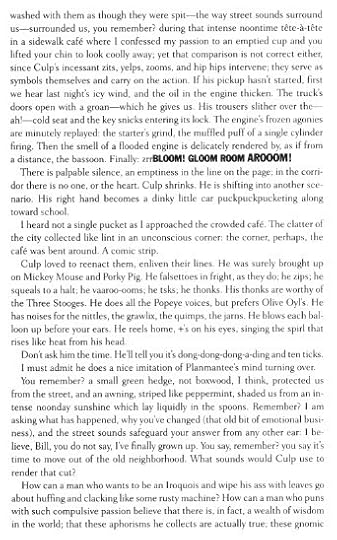
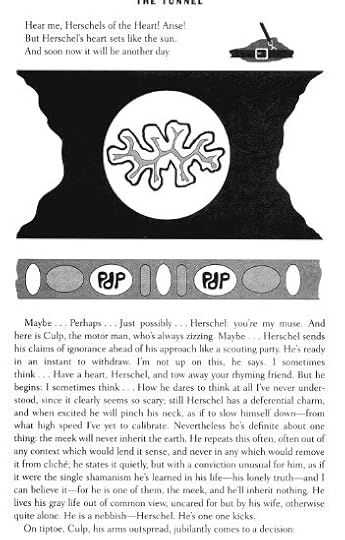
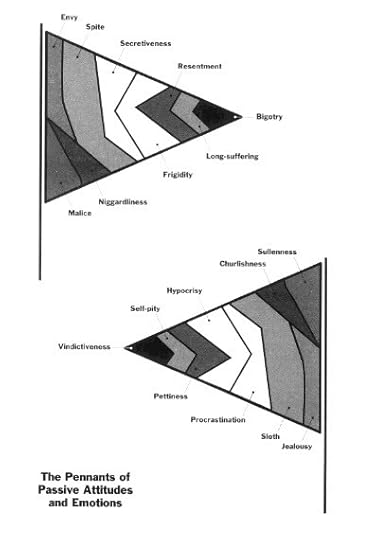
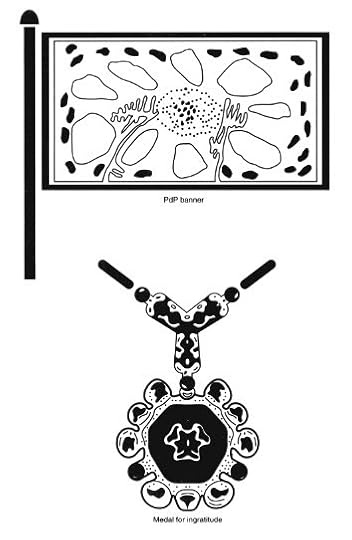
The text is filled with wordplay, limericks, letters, literary and historical allusions. An annotated version would be helpful, though probably most of these references could be picked up by any well-read person. At least enough to know something is going on here. There is much physical inventiveness too, using devices such as "concrete" poems, bold text, script, crossword puzzle design running down the page,various fonts. Illustrations. Here are some examples:



From bits of Kohler's memory one of the people we meet is Susu. So terrible, yet so beautifully created:
I came to hear skinny Susu sing in her low, throaty Sprechstimme, which was nevertheless French, a song about the carrion crow. It had innumerable verses and she never sang them all. How her voice reached me through the noise and bulk of those bodies, belly to belly like the bottles on the bar, was a mystery belonging more to magic than to science. Her sounds were hesitant, shy, as though regretting they had come, and hardly strong as the waitresses who, dressed in costumes purportedly Bavarian, elbowed everyone aside to slop down drinks. Perhaps it was drawn to me as sucking insects are, and became devious. Certainly that song was thirsty for my blood, and I never really heard any other. Perhaps I shouldn't smoke so much. Perhaps the roses will freeze. In the camps a cigarette was often hard to come by. We often smoked together, you and I, toes exquisitely touching, once at the hips, again at the elbows, the smoke going off toward the ceiling in a lazy curl the way our bodies seemed to burn off after loving....
Susu would sing it once every evening; she would sing it with blank black doll's eyes and a fixed sad smile she wore the way she wore her clothing—absently—scarcely moving her mouth. Her dresses were cut in a deep V like the style you see in Lautrec's posters of Yvette Guilbert. Sometimes yellow, mostly green, they were stretched so tight across her boyish braless chest, the nipples leaped out from the fabric like bumps on pebbled water. The song could have come from her eyes just as well. They never blinked. I had a passion for that woman. Immense. Now I can't bear to have a table touch me. In this house I avoid chairs with arms, and sit in the middle of couches—and then only on the yielding edge. I am impressed by what the world will swallow. Mouths, too. I must confess, no longer please me....
Susu I love you. A little like the mantis, I remember, since her head would swivel slowly in the hard inhuman manner of the mantis, and her face was blunted at its points like a badly damaged triangle. Not you. Lou. You stood straight; yet every curve was languorous, smoothly moving like a line drawn through the unobstructed space of sleep. They fell, when shot, in all the ways open. One could have made a study of such falling bodies: the stance, the weight, the tension of the limbs, the impact of the bullet. I love you, Susu—anyway.
...that blank watchfulness which Susu had so much of, a watchfulness—a mirror's you knew there was no consciousness behind ... something is watching, something is watchful, but what? At the back of Susu's eyes, of course, there was plenty; there was Hieronymus Bosch, there were diableries…so my life lasts a little longer...
And what did I read about you, Susu, in those documents? Susu, my slender singer, whom I love? that you roasted the thumbs of a dozen Jews and ate them while they watched ... those who had not fainted.When the smoldering Monro Cast Is, under tow to New York, snapped her lines and became snagged on a sand bar only a few yards off Convention Pier in Asbury Park, bodies began to bob up on Asbury beaches; 25 cents was charged to gaze upon the stricken ocean liner from the Hall; at night people crept aboard to steal from the bodies and loot the ship, hacking off fingers to get their rings; while a mortician, among the spectators on the pier, passed out his business card.
Is there any way of digesting facts like this—like this one—as Susu digested the handy phallic thumb-sticks of her Jews? Why she didn't have their cocks cut, I cannot imagine. Wasn't that what she was up to? Could she—my Susu— have shrunk at it? Hers certainly wasn't an anti-Semitic act, because it violated the Nazis' dietary laws. Could she have sucked such thumbs without the Reich's grand plans? could she have realized herself and come so splendidly upon her nature? She might have sung songs all her life and fingered milkless leather dildoes, who can tell? Susu, you at least became a true black queen; the evil you created was as close to you as you were; you confronted it; you took it in your mouth; added it, quite palpably, as weight, as measurable nutrition, to your hard flat-stomached self. In fact I always wondered just how much you were a woman. No. A man in drag, that kind of ersatz queen, would fashion for himself an ampler bosom—not so ample as my wife's perhaps, there is a limit. What did I find to admire—ever—in such flaps? The Germans executed my Susu themselves. Neither her exemplary performance as a commandant's whore, nor her sweetly twisted songs and whispered singing, could save her when they found she had some gypsy in her, though after her head was amputated, color photographs were taken, and kept as souvenirs in little folding cases covered neatly in blue cloth, with a small, though conventional, gold decoration.
Sing, Susu, through your severed head, through your severed arteries; and I shall put my mouth to your lips as though you were such an instrument. My breath shall reinflate your brain. Susu, O bag of pipes, I approach you in my dreams.
The deeper we go into The Tunnel, the more disturbing it is. To look through such eyes, and to know that this too is what it means to be a human being.

March 12, 2013
RIP
Hamlet:
What have you, my good friends, deserv'd at the hands of
Fortune, that she sends you to prison hither?
Guildenstern:
Prison, my lord?
Hamlet:
Denmark's a prison.
Rosencrantz:
Then is the world one.
Hamlet:
A goodly one, in which there are many confines, wards, and
dungeons, Denmark being one o' th' worst.
Rosencrantz:
We think not so, my lord.
Hamlet:
Why then 'tis none to you; for there is nothing either good or
bad, but thinking makes it so. To me it is a prison.
Don’t you see that when a man writes the history of your country in another mother-language, he is bent on conquest? If he succeeds, he will have replaced your past, and all your methods of communication, your habits of thinking, feeling, and perceiving, your very way of being, with his own. His history will be yours, perforce. - Mad Meg.
Guilt and Innocence
The process of Denazification began in earnest in early 1946 with a series of directives issued by the Allied Control Council. The aim was a thorough, meticulous investigation of the entire German people and the punishment of all found to be “guilty” of supporting the Nazi state. Germans were to be placed in one of five categories: Major Offenders; Offenders; Lesser Offenders; Followers; and Exonerated Persons. The concept of collective guilt was emphasized through the posting of graphic images of the concentration camps in newspapers, on placards, pamphlets and posters displayed in towns, cities, storefronts and cinemas headed with the statement “YOU ARE GUILTY OF THIS”.
However, quite rapidly it became clear that such a process was impractical. Not only was there no clear defining line between the “guilty” and the “innocent” (if such words have any real meaning – who amongst us could be truly “exonerated”?) but the process also ran counter to the urgent need to create a functioning, economically sound, society. To speed up the procedure it was decided that, unless their crimes were serious, members of the Nazi Party born after 1919 were exempted on the grounds that they had been brainwashed.
Members of the Nazi party began to buy and sell denazification certificates on the black market. The system fragmented and slipped out of sight. All that remained were the Nuremburg Trials with all their symbolic, cathartic theatre. The German people’s history was left in chimeric disarray – half-conquered by the American tongue. Is genocide a zombie or a hydra – what happens when we cut off its head?
The actions of the Nazis were only “bad” because they failed. Had they been successful, and the Thousand Year Reich established, Himmler would be a hero and not a failed chicken farmer with the blood of millions on his hands.
William Frederick Kohler, the “monster” tunnelled-through by Gass has faced the complexity of this problem, and recognised its Hydraic nature. He is filled with enough self-loathing (legacy of a wonderfully evoked childhood) to face the implications of these events – the fact that, as a species, it is a rare specimen who would not, at heart, belong as a member of the PdP. Of course, as its name implies, to be a member of the PdP means one would, had one be born elsewhere, been a member of the NSDAP. Can any of us truly say with certainty that all our petty disappointments, bitterness and self-disgust would not have led us by the hand into that darkness?
On the first page of the novel are two flags. They are broken into sections that name those “minor” character flaws that we all, as human beings, suffer from at one time or another: Envy; Spite; Secretiveness; Resentment; Bigotry; Long-Suffering; Frigidity; Niggardliness; Malice; Sullenness; Churlishness; Hypocrisy; Self-pity; Vindictiveness; Pettiness; Procrastination; Sloth; and Jealousy. Gass wishes to remind us that this is also a list of the ingredients required to fashion genocide. The components of inhumanity are human, all too human.
Hamlet’s statement that it is our thoughts that designate ‘good’ and ‘bad’ is, of course, in one sense correct – particularly when one refers to “morals” (as Nietzsche pointed out) but is there an objective sense in which those “flaws” listed above can be labelled “bad” (is there something to be said for moral universalism – is there a viewpoint from which, had the Nazi’s succeeded, one could still see their guilt?) and, if so, then are not all of us veined and marbled by such immorality? It is simple enough to designate the Shoah as “a bad thing” (not – it must be stated - “evil” as that term is a meaningless excuse) , but it is the point where, as one digs further and further down into individuals and individual acts, such certainty starts to crumble that is the most difficult to reconcile with our ideas of humanity. Where does one draw the line in the five categories of guilt and innocence set out above?
It is this issue, something I believe is one of the most important and profound legacies of the horrors of the 20thc, that Gass spent almost 30 years investigating. The Tunnel is a novel of great philosophical importance and subtlety, as well as technical masterpiece. It is hard going, and the passage gets dark, narrow and stifling, but it is a novel that I cannot recommend highly enough. There is no simple answer to the paradox that humanity is fundamentally inhumane, but to accept this fact should at least inspire us to vigilance. We should continue to tunnel inward, even when the dirt falls in our eyes.
Hamlet:
What have you, my good friends, deserv'd at the hands of
Fortune, that she sends you to prison hither?
Guildenstern:
Prison, my lord?
Hamlet:
Denmark's a prison.
Rosencrantz:
Then is the world one.
Hamlet:
A goodly one, in which there are many confines, wards, and
dungeons, Denmark being one o' th' worst.
Rosencrantz:
We think not so, my lord.
Hamlet:
Why then 'tis none to you; for there is nothing either good or
bad, but thinking makes it so. To me it is a prison.
Don’t you see that when a man writes the history of your country in another mother-language, he is bent on conquest? If he succeeds, he will have replaced your past, and all your methods of communication, your habits of thinking, feeling, and perceiving, your very way of being, with his own. His history will be yours, perforce. - Mad Meg.
Guilt and Innocence
The process of Denazification began in earnest in early 1946 with a series of directives issued by the Allied Control Council. The aim was a thorough, meticulous investigation of the entire German people and the punishment of all found to be “guilty” of supporting the Nazi state. Germans were to be placed in one of five categories: Major Offenders; Offenders; Lesser Offenders; Followers; and Exonerated Persons. The concept of collective guilt was emphasized through the posting of graphic images of the concentration camps in newspapers, on placards, pamphlets and posters displayed in towns, cities, storefronts and cinemas headed with the statement “YOU ARE GUILTY OF THIS”.
However, quite rapidly it became clear that such a process was impractical. Not only was there no clear defining line between the “guilty” and the “innocent” (if such words have any real meaning – who amongst us could be truly “exonerated”?) but the process also ran counter to the urgent need to create a functioning, economically sound, society. To speed up the procedure it was decided that, unless their crimes were serious, members of the Nazi Party born after 1919 were exempted on the grounds that they had been brainwashed.
Members of the Nazi party began to buy and sell denazification certificates on the black market. The system fragmented and slipped out of sight. All that remained were the Nuremburg Trials with all their symbolic, cathartic theatre. The German people’s history was left in chimeric disarray – half-conquered by the American tongue. Is genocide a zombie or a hydra – what happens when we cut off its head?
The actions of the Nazis were only “bad” because they failed. Had they been successful, and the Thousand Year Reich established, Himmler would be a hero and not a failed chicken farmer with the blood of millions on his hands.
William Frederick Kohler, the “monster” tunnelled-through by Gass has faced the complexity of this problem, and recognised its Hydraic nature. He is filled with enough self-loathing (legacy of a wonderfully evoked childhood) to face the implications of these events – the fact that, as a species, it is a rare specimen who would not, at heart, belong as a member of the PdP. Of course, as its name implies, to be a member of the PdP means one would, had one be born elsewhere, been a member of the NSDAP. Can any of us truly say with certainty that all our petty disappointments, bitterness and self-disgust would not have led us by the hand into that darkness?
On the first page of the novel are two flags. They are broken into sections that name those “minor” character flaws that we all, as human beings, suffer from at one time or another: Envy; Spite; Secretiveness; Resentment; Bigotry; Long-Suffering; Frigidity; Niggardliness; Malice; Sullenness; Churlishness; Hypocrisy; Self-pity; Vindictiveness; Pettiness; Procrastination; Sloth; and Jealousy. Gass wishes to remind us that this is also a list of the ingredients required to fashion genocide. The components of inhumanity are human, all too human.
Hamlet’s statement that it is our thoughts that designate ‘good’ and ‘bad’ is, of course, in one sense correct – particularly when one refers to “morals” (as Nietzsche pointed out) but is there an objective sense in which those “flaws” listed above can be labelled “bad” (is there something to be said for moral universalism – is there a viewpoint from which, had the Nazi’s succeeded, one could still see their guilt?) and, if so, then are not all of us veined and marbled by such immorality? It is simple enough to designate the Shoah as “a bad thing” (not – it must be stated - “evil” as that term is a meaningless excuse) , but it is the point where, as one digs further and further down into individuals and individual acts, such certainty starts to crumble that is the most difficult to reconcile with our ideas of humanity. Where does one draw the line in the five categories of guilt and innocence set out above?
It is this issue, something I believe is one of the most important and profound legacies of the horrors of the 20thc, that Gass spent almost 30 years investigating. The Tunnel is a novel of great philosophical importance and subtlety, as well as technical masterpiece. It is hard going, and the passage gets dark, narrow and stifling, but it is a novel that I cannot recommend highly enough. There is no simple answer to the paradox that humanity is fundamentally inhumane, but to accept this fact should at least inspire us to vigilance. We should continue to tunnel inward, even when the dirt falls in our eyes.

February 25, 2018
El mismo día que compré The Tunnel William Gass se murió. Esto volvió, debo aceptar, un tanto tétrica la experiencia de lectura, superando incluso su contenido, que ya de por sí es lo suficientemente perturbador. The Tunnel es un juego introspectivo, un soliloquio entrópico de William Frederick Kohler, un profesor universitario de historia con tendencias fascistas, pesimista, depredador sexual, que odia a sus hijos, a su esposa y a sus colegas de trabajo. El libro comienza con Kohler tratando de escribir el prefacio para su obra maestra: Guilt and Innocence in Hitler's Germany. Sin embargo, a raíz del bloqueo del escritor, pronto se encuentra escribiendo sobre su propia vida, sus propias miserias, su dura infancia, su soledad y su ira con el mundo, destilando una filosofía muy profunda que resquebraja la corteza que oculta la parte más oscura que nos forma como seres humanos. Kohler deja que el embrión envenenado que lleva dentro hable por sí solo, que se exprese a su gusto haciendo de Kohler un espectador que asiente y no se achica ante su propia vida.
Pero la verdadera historia se despliega cuando Kohler, como un minero aficionado, emprende la tarea de cavar un túnel en su sótano, mientras guarda la tierra que expulsa dentro de unos cajones para que su esposa Martha no lo sepa. De esta forma, se da inicio a una exploración personal que sigue el ritmo del túnel (una exploración que evoca más bien a una confesión de un condenado a muerte). Cuanta más tierra saca, más profundo entra en el túnel Kohler, y más profundo el lector penetra en su pasado y ontología. Así, la corriente del libro es exponencial y paralela a su tarea, a medida que nos adentramos en el túnel, más secretos salen a la luz, más miserias se revelan y más el lector va comprendiendo la angustiosa psiquis del protagonista. Esto no será fácil, sin embargo. Kohler es un personaje que dota de mucha polémica a su filosofía, y lo más peligroso es su capacidad de influencia y persuasión. Porque detrás de su llamado pesimismo y sus inclinaciones misantrópicas, Kohler es una persona inmersa en dolor e impotencia ante su existencia, y en muchas ocasiones sus rants se irán desvaneciendo a merced de su sufrimiento, que se rehuye pero rara vez se ignora.
No obstante, no hay que dejarse engañar. No hay que dejar que Kohler nos sacuda como lo desee. William Kohler es la personificación de la infamia que palpita en el interior del hombre promedio. Gass, al ser consultado sobre de qué trataba este libro, contestó que The Tunnel examina el fascismo del corazón. Kohler es la representación del mal que aún persiste en el humano. El holocausto, la guerra, el impulso que llevó al hombre a perpetuar aquellas matanzas y muestras de ira aún se encuentra allí, dentro de personas como William Kohler. Personas que esperan el contexto apropiado y un loco que eleve la voz para despertar y repetir la historia. Tu profesor de matemáticas, la señora que pasea a su perro todas las mañanas, el vecino que te saluda por las tardes mientras riega sus plantas. Según Gass, en personas como esas puede subyacer el odio aguardando pacientemente el momento para actuar. Están entre nosotros.
Y hay algo que hace todo el proceso de lectura aún peor y más incómodo: el odio de William Kohler es, casi en su totalidad (y resalto el casi), fundado. Nadie va preso por lo que piensa, sino por lo que hace (aunque sí tiró un ladrillo a la ventana de un comercio judío durante la Kristallnacht, conocida en español como La Noche de los Cristales Rotos, en 1938). William Kohler es una persona que, como dijo Gass sobre sí mismo, "Odia. Mucho. Profundamente". Esto sitúa al lector en una situación contradictoria, inquietante. Recuerdo un capítulo en el que Gass escribe sobre, por ejemplo, el arte de la intolerancia, a través del padre de William, un simpatizante de la extrema derecha. O también recuerdo un capítulo insuperable sobre las distintas personalidades de los compañeros de trabajo del protagonista, en el que los degrada y ataca sin miramientos pero de una manera tan brillante que no me quedó otra que rendirme de fascinación. Pero insisto en que no resulta cómodo leer sobre esas cosas, principalmente por su carácter tan explicativo, inteligente y filosófico (a excepción de los puntos, por fortuna escasos, que tratan el racismo o la misoginia, que se lo nota intencionalmente irracional por completo). Aunque creo que hay un modo correcto de abordar The Tunnel; hay que aprender a ver lo que yace detrás del filtro de inquina que supone la mente de Kohler para no perderse en la manipulación de este. (También hay muchísimas partes asombrosas que no caen en ninguna polémica, claro, como la brillante comparación entre las guerras y las peleas domésticas, que me hizo reír bastante).
No puedo evitar hablar sobre los temas que trata The Tunnel. Muchos ya los mencioné, pero otros no. William Kohler, como ya dije, es un profesor de historia, y en esto se detiene en varias ocasiones la novela: en lo que es la historia, para qué sirve, cuán fiable es y cómo debemos afrontarla. William Gass prácticamente delira al hablar sobre el contenido histórico de la humanidad; múltiples puntos de vista toman forma y se plantean desde todos los ángulos. El tratamiento de la historia es un pilar fundamental en la concepción de esta obra, y uno de los elementos más interesantes. Asimismo, The Tunnel es un libro sobre el lenguaje, su importancia en nuestro día a día y cómo este nos ayuda a crear una realidad alterna a lo físico pero no por eso menos real (¿Wittgenstein?). Aquí el lenguaje se celebra, se manipula, traspasa convencionalismos para depositarse como nuevas sensaciones en la mente del lector. Esos serían los temas que se tratan con más ahínco, aunque por supuesto que Gass no se guarda nada acerca de otras cuestiones que nutren la vida de Kohler, como su infelicidad, su solipsismo, su autoaborrecimiento, sus ilusiones y su falta de esperanza hacia la existencia humana. Este no es un libro optimista, pero también cabe resaltar que William Kohler en numerosas oportunidades se libera de su traje de estoicismo y aberración y se explaya sobre asuntos inmensamente conmovedores y sentimentales, tales como sus relaciones extramatrimoniales y cómo una de ellas lo llevó a hallar el amor, su doloroso duelo por la pérdida de este y su frustración ante lo que es incapaz de transformarse, junto con, por el lado de la infancia, el trauma de una madre alcohólica y un padre que nunca le dio el reconocimiento que, quizá, merecía. En todo eso último radica la tragedia de Kohler y su perfil más humano.
Leyendo la reseña de Michael Silverblatt para L. A. Times me encuentro con algo que dice con lo que concuerdo completamente y vale la pena mencionar: "El problema con el personaje no es que sea un monstruo, el problema es que el monstruo haya tomado una forma humana reconocible. La gente común siente sus desilusiones con ardiente resentimiento todos los días. La gente común piensa en pegarle a sus hijos, y otras personas ordinarias incluso lo hacen. Nos sentimos cómodos culpando a un Hitler, pero en este libro Hitler es solo una chispa que incendia el resentimiento". William Kohler es un pensador, no una persona que toma un papel activo contra lo que cree (a excepción, una vez más, del incidente de 1938), y varias aristas de su odio, se ve y se explica, están persuasivamente justificadas. Es por eso que The Tunnel apunta al rencor que anida dentro de muchas personas, a la ira por la falta de justicia mientras uno contempla, por ejemplo, cómo otros tienen éxito en cosas que no merecen pero uno sí. Como dice la frase en inglés, it hits too close to home. Muchos de nosotros, en alguna fase de nuestras vidas, o siempre, somos, en mayor o menor medida, William Kohler. De eso se trata este libro: de inquietarnos. Dicho sea de paso, una novela que logra un efecto parecido es El fin de Alice, de Amy Homes, la cual recomiendo mucho.
En cuanto a la escritura, es fantástica. Cada oración de Gass está esculpida con minuciosa consideración y cuidado. Las oraciones son suicidas, asfixiantes y maravillosas, oraciones que se prologan tanto que te quitan el aire y te transportan hacia los pensamientos de Kohler junto con los impulsos nerviosos que hacen posible su memoria. Existen pocos autores que conozca capaces de lograr este nivel sublime de escritura (ahora se me vienen a la mente Joseph McElroy, Vladimir Nabokov y no muchos más). A veces me hallaba releyendo párrafos enteros una y otra vez de lo espectaculares que eran, y no estoy exagerando. Treinta años estuvo escribiendo Gass este libro, así que dense la idea de que no fue hecho a la ligera. Sin esta calidad de escritura, probablemente la novela hubiese caído muerta víctima de su propio peso, puesto que no habría nada que la sustentase. Porque olvídense de encontrar acción o una trama. Aquí no hay nada de eso. Solo hay un hombre solitario que cava y, como diría Hemingway, se desangra ante el filo de sus páginas.
The Tunnel, sin lugar a dudas, es el mejor libro que llevo leído en el año, y sé desde ya que es uno de los mejores que he leído en mi vida como lector. No obstante, esta no es una obra que pueda recomendar así como así, ya que, sí, es muy pesada y compleja (aunque las primeras 250 páginas son las peores; después todo se vuelve más accesible, esto debido al intento de Gass de formar una especie de filtro al inicio para que solo los más merecedores pudiesen llegar a la parte más clara de la historia). No hay diálogo y tampoco Gass tuvo piedad de nosotros los lectores, sino que se empeñó en mostrar como un espejo el stream of consciousness de Kohler sin dejar de lado ni un poco su locura narcisista. De todos modos, es un libro que disfruté al máximo, con muchísimo contenido filosófico y un personaje detestable pero tan humano que el lector se asusta ante el extraño apego que se puede llegar a sentir por él. The Tunnel es una novela brillante, de lo más extraordinario que he leído en años, y quiero que la lean.
Do not hate us because you aren't perfect or the world is unimprovable; because wrongs can't really be righted; injustice lingers on like a congestion in the lung, waiting for reinfection; do not despair because there is no cure, for there is no cure, no cure for any of it; there's no stopping the fall of man, but at least we all fall along with one another.
Pero la verdadera historia se despliega cuando Kohler, como un minero aficionado, emprende la tarea de cavar un túnel en su sótano, mientras guarda la tierra que expulsa dentro de unos cajones para que su esposa Martha no lo sepa. De esta forma, se da inicio a una exploración personal que sigue el ritmo del túnel (una exploración que evoca más bien a una confesión de un condenado a muerte). Cuanta más tierra saca, más profundo entra en el túnel Kohler, y más profundo el lector penetra en su pasado y ontología. Así, la corriente del libro es exponencial y paralela a su tarea, a medida que nos adentramos en el túnel, más secretos salen a la luz, más miserias se revelan y más el lector va comprendiendo la angustiosa psiquis del protagonista. Esto no será fácil, sin embargo. Kohler es un personaje que dota de mucha polémica a su filosofía, y lo más peligroso es su capacidad de influencia y persuasión. Porque detrás de su llamado pesimismo y sus inclinaciones misantrópicas, Kohler es una persona inmersa en dolor e impotencia ante su existencia, y en muchas ocasiones sus rants se irán desvaneciendo a merced de su sufrimiento, que se rehuye pero rara vez se ignora.
No obstante, no hay que dejarse engañar. No hay que dejar que Kohler nos sacuda como lo desee. William Kohler es la personificación de la infamia que palpita en el interior del hombre promedio. Gass, al ser consultado sobre de qué trataba este libro, contestó que The Tunnel examina el fascismo del corazón. Kohler es la representación del mal que aún persiste en el humano. El holocausto, la guerra, el impulso que llevó al hombre a perpetuar aquellas matanzas y muestras de ira aún se encuentra allí, dentro de personas como William Kohler. Personas que esperan el contexto apropiado y un loco que eleve la voz para despertar y repetir la historia. Tu profesor de matemáticas, la señora que pasea a su perro todas las mañanas, el vecino que te saluda por las tardes mientras riega sus plantas. Según Gass, en personas como esas puede subyacer el odio aguardando pacientemente el momento para actuar. Están entre nosotros.
Y hay algo que hace todo el proceso de lectura aún peor y más incómodo: el odio de William Kohler es, casi en su totalidad (y resalto el casi), fundado. Nadie va preso por lo que piensa, sino por lo que hace (aunque sí tiró un ladrillo a la ventana de un comercio judío durante la Kristallnacht, conocida en español como La Noche de los Cristales Rotos, en 1938). William Kohler es una persona que, como dijo Gass sobre sí mismo, "Odia. Mucho. Profundamente". Esto sitúa al lector en una situación contradictoria, inquietante. Recuerdo un capítulo en el que Gass escribe sobre, por ejemplo, el arte de la intolerancia, a través del padre de William, un simpatizante de la extrema derecha. O también recuerdo un capítulo insuperable sobre las distintas personalidades de los compañeros de trabajo del protagonista, en el que los degrada y ataca sin miramientos pero de una manera tan brillante que no me quedó otra que rendirme de fascinación. Pero insisto en que no resulta cómodo leer sobre esas cosas, principalmente por su carácter tan explicativo, inteligente y filosófico (a excepción de los puntos, por fortuna escasos, que tratan el racismo o la misoginia, que se lo nota intencionalmente irracional por completo). Aunque creo que hay un modo correcto de abordar The Tunnel; hay que aprender a ver lo que yace detrás del filtro de inquina que supone la mente de Kohler para no perderse en la manipulación de este. (También hay muchísimas partes asombrosas que no caen en ninguna polémica, claro, como la brillante comparación entre las guerras y las peleas domésticas, que me hizo reír bastante).
No puedo evitar hablar sobre los temas que trata The Tunnel. Muchos ya los mencioné, pero otros no. William Kohler, como ya dije, es un profesor de historia, y en esto se detiene en varias ocasiones la novela: en lo que es la historia, para qué sirve, cuán fiable es y cómo debemos afrontarla. William Gass prácticamente delira al hablar sobre el contenido histórico de la humanidad; múltiples puntos de vista toman forma y se plantean desde todos los ángulos. El tratamiento de la historia es un pilar fundamental en la concepción de esta obra, y uno de los elementos más interesantes. Asimismo, The Tunnel es un libro sobre el lenguaje, su importancia en nuestro día a día y cómo este nos ayuda a crear una realidad alterna a lo físico pero no por eso menos real (¿Wittgenstein?). Aquí el lenguaje se celebra, se manipula, traspasa convencionalismos para depositarse como nuevas sensaciones en la mente del lector. Esos serían los temas que se tratan con más ahínco, aunque por supuesto que Gass no se guarda nada acerca de otras cuestiones que nutren la vida de Kohler, como su infelicidad, su solipsismo, su autoaborrecimiento, sus ilusiones y su falta de esperanza hacia la existencia humana. Este no es un libro optimista, pero también cabe resaltar que William Kohler en numerosas oportunidades se libera de su traje de estoicismo y aberración y se explaya sobre asuntos inmensamente conmovedores y sentimentales, tales como sus relaciones extramatrimoniales y cómo una de ellas lo llevó a hallar el amor, su doloroso duelo por la pérdida de este y su frustración ante lo que es incapaz de transformarse, junto con, por el lado de la infancia, el trauma de una madre alcohólica y un padre que nunca le dio el reconocimiento que, quizá, merecía. En todo eso último radica la tragedia de Kohler y su perfil más humano.
Leyendo la reseña de Michael Silverblatt para L. A. Times me encuentro con algo que dice con lo que concuerdo completamente y vale la pena mencionar: "El problema con el personaje no es que sea un monstruo, el problema es que el monstruo haya tomado una forma humana reconocible. La gente común siente sus desilusiones con ardiente resentimiento todos los días. La gente común piensa en pegarle a sus hijos, y otras personas ordinarias incluso lo hacen. Nos sentimos cómodos culpando a un Hitler, pero en este libro Hitler es solo una chispa que incendia el resentimiento". William Kohler es un pensador, no una persona que toma un papel activo contra lo que cree (a excepción, una vez más, del incidente de 1938), y varias aristas de su odio, se ve y se explica, están persuasivamente justificadas. Es por eso que The Tunnel apunta al rencor que anida dentro de muchas personas, a la ira por la falta de justicia mientras uno contempla, por ejemplo, cómo otros tienen éxito en cosas que no merecen pero uno sí. Como dice la frase en inglés, it hits too close to home. Muchos de nosotros, en alguna fase de nuestras vidas, o siempre, somos, en mayor o menor medida, William Kohler. De eso se trata este libro: de inquietarnos. Dicho sea de paso, una novela que logra un efecto parecido es El fin de Alice, de Amy Homes, la cual recomiendo mucho.
En cuanto a la escritura, es fantástica. Cada oración de Gass está esculpida con minuciosa consideración y cuidado. Las oraciones son suicidas, asfixiantes y maravillosas, oraciones que se prologan tanto que te quitan el aire y te transportan hacia los pensamientos de Kohler junto con los impulsos nerviosos que hacen posible su memoria. Existen pocos autores que conozca capaces de lograr este nivel sublime de escritura (ahora se me vienen a la mente Joseph McElroy, Vladimir Nabokov y no muchos más). A veces me hallaba releyendo párrafos enteros una y otra vez de lo espectaculares que eran, y no estoy exagerando. Treinta años estuvo escribiendo Gass este libro, así que dense la idea de que no fue hecho a la ligera. Sin esta calidad de escritura, probablemente la novela hubiese caído muerta víctima de su propio peso, puesto que no habría nada que la sustentase. Porque olvídense de encontrar acción o una trama. Aquí no hay nada de eso. Solo hay un hombre solitario que cava y, como diría Hemingway, se desangra ante el filo de sus páginas.
The Tunnel, sin lugar a dudas, es el mejor libro que llevo leído en el año, y sé desde ya que es uno de los mejores que he leído en mi vida como lector. No obstante, esta no es una obra que pueda recomendar así como así, ya que, sí, es muy pesada y compleja (aunque las primeras 250 páginas son las peores; después todo se vuelve más accesible, esto debido al intento de Gass de formar una especie de filtro al inicio para que solo los más merecedores pudiesen llegar a la parte más clara de la historia). No hay diálogo y tampoco Gass tuvo piedad de nosotros los lectores, sino que se empeñó en mostrar como un espejo el stream of consciousness de Kohler sin dejar de lado ni un poco su locura narcisista. De todos modos, es un libro que disfruté al máximo, con muchísimo contenido filosófico y un personaje detestable pero tan humano que el lector se asusta ante el extraño apego que se puede llegar a sentir por él. The Tunnel es una novela brillante, de lo más extraordinario que he leído en años, y quiero que la lean.
Do not hate us because you aren't perfect or the world is unimprovable; because wrongs can't really be righted; injustice lingers on like a congestion in the lung, waiting for reinfection; do not despair because there is no cure, for there is no cure, no cure for any of it; there's no stopping the fall of man, but at least we all fall along with one another.

October 24, 2011
The Tunnel Conceit
The tunnel is an authorial conceit on the part of William H Gass as well as his protagonist, William F. Kohler.
It's probably best to abandon any preconceptions of what it might mean when you enter either tunnel as a reader.
The metaphorical tunnel doesn't represent an escape route out of anywhere, nor does it represent a method of entry into somewhere else.
Instead, it constitutes a long strange trip or journey through the mind of the first person protagonist.
At this level, the novel is simply an account of the intellectual life of the protagonist. It's not clear whether it's merely thought or written down. I'll settle for the latter, because of its self-consciously literary tone.
Language is the vehicle by which this mind's ore is drilled (bored?), extracted, conveyed to us and laid bare, so that, if we're interested enough, we can sift through it, looking for gold (or gelt or guilt).
The Dirty Digger
So much for the metaphysical tunnel. At a more physical level, Kohler (his name is German for "digger") goes down to the basement of his home, and starts digging a tunnel or hole. It's not clear what he intends to do with his hole or where he hopes it will take him. It's almost as if it's sufficient, as if it's an act of liberation in its own right, that Kohler is digging his own hole. This hole belongs to him. It is his very own piece of nothingness. Kohler is a man for whom nothing is enough.
On the other hand, Kohler is a dirty digger. The act of digging a hole requires him to dig up and remove dirt. He doesn't want his wife, Martha, to realise he is digging a hole for himself. So he shovels the dirt into the chests of drawers and dressing tables upstairs (in all of the rooms other than the room in which, this might come as a surprise, she sleeps separately).
Of course, Martha finds out and quite reasonably remarks, "I don't want your dirt in my drawers any more than I want your ideas in my head."
You've got to admit, this is pretty funny in the absurdist manner of Beckett. Only the playwright didn't take 651 pages to achieve a similar result. Plus, structurally, the two-act play enabled Beckett to ensure that, at least, nothing happened twice. Here, nothing only happens once. It's just that there's a whole lot of nothing going down.
That's enough about the conceit of the tunnel. It's little more than a framing device for a monologue.
Digging All the Dirt on Kohler
Over the course of these 651 pages, we literally get to know everything about Kohler. Perhaps, a better way to say it is that we get all the dirt there is to know about Kohler. The more he digs, the more dirt we get.
The remarkable thing is we get Kohler, warts and all, from the horse's mouth. Needless to say, it's not pretty. In fact, he is a disgrace in just about every aspect of life. Even more remarkably, we don't get any sense of embarrassment or shame about anything he has to say about himself. It's as if he has to tell somebody else, for it to be really true. In the telling, his story becomes history. You don't have to be a king to make history. You just need to have lived, to have been alive. To this extent (only?), he has something in common with everyman.
Ironically, or perhaps not, Kohler is an academic historian. He has written a book called "Guilt and Innocence in Hitler's Germany". At the beginning of the novel, he sits down to write the Introduction to the book, only his own story distracts him. This alone suggests that history can't be written objectively; there will always be something subjective of the historian or author in the telling. Thus, we are misguided, if we think that history is objective. Conversely, we're entitled to ask, what can we learn from history? It seems that we will encounter more unreliable narrators in history than we do in fiction.
We don't learn much about what Kohler has written in his book. Perhaps, if we did, it could have constituted his Introduction! However, we learn a whole lot about his past.
The Mad Meg Legacy
Gass started writing the novel in 1965, when he was about 40. He took another 30 years to finish and publish it. It's difficult to judge when the novel is set, or at least when the narration is taking place. A couple of times, it's mentioned that Kohler is 50. There is little reference to contemporaneous events, other than a brief mention of protests against the Vietnamese War. There is some incidental mention of hippies, but no suggestion that the Summer of Love has occurred. Thus, it's possible that the narration occurs about 1965, which means that Kohler was born in about 1915 and was about nine or ten years older than Gass himself.
This difference in age makes it possible for Kohler to have spent at least a year studying in Germany, after Hitler came to power. It seems that he studied history under a charismatic, persuasive and compelling pro-Nazi Professor (Magus "Mad Meg" Tabor) who greatly influenced his actions and beliefs. It's tempting, but ultimately futile, to try to work out who Mad Meg represents .
We soon learn that Kohler shares in the guilt of the Nazis: he threw a brick through the window of a Jewish grocery store on Kristallnacht in November, 1938.
Although Kohler's colleagues suspect that he has pro-Hitler tendencies, we never learn how much it is reflected in his book. However, Gass leaves it to us to infer that Kohler must be asked the same questions about guilt and innocence as he purports to ask of the German people.
The Abyss
Regardless of any question about the complicity of the average German, the Holocaust must be regarded as the single most evil act committed in human history.
As at 1965, the philosophical implications were still highly topical. The Holocaust was particularly relevant to post-war philosophies such as Existentialism and philosophers like Heidegger, who had started to get widespread attention in America from the 1950's onwards.
Philosophy had started to discuss the plight of modern man in terms of the Abyss. Even though it is now believed that Heidegger was a Nazi sympathiser (not a simple issue to deal with), there can be no better practical example of the Abyss than the Holocaust.
For all the centrality of history and philosophy to the novel, Kohler's tone is comic, light, complacent, conceited, flippant, even dismissive. There is no sense of the gravity of the Holocaust. He seems to embrace the meaninglessness of the Abyss rather than trying to escape it with some rational argument or philosophy. He is no man of action or commitment. He is a man of inaction, an exponent of passivity, a "gnomic wiseguy". He spends the whole of his life in a swivel chair (inherited from Mad Meg), changing perspectives as he sees fit.
He argues, "We are as free to be of value as chewed gum...our philosophies rot in the back lots of our culture like struck sets...reality doesn't really give a shit...the truth plainly doesn't matter a damn."
The Tunnel Shot
The one source of solace seems to be sex ("the furry tunnel"), whether or not with Martha, or his mistresses or students (it's not clear whether they are real or just figments of his imagination).
In this pastiche of Nabokov, he is massaging his lover, Lou:
"Il...li...nois. I liked that name, that stream. It knew how to run, where to flow. Initially, the Il...li...nois would slide a little way along her upper shoulder before turning down, would tend to seek cracks, where the arm rested against her body, or run a deep indentation at the waist, before falling between her buttocks to tiptongue - that lightly - over her anus to...nois's home in the cleft of her cunt. But she would wiggle a little resentfully then, thinking I was trying to rouse her again. I suppose, though I wouldn't have minded that, rivers always roused me, and once in a while Il...li...nois would encounter the wad of Kleenex she used to mop me up with: I liked that, I thought it a fitting end to such a cunt-hunting river."
A lot of the novel is hilarious. Often, it reminded me of "A Confederacy of Dunces", "Catch 22", "Seinfeld" , "Family Guy", "South Park" or "Gravity's Rainbow".
Most of the sexual escapades and descriptions are amusing in a vulgar, undergraduate , Pynchonesque, Pythonesque, almost absurdist way. However, many readers will find them gratuitous and offensive.
Tell Me What You Really Think
Gass avoids any complicity in the philosophical or sexual offensiveness of the novel, because we don't know his views as author or person.
All we have to go on is Kohler, who we already know to be a dirty digger. Importantly, Kohler doesn't aspire , he doesn't change, he doesn't improve, he doesn't redeem himself, he doesn't even seek forgiveness. In the end, this self-proclaimed fat man with a small penis is neither punished nor well hung. He remains in his hole(s):
"I am an intransitive man. I'm reconciled to it. Even my husbanding has no object. With my tunnel, I have committed the ultimate inactive act. After all, what is a useless hole? I can honestly say I have accomplished Nothing...
"Such doughnut-shaped deeds have amassed this pile of paper, determined my present detachment from my work, developed my unimpinging personality,...endlessly rehearsed these unheard lectures, projected my antiutopian visions onto a darkly boarded black screen, formed there my dishevelling plans. I've done nothing except fill her drawers with dirt. When she finds out, what then?"
Yes, exactly, what then? This is the point of discovery at which Gass chooses to end his novel. Unfortunately, there is no what then.
Holocaustic Remarks
Like any good (Post-) Modernist, Gass reserves the right to hide behind his protagonist and not give anything away.
Even when the subject matter is the Holocaust, Gass' authorial practice seems to prefer the beauty of language in the abstract to the ugliness of how and why it is used. It's true, history is not poetry. But sometimes or in some circumstances, poetry is not enough.
I recognise and respect the effort and skill that went into this novel. However, I didn't find it wholly satisfying.
Gass is clearly literate in the metaphysics of the issues his novel raises and discusses. The philosophy of Hegel and Heidegger is mentioned frequently, as are the ideas of Rilke. However, Gass seems to be content with a smokescreen rather than sending smoke signals, however subtle.
Kohler versus Herzog
Kohler luxuriates in a world of pointlessness, by which he means:
"...the weakening of resolve,...the absence of any value, good or ill, the shoreline of the banal..."
What appealed to him about Hitler was that he [Kohler] could be a "little finger...in a big fist".
He didn't have to act or think. He just had to stay in synch with the fist, whether it was willed to do good or evil.
Contrast this with Saul Bellow's character, Herzog :
"In the sphere of culture the newly risen educated classes caused confusion between aesthetic and moral judgments...reaching at last the point of denying the humanity of the industrialised, 'banalised' masses.
"It was easy for the Wastelanders to be assimilated to totalitarianism. Here the responsibility of artists remains to be assessed.
"To have assumed, for instance, that the deterioration of language and its debasement was tantamount to dehumanisation led straight to cultural fascism."
What is present in "Herzog", but missing from "The Tunnel", is any sense that we might owe it to the victims of the Holocaust to choose, value and champion Being and Existence (as opposed to Nothingness).
There is no intimation that we could (or should) develop enough backbone to climb out of the Abyss that we seem to have dug ourselves into.
"Herzog" treats these issues very seriously, whereas "The Tunnel" seems to treat them as a bit of a joke. Any glimmer of Humanism is wishful thinking. Rather, Kohler seems to be undermining Humanism like a termite burrowing under the floorboards. This book is his tunnel.
Ironically, the respect for existence and life that emerged (or was at least reinforced) after the Holocaust is equally available to any life, including that of a Kohler. He's entitled to be treated as a human being, even if he thinks of himself and all others as worms.
Of course, Gass might argue that this is all Post-Modernist play, that the author has a right to remain silent, and/or that his novel is a legitimate attack on Modernism and possibly, through it, Humanism.
If Post-Modernism finds Modernism wanting in this regard, then I prefer this aspect of Modernism. If Gass is capable of something better and more Humanist than metaphysical and literary glibness, then it's not on display here.
This novel is riddled with the wormholes of ignoble protagonistic hatred. I wonder how, had Gass finished it, it would have been received in 1965, a year after the publication of "Herzog" (a novel to which it seems to be a response, to which I think it deserves to be compared adversely, and which contributed to the reasons Saul Bellow was awarded the Nobel Prize for Literature).
Still, even now, the question remains, how should we respond to someone (a protagonist, an author) who hates. This much. A lot. And hard.
The Tunnel (According to Culp)
You'll dig why Culp's smile is so mighty,
When you meet his wife, Aphrodite.
As you might know, from the fable,
She's ready, willing and able,
He just needs to lift up her nightie.
SOUNDTRACK:
Robyn Hitchcock - "Balloon Man"
http://www.jukebo.com/robyn-hitchcock...
"He was round and fat and spherical"
The tunnel is an authorial conceit on the part of William H Gass as well as his protagonist, William F. Kohler.
It's probably best to abandon any preconceptions of what it might mean when you enter either tunnel as a reader.
The metaphorical tunnel doesn't represent an escape route out of anywhere, nor does it represent a method of entry into somewhere else.
Instead, it constitutes a long strange trip or journey through the mind of the first person protagonist.
At this level, the novel is simply an account of the intellectual life of the protagonist. It's not clear whether it's merely thought or written down. I'll settle for the latter, because of its self-consciously literary tone.
Language is the vehicle by which this mind's ore is drilled (bored?), extracted, conveyed to us and laid bare, so that, if we're interested enough, we can sift through it, looking for gold (or gelt or guilt).
The Dirty Digger
So much for the metaphysical tunnel. At a more physical level, Kohler (his name is German for "digger") goes down to the basement of his home, and starts digging a tunnel or hole. It's not clear what he intends to do with his hole or where he hopes it will take him. It's almost as if it's sufficient, as if it's an act of liberation in its own right, that Kohler is digging his own hole. This hole belongs to him. It is his very own piece of nothingness. Kohler is a man for whom nothing is enough.
On the other hand, Kohler is a dirty digger. The act of digging a hole requires him to dig up and remove dirt. He doesn't want his wife, Martha, to realise he is digging a hole for himself. So he shovels the dirt into the chests of drawers and dressing tables upstairs (in all of the rooms other than the room in which, this might come as a surprise, she sleeps separately).
Of course, Martha finds out and quite reasonably remarks, "I don't want your dirt in my drawers any more than I want your ideas in my head."
You've got to admit, this is pretty funny in the absurdist manner of Beckett. Only the playwright didn't take 651 pages to achieve a similar result. Plus, structurally, the two-act play enabled Beckett to ensure that, at least, nothing happened twice. Here, nothing only happens once. It's just that there's a whole lot of nothing going down.
That's enough about the conceit of the tunnel. It's little more than a framing device for a monologue.
Digging All the Dirt on Kohler
Over the course of these 651 pages, we literally get to know everything about Kohler. Perhaps, a better way to say it is that we get all the dirt there is to know about Kohler. The more he digs, the more dirt we get.
The remarkable thing is we get Kohler, warts and all, from the horse's mouth. Needless to say, it's not pretty. In fact, he is a disgrace in just about every aspect of life. Even more remarkably, we don't get any sense of embarrassment or shame about anything he has to say about himself. It's as if he has to tell somebody else, for it to be really true. In the telling, his story becomes history. You don't have to be a king to make history. You just need to have lived, to have been alive. To this extent (only?), he has something in common with everyman.
Ironically, or perhaps not, Kohler is an academic historian. He has written a book called "Guilt and Innocence in Hitler's Germany". At the beginning of the novel, he sits down to write the Introduction to the book, only his own story distracts him. This alone suggests that history can't be written objectively; there will always be something subjective of the historian or author in the telling. Thus, we are misguided, if we think that history is objective. Conversely, we're entitled to ask, what can we learn from history? It seems that we will encounter more unreliable narrators in history than we do in fiction.
We don't learn much about what Kohler has written in his book. Perhaps, if we did, it could have constituted his Introduction! However, we learn a whole lot about his past.
The Mad Meg Legacy
Gass started writing the novel in 1965, when he was about 40. He took another 30 years to finish and publish it. It's difficult to judge when the novel is set, or at least when the narration is taking place. A couple of times, it's mentioned that Kohler is 50. There is little reference to contemporaneous events, other than a brief mention of protests against the Vietnamese War. There is some incidental mention of hippies, but no suggestion that the Summer of Love has occurred. Thus, it's possible that the narration occurs about 1965, which means that Kohler was born in about 1915 and was about nine or ten years older than Gass himself.
This difference in age makes it possible for Kohler to have spent at least a year studying in Germany, after Hitler came to power. It seems that he studied history under a charismatic, persuasive and compelling pro-Nazi Professor (Magus "Mad Meg" Tabor) who greatly influenced his actions and beliefs. It's tempting, but ultimately futile, to try to work out who Mad Meg represents .
We soon learn that Kohler shares in the guilt of the Nazis: he threw a brick through the window of a Jewish grocery store on Kristallnacht in November, 1938.
Although Kohler's colleagues suspect that he has pro-Hitler tendencies, we never learn how much it is reflected in his book. However, Gass leaves it to us to infer that Kohler must be asked the same questions about guilt and innocence as he purports to ask of the German people.
The Abyss
Regardless of any question about the complicity of the average German, the Holocaust must be regarded as the single most evil act committed in human history.
As at 1965, the philosophical implications were still highly topical. The Holocaust was particularly relevant to post-war philosophies such as Existentialism and philosophers like Heidegger, who had started to get widespread attention in America from the 1950's onwards.
Philosophy had started to discuss the plight of modern man in terms of the Abyss. Even though it is now believed that Heidegger was a Nazi sympathiser (not a simple issue to deal with), there can be no better practical example of the Abyss than the Holocaust.
For all the centrality of history and philosophy to the novel, Kohler's tone is comic, light, complacent, conceited, flippant, even dismissive. There is no sense of the gravity of the Holocaust. He seems to embrace the meaninglessness of the Abyss rather than trying to escape it with some rational argument or philosophy. He is no man of action or commitment. He is a man of inaction, an exponent of passivity, a "gnomic wiseguy". He spends the whole of his life in a swivel chair (inherited from Mad Meg), changing perspectives as he sees fit.
He argues, "We are as free to be of value as chewed gum...our philosophies rot in the back lots of our culture like struck sets...reality doesn't really give a shit...the truth plainly doesn't matter a damn."
The Tunnel Shot
The one source of solace seems to be sex ("the furry tunnel"), whether or not with Martha, or his mistresses or students (it's not clear whether they are real or just figments of his imagination).
In this pastiche of Nabokov, he is massaging his lover, Lou:
"Il...li...nois. I liked that name, that stream. It knew how to run, where to flow. Initially, the Il...li...nois would slide a little way along her upper shoulder before turning down, would tend to seek cracks, where the arm rested against her body, or run a deep indentation at the waist, before falling between her buttocks to tiptongue - that lightly - over her anus to...nois's home in the cleft of her cunt. But she would wiggle a little resentfully then, thinking I was trying to rouse her again. I suppose, though I wouldn't have minded that, rivers always roused me, and once in a while Il...li...nois would encounter the wad of Kleenex she used to mop me up with: I liked that, I thought it a fitting end to such a cunt-hunting river."
A lot of the novel is hilarious. Often, it reminded me of "A Confederacy of Dunces", "Catch 22", "Seinfeld" , "Family Guy", "South Park" or "Gravity's Rainbow".
Most of the sexual escapades and descriptions are amusing in a vulgar, undergraduate , Pynchonesque, Pythonesque, almost absurdist way. However, many readers will find them gratuitous and offensive.
Tell Me What You Really Think
Gass avoids any complicity in the philosophical or sexual offensiveness of the novel, because we don't know his views as author or person.
All we have to go on is Kohler, who we already know to be a dirty digger. Importantly, Kohler doesn't aspire , he doesn't change, he doesn't improve, he doesn't redeem himself, he doesn't even seek forgiveness. In the end, this self-proclaimed fat man with a small penis is neither punished nor well hung. He remains in his hole(s):
"I am an intransitive man. I'm reconciled to it. Even my husbanding has no object. With my tunnel, I have committed the ultimate inactive act. After all, what is a useless hole? I can honestly say I have accomplished Nothing...
"Such doughnut-shaped deeds have amassed this pile of paper, determined my present detachment from my work, developed my unimpinging personality,...endlessly rehearsed these unheard lectures, projected my antiutopian visions onto a darkly boarded black screen, formed there my dishevelling plans. I've done nothing except fill her drawers with dirt. When she finds out, what then?"
Yes, exactly, what then? This is the point of discovery at which Gass chooses to end his novel. Unfortunately, there is no what then.
Holocaustic Remarks
Like any good (Post-) Modernist, Gass reserves the right to hide behind his protagonist and not give anything away.
Even when the subject matter is the Holocaust, Gass' authorial practice seems to prefer the beauty of language in the abstract to the ugliness of how and why it is used. It's true, history is not poetry. But sometimes or in some circumstances, poetry is not enough.
I recognise and respect the effort and skill that went into this novel. However, I didn't find it wholly satisfying.
Gass is clearly literate in the metaphysics of the issues his novel raises and discusses. The philosophy of Hegel and Heidegger is mentioned frequently, as are the ideas of Rilke. However, Gass seems to be content with a smokescreen rather than sending smoke signals, however subtle.
Kohler versus Herzog
Kohler luxuriates in a world of pointlessness, by which he means:
"...the weakening of resolve,...the absence of any value, good or ill, the shoreline of the banal..."
What appealed to him about Hitler was that he [Kohler] could be a "little finger...in a big fist".
He didn't have to act or think. He just had to stay in synch with the fist, whether it was willed to do good or evil.
Contrast this with Saul Bellow's character, Herzog :
"In the sphere of culture the newly risen educated classes caused confusion between aesthetic and moral judgments...reaching at last the point of denying the humanity of the industrialised, 'banalised' masses.
"It was easy for the Wastelanders to be assimilated to totalitarianism. Here the responsibility of artists remains to be assessed.
"To have assumed, for instance, that the deterioration of language and its debasement was tantamount to dehumanisation led straight to cultural fascism."
What is present in "Herzog", but missing from "The Tunnel", is any sense that we might owe it to the victims of the Holocaust to choose, value and champion Being and Existence (as opposed to Nothingness).
There is no intimation that we could (or should) develop enough backbone to climb out of the Abyss that we seem to have dug ourselves into.
"Herzog" treats these issues very seriously, whereas "The Tunnel" seems to treat them as a bit of a joke. Any glimmer of Humanism is wishful thinking. Rather, Kohler seems to be undermining Humanism like a termite burrowing under the floorboards. This book is his tunnel.
Ironically, the respect for existence and life that emerged (or was at least reinforced) after the Holocaust is equally available to any life, including that of a Kohler. He's entitled to be treated as a human being, even if he thinks of himself and all others as worms.
Of course, Gass might argue that this is all Post-Modernist play, that the author has a right to remain silent, and/or that his novel is a legitimate attack on Modernism and possibly, through it, Humanism.
If Post-Modernism finds Modernism wanting in this regard, then I prefer this aspect of Modernism. If Gass is capable of something better and more Humanist than metaphysical and literary glibness, then it's not on display here.
This novel is riddled with the wormholes of ignoble protagonistic hatred. I wonder how, had Gass finished it, it would have been received in 1965, a year after the publication of "Herzog" (a novel to which it seems to be a response, to which I think it deserves to be compared adversely, and which contributed to the reasons Saul Bellow was awarded the Nobel Prize for Literature).
Still, even now, the question remains, how should we respond to someone (a protagonist, an author) who hates. This much. A lot. And hard.
The Tunnel (According to Culp)
You'll dig why Culp's smile is so mighty,
When you meet his wife, Aphrodite.
As you might know, from the fable,
She's ready, willing and able,
He just needs to lift up her nightie.
SOUNDTRACK:
Robyn Hitchcock - "Balloon Man"
http://www.jukebo.com/robyn-hitchcock...
"He was round and fat and spherical"

July 3, 2017
The Tunnel is a difficult book to rate. As an achievement it is immense. It took thirty years to write, and it shows. The prose is careful and precise, full of allusions to literature, philosophy and life. It is wonderfully evocative, poetic: stumbling upon a perfectly formed sentence or unique turn of phrase is one of the great pleasures of this book. It’s inventive: Gass utilises every conceivable method of breaking the default novel format, by messing with fonts and layout, adding pictures and even occasionally inserting objects like scraps of paper or cloth. The novel’s underlying conceit is compelling and well-executed, and the book achieves a deep, subtle and layered exploration of its chosen subject.
However…
Reading The Tunnel was simply not an enjoyable experience. It took a very long time (I could only manage an average of about 20 pages per day), and I had to really push myself to get through to the end. I felt like I was digging my own tunnel, laboriously burrowing through the pages in an effort to break through to daylight. I wanted to quit. The prose was not enough to keep me engaged, and while the experimentation with styles was initially interesting, it was ultimately disappointing as it didn’t really add anything substantial to the novel (In any case the experimental ideas seemed to be exhausted after a couple of hundred pages, when the novel reverted to a more or less standard layout and style).
While I have read and enjoyed many novels with very little plot, these novels have usually still offered something in the way of development, either of character or of ideas. But The Tunnel offers almost no progression to the “story” (so-called). The characters do not learn and change, and there is no real emotional development, no epiphany, no denouement (Well, there may be something in the final few pages, but not spectacular enough to warrant the preceding six-hundred and fifty). There is really no movement of any sort: even the protagonist remains more or less physically stationary throughout the novel. So though much of the content may be intermittently engaging, the absence of a unifying narrative progression makes for a tedious reading experience.
The character of William Kohler is often described as despicable, but I don’t think he’s worthy of hate. His bigotry is not affronting: it seems mundane, petty and impotent. He elicits a response of pity or disgust, and at times sympathy, but rarely anger. I suppose that’s pretty much the point of this book: to bare the festering wounds, to account for great evil by examining the banal, everyday failures of humanity. Kohler’s thoughts are often embarrassing in their frankness – his antagonistic relationship with his wife, his self-destructive tendencies, and his overriding horniness: Kohler’s character is consistently revealed to be pathetic, yet each of his many flaws is undeniably normal. The ordeals of his family history offer a potential excuse for his behaviour, but not an entirely satisfactory one – this unanswered question of blame and culpability is central to the novel.
It’s unclear whether the Gass’s intention is actually to answer the protagonist’s implied question (that of Guilt and Innocence in Hitler’s Germany), or to explore the wider subject of human weakness, or simply to revel in the muck of this disagreeable, but fascinating character. But in all these aims The Tunnel does succeed: it’s about as complete and honest a depiction of a character I’ve read. But as a novel, and as a reading experience, it’s difficult to defend. It could have achieved the same result with far more impact, and much more enjoyably for the reader, had it contained about half as many pages.
However…
Reading The Tunnel was simply not an enjoyable experience. It took a very long time (I could only manage an average of about 20 pages per day), and I had to really push myself to get through to the end. I felt like I was digging my own tunnel, laboriously burrowing through the pages in an effort to break through to daylight. I wanted to quit. The prose was not enough to keep me engaged, and while the experimentation with styles was initially interesting, it was ultimately disappointing as it didn’t really add anything substantial to the novel (In any case the experimental ideas seemed to be exhausted after a couple of hundred pages, when the novel reverted to a more or less standard layout and style).
While I have read and enjoyed many novels with very little plot, these novels have usually still offered something in the way of development, either of character or of ideas. But The Tunnel offers almost no progression to the “story” (so-called). The characters do not learn and change, and there is no real emotional development, no epiphany, no denouement (Well, there may be something in the final few pages, but not spectacular enough to warrant the preceding six-hundred and fifty). There is really no movement of any sort: even the protagonist remains more or less physically stationary throughout the novel. So though much of the content may be intermittently engaging, the absence of a unifying narrative progression makes for a tedious reading experience.
The character of William Kohler is often described as despicable, but I don’t think he’s worthy of hate. His bigotry is not affronting: it seems mundane, petty and impotent. He elicits a response of pity or disgust, and at times sympathy, but rarely anger. I suppose that’s pretty much the point of this book: to bare the festering wounds, to account for great evil by examining the banal, everyday failures of humanity. Kohler’s thoughts are often embarrassing in their frankness – his antagonistic relationship with his wife, his self-destructive tendencies, and his overriding horniness: Kohler’s character is consistently revealed to be pathetic, yet each of his many flaws is undeniably normal. The ordeals of his family history offer a potential excuse for his behaviour, but not an entirely satisfactory one – this unanswered question of blame and culpability is central to the novel.
It’s unclear whether the Gass’s intention is actually to answer the protagonist’s implied question (that of Guilt and Innocence in Hitler’s Germany), or to explore the wider subject of human weakness, or simply to revel in the muck of this disagreeable, but fascinating character. But in all these aims The Tunnel does succeed: it’s about as complete and honest a depiction of a character I’ve read. But as a novel, and as a reading experience, it’s difficult to defend. It could have achieved the same result with far more impact, and much more enjoyably for the reader, had it contained about half as many pages.

May 22, 2010
For six hundred and fifty-one pages Gass invites the reader to wade through a lifetime of memories dredged—and at times perhaps cooked—up by a caustically disillusioned and despairing professor of history at a midwest American university, a reminiscence that functions as a delaying tactic against the completion of his life's work: a massive, exhaustively researched revisionist history of the Third Reich entitled Guilt and Innocence in Hitler's Germany. Beginning his recollection with Anaxagoras' assurance that The descent to hell is the same from every place, the confessor professor, William Frederick Kohler, proceeds from the purview of Life in a Chair, an inveterate position in which his body and soul have become etiolated and flabby even as his mind penetrates and cuts through the morass of his viscous, ofttimes vicious memories with the keenness of a razor honed regularly by bemusement, contempt, ribald honesty, and simmering rage. From what details Kohler provides his life can be seen as consisting of brief periods of happiness and contentment, usually sexually based, that bob and float like scattered pockets of bright material encapsulated by defeat and disgrace, humiliation and hatred, betrayal and bewitchment, all hopes hobbled and every choice apparently made in error.
Yet if the recurrent episodes of his life seem irremediably fruitless, the materials, the rituals, the gewgaws, the routine actions in-themselves, are sometimes elucidated with a trancelike levity that burnishes them with more light than they inherently possess. Born of an angry, bullying father and an alcoholic, bullied mother, starring throughout childhood in one miserable, dysfunctional episode of Father Knows Best after another, Kohler sought to leave this familial failure behind and embrace a future freed from the clutches of small-town Git-r-Done America; yet he has wound up back in the mid-west—fabled tableland of that mythological stalwart the Average American—married to a corpulent woman who despises his mind and refuses her body; father to two boys - one of whom is never named outright - that he detests with a richness that is apparently returned in kind; and teaches history that he doesn't believe in, to students he holds to be a tedious admixture of ovine and bovine, whilst sharing office space with four colleagues who—by snobbery, meekness, cholera, and gimcrackery—are draining the very air he breathes of any remaining traces of oxygen. Adulteries of a teacher-student timber and flashpoint, arcing remembrances of his periods spent in post- and pre-war Germany, where he was taught much by an eccentric scholar, Mad Meg in the Maelstrom, including the occluded reality that lies behind History and Historical truth, that history is but a myth, imagined from the past as an assurance for the future, the fabricated story that details a prior configuration of time-bound space that is desired-but-unknowable, form the primary substance of those meagre portions of his banal, stretched existence that could be described with any measure of fondness.
This is a book that really evokes the full range of a reader's emotions: wonder and weariness, exasperation and exaltation, loathing and laughter, profound appreciation and mounting desperation; but most of all, an amazed joy at beholding page after page of diamond-like prose, that sings and soars, penned by a master. To have the gift of writing that Gass puts on display throughout The Tunnel is a marvelous thing to behold, one that redounds in many ways. I can certainly understand why many readers have abandoned the book, done-in by Gass' lemon loaf trickery—during the first eighty-or-so pages it is almost as if Gass is trying to drive the reader away, testing their patience to the limit in an effort to ensure that only the most dedicated survive the ordeal—or the disturbing and vile character whose mind the reader is forced to inhabit for an extended period of (often unpleasant) time. Kohler is indeed a nasty piece of business—yet I really think Gass achieved something remarkable here: a semi-autobiographical novel that explores the implacable reality of that anger and resentment, the crushed expectations and purblind envy that amass in increasing amounts in subcutaneous hollows like charcoal, a vast reservoir of spiritual fuel, spread across the commercial realms of modernity, with a ferocious, untapped potential for energy to be harnessed by the stentorian tones and darkling eyes of the demagogue, the messianic leader, and channeled into a tribal tsunami of ruinous and murderous strength. The commonest question aroused by the horrors of Nazi Germany is How could so many average, ordinary Germans have participated in Hitler's madness? Gass, in a tale that attempts an honesty in dissecting the quotidian defeats and retreats in one intelligent-but-alienated man's life, probes the shadowy existence of the totalitarian demon that lurks within the neighbour, the co-worker, the family member, the friend.
It gradually emerges that Kohler was no stranger to the fury of Kristallnacht, and in his middle years of disappointment, tunneling deep into his isolation while he tunnels physically through the earth of his basement prison, he creates the PdP, the Party of the Disappointed People. The PdP is born of the desire to be on the side of the strong, to be one of those wielding the whip against the weak and persecuted, to be a glorious part of the regnant force that revels in trampling impartial justice underfoot in order to dish out what is deserved. For Kohler, it is a one-man party—and in his equally willful wife, Gass has penned a feminine avatar of western democratic force who, when push comes to shove and the dirt is discovered, meets the underground furtiveness and shadowy furor of the subterranean professor with a grim-but-calm resolve—indeed, almost terrifyingly so—that proves more than a match for her hidebound husband, whose place in the household structure is once more made perfectly clear; but resentment becomes more powerful, its means less hidden, its potential for violence more real, as it enjoins itself with other like-wounded souls. The PdP as a one-man show of doodling and riffing and brooding will perforce back down—but given time to amass converts, its spine would stiffen and its arms become muscled; the fire in its eyes flare bright enough to light the way forward. Disappointed with husband or wife, with work or with home, with children or parents, wracked by the daily drive to get up, to move about, to earn, to achieve, to do, how many people would grasp the opportunity to join the PdP and empty the reserves of bottled anger in choleric flood upon the world? Perhaps a handful, perhaps a small crowd, perhaps millions.
Yet if the recurrent episodes of his life seem irremediably fruitless, the materials, the rituals, the gewgaws, the routine actions in-themselves, are sometimes elucidated with a trancelike levity that burnishes them with more light than they inherently possess. Born of an angry, bullying father and an alcoholic, bullied mother, starring throughout childhood in one miserable, dysfunctional episode of Father Knows Best after another, Kohler sought to leave this familial failure behind and embrace a future freed from the clutches of small-town Git-r-Done America; yet he has wound up back in the mid-west—fabled tableland of that mythological stalwart the Average American—married to a corpulent woman who despises his mind and refuses her body; father to two boys - one of whom is never named outright - that he detests with a richness that is apparently returned in kind; and teaches history that he doesn't believe in, to students he holds to be a tedious admixture of ovine and bovine, whilst sharing office space with four colleagues who—by snobbery, meekness, cholera, and gimcrackery—are draining the very air he breathes of any remaining traces of oxygen. Adulteries of a teacher-student timber and flashpoint, arcing remembrances of his periods spent in post- and pre-war Germany, where he was taught much by an eccentric scholar, Mad Meg in the Maelstrom, including the occluded reality that lies behind History and Historical truth, that history is but a myth, imagined from the past as an assurance for the future, the fabricated story that details a prior configuration of time-bound space that is desired-but-unknowable, form the primary substance of those meagre portions of his banal, stretched existence that could be described with any measure of fondness.
This is a book that really evokes the full range of a reader's emotions: wonder and weariness, exasperation and exaltation, loathing and laughter, profound appreciation and mounting desperation; but most of all, an amazed joy at beholding page after page of diamond-like prose, that sings and soars, penned by a master. To have the gift of writing that Gass puts on display throughout The Tunnel is a marvelous thing to behold, one that redounds in many ways. I can certainly understand why many readers have abandoned the book, done-in by Gass' lemon loaf trickery—during the first eighty-or-so pages it is almost as if Gass is trying to drive the reader away, testing their patience to the limit in an effort to ensure that only the most dedicated survive the ordeal—or the disturbing and vile character whose mind the reader is forced to inhabit for an extended period of (often unpleasant) time. Kohler is indeed a nasty piece of business—yet I really think Gass achieved something remarkable here: a semi-autobiographical novel that explores the implacable reality of that anger and resentment, the crushed expectations and purblind envy that amass in increasing amounts in subcutaneous hollows like charcoal, a vast reservoir of spiritual fuel, spread across the commercial realms of modernity, with a ferocious, untapped potential for energy to be harnessed by the stentorian tones and darkling eyes of the demagogue, the messianic leader, and channeled into a tribal tsunami of ruinous and murderous strength. The commonest question aroused by the horrors of Nazi Germany is How could so many average, ordinary Germans have participated in Hitler's madness? Gass, in a tale that attempts an honesty in dissecting the quotidian defeats and retreats in one intelligent-but-alienated man's life, probes the shadowy existence of the totalitarian demon that lurks within the neighbour, the co-worker, the family member, the friend.
It gradually emerges that Kohler was no stranger to the fury of Kristallnacht, and in his middle years of disappointment, tunneling deep into his isolation while he tunnels physically through the earth of his basement prison, he creates the PdP, the Party of the Disappointed People. The PdP is born of the desire to be on the side of the strong, to be one of those wielding the whip against the weak and persecuted, to be a glorious part of the regnant force that revels in trampling impartial justice underfoot in order to dish out what is deserved. For Kohler, it is a one-man party—and in his equally willful wife, Gass has penned a feminine avatar of western democratic force who, when push comes to shove and the dirt is discovered, meets the underground furtiveness and shadowy furor of the subterranean professor with a grim-but-calm resolve—indeed, almost terrifyingly so—that proves more than a match for her hidebound husband, whose place in the household structure is once more made perfectly clear; but resentment becomes more powerful, its means less hidden, its potential for violence more real, as it enjoins itself with other like-wounded souls. The PdP as a one-man show of doodling and riffing and brooding will perforce back down—but given time to amass converts, its spine would stiffen and its arms become muscled; the fire in its eyes flare bright enough to light the way forward. Disappointed with husband or wife, with work or with home, with children or parents, wracked by the daily drive to get up, to move about, to earn, to achieve, to do, how many people would grasp the opportunity to join the PdP and empty the reserves of bottled anger in choleric flood upon the world? Perhaps a handful, perhaps a small crowd, perhaps millions.

December 1, 2021
“Perfection is impossible. Utopias are foolish. All projects must be undertaken with the understanding that human flaws are likely to undo them. […] The only enemy of man is man.”
My tunnel-length review of The Tunnel is now available for free here: https://thecollidescope.com/2022/01/2...
What an amazing experience, from the group read to tackling this review and more. Definitely one of the best books I've had the pleasure of reading. More Gass content in the works, including a Collidescope Podcast episode in which I read one of his stories.
My tunnel-length review of The Tunnel is now available for free here: https://thecollidescope.com/2022/01/2...
What an amazing experience, from the group read to tackling this review and more. Definitely one of the best books I've had the pleasure of reading. More Gass content in the works, including a Collidescope Podcast episode in which I read one of his stories.

September 21, 2012
WARNING: This review contains graphic content. I am not joking. If you are squeamish, please do not read this review!
Years ago, on our way home from Disney World, of all places, my wife and I came on the scene of a wreck on a rural California highway. The accident couldn't have happened but a few minutes before we arrived. The police had not yet made it to the scene, though some good citizens were directing traffic and approaching the victims. It appeared to be a single-vehicle accident. The car had rolled, if the dents on the roof were any indication (the car was upright on its three remaining wheels), and one of the passengers had been thrown through the windshield. He was quite dead: a river of blood a foot wide, coming from his neck, had already flooded across two lanes of traffic. We drove right through it, no avoiding it. The body was not all in one piece, I'll leave it at that. Another person, the other passenger from the looks of it (the body might have been his brother, I don't know) was aimlessly wandering around the middle of the highway in obvious shock at what had just happened. Thankfully there were people trying to slow traffic and make way for the police, who arrived just as we passed the body.
The feeling I felt then was akin to the feelings this book gave me inside. As an experiment in literature, it's brilliant. The formatting is incredible and intellectually stimulating. The language is superb, as one would expect from William Gass. I am a huge fan of his shorter work and have been in awe of his facile use of the English language. Academically, this book is a hit. An existentialist experiment in sentence construction, word usage, and visual arrangement.
That said, the book made me sick. I couldn't put it down, once I had picked it up, but I loathed picking it up at each reading session. There was an internal battle raging within me during the time I read it: Intellectual curiosity vs emotional revulsion. Ultimately, I hated myself for reading this book. But in the back of my mind, I admire it.
The narrator, Frederick Kohler, is attempting to write his forward to his life's work, "Guilt and Innocence in Hitler's Germany". He never finishes. Instead, the story follows Kohler's life, a failure in almost every sense, in a meandering, tedious narrative . . . well, tunnel. The sense of self-loathing in this work is powerful and depressing. Rather than making the book playful, the clever tinkering with formatting serves to disarm the reader into thinking she or he should be really excited about tackling this intellectual challenge, setting the reader up for a downward emotional plunge from which it is difficult to break free. I would not recommend this book for those who easily fall into depression. The Tunnel won't just let you fall into depression, it will forcefully push you there, face first. If you can distance yourself enough to enjoy the cleverness of it all, by all means, do so. But I couldn't distance myself enough. In the end, I found myself stuck in The Tunnel and it took a good few days to get out. Just like the feeling I had after witnessing the aftermath of that accident.
Four stars for intellectual bravado and inventiveness, two stars for internal yuck = 3 stars.
Years ago, on our way home from Disney World, of all places, my wife and I came on the scene of a wreck on a rural California highway. The accident couldn't have happened but a few minutes before we arrived. The police had not yet made it to the scene, though some good citizens were directing traffic and approaching the victims. It appeared to be a single-vehicle accident. The car had rolled, if the dents on the roof were any indication (the car was upright on its three remaining wheels), and one of the passengers had been thrown through the windshield. He was quite dead: a river of blood a foot wide, coming from his neck, had already flooded across two lanes of traffic. We drove right through it, no avoiding it. The body was not all in one piece, I'll leave it at that. Another person, the other passenger from the looks of it (the body might have been his brother, I don't know) was aimlessly wandering around the middle of the highway in obvious shock at what had just happened. Thankfully there were people trying to slow traffic and make way for the police, who arrived just as we passed the body.
The feeling I felt then was akin to the feelings this book gave me inside. As an experiment in literature, it's brilliant. The formatting is incredible and intellectually stimulating. The language is superb, as one would expect from William Gass. I am a huge fan of his shorter work and have been in awe of his facile use of the English language. Academically, this book is a hit. An existentialist experiment in sentence construction, word usage, and visual arrangement.
That said, the book made me sick. I couldn't put it down, once I had picked it up, but I loathed picking it up at each reading session. There was an internal battle raging within me during the time I read it: Intellectual curiosity vs emotional revulsion. Ultimately, I hated myself for reading this book. But in the back of my mind, I admire it.
The narrator, Frederick Kohler, is attempting to write his forward to his life's work, "Guilt and Innocence in Hitler's Germany". He never finishes. Instead, the story follows Kohler's life, a failure in almost every sense, in a meandering, tedious narrative . . . well, tunnel. The sense of self-loathing in this work is powerful and depressing. Rather than making the book playful, the clever tinkering with formatting serves to disarm the reader into thinking she or he should be really excited about tackling this intellectual challenge, setting the reader up for a downward emotional plunge from which it is difficult to break free. I would not recommend this book for those who easily fall into depression. The Tunnel won't just let you fall into depression, it will forcefully push you there, face first. If you can distance yourself enough to enjoy the cleverness of it all, by all means, do so. But I couldn't distance myself enough. In the end, I found myself stuck in The Tunnel and it took a good few days to get out. Just like the feeling I had after witnessing the aftermath of that accident.
Four stars for intellectual bravado and inventiveness, two stars for internal yuck = 3 stars.

August 22, 2020
What is this monstrous thing in the shape of a novel? this corpulent, unkind, savage, lexical anomaly? Maybe not a good gift for your grandmother for Hanukkah.
The first thing you might notice, if you’re paying attention, is Gass’s sentence architecture: most of his prose waterfalls are extended metaphors woven through elaborate sentence jazz sessions, hinging on portmanteau-ed verbs, vividly surrounding an image without precisely touching it, m-dashes prancing haphazardly, splashing interpolated questions at the reader, commas like ants, fluid, rhythmic, incantatory monologuing, mingled with short sentence fragments, snippets, wrapping around heady themes, and wildly weird moments peeking inappropriately from behind the curtain mid-sentence.
Many performances flabbily luxuriate across multipage beds. He constructs defensive bulwarks from brick-like metaphors, voyaging across time and perspective, acquiring layers of dense blubber and baroque barnacles along the way, manacled by the belligerent narrator, who is buried in deep piles of suspicion and guilt. The narrator sees himself in his work, becoming a work of fiction in turn. His body of work is propelled corpseward, a body already corpselike, like his own physical body, and yet his mind keeps his corpseworthy self in the self-composed loop of renewable decay.
It continues on at great length, fractally expanding from its origin. Language is the vehicle with which the narrator travels, while chairbound, hidebound, within his tenement of uncomfortably moist clay, his thoughts shimmer, elegiac, uncontainable, craggy, scintillating with love, but much more hate, and all related crenelations of despair, cruelty, obsession, strained analysis, and terror, partaking of spite in form & style, inflicting the mental acrobatics of referential mania upon the reader. Subsiding over this accumulating mess is a dense shadow, crystallizing the experiences of his youth and professional mistakes, his humiliations and family trouble. The descending darkness takes on abyssal depths, dawning, breaking, frothing, molting, assuming wing-like protuberances, hovering, sucking in with maw-like apertures all hope and joy from front and center, the here and now, and that vain contemplation of the future. He relates the grievous chronicle of his growing up, the heinous history of disdain which ploughs over sympathy and modesty and good sense, leaving pummeled and flattened any shriveled shred of innocence, while the ripe, musty, and brackish stench of his tainted presence stains the pages. The weight of the book increases as the reader proceeds, taking on teetering bastions and ramparts of lingual innovation, slime-castles, gluttonous rage, ruthless, grim, determined, sustained, abstract loathing, and many poetic, sublime and pasty comparisons, all transmogrified into indictments, glued together with bubble gum and band-aids, threatening to collapse from a stray breath.
Kohler's life is not without tragedy. With each baroque sentence, he fingerpaints himself into a gilded cage. His bawdy, infantile ramblings are textbook Freudian diarrhea. Listening to him creates a lack of envy toward any psychoanalyst currently on the beat. It makes for nerve-fraying reading, comparable to letting a donkey bray in your ear for hours on end. It is an endless barrage of apt metaphors and carousing similes, which always and forever hesitate to shamble meaningward, but limp toward nirvana in their protracted, spasmodic swagger. The vagaries of pantomiming dilly-dallying are distracting, like the quasi-experimental breakdance of his typographical schizophrenia.
Pervading the entirety of the novel is the humid presence of the main characters' engorged personality, percolating sweat and salacious innuendoes into every line, adding racy description into every profound passing thought.
Our narrator does not believe in the inner goodness of human beings, does not believe in beauty as an internal thing. His thesis would seem to be: Unhappy people like to blame others for their unhappiness. As such, he would like to list off all of the people who make him unhappy.
And he goes on furious 15-page bigoted rants, skewering other cultures for humor and laughs and giggles, following up the long paragraphs of vituperation with "my father said," and thereby absolving himself. Bigotry may be a symptom of unhappiness, he posits, and he distinguishes it from racism. (The whole theory is wack if you ask me.)
This book is a monstrosity. A monolith of self-indulgence. Gass has his cake and eats it too. He regurgitates it and masticates anew. He does things with the cake which will make you blush.
This book is a vomitorium of mundane human details. Much of it is unnecessary. The intimate details of baking, driving, shitting, bathing, and that traumatizing doctor scene. The obsession with chocolate and poop – the main and central subjects of the book – the quirky pages about cake, lathering textures into skyscrapers of imagery, investing meaningless drivel with inherent significance. For the benefit of whom? Toward what end? Just why?
Is there an upward limit to introspection? This novel exemplifies why so many mega-novels are not written in the 1st person. I’m reminded of Auster’s similar literary debacle – they are merely a thick gruel of mental effluence.
The sad, nauseating bathroom rituals, obscene details, intensely self-focused categorization. The tunnel-vision of this novel is astounding. Kohler almost never mentions his children, as if they are off limits. But he decimates his wife with diatribes, jibes, cruel, sick, and horrifying descriptions. Gass never bothers to explain how a character so physically and mentally repulsive could seduce young students into twisted relationships – are they all in his head?
Thankfully, he provides a few astute observations on the ruinous effects of history resonating through modern culture.
In the end, there was far too much navel-gazing. If you’re a fan of all the goofing off in Philip Roth’s less relevant novels, you’ll have plenty to chew on here. Gass records enough aberration to fill every confession box in the Vatican. The frank and libidinous memories will wear and tear your peace of mind, but some of the nostalgic childhood woes may touch you in a special place, which you may have to indicate on a chart later for the law enforcement professional. The self-pity, the verbal virtuosity, the ranting, raving, and savage gallivanting toward aesthetic interpretation is a stylized descent into Hell, a reminder that we decorate our own prisons in life, and that the search for peace or culpability will often lead to cobbling together meaning out of the junkyard baubles of the past, discerning glorious veracity in reflective pools of toilet water. We frame the world in words, only so we can gaze at the incomprehensible artistry of it.
Passing comets of ideas illuminate an otherwise bleak and unendurable novel, happy accidents abound beneath the pun-piles. All in all, you have a punhill to look forward to, Gass is a pun-beetle, equipped with an inward-diving plumb-bob for the universe. He does a bang up job bounding a loathsome man in a nutshell. Flashes of erudition occur like intermittent lightning. The literary creation of history offers food for thought, and Gass bears out his ideas in exhaustive ways – does writing absolve or incriminate, and what better way to focus these concerns than through a writer narrator?
Besides the swarming ranthills, the gross meditation, the jingles and limericks galore, the illustrations, digressions, double coding, the bad breath, the propaganda, quips and unfortunate stereotypes, this rantfarm abounds with echoes of Homer, Oedipus, Joycean mumble jumble, and frequently channels Whitman's Song of Myself, in a "sordid sado mado" catalog of maximinimalism.
Everything from the: "eggplant, marveling at the beauty of the soft glossy fruit, at its obvious inedibility, its incomprehensible name," to the terror and inconvenience within the sphere of marriage. Blake's Songs of Innocence & Experience might come to mind. If you are not bothered by the mist of a prolapsed soul jettisoning out of the pages when you crack the book open, feel free to freefall into this book, go ahead and contemplate the abyss. Maybe this cathedral in a snowglobe will ring your bell. It is an elaborate building indeed, tenanted and fully reticulated, etched into white soapstone, with microscopic precision, with the fidelity of a St. Peter’s or Notre Dame, but constantly battered with fake snow, concealed by that artifice, making a mound out of motes, blinding in its simplicity, muddled by the never-invisible pudgy hands of the author, smudging any obscure definitions of self-perpetuating chaos you might read between the flurries. This is dredged pond scum, silt and sputum of the mind,
Despite all of the jokes, it is not funny at all. It is quite deeply sad.
The first thing you might notice, if you’re paying attention, is Gass’s sentence architecture: most of his prose waterfalls are extended metaphors woven through elaborate sentence jazz sessions, hinging on portmanteau-ed verbs, vividly surrounding an image without precisely touching it, m-dashes prancing haphazardly, splashing interpolated questions at the reader, commas like ants, fluid, rhythmic, incantatory monologuing, mingled with short sentence fragments, snippets, wrapping around heady themes, and wildly weird moments peeking inappropriately from behind the curtain mid-sentence.
Many performances flabbily luxuriate across multipage beds. He constructs defensive bulwarks from brick-like metaphors, voyaging across time and perspective, acquiring layers of dense blubber and baroque barnacles along the way, manacled by the belligerent narrator, who is buried in deep piles of suspicion and guilt. The narrator sees himself in his work, becoming a work of fiction in turn. His body of work is propelled corpseward, a body already corpselike, like his own physical body, and yet his mind keeps his corpseworthy self in the self-composed loop of renewable decay.
It continues on at great length, fractally expanding from its origin. Language is the vehicle with which the narrator travels, while chairbound, hidebound, within his tenement of uncomfortably moist clay, his thoughts shimmer, elegiac, uncontainable, craggy, scintillating with love, but much more hate, and all related crenelations of despair, cruelty, obsession, strained analysis, and terror, partaking of spite in form & style, inflicting the mental acrobatics of referential mania upon the reader. Subsiding over this accumulating mess is a dense shadow, crystallizing the experiences of his youth and professional mistakes, his humiliations and family trouble. The descending darkness takes on abyssal depths, dawning, breaking, frothing, molting, assuming wing-like protuberances, hovering, sucking in with maw-like apertures all hope and joy from front and center, the here and now, and that vain contemplation of the future. He relates the grievous chronicle of his growing up, the heinous history of disdain which ploughs over sympathy and modesty and good sense, leaving pummeled and flattened any shriveled shred of innocence, while the ripe, musty, and brackish stench of his tainted presence stains the pages. The weight of the book increases as the reader proceeds, taking on teetering bastions and ramparts of lingual innovation, slime-castles, gluttonous rage, ruthless, grim, determined, sustained, abstract loathing, and many poetic, sublime and pasty comparisons, all transmogrified into indictments, glued together with bubble gum and band-aids, threatening to collapse from a stray breath.
Kohler's life is not without tragedy. With each baroque sentence, he fingerpaints himself into a gilded cage. His bawdy, infantile ramblings are textbook Freudian diarrhea. Listening to him creates a lack of envy toward any psychoanalyst currently on the beat. It makes for nerve-fraying reading, comparable to letting a donkey bray in your ear for hours on end. It is an endless barrage of apt metaphors and carousing similes, which always and forever hesitate to shamble meaningward, but limp toward nirvana in their protracted, spasmodic swagger. The vagaries of pantomiming dilly-dallying are distracting, like the quasi-experimental breakdance of his typographical schizophrenia.
Pervading the entirety of the novel is the humid presence of the main characters' engorged personality, percolating sweat and salacious innuendoes into every line, adding racy description into every profound passing thought.
Our narrator does not believe in the inner goodness of human beings, does not believe in beauty as an internal thing. His thesis would seem to be: Unhappy people like to blame others for their unhappiness. As such, he would like to list off all of the people who make him unhappy.
And he goes on furious 15-page bigoted rants, skewering other cultures for humor and laughs and giggles, following up the long paragraphs of vituperation with "my father said," and thereby absolving himself. Bigotry may be a symptom of unhappiness, he posits, and he distinguishes it from racism. (The whole theory is wack if you ask me.)
This book is a monstrosity. A monolith of self-indulgence. Gass has his cake and eats it too. He regurgitates it and masticates anew. He does things with the cake which will make you blush.
This book is a vomitorium of mundane human details. Much of it is unnecessary. The intimate details of baking, driving, shitting, bathing, and that traumatizing doctor scene. The obsession with chocolate and poop – the main and central subjects of the book – the quirky pages about cake, lathering textures into skyscrapers of imagery, investing meaningless drivel with inherent significance. For the benefit of whom? Toward what end? Just why?
Is there an upward limit to introspection? This novel exemplifies why so many mega-novels are not written in the 1st person. I’m reminded of Auster’s similar literary debacle – they are merely a thick gruel of mental effluence.
The sad, nauseating bathroom rituals, obscene details, intensely self-focused categorization. The tunnel-vision of this novel is astounding. Kohler almost never mentions his children, as if they are off limits. But he decimates his wife with diatribes, jibes, cruel, sick, and horrifying descriptions. Gass never bothers to explain how a character so physically and mentally repulsive could seduce young students into twisted relationships – are they all in his head?
Thankfully, he provides a few astute observations on the ruinous effects of history resonating through modern culture.
In the end, there was far too much navel-gazing. If you’re a fan of all the goofing off in Philip Roth’s less relevant novels, you’ll have plenty to chew on here. Gass records enough aberration to fill every confession box in the Vatican. The frank and libidinous memories will wear and tear your peace of mind, but some of the nostalgic childhood woes may touch you in a special place, which you may have to indicate on a chart later for the law enforcement professional. The self-pity, the verbal virtuosity, the ranting, raving, and savage gallivanting toward aesthetic interpretation is a stylized descent into Hell, a reminder that we decorate our own prisons in life, and that the search for peace or culpability will often lead to cobbling together meaning out of the junkyard baubles of the past, discerning glorious veracity in reflective pools of toilet water. We frame the world in words, only so we can gaze at the incomprehensible artistry of it.
Passing comets of ideas illuminate an otherwise bleak and unendurable novel, happy accidents abound beneath the pun-piles. All in all, you have a punhill to look forward to, Gass is a pun-beetle, equipped with an inward-diving plumb-bob for the universe. He does a bang up job bounding a loathsome man in a nutshell. Flashes of erudition occur like intermittent lightning. The literary creation of history offers food for thought, and Gass bears out his ideas in exhaustive ways – does writing absolve or incriminate, and what better way to focus these concerns than through a writer narrator?
Besides the swarming ranthills, the gross meditation, the jingles and limericks galore, the illustrations, digressions, double coding, the bad breath, the propaganda, quips and unfortunate stereotypes, this rantfarm abounds with echoes of Homer, Oedipus, Joycean mumble jumble, and frequently channels Whitman's Song of Myself, in a "sordid sado mado" catalog of maximinimalism.
Everything from the: "eggplant, marveling at the beauty of the soft glossy fruit, at its obvious inedibility, its incomprehensible name," to the terror and inconvenience within the sphere of marriage. Blake's Songs of Innocence & Experience might come to mind. If you are not bothered by the mist of a prolapsed soul jettisoning out of the pages when you crack the book open, feel free to freefall into this book, go ahead and contemplate the abyss. Maybe this cathedral in a snowglobe will ring your bell. It is an elaborate building indeed, tenanted and fully reticulated, etched into white soapstone, with microscopic precision, with the fidelity of a St. Peter’s or Notre Dame, but constantly battered with fake snow, concealed by that artifice, making a mound out of motes, blinding in its simplicity, muddled by the never-invisible pudgy hands of the author, smudging any obscure definitions of self-perpetuating chaos you might read between the flurries. This is dredged pond scum, silt and sputum of the mind,
Despite all of the jokes, it is not funny at all. It is quite deeply sad.
June 25, 2017
Wow. Whew. Whaa?
[This is gonna hafta percolate then precipitate a bit before I don't even pretend to articulate (much less cogitate) around&about it]
[144 Hours Later: Ok, no actual ideas actually popped into my head, but I guess I am about as ready as I'll ever be to say a few small things about this bedevilling book]
...Is it a cliche or truism to say that every "strong" (in the Harold Bloom-ian sense of that word) author creates the aesthetic according to which he or she wishes to be judged? If so, I still kinda dig it, that sentiment. And Mr. Gass is definitely a strong so-and-so, and this is his masterpiece and all (or so I am told: this is my first visit to the heart of the heart of his oeuvre). But mastery/strength be damned, the question remains: should you read it? And my 5-star answer is: well, maybe. That is, yes, definitely, if you can stand looking into a not-so-flattering mirror for a month or so. (What did Hamlet say the function of art was, again?)
See (and I haven't read any tertiary materials yet, just winging it here), though I have looked into that damned mirror and recognised much that I would care not to, still, I can't see, I can't see who this was influenced by or perhaps influenced, I can't quite see what makes it tick. I can't yet see what motivated its structure, its stylistic quirks (their name is...legion). It's like like no book I have ever read, and it is like no book I would ever choose to read. Don't get me wrong, the book brilliantly sticks to its principles, and meticulously fulfills its programme, and it is just about as impossible to avoid admiring as it is difficult to enjoy. And at about a month and a half of reading, it is as though it was I who was married to protagonist William Kohler and not his much-maligned and long-suffering Martha. Billy-boy's got a massive ego, a huge problem with misogyny (not to mention misanthropy), and did I say a hypertrophied ego? He associates his life's arc (such as it is, as he has accomplished little and nothing much has really happened to him, except that he has managed to have alienated himself from just about every other human being around him) with that of the 20th century:
It will come as a surprise, then, that our Bill sees little of value in the contemporary world, and spends much of the novel reminiscing about past (and lost) loves and his execrable family life. & Oh yeah, also about his miniature penis hidden by his bloated belly, which I won't go on about but he does. And on and on, though not as much much, admittedly, as he obsesses over women's body parts. He's a catch, all right. Plus he has fascist sympathies, of an attenuated, strictly minor kind, mind you (though he did throw a brick through a window of an empty Jewish shop on Kristallnacht, and does something unspeakable with one of his wife's chests of drawers): a man of action he is not, but rather a man of unfathomably large, mostly petty resentments.
And he's written a Big Book, one that explains everything that we should ever need to know about the awfulness of the 20th Century's most awful years. Yet though he's obsessed with its importance (and with his career as a professional historian and seducer of young students), he's as full of self-loathing as he is with contempt for his colleagues (read: competitors), and Gass captures this time-and-again with breath-takingly beautiful sentences:
It is a fair question to ask: is the "work" (here, let's gussy it up a bit, Frenchify it and call it the "oeuvre", there, now it's got a bit of class, amirite?), is the work a pardon for a misspent life? That is the question the book itself seems to be asking, providing you with THE MOST MISSPENT LIFE EVAH by way of making sure that you take the question seriously. It's getting caught up in a 651 page Hobson's Choice, this novel, when what you really had more in mind was a 15-minute-think about The Trolley Problem.
But then you get caught up in Gass's ability to craft a sentence, and that's it, you're hooked (by which I mean, you're f*cked, like everyone else in the novel), and your family won't be seeing much of you for 45 days or so.
There are enough passages of sheer beauty like the above to keep you going, but be forewarned (I wasn't): if you can tolerate a pun or two, you'll get 21,437. If you shrink from limericks as from libertarians, you're going to a Rand Paul convention, my friend. And if you value judicious economy even in long novels (my pole star is Thomas Pynchon's ability to cast a "throwaway gesture" our way [one that sends thoughts cascading off in multiple directions, one of which being the reference library] in a sentence or two before moving quickly on to something else of import), be prepared for reams of minutiae piled atop minutiae—a case in point: a 20 page extended metaphor on the psychopathology of the eroticism of "sweets" sounds promising in the abstract, but it ground my few remaining brain cells into dry-as-dust dust (compare to: Pynchon's Slothrop's brief-yet-coruscating visit to Mrs Quoad and Candy Hell in Gravity's Rainbow ).
But all is forgiven when Gass shows that he can write like this:
Thus ends my account of Gass's account of one lost soul's inadvertent (this is the book he writes when he should be writing the concluding bits to his "masterpiece") accounting of his misspent life. Should you spend part of yours reading it, it will reward more than it repulses you, I am sure of that much, but after reading it, I'm not really very sure of anything except that I needed to rush into the good-natured, no-nonsense arms of George Eliot by way of purgation!
[This is gonna hafta percolate then precipitate a bit before I don't even pretend to articulate (much less cogitate) around&about it]
[144 Hours Later: Ok, no actual ideas actually popped into my head, but I guess I am about as ready as I'll ever be to say a few small things about this bedevilling book]
...Is it a cliche or truism to say that every "strong" (in the Harold Bloom-ian sense of that word) author creates the aesthetic according to which he or she wishes to be judged? If so, I still kinda dig it, that sentiment. And Mr. Gass is definitely a strong so-and-so, and this is his masterpiece and all (or so I am told: this is my first visit to the heart of the heart of his oeuvre). But mastery/strength be damned, the question remains: should you read it? And my 5-star answer is: well, maybe. That is, yes, definitely, if you can stand looking into a not-so-flattering mirror for a month or so. (What did Hamlet say the function of art was, again?)
See (and I haven't read any tertiary materials yet, just winging it here), though I have looked into that damned mirror and recognised much that I would care not to, still, I can't see, I can't see who this was influenced by or perhaps influenced, I can't quite see what makes it tick. I can't yet see what motivated its structure, its stylistic quirks (their name is...legion). It's like like no book I have ever read, and it is like no book I would ever choose to read. Don't get me wrong, the book brilliantly sticks to its principles, and meticulously fulfills its programme, and it is just about as impossible to avoid admiring as it is difficult to enjoy. And at about a month and a half of reading, it is as though it was I who was married to protagonist William Kohler and not his much-maligned and long-suffering Martha. Billy-boy's got a massive ego, a huge problem with misogyny (not to mention misanthropy), and did I say a hypertrophied ego? He associates his life's arc (such as it is, as he has accomplished little and nothing much has really happened to him, except that he has managed to have alienated himself from just about every other human being around him) with that of the 20th century:
I pick up my dropped life in this calamitous century’s sixty-seventh year; a year windy with unreason, noisy with nonsense and meaningless milling; a year like the last, just right for a decade as mired in morality as a circus in mud, as infested with fakes as a fair. Perhaps it’s only a trampled package in the street—this life I pick up—and maybe my writing is its furtive unwrapping (19).
...now there are more artifacts and less art, more that is tame, little that is wild, more people, fewer species, more things, less world, more of the disappointment we all know so well, the defeats which devour us, the hours we spend with our heads buried in our books, blinding our eyes with used up words.. (435)
It will come as a surprise, then, that our Bill sees little of value in the contemporary world, and spends much of the novel reminiscing about past (and lost) loves and his execrable family life. & Oh yeah, also about his miniature penis hidden by his bloated belly, which I won't go on about but he does. And on and on, though not as much much, admittedly, as he obsesses over women's body parts. He's a catch, all right. Plus he has fascist sympathies, of an attenuated, strictly minor kind, mind you (though he did throw a brick through a window of an empty Jewish shop on Kristallnacht, and does something unspeakable with one of his wife's chests of drawers): a man of action he is not, but rather a man of unfathomably large, mostly petty resentments.
And he's written a Big Book, one that explains everything that we should ever need to know about the awfulness of the 20th Century's most awful years. Yet though he's obsessed with its importance (and with his career as a professional historian and seducer of young students), he's as full of self-loathing as he is with contempt for his colleagues (read: competitors), and Gass captures this time-and-again with breath-takingly beautiful sentences:
...I’ve not rescued God’s Great Blueprint from a pile of soggy discards. I’ve not done that...I haven’t pasted up some poster showing a litho-nippled Providence grimly dicing us home as though we were counters on a board game—nothing so trivial or so grand...I’ve contrived for history a book’s sewn spine, a book’s soft closure, its comfortable oblong handweight, when it ought to be heavier than Hercules could heft. (43)
... (is not the work a pardon for a misspent life? a rescue? the creation of substance from shadow? for value occurs only in order, only in art and mathematics, science and the Third Reich, the work of bureaucrats like me and Alfred Jarry, Rosenberg and Ike. (72)
It is a fair question to ask: is the "work" (here, let's gussy it up a bit, Frenchify it and call it the "oeuvre", there, now it's got a bit of class, amirite?), is the work a pardon for a misspent life? That is the question the book itself seems to be asking, providing you with THE MOST MISSPENT LIFE EVAH by way of making sure that you take the question seriously. It's getting caught up in a 651 page Hobson's Choice, this novel, when what you really had more in mind was a 15-minute-think about The Trolley Problem.
But then you get caught up in Gass's ability to craft a sentence, and that's it, you're hooked (by which I mean, you're f*cked, like everyone else in the novel), and your family won't be seeing much of you for 45 days or so.
The muses do not look below the moon, nor we, now, much above it; but there may be fallen angels of artistic bent & interest who might hearken if we cried out in the right direction, briskly beat upon the plumbing till, from some deep distance, tunes returned, & we could rhyme again, or at least curse with relish...our vulgar verses like a sickness, inspire our musicals & movie scripts, our lying adverts & political bins. (103)
There are enough passages of sheer beauty like the above to keep you going, but be forewarned (I wasn't): if you can tolerate a pun or two, you'll get 21,437. If you shrink from limericks as from libertarians, you're going to a Rand Paul convention, my friend. And if you value judicious economy even in long novels (my pole star is Thomas Pynchon's ability to cast a "throwaway gesture" our way [one that sends thoughts cascading off in multiple directions, one of which being the reference library] in a sentence or two before moving quickly on to something else of import), be prepared for reams of minutiae piled atop minutiae—a case in point: a 20 page extended metaphor on the psychopathology of the eroticism of "sweets" sounds promising in the abstract, but it ground my few remaining brain cells into dry-as-dust dust (compare to: Pynchon's Slothrop's brief-yet-coruscating visit to Mrs Quoad and Candy Hell in Gravity's Rainbow ).
But all is forgiven when Gass shows that he can write like this:
...the right rhymes would continue to rob signs of their significance &overthrow thrones (hosanna/banana, Buddha/gouda, Duke/puke); we would express ourselves in jingles. The soul would close&open like a shop; punning would replace the rule of reason & while life might become as shallow as a saucer, it couldn’t hold much hate. Seriousness of every kind would be canceled so the real show could go on: the Celebrity Roast.(175)
If there’s a real Real behind all this rigamarole, why don’t we say what it is? ...Saying is the problem, isn’t it? Our accounts, our accounts...our accounts: when they are not absurd fancies or outright lies or mad misconceptions or manipulative tricks (a category which covers most of our ideologies with dirt fresh from the grave) they are invariably prejudiced, partial, incomplete, confused, unbalanced, injudicious (422).
Thus ends my account of Gass's account of one lost soul's inadvertent (this is the book he writes when he should be writing the concluding bits to his "masterpiece") accounting of his misspent life. Should you spend part of yours reading it, it will reward more than it repulses you, I am sure of that much, but after reading it, I'm not really very sure of anything except that I needed to rush into the good-natured, no-nonsense arms of George Eliot by way of purgation!

December 2, 2014
William Frederick Kohler, professor of history, has almost finished his major work: Guilt and Innocence in Hitler's Germany. He postulates that it takes more than one madman. He postulates that it takes more than one madman and one thousand of rabid kindred spirits. It takes more than self-interest. His work remains undone.
William Frederick Kohler, husband and father of two, unloved and unlovable, starts to build a tunnel in his basement. There are metaphorical reasons aplenty to start digging a hole in your cellar. A practical, real reason is uncertain. Just one of those things a man's got to do, maybe. My point being: a tunnel by its nature is a route somewhere, a destination, an escape. But Kohler is not digging to somewhere. He's just digging down. There is, this is, no way out. It is not so much a tunnel as a tomb. It is a journey to the past, Kohler's past.
This is oddly in the first-person. I say that because Gass describes Kohler as being fat, and white-haired, with sleep-deprived eyes resembling the circular lineage of a sawed tree. I kept looking to the back flap, the author photo: yes, yes, and...yes!
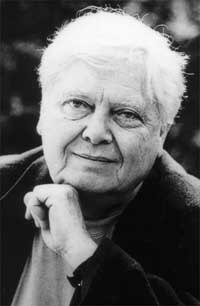
It reads like self-analysis. Gass writes (to himself?): Is writing to yourself a healthier insanity than talking to yourself? Characters talk to William or some derivation thereof throughout. I kept stumbling over whether they meant Kohler....or this guy:
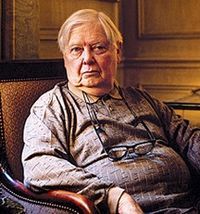
But, oh, I didn't like Kohler. It isn't that he was an admirer of Hitler. He denied that accusation. Yet he smiled thinking Goering denied them their hanging at Nuremburg. At 15, he institutionalized his mother (a drunk) and his father (a bigot, not a racist). He signed the papers so they could die. He was, see, precocious in some things, though not others. As a student in Germany on a November night in 1938, he stood with others, a rock in hand, and as the glass broke all around him, he threw his too, not out of hate or following, but just because he was a kid with a rock in his hand on a November night. Like streaking. Or so he says. He talks about female genitalia a lot, hundreds of times, and manages never to say vagina. He talks about African-Americans a lot, hundreds of times, and even though a college professor in the 70s, he prefers the most vile term. You know the one. He is called before a university committee twice because of allegations of inappropriate behavior with female students. They have axes to grind, he sniffs; bad grades and that. The student he has inappropriate relations with does not complain. Reading about it though, I wondered why not. He has one real affair; is too fat, he feels, to pull it off again. He and his wife do a shadow dance around their house. He talks more about his penis and his ablutions than he does about his two sons. I'm not even sure how old they are, or how he managed to dig a tunnel under his house without their notice. He killed a cat.
He is no hero. He's not even Brackett Omensetter.
But I don't read Gass to fall in love with a character. Or even to fall in love with a horrible character. It's the writing. The writing and the ideas. The flow, the torrent of thought. It's the possibility of what a novel can be.
This is how a master does description:
Gray even when he is not dressed in gray, Herschel goes dismayingly gray with this gray day. And: His eyes seemed unnaturally bright, as if there were no other stars.
This is how he makes me laugh:
In any well-run society, alliteration would be a hanging offense.
This is how he makes me think:
Time cannot do to ordinary things what we timelessly do to one another.
It's hard to do Gass justice because he spends twenty pages talking about how Wars are like Quarrels, no more no less. Here's a fragment:
Every war has its distant causes and conditions. ... It is absolutely necessary that these factors remain hidden and continue undisturbed, because, if they are dragged into the light and confronted, their nature realized, all restraints will be snapped, all principles forsworn. Neither unconditional surrender, total war, nor Blitzkreig will do--none of that kindergarten temporizing--only extirpation, only utter cancellation, the Carthaginian solution: the blot that blots out its blotting. ... Never look beneath the surface of life, because beneath the surface of life you will not find neat schools of gently swimming fish, seaweed swaying ... to water music, or even cicadas somewhere in their seven-year sleep, or moles stubbornly contriving their succulent runnels; beneath the surface of life is a pit, the abyss, the awful truth that cannot be lived with, that cannot be abided: human worthlessness, our worthlessness, yours and mine. So what the hell.
So call me a romantic.
Think about this:
Listen. We do things differently ... History must move--it must be moving!
And so he can say:
No, Caesar, you were born with the blades in you.
Think about this, as long as you want:
If people disliked in me what I dislike in them, I wouldn't dislike them. We would have reached an understanding.
And:
in the deceitful pursuit of self-interest nothing is altered but its occasional disguises, its alternative routes.
And:
cursed by God Himself, I'd heard the radio ... say, in another one of God's petulant moments, I supposed, since, for an omnipotent deity, He clearly had trouble getting His way--which was seeing to the transmission of a single sin through generation after generation, and consequently to centuries of retribution. And people complained of the Nazis?
And:
You know, sometimes in a marriage, only one side hears the other cough...
__________________________
I'm glad I read this after I read In the Heart of the Heart of the Country and Omensetter's Luck and pretty much in that order, even though The Tunnel, though considerably longer, was more obviously accessible. I never did not know where I was.
That said, I'm guessing it was no accident that the protagonist is named William Frederick Kohler. Can anyone say Georg Wilhelm Friedrich Hegel? But I'm not going to pretend I know anything about Hegel. I don't have to; you can't make me.
__________________________
Maybe like Gass, I don't know how to end. I have my own tunnel. But I need to say that I don't know anyone who can do with words what Gass does. Words.
Wait for the words, he'd say, and then you'll know what's going on. ... I was a word, therefore I was...
William Frederick Kohler, husband and father of two, unloved and unlovable, starts to build a tunnel in his basement. There are metaphorical reasons aplenty to start digging a hole in your cellar. A practical, real reason is uncertain. Just one of those things a man's got to do, maybe. My point being: a tunnel by its nature is a route somewhere, a destination, an escape. But Kohler is not digging to somewhere. He's just digging down. There is, this is, no way out. It is not so much a tunnel as a tomb. It is a journey to the past, Kohler's past.
This is oddly in the first-person. I say that because Gass describes Kohler as being fat, and white-haired, with sleep-deprived eyes resembling the circular lineage of a sawed tree. I kept looking to the back flap, the author photo: yes, yes, and...yes!
It reads like self-analysis. Gass writes (to himself?): Is writing to yourself a healthier insanity than talking to yourself? Characters talk to William or some derivation thereof throughout. I kept stumbling over whether they meant Kohler....or this guy:
But, oh, I didn't like Kohler. It isn't that he was an admirer of Hitler. He denied that accusation. Yet he smiled thinking Goering denied them their hanging at Nuremburg. At 15, he institutionalized his mother (a drunk) and his father (a bigot, not a racist). He signed the papers so they could die. He was, see, precocious in some things, though not others. As a student in Germany on a November night in 1938, he stood with others, a rock in hand, and as the glass broke all around him, he threw his too, not out of hate or following, but just because he was a kid with a rock in his hand on a November night. Like streaking. Or so he says. He talks about female genitalia a lot, hundreds of times, and manages never to say vagina. He talks about African-Americans a lot, hundreds of times, and even though a college professor in the 70s, he prefers the most vile term. You know the one. He is called before a university committee twice because of allegations of inappropriate behavior with female students. They have axes to grind, he sniffs; bad grades and that. The student he has inappropriate relations with does not complain. Reading about it though, I wondered why not. He has one real affair; is too fat, he feels, to pull it off again. He and his wife do a shadow dance around their house. He talks more about his penis and his ablutions than he does about his two sons. I'm not even sure how old they are, or how he managed to dig a tunnel under his house without their notice. He killed a cat.
He is no hero. He's not even Brackett Omensetter.
But I don't read Gass to fall in love with a character. Or even to fall in love with a horrible character. It's the writing. The writing and the ideas. The flow, the torrent of thought. It's the possibility of what a novel can be.
This is how a master does description:
Gray even when he is not dressed in gray, Herschel goes dismayingly gray with this gray day. And: His eyes seemed unnaturally bright, as if there were no other stars.
This is how he makes me laugh:
In any well-run society, alliteration would be a hanging offense.
This is how he makes me think:
Time cannot do to ordinary things what we timelessly do to one another.
It's hard to do Gass justice because he spends twenty pages talking about how Wars are like Quarrels, no more no less. Here's a fragment:
Every war has its distant causes and conditions. ... It is absolutely necessary that these factors remain hidden and continue undisturbed, because, if they are dragged into the light and confronted, their nature realized, all restraints will be snapped, all principles forsworn. Neither unconditional surrender, total war, nor Blitzkreig will do--none of that kindergarten temporizing--only extirpation, only utter cancellation, the Carthaginian solution: the blot that blots out its blotting. ... Never look beneath the surface of life, because beneath the surface of life you will not find neat schools of gently swimming fish, seaweed swaying ... to water music, or even cicadas somewhere in their seven-year sleep, or moles stubbornly contriving their succulent runnels; beneath the surface of life is a pit, the abyss, the awful truth that cannot be lived with, that cannot be abided: human worthlessness, our worthlessness, yours and mine. So what the hell.
So call me a romantic.
Think about this:
Listen. We do things differently ... History must move--it must be moving!
And so he can say:
No, Caesar, you were born with the blades in you.
Think about this, as long as you want:
If people disliked in me what I dislike in them, I wouldn't dislike them. We would have reached an understanding.
And:
in the deceitful pursuit of self-interest nothing is altered but its occasional disguises, its alternative routes.
And:
cursed by God Himself, I'd heard the radio ... say, in another one of God's petulant moments, I supposed, since, for an omnipotent deity, He clearly had trouble getting His way--which was seeing to the transmission of a single sin through generation after generation, and consequently to centuries of retribution. And people complained of the Nazis?
And:
You know, sometimes in a marriage, only one side hears the other cough...
__________________________
I'm glad I read this after I read In the Heart of the Heart of the Country and Omensetter's Luck and pretty much in that order, even though The Tunnel, though considerably longer, was more obviously accessible. I never did not know where I was.
That said, I'm guessing it was no accident that the protagonist is named William Frederick Kohler. Can anyone say Georg Wilhelm Friedrich Hegel? But I'm not going to pretend I know anything about Hegel. I don't have to; you can't make me.
__________________________
Maybe like Gass, I don't know how to end. I have my own tunnel. But I need to say that I don't know anyone who can do with words what Gass does. Words.
Wait for the words, he'd say, and then you'll know what's going on. ... I was a word, therefore I was...

November 17, 2014
Ten stars.
“And what is the ultimate element in history but human life—human coupling, human pain?” (P.130)
Rage, or rather, impotent rage, is the dominant emotion of this book, sustained by the side notes of contempt, bitterness, and an all pervasive melancholy. At its barest bones, The Tunnel is an attempt at understanding one of the darkest chapters in History— the Holocaust. That it becomes a subterranean exploration into a person's history and time & by extrapolation an exposition on the nature of History and Time itself; is no surprise: "the sum total of one man’s loquacious consciousness expands like the cosmos (and sums up the century)."
So I finished reading The Tunnel- I survived it! And if that sounds like a hyperbolic statement, know that hyperbole is not my favourite figure of speech; irony is.
Yet I'm not at all being ironic when I say, if you only get to read hundred books in your entire lousy life; make sure The Tunnel is one of them, get it?
But here's the catch—
Gass spent thirty years writing this book, yet look at the consistency of its tone! – it's not a joke– imagine a method actor being in character for a part for thirty long years! Enough to drive an actor insane, yet Gass channelled this insanity into this miasmic world that is Kohler's waking nightmare.
This long gestation period was needed because if one needed a life time of reading to understand it; one also needed a life time of experiences to write it. Gass was already seventy when this book was first published. ( Begun in 1965, published in 1995.) Or maybe I'm taking a romantic view of it. Perhaps the harsh truth behind those thirty long years is contained somewhere in his long teaching hours, setting & grading papers, guiding Ph.D. candidates, reading, reviewing books, making a living, making a life, and yes, writing, writing through it all.
And it all comes unexpurgated, uncensored, no-holds-barred – we have descended into the deepest level of consciousness here– the deep dark world of the id let loose.
Gass is a confirmed Freudian & though it's the trend now to laugh at the latter's theories; it's the place Tunnel is coming from so that's where I'm going.
Kohler's most painful memories are the most repressed ones & they come towards the extreme end of the tunnel, only after he has peeled away layers after layers off his complicated self.
The tunnel in the title could be a return to the womb—where one could curl up fetus-like, the desire for oblivion, the desire for escape, the desire for rebirth. In the chapter, Today I Began to Dig, Kohler lists his reasons for digging the tunnel, & they range from the sublime to the ridiculous, yet strangely enough, they all make sense! And there are more reasons scattered throughout the book.
I did some preparatory reading for this– I read fiction featuring damaged men– Rev. Jethro Furber, Dr. Crucifer, Dr. Aue, The Collected Stories of Kafka, yet Kohler's fulminations still took me by surprise!
The first 85 pages or so are daunting—Gass very famously instructed his publisher: "I would love it if every line looked like a length of barbed wire," & so they do over which the reader trips & bloodies himself! Full of typographical oddities: varying typefaces, images, doodles, cartoons, limericks, blackened surface, etc, the "manuscript" resembles a diary. My bestie very picturesquely described this beginning, "Perhaps those first 200 pages are like a burly bouncer checking the riffraff at the door."*
On a very close reading, it reveals some of its secrets: those textual stylizations serve a purpose, e.g., there are words interspersed with text/buried under it that seem to be crying out/telling a different story such as the darkened note note note on page 45, or the pages 48-49 that seem riddled with bullets with the ringing repetition of shot shot shot and the hangman's noose. Is Kohler's narration illuminating or obfuscating the truth? Of the novel, Gass stated, “It is the opposite of history,” in that it “denies and defies all the ordinary methods of narration, plot, character, and so on.” The Tunnel’s subject: “Many elements go into this novel, but its fundamental subject is the fascism of the heart, the character of the household tyrant and imaginary genocide.” The book’s action: “There is scarcely any at all.” The narrator: “wholly unreliable.”
Fiction as history & history as fiction? Are we to take Kohler's book Guilt and Innocence...as the truth or his own history as such? It becomes tricky because
Gass returns to this theme of fictionally constructed self again in the Middle C.
Here is how Gass explains it:
The book begins with an attempt more at concealing than revealing & you wail : "For God's sake, stop prevaricating & get on with the story," but Kohler couldn't tell it anymore easily than you could read it any easier: this is a mind trapped by certain obsessive thoughts/experiences & it keeps circling them like a tiger in a confined space,** remembering & reliving them over & over again with slight variations— his small-town childhood, his life as an academic, his years in Germany, Lou, his lover, his fat wife, Rilke, his "cocktail sausage"... Pages & pages of dross, darkened & putrid places, suddenly dappled by brilliant passages of writing— you can't give up reading, the reader is trapped in the tunnel as well.
Once Kohler's reminiscences of his Midwestern childhood start, the plane that earlier seemed to be taxiing the runway forever takes off into the literary stratosphere with a supersonic roar!
This is Sublime writing, The Tunnel is. And since Prof Kohler loves lists so much:
A List of my fav sections!
—Invocation to the Muses: one of the best instances of mock epic invocations—try topping that. Here Herr Gass gives you the abject subject matter: "Sing of disappointments more repeated than the batter of the sea, of lives embittered by resentments so ubiquitous the ocean's salt seems thinly shaken, of let downs local as the sofa where I copped my freshman's feel, of failures as frequent as first love, first nights, last stands; do not warble of arms or adventurous deeds or shepherds playing on their private fifes, or of civil war or monarchies at swords; consider rather the slightly squinkered clerk, the soul which has become as shabby and soiled in its seat as worn- out underwear, a life lit like a lonely room and run like a laddered stocking." (P. 54)
—We Have Not Lived the Right Life: the book proper begins! This chapter is loaded with goodies- from a plague of relatives to a plague of grasshoppers!
—Uncle Balt and the Nature of Being: readers, appreciative of philosophy, would get more out of this book.
—Break-up with Lou at the cafe: Kohler at his most vulnerable
—THE QUARREL: Kohler's brilliant exposition on the nature & types of quarrel & its conflation with the larger study of war
—Mad Meg: the last speech—GERMAN GERMAN GERMAN GERMAN
—The First Winter of My Married Life
—Family Album
—Child Abuse: still gives me goosebumps...
—Life Around the House: life in slow motion
—Being a Bigot: forever relevant
—Sweets: a sweet & sometimes sour recapitulation of childhood obsession with sweets of all sorts, made me hungry!
—Outcasts on the Mountains of the Heart: Aunts—just read it!
—Mother Makes a Cake: I cried reading this.
****************
The thorny issue of moral culpability—How far does guilt go? Do we forever carry the burden of our race & nationality ?— is every German guilty by association? Kohler writes to indict mankind but ends up indicting himself. Gass has asked provocative moral questions & even after so many years; they still have the power to shock and hurt. After the humiliating Treaty of Versailles, Germany was ready for a Hitler— and when the malcontents of society get their paws on unlimited power; it's Revenge time, big time .
The thesis of Kohler's historical study, Guilt and Innocence in Hitler's Germany prepares us for what follows: "Thus, neither guilt nor innocence are ontological elements in history; they are merely ideological factors to which a skillful propaganda can seem to lend a causal force, and in that fashion furnish others. … and if there is a truly diabolical ingredient to events, in the victims and vicissitudes of Time, as has been lately alleged, it lies in the nature of History itself, for it is the chronicle of the cause which causes, not the cause…” (p.13)
So If we erase the past & start with a clean slate, is a new beginning possible?! But are there any clean slates ever!? If "half of history is revenge; the other half is its provocation."(P.332)
Kohler is quick to reiterate that he is not a "genuine German" i.e., not the Aryan image of perfection, in fact, his physical inadequacies have a lot to do with his overall bitterness in life (Freud everywhere! ). A Neo-Nazi (?) with a small dick, what an astute image! Didn't Amos Vogel in his critique of Nazi cinema, esp. Triumph of the Will ( which Gass has also referenced in the book), state: "...if a monomaniac cannot 'make' it with a woman, he attempts to make it with an entire nation."
In a 652 page book, there were 44 specific references by Kohler to his "middle leg"— that's some penile obsession! It's also a very sad commentary on a culture that judges men by the size of their dicks: "My weenie was, a little wormlike model of my soul, and whether I had grown like it over time, or it had proved to mimic me, I will never know; but my self-image, if that was what it was, would shrivel so it seemed to be nothing more, sometimes, than a circle of foreskin like a puddle of clothes which have fallen about absent feet; and I often rather ruefully wondered what would have become of me, if my father had had my foreskin snipped. I might have sat to tinkle afterward because I could manage no manlier way. I'd be a she. And if I were a she, I'd let gin go guggle into me till I was gone the way my mother did, and otherwise remain wet as a cave, dark as this thought, out of my own sight, where no knowledge might reach me, anyone's pity or anyone's mourning." (PP. 383-4)
Most readers call Kohler a monster but I found in him a heartbreaking sadness. I found him only too human. He tells it like it is, his "fascism of the heart" because "honesty is a sign of disdain," in his abandonment of his parents, he also gets to identify with the victims of the nazis: "...hence I had to be the goat—Benedict Iscariot, the duplicitous double agent. The feeling became useful later when I tried to understand the ambivalent emotions of those who fingered friends to punitive authorities and gave up loved ones to their fate." (P. 619) Kohler is capable of sublime thoughts:
"The greatest gift you can give another human being is to let them warm you till, in passing beyond pleasure, your defenses fall, your ego surrenders, its structure melts, its towers topple, lies, fancies, vanities, blow away in no wind, and you return, not to the clay you came from—the unfired vessel—but to the original moment of inspiration, when you were the unabbreviated breath of God." (P. 560)
But he immediately negates that with his despondency.
Don't know about you but I wished Kohler all the peace in the world—he had become that real to me. Kohler captured the "prison of (his) life in language" and the book became a monument to Gass' phenomenal prose.
"For here you will see the seasons change, and when winter thaws, you will see and hear prose melt. You will sit in weeds by the banks of the Wabash and you will draw rivers in loving strokes down the body of a lost love and witness a prose that can caress as it touches the page. You will be abraded by the harshness of the narrator's rejection of humanity and you will be drawn, miserably, into the contemplation of a consciousness that has seen the nightmares and aberrations of history not as exceptions to the human but as the ultimate expression of the human."***
*************
Trivia: Lucky Pierre gets a shout out on page 454: "Sexing these sheets is not easy. Besides, there are two of Guilt ( Kohler's book) for every one of this sort (i.e., his life story) here, on top and bottom like Lucky Pierre."
**************
(*) And Samsa was right! In his March 1995 KCRW interview with Michael Silverblatt, Gass mentions making the early sections of The Tunnel intentionally difficult:
Silverblatt: "...you’ve begun the book with ninety pages which will frustrate and baffle even your most persistent reader. When I came on the opening of this book, it stuck me three, four, five times."
Gass: " I think this is a standard modernist thing. What it is is to make sure that the person who gets into the book is ready and deserves to be there. It’s a kind of test of competency. To discover that the book is not only the narrator’s problem, or the writer’s problem—as I’m trying to find out what the heck is going on, too—but also the reader’s problem. It’s also I think essential to establish very early the kind of range of reference, of demand, that the book is going to make of the reader. That’s just fair. You could of course just start out with, ‘We’re all going to see grandmother in the woods with our basket…’ and suddenly alter the game down the road. I think this would be more unfair then saying, right from the start, ‘If you want to go one with this….’"
https://medium.com/the-william-h-gass...
(***) A must-read: the Silverblatt review in LA Times:
"The problem with the character is not that he is a monster; the problem is that the monster has taken recognizable human form. Ordinary people feel their disappointments with burning resentment everyday. Ordinary people think of hitting their children; some ordinary people do. The monstrous is all around us. We feel comfortable blaming a Hitler, but in this book Hitler is just a spark that sets resentment ablaze."
http://articles.latimes.com/1995-03-1...
Designing The Tunnel
From the Dalkey Archive Press, Context No 18
http://www.dalkeyarchive.com/designin...
In this podcast, Gass talks about the musical structure of The Tunnel based on Schoenberg's 12-tone system, but really that system is worked out far more deeply & effectively in The Cartesian Sonata, & Middle C. Watch this for Gass' take down of those readers who confuse the writers with their protagonists:
http://podcast.lannan.org/2010/07/03/...
Basking in Hell: Stephen Schenkenberg:
"It is through this storyboard-like document that we first understand that the plotless stream in fact has segmented plots. Further, we get a better sense of Gass’s intent to have the book take the form of a tunnel itself, with the reader, as he says he wants in one section, “crawling through an unpleasant and narrow darkness.” Reading a document like “Designing The Tunnel” retrospectively, of course, it’s difficult to determine how much intent equals success. Had I found the book unsettling? Check. Unpleasant? Check. Did I wonder, at least once, ‘What the fuck?’ Mission, in this case, accomplished."
http://quarterlyconversation.com/will...
Ps. This is the first time I've run out of review space! I still have two more items to share– examples of Similes, & a few choice quotes. I'll share them in the comments section.
Edit: 8/12/14
More links for in depth reading:
Confronting The Tunnel: History, Authority, Reference
http://www.dalkeyarchive.com/wp-conte...
The Tunnel: A Topical Overview
By H. L. Lix
http://www.dalkeyarchive.com/wp-conte...
“And what is the ultimate element in history but human life—human coupling, human pain?” (P.130)
Rage, or rather, impotent rage, is the dominant emotion of this book, sustained by the side notes of contempt, bitterness, and an all pervasive melancholy. At its barest bones, The Tunnel is an attempt at understanding one of the darkest chapters in History— the Holocaust. That it becomes a subterranean exploration into a person's history and time & by extrapolation an exposition on the nature of History and Time itself; is no surprise: "the sum total of one man’s loquacious consciousness expands like the cosmos (and sums up the century)."
So I finished reading The Tunnel- I survived it! And if that sounds like a hyperbolic statement, know that hyperbole is not my favourite figure of speech; irony is.
Yet I'm not at all being ironic when I say, if you only get to read hundred books in your entire lousy life; make sure The Tunnel is one of them, get it?
But here's the catch—
Gass spent thirty years writing this book, yet look at the consistency of its tone! – it's not a joke– imagine a method actor being in character for a part for thirty long years! Enough to drive an actor insane, yet Gass channelled this insanity into this miasmic world that is Kohler's waking nightmare.
This long gestation period was needed because if one needed a life time of reading to understand it; one also needed a life time of experiences to write it. Gass was already seventy when this book was first published. ( Begun in 1965, published in 1995.) Or maybe I'm taking a romantic view of it. Perhaps the harsh truth behind those thirty long years is contained somewhere in his long teaching hours, setting & grading papers, guiding Ph.D. candidates, reading, reviewing books, making a living, making a life, and yes, writing, writing through it all.
And it all comes unexpurgated, uncensored, no-holds-barred – we have descended into the deepest level of consciousness here– the deep dark world of the id let loose.
Gass is a confirmed Freudian & though it's the trend now to laugh at the latter's theories; it's the place Tunnel is coming from so that's where I'm going.
Kohler's most painful memories are the most repressed ones & they come towards the extreme end of the tunnel, only after he has peeled away layers after layers off his complicated self.
The tunnel in the title could be a return to the womb—where one could curl up fetus-like, the desire for oblivion, the desire for escape, the desire for rebirth. In the chapter, Today I Began to Dig, Kohler lists his reasons for digging the tunnel, & they range from the sublime to the ridiculous, yet strangely enough, they all make sense! And there are more reasons scattered throughout the book.
I did some preparatory reading for this– I read fiction featuring damaged men– Rev. Jethro Furber, Dr. Crucifer, Dr. Aue, The Collected Stories of Kafka, yet Kohler's fulminations still took me by surprise!
The first 85 pages or so are daunting—Gass very famously instructed his publisher: "I would love it if every line looked like a length of barbed wire," & so they do over which the reader trips & bloodies himself! Full of typographical oddities: varying typefaces, images, doodles, cartoons, limericks, blackened surface, etc, the "manuscript" resembles a diary. My bestie very picturesquely described this beginning, "Perhaps those first 200 pages are like a burly bouncer checking the riffraff at the door."*
On a very close reading, it reveals some of its secrets: those textual stylizations serve a purpose, e.g., there are words interspersed with text/buried under it that seem to be crying out/telling a different story such as the darkened note note note on page 45, or the pages 48-49 that seem riddled with bullets with the ringing repetition of shot shot shot and the hangman's noose. Is Kohler's narration illuminating or obfuscating the truth? Of the novel, Gass stated, “It is the opposite of history,” in that it “denies and defies all the ordinary methods of narration, plot, character, and so on.” The Tunnel’s subject: “Many elements go into this novel, but its fundamental subject is the fascism of the heart, the character of the household tyrant and imaginary genocide.” The book’s action: “There is scarcely any at all.” The narrator: “wholly unreliable.”
Fiction as history & history as fiction? Are we to take Kohler's book Guilt and Innocence...as the truth or his own history as such? It becomes tricky because
Gass returns to this theme of fictionally constructed self again in the Middle C.
Here is how Gass explains it:
The book begins with an attempt more at concealing than revealing & you wail : "For God's sake, stop prevaricating & get on with the story," but Kohler couldn't tell it anymore easily than you could read it any easier: this is a mind trapped by certain obsessive thoughts/experiences & it keeps circling them like a tiger in a confined space,** remembering & reliving them over & over again with slight variations— his small-town childhood, his life as an academic, his years in Germany, Lou, his lover, his fat wife, Rilke, his "cocktail sausage"... Pages & pages of dross, darkened & putrid places, suddenly dappled by brilliant passages of writing— you can't give up reading, the reader is trapped in the tunnel as well.
Once Kohler's reminiscences of his Midwestern childhood start, the plane that earlier seemed to be taxiing the runway forever takes off into the literary stratosphere with a supersonic roar!
This is Sublime writing, The Tunnel is. And since Prof Kohler loves lists so much:
A List of my fav sections!
—Invocation to the Muses: one of the best instances of mock epic invocations—try topping that. Here Herr Gass gives you the abject subject matter: "Sing of disappointments more repeated than the batter of the sea, of lives embittered by resentments so ubiquitous the ocean's salt seems thinly shaken, of let downs local as the sofa where I copped my freshman's feel, of failures as frequent as first love, first nights, last stands; do not warble of arms or adventurous deeds or shepherds playing on their private fifes, or of civil war or monarchies at swords; consider rather the slightly squinkered clerk, the soul which has become as shabby and soiled in its seat as worn- out underwear, a life lit like a lonely room and run like a laddered stocking." (P. 54)
—We Have Not Lived the Right Life: the book proper begins! This chapter is loaded with goodies- from a plague of relatives to a plague of grasshoppers!
—Uncle Balt and the Nature of Being: readers, appreciative of philosophy, would get more out of this book.
—Break-up with Lou at the cafe: Kohler at his most vulnerable
—THE QUARREL: Kohler's brilliant exposition on the nature & types of quarrel & its conflation with the larger study of war
—Mad Meg: the last speech—GERMAN GERMAN GERMAN GERMAN
—The First Winter of My Married Life
—Family Album
—Child Abuse: still gives me goosebumps...
—Life Around the House: life in slow motion
—Being a Bigot: forever relevant
—Sweets: a sweet & sometimes sour recapitulation of childhood obsession with sweets of all sorts, made me hungry!
—Outcasts on the Mountains of the Heart: Aunts—just read it!
—Mother Makes a Cake: I cried reading this.
****************
The thorny issue of moral culpability—How far does guilt go? Do we forever carry the burden of our race & nationality ?— is every German guilty by association? Kohler writes to indict mankind but ends up indicting himself. Gass has asked provocative moral questions & even after so many years; they still have the power to shock and hurt. After the humiliating Treaty of Versailles, Germany was ready for a Hitler— and when the malcontents of society get their paws on unlimited power; it's Revenge time, big time .
The thesis of Kohler's historical study, Guilt and Innocence in Hitler's Germany prepares us for what follows: "Thus, neither guilt nor innocence are ontological elements in history; they are merely ideological factors to which a skillful propaganda can seem to lend a causal force, and in that fashion furnish others. … and if there is a truly diabolical ingredient to events, in the victims and vicissitudes of Time, as has been lately alleged, it lies in the nature of History itself, for it is the chronicle of the cause which causes, not the cause…” (p.13)
So If we erase the past & start with a clean slate, is a new beginning possible?! But are there any clean slates ever!? If "half of history is revenge; the other half is its provocation."(P.332)
Kohler is quick to reiterate that he is not a "genuine German" i.e., not the Aryan image of perfection, in fact, his physical inadequacies have a lot to do with his overall bitterness in life (Freud everywhere! ). A Neo-Nazi (?) with a small dick, what an astute image! Didn't Amos Vogel in his critique of Nazi cinema, esp. Triumph of the Will ( which Gass has also referenced in the book), state: "...if a monomaniac cannot 'make' it with a woman, he attempts to make it with an entire nation."
In a 652 page book, there were 44 specific references by Kohler to his "middle leg"— that's some penile obsession! It's also a very sad commentary on a culture that judges men by the size of their dicks: "My weenie was, a little wormlike model of my soul, and whether I had grown like it over time, or it had proved to mimic me, I will never know; but my self-image, if that was what it was, would shrivel so it seemed to be nothing more, sometimes, than a circle of foreskin like a puddle of clothes which have fallen about absent feet; and I often rather ruefully wondered what would have become of me, if my father had had my foreskin snipped. I might have sat to tinkle afterward because I could manage no manlier way. I'd be a she. And if I were a she, I'd let gin go guggle into me till I was gone the way my mother did, and otherwise remain wet as a cave, dark as this thought, out of my own sight, where no knowledge might reach me, anyone's pity or anyone's mourning." (PP. 383-4)
Most readers call Kohler a monster but I found in him a heartbreaking sadness. I found him only too human. He tells it like it is, his "fascism of the heart" because "honesty is a sign of disdain," in his abandonment of his parents, he also gets to identify with the victims of the nazis: "...hence I had to be the goat—Benedict Iscariot, the duplicitous double agent. The feeling became useful later when I tried to understand the ambivalent emotions of those who fingered friends to punitive authorities and gave up loved ones to their fate." (P. 619) Kohler is capable of sublime thoughts:
"The greatest gift you can give another human being is to let them warm you till, in passing beyond pleasure, your defenses fall, your ego surrenders, its structure melts, its towers topple, lies, fancies, vanities, blow away in no wind, and you return, not to the clay you came from—the unfired vessel—but to the original moment of inspiration, when you were the unabbreviated breath of God." (P. 560)
But he immediately negates that with his despondency.
Don't know about you but I wished Kohler all the peace in the world—he had become that real to me. Kohler captured the "prison of (his) life in language" and the book became a monument to Gass' phenomenal prose.
"For here you will see the seasons change, and when winter thaws, you will see and hear prose melt. You will sit in weeds by the banks of the Wabash and you will draw rivers in loving strokes down the body of a lost love and witness a prose that can caress as it touches the page. You will be abraded by the harshness of the narrator's rejection of humanity and you will be drawn, miserably, into the contemplation of a consciousness that has seen the nightmares and aberrations of history not as exceptions to the human but as the ultimate expression of the human."***
*************
Trivia: Lucky Pierre gets a shout out on page 454: "Sexing these sheets is not easy. Besides, there are two of Guilt ( Kohler's book) for every one of this sort (i.e., his life story) here, on top and bottom like Lucky Pierre."
**************
(*) And Samsa was right! In his March 1995 KCRW interview with Michael Silverblatt, Gass mentions making the early sections of The Tunnel intentionally difficult:
Silverblatt: "...you’ve begun the book with ninety pages which will frustrate and baffle even your most persistent reader. When I came on the opening of this book, it stuck me three, four, five times."
Gass: " I think this is a standard modernist thing. What it is is to make sure that the person who gets into the book is ready and deserves to be there. It’s a kind of test of competency. To discover that the book is not only the narrator’s problem, or the writer’s problem—as I’m trying to find out what the heck is going on, too—but also the reader’s problem. It’s also I think essential to establish very early the kind of range of reference, of demand, that the book is going to make of the reader. That’s just fair. You could of course just start out with, ‘We’re all going to see grandmother in the woods with our basket…’ and suddenly alter the game down the road. I think this would be more unfair then saying, right from the start, ‘If you want to go one with this….’"
https://medium.com/the-william-h-gass...
(***) A must-read: the Silverblatt review in LA Times:
"The problem with the character is not that he is a monster; the problem is that the monster has taken recognizable human form. Ordinary people feel their disappointments with burning resentment everyday. Ordinary people think of hitting their children; some ordinary people do. The monstrous is all around us. We feel comfortable blaming a Hitler, but in this book Hitler is just a spark that sets resentment ablaze."
http://articles.latimes.com/1995-03-1...
Designing The Tunnel
From the Dalkey Archive Press, Context No 18
http://www.dalkeyarchive.com/designin...
In this podcast, Gass talks about the musical structure of The Tunnel based on Schoenberg's 12-tone system, but really that system is worked out far more deeply & effectively in The Cartesian Sonata, & Middle C. Watch this for Gass' take down of those readers who confuse the writers with their protagonists:
http://podcast.lannan.org/2010/07/03/...
Basking in Hell: Stephen Schenkenberg:
"It is through this storyboard-like document that we first understand that the plotless stream in fact has segmented plots. Further, we get a better sense of Gass’s intent to have the book take the form of a tunnel itself, with the reader, as he says he wants in one section, “crawling through an unpleasant and narrow darkness.” Reading a document like “Designing The Tunnel” retrospectively, of course, it’s difficult to determine how much intent equals success. Had I found the book unsettling? Check. Unpleasant? Check. Did I wonder, at least once, ‘What the fuck?’ Mission, in this case, accomplished."
http://quarterlyconversation.com/will...
Ps. This is the first time I've run out of review space! I still have two more items to share– examples of Similes, & a few choice quotes. I'll share them in the comments section.
Edit: 8/12/14
More links for in depth reading:
Confronting The Tunnel: History, Authority, Reference
http://www.dalkeyarchive.com/wp-conte...
The Tunnel: A Topical Overview
By H. L. Lix
http://www.dalkeyarchive.com/wp-conte...

July 6, 2026
Beginning The Tunnel:
Wow, only to page 25 and cannot believe how great this is. Evidently it's about an historian who's written a questionable book about Hitler's Germany-- but it's all the character's internals, as rich as anything by Nabokov, Pynchon or Joyce. Clues as to 'plot' start to emerge, winking at me, a student, a dime-store beauty, he had an affair with, his wife, a circle of friends, maybe fellow historians, his mentor "Mad Meg". It's fascinating on the page, too, lots of visual inserts, but I can see it's no more about its plot than Ulysses or Fernando del Paso's Palinuro of Mexico. Many literary references. I'm absolutely enraptured. Can't mark up the pages, it's a shared copy, but it's thick with great metaphors:
"...while above me the house twists like a hankie in nervous hands."
"I have ransacked Rilke...plundered him as if he was a town..."
"as infested with fakirs as a fair..."
"Another Day. Another dolor."
So much Nabokovian wordplay, and then a sudden incursion of the most grim subject matter. This is. going to be quite a ride, can't imagine getting any other reading done this month.
____________
On page 270:
This is alternately fascinating and excruciating. The experience reminds me much of reading the Magic Mountain, quite the climb. The petty awfulness of the middle-aged protagonist, historian William Kohler, is absolute water torture--his misogyny, his self-loathing and his loathing of everyone else--wife, his children, History, colleagues, everyone except his mentor Magus Tabor, the reputedly brilliant historian "Mad Meg," who I find as loathsome as Kohler, but is one of the three people Kohler doesn't despise--maybe four, the others being his girlfriend of a season, Lou--whom he found at a 5 and Dime, eventually becoming his student, eventually finding him loathsome and dumping him; Susu--a Hitlerian songstress he met in the 1930's in Germany (Kohler is a scholar of German history, visited (or did he) in the 1930s and probably/possibly took part in Nazi activities, and possibly/probably still retains some of his Nazi-loving affinities) and who was executed for her crimes; and his mother, a drunk and a dreamer, who is presented in all of her flaws, and yet, there's a huge vein of tenderness and pity there... But everyone else is horrid, especially him.
At page 270, still haven't become clear on his philosophy of history, only what it is not. I'm enjoying many of the literary referents--Rilke is a touchstone, both for Kohler and in life, for Gass. Gide, Proust (most of the book is Proustian reminiscence of Kohler's own past, his family, his domestic life--and yields much of its metaphor on war and history from the personal)... but I cannot imagine a less Rilkean figure than Kohler, who threw over poetry for history as a young man. Let alone Proust--the world Proust wants to reanimate is done so for its intense European fin de siecle beauty, where this is so American--dustbowl and harsh farm grandfathers and bitter fathers and the pettiness of academic life.
What keeps me reading? The insane beauty of the language, the surprise of the metaphors--each sentence frames a choice one--the liveliness of the verbs, the perfect adjectives, the alliterations, the breathtaking choices. I've got two pens in my hand as I read, a black one for clues, for statements, for facts, for moments of decision, and a yellow highlighter for language. I'd never be able to sell this book at a used bookstore, so heavily have I annotated it. It's said that the legendary LA book interviewer Michael Silverblatt read this 4 times. I'm 100% sure I would never read it again, but also 1oo% sure I will pick it up again and again to go right to the yellow marks--five or six to a page.
Gorgeous sections: one about going with his wife and kids for Sunday drives to cut weeds for drying into arrangements (his wife's hobby) melding into memories of the Sunday drives of his childhood with his tough father and his alcoholic mother (a woman right out of Tennessee Williams) and his aunt to glean the countryside for apples and walnuts and berries--free food in the Depression... in a section about Quarrels--and how war is the macrocosm of the domestic version... As was his description of his childhood town, absolutely Proustian. His description of the Dust Bowl and the grasshopper infestation, incredible.
So, onward I go.
___________
On finishing The Tunnel:
Almost a month sunk in hand to hand combat with this book. I don't think I have ever, ever worked so hard to complete a novel. It was evidently part of Gass's project to weed out readers, and I think if I hadn't read this for a book club--knowing I would be part of the best discussion ever--whether I would have persevered. How many easier books could I have completed in the time this took?
First and foremost, this was a piece of unquestionably masterful writing. Glorious description, perfectly crafted sentences, the insanely wonderful verbs, nouns, metaphors. Musical writing, alliteration and assonance, litany, rhyme. 660 pages of it.
So what's it about? Ultimately?
William Kohler is a history professor specializing in Nazi Germany. He's about to send out his magnum opus, Guilt and Innocence in Hitler's Germany, but he dithers. All he needs to do is write the intro, but he imagines that it will be met with professional and general hostility, and end his career.
History is a major theme in the book. History, and the various attitudes that fuel its writing, but also the personalities of the other historians. There's his mentor, Magus "Mad Meg" Tabor, who believes that history is created by the historian, a heroic figure, to establish cultural dominance over other people, a basic belief that there is no such thing as objective Truth in history. Then we have Kohler's four colleagues, like the four humors: Plamantree--his archrival, a positivist (only believing in provable facts, quantifiable realities), Governali--who prefers history as the result of personality, the "operatic" treatment of events; Culp--an ironist, reducing history to limerick and relieving it of its tragic weight; and Herschel, who still believes in Truth and hearing both sides, a humanist and sob sister. And Kohler himself, who basically hates them all, and believes any human being could enact the worst episodes in history, the premise which appears to let the leaders off the hook and has landed him already on the outskirts of his profession.
Then there's the tunnel, which he's digging in his basement. Tunnel to what? some idea of escape, but escape from existential condition.There's the tunneling that is the historian's job. But in the personal, Kohler and his wife live in a stalemated war, don't sleep together any more, they barely speak. So there's that escape-- from the marriage and his children, a source of profound disappointment and resentment.
And there's also--and most importantly--the tunneling into the self and the personal past, the greatest part of the book--his childhood and awful family life, the bitter, rigid father, the watery alcoholic mother. But it also excavates scenes of tremendous beauty and power--a description of his small town in Indiana as a child. The dust bowl and an infestation of grasshoppers. His alcoholic mother's attempt to make a birthday party for him. Sunday drives. The maiden aunt who collects boxes, inside boxes, inside boxes.
And her come the lovers. A horrible Nazi singer, Susu, guilty of heinous crimes and later executed, and Lou (overtones of Lou Salome? I think so) a girl he meets working at a 5 and Dime who becomes a student at his college, develops awareness and dumps him. The man is obsessed with the sex he's not getting, and, it turns out, is in hot water at the university for preying on his female students, about which subject he is problematic to his department but in the end protected by administrative ass-covering.
And finally, there's the Party of Disappointed People Kohler fantasizes about creating--the commonality between Hitler's Germany and Stalin's Russia and his own America--people who expected to get something and then felt denied when it didn't come, and turn on those they feel undeserving and receiving the goods they feel to be theirs. Like those who became Hitler's followers--Kohler feels his project is misunderstood, that by trying to understand the basis of fascism, he appears to be condoning it--and why he's afraid to finish his magnum opus. Is he condoning it? Is he letting the leaders off the hook as merely the occasion of drawing these people out of hiding. There's a New York Times review in 2019 which centers on this theme and its prescience about the current age.
There is much on the Dalkey Archive website about the book--essays and an outline, the visual layout... I'm from the old school, I read a book first, struggle with it on my own, make lists and charts and mark it up, and then go to the secondary sources. Now I'm reading through the Dalkey materials. Having already read the book, it makes many things I already suspected sharper, or missed entirely, like the 12 chapters--as there are all kinds of headings and fonts and illustrations, I missed that the headings on the left are the chapter headings... but it's good to help the book settle into my mind before I completely leave it.
Should you read it? I'm glad I did, but it was quite the investment of time, patience, effort.
As Joy Williams wrote in her essay (in the Dalkey materials):
"I’ve only read The Tunnel once, unlike some of my other monumental favorites—The Magic Mountain, J R, Coetzee’s Jesus Trilogy, Under the Volcano—but I dip back into it often, or graze within it as though it were a pasture, a pasture in a thunderstorm, over which hovers a terrible black sky. I didn’t think this would be the case. I thought that after many weeks of reading when I staggered out of The Tunnel, done, start to finish, that I would [consider] the task heroically accomplished, that there would be no need to go back. I didn’t know how to think about it actually. It ignored my confusions. It didn’t want to be my friend. It had spoken and wanted no half-baked comprehensions on my part. But over the years I did go back, again and again, shuffling through the ochre pages of my old fat sturdy paperback with its underlinings of this and that, here and there, to realize what treasures I was finding amidst the snark and gloom...."
Wow, only to page 25 and cannot believe how great this is. Evidently it's about an historian who's written a questionable book about Hitler's Germany-- but it's all the character's internals, as rich as anything by Nabokov, Pynchon or Joyce. Clues as to 'plot' start to emerge, winking at me, a student, a dime-store beauty, he had an affair with, his wife, a circle of friends, maybe fellow historians, his mentor "Mad Meg". It's fascinating on the page, too, lots of visual inserts, but I can see it's no more about its plot than Ulysses or Fernando del Paso's Palinuro of Mexico. Many literary references. I'm absolutely enraptured. Can't mark up the pages, it's a shared copy, but it's thick with great metaphors:
"...while above me the house twists like a hankie in nervous hands."
"I have ransacked Rilke...plundered him as if he was a town..."
"as infested with fakirs as a fair..."
"Another Day. Another dolor."
So much Nabokovian wordplay, and then a sudden incursion of the most grim subject matter. This is. going to be quite a ride, can't imagine getting any other reading done this month.
____________
On page 270:
This is alternately fascinating and excruciating. The experience reminds me much of reading the Magic Mountain, quite the climb. The petty awfulness of the middle-aged protagonist, historian William Kohler, is absolute water torture--his misogyny, his self-loathing and his loathing of everyone else--wife, his children, History, colleagues, everyone except his mentor Magus Tabor, the reputedly brilliant historian "Mad Meg," who I find as loathsome as Kohler, but is one of the three people Kohler doesn't despise--maybe four, the others being his girlfriend of a season, Lou--whom he found at a 5 and Dime, eventually becoming his student, eventually finding him loathsome and dumping him; Susu--a Hitlerian songstress he met in the 1930's in Germany (Kohler is a scholar of German history, visited (or did he) in the 1930s and probably/possibly took part in Nazi activities, and possibly/probably still retains some of his Nazi-loving affinities) and who was executed for her crimes; and his mother, a drunk and a dreamer, who is presented in all of her flaws, and yet, there's a huge vein of tenderness and pity there... But everyone else is horrid, especially him.
At page 270, still haven't become clear on his philosophy of history, only what it is not. I'm enjoying many of the literary referents--Rilke is a touchstone, both for Kohler and in life, for Gass. Gide, Proust (most of the book is Proustian reminiscence of Kohler's own past, his family, his domestic life--and yields much of its metaphor on war and history from the personal)... but I cannot imagine a less Rilkean figure than Kohler, who threw over poetry for history as a young man. Let alone Proust--the world Proust wants to reanimate is done so for its intense European fin de siecle beauty, where this is so American--dustbowl and harsh farm grandfathers and bitter fathers and the pettiness of academic life.
What keeps me reading? The insane beauty of the language, the surprise of the metaphors--each sentence frames a choice one--the liveliness of the verbs, the perfect adjectives, the alliterations, the breathtaking choices. I've got two pens in my hand as I read, a black one for clues, for statements, for facts, for moments of decision, and a yellow highlighter for language. I'd never be able to sell this book at a used bookstore, so heavily have I annotated it. It's said that the legendary LA book interviewer Michael Silverblatt read this 4 times. I'm 100% sure I would never read it again, but also 1oo% sure I will pick it up again and again to go right to the yellow marks--five or six to a page.
Gorgeous sections: one about going with his wife and kids for Sunday drives to cut weeds for drying into arrangements (his wife's hobby) melding into memories of the Sunday drives of his childhood with his tough father and his alcoholic mother (a woman right out of Tennessee Williams) and his aunt to glean the countryside for apples and walnuts and berries--free food in the Depression... in a section about Quarrels--and how war is the macrocosm of the domestic version... As was his description of his childhood town, absolutely Proustian. His description of the Dust Bowl and the grasshopper infestation, incredible.
So, onward I go.
___________
On finishing The Tunnel:
Almost a month sunk in hand to hand combat with this book. I don't think I have ever, ever worked so hard to complete a novel. It was evidently part of Gass's project to weed out readers, and I think if I hadn't read this for a book club--knowing I would be part of the best discussion ever--whether I would have persevered. How many easier books could I have completed in the time this took?
First and foremost, this was a piece of unquestionably masterful writing. Glorious description, perfectly crafted sentences, the insanely wonderful verbs, nouns, metaphors. Musical writing, alliteration and assonance, litany, rhyme. 660 pages of it.
So what's it about? Ultimately?
William Kohler is a history professor specializing in Nazi Germany. He's about to send out his magnum opus, Guilt and Innocence in Hitler's Germany, but he dithers. All he needs to do is write the intro, but he imagines that it will be met with professional and general hostility, and end his career.
History is a major theme in the book. History, and the various attitudes that fuel its writing, but also the personalities of the other historians. There's his mentor, Magus "Mad Meg" Tabor, who believes that history is created by the historian, a heroic figure, to establish cultural dominance over other people, a basic belief that there is no such thing as objective Truth in history. Then we have Kohler's four colleagues, like the four humors: Plamantree--his archrival, a positivist (only believing in provable facts, quantifiable realities), Governali--who prefers history as the result of personality, the "operatic" treatment of events; Culp--an ironist, reducing history to limerick and relieving it of its tragic weight; and Herschel, who still believes in Truth and hearing both sides, a humanist and sob sister. And Kohler himself, who basically hates them all, and believes any human being could enact the worst episodes in history, the premise which appears to let the leaders off the hook and has landed him already on the outskirts of his profession.
Then there's the tunnel, which he's digging in his basement. Tunnel to what? some idea of escape, but escape from existential condition.There's the tunneling that is the historian's job. But in the personal, Kohler and his wife live in a stalemated war, don't sleep together any more, they barely speak. So there's that escape-- from the marriage and his children, a source of profound disappointment and resentment.
And there's also--and most importantly--the tunneling into the self and the personal past, the greatest part of the book--his childhood and awful family life, the bitter, rigid father, the watery alcoholic mother. But it also excavates scenes of tremendous beauty and power--a description of his small town in Indiana as a child. The dust bowl and an infestation of grasshoppers. His alcoholic mother's attempt to make a birthday party for him. Sunday drives. The maiden aunt who collects boxes, inside boxes, inside boxes.
And her come the lovers. A horrible Nazi singer, Susu, guilty of heinous crimes and later executed, and Lou (overtones of Lou Salome? I think so) a girl he meets working at a 5 and Dime who becomes a student at his college, develops awareness and dumps him. The man is obsessed with the sex he's not getting, and, it turns out, is in hot water at the university for preying on his female students, about which subject he is problematic to his department but in the end protected by administrative ass-covering.
And finally, there's the Party of Disappointed People Kohler fantasizes about creating--the commonality between Hitler's Germany and Stalin's Russia and his own America--people who expected to get something and then felt denied when it didn't come, and turn on those they feel undeserving and receiving the goods they feel to be theirs. Like those who became Hitler's followers--Kohler feels his project is misunderstood, that by trying to understand the basis of fascism, he appears to be condoning it--and why he's afraid to finish his magnum opus. Is he condoning it? Is he letting the leaders off the hook as merely the occasion of drawing these people out of hiding. There's a New York Times review in 2019 which centers on this theme and its prescience about the current age.
There is much on the Dalkey Archive website about the book--essays and an outline, the visual layout... I'm from the old school, I read a book first, struggle with it on my own, make lists and charts and mark it up, and then go to the secondary sources. Now I'm reading through the Dalkey materials. Having already read the book, it makes many things I already suspected sharper, or missed entirely, like the 12 chapters--as there are all kinds of headings and fonts and illustrations, I missed that the headings on the left are the chapter headings... but it's good to help the book settle into my mind before I completely leave it.
Should you read it? I'm glad I did, but it was quite the investment of time, patience, effort.
As Joy Williams wrote in her essay (in the Dalkey materials):
"I’ve only read The Tunnel once, unlike some of my other monumental favorites—The Magic Mountain, J R, Coetzee’s Jesus Trilogy, Under the Volcano—but I dip back into it often, or graze within it as though it were a pasture, a pasture in a thunderstorm, over which hovers a terrible black sky. I didn’t think this would be the case. I thought that after many weeks of reading when I staggered out of The Tunnel, done, start to finish, that I would [consider] the task heroically accomplished, that there would be no need to go back. I didn’t know how to think about it actually. It ignored my confusions. It didn’t want to be my friend. It had spoken and wanted no half-baked comprehensions on my part. But over the years I did go back, again and again, shuffling through the ochre pages of my old fat sturdy paperback with its underlinings of this and that, here and there, to realize what treasures I was finding amidst the snark and gloom...."

October 12, 2012
William H. Gass's The Tunnel is a paradox. A celebration of literature and an anti-novel.
From a simple narrative idea Gass creates a complicated internal odyssey; both life affirming and despair inducing. A classic David Foster Wallace double bind if you will.
To quote Gass's own description:
William Frederick Kohler "teaches history at a major mid-western university. He has studied in Germany during the thirties, returned with the 1st Army during the invasion as a debriefer, then as a consultant during the Nuremberg Trials. Writes a book called Nuremburg Notes. Its softness earns him some suspicion. He has been working for many years on his magnum opus: 'Guilt and Innocence in Hitler's Germany.' As the novel begins, he has just concluded this book and has begun a self-congratulatory preface when he finds himself blocked and unable to continue. He finds himself writing these pages instead. Since they are exceedingly personal, and he doesn't want his wife to see them, he hides them between the pages of 'Guilt and Innocence,' since he knows she will never read them."
Instead of writing the preface to his master work, Kohler digresses into his personal past as memories surge to the surface; as note taking and scribbling manifest as spurious writings and determined digging. An excavation of the soul in shimmering prose. Vile, filthy and rotten and utterly compelling.
Kohler is a pathetic soul. He is powerless and weak and over 650 pages I found myself struggling to maintain a reading. For me this is a flawed book in this sense but so enchanting in it's prose; in it's utter single minded structure.
As a distinctive piece of writing, for me, it feels comparable to the music of Radiohead, shimmering discordant riffs; motifs and harmonies layered upon undulating sonic sound scapes - beautifully melancholic with moments of brutal, almost unlistenable dischord. Measured and intentional.
The novel's formatting is fascinating. Gass attempted to create visual cues to emulate note taking; scrawls, doodles and scribbles - some of the pages are dirtied and over-printed; passages of text are repeated with minimal alterations or amendments. It's a compelling visual treatment and there are moments when, as a reader —trance like— you feel as if you're reading the original artifact. Like I said, it's a peculiar book full of peculiar notions...
Through Kohler's vivid memories characters from his past loom large and life like. We only ever experience them from Kohlers point-of-view and it is with sneer and resentment he evokes them. Gass's use of language and sentence-craft elevate this singular viewpoint to heady, dizzy-making heights.
And in the end it is the writing which supercedes all.
The Tunnel is peculiar beast of a novel, it echoes and reverberates in ones head weeks after reading it. I scrawled and scribbled all over my paperback copy; utterly defaced it. I both loveed and loathed this masterwork in equal measure.
From a simple narrative idea Gass creates a complicated internal odyssey; both life affirming and despair inducing. A classic David Foster Wallace double bind if you will.
To quote Gass's own description:
William Frederick Kohler "teaches history at a major mid-western university. He has studied in Germany during the thirties, returned with the 1st Army during the invasion as a debriefer, then as a consultant during the Nuremberg Trials. Writes a book called Nuremburg Notes. Its softness earns him some suspicion. He has been working for many years on his magnum opus: 'Guilt and Innocence in Hitler's Germany.' As the novel begins, he has just concluded this book and has begun a self-congratulatory preface when he finds himself blocked and unable to continue. He finds himself writing these pages instead. Since they are exceedingly personal, and he doesn't want his wife to see them, he hides them between the pages of 'Guilt and Innocence,' since he knows she will never read them."
Instead of writing the preface to his master work, Kohler digresses into his personal past as memories surge to the surface; as note taking and scribbling manifest as spurious writings and determined digging. An excavation of the soul in shimmering prose. Vile, filthy and rotten and utterly compelling.
Kohler is a pathetic soul. He is powerless and weak and over 650 pages I found myself struggling to maintain a reading. For me this is a flawed book in this sense but so enchanting in it's prose; in it's utter single minded structure.
As a distinctive piece of writing, for me, it feels comparable to the music of Radiohead, shimmering discordant riffs; motifs and harmonies layered upon undulating sonic sound scapes - beautifully melancholic with moments of brutal, almost unlistenable dischord. Measured and intentional.
The novel's formatting is fascinating. Gass attempted to create visual cues to emulate note taking; scrawls, doodles and scribbles - some of the pages are dirtied and over-printed; passages of text are repeated with minimal alterations or amendments. It's a compelling visual treatment and there are moments when, as a reader —trance like— you feel as if you're reading the original artifact. Like I said, it's a peculiar book full of peculiar notions...
Through Kohler's vivid memories characters from his past loom large and life like. We only ever experience them from Kohlers point-of-view and it is with sneer and resentment he evokes them. Gass's use of language and sentence-craft elevate this singular viewpoint to heady, dizzy-making heights.
And in the end it is the writing which supercedes all.
The Tunnel is peculiar beast of a novel, it echoes and reverberates in ones head weeks after reading it. I scrawled and scribbled all over my paperback copy; utterly defaced it. I both loveed and loathed this masterwork in equal measure.

Read
September 1, 2026
The Tunnel by William H Gass, a maximal novel that is ideally to be read and listened to via Gass himself narrating the text now available as an audiobook. Why am I saying this? Gass was a fierce proponent that a work of fiction ideally should be spoken, tasted, and heard rather than simply scanned with the eyes. Listening to Gass's precise, rhythmic Midwestern cadence accentuates the inherent musicality, metric variety, and dark poetry of the novel that can otherwise strike a reader as intimidatingly dense on the printed page.
Yet having the Dalkey edition of The Tunnel is also a necessary and vital part of appreciating the full force of the novel's literary and aesthetic dimensions. The reason is clear: The Tunnel relies deeply on layout, varying fonts, and visual formatting of the text, sharing common ground with concrete poetry. Additionally, there's something about Gass's extraordinary use of language, the magic of a master wordsmith, that is missed if one only listens to the audiobook.
So, why do some readers and critics pass harsh judgement on The Tunnel? It has everything to do with narrator and subject matter. The first-person narrator, William Frederick Kohler, is a fifty-something American historian, a Nazi sympathizer, bigot, black bile stinker, and grousing smellfungus with his mind and fat, misshapen blob of a body rotting in his chair at his writing desk, an odious louse overflowing with hatred and resentment. As for the subject matter, Kohler distills historical, diabolical Nazism and turns it into a deadly poison soaking and drowning his neighbors, his family, and himself in the novel's 652 pages.
I will have much more to write about when I finish reading and listening to the entire work, an undertaking that will require months to accomplish.

November 21, 2021
…where do I even begin? Assurances are few and far between with this novel, as are my varied and conflicting responses to it. So, I’ll pre-emptively ask for both your forgiveness and indulgence as I compose a philippic of my own. But don’t worry, I don’t plan to drag this one out over seven hundred pages.
In writing this, I submit myself to Gass' ambition with the conclusion that my reading - a first reading - of The Tunnel and the author’s work as a whole, was not in and of itself an achievement, but rather "practice" for when I actually get the opportunity to experience it as was intended: on a reread. I say this not only as a commitment to myself to return to the novel in the future but also as a suggestion to anyone who is reading this and considering approaching it themselves. While plenty of enjoyment can be gleaned from a single reading - and hats off to anyone who makes it that far - The Tunnel was purpose-built for those who choose to return for successive examinations. Dwarfing Ulysses by nearly a third of its length, this novel defies close inspection on first pass, and is likely to leave the exhausted reader overwhelmed by its scope; an expected response to most thick-spined, introspective modernist texts. Confident in this opinion, I can offer the small courtesy of unburdening myself from the expectation that I have to “get it” in order to justify my month-long investment in it. To do so would be a masochistic exercise in futility, given the simple fact that I’ve had quite literally one three-hundredth of the time to read it as the author did to write it. So, allow me to wear my dilettantism on my sleeve as I attempt to arrive at something of a point.
A common feature of what many readers would reflexively label as “postmodern” – a term that is at best, weakly applied here – is complexity. One need only read a dozen or so pages of The Tunnel to become intimidatingly aware of its intricacies: structural, referential, and thematic. Gass has gone on record stating the opening pair of philippics were intentionally designed as a sort of 'aptitude test' to dissuade the casual reader from digging any further (cute pun, right?). To that challenge I say, “hold my beer”, but with a notable caveat. While I’m happy to adopt the Chris Via model of 'reading as an extreme sport', I’m only willing to do so if the complexity is constructed in good faith and serves a functional or thematic purpose. There’s nothing emptier to me than a novel in which the complexity exists only to confound and alienate the reader. In the case of The Tunnel, I’m pleased to report that its difficulty is not adversarial but intended to reflect a universality: the illogical conniptions of human consciousness.
It bears repeating, that despite the novel’s heroic effort to evade neat categorisation, it easy to see how The Tunnel would compel readers to deploy the term 'postmodernism' in their description of it. The rubber-stamp label – worn and faded as it may be – has the convenience of an arm's reach and loose applicability. The breadth of the novel's scope, the inclusion of both meta- and self-referentiality, the many playful visual flourishes, and so on. While I appreciate Gass’ deviation from conventional form, I think his own classification – 'decayed modernism' – is a far more appropriate description. The Tunnel, whether through conscious intention or not, takes on an achronological, helical structure, that both dilates in and out of itself at any given moment. It’s stunningly large in chronological and geographical scope, despite its centre of gravity rarely leaving the confines of the chair from which it was written. Regardless of how you feel about him as a person – I suspect I’m not alone in condemning him to be a borderline (though not irredeemable?) fascist – Kohler has a truly brilliant philosophical and introspective mind; a mind constantly in motion, yet perpetually stationary; actively inactive.
This concept – the ultimate inactive act - is raised in stark relief from the rest of his neurotic ruminations through his digging of a possibly-literal but-you-can’t-be-quite-sure tunnel under his home while his wife is out running errands. A tunnel to nowhere, the detritus of which accumulates in the various antiquities of his loveless home. The further he bores pointlessly into the earth upon which his home is built, the deeper we as his readers explore the blood and gin-soaked recesses of his miserable memories. We see into his hideous mind, as he continues to shovel away the layers of loss he’s suffered, showing exactly how a person becomes this broken. It's only in the twelfth philippic that Kohler’s excavation becomes his exorcism, what was unearthed becomes buried again, and he has no choice but to resign himself to sorrow.
Given the innumerable instances of contradiction Gass has been permitted to build into his novel, I think it’s only fitting that provide myself with the latitude to contradict myself. I previously condemned Kohler as a “fascist”, but to pass such a simple judgement on him so expediently flattens the nuance of his character into something far less interesting than he actually is. While certainly integral to his own misery, much of Kohler’s misanthropy is acquired through a lifetime of neglect, abuse, and simple disappointment. This makes him the perfect flag bearer for the Party of Disappointed People, a hypothetical commune for people who have shared similar forms of suffering. Under the right societal conditions, this theoretical collective would draw up the miserable masses from all corners of Kohler’s America, to congregate under its jaundiced banner. His disillusionment with the world is not a unique disease but a viral pathogen; one to which he is just another link in the chain of transmission. Despite what some readers would pass off as simple, run-of-the-mill sociopathy, what Kohler truly suffers from is fascism of the heart. I challenge any reader who sees The Tunnel through to completion to tell me they don't see shades of themselves reflected back at them when reading it. This novel isn't just a portrait, it's a window on a dark night.
The Tunnel is a singular entity – a creature made of pure crawl – the beauty of which is rivalled only by its wretchedness; a baroque monument to the bloated, loathsome, regretful mind. Ultimately, if I had to offer an estimation as to what Gass’ overarching intent was when composing this story, it would be an exploration of loss: the great deluge of life one wastes away when they spend the entirety of their existence... in a chair.
In writing this, I submit myself to Gass' ambition with the conclusion that my reading - a first reading - of The Tunnel and the author’s work as a whole, was not in and of itself an achievement, but rather "practice" for when I actually get the opportunity to experience it as was intended: on a reread. I say this not only as a commitment to myself to return to the novel in the future but also as a suggestion to anyone who is reading this and considering approaching it themselves. While plenty of enjoyment can be gleaned from a single reading - and hats off to anyone who makes it that far - The Tunnel was purpose-built for those who choose to return for successive examinations. Dwarfing Ulysses by nearly a third of its length, this novel defies close inspection on first pass, and is likely to leave the exhausted reader overwhelmed by its scope; an expected response to most thick-spined, introspective modernist texts. Confident in this opinion, I can offer the small courtesy of unburdening myself from the expectation that I have to “get it” in order to justify my month-long investment in it. To do so would be a masochistic exercise in futility, given the simple fact that I’ve had quite literally one three-hundredth of the time to read it as the author did to write it. So, allow me to wear my dilettantism on my sleeve as I attempt to arrive at something of a point.
A common feature of what many readers would reflexively label as “postmodern” – a term that is at best, weakly applied here – is complexity. One need only read a dozen or so pages of The Tunnel to become intimidatingly aware of its intricacies: structural, referential, and thematic. Gass has gone on record stating the opening pair of philippics were intentionally designed as a sort of 'aptitude test' to dissuade the casual reader from digging any further (cute pun, right?). To that challenge I say, “hold my beer”, but with a notable caveat. While I’m happy to adopt the Chris Via model of 'reading as an extreme sport', I’m only willing to do so if the complexity is constructed in good faith and serves a functional or thematic purpose. There’s nothing emptier to me than a novel in which the complexity exists only to confound and alienate the reader. In the case of The Tunnel, I’m pleased to report that its difficulty is not adversarial but intended to reflect a universality: the illogical conniptions of human consciousness.
It bears repeating, that despite the novel’s heroic effort to evade neat categorisation, it easy to see how The Tunnel would compel readers to deploy the term 'postmodernism' in their description of it. The rubber-stamp label – worn and faded as it may be – has the convenience of an arm's reach and loose applicability. The breadth of the novel's scope, the inclusion of both meta- and self-referentiality, the many playful visual flourishes, and so on. While I appreciate Gass’ deviation from conventional form, I think his own classification – 'decayed modernism' – is a far more appropriate description. The Tunnel, whether through conscious intention or not, takes on an achronological, helical structure, that both dilates in and out of itself at any given moment. It’s stunningly large in chronological and geographical scope, despite its centre of gravity rarely leaving the confines of the chair from which it was written. Regardless of how you feel about him as a person – I suspect I’m not alone in condemning him to be a borderline (though not irredeemable?) fascist – Kohler has a truly brilliant philosophical and introspective mind; a mind constantly in motion, yet perpetually stationary; actively inactive.
This concept – the ultimate inactive act - is raised in stark relief from the rest of his neurotic ruminations through his digging of a possibly-literal but-you-can’t-be-quite-sure tunnel under his home while his wife is out running errands. A tunnel to nowhere, the detritus of which accumulates in the various antiquities of his loveless home. The further he bores pointlessly into the earth upon which his home is built, the deeper we as his readers explore the blood and gin-soaked recesses of his miserable memories. We see into his hideous mind, as he continues to shovel away the layers of loss he’s suffered, showing exactly how a person becomes this broken. It's only in the twelfth philippic that Kohler’s excavation becomes his exorcism, what was unearthed becomes buried again, and he has no choice but to resign himself to sorrow.
Given the innumerable instances of contradiction Gass has been permitted to build into his novel, I think it’s only fitting that provide myself with the latitude to contradict myself. I previously condemned Kohler as a “fascist”, but to pass such a simple judgement on him so expediently flattens the nuance of his character into something far less interesting than he actually is. While certainly integral to his own misery, much of Kohler’s misanthropy is acquired through a lifetime of neglect, abuse, and simple disappointment. This makes him the perfect flag bearer for the Party of Disappointed People, a hypothetical commune for people who have shared similar forms of suffering. Under the right societal conditions, this theoretical collective would draw up the miserable masses from all corners of Kohler’s America, to congregate under its jaundiced banner. His disillusionment with the world is not a unique disease but a viral pathogen; one to which he is just another link in the chain of transmission. Despite what some readers would pass off as simple, run-of-the-mill sociopathy, what Kohler truly suffers from is fascism of the heart. I challenge any reader who sees The Tunnel through to completion to tell me they don't see shades of themselves reflected back at them when reading it. This novel isn't just a portrait, it's a window on a dark night.
The Tunnel is a singular entity – a creature made of pure crawl – the beauty of which is rivalled only by its wretchedness; a baroque monument to the bloated, loathsome, regretful mind. Ultimately, if I had to offer an estimation as to what Gass’ overarching intent was when composing this story, it would be an exploration of loss: the great deluge of life one wastes away when they spend the entirety of their existence... in a chair.

February 2, 2014
I have now, over the course of a snail's two months, finished what has got to stand as one of the roughest, toughest, meanest books on my shelf. What took me so long? A 671-page novel is nothing to sneeze at, but I'd read longer over shorter periods. So what the hell took me so long? I'll get to that, but let's get to the good stuff first: the Tunnel is a brilliant novel, deserving of five stars on any sort of reasonably objective scale. The prose is out of this world, full of beautifully realized metaphors and grimly funny turns of phrase. It's also a lacerating study of the Holocaust, full of insight into the mindsets of both Hitler and the German people. Readers tend to cite the Party of Disappointed People as the best part of this novel, and I will do no different.
Why a four instead of a five? What an unpleasant novel. Jesus fucking Christ. Part of me wonders if that's a fair reason to detract a star, since after all it's meant to be unpleasant, so consider this rating in a state of flux until I've given the issue of rating its due consideration, but William F. Kohler is such a repulsive human being that I couldn't bear to read this for more than thirty pages at a time. Granted, the ending implies the possibility of change and even redemption for him, but throughout the near-seven hundred pages of this book, the reader is assaulted with his bigotry, his sexism, his dismissiveness, his pettiness, his spitefulness. This is a man who has seethed for years, a man who has endured kick after kick and will not fucking stand for it anymore. Anyone making a connection between him and the Nazis - and this novel does plenty to implicate the daily walking-around Germans of the Third Reich - is, in my opinion, right on the fucking money.
The combination of subject matter and narrator makes the Tunnel the culmination of decades, perhaps centuries, of effort to write a novel with no filter. Roth tried it, Joyce tried it, Burroughs tried it, Sterne and Fielding probably tried it, Palahniuk has made a career shooting for it, but for my liking, it was Gass who hit the closest to writing without consideration for anyone's sensibilities. Because make no mistake: this will offend you. This will probably even disgust you. It will also enlighten you. While we can consider a lot of potential symbolic meanings for Kohler's tunnel - the excavation of both personal and national pasts, the human vagina, the hidden depths being brought to light - the book itself digs to the very depths of human feeling and human experience. That makes it in many ways brilliant, in many ways repulsive. I guess I loved and hated this book at the same time, then, but I more loved it than hated it. Part of me wants to reread it and relish in every detail, and part of me never wants to touch it again.
Why a four instead of a five? What an unpleasant novel. Jesus fucking Christ. Part of me wonders if that's a fair reason to detract a star, since after all it's meant to be unpleasant, so consider this rating in a state of flux until I've given the issue of rating its due consideration, but William F. Kohler is such a repulsive human being that I couldn't bear to read this for more than thirty pages at a time. Granted, the ending implies the possibility of change and even redemption for him, but throughout the near-seven hundred pages of this book, the reader is assaulted with his bigotry, his sexism, his dismissiveness, his pettiness, his spitefulness. This is a man who has seethed for years, a man who has endured kick after kick and will not fucking stand for it anymore. Anyone making a connection between him and the Nazis - and this novel does plenty to implicate the daily walking-around Germans of the Third Reich - is, in my opinion, right on the fucking money.
The combination of subject matter and narrator makes the Tunnel the culmination of decades, perhaps centuries, of effort to write a novel with no filter. Roth tried it, Joyce tried it, Burroughs tried it, Sterne and Fielding probably tried it, Palahniuk has made a career shooting for it, but for my liking, it was Gass who hit the closest to writing without consideration for anyone's sensibilities. Because make no mistake: this will offend you. This will probably even disgust you. It will also enlighten you. While we can consider a lot of potential symbolic meanings for Kohler's tunnel - the excavation of both personal and national pasts, the human vagina, the hidden depths being brought to light - the book itself digs to the very depths of human feeling and human experience. That makes it in many ways brilliant, in many ways repulsive. I guess I loved and hated this book at the same time, then, but I more loved it than hated it. Part of me wants to reread it and relish in every detail, and part of me never wants to touch it again.

November 19, 2018
Ну что, пришла пора подводить предварительные итоги и как-то осмыслять эти четыре с лишним месяца, потраченные на этот текст.
С одной стороны — это просто очень длинный и рыхлый роман, в котором ничего не происходит. Т.е. буквально ничего, ни рытья тоннеля, ни жизни духа. Есть жизнь как бы рептильного мозга (на самом деле нет). И вообще, конечно, этому роману лучше было бы остаться в 60-х, когда он и начинал писаться, и каковыми годами он весь проникнут, а в 90-х (и тем паче в 10-х) ему делать нечего, настолько он устарел, и место ему на свалке литературной истории, как «Обдолбышу», с которым его иногда безосновательно сравнивают.
С другой стороны — это гениально воссозданное содержимое помойки в уме одного конкретного не нацело придуманного персонажа. Если, читая (и уж тем более реконструируя на другом языке) этот текст, ни на секунду об этом не забывать, все у нас будет в порядке, и роман даже не будет раздражать.
А раздражает он ужасно (больше, гораздо больше «Бесконечной шутки», хотя казалось бы). Метафоры то и дело разваливаются, сравнения нелепы до клинического идиотизма (по ним можно диагноз ставить, и уж слабоумие там точно вылезет), игра слов чудовищна, поэтические приемы нарочиты и неприятны. Обещанный критиками сладостный стиль наступает иногда, но такие проблески закопаны настолько глубоко в наносах вербиажа, что выглядят случайными.
Кстати, о критиках. Уже стало понятно, что никто из заявляющих о том, что его прочел или что-то понял в тексте, на самом деле, ничего не читал - в лучшем случае, проглядел его по косой (ну или вообще наврали — что с романом о человеке, который постоянно врет, даже — и в первую очередь — самому себе, выглядит даже уместно). Весь обещанный ими инструментарий присутствует, конечно, в обозначенном ничтожном виде, но до заявляемых высот, конечно, не поднимается. Скорее, как упражнения из букваря для слабослышащих. А вот с высотами стиля, как я уже сказал, неувязочка, поэтому верить тем, кто рассказывает нам о том, что «эта книга живет в языке» (нелепее фразу придумать можно, например: «книга найдет своего читателя»), не стоит. Любая книга живет в своем языке (и головах тех читателей, которые ее найдут). Так что caveat emptor, когда будете «критику» читать. Да, и ключевые, якобы, сцены, которым критики, начиная с самых первых, придают такое значение, рассказывая о событиях детства, вроде бы сделавших нашего героя таким, на самом деле — не об этом. Если читать текст, а не писать диссертации по нему или выступать по радио, станет понятно даже умственному калеке, что акценты там расставлены совсем не так, как было бы удобно «критику». Заканчивается книга тоже совсем не тем, что принято считать "концом романа". Она не заканчивается. У автора просто заканчивается завод. И тут все, как жизни, вы заметили?
Но вот если списывать все эти баги текста на героя-рассказчика, персонажа неприятного, но не настолько, чтобы мы себя с ним не ассоциировали, то тогда да — тогда все гениально. В том, что персонаж этот придумал якобы от кончиков ушей до кончика хвоста нас, в первую очередь уверяет сам автор в корпусе текстов и интервью, которыми счел нужным неохотно пояснить свой magnum opus. Не стоит-де ассоциировать себя с ним (а не ассоциировать трудно, на таком-то пробеге), он придуман, он не автор, он симулякр и колчеданная обманка. Но тут и возникает вопрос: если с ним все так, то стоит ли верить и самому автору? Может, все ж в Колере много от Гэсса (жену писателя, к примеру, кто-нибудь видел? то-то же)? В общем, как бы там дело не обстояло, мы — и я, конечно, в числе этих нас — «экзамен Гэсса» блистательно проваливаем. Вступаем в личные отношения с текстом, негодуем, возмущаемся, влюбляемся в него, он нас не отпускает от себя. Вот херню всякую в соцсеточках и на блогплатформах пишем…
В общем, я пока заткнусь. Роман и без меня найдут за что ненавидеть.
С одной стороны — это просто очень длинный и рыхлый роман, в котором ничего не происходит. Т.е. буквально ничего, ни рытья тоннеля, ни жизни духа. Есть жизнь как бы рептильного мозга (на самом деле нет). И вообще, конечно, этому роману лучше было бы остаться в 60-х, когда он и начинал писаться, и каковыми годами он весь проникнут, а в 90-х (и тем паче в 10-х) ему делать нечего, настолько он устарел, и место ему на свалке литературной истории, как «Обдолбышу», с которым его иногда безосновательно сравнивают.
С другой стороны — это гениально воссозданное содержимое помойки в уме одного конкретного не нацело придуманного персонажа. Если, читая (и уж тем более реконструируя на другом языке) этот текст, ни на секунду об этом не забывать, все у нас будет в порядке, и роман даже не будет раздражать.
А раздражает он ужасно (больше, гораздо больше «Бесконечной шутки», хотя казалось бы). Метафоры то и дело разваливаются, сравнения нелепы до клинического идиотизма (по ним можно диагноз ставить, и уж слабоумие там точно вылезет), игра слов чудовищна, поэтические приемы нарочиты и неприятны. Обещанный критиками сладостный стиль наступает иногда, но такие проблески закопаны настолько глубоко в наносах вербиажа, что выглядят случайными.
Кстати, о критиках. Уже стало понятно, что никто из заявляющих о том, что его прочел или что-то понял в тексте, на самом деле, ничего не читал - в лучшем случае, проглядел его по косой (ну или вообще наврали — что с романом о человеке, который постоянно врет, даже — и в первую очередь — самому себе, выглядит даже уместно). Весь обещанный ими инструментарий присутствует, конечно, в обозначенном ничтожном виде, но до заявляемых высот, конечно, не поднимается. Скорее, как упражнения из букваря для слабослышащих. А вот с высотами стиля, как я уже сказал, неувязочка, поэтому верить тем, кто рассказывает нам о том, что «эта книга живет в языке» (нелепее фразу придумать можно, например: «книга найдет своего читателя»), не стоит. Любая книга живет в своем языке (и головах тех читателей, которые ее найдут). Так что caveat emptor, когда будете «критику» читать. Да, и ключевые, якобы, сцены, которым критики, начиная с самых первых, придают такое значение, рассказывая о событиях детства, вроде бы сделавших нашего героя таким, на самом деле — не об этом. Если читать текст, а не писать диссертации по нему или выступать по радио, станет понятно даже умственному калеке, что акценты там расставлены совсем не так, как было бы удобно «критику». Заканчивается книга тоже совсем не тем, что принято считать "концом романа". Она не заканчивается. У автора просто заканчивается завод. И тут все, как жизни, вы заметили?
Но вот если списывать все эти баги текста на героя-рассказчика, персонажа неприятного, но не настолько, чтобы мы себя с ним не ассоциировали, то тогда да — тогда все гениально. В том, что персонаж этот придумал якобы от кончиков ушей до кончика хвоста нас, в первую очередь уверяет сам автор в корпусе текстов и интервью, которыми счел нужным неохотно пояснить свой magnum opus. Не стоит-де ассоциировать себя с ним (а не ассоциировать трудно, на таком-то пробеге), он придуман, он не автор, он симулякр и колчеданная обманка. Но тут и возникает вопрос: если с ним все так, то стоит ли верить и самому автору? Может, все ж в Колере много от Гэсса (жену писателя, к примеру, кто-нибудь видел? то-то же)? В общем, как бы там дело не обстояло, мы — и я, конечно, в числе этих нас — «экзамен Гэсса» блистательно проваливаем. Вступаем в личные отношения с текстом, негодуем, возмущаемся, влюбляемся в него, он нас не отпускает от себя. Вот херню всякую в соцсеточках и на блогплатформах пишем…
В общем, я пока заткнусь. Роман и без меня найдут за что ненавидеть.

March 27, 2022
Πόσα βιβλία αξίζουν όσο ένα παράθυρο;
Το Τούνελ του Γκας είναι σαν να πηγαίνεις για ένα καφέ με ένα φίλο, ένα παλιό συμφοιτητή, τον κολλητό που ονειρευοσασταν χωρίς όρια..
Δύο ώρες max...
Έναν καφέ κ επιστροφή...
Βαριά καμιά μπύρα για να μην στεγνώνει το στόμα...
Και καταλήγετε σε συνεχόμενα 24ωρα χενριμιλλερικα πιωματα, όπου στη συζήτηση για το κατηγορώ του γίγνεσθαί σας , μπαίνουν μάνα, πατέρας, σύζυγος,παιδιά, ερωμένες, μαθητές, Αμερικάνοι, Ευρωπαίοι, Εβραίοι και το απόλυτο άλλοθι, οι ναζί....
Κάνεις δεν θέλει ισορροπία, αλήθεια ή αμεροληψία από την ιστορία.
Κάνεις.
Κ ο μεγαλύτερος καριολης από όλους, ο κολλητός κ μέντορας Τρελός Μεγκ, που τόλμησε να εμπνεύσει τον τρόπο του να γίνουμε αθάνατοι, καταφέρνει να αποτύχει να φύγει με τον τρόπο που υποσχέθηκε... με την έκρηξη των ρηξικέλευθων ιδεών του...
Αλλά φεύγει σαν τον πιο κοινό θνητό, αν υπάρχει τέτοιος, επιστεγαζοντας την ματαιοδοξία της απόλυτης δημοκρατίας του θανάτου, με ένα επιθανάτιο ρογχο ενός γέρου, εμποτιζοντας τη μισαλλοδοξία μας με το φόβο της αποτυχίας.
Το Τούνελ του Γκας είναι σαν να πηγαίνεις για ένα καφέ με ένα φίλο, ένα παλιό συμφοιτητή, τον κολλητό που ονειρευοσασταν χωρίς όρια..
Δύο ώρες max...
Έναν καφέ κ επιστροφή...
Βαριά καμιά μπύρα για να μην στεγνώνει το στόμα...
Και καταλήγετε σε συνεχόμενα 24ωρα χενριμιλλερικα πιωματα, όπου στη συζήτηση για το κατηγορώ του γίγνεσθαί σας , μπαίνουν μάνα, πατέρας, σύζυγος,παιδιά, ερωμένες, μαθητές, Αμερικάνοι, Ευρωπαίοι, Εβραίοι και το απόλυτο άλλοθι, οι ναζί....
Κάνεις δεν θέλει ισορροπία, αλήθεια ή αμεροληψία από την ιστορία.
Κάνεις.
Κ ο μεγαλύτερος καριολης από όλους, ο κολλητός κ μέντορας Τρελός Μεγκ, που τόλμησε να εμπνεύσει τον τρόπο του να γίνουμε αθάνατοι, καταφέρνει να αποτύχει να φύγει με τον τρόπο που υποσχέθηκε... με την έκρηξη των ρηξικέλευθων ιδεών του...
Αλλά φεύγει σαν τον πιο κοινό θνητό, αν υπάρχει τέτοιος, επιστεγαζοντας την ματαιοδοξία της απόλυτης δημοκρατίας του θανάτου, με ένα επιθανάτιο ρογχο ενός γέρου, εμποτιζοντας τη μισαλλοδοξία μας με το φόβο της αποτυχίας.

March 14, 2014
Some attempts to explain William Gass:
i) I put him in the same category as Burton, Shakespeare and Joyce. If you disagree now, wait until I'm done, when you'll disagree even more: these four men, extraordinary geniuses in their own way, are the ultimate specialists. None of them have any imagination whatsoever. Their books either lack or steal plot and their ideas are predominantly dull or second-hand. Burton got around this problem by writing a medical treatise. Shakespeare stole almost everything he needed from others. Joyce wrote some stories, then a book about himself, which he burned, and turned into a different book about some one very slightly different from himself, then a book about two guys walking around Dublin for a day, then a book which is more or less as close as you can get to pure linguistic play. Gass is exactly the same: he has no imagination whatsoever, his characters are nothings, his ideas are too often boring and/or borrowed from the 'big' thinkers of his time.
You'll note that, despite these flaws, of the three people I've read who are most like Gass, two are considered the greatest writers of their time. These men were the Mozarts of language. I imagine that, when five years old, they could have knocked out a novel or play or book length essay on phlegm in a week.
ii) This linguistic brilliance led me to think, after a couple of chapters, that this was *the* novel to read from the '90s, if only for this sentence (putting the newly sincere on notice): "Yet Hitler--the dissembler, the liar, the hypocrite, the mountebank, the deluder, the con man, the sophist, the manipulator, the dreamer, the stage manager, and the ultimate ham--he was probably history's single most sincere man."
iii) But this linguistic brilliance also leads him to inflate cliches into chapters (the horrors of a small town childhood! the traumas of late male sexuality!). No matter how brilliant the prose, it still needs to hang on something. It's not coincidence that the most entertaining parts of the book are Kohler's rants about ideas or philistines; Gass's words match those situations. Long passages about ye olde homestead and one's upbringing, on the other hand, deserve only half a paragraph of bog-standard Eggersism.
iv) The book has a few different strands: Kohler's memories of childhood (dull); Kohler's memories of school in Germany during the Nazi rise to power (intermittently interesting); Kohler's penis (dull); Kohler's marriage (entertaining because his wife gets the better of him so reliably); Kohler and his history department colleagues (slightly more interesting, except when we get long descriptions of said colleagues); Kohler's reflections on his book about Nazi Germany (fairly interesting); Kohler digs a tunnel (I do not care); Kohler's misanthropic rants (great fun, except when mixed in with his penis or childhood). What do these strands add up to? Not much. I wonder if a book of straight ranting would be readable?
v) The only thing that changed between the end of the first couple of chapters, when I was in love with the book, and the end of the book: my opinion of the book. There was no plot, fine, that's Gass's theory about literature, there's something wrong with stories.* There was no character development, fine, people don't develop. But there should be some movement to justify 650 pages (probably more like 800 in an ordinary sized book). And there is none.
vi) This makes me think of Gass's essays. I read an essay, I love it, I get excited, I move on, and then by the fourth or fifth essay in a collection I'm bored. I'm irritated by his self-righteousness. Same thing happened here.
vii) But the Tunnel is better than the essays for one very simple reason: here, the ridiculous claims that Gass makes in his more metaphysical essays are countered by other characters (Herschel is such a pleasant schmuck; Kohler's wife is gloriously impassive) and other ideas. The nihilism is ironized just enough to make it bearable.
ix) But at the end of the day, Gass is, as Kohler suggests, hoisted by his own prose. It's often breathtaking, I read whole pages without caring about what the words were just for the sound, but I can't do that for a whole book.
xi) A few decades ago there was a real vogue for 'The X Reader.' Steinbeck had one, Joyce had one, Faulkner had one. Gass is *made* for a reader. You could take his best essays, his best short fiction, a few select chapters from The Tunnel and one of the other novels, and throw in the full text of either Middle C or Omensetter's Luck. That might be one of the best books of the twenty-first century.
xii) On the release of that reader, Gass could become the Gertrude Stein of his generation--some new Hemingway will pilfer from and popularize him, except instead of Hemingway and his epigones taking Stein's 'style,' dumbing it down to high school English levels and inflicting it on untold millions of readers, Gass's popularizer will be doing us a favor, bringing life and vigor back to American prose. I think William would be happy with that result.
xiii) If you only read one of the big, fat late twentieth century American classics, make it Gaddis's JR, and not this.
PS: Is there some relation between this book and the Sabato novel? Has anyone read them both?
*: how likely is it that an author's theory about literature is tied directly to his or her abilities? E.g., an author who just isn't very good at coming up with plots argues that plot isn't important; an author who isn't very good at descriptions argues that description is juvenile... very likely, I think.
i) I put him in the same category as Burton, Shakespeare and Joyce. If you disagree now, wait until I'm done, when you'll disagree even more: these four men, extraordinary geniuses in their own way, are the ultimate specialists. None of them have any imagination whatsoever. Their books either lack or steal plot and their ideas are predominantly dull or second-hand. Burton got around this problem by writing a medical treatise. Shakespeare stole almost everything he needed from others. Joyce wrote some stories, then a book about himself, which he burned, and turned into a different book about some one very slightly different from himself, then a book about two guys walking around Dublin for a day, then a book which is more or less as close as you can get to pure linguistic play. Gass is exactly the same: he has no imagination whatsoever, his characters are nothings, his ideas are too often boring and/or borrowed from the 'big' thinkers of his time.
You'll note that, despite these flaws, of the three people I've read who are most like Gass, two are considered the greatest writers of their time. These men were the Mozarts of language. I imagine that, when five years old, they could have knocked out a novel or play or book length essay on phlegm in a week.
ii) This linguistic brilliance led me to think, after a couple of chapters, that this was *the* novel to read from the '90s, if only for this sentence (putting the newly sincere on notice): "Yet Hitler--the dissembler, the liar, the hypocrite, the mountebank, the deluder, the con man, the sophist, the manipulator, the dreamer, the stage manager, and the ultimate ham--he was probably history's single most sincere man."
iii) But this linguistic brilliance also leads him to inflate cliches into chapters (the horrors of a small town childhood! the traumas of late male sexuality!). No matter how brilliant the prose, it still needs to hang on something. It's not coincidence that the most entertaining parts of the book are Kohler's rants about ideas or philistines; Gass's words match those situations. Long passages about ye olde homestead and one's upbringing, on the other hand, deserve only half a paragraph of bog-standard Eggersism.
iv) The book has a few different strands: Kohler's memories of childhood (dull); Kohler's memories of school in Germany during the Nazi rise to power (intermittently interesting); Kohler's penis (dull); Kohler's marriage (entertaining because his wife gets the better of him so reliably); Kohler and his history department colleagues (slightly more interesting, except when we get long descriptions of said colleagues); Kohler's reflections on his book about Nazi Germany (fairly interesting); Kohler digs a tunnel (I do not care); Kohler's misanthropic rants (great fun, except when mixed in with his penis or childhood). What do these strands add up to? Not much. I wonder if a book of straight ranting would be readable?
v) The only thing that changed between the end of the first couple of chapters, when I was in love with the book, and the end of the book: my opinion of the book. There was no plot, fine, that's Gass's theory about literature, there's something wrong with stories.* There was no character development, fine, people don't develop. But there should be some movement to justify 650 pages (probably more like 800 in an ordinary sized book). And there is none.
vi) This makes me think of Gass's essays. I read an essay, I love it, I get excited, I move on, and then by the fourth or fifth essay in a collection I'm bored. I'm irritated by his self-righteousness. Same thing happened here.
vii) But the Tunnel is better than the essays for one very simple reason: here, the ridiculous claims that Gass makes in his more metaphysical essays are countered by other characters (Herschel is such a pleasant schmuck; Kohler's wife is gloriously impassive) and other ideas. The nihilism is ironized just enough to make it bearable.
ix) But at the end of the day, Gass is, as Kohler suggests, hoisted by his own prose. It's often breathtaking, I read whole pages without caring about what the words were just for the sound, but I can't do that for a whole book.
xi) A few decades ago there was a real vogue for 'The X Reader.' Steinbeck had one, Joyce had one, Faulkner had one. Gass is *made* for a reader. You could take his best essays, his best short fiction, a few select chapters from The Tunnel and one of the other novels, and throw in the full text of either Middle C or Omensetter's Luck. That might be one of the best books of the twenty-first century.
xii) On the release of that reader, Gass could become the Gertrude Stein of his generation--some new Hemingway will pilfer from and popularize him, except instead of Hemingway and his epigones taking Stein's 'style,' dumbing it down to high school English levels and inflicting it on untold millions of readers, Gass's popularizer will be doing us a favor, bringing life and vigor back to American prose. I think William would be happy with that result.
xiii) If you only read one of the big, fat late twentieth century American classics, make it Gaddis's JR, and not this.
PS: Is there some relation between this book and the Sabato novel? Has anyone read them both?
*: how likely is it that an author's theory about literature is tied directly to his or her abilities? E.g., an author who just isn't very good at coming up with plots argues that plot isn't important; an author who isn't very good at descriptions argues that description is juvenile... very likely, I think.

March 28, 2015
Gorgeously disgusting. Alliteration, assonance, consonance, and rhyme are all wielded in the name of bitterness - the fascism of the heart. My initial impression was that the style of The Tunnel approximates a jumbling-up of Omensetter's Luck, as though the difficult, distressed, singsongy (sure, a degraded-and-ing song at that) middle portion of OL were mixed in with the more pleasant prose from other portions. I'll have to reread the O Luck to see if those thoughts really hold court or not. With no new insights into The Tunnel, I'll have to terminate this review, but before I do I encourage anyone interested in Gass to read the other reviews of his work on GR and to track down some of his essays and interviews. The man is a genius. The Tunnel is a masterpiece.

January 26, 2012
Gass's second novel seethes with rage, horror, sorrow, and contempt, yet, paradoxically, is a joy to read simply because his writing is so mellifluous, so inventive, so alive with an intoxicating love for the powers and possibilities of the English language. Indeed, it seems as though words and the talent to arrange/distill/reinvigorate them are the only things keeping Tunnel’s narrator, middle-aged history professor William Kohler, from totally succumbing to the dungeon of despair that his life has built around him: his painful childhood, his deteriorating marriage, his unpromising children, his annoying academic colleagues, his disappointing genitalia – all of these subjects and more are rendered in startling and elaborate detail as the reader joins him on this vast excavation of his tormented psyche.
While trying to finish the lengthy historical/philosophical study on the Third Reich that has dominated his mind for years, Kohler collides with an epic case of writers’ block and isolates himself in his basement; then, for reasons that seem unclear even to him, he begins digging a tunnel through one of the walls (figuratively and literally becoming a Dostoyevskian Underground Man). What does he hope to accomplish with this bizarre subterranean project? Where is his destination? Has he gone completely insane, or are the implications meant to exist purely in the metaphorical realm (is his womb-like cave a symbol of his need for an intellectual and/or "spiritual" rebirth? Or is it more like a rectal tube through which he longs to evacuate a lifetime's worth of (bull)shit?)? The personal essays he spends the rest of his time composing (and which constitute the novel itself) act as a writerly exorcism for his bleak memories, guilts, theories, and regrets, and even though readers may feel repulsed and confused by his actions and thoughts, we come to know and sympathize with him as a complex, fully wrought, shockingly recognizable human being – all within the pages of a fictional book that is probably more uncomfortably autobiographical than even Gass himself would care to admit. Even at its most ponderous or at its most obscene, and even when its author appears intent to overdose on similes and metaphors, The Tunnel remains an uncompromising and overpowering triumph of creative expression.

July 20, 2025
Ondoorgrondelijk meesterwerk, onmiskenbaar the one and only Great American Novel. Mezelf twee weken lang ondergedompeld in de duistere wereld van William Köhler. Enorm genoten van de eindeloos meanderende en uitwaaierende Gass-zinnen! Zelden zo'n leesdrift ervaren. Dit is een ongelooflijk boek, voor mij qua intensiteit zeker en vast op dezelfde hoogte als 'Infinite Jest'. Wie o wie waagt zich aan een Nederlandse vertaling? In de prospectus van Koppernik las ik dat Robbert-Jan Henkes' vertaling van DFW's magnum opus in februari 2026 uitkomt, met als titel 'Eindeloos vertier'. Wellicht is Henkes de enige die momenteel een Tunnel-vertaling zou aankunnen/-durven. Ik stuur 'm een mail ;-) Wie weet is hij er al mee bezig?
Displaying 1 - 30 of 410 reviews