2022 Reading Challenge #17 A book someone recommended to you ☑
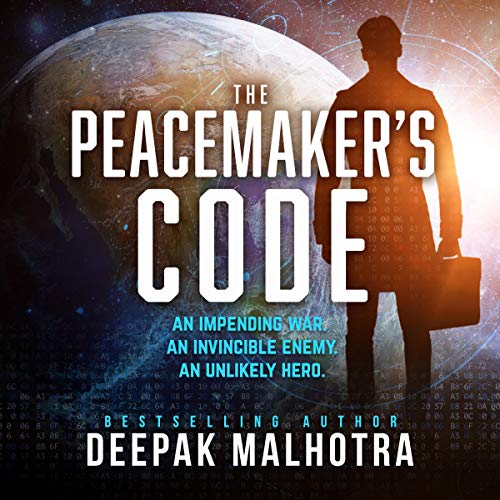
This book came highly recommended, but that tagline gives off “mediocre action flick” vibes, so I was still unsure going into it.
However, as my star rating illustrates, it turned out to be really good. I’d go so far as to say it’s incredible, honestly. However, some people might not like how it sorta feels like Deepak Malhotra was following a Dan Brown’s Step-by-Step How-To-Write-A-Thriller-Novel instruction manual:
Short chapters? ✓
Dramatic reveals and cliffhangers? ✓
Countdown to some unimaginable horror? ✓
Cryptic riddles that require an in-depth knowledge of history? ✓
Whether it feels formulaic or effective will come down to the individual, but it worked for me. It’s fast-paced, suspenseful, and compelling; and it got my head coming up with all kinds of (incorrect) predictions and explanations.
I also loved the puzzles (problems) that are presented. With each solution, Malhotra gives some crucial lessons about human nature and history. Using excerpts from a fictional text written by the protagonist, these lessons parallel the plot, demonstrate the importance of things such as empathy, and the limits of using historical analogies to assess a given situation. The excerpts are also immensely quotable (but no less profound):
“If you enter Korea to avoid another China, and enter Vietnam to enter another Korea, and enter Cambodia to avoid another Vietnam—at what point do you begin to worry that you are drawing lessons and inspiration from too shallow a pool of historical events?,” (p. 94).
“The elite guardians of wisdom will be rendered useless if the masses are incapable of understanding their language, unable to appreciate their concerns, or uninterested even in considering their advice. The danger is not new, but it is always magnified during those times when a population is empowered at a faster rate than it is educated,” (p. 142).
“Waging war takes guts, but you have the comfort of knowing that your friends stand beside you. Fighting for peace takes even greater courage, because all too often, you stand alone,” (p. 291).
If those passages are giving the impression that the book is overly academic, I apologize, because it really isn’t. It is a science fiction thriller, but also an insightful guide for solving real-life problems of division and conflict (and I realize I’m loosely quoting Jonathan Powell’s blurb on the back there; I apologize, it’s true).
Of course, not even a five-star is actually perfect. There were a few things that slightly bothered me, but might turn-off pickier readers:
First, the protagonist is a bit of a “Superman” character: Although he does have a bit of assistance, the history professor practically single-handedly solves every problem; and these are some pretty high-stakes problems. This didn’t bother me much, though, because it felt like the book was meant to show how our continual conflicts are a result of us learning the wrong lessons from history. I wouldn’t expect anyone in government to behave differently than they did in this book, so a different approach would have to come from an outsider, and the whole point of the book was to show what could happen if we followed through with that alternative approach.
Second, in an effort to add depth and diversity to the characters and perspectives, Malhotra made the characters almost too likable: the matchmaker POTUS and silly quips exchanged in the middle of dead serious briefings were a bit much. It didn’t bother me every instance, but some of them seemed really out of place.
Lastly, the romance element. It wasn’t strictly necessary (but then you could say that about adding romance into anything that isn’t solely a romance), and the pacing and cutesy-ness of it all, especially in context of what’s going on, made it feel more than a bit implausible. Fortunately, it wasn’t too over the top, and love, friendship, and loyalty are kind of a big part of the theme, so it wasn’t an entirely gratuitous inclusion.
At the end of the day though, those things were overshadowed by everything that made this an exciting and inspiring read. And because I can’t help myself, here are some equally quotable lines of dialogue:
“Laws cannot end war. Laws can only tell you how to start wars,” (p. 377).
“Every leader has the power to do harm, but it’s only when citizens know nothing of history that leaders find it possible to do evil on behalf of their people,” (p. 457).
“I don’t think we can strategize against a player that we’re unwilling to understand. We will neither fight effectively, nor negotiate successfully, if we are too blinded by fear of hatred to see what’s really going on—or to consider how the other side justifies the things they do,” (p. 457).
Finally, I end by sharing a sentiment that has relevance to this moment in our history:
“May you find peace where it exists and create peace where it does not,” (p. 475).