I told you this was a thirst so great it could carve rivers.
This fierce debut from award-winning writer Evelyn Araluen confronts the tropes and iconography of an unreconciled nation with biting satire and lyrical fury. Dropbear interrogates the complexities of colonial and personal history with an alternately playful, tender and mournful intertextual voice, deftly navigating the responsibilities that gather from sovereign country, the spectres of memory and the debris of settler-coloniality. This innovative mix of poetry and essay offers an eloquent witness to the entangled present, an uncompromising provocation of history, and an embattled but redemptive hope for a decolonial future.
Evelyn Araluen is a poet and teacher researching Indigenous literatures at the University of Sydney, where she is completing her PhD. She coordinates Black Rhymes Aboriginal Poetry Nights in Redfern and is a founding member of Students Support Aboriginal Communities, a grassroots organisation based in Sydney. Born and raised in Dharug country, she is a descendant of the Bundjalung nation.
4.5~4★ - This just won the 2022 Stella Prize! “There’s no stars like the ones that hang wide night above that dam.”
Ultimately, this isn’t for me, of course, but for Araluen’s people, the original inhabitants of Australia, often referred to as the Traditional Owners. I’m a blow-in, a newcomer, migrated from the US many decades ago.
Unlike many Aussies (yes, I’m now an Aussie), I have had Aboriginal friends for many years. I’ve also lived in Kamilaroi/Gamilaraay Country during drought, looking out for roos when only the road verges had a green pick from whatever bit of run-off was available. (Currently, it's wet there.)
“I take Richmond Road slower in the dry, when everything comes out for the green.”
In the 1970s, there were still light-skinned Aboriginal children being taken from their families to be raised as whites. The authorities assumed everybody would want to be white, but they didn’t reckon with the strength and depth of the oldest culture on earth. The Stolen Generations are raising their voices, and people are finding their families at last.
I have loved seeing blue-eyed, fair-skinned Aboriginal descendants who are proud of their indigenous heritage and seeking to make their voices heard. Some have very dark-skinned parents and siblings, So what? Your family is your family. Your granny is your granny.
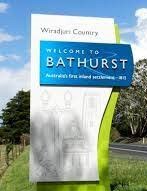
There are still plenty of Aussies who don’t know what all the fuss is about, but we are gradually learning, with the proliferation of official town entry signs, like the one for Bathurst, saying “Welcome to Wiradjuri Country”. The ‘real’ country name is often shown under tv broadcasts, and newscasters say where they’re broadcasting from.
I noticed this one being shown during the recent broadast of the Bathurst 12-hour race. Welcome to Wiradjuri Country entry sign to Bathurst, NSW
Araluen is addressing many of the past and continuing wrongs in what I think of as a poetic memoir, with poems and essays about growing up, her childhood with family and grandparents, and her homesickness for country. About her grandmother, knowing we take grandparents for granted.
“She loved birds, but I never asked her how. Just soaked up the heat from the wood burner in the kitchen, just splashed in the third-filled tub with a cousin or two, just leant against the fence as the caw of silhouettes descended across the dam. There’s no stars like the ones that hang wide night above that dam.”
She writes wherever she is, including during Covid isolation when she couldn’t get home. In Great Britain, she was even more uncomfortable. But writing about travelling home really struck a chord with me because I know some of these roads and circumstances.
“South Creek is running low and dry, and my uncle up at the farm says he’s had to sell off the cattle that he can’t afford to feed. I go the tree-lined road and drive slow for the dusking roos bounding into the ironbarks. Every few seconds is a flicker of scribbly gum, white and stark and inscripted in the distance.”
We lost part of the front-end of a car to a hidden 'dusking roo' who leapt onto the bonnet from behind the scrub as it jumped across the road. (It continued on its way.)
There are essays printed in the usual format with regular page margins, but many poems and thoughts are printed in small groups of words, spaced out across the page. To illustrate what I mean, below are the two pages that comprise the poem “Gather”, from the section of the same name. “Gather”, by Evelyn Araluen
Some of her work is unflinchingly angry.
There are three sections: Gather, Spectre, Debris. This is the title of one in the last section:
“FOR POWER FOR PRAYER FOR PROMISE FOR PEACE”
The poem is written partly in all caps, and partly in all lower case. This is only the introductory few lines. Nobody is settling for anything less than justice.
“IN THE ABSENCE OF POWER, SAY WE WILL NOT FORGET // IN THE THOUGHTS AND PRAYERS, SAY WE WILL NOT SETTLE FOR SILENCE // TO THOSE WHO ARE COMING, WE PROMISE WE WILL NOT LEAVE // IF THERE WILL BE NO JUSTICE, WE WILL NOT PERMIT PEACE //”
As developers continue to eat up the open spaces, (and governments allow new homes on floodplains, which are now flooding), she offers us this:
“I’ve seen South Creek swell this plain they’re cutting up for lines of neat houses all along this way, but they’ll never come for the scrub. They need this scrub to keep the ghosts in.”
I reckon there are plenty of ghosts in the scrub, and plenty of stories still to be passed on.
Incidentally, the title refers to a hoax played on tourists and unsuspecting backpackers and campers. For an entertaining discussion of the history of the drop bear. https://en.wikipedia.org/wiki/Drop_bear
This is certainly an intriguing collection of work that I am in no way qualified to criticise or review. I’ve been thinking about it for some time, and I keep going back to read sections again and can’t help but be affected by the overall impression it leaves me with.
Hers sounds like an important voice, and long may she speak.
Dropbear is a beguiling anthology of poetry, riff, and short prose-essays by Australian indigenous poet/author/critic Evelyn Araluen. The collection won the prestigious Stella Prize for women's writing in 2022.
Evelyn Araluen's work in Dropbear includes a variety of prose and poetic forms, including lyrical open or free poetry in a familiar structure of stanzas, 2-3 page narrative prose-essays and more expressionistic free verse featuring word and phrase fragments and the use of mise-en-page (unconventional line and poem layout).
I should admit that, while I enjoy reading poems purely as a conscious or sensory experience, I haven't studied poetry from a academic or critical perspective since senior high school (fairly orthodox anthologies of S.T. Coleridge and Kenneth Slessor's works were set texts for my Matric English Lit. curriculum). Given my rustiness, Dropbear presented an opportunity for me to "go down the rabbit hole" of poetry theory a little - primarily in order to identify different types of poetry - in an effort to better appreciate the form and content of Evelyn Araluen's words.
Araluen's poems and prose are inextricably bound with her personal history as a descendant of the (Australian indigenous) Bundjalung Nation, and raised on Dharug Country (the area encompassing Western Sydney out to the Blue Mountains). Many of her works express the anger, loss, and inequity associated with colonialisation. She explores many of the familiar tropes, icons and texts of Australian literature, such as May Gibbs' Snugglepot and Cuddlepie, D.H. Lawrence's Kangaroo and Banjo Paterson's "Song of the Future". Many such works celebrate the unique Australian landscape and and animal life, while effectively erasing or demonising the influence of the original (indigenous) owners.
Other poems have more of a nostalgic, verging on elegaic, tone, as Araluen reflects on her personal connections with land and family members, memories of childhood and notions of home.
The poems and essays that most resonated for me were: Learning Bundajalung on Tharawal Index Australis Pyro Concessions (prose) To the Parents (prose) The Inevitable Pandemic Poem Breath (prose-poetry) See You Tonight The Last Bush Ballad
I found Dropbear a thought-provoking and stirring read. While occasionally jarring, much of the writing is lyrical and richly evocative. As a non-indigenous reader, I was conscious of my own ignorance as to many of Araluen's references and themes. This was an eye-opening and troubling read that it's my intention to return to re-read at a later date, in the hope of finding further layers of meaning and nuance.
4.75 Stars — An elegantly crafted book of prose that glides along like a poetic zephyr, Dropbear is captivating and inspiring without in any way being a novel that’s caught up in being merely verse or preaching social commentary on any particular agenda. It is just a sublimely written piece of literature that holds the readers full attention one sentence at a time.
I was not expecting to be as enthusiastic about turning these pages, I figured it’d be a nice classy read that needed to go taken in the context of knowing that it’s more of a conscious flow of words and shape, than anything else.
But it most certainly isn’t, it’s breathtaking and beautiful. It’s unashamedly Australian and I can’t push a strong enough recommendation for anyone whom enjoys lyrically insecure prose that can be hypnotic as well as create a cogitator-fuelled narrative for any mood.
Wow wow wow! I don’t often read a collection of poetry. What a debut collection of poems this is. Dropbear is engaging, it gets you thinking and questioning, it stops you in your track and totally disrupts your reading of the text in the most beautiful way, that opens your eyes. It is good with just honesty and ease and at times anger. Dropbear is full of references that familiar to people to have lived in Australia, it pays homage and critiques popular culture. A deeper connection to the land and Araluen’s verses comes from her experiences as a Bundjalung descendant. Highly recommend this collection of poems but an amazing voice to the genre.
‘AGAIN WE ARE UNHEARD AS WE SPEAK KNOWINGS WE HAVE CARRIED TO CARE FOR THIS PLACE THROUGH RECKONING// AGAIN AGAIN WE ARE TOLD TO BE GRATEFUL FOR THIS GIFT AS IF THE MACHINE HAS FIREPROOFED ANYTHING BUT ITSELF// I WROTE THIS POEM AT A DESK COVERED IN ASK’
This book is significantly more well-read than I am, which didn't lessen the pleasure but does contextualise my review. Araluen is a clever writer - she subverts and slays a tradition of Australian poetry and children's literature, exposing the ignorance and presumption of the colony while answering back from Country and Culture. Even though tons of the references whizzed well over my head, there was enough of my childhood here to wince, groan and laugh. Araluen invites the reader into a different perspective, the poking is funny, but this is ultimately a celebration too of how much richer this continent is than we have got the literature for yet. And Araluen wields words with tenderness as well as wit. Some lines just take your breath away with their wistfulness or joy. Recently, there has been some chatter about the number of First Nations writers nominated for prizes. In possibly my favourite piece in this volume, Araluen reminds us forcefully how small and insular the communities which defined our national literary culture have been - and how, while we can love much of what they produced - they also wielded sexual and racial harassment as weapons to keep their sanctums to themselves. Drop Bear has so many allusions in it few readers will get them all - but the flip side is that most will get at least some. There is something here to speak to everyone, and that's quite something.
In their debut collection of poetry, Araluen ruptures and rearranges the colonial narrative which has facilitated the oppression of Australia’s indigenous communities and its native environment since settlers arrived. Since the erasure of native beings has been an act of literary violence, Araluen rightfully contends that protest, too, must be literary. Scrutinising aspects of kitsch and cuteness (one of our contemporary aesthetic categories as per Sianne Ngai) through a reckoning with racially-coded children’s literature and mythical Aussie tropes - from the titular drop bear said to attack unwary tourists, to Kylie Minogue’s hot pants - Araluen’s poems, in all their formal experimentation, critical creativity and entanglement, are vital and Veggiemighty. They are not solely scathing pieces, though: there is a lot of love in this collection; for family, for the bush and it’s inhabitants ravaged by forest fires. Not to arbitrarily conflate indigenous voices, but if you’ve read Diaz’s Postcolonial Love Poem, you’ll find a lot to like and provoke/challenge your thoughts in here.
I can see why this is deservedly getting so many 5 star reviews, my good-to-averageish score is very much on me: a lot of the Australian-specific references, so critical to Araluen’s critique of the national kitsch culture, went over my head and, coupled with the fragmentary nature of the verse itself, made comprehension and the act of reading itself rather hard going at times. A little glossary could have come in handy, so have Google at the ready! That being said, perhaps that’s part of the intention; some poems really stop you in your tracks - not just by their lyrical beauty! - and demand uncomfortable ruminations with our complicity, as consumers of such totems and stories, which have historically enabled, and continues to enable, such injustices against aboriginal populations.
Difficult to rate ; some pieces (I’m reluctant to call them all poetry) were a 5 star and some so dense to me that I didn’t understand them. She has a great voice and thrilled that these ideas captured and expressed this way.
‘You cannot put back into the earth what you’ve taken from it.’
I have been dipping into this book slowly over the past two years. I read a poem or an essay, think about it, put the book to one side for another day. I find the essays easier to navigate than the poetry but, in both forms, I feel the passion. And, because I feel like an observer in an unfolding story, I cannot apply the usual tools I use when commenting on books I read. This is a confronting, uncomfortable and thought provoking read. The book is divided into three parts: Gather Spectre Debris
It may only be 104 pages in length, but it is millennia in depth. Read, reflect, and recommend to others.
Some 200 years after invasion, in 1991, a vision of Australia was offered by poetry: Robert Gray and Geoffrey Lehmann’s Australian Poetry in the Twentieth Century.
The anthology was typified not only by the complete absence of Black poets, but the glowing approval of Les Murray on the cover and dutiful inclusion of Barry Humphries’ smiling zinc cream kitsch in Edna’s Hymn, whose balancing act of “mockery and affectionate nostalgia” (“All things bright and beautiful – Pavlovas that we bake,/All things wise and wonderful – Australia takes the cake”) apparently meant no room could be found for Oodgeroo Noonuccal or Lionel Fogarty.
In Dropbear, her debut collection of poetry, Evelyn Araluen wields a scalpel through twinkly visions and phantasma that treat the Australian landscape as empty necropolis: the Peters ice-cream white suburbs and grey-lapel metropolises; the interior as vacant object of “sunburnt” affection; women quietly tending logpiles at the homestead while men trek across the frontier and sheep and rabbits destroy the topsoil.
To these, Araluen says: “Straya is a man’s country/and you’re here to die lovely against the rock/to fold linenly into horizon/and sweat beautiful blonde on the beach”.
She incorporates lyric meditations, memoir and pastiche with equal facility. In this she has been compared to Alison Whittaker; I would suggest, however, that both authors are part of a broader First Nations practice. From Leanne Betasamosake Simpson in Canada and Esther G Belin and Michael Wasson in Turtle Island to Walis Norgan and Adaw Palaf in Taiwan, it is not uncommon to see various modes and forms incorporated into the poetics of First Nations.
In poems like PYRO, Breath, and Bastards from the Bar, bristling with hard-bitten tenderness (“For what/they did to the women, and what they never did for us, it’s/worth growing older”), Araluen writes something akin to prose poetry. She is attuned to that form’s particular mode of consciousness wending its way through memories: of bushfire, familial love, even “A SNEAK PEEK PRE-COLLECTION OF ORGANIC COTTON WOMENSWEAR IN WHICH THE THIN WHITE MODEL LEANS DOUR AGAINST A FIRETRUCK IN THE THRICE-BURNT CHAR OF A HOMELAND”. Her work asks what it is we wish to keep, in this “relic-making” of the “half-finished” “Anthropocene display”. What is the point in chiselling the clay of language, if all that eventuates is another object to be placed amid the dead and dying “in a museum of extinct things”?
Araluen’s clever repurposing of Biblical themes, Australiana kitsch, and settler-colonial tropes (see the glorious frontier pastiche of The Last Endeavour) speaks back to a long history of Australian myth-making, from Patrick White’s Voss and Harold Lasseter to John Oxley and Madeleine Watts’ recently published debut. In one very fine piece, THE INLAND SEA, Araluen remixes Peter Carey’s Oscar and Lucinda with shades of Corinthians (“how many churches carried up the creek, how much glass for that dark little light”), building toward a stunning image of apocalyptic decay:
What did your ruin want with us anyway? Sydney is soft and
humid and dying, your ghosts lingering and unsettling ash
as they trace too close to the fire’s edge. Your god was dead
before the nails, and the cross was bored of waiting for a
Araluen's Dropbear is overall a really strong collection of writing with few low points. I loved her use of colonial Australia's iconography and the way she interrogated it, as well as her skill at evoking the Australian landscape. Araluen's send-up of a rote Welcome to Country was a particular stand-out, and I also enjoyed her critique of academia in Appendix Australis, although I think I liked these because I understood them the most. Dropbear is full of textual and Indigenous references that make some of the writing a bit opaque (which is a criticism of myself, not Araluen, to be clear), so this is definitely a collection you'd need to read more than once. Even if you don't fully understand the content, though, you'll still appreciate the beautiful writing.
While reading this collection of poetry/prose/memoir all I could think of was ‘instant classic’, ‘this needs to be taught’...astonishing is the only word that I can aptly use to describe the impact of reading Drop Bear. A potent evisceration of Australian kitsch culture through a decolonial lens, Araluen’s voice is clear, biting and powerful that left me breathless and questioning the the very foundations of the Australian mythology and the lasting and damaging impact is has and is still causing as it appropriates and silences the culture, history and language of the First Nations peoples. A must read.
A breathtaking debut collection that tears apart the nostalgic facade of Aussie kitsch culture. Drawing from their academic background Araluen weaves and twists through time and literary structures, peeling back classic Australian iconography to reveal the complex violence in which so-called Australiana is forced upon and attempts to erase the landscapes of First Nations people. Righteously angry and resiliently tender each poem packs a punch, unrelenting until the very last page. Writing through Bushfires, BLM and the pandemic this is a collection for the now that is destined to become a classic, I feel changed by these words. Best of contemporary poetry.
dropbear was, in ways, a confronting experience! covers important ground, in a way which is often very lyrical and beautiful, but also often structured in a manner so fragmented i couldn't understand much, though that seems intentional
unfortunately, i'm unfamiliar with the majority of the vast number of intertextual and literary references made in dropbear, which probably limited my understanding further
This has been on currently reading pile for a while, and I think it always will be. Beautiful, fierce and confronting read of poetry and essays. It unpicks the tropes and iconography that maintains the white settler colonial voice and story of Australia. Evelyn spoke straight to my childhood heart being swept up in bush stories, and asked me to interrogate the politics of this colonial inheritance.
Challenging not only in form but also in content, I will be revisiting many of these poems and grappling with what effective, true allyship looks like as a previous/childhood fan of several of the problematic and ultimately colonial (colonising) literary works examined, parodied, and deconstructed in this collection
“The trope neatly folds conflictual narratives of national subjugation and external politics into aesthetic production.”
7/5 stars.
One of the most important books I’ve ever read, and some of the most stunning poetry I’ve ever encountered. Truly incredible. This should be required reading for every school.
"singing broken bars like harpooned ghosts" (11) "And it was from each to each that ghosts grew boats" (23) "The trope feels a ghostly spectre haunting the land, but smothers it with fence and field and church" (32) "not all that haunts is ghost" (52) "we ghost hands where furniture hasn't stood in years" (62) "Sydney is soft and humid and dying, your ghosts lingering and unsettling ash" (72) "I have a ghost story" (91)
it’s a weird rating to leave, but it feels right - there was so much to love about this collection of poetry and prose poetry, but most of the references to australian media and literature went over my head by virtue of them being before my time. i think ‘dropbear’ would absolutely be a better experience for a different reader, but i still enjoyed a lot of what araluen had to offer
-Evelyn is a genius. -I might end up using 'for power for prayer for promise for peace' in an essay! -'Home, after the fire' was my favourite <3 her diction and writing is so beautiful.
Congratulations are in order for Evelyn Araluen’s first collection Dropbear which feeds its readers a collection of free verse poems and prose. I had been waiting for this collection for a while, watching as the cover was revealed and I’m glad to have read it so soon after release.
“It is hard to unlearn a language: to unspeak the empire to teach my voice to rise and fall like landscape” (8).
Araluen is negotiating language and identity in her collection. Throughout Dropbear, she discusses the past of colonialism and its continuing impacts on First Nations Australians and society itself. Araluen is careful and concise before the bite of lines and in some places satirical as she embodies the coloniser:
“I would like to be invited to your homes to pay my respects my acknowledgements” (31).
Her connection to space and to the people in her life and those noted in her poetry is moving. This is where I was able to relate the strongest to her writing, in poems like ‘Guarded by Birds’ (34), and ‘Hold’ (52). Her relationship with place and space and the ability to move through the layers of change within this so-called Australia is what catches me the most.
This collection is a reminder that memory and trauma are continual in landscape and people, and presents some of those pains. Araluen has published a number of successful and empowering poems and I’m excited to see more.
“Nothing is forgotten from the earth, just moves in muscle memory, what doesn’t echo is recalled by the first bird to rustle free from the dust” (69).
Examines identity and myth and nature and the slippery existence of languages that are formulated or expressed less through expulsion as much as they are absorbed into the body - the book’s first and last poems both end with reference to ‘swallow[ing]’. The poems, then, dig into how what we speak becomes us; that is, how our conception of the world - how we read it and talk it into being - shapes how we see and understand ourselves. It is streaked through with a kind of exhausted, cynical anger and frustration, a gathering and dispersal of ideas and misunderstandings and signifiers of bush, Indigenous culture, appropriated (reappropriated?) touchstones - all amounting to an overwhelming sense of the world that the speaker often finds herself lost within, seeking comfort and partnership, and finding it to be almost transitory, if still tinged with meaning and light. The mixture of fractured poetry, wordplay, erasure, and prose-poems (essays, almost) establish a restless, curious, dryly humorous, apocryphal voice that builds worlds and ideas that feel both tangible and lost within a dream or memory; intrusions of contemporary, Western culture into Indigenous landscapes of First Nation language, animals, bush, water, flow, displacement. A beautiful, haunting book that still feels utterly modern and intimate - in equal measure a book about a people, while also being about a person; a woman in the city or country (it shifts) finding herself amidst the histories and memories of her people, while also trying, in some sense, to make sense of this fluid uncentering of self for something suggestively bigger.
“Water carries immemorial, a river without peace will not let you pray. The best way to learn a lesson is to let it find you, and drink.” - From Secret River.
Isn’t that beautiful? This book of poetry & prose won the Stella prize a few years ago, and I’ve been meaning to get to it ever since. Here are some more of my favourite lines:
“That this land had no poets but it had thirst and rage and dreaming”
“As the wideness dusks to dark the ghost gum globes are all aflicker in guidance…” from THE LAST BUSH BALLAD
“To wash my skin back into its scent” from Home, After the Fire
“With each day I learn new ways to feel unprepared.” from Breath - the panic and disorientation of travel, and also the underlying emotion, the anxiety of being away.
i didn’t expect to like this book as much i did, i didn’t always understand the poetry, it made a lot of references to texts i haven’t read but the writing was so strong that i didn’t need to understand. i felt it. i felt the anger, the ownership, i felt the unforgiving. and these are all things i’ve felt before and feel still. i’ve felt the love and the grief of something you can never have back, something you know you would have loved if you had been there to witness it and your body still yearns from it, but it’s like a void that will never be full. a part of you that will always be empty. beautiful beautiful beautiful.
In her interview for The Stella Prize, Evelyn Araluen describes her work as evoked by the landscapes she herself had been raised into, influenced by contemporary settler-colonial legacies and the artistic response cultivated from this. At its core, Dropbear is a story of home; where such a place is created, and how one’s relationship to such a place comes to define the individual. It seems reductive to consider Araluen’s work to the effects of colonialism a response; in her remembrance and honour for the natural environment, her poetry transforms into a form of resistance, a radical tool against forced Indigenous assimilation. Blunt use of colloquial language ‘as we pass the earthmovers stacked at the post-Maccas merge’ signifies the absence of subtlety in Araluen’s work, speaking to a shared experience lost in time that is not transcribed to be understood by all that will read her collection.
Oscillating between broken poetry reminiscent of the works of William Carlos Williams and longer epistolary entries that read similar to a journal entry, Araluen’s poetry speaks to a tone of franticness that is yet underscored by the peace she finds within the natural landscape. She laments ‘in another version of history we are here, together, still’; her work becomes infused with melancholy for a life that was lost before she realised it was gone altogether, fragmented by a regret of not realising it was being taken from her in the same moment that it was occurring. As Araluen expresses that ‘history forgets some places’, I think of all the memories that are captured between the bones and not in writing. The physical remembers everything that my mind can’t, but when do my thoughts stop and when does my memory start? Araluen speaks to this disintegration of language; ‘it’s best if we only remember through the body / to build muscle around it before you go’. Will the land still speak to us when we cannot speak to it? Does my childhood bedroom remember the way I laid on the floorboards, are my footprints still visible on the bathroom tiles if I look hard enough? Araluen’s writing becomes infused with the fear of forgetting the way that love physically imprints itself upon the individual’s skin, that memory isn’t enough if it’s tangible only within the mind. She consistently reminds herself throughout the collection that words are not enough to store a memory within; ‘don’t let the room empty before / I’ve built the muscle to remember / don’t go until I can like it like that’.
Yet Araluen’s work, despite overarchingly drenched in her fear of her memory – the fear of forgetting, and the need for the unknown – moves towards peace, and tenderness not only for those she loves but herself too. As she ‘leaves loving you to muscle memory’, she reminds her reader that righteous anger serves to usurp those who have already had the past taken from them. Reminding herself that ‘nothing is forgotten from earth, just moves in muscle memory’, Araluen becomes her own voyeur, assuming the position of the reader themselves to reach to a younger version of herself and stroke her face with tenderness that the earth does not forget her in the way she fears. In the act of affirming that loving others must coexist with love for oneself, Araluen deposits her most radical argument – that generational trauma cannot be healed solely through anger, that resilience and solidarity become necessary acts of self-love for healing.