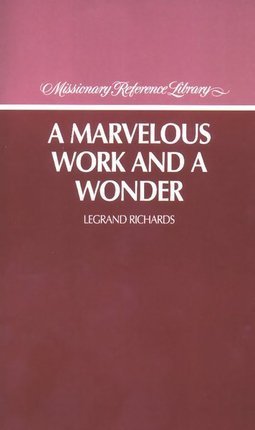
This was probably my first introduction to a book that covered the doctrines of The Church of Jesus Christ of Latter-day Saints (LDS Church). Originally published in 1950, this book has stood the test of time and continues to provide a valuable resource for individuals seeking to deepen their understanding of LDS teachings. It is written on a basic level as an introductory text.
Richards, was an apostle in the LDS Church. He was related to a close friend of mine. He arranged a small group meeting in his parent’s home in 1981. At that time Richards was 94. He spoke off the cuff with no notes and answered some questions. He was an engaging speaker. At one point during the discussion he asked for a glass of water. When it was brought to him he declared “Take away the coffee, whiskey, and tea, ice-cold water is the drink for me.” It was quite an experience listening to him that night. I read his classic book a few years earlier.
The book presents a basic overview of fundamental doctrines, principles, and beliefs that form the bedrock of Mormonism. His writing style is clear, concise, and accessible, making complex theological concepts understandable to a wide range of readers, including both devout members of the LDS Church and those seeking to learn more about it.
Richards covers a broad spectrum of topics, including the nature of God, the divinity of Jesus Christ, the plan of salvation, the role of prophets, and the importance of personal revelation. Each chapter builds upon the previous one, creating a cohesive narrative that enhances the reader's understanding of LDS doctrine as a whole.
The book's greatest merit lies in its ability to inspire and strengthen faith. Richards weaves personal anecdotes, testimonies, and real-life examples throughout the text, illustrating how the principles and teachings he discusses have practical application in daily life. Readers that are not LDS find it challenging to fully connect with the book's content. While the author makes efforts to address potential questions and concerns, it may not satisfy those seeking an objective analysis or a critical examination of LDS doctrine. Its purpose is not deep critical analysis but more inspirational in tone.
LeGrand Richards was a treasure. His passion and life-long commitment was inspiring. Whether one is a devout member of the LDS Church or simply curious about its teachings, this book provides a basic yet valuable resource.
As a young missionary I would have rated the book 5 stars. As a mature adult with decades of churchy service and leadership behind me I rate it 3 stars. Not because I'm critical, but rather it is a bit more fluff than what I feel like I need now. Nuance and ambiguity is the sign of a mature faith, which requires a bit more than what this book did for me 40 years ago. Nonetheless I value the book and certainly Elder Richards.