

What do you think?

Pozwol sobie na uczucia. Wykorzystaj moc inteligencji emocjonalnej
Odblokuj potęgę własnych emocji!
Ludzie cierpią z powodu uczuć i emocji. Nie mogą ich powstrzymać, obawiają się ich, czasami czują się nimi przerażeni. Nic dziwnego. Prawdziwe uczucia bywają skomplikowane, uciążliwe, dezorientujące lub nawet uzależniające. Sprawiają, że człowiek jest bezbronny albo robi rzeczy, których potem żałuje. Jednak konsekwencje prób zapanowania nad emocjami za wszelką cenę lub nawet odmówienia sobie prawa do ich odczuwania bywają jeszcze gorsze: wybuchy gniewu, kompulsywne objadanie się, agresja, narkotyki czy depresyjne myśli. Jak więc przerwać to błędne koło?
Ta książka uzmysłowi Ci, jak ważne jest to, by pozwolić sobie na emocje i uczucia. A zaraz potem dowiesz się, czym są, jaką odgrywają rolę i co należy zrobić, aby pomagały, a nie przeszkadzały. Poznasz system składający się z pięciu umiejętności emocjonalnych i w lot go zrozumiesz. Przekonasz się, że pracy z własnymi uczuciami można się nauczyć. W efekcie pozbędziesz się ciągłego stresu i wypalenia, poprawisz relacje międzyludzkie, być może odczujesz poprawę stanu zdrowia, a na pewno będziesz szczęśliwszym i bardziej spełnionym człowiekiem!
Dzięki tej książce dowiesz się, jak:
odczytywać z emocji ważne informacje
rozpoznawać, wyrażać i rozumieć emocje
radzić sobie z własnymi emocjami
stosować umiejętności emocjonalne w domu i w pracy
rozwijać inteligencję emocjonalną swoich dzieci
Metoda ta znakomicie sprawdza się również w przypadku dzieci i młodzieży!
O autorze ebooka
Dr Marc Brackett wykłada w Child Study Center na Uniwersytecie Yale. Jest też badaczem. Od ponad dwudziestu lat zajmuje się wpływem inteligencji emocjonalnej na procesy uczenia się, podejmowania decyzji, a także na kreatywność, zdrowie, efektywność i związki. Opublikował ponad setkę artykułów naukowych i otrzymał liczne wyróżnienia za edukowanie ludzi w zakresie wartości emocji i ich świadomego wykorzystywania.
Ludzie cierpią z powodu uczuć i emocji. Nie mogą ich powstrzymać, obawiają się ich, czasami czują się nimi przerażeni. Nic dziwnego. Prawdziwe uczucia bywają skomplikowane, uciążliwe, dezorientujące lub nawet uzależniające. Sprawiają, że człowiek jest bezbronny albo robi rzeczy, których potem żałuje. Jednak konsekwencje prób zapanowania nad emocjami za wszelką cenę lub nawet odmówienia sobie prawa do ich odczuwania bywają jeszcze gorsze: wybuchy gniewu, kompulsywne objadanie się, agresja, narkotyki czy depresyjne myśli. Jak więc przerwać to błędne koło?
Ta książka uzmysłowi Ci, jak ważne jest to, by pozwolić sobie na emocje i uczucia. A zaraz potem dowiesz się, czym są, jaką odgrywają rolę i co należy zrobić, aby pomagały, a nie przeszkadzały. Poznasz system składający się z pięciu umiejętności emocjonalnych i w lot go zrozumiesz. Przekonasz się, że pracy z własnymi uczuciami można się nauczyć. W efekcie pozbędziesz się ciągłego stresu i wypalenia, poprawisz relacje międzyludzkie, być może odczujesz poprawę stanu zdrowia, a na pewno będziesz szczęśliwszym i bardziej spełnionym człowiekiem!
Dzięki tej książce dowiesz się, jak:
odczytywać z emocji ważne informacje
rozpoznawać, wyrażać i rozumieć emocje
radzić sobie z własnymi emocjami
stosować umiejętności emocjonalne w domu i w pracy
rozwijać inteligencję emocjonalną swoich dzieci
Metoda ta znakomicie sprawdza się również w przypadku dzieci i młodzieży!
O autorze ebooka
Dr Marc Brackett wykłada w Child Study Center na Uniwersytecie Yale. Jest też badaczem. Od ponad dwudziestu lat zajmuje się wpływem inteligencji emocjonalnej na procesy uczenia się, podejmowania decyzji, a także na kreatywność, zdrowie, efektywność i związki. Opublikował ponad setkę artykułów naukowych i otrzymał liczne wyróżnienia za edukowanie ludzi w zakresie wartości emocji i ich świadomego wykorzystywania.
416 pages, Paperback
First published September 3, 2019
Ratings & Reviews
Friends & Following
Create a free account to discover what your friends think of this book!
Community Reviews
Displaying 1 - 30 of 1,353 reviews

September 3, 2019
"And when we can't recognize, understand, or put into words what we feel, it's impossible for us to do anything about it: to master our feelings — not to deny them but to accept them all, even embrace them — and learn to make our emotions work for us, not against us." pg 2
Marc Brackett, Ph.D., is the director of the Yale Center for Emotional Intelligence. In this book, Permission to Feel, he has given the world a new set of tools to learn more about ourselves through our emotions, to facilitate communication, and to teach the next generation how to do the same.
I really appreciated this book as I am someone who has trouble sharing emotions.
I am probably like this because, as Brackett explains, we learn our communication styles from our parents. My mother had a lot of kids and, though I know she cares, never had much time for one-on-one interaction.
My father is so introverted he barely speaks to his family. I have spent entire car rides with my dad while sitting in absolute silence, which sounds like it could be desperately uncomfortable, but with him it's not. That's just the way he is.
And what I have become. It can take time to coax anything like an intimate conversation out of me and few have ever bothered to try.
But I want to be better at sharing what's going on in my inner world. This book has shown me a way I can move towards making that happen.
"Feelings are a form of information. They're like news reports from inside our psyches, sending messages about what's going on inside the unique person that is each of us in response to whatever internal or external events we're experiencing. We need to access that information and then figure out what it's telling us."
Brackett first outlines why emotions are important as they affect everything from "where we direction our attention" to decision making, relationships, creativity and our physical health.
He then explains how to become "emotion scientists," which he says are more desirable than "emotion judges." The scientist listens and seeks clues to tease out what is going on in order to help. The judge does the same, but then, rather than helping, he strangles any potential improvement by putting the smack down on what they discover.
"We all want our lives, and the lives of the people we love, to be free of hardship and troubling events. We can never make that happen. We all want our lives to be filled with healthy relationships, compassion, and a sense of purpose. That we can make happen." pg 21
Then, he gives the tool kit he has spent years honing in workshops and studies, and shares how to apply it in various areas of your life.
I could see this book being useful to parents, educators, leaders or people like me. I knew I had room for improvement in accessing my emotions, but no idea how to go about it. Now, I know.
Thank you to the publisher for a free advance reader copy of this book. The short quotations I cited in my review may change or be omitted in the final print copy. Permission to Feel should be published in early September 2019.
Marc Brackett, Ph.D., is the director of the Yale Center for Emotional Intelligence. In this book, Permission to Feel, he has given the world a new set of tools to learn more about ourselves through our emotions, to facilitate communication, and to teach the next generation how to do the same.
I really appreciated this book as I am someone who has trouble sharing emotions.
I am probably like this because, as Brackett explains, we learn our communication styles from our parents. My mother had a lot of kids and, though I know she cares, never had much time for one-on-one interaction.
My father is so introverted he barely speaks to his family. I have spent entire car rides with my dad while sitting in absolute silence, which sounds like it could be desperately uncomfortable, but with him it's not. That's just the way he is.
And what I have become. It can take time to coax anything like an intimate conversation out of me and few have ever bothered to try.
But I want to be better at sharing what's going on in my inner world. This book has shown me a way I can move towards making that happen.
"Feelings are a form of information. They're like news reports from inside our psyches, sending messages about what's going on inside the unique person that is each of us in response to whatever internal or external events we're experiencing. We need to access that information and then figure out what it's telling us."
Brackett first outlines why emotions are important as they affect everything from "where we direction our attention" to decision making, relationships, creativity and our physical health.
He then explains how to become "emotion scientists," which he says are more desirable than "emotion judges." The scientist listens and seeks clues to tease out what is going on in order to help. The judge does the same, but then, rather than helping, he strangles any potential improvement by putting the smack down on what they discover.
"We all want our lives, and the lives of the people we love, to be free of hardship and troubling events. We can never make that happen. We all want our lives to be filled with healthy relationships, compassion, and a sense of purpose. That we can make happen." pg 21
Then, he gives the tool kit he has spent years honing in workshops and studies, and shares how to apply it in various areas of your life.
I could see this book being useful to parents, educators, leaders or people like me. I knew I had room for improvement in accessing my emotions, but no idea how to go about it. Now, I know.
Thank you to the publisher for a free advance reader copy of this book. The short quotations I cited in my review may change or be omitted in the final print copy. Permission to Feel should be published in early September 2019.
August 9, 2019
I received an ARC (advanced reader copy) of this book which I was pretty excited about because everyone knows I have a self-help book addiction.
First, I’m going to address what we’re probably all thinking: the title isn’t the best. I was too embarrassed to read this on the subway or in the waiting room at my doctor’s office. To me, it conjures up images of weird touchy-feely group therapy sessions where people do things like punch pillows while yelling, “I HATE YOU DAD!” or dudes in pleated khaki pants talking to kids with sock puppets or something else equally awkward.
I’m passed the age where I feel I need permission to do anything, so I hid this book for fear someone would think it was a cry for help.
Anyway, based on the description you might expect this book to be very technical, but it’s actually pretty personal. Most of the examples relate to the author and his childhood, or interactions he’s had with friends or students, and even hypothetical situations seem to be about him. (Like he asks the reader to imagine themselves going to a conference or being a teacher and having x, y or z happen.) I think this book was a cathartic exercise for the author. I think Marc Brackett should just write a memoir. I’d read it. Honestly, his best writing was when he was talking about his personal experiences. I wish he’d taken all these lessons he’s trying to impart here and folded them into the narrative of his life instead of sticking the narrative of his life into this book about his program.
Basically, I think this book probably would have benefited from being either way more personal, or way less. I think the RULER system probably works best as a powerpoint presentation or a pamphlet. Something easy to digest. It doesn’t really need a long explanation because it’s pretty simple, and because this book tries to be both personal and technical, it feels messy and unnecessarily long.
Also, the author spends way more time arguing against the idea that the system is pointless than he spends actually talking about the system. I came away feeling like I barely learned anything other than the fact that the author thinks kids really, really, really need a safe space to talk about their feelings.
I think the intended audience is parents, school administrators, and business managers. If you’re trying to decide if you’re interested in this book you should check out the author’s ted talk. It’s basically the book distilled down into a twenty minute speech. If you like that, you’ll like this book.
And just to address something that kept coming to mind for me over and over again: I think there’s something to be said for developing a thick skin. The author repeatedly gives examples of times he was “triggered” by his students (triggered is his word, not mine) and I get that the intention was to show how he had a bad internal reaction and then chose a better outward reaction, but to me his examples showed that he’s extremely sensitive in ways other people can’t anticipate. I think there’s a better answer for situations like these. Because let’s face it, most people don’t care about your feelings. They don’t have the time and energy. We also all have completely different ideas about what is acceptable behavior. I think it’s important (as an adult) to learn to accept this, otherwise you’re going to go through life feeling triggered by lots of small interactions that really don’t matter in the grand scheme of things. I think it’s fair to expect people not to verbally abuse you, but if you have a small meltdown because you don’t like the way someone you barely know asked you a question...you’re gonna have a bad time. People are always going to be snippy, sarcastic and dismissive. I find the best thing to do isn’t to find a way to suck it up every time it happens and force yourself to react better and then pull them aside later for a little talk, but rather, understand that not everyone cares and they shouldn’t have to. Then you don’t have to manage your reaction because it will barely register to you as a problem. It will be, “Oh man, that guy’s cranky” and not, “HOW DARE HE TALK TO ME LIKE THAT!” I think the author essentially wants to give the world sensitivity training, but if we manage our expectations we won’t need people we barely know to change so we can be happy. It’s really freeing to not expect so much from everyone. None of this is to say we shouldn’t strive to treat each other better, but we can also learn to chill out with the expectation that everyone be nice all the time.
First, I’m going to address what we’re probably all thinking: the title isn’t the best. I was too embarrassed to read this on the subway or in the waiting room at my doctor’s office. To me, it conjures up images of weird touchy-feely group therapy sessions where people do things like punch pillows while yelling, “I HATE YOU DAD!” or dudes in pleated khaki pants talking to kids with sock puppets or something else equally awkward.
I’m passed the age where I feel I need permission to do anything, so I hid this book for fear someone would think it was a cry for help.
Anyway, based on the description you might expect this book to be very technical, but it’s actually pretty personal. Most of the examples relate to the author and his childhood, or interactions he’s had with friends or students, and even hypothetical situations seem to be about him. (Like he asks the reader to imagine themselves going to a conference or being a teacher and having x, y or z happen.) I think this book was a cathartic exercise for the author. I think Marc Brackett should just write a memoir. I’d read it. Honestly, his best writing was when he was talking about his personal experiences. I wish he’d taken all these lessons he’s trying to impart here and folded them into the narrative of his life instead of sticking the narrative of his life into this book about his program.
Basically, I think this book probably would have benefited from being either way more personal, or way less. I think the RULER system probably works best as a powerpoint presentation or a pamphlet. Something easy to digest. It doesn’t really need a long explanation because it’s pretty simple, and because this book tries to be both personal and technical, it feels messy and unnecessarily long.
Also, the author spends way more time arguing against the idea that the system is pointless than he spends actually talking about the system. I came away feeling like I barely learned anything other than the fact that the author thinks kids really, really, really need a safe space to talk about their feelings.
I think the intended audience is parents, school administrators, and business managers. If you’re trying to decide if you’re interested in this book you should check out the author’s ted talk. It’s basically the book distilled down into a twenty minute speech. If you like that, you’ll like this book.
And just to address something that kept coming to mind for me over and over again: I think there’s something to be said for developing a thick skin. The author repeatedly gives examples of times he was “triggered” by his students (triggered is his word, not mine) and I get that the intention was to show how he had a bad internal reaction and then chose a better outward reaction, but to me his examples showed that he’s extremely sensitive in ways other people can’t anticipate. I think there’s a better answer for situations like these. Because let’s face it, most people don’t care about your feelings. They don’t have the time and energy. We also all have completely different ideas about what is acceptable behavior. I think it’s important (as an adult) to learn to accept this, otherwise you’re going to go through life feeling triggered by lots of small interactions that really don’t matter in the grand scheme of things. I think it’s fair to expect people not to verbally abuse you, but if you have a small meltdown because you don’t like the way someone you barely know asked you a question...you’re gonna have a bad time. People are always going to be snippy, sarcastic and dismissive. I find the best thing to do isn’t to find a way to suck it up every time it happens and force yourself to react better and then pull them aside later for a little talk, but rather, understand that not everyone cares and they shouldn’t have to. Then you don’t have to manage your reaction because it will barely register to you as a problem. It will be, “Oh man, that guy’s cranky” and not, “HOW DARE HE TALK TO ME LIKE THAT!” I think the author essentially wants to give the world sensitivity training, but if we manage our expectations we won’t need people we barely know to change so we can be happy. It’s really freeing to not expect so much from everyone. None of this is to say we shouldn’t strive to treat each other better, but we can also learn to chill out with the expectation that everyone be nice all the time.

August 22, 2019
One of the best books on emotional balance I have read in quite some time. Mark Brackett does a fantastic job of 'mapping' all the problem territories one encounters when emotional boundaries are explored. The advice that Mark gives is based on his extensive experience (25 years as an emotion scientist) but is centered on a specific steps that can be taken and applied. Many of the issues facing our children today are covered with a rare applicability that translates smoothly into specific situations - highest recommendation.
August 16, 2019
Permission to Feel is a thoughtful, well-searched book about emotional intelligence and how it helps adults and children alike.
I wish Dr. Brackett’s program was available locally so I could see it in action because I have loved what I read about so far. He has designed a program called RULER, which is a prescription for healthy children, and includes healthier parents, teachers, and children. The focus is emotional health, and I love that.
I’m so grateful I read this, and I hope parents and teachers will get a look, too. This book is approachable, written for anyone, and is not heavy in jargon.
I received a complimentary copy. All opinions are my own.
I wish Dr. Brackett’s program was available locally so I could see it in action because I have loved what I read about so far. He has designed a program called RULER, which is a prescription for healthy children, and includes healthier parents, teachers, and children. The focus is emotional health, and I love that.
I’m so grateful I read this, and I hope parents and teachers will get a look, too. This book is approachable, written for anyone, and is not heavy in jargon.
I received a complimentary copy. All opinions are my own.

June 21, 2023
اگه یه روزی یکی بهم بگه از این کتاب چی یاد گرفتی بهش میگم : « تو ۳۷۵ صفحه کتاب میخونی و فقط فقط میفهمی احساسات رو پنهان نکنی.»
نویسنده عزیز من به عنوان یک فردی که با نحوه بیان احساساتم مشکل دارم دنبال راهکار میگردم، دوست عزیز من اگر نمیدونستم احساساتم نیاز به بیان شدن و گفتن ندارن که نمیومدم کتابت رو بخونم که تو هر صفحه فقط همین رو بولد کنی و بکوبی تو صورتم، امار و ارقامی که میگی صرفا زمانی به کار میاد که تو به نتیجهای رسیدی باشی و اون نتیجه راهکاری باشه برای حل مشکل.
حسی که از این کتاب گرفتم تنها تبلیغاتی بود و به به و چه چه کردن در مورد برگزار کردن سمینارهای خفن و غبطه خورد به حال جناب آقای براکت که از کودکی نه چندان سخت به همچین جایگاهی رسیده :/
مخلص کلام: این کتاب دیدید جیغ کشان فرار کنید.
پ.ن: به شخصه فقط حس میکنم میتونستم از یه کتاب جنایی روانشناختی درس بهتری بگیرم تا این کتاب.
پ.ن۲: حس میکنم درسته که خوندن کتابایی که حس خوبی بهشون ندارم، چیزی به آگاهی و رفتار بهارم اضافه نمیکنه اما نکته مثبتش اینه باعث تقویت صبر و بردباری میشن و ولاغیر :)
پایان: سی و یک خردادماه سال ۱۴۰۲
نویسنده عزیز من به عنوان یک فردی که با نحوه بیان احساساتم مشکل دارم دنبال راهکار میگردم، دوست عزیز من اگر نمیدونستم احساساتم نیاز به بیان شدن و گفتن ندارن که نمیومدم کتابت رو بخونم که تو هر صفحه فقط همین رو بولد کنی و بکوبی تو صورتم، امار و ارقامی که میگی صرفا زمانی به کار میاد که تو به نتیجهای رسیدی باشی و اون نتیجه راهکاری باشه برای حل مشکل.
حسی که از این کتاب گرفتم تنها تبلیغاتی بود و به به و چه چه کردن در مورد برگزار کردن سمینارهای خفن و غبطه خورد به حال جناب آقای براکت که از کودکی نه چندان سخت به همچین جایگاهی رسیده :/
مخلص کلام: این کتاب دیدید جیغ کشان فرار کنید.
پ.ن: به شخصه فقط حس میکنم میتونستم از یه کتاب جنایی روانشناختی درس بهتری بگیرم تا این کتاب.
پ.ن۲: حس میکنم درسته که خوندن کتابایی که حس خوبی بهشون ندارم، چیزی به آگاهی و رفتار بهارم اضافه نمیکنه اما نکته مثبتش اینه باعث تقویت صبر و بردباری میشن و ولاغیر :)
پایان: سی و یک خردادماه سال ۱۴۰۲

December 7, 2023
Dr. Brackett is the director of the Yale Center for Emotional Intelligence. He's a man on a mission and, like most mission-oriented men, he's come up with a system. He calls it RULER, "a high-impact and fast-effect approach to understanding and mastering emotions." He hopes to implement his program in as many schools and workplaces as possible, among parents, teachers, students, employers, employees - in short, anyone who's missing the emotional component in their quest for achievement. Which amounts to most of us. Feelings, especially in America's free-wheeling, capitalist society, don't generally get a lot of play. And when they do? No one's all that happy about it.
Dr. Brackett has a mountain to climb, and his book is an engaging account of how he's attempting to do it. Still, as someone who is not currently parenting, teaching, academically studying, or in any way corporately-focused, I did begin to wonder what this work might offer me. Lo and behold...Part Two, Chapter Six, "Labeling Emotion."
Turns out the more words we have at our disposal to describe our emotions, and the more discerning we are about the exact quality of our feeling, the healthier and more successful we're bound to be. Now, I like words. I like words a lot. I like them so much that I've been known to collect a hundred or three on a lark. So, this is good news for me. (I guess you could say I was left feeling pretty "jazzed" about it.)
I also got a kick out of his section on cultural expressions of emotion that have no English translation. There's schadenfreude, of course. But then there were these:
Litost - A Czech word meaning, according to the novelist Milan Kundera, "a state of torment created by the sudden sight of one's own misery."
Iktsuarpok - An Inuit word that describes the anticipation you feel when you're so impatient for a guest's arrival at your home that you keep going outside to check.
Hygge - The fabled Danish sensation experienced while sitting around a fire in winter surrounded by friends.
Ya'arburnee - The Arabic expression "May you bury me," meaning the hope that you will die before a loved one because you couldn't stand to live without him or her.
That's four more words for my collection. A productive day. (Color me cheerful!)
Dr. Brackett has a mountain to climb, and his book is an engaging account of how he's attempting to do it. Still, as someone who is not currently parenting, teaching, academically studying, or in any way corporately-focused, I did begin to wonder what this work might offer me. Lo and behold...Part Two, Chapter Six, "Labeling Emotion."
Turns out the more words we have at our disposal to describe our emotions, and the more discerning we are about the exact quality of our feeling, the healthier and more successful we're bound to be. Now, I like words. I like words a lot. I like them so much that I've been known to collect a hundred or three on a lark. So, this is good news for me. (I guess you could say I was left feeling pretty "jazzed" about it.)
I also got a kick out of his section on cultural expressions of emotion that have no English translation. There's schadenfreude, of course. But then there were these:
Litost - A Czech word meaning, according to the novelist Milan Kundera, "a state of torment created by the sudden sight of one's own misery."
Iktsuarpok - An Inuit word that describes the anticipation you feel when you're so impatient for a guest's arrival at your home that you keep going outside to check.
Hygge - The fabled Danish sensation experienced while sitting around a fire in winter surrounded by friends.
Ya'arburnee - The Arabic expression "May you bury me," meaning the hope that you will die before a loved one because you couldn't stand to live without him or her.
That's four more words for my collection. A productive day. (Color me cheerful!)

September 9, 2019
Earlier this year, I read Emotional Intelligence 2.0 and took the accompanying test, testing lower than I would have liked to. Reading Permission to Feel helped me understand that emotional intelligence is something that must be modeled and taught intentionally (so that explains a lot.)
I appreciate this book because it can be read from a lot of perspectives - for personal growth, as a parent, an educator, or just a human in the world. Brackett unpacks emotional intelligence in the first part of the book, then introduces a tool he likes to use. He uses RULER - Recognize, Understand, Label, Express, Regulate - and there are chapters on each of those skills. The final section addresses emotional intelligence in schools, homes, and work.
It was interesting to read the failures of his work - they started by trying to teach educators how to teach emotional intelligence but quickly discovered that the teachers themselves needed to be trained and improve their own first (as is often the case with most pedagogy!)
I read it from the perspective of working in higher education, but found more to reflect on for myself. Not too surprisingly, mindfulness is a component of both recognizing and regulating ones emotions, so I appreciated the connection to a practice I already have.
Thanks to the publisher for sending a copy my way. This came out September 3, 2019.
I appreciate this book because it can be read from a lot of perspectives - for personal growth, as a parent, an educator, or just a human in the world. Brackett unpacks emotional intelligence in the first part of the book, then introduces a tool he likes to use. He uses RULER - Recognize, Understand, Label, Express, Regulate - and there are chapters on each of those skills. The final section addresses emotional intelligence in schools, homes, and work.
It was interesting to read the failures of his work - they started by trying to teach educators how to teach emotional intelligence but quickly discovered that the teachers themselves needed to be trained and improve their own first (as is often the case with most pedagogy!)
I read it from the perspective of working in higher education, but found more to reflect on for myself. Not too surprisingly, mindfulness is a component of both recognizing and regulating ones emotions, so I appreciated the connection to a practice I already have.
Thanks to the publisher for sending a copy my way. This came out September 3, 2019.

September 16, 2020
I found out about this book via Brene Brown’s podcast, in her interview with the author. I was intrigued to learn more. And man, I wanted to like this one so much. It just had too many issues.
First off, the author starts the book by attributing America’s high rates of anxiety, depression, suicide, etc. to our low emotional intelligence. As someone who battles anxiety, I took issue with the fact that he was implying that simply learning how to process your emotions will solve these complex mental health issues that result from chemical imbalances in the brain.
The book did have useful summaries of research that explains why understanding, feeling, and expressing emotions is critical to our health. I found these parts interesting, but also started skimming over them since I already understood this point before starting the book (and it got very redundant).
The one part of the book I really enjoyed was his explanation of the “mood meter.” As he says, our emotions all lie somewhere on the spectrum from low to high energy and low to high pleasantness. For example, if you’re angry, you’re high energy and low pleasantness, or if you’re calm, you’re low energy high pleasantness. He gives each quadrant of the mood meter colors, which creates useful language (“I’m in the green zone”). He also created an app called “Mood Meter” to help track these emotions and zones you experience day-by-day, which I downloaded and enjoy using.
However, this felt like another self help-style book that just didn’t have enough content to fill an entire book. The gist of it is that the author created a nifty acronym for dealing with emotions (RULER):
Recognize
Understand
Label
Express
Regulate
This is a cool acronym. But as an emotionally intelligent person, I am already very aware of how to recognize, understand, label, and express my emotions. The trickiest part is regulating, of course, so I was hopeful he would have useful advice.
Yet, his tips for regulating emotion were either obvious or impractical. I.e, he recommends things like deep breathing, minimizing screen time, going for walks, etc. - duh, everyone knows those things. Other recommendations felt overly simple and unrealistic. At some point he basically said, if you’re dreading a one-on-one meeting at work, just turn it into a group meeting and your problem is solved. Hmm. That doesn’t feel very practical to me. I’m sure my coworkers would feel weird if I randomly invited them to meetings they don’t have stakes in, just because I have difficulties dealing with a certain person.
There were many examples of that. But, the point is, I just don’t think this was worth reading as an entire book. The bulk of its useful information can be summarized in this review. If you’re interested in the topic, I would recommend just listening to Brene’s interview and skipping the book altogether (unless you are completely new to or uncomfortable with emotions).
First off, the author starts the book by attributing America’s high rates of anxiety, depression, suicide, etc. to our low emotional intelligence. As someone who battles anxiety, I took issue with the fact that he was implying that simply learning how to process your emotions will solve these complex mental health issues that result from chemical imbalances in the brain.
The book did have useful summaries of research that explains why understanding, feeling, and expressing emotions is critical to our health. I found these parts interesting, but also started skimming over them since I already understood this point before starting the book (and it got very redundant).
The one part of the book I really enjoyed was his explanation of the “mood meter.” As he says, our emotions all lie somewhere on the spectrum from low to high energy and low to high pleasantness. For example, if you’re angry, you’re high energy and low pleasantness, or if you’re calm, you’re low energy high pleasantness. He gives each quadrant of the mood meter colors, which creates useful language (“I’m in the green zone”). He also created an app called “Mood Meter” to help track these emotions and zones you experience day-by-day, which I downloaded and enjoy using.
However, this felt like another self help-style book that just didn’t have enough content to fill an entire book. The gist of it is that the author created a nifty acronym for dealing with emotions (RULER):
Recognize
Understand
Label
Express
Regulate
This is a cool acronym. But as an emotionally intelligent person, I am already very aware of how to recognize, understand, label, and express my emotions. The trickiest part is regulating, of course, so I was hopeful he would have useful advice.
Yet, his tips for regulating emotion were either obvious or impractical. I.e, he recommends things like deep breathing, minimizing screen time, going for walks, etc. - duh, everyone knows those things. Other recommendations felt overly simple and unrealistic. At some point he basically said, if you’re dreading a one-on-one meeting at work, just turn it into a group meeting and your problem is solved. Hmm. That doesn’t feel very practical to me. I’m sure my coworkers would feel weird if I randomly invited them to meetings they don’t have stakes in, just because I have difficulties dealing with a certain person.
There were many examples of that. But, the point is, I just don’t think this was worth reading as an entire book. The bulk of its useful information can be summarized in this review. If you’re interested in the topic, I would recommend just listening to Brene’s interview and skipping the book altogether (unless you are completely new to or uncomfortable with emotions).

October 13, 2019
Marc Brackett is a professor at Yale who studies emotional intelligence, especially in children. Through his research at Yale University’s Child Emotional Center, he’s come up with a science-based system called RULER that helps kids better process and express their emotions. He’s already implemented his method at hundreds of schools across the country and seen very positive (and quick) results.
The book is divided into three parts. Part One talks about what emotions are and how to become an emotion scientist. Part Two describes the RULER skills. And Part Three is all about putting the RULER system to work in everyday life.
I really loved this book. Brackett provides so much insight on how to help kids recognize their emotions, understand them, label them, express them in a way that helps them actually get heard, and then—most important in my household (myself included)—regulate them.
My favorite part of this book was learning about coping methods for emotional regulation: eat well, sleep well, exercise, breathe deeply, work on establishing good relationships, and cultivate hobbies. So simple, but I’ve really been focusing on helping my kids do these things, and I’m noticing positive differences already.
In short, Permission to Feel is such an informative read. I learned so much, and I continue to use his advice to help myself and my family on a daily basis.
Thank you to Celadon Books for the ARC!
See more of my reviews at www.bugbugbooks.com!
The book is divided into three parts. Part One talks about what emotions are and how to become an emotion scientist. Part Two describes the RULER skills. And Part Three is all about putting the RULER system to work in everyday life.
I really loved this book. Brackett provides so much insight on how to help kids recognize their emotions, understand them, label them, express them in a way that helps them actually get heard, and then—most important in my household (myself included)—regulate them.
My favorite part of this book was learning about coping methods for emotional regulation: eat well, sleep well, exercise, breathe deeply, work on establishing good relationships, and cultivate hobbies. So simple, but I’ve really been focusing on helping my kids do these things, and I’m noticing positive differences already.
In short, Permission to Feel is such an informative read. I learned so much, and I continue to use his advice to help myself and my family on a daily basis.
Thank you to Celadon Books for the ARC!
See more of my reviews at www.bugbugbooks.com!

August 15, 2019
“When I tell audiences how extreme reactions, over the course of time, can actually alter the brain structure of their children, the room goes quiet. Everyone is silently totaling up the times they lost their temper and went crazy on their kids, sizing up how much permanent damage they did.”
Ignore the questionable title and go read this book. The focus of Brackett’s study is on emotional intelligence, and that we, as a society, need to improve the way we recognize, understand, label, express, and regulate emotion (RULER). Many of his examples about how parents and teachers interact with their children/students dredged up painful memories for me. It also made me thankful for the adults in my life who had a high emotional IQ and we able to help me through my struggles.
I can no longer count the amount of times I’ve had a manager or colleague tell me “you need a thick skin” or “you wear your heart on your sleeve” or “I can’t tell what you’re thinking” or “you’re hyper sensitive” or “you’re too hard on yourself.” The balance of emoting too little vs too much is absolutely impossible to manage, so it’s no surprise that Brackett hones in on this culture of saying “I’m fine” ALL THE TIME. We are conditioned to not talk about how we feel, and oftentimes, we’re even punished for our feelings. As you can imagine, this has compounded over time to have a significant negative impact in the US.
“Over the last two decades, there has been a 28 percent increase in our suicide rate.” This should be outrageous to every one of us. Brackett asserts (in so many words) that the “tough love” model of our parents and grandparents isn’t working—it’s actually perpetuating anger, bullying, and anxiety among young people, and can lead to decreased productivity and burnout among employees.
You don’t need to have children (or want children) to learn important lessons from this book, but there is a certain emphasis on affecting change through schools, teaching, and parenting. On a basic level, I think it’s critical for everyone to read this book and understand that if you suffered as a child, your feelings were valid. Thank you Celadon Books for reaching out and sending me an advance reading copy!
See more of my reviews: Blog // Instagram
Ignore the questionable title and go read this book. The focus of Brackett’s study is on emotional intelligence, and that we, as a society, need to improve the way we recognize, understand, label, express, and regulate emotion (RULER). Many of his examples about how parents and teachers interact with their children/students dredged up painful memories for me. It also made me thankful for the adults in my life who had a high emotional IQ and we able to help me through my struggles.
I can no longer count the amount of times I’ve had a manager or colleague tell me “you need a thick skin” or “you wear your heart on your sleeve” or “I can’t tell what you’re thinking” or “you’re hyper sensitive” or “you’re too hard on yourself.” The balance of emoting too little vs too much is absolutely impossible to manage, so it’s no surprise that Brackett hones in on this culture of saying “I’m fine” ALL THE TIME. We are conditioned to not talk about how we feel, and oftentimes, we’re even punished for our feelings. As you can imagine, this has compounded over time to have a significant negative impact in the US.
“Over the last two decades, there has been a 28 percent increase in our suicide rate.” This should be outrageous to every one of us. Brackett asserts (in so many words) that the “tough love” model of our parents and grandparents isn’t working—it’s actually perpetuating anger, bullying, and anxiety among young people, and can lead to decreased productivity and burnout among employees.
You don’t need to have children (or want children) to learn important lessons from this book, but there is a certain emphasis on affecting change through schools, teaching, and parenting. On a basic level, I think it’s critical for everyone to read this book and understand that if you suffered as a child, your feelings were valid. Thank you Celadon Books for reaching out and sending me an advance reading copy!
See more of my reviews: Blog // Instagram

April 3, 2022
The following quote sums the premise of this book nicely: “We need the ability to experience and express all emotions, to down- or up-regulate both pleasant and unpleasant emotions in order to achieve greater well-being, make the most informed decisions, build and maintain meaningful relationships, and realize our potential.”
Indeed, “if we don’t express our emotions, they pile up like a debt that will eventually come due.” We have all seen that tantrum or outburst in public where the person just got to the end of their tether and their emotions rushed to the surface and overspilled like a volcano erupting.
I thought this definition on experiencing anger was quite interesting: “Anger can sometimes seem unprovoked or inexplicable, but in almost every case it’s a response to what we perceive as unfair treatment.”
The area that drew me in the most was about emotions at work and the group experience. How one person's emotions can influence the entire workplace, sometimes without people realizing it. “Emotion skills are both personal and mutual. They can be used privately, but their best application is throughout a community, so that a network emerges to reinforce its own influence.”
Overall, this was an interesting and insightful reading experience.
Indeed, “if we don’t express our emotions, they pile up like a debt that will eventually come due.” We have all seen that tantrum or outburst in public where the person just got to the end of their tether and their emotions rushed to the surface and overspilled like a volcano erupting.
I thought this definition on experiencing anger was quite interesting: “Anger can sometimes seem unprovoked or inexplicable, but in almost every case it’s a response to what we perceive as unfair treatment.”
The area that drew me in the most was about emotions at work and the group experience. How one person's emotions can influence the entire workplace, sometimes without people realizing it. “Emotion skills are both personal and mutual. They can be used privately, but their best application is throughout a community, so that a network emerges to reinforce its own influence.”
Overall, this was an interesting and insightful reading experience.

August 15, 2022
چه کتاب خوبی بود.

November 18, 2019
“But the trigger is inside us, not out there. We have to take responsibility for our actions rather than shift the blame elsewhere. It may not have felt like a choice, but it surely was—we decide how we’ll respond to life’s provocations.”
I find it interesting that so many people are unhappy with the title of this book. The way I interpreted it was that if we really own the feelings we have, name them, and let ourselves feel them, we can then decide how to respond to them. To be able to get to the place of responding it's really important to actually feel your feelings. Lack of awareness, lack of naming, are, in my opinion, all ways in which we don't always give ourselves permission or space to feel the feelings. Maybe I misinterpreted what the title was trying to say but alas this interpretation made the title totally make sense for me.
I've seen Marc Brackett live before when he visited the elementary school my kids attended at the time, I've sent my kids to SEL-heavy schools all the way from elementary to high school. I believe strongly in Marc's assertion that a high EQ is going to be crucial to one's success in life. So I was already a primed audience for this book.
And it didn't disappoint. I think the parts where the book shines are where the author shares his own journey and experiences. I wish there were more of that. I like the RULER framework: recognizing, understanding, labeling, expressing and regulating. I've found journaling can really help me with the first three and I am constantly working on the latter two.
It was painful to read the chapter on emotions at home and understanding how much of my learning comes from my own history and how much I am impacting my children's story. I am grateful that there are opportunities to course-correct but I also am reminded how much more I have to work on this in my home (and in my work!)
Even if the title makes you uncomfortable, or maybe especially then, I would recommend this read. IMHO, emotions are there whether we acknowledge them or not and they have the capacity to wreak havoc when we don't.
thank you to the publisher and netgalley for an advanced copy in return for an honest review.
I find it interesting that so many people are unhappy with the title of this book. The way I interpreted it was that if we really own the feelings we have, name them, and let ourselves feel them, we can then decide how to respond to them. To be able to get to the place of responding it's really important to actually feel your feelings. Lack of awareness, lack of naming, are, in my opinion, all ways in which we don't always give ourselves permission or space to feel the feelings. Maybe I misinterpreted what the title was trying to say but alas this interpretation made the title totally make sense for me.
I've seen Marc Brackett live before when he visited the elementary school my kids attended at the time, I've sent my kids to SEL-heavy schools all the way from elementary to high school. I believe strongly in Marc's assertion that a high EQ is going to be crucial to one's success in life. So I was already a primed audience for this book.
And it didn't disappoint. I think the parts where the book shines are where the author shares his own journey and experiences. I wish there were more of that. I like the RULER framework: recognizing, understanding, labeling, expressing and regulating. I've found journaling can really help me with the first three and I am constantly working on the latter two.
It was painful to read the chapter on emotions at home and understanding how much of my learning comes from my own history and how much I am impacting my children's story. I am grateful that there are opportunities to course-correct but I also am reminded how much more I have to work on this in my home (and in my work!)
Even if the title makes you uncomfortable, or maybe especially then, I would recommend this read. IMHO, emotions are there whether we acknowledge them or not and they have the capacity to wreak havoc when we don't.
thank you to the publisher and netgalley for an advanced copy in return for an honest review.

July 28, 2020
There are definitely useful ideas in here about emotional regulation, but the writing is repetitive and occasionally condescending.

December 8, 2019
As a parent this book was helpful and I have already been employing some of the tactics when addressing my children. I really appreciate Dr. Marc Brackett's perspective and self-awareness (which kind of goes without saying). I also am sad to read about education and our current system. We owe our kids more than we are giving them. I hope other parents and educators stumble upon this book as I have.

January 5, 2020
The core of this book is emotion mapping for better mental health. Marc Brackett, who works at the Yale Centre for Emotional Intelligence introduces us to the RULER Method, jointly developed by him and his colleague, David Caruso.
The RULER Method ie. Recognise, Understand, Label, Express, Regulate, the author stresses is a healthy way of comprehending and regulating our emotions.
He explains that the centre of his motivation lay in his childhood trauma exacerbated by an inability to express emotions. He emphasises on the power of recognition of emotions and introduces us to the Mood Meter i.e. a colourful quadrant with a matrix of words describing a range of emotions. He stresses that labelling our emotions organises our experience, and helps others understand our state of mind and has added benefit of lessening our own negative emotions.
The place where the book falls short is the chapter on regulation, which felt like a hasty end to an academic assignment without enough discussion. He briefly introduces the attention shifting strategy, forward looking and cognitive reframing, but fails to give a deeper understanding on these methods and when to use them.
The book then begins to feel like a brochure on the author’s program being used in schools and workplaces without any actionable solutions for the reader to takeaway.
I would still however recommend the book for the first few chapters which introduce the RULER Method.
The RULER Method ie. Recognise, Understand, Label, Express, Regulate, the author stresses is a healthy way of comprehending and regulating our emotions.
He explains that the centre of his motivation lay in his childhood trauma exacerbated by an inability to express emotions. He emphasises on the power of recognition of emotions and introduces us to the Mood Meter i.e. a colourful quadrant with a matrix of words describing a range of emotions. He stresses that labelling our emotions organises our experience, and helps others understand our state of mind and has added benefit of lessening our own negative emotions.
The place where the book falls short is the chapter on regulation, which felt like a hasty end to an academic assignment without enough discussion. He briefly introduces the attention shifting strategy, forward looking and cognitive reframing, but fails to give a deeper understanding on these methods and when to use them.
The book then begins to feel like a brochure on the author’s program being used in schools and workplaces without any actionable solutions for the reader to takeaway.
I would still however recommend the book for the first few chapters which introduce the RULER Method.
This entire review has been hidden because of spoilers.

January 17, 2021
Takeaways from reading the book:
What is joy?
Page 94: We feel joy when we feel pleasant as well as full of energy. Joy is caused by a sense of getting what one wants.
What happens when we feel positive emotions such as joy?
- Page 28: The brain excretes serotonin, dopamine and other "feel good" neurochemicals.
- Page 29: Excitement helps us develop ideas.
- Page 31: We base decisions on gut instinct.
What is anger?
- Page 28: Anger helps us to act and fix what made us angry.
- Page 32: When people feel anger, they tend to believe that people are at fault and things go wrong.
- Page 36: When we express anger, we instill fear in others.
- Pages 115 and 130: Anger is usually a response to inequality, injustice and unfair treatment.
What are examples of other negative emotions?
- Page 28: When people feel pessimism, it helps them anticipate things that could go wrong and take actions to prevent them.
- Page 32: When people feel sad, they are more likely to blame external circumstances.
- Page 115: When a person feels disappointment, it is because an expectation has not been met.
- Page 93: Shame is a judgment from the outside - from our perception that other people believe we broke a moral or ethical rule or some shared convention. We believe we are diminished in their eyes.
- Page 93: Guilt is a judgment we make of ourselves when we feel remorse or responsibility for something we did, usually something that feels wrong.
- Page 93: Embarrassment is when we have been caught violating some social norm such as how to dress for an occasion, which fork to use or how to behave in a certain situation.
- Pages 94 and 115: Jealousy is fear of losing someone important to you - especially to someone else.
- Pages 94 and 115: We feel envy when we want something that someone else has.
What happens when we feel negative emotions?
- Page 29: Negative emotions focus our attention.
- Page 12: Negative emotions connect us with our weaknesses. We do not not want to talk our weaknesses because we want to protect ourselves.
- Page 27: When we feel negative emotions, our brains secrete cortisol, the stress hormone. This inhibits the prefrontal cortex from effectively processing information and thereby reduces our ability to learn.
- Page 35: When people feel negative emotions, they cry for help.
- Page 40: When people feel negative emotions, they do unhealthy things, for example eat too much and exercise too little.
What happens when we do not give ourselves permission to feel emotions?
- Page 2: We are unable to name the emotion we feel.
- Page 2: We are unable to understand why we feel that emotion.
- Page 2: We are unable to explain to others what emotion we feel and why.
- Page 13: When we ignore or suppress emotions we feel, they become stronger.
- Page 130: Suppressing feelings leads to burnout, lower job satisfaction as well as increased anxiety and depression.
What can we do to recognize emotions people feel?
- Pages 18 and 54: Observe facial expressions such as how the mouth looks.
- Pages 18 and 54: Observe body language - including how people move their arms, legs, heads and other parts of the body.
- Pages 18 and 54: Listen to tones in people's voices. Is the tone of voice a) loud or silent? b) high or low?, c) monotonous or varied?
- Pages 18 and 54: Listen to words people say.
- Page 54: Notice a person's energy level - including pulse / heart beat.
- Page 58: Observe colour of skin, for example face colour.
- Page 76: Observe the body posture. Is it erect or bent?
- Page 76: Observe expressions in the eyes. Are eyes sparkling or cheerless?
What can we do to get better at naming emotions we feel?
- Pages 11, 18 and 55: Ask "What are the names of emotions you feel right now?"
- Page 34: Show a person a photo of a person. Then ask: What is the most important emotion you feel when you look at this person? Then ask, "how does this emotion influence the way you act towards this person?"
What happens when we name emotions we feel?
- Page 106: When we name emotions we feel, we can compare emotions with other emotions we feel or compare them with emotions other people feel.
- Page 107: When we name emotions we feel, we help other people to understand needs we have.
- Page 107: Naming emotions we feel helps us connect with other people.
What can we to to understand why we feel certain emotions?
Page 18: Ask people "Why do you feel.....?"
What can you do to express emotions?
Pages 11 and 18: Ask "What makes it difficult for you to talk about emotions you feel?"
What happens when we express emotions we feel?
- Page 136: When we express emotions, we reduce stress and lower blood pressure.
- Page 41: Crying carries stress hormones out of our bodies.
- Page 41: Expressing gratitude increase oxygen levels in your tissues, speed healing and boost your immune system.
- Page 41: Laughing increases the flow of beta-endorphins, which enhance our mood, and stimulates growth hormones, which repair our cells. Laughing lowers the levels of cortisol as well as adrenaline and reduces the risk of heart attack.
What can you do to regulate emotions?
- Page 180: When we work, we have a tight lash on our emotions, as we pretend to be the person, who is always calm, competent and in control. When the day is done, there is an automatic release. To remain cool when we stop working and spend time with people, we live with, we need a reminder to regulate our emotions. It could, for example, be the door handle that you use to open the door.
- Page 158: Pause. Pausing helps us refrain from making a decision based on a temporary emotion. It helps us create a space before we respond.
- Pages 146-147: Breathe. Breathing helps us slow down the heart rate, calm the mind and be fully present. Breathing through the nose is slower than breathing through the mouth and thereby slows breathing down.
- Pages 158 and 178: Think about what your best self would do right now.
- Page 150: Doing something you enjoy is an effective strategy for regulating negative emotions.
- Page 181: Ask yourself how you want to feel and what you can do to feel those emotions as often as possible.
- Page 149: Avoid people. Avoiding one or more people can help avoid feeling different emotions.
- Page 157: Reframing / thinking differently about something can help regulate your emotions. Example: When you feel sadness, try to think also about positive consequences of sadness instead of only about negative consequences.
- Page 160: Eating healthily can help us regulate emotions.
- Page 161: Sleeping can help us regulate emotions.
- Page 161: Getting exercise can help us regulate emotions.
- Page 150: Shifting attention to something else can help regulate emotions. The problem: Shifting attention / seeking distractions is a form of denial and a way of procrastinating. The problem will grow bigger.
Other research from the book:
- Page 158: Early in life, many people are exposed to negative strategies that keep us away from reaching our goals. Examples: Negative talk. Screaming. Blaming.
- Page 168: We are not born with emotion knowledge. We mostly respond to stimuli. Examples: We are hungry. We are cold.
- Page 169: In 1915, the President of the American Psychological Association, John B. Watson, warned that too much love and comforting was dangerous for children, and that their lives would be spoiled by cuddling. Today, nothing could sound more misguided or damaging.
- Page 174: How did your parents help you deal with emotions you felt, for example emotions such as anger, fear or sadness. Possibility A: Did your parents help you express emotions you felt and help you find out why you were feeling these emotions? Possibility B: Or did your parents judge you, blame you and/or find fault when you expressed emotions you felt? Did your parents want you to suppress emotions you felt?
- Page 188: Children do not have the inner strength and knowledge about people and their motivations to say, for example, "Why do you need to belittle me?" or "I reject your judgment of me." They need our unconditional adult support.
- Page 194: The 3 most important aspects of learning - attention, focus and memory - are all controlled by our emotions, not by cognition.
What is joy?
Page 94: We feel joy when we feel pleasant as well as full of energy. Joy is caused by a sense of getting what one wants.
What happens when we feel positive emotions such as joy?
- Page 28: The brain excretes serotonin, dopamine and other "feel good" neurochemicals.
- Page 29: Excitement helps us develop ideas.
- Page 31: We base decisions on gut instinct.
What is anger?
- Page 28: Anger helps us to act and fix what made us angry.
- Page 32: When people feel anger, they tend to believe that people are at fault and things go wrong.
- Page 36: When we express anger, we instill fear in others.
- Pages 115 and 130: Anger is usually a response to inequality, injustice and unfair treatment.
What are examples of other negative emotions?
- Page 28: When people feel pessimism, it helps them anticipate things that could go wrong and take actions to prevent them.
- Page 32: When people feel sad, they are more likely to blame external circumstances.
- Page 115: When a person feels disappointment, it is because an expectation has not been met.
- Page 93: Shame is a judgment from the outside - from our perception that other people believe we broke a moral or ethical rule or some shared convention. We believe we are diminished in their eyes.
- Page 93: Guilt is a judgment we make of ourselves when we feel remorse or responsibility for something we did, usually something that feels wrong.
- Page 93: Embarrassment is when we have been caught violating some social norm such as how to dress for an occasion, which fork to use or how to behave in a certain situation.
- Pages 94 and 115: Jealousy is fear of losing someone important to you - especially to someone else.
- Pages 94 and 115: We feel envy when we want something that someone else has.
What happens when we feel negative emotions?
- Page 29: Negative emotions focus our attention.
- Page 12: Negative emotions connect us with our weaknesses. We do not not want to talk our weaknesses because we want to protect ourselves.
- Page 27: When we feel negative emotions, our brains secrete cortisol, the stress hormone. This inhibits the prefrontal cortex from effectively processing information and thereby reduces our ability to learn.
- Page 35: When people feel negative emotions, they cry for help.
- Page 40: When people feel negative emotions, they do unhealthy things, for example eat too much and exercise too little.
What happens when we do not give ourselves permission to feel emotions?
- Page 2: We are unable to name the emotion we feel.
- Page 2: We are unable to understand why we feel that emotion.
- Page 2: We are unable to explain to others what emotion we feel and why.
- Page 13: When we ignore or suppress emotions we feel, they become stronger.
- Page 130: Suppressing feelings leads to burnout, lower job satisfaction as well as increased anxiety and depression.
What can we do to recognize emotions people feel?
- Pages 18 and 54: Observe facial expressions such as how the mouth looks.
- Pages 18 and 54: Observe body language - including how people move their arms, legs, heads and other parts of the body.
- Pages 18 and 54: Listen to tones in people's voices. Is the tone of voice a) loud or silent? b) high or low?, c) monotonous or varied?
- Pages 18 and 54: Listen to words people say.
- Page 54: Notice a person's energy level - including pulse / heart beat.
- Page 58: Observe colour of skin, for example face colour.
- Page 76: Observe the body posture. Is it erect or bent?
- Page 76: Observe expressions in the eyes. Are eyes sparkling or cheerless?
What can we do to get better at naming emotions we feel?
- Pages 11, 18 and 55: Ask "What are the names of emotions you feel right now?"
- Page 34: Show a person a photo of a person. Then ask: What is the most important emotion you feel when you look at this person? Then ask, "how does this emotion influence the way you act towards this person?"
What happens when we name emotions we feel?
- Page 106: When we name emotions we feel, we can compare emotions with other emotions we feel or compare them with emotions other people feel.
- Page 107: When we name emotions we feel, we help other people to understand needs we have.
- Page 107: Naming emotions we feel helps us connect with other people.
What can we to to understand why we feel certain emotions?
Page 18: Ask people "Why do you feel.....?"
What can you do to express emotions?
Pages 11 and 18: Ask "What makes it difficult for you to talk about emotions you feel?"
What happens when we express emotions we feel?
- Page 136: When we express emotions, we reduce stress and lower blood pressure.
- Page 41: Crying carries stress hormones out of our bodies.
- Page 41: Expressing gratitude increase oxygen levels in your tissues, speed healing and boost your immune system.
- Page 41: Laughing increases the flow of beta-endorphins, which enhance our mood, and stimulates growth hormones, which repair our cells. Laughing lowers the levels of cortisol as well as adrenaline and reduces the risk of heart attack.
What can you do to regulate emotions?
- Page 180: When we work, we have a tight lash on our emotions, as we pretend to be the person, who is always calm, competent and in control. When the day is done, there is an automatic release. To remain cool when we stop working and spend time with people, we live with, we need a reminder to regulate our emotions. It could, for example, be the door handle that you use to open the door.
- Page 158: Pause. Pausing helps us refrain from making a decision based on a temporary emotion. It helps us create a space before we respond.
- Pages 146-147: Breathe. Breathing helps us slow down the heart rate, calm the mind and be fully present. Breathing through the nose is slower than breathing through the mouth and thereby slows breathing down.
- Pages 158 and 178: Think about what your best self would do right now.
- Page 150: Doing something you enjoy is an effective strategy for regulating negative emotions.
- Page 181: Ask yourself how you want to feel and what you can do to feel those emotions as often as possible.
- Page 149: Avoid people. Avoiding one or more people can help avoid feeling different emotions.
- Page 157: Reframing / thinking differently about something can help regulate your emotions. Example: When you feel sadness, try to think also about positive consequences of sadness instead of only about negative consequences.
- Page 160: Eating healthily can help us regulate emotions.
- Page 161: Sleeping can help us regulate emotions.
- Page 161: Getting exercise can help us regulate emotions.
- Page 150: Shifting attention to something else can help regulate emotions. The problem: Shifting attention / seeking distractions is a form of denial and a way of procrastinating. The problem will grow bigger.
Other research from the book:
- Page 158: Early in life, many people are exposed to negative strategies that keep us away from reaching our goals. Examples: Negative talk. Screaming. Blaming.
- Page 168: We are not born with emotion knowledge. We mostly respond to stimuli. Examples: We are hungry. We are cold.
- Page 169: In 1915, the President of the American Psychological Association, John B. Watson, warned that too much love and comforting was dangerous for children, and that their lives would be spoiled by cuddling. Today, nothing could sound more misguided or damaging.
- Page 174: How did your parents help you deal with emotions you felt, for example emotions such as anger, fear or sadness. Possibility A: Did your parents help you express emotions you felt and help you find out why you were feeling these emotions? Possibility B: Or did your parents judge you, blame you and/or find fault when you expressed emotions you felt? Did your parents want you to suppress emotions you felt?
- Page 188: Children do not have the inner strength and knowledge about people and their motivations to say, for example, "Why do you need to belittle me?" or "I reject your judgment of me." They need our unconditional adult support.
- Page 194: The 3 most important aspects of learning - attention, focus and memory - are all controlled by our emotions, not by cognition.

February 28, 2024
When it comes to expressing feelings I’m a man of few words. It’s not that I have a low EQ; but have grown a thick skin over time and mostly just keep it to myself unless I need to intervene or respond to a certain situation. My wife -longtime kindergarten teacher- warns me when she sees me huffing and puffing sometimes: please use your words :) She doesn’t buy if I just mumble that I’m fine or only mad at something not working, where my face is red like blowing a gasket in the animation movie Inside-Out… Dr Brackett’s RULER system is very readable, informative and practical in recognizing, labeling, expressing nuanced feelings in a wide variety of occasions. The mood meter inside the cover of the hardcopy offers 100 words just to start with, 25 for each quadrant where my default mood is just one word for each of the red, blue, green or yellow corners. I understand now why my wife has this on her bookshelf for years. I think it is a good guide not just for parents and teachers but also team leads and managers in all work life situations.

May 16, 2020
Must read for teachers and parents

September 25, 2024
میتونست یک کتاب صد صفحهای با اطلاعات جالب در مورد هیجانات باشه اما در عوض یک کتاب سیصد صفحهای پر از تکرار مکررات بود که یک سری پژوهش رو پشت هم ردیف کرده بود.
راهحلهاش از دید من غیرکاربردی و سطحی بود.
بهجز بریدههایی که نوشتم، نکتهٔ خاصی نداشت و در کل برام کتاب تأثیرگذار و منسجمی نبود.
--------------------
یادگاری از کتاب:
آنچه درونمان میگذرد حتی برای خودمان هم قلمرویی کشف نشده است.
...
وقتی احساساتمان را نادیده میگیریم یا سرکوب میکنیم برعکس قویتر میشوند. احساساتی که خیلی قوی هستند در درونمان بزرگ میشوند، مثل نیرویی تاریک که عاقبت تمام کارهایمان را مسموم میکند، چه خوشمان بیاید چه نیاید. احساسات جریحهدار شده خودبهخود محو نمیشوند، خودبهخود التیام پیدا نمیکنند. اگر احساساتمان را ابراز نکنیم، مثل بدهی روی هم تلنبار میشوند و بالاخره مهلت پرداخت و تسویهحسابشان سر میرسد.
...
دانشمند احساسات در پی آن است که بدون داوری و قضاوت دربارهٔ ارزش یک احساس یا نظر دادن راجع به این که آیا موجه است یا نه، سودمند است یا نه، یا منعکس کنندهٔ واقعیتی عینی است یا نه، صرفاً آن احساس را درک کند. دانشمند احساسات فقط سؤال دارد و میخواهد گوش بدهد و یاد بگیرد.
اما قاضی احساسات در پی چیز دیگری است؛ قاضی احساسات در پی آن است که احساسات را ارزیابی کند (حتی احساسات خودش، چرا که ما در برابر قضاوت سختگیرانهٔ خودمان نیز مصون نیستیم) و سپس آنها را خوب یا بد، مفید یا مضر، مبتنی بر واقعیت یا مبتنی بر خیال و تصور، تعیین کند. قاضی احساسات خواهان قدرت تأیید احساسات یا نفی آنها است؛ یعنی حکم میدهد.
...
گاهی اوقات رفتارمان پیامی میفرستد که دقیقا خلاف پیامی است که مدنظر ما است.
...
استرس واکنشی است به تقاضاهای بیش از حد و این که منابع کافی برای رسیدگی به آنها نداشته باشید.
...
ترس واکنشی زودهنگام به آسیب است.
...
هملت میگوید: هیچ چیزی خوب یا بد نیست؛ این تفکر است که باعث میشود چنین شود.
...
مکث کردن کمک میکند تا از گرفتن تصمیمی دائمی بر اساس حسی موقتی خودداری کنید.
راهحلهاش از دید من غیرکاربردی و سطحی بود.
بهجز بریدههایی که نوشتم، نکتهٔ خاصی نداشت و در کل برام کتاب تأثیرگذار و منسجمی نبود.
--------------------
یادگاری از کتاب:
آنچه درونمان میگذرد حتی برای خودمان هم قلمرویی کشف نشده است.
...
وقتی احساساتمان را نادیده میگیریم یا سرکوب میکنیم برعکس قویتر میشوند. احساساتی که خیلی قوی هستند در درونمان بزرگ میشوند، مثل نیرویی تاریک که عاقبت تمام کارهایمان را مسموم میکند، چه خوشمان بیاید چه نیاید. احساسات جریحهدار شده خودبهخود محو نمیشوند، خودبهخود التیام پیدا نمیکنند. اگر احساساتمان را ابراز نکنیم، مثل بدهی روی هم تلنبار میشوند و بالاخره مهلت پرداخت و تسویهحسابشان سر میرسد.
...
دانشمند احساسات در پی آن است که بدون داوری و قضاوت دربارهٔ ارزش یک احساس یا نظر دادن راجع به این که آیا موجه است یا نه، سودمند است یا نه، یا منعکس کنندهٔ واقعیتی عینی است یا نه، صرفاً آن احساس را درک کند. دانشمند احساسات فقط سؤال دارد و میخواهد گوش بدهد و یاد بگیرد.
اما قاضی احساسات در پی چیز دیگری است؛ قاضی احساسات در پی آن است که احساسات را ارزیابی کند (حتی احساسات خودش، چرا که ما در برابر قضاوت سختگیرانهٔ خودمان نیز مصون نیستیم) و سپس آنها را خوب یا بد، مفید یا مضر، مبتنی بر واقعیت یا مبتنی بر خیال و تصور، تعیین کند. قاضی احساسات خواهان قدرت تأیید احساسات یا نفی آنها است؛ یعنی حکم میدهد.
...
گاهی اوقات رفتارمان پیامی میفرستد که دقیقا خلاف پیامی است که مدنظر ما است.
...
استرس واکنشی است به تقاضاهای بیش از حد و این که منابع کافی برای رسیدگی به آنها نداشته باشید.
...
ترس واکنشی زودهنگام به آسیب است.
...
هملت میگوید: هیچ چیزی خوب یا بد نیست؛ این تفکر است که باعث میشود چنین شود.
...
مکث کردن کمک میکند تا از گرفتن تصمیمی دائمی بر اساس حسی موقتی خودداری کنید.

August 8, 2019
Thank you to @celadonbooks for the Advance Reading Copy of Permission to Feel. Please look past the "touchy-feely, warm and fuzzy" title, if you're inclined to be turned off by it. This is a thought-provoking and very relatable read that should inspire teenagers through adults to take a hard look at the role emotional intelligence plays in our society. You don't have to get too far into it before the relevance becomes evident. Whether you are a parent, a teacher, a significant other, a co-worker or employer, there will be a theme that resonates within these pages. Additionally, we don't need to look far to see how our emotions are targeted on a near-constant basis, either from people within our circles or those who earn a profit/benefit from manufacturing outrage; understanding that manipulation and how we respond to it is increasingly important.
In Permission to Feel, the author explains how emotions directly influence us daily: where we direct our attention; how we make decisions; social relations; physical health; creativity, effectiveness, and performance. He describes how deeply impactful emotions are to the learning and professional environments, in addition to our social/personal interactions. It's part science, part story-telling, part manual for self-improvement, and part call to action for an entire society, all wrapped up in 241 pages. Perhaps the most important points are how we are failing our children as a society by ignoring the importance of teaching emotion regulation skills -- in large part because we adults don't have those skills ourselves.
And for those who remain skeptical about the topic of emotional intelligence and/or the title, there's this apt summary:
"To some observers, emotional intelligence or emotion skills signify something fuzzy and touchy-feely, like a retreat from reality...In fact, just the opposite is true...Emotional intelligence doesn't allow feelings to get in the way -- it does just the opposite. It restores balance to our thought processes; it prevents emotions from having undue influence over our actions.."
All of that said, the title of the book really does not do it justice. I personally love this topic, but had I not received an ARC, I likely would not have read it based on the title. The subtitle is much more relevant to the content.
#PermissiontoFeel #CeladonReads
In Permission to Feel, the author explains how emotions directly influence us daily: where we direct our attention; how we make decisions; social relations; physical health; creativity, effectiveness, and performance. He describes how deeply impactful emotions are to the learning and professional environments, in addition to our social/personal interactions. It's part science, part story-telling, part manual for self-improvement, and part call to action for an entire society, all wrapped up in 241 pages. Perhaps the most important points are how we are failing our children as a society by ignoring the importance of teaching emotion regulation skills -- in large part because we adults don't have those skills ourselves.
And for those who remain skeptical about the topic of emotional intelligence and/or the title, there's this apt summary:
"To some observers, emotional intelligence or emotion skills signify something fuzzy and touchy-feely, like a retreat from reality...In fact, just the opposite is true...Emotional intelligence doesn't allow feelings to get in the way -- it does just the opposite. It restores balance to our thought processes; it prevents emotions from having undue influence over our actions.."
All of that said, the title of the book really does not do it justice. I personally love this topic, but had I not received an ARC, I likely would not have read it based on the title. The subtitle is much more relevant to the content.
#PermissiontoFeel #CeladonReads

July 8, 2024
نه! واقعا نه ! =)
فقط حس کردم تو جلسه دفاع پایان نامه اقای براکت نشستم =)
فقط حس کردم تو جلسه دفاع پایان نامه اقای براکت نشستم =)

Read
January 5, 2026For seminary.

November 2, 2025
“When you can understand and name your emotions, something magical happens. The mere fact of acknowledgment creates the ability to shift. When we don’t have the words for our feelings, we’re not just lacking descriptive flourish—we are lacking authorship of our own lives.”
"When we settle for the six or seven words that we all rely on, we’re shortchanging ourselves—it’s like taking a vow of emotional poverty when riches await. Ask yourself now: How am I feeling? And try coming up with as many words—more thoughtful and precise ones than you usually deploy. That’s how this skill improves. Without it, we remain unknown to ourselves or anyone else."
"When we settle for the six or seven words that we all rely on, we’re shortchanging ourselves—it’s like taking a vow of emotional poverty when riches await. Ask yourself now: How am I feeling? And try coming up with as many words—more thoughtful and precise ones than you usually deploy. That’s how this skill improves. Without it, we remain unknown to ourselves or anyone else."

February 3, 2022
في هذا الكتاب يستخدم المؤلف آلية لتحديد المشاعر عرفها اختصاراً باسم (RULER) والتي تشير إلى الأحرف الأولى من مراحل تلك الآلية لتحديد مشاعرنا (إدراك – فهم – تصنيف – تعبير – تنظيم) ولسهولة تذكر هذه الخطوات أشرنا لها هنا بالأحرف الأولى من كل كلمة فكان الفعل "افتتت" الذي يوافق بدوره كلمة سيتوقف عندها الكاتب كثيراً عند الحديث عن "التصنيف" (الذي اعتبره مرحلة حجر الزاوية والمفصل) ويشير به إلى تفتيت المشاعر لأبسط وأدق كلمة ممكنة ما يسمح بتصنيفها وبالتالي يبنى على هذا الأساس عمله إجمالاً.
أهم الأفكار التي ثبتت معي أثناء الترجمة أننا كثيراً ما نسبغ مشاعرنا الحالية على من أمامنا، أو نتخيل أنفسنا في موقف شخص ما ولا ندع مجالاً للشك أن تلك هي مشاعره الحالية، خاصة السلبي منها، أو ما يُطلق عليه كما ذكر د. مارك براكيت "انحياز العزو"، فنتخيل أن شخص ما غاضب في لحظات خوفه أو أن شخص ما يغار في لحظات خيبة أمله أو غير ذلك من التشخيص الخاطئ الذي لا يكفي موقف واحد لإثباته عن الشخص، فمعرفة الطباع تلزمها المعاشرة والتقصي بالسؤال تلو الآخر عن سبب ردة فعل معينة حتى نصل إلى جذورها.
أعجبني تناول الكتاب لهذا المفتاح البسيط الذي نتجاهله إما خجلاً أو ضعفًا أمام أنفسنا وأمام الآخرين، مفتاح التعامل مع المشاعر بل وإدارتها. فالتجاهل والإنكار هما السمتين الأساسيتين اللتان نلجأ إليهما عادة في التعامل مع مشاعر سلبية دفينة أو آنية والتي حسبما ذكر الكاتب تتحور بكبتها لتصبح أمراضًا أو ردود فعل سلبية على مواقف أخرى أو مع أشخاص آخرين. لكن ما إن تتعلم طرق إدارة مشاعرك بفضل تلك الآلية العملية والعلمية التي عرضها د. مارك، ربما تجد نفسك تمسك بزمام أمور حياتك مرة أخرى. ليس هذا من قبيل الإطراء أو الأمل الزائف بل نقلاً عن تجارب معملية وسريرية ودراسات وحتى تجارب شخصية أشرف عليها د. مارك بنفسه.
أما تحفظي على الكتاب فينحصر في استخدام مظلة التنمر –الذي يكافح بحملات توعية جيدة في كافة المدارس حاليًا– لكي تشمل الشواذ وإظهارهم في صورة المستضعف الذي يستحق حمايتك، لا كآثمين أو مرضى يحتاجون إلى متخصص نفساني، بل كأصحاب سلوك طبيعي وعليك أن تتقبل هذا السلوك وتطبع معه. ولا عجب فهذا المفهوم يروج له كثيراً في معظم الكتب المعتبرة الصادرة بعد 2011 فضلاً عن المسلسلات والأفلام خاصة التي تصدر على منصات عالمية معروفة فصار الأمر بمثابة تذكرة عبور تضمن نجاحًا ودعمًا لأي أعمال مطبوعة أو مسموعة أو مرئية. لكن كما أن مكافحة التنمر أمر محمود فكذا فكرة الكتاب الأساسية وأهمية التصريح عن المشاعر ومعرفتها والتعامل معها فكرة محمودة لا تجعلنا نتغاضى عن الفائدة الإجمالية والمهمة للكتاب وعلم المؤلف.
كثير منا يرفض الذهاب لطبيب نفساني عندما تستدعي الحاجة لذلك عندما تشتد هموم الحياة ويتحول الكبت إلى أمراض عضال، يمكنك أن تعتبر هذا الكتاب مدخلاً إلى كيفية تعاملك بنفسك مع ما يقيك من مقدمات هذه الأمراض لا قدر الله أو حتى تجفيف منابع مسبباتها. الكتاب أيضًا أداة مهمة للمعلمين والآباء وكل من لديهم احتكاك بالأطفال على وجه الخصوص، فضلاً عن أرباب الأعمال وصناع القرار في الشركات والمؤسسات والموظفين، فهو بالفعل يحمل مفتاحًا مهمًا وإن كان بسيطًا في ظاهره عن أسباب نفور الموظفين الأكفاء من أماكن العمل أو تبلدهم مع مرور الوقت وتأثير ذلك على حياتهم الشخصية، ليس من مؤلف يُنظر أكاديميًا من برجه العاجي في جامعة ييل، بل من شخص جرب وتمرس في حياته الشخصية وفي العمل بالشركات قبل التفرغ للسلك الأكاديمي، وأجد وقعًا في نفسي لكثير من الشواهد التي ذكرها نتيجة تجربة عملي بالشركات قبل تفرغي حاليًا للترجمة. أما إذا كان القارئ طفلاً أو شابًا يافعًا ووهب نعمة حب القراءة فسيجد في مقتبل عمره ما يعينه على تقلبات عاطفية شكلت حياة كل منا دون أن يحظى غالبيتنا بما يجعلهم يتعاملون مع تلك القوة التي بداخلنا على أكمل وجه، قوة الشعور.. قراءة ممتعة.
أهم الأفكار التي ثبتت معي أثناء الترجمة أننا كثيراً ما نسبغ مشاعرنا الحالية على من أمامنا، أو نتخيل أنفسنا في موقف شخص ما ولا ندع مجالاً للشك أن تلك هي مشاعره الحالية، خاصة السلبي منها، أو ما يُطلق عليه كما ذكر د. مارك براكيت "انحياز العزو"، فنتخيل أن شخص ما غاضب في لحظات خوفه أو أن شخص ما يغار في لحظات خيبة أمله أو غير ذلك من التشخيص الخاطئ الذي لا يكفي موقف واحد لإثباته عن الشخص، فمعرفة الطباع تلزمها المعاشرة والتقصي بالسؤال تلو الآخر عن سبب ردة فعل معينة حتى نصل إلى جذورها.
أعجبني تناول الكتاب لهذا المفتاح البسيط الذي نتجاهله إما خجلاً أو ضعفًا أمام أنفسنا وأمام الآخرين، مفتاح التعامل مع المشاعر بل وإدارتها. فالتجاهل والإنكار هما السمتين الأساسيتين اللتان نلجأ إليهما عادة في التعامل مع مشاعر سلبية دفينة أو آنية والتي حسبما ذكر الكاتب تتحور بكبتها لتصبح أمراضًا أو ردود فعل سلبية على مواقف أخرى أو مع أشخاص آخرين. لكن ما إن تتعلم طرق إدارة مشاعرك بفضل تلك الآلية العملية والعلمية التي عرضها د. مارك، ربما تجد نفسك تمسك بزمام أمور حياتك مرة أخرى. ليس هذا من قبيل الإطراء أو الأمل الزائف بل نقلاً عن تجارب معملية وسريرية ودراسات وحتى تجارب شخصية أشرف عليها د. مارك بنفسه.
أما تحفظي على الكتاب فينحصر في استخدام مظلة التنمر –الذي يكافح بحملات توعية جيدة في كافة المدارس حاليًا– لكي تشمل الشواذ وإظهارهم في صورة المستضعف الذي يستحق حمايتك، لا كآثمين أو مرضى يحتاجون إلى متخصص نفساني، بل كأصحاب سلوك طبيعي وعليك أن تتقبل هذا السلوك وتطبع معه. ولا عجب فهذا المفهوم يروج له كثيراً في معظم الكتب المعتبرة الصادرة بعد 2011 فضلاً عن المسلسلات والأفلام خاصة التي تصدر على منصات عالمية معروفة فصار الأمر بمثابة تذكرة عبور تضمن نجاحًا ودعمًا لأي أعمال مطبوعة أو مسموعة أو مرئية. لكن كما أن مكافحة التنمر أمر محمود فكذا فكرة الكتاب الأساسية وأهمية التصريح عن المشاعر ومعرفتها والتعامل معها فكرة محمودة لا تجعلنا نتغاضى عن الفائدة الإجمالية والمهمة للكتاب وعلم المؤلف.
كثير منا يرفض الذهاب لطبيب نفساني عندما تستدعي الحاجة لذلك عندما تشتد هموم الحياة ويتحول الكبت إلى أمراض عضال، يمكنك أن تعتبر هذا الكتاب مدخلاً إلى كيفية تعاملك بنفسك مع ما يقيك من مقدمات هذه الأمراض لا قدر الله أو حتى تجفيف منابع مسبباتها. الكتاب أيضًا أداة مهمة للمعلمين والآباء وكل من لديهم احتكاك بالأطفال على وجه الخصوص، فضلاً عن أرباب الأعمال وصناع القرار في الشركات والمؤسسات والموظفين، فهو بالفعل يحمل مفتاحًا مهمًا وإن كان بسيطًا في ظاهره عن أسباب نفور الموظفين الأكفاء من أماكن العمل أو تبلدهم مع مرور الوقت وتأثير ذلك على حياتهم الشخصية، ليس من مؤلف يُنظر أكاديميًا من برجه العاجي في جامعة ييل، بل من شخص جرب وتمرس في حياته الشخصية وفي العمل بالشركات قبل التفرغ للسلك الأكاديمي، وأجد وقعًا في نفسي لكثير من الشواهد التي ذكرها نتيجة تجربة عملي بالشركات قبل تفرغي حاليًا للترجمة. أما إذا كان القارئ طفلاً أو شابًا يافعًا ووهب نعمة حب القراءة فسيجد في مقتبل عمره ما يعينه على تقلبات عاطفية شكلت حياة كل منا دون أن يحظى غالبيتنا بما يجعلهم يتعاملون مع تلك القوة التي بداخلنا على أكمل وجه، قوة الشعور.. قراءة ممتعة.

November 12, 2021
"When we don’t have the words for our feelings, we’re not just lacking descriptive flourish. We’re lacking authorship of our own lives." Marc Brackett in Permission to Feel
Permission to Feel is half memoir and half scientific argument on how we can all benefit from learning to be emotionally attuned. Marc Brackett shares his experience of being bullied and abuse as a child, which led to the emotional turmoil that challenged him socially and intellectually. That is, until, his uncle asked him about his feelings.
An early chapter in the book is dedicated to the question, "How are you feeling?", or more precisely, our inability to answer this truthfully -- either due to social convention which dictates us to say that we're fine or good or due to the lack of chance for us to reflect on and probe our own feelings. Brackett argues that this results in an emotionally stunted society, which obviously causes other problems too, starting from bullying to the toxic working environment, not to mention exacerbating other forms of mental disorders at the individual level.
While the central argument in the book itself is not new, especially in the middle of pandemic and increasing awareness of mental health, the strategies that Brackett offers are helpful and practical. Brackett formulates the RULER strategy in dealing with our emotions: Recognize, Understand, Label, Express, and Regulate along with some tips and questions that can help us navigate each step in the strategy.
That said, Permission to Feel falls short in its promise to make "society thrive" as it deals with problems at a rather superficial level. While Brackett argues that managing our emotions is one step further than just managing behavior, doing so can only do so much in the face of structural problems that we face as a society. Focusing on individual well-being or a community of caring and emotionally attuned people will not benefit those who are struggling amid the lack or total absence of welfare policies that might help them more.
It's a short and helpful book, nonetheless. I truly believe that everyone will benefit from learning and understanding our emotions and feelings, rather than just keeping them all buried only to explode later. So next time someone asks you how you're feeling, perhaps it's better to pause for a second before answering honestly. Chances are, you'll be more adept at expressing your emotions, or have fewer small talks after several awkward conversations. Still a win in my opinion.
Permission to Feel is half memoir and half scientific argument on how we can all benefit from learning to be emotionally attuned. Marc Brackett shares his experience of being bullied and abuse as a child, which led to the emotional turmoil that challenged him socially and intellectually. That is, until, his uncle asked him about his feelings.
An early chapter in the book is dedicated to the question, "How are you feeling?", or more precisely, our inability to answer this truthfully -- either due to social convention which dictates us to say that we're fine or good or due to the lack of chance for us to reflect on and probe our own feelings. Brackett argues that this results in an emotionally stunted society, which obviously causes other problems too, starting from bullying to the toxic working environment, not to mention exacerbating other forms of mental disorders at the individual level.
While the central argument in the book itself is not new, especially in the middle of pandemic and increasing awareness of mental health, the strategies that Brackett offers are helpful and practical. Brackett formulates the RULER strategy in dealing with our emotions: Recognize, Understand, Label, Express, and Regulate along with some tips and questions that can help us navigate each step in the strategy.
That said, Permission to Feel falls short in its promise to make "society thrive" as it deals with problems at a rather superficial level. While Brackett argues that managing our emotions is one step further than just managing behavior, doing so can only do so much in the face of structural problems that we face as a society. Focusing on individual well-being or a community of caring and emotionally attuned people will not benefit those who are struggling amid the lack or total absence of welfare policies that might help them more.
It's a short and helpful book, nonetheless. I truly believe that everyone will benefit from learning and understanding our emotions and feelings, rather than just keeping them all buried only to explode later. So next time someone asks you how you're feeling, perhaps it's better to pause for a second before answering honestly. Chances are, you'll be more adept at expressing your emotions, or have fewer small talks after several awkward conversations. Still a win in my opinion.

August 29, 2019
Permission to Feel is a wonderful guide to recognizing our own emotions and those of others. Author Marc Brackett has spent years researching this important topic after his experiences as a child showed him how life-changing it was to have someone see, listen and truly recognize the things you have gone through as an individual.
While Brackett has spent decades studying this important topic, he presents the information in this book in an attainable and accessible manner for his readers. The first part of this book dives into how understanding emotions and determining their sources can help us influence our behaviors moving forward. When we understand where and why we are feeling a certain way, we can regulate our own emotions instead of them regulating us. The more we know the more we can find practical strategies for dealing with what we feel and why we be might feeling that way.
Brackett shares that emotions are a powerful source of information. He shares that when we become "emotion scientists" we can learn how to use our emotions wisely, even when they are challenging emotions. Learning how to use them instead of ignoring them can help our figure out our steps forward.
Both physical and emotional symptoms can help us identify our feeling so we can respond appropriately. Feelings are strengths we all have when we learn how to label and understand them. When we can better understand both ourselves and each other, more people are able to be their best most authentic selves.
"Emotional skills are the key to unlocking the potential inside each one of us." Highly recommend!!
Thank you to Celadon Books for an advanced copy in exchange for an honest review.
While Brackett has spent decades studying this important topic, he presents the information in this book in an attainable and accessible manner for his readers. The first part of this book dives into how understanding emotions and determining their sources can help us influence our behaviors moving forward. When we understand where and why we are feeling a certain way, we can regulate our own emotions instead of them regulating us. The more we know the more we can find practical strategies for dealing with what we feel and why we be might feeling that way.
Brackett shares that emotions are a powerful source of information. He shares that when we become "emotion scientists" we can learn how to use our emotions wisely, even when they are challenging emotions. Learning how to use them instead of ignoring them can help our figure out our steps forward.
Both physical and emotional symptoms can help us identify our feeling so we can respond appropriately. Feelings are strengths we all have when we learn how to label and understand them. When we can better understand both ourselves and each other, more people are able to be their best most authentic selves.
"Emotional skills are the key to unlocking the potential inside each one of us." Highly recommend!!
Thank you to Celadon Books for an advanced copy in exchange for an honest review.

August 8, 2022
1. What is this, Why I need to care?
Emotions, world of Social-Psychology.
Building block of relationship.
Building block of giving you vocabulary to form & give deeper relationships.
Building block of giving space for being human.
Building block of making life colorful.
Quite a lovely book.
The Words that Men fear the most, "Feelings, Emotions"
Yet, they have plenty of them inside.
Watch Men converse, most want to talk about objects of n-types, includes me.
Notice Men, Be friends with Men who are brave to display their emotions, feelings.
They are rare breed - Why?
They know, how to form deeper relationships with children, women.
2. So, What do you want me to do?
Read this book, keep working.
3. What else?
Allow yourself, to feel the emotions, feelings from this,
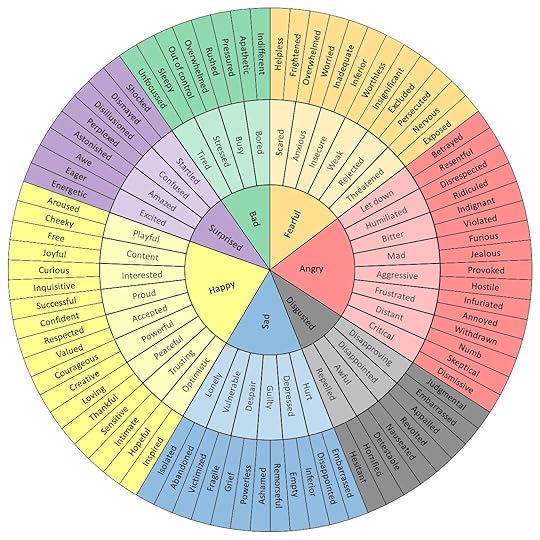
Let's say, you notice un-cleaned dishes, what do you do?
Try this, "I feel deep disgust when I notice the uncleaned dishes"
If you say, "You left the dishes, you are always..."
It will signal, Big messy unresolved fight.
Also, it communicates lack of effort in communication skills.
Tamil Version:
If you say, "Ne yapovudhu ippadi dhan" {You are always like this}
Doesn't work out, you won't achieve what you want the other person to do
Try saying, "Na Kovama feel panrae, Veedu Kuppaya irukadhu paaka"
Never say, "NE, NE, NE" {You} puts the other person on stage.
I believe, I'd continue to grow on this skill, grow further.
Be Patient, Persevere; It will take a decade to master them.
Deus Vult,
Gottfried
Emotions, world of Social-Psychology.
Building block of relationship.
Building block of giving you vocabulary to form & give deeper relationships.
Building block of giving space for being human.
Building block of making life colorful.
Quite a lovely book.
The Words that Men fear the most, "Feelings, Emotions"
Yet, they have plenty of them inside.
Watch Men converse, most want to talk about objects of n-types, includes me.
Notice Men, Be friends with Men who are brave to display their emotions, feelings.
They are rare breed - Why?
They know, how to form deeper relationships with children, women.
2. So, What do you want me to do?
Read this book, keep working.
3. What else?
Allow yourself, to feel the emotions, feelings from this,
Let's say, you notice un-cleaned dishes, what do you do?
Try this, "I feel deep disgust when I notice the uncleaned dishes"
If you say, "You left the dishes, you are always..."
It will signal, Big messy unresolved fight.
Also, it communicates lack of effort in communication skills.
Tamil Version:
If you say, "Ne yapovudhu ippadi dhan" {You are always like this}
Doesn't work out, you won't achieve what you want the other person to do
Try saying, "Na Kovama feel panrae, Veedu Kuppaya irukadhu paaka"
Never say, "NE, NE, NE" {You} puts the other person on stage.
I believe, I'd continue to grow on this skill, grow further.
Be Patient, Persevere; It will take a decade to master them.
Deus Vult,
Gottfried

January 6, 2022
This was one of the worst books I’ve ever read. For the director of emotional intelligence at Yale, this author has 0 self awareness and offers no trauma informed approaches in his work. His personal examples of how to use his method made up 60% of this book and to be completely honest I don’t think readers care about his Uncle Marvin and his emotional regulation strategies. I could not recommend this book less and I hope that more people take a critical lens to this person’s research as it has no place in the psychological community.

February 8, 2022
I did not enjoy this book. I read this book in our professional learning group at work. Our entire group was not feeling as though we were gaining anything from the reading. It was repetitive and tough going to keep focused. We actually changed books mid year because as the book states, Permission to Feel” we gave ourselves permission to feel we collectively did not like the book. Most did not even finish it. I did, but sadly it didn’t get any better.
Displaying 1 - 30 of 1,353 reviews