What do you think?
Rate this book


359 pages, Paperback
First published April 4, 2019

"This is Belfast. This is not Belfast.
Better to avoid calling anything a spade in this city. Better to avoid names and places, dates and second names. In this city names are like points on a map or words worked in ink. They are trying too hard to pass for truth. In this city truth is a circle from one side and a square from the other."
"The Troubles is too less a word for all of this. It is a word for minor inconveniences, such as overdrawn bank accounts, slow punctures, a woman's time of the month. It is not a violent word. [...] The Troubles is always written with a capital T as if it were an event, as the Battle of Hastings is an event with a fixed beginning and end, a point on the calendar year. History will no doubt prove it is actually a verb; an action that can be done to people over and over again, like stealing."
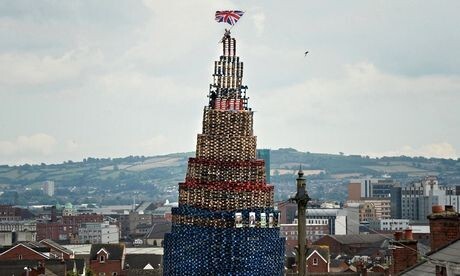
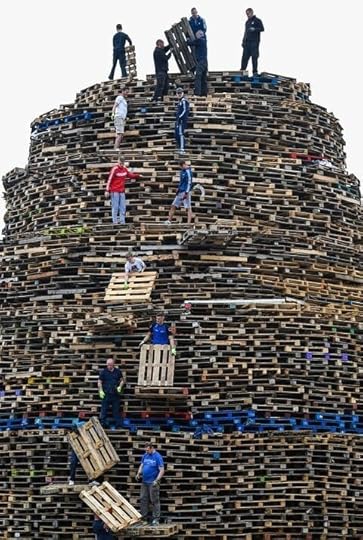
The bonfires are lit to celebrate (1688) and victory of Protestant King William (Billy) of Orange over Catholic king James II at the Battle of the Boyne (1690), which began the Protestant Ascendancy in Ireland. - Wikipedia
This is how it has been in Belfast every summer since the Agreement. The same hot anger rises at the end of June and and goes stamping up and down the little streets. Stamping and shouting and raising Cain all the way through July until, by August's end, the energy's gone right out of it.
This is Belfast. This is not Belfast.
Better to avoid calling anything a spade in this city. Better to avoid names and places, dates and second names. In this city names are like points on a map or words worked in ink. They are trying too hard to pass for truth. In this city truth is a circle from one side and a square from the other. It is possible to go blind staring at the shape of it. Even now, sixteen years after the Troubles, it is much safer to stand back and say with conviction, 'It all looks the same to me.'
The community arts sector in Northern Ireland has played a huge role in the peace and reconciliation process. Primarily it brings people from both communities together into a shared space but I also think it has also taught people soft skills that have been missing from Northern Irish culture.
It’s very, very hard for people here to practice empathy because quite often we grow up segregated, so how are you supposed to understand what life is like if you don’t have any friends who aren't from the same background as you, the skill system is still largely segregated,and government housing and things.
So these conversations around learning how to empathise, which I think the creative act, particularly writing fiction, you’re putting yourself in the shoes of another character, even when you read, it's an act of empathy, those skills can be taught and then transferred into the social realms that we’re working in Northern Ireland at the moment, that people can imagine a life that isn’t theirs, it's much more difficult to hate and to segregate when you have the ability to empathise with other people.
«La palabra "conflicto" se queda corta para describir todo esto (...) No es una palabra suficientemente violenta. Por necesidad, nos hemos tenido que ganar una palabra violenta, algo tan rotundo y tan brutal como "apartheid" (...) Se habla del conflicto como si fuese un acontecimiento concreto (...) Sin duda la historia demostrará que en realidad es un verbo; una acción que se le puede infligir a la población una y otra vez, como robar»
«Son casi las cinco. Se ha acabado el partido. Han ganado, lo que quiere decir que en el otro lado de la ciudad han perdido. Aquí para todo hay dos bandos, especialmente para el fútbol. Todo el mundo está obligado a escoger uno y no cambiar»
«Los padres no dejan ver las noticias a sus hijos esta semana, y la gente de otros países que casi se había olvidado de los problemas de Belfast ve estas imágenes y coge aire lentamente entre los dientes, haciendo un ruido que expresa a la vez sorpresa y lástima y que en cierto modo es también el sonido que hace un antiguo recuerdo al ser desenterrado»
«En el fondo les aterra que, una vez que les roben el último símbolo, no sepan diferenciarse a sí mismos de cualquier desconocido con el que se crucen por la calle»