The second in a new series of graphic novels from Hugo Award-winning author Liu Cixin and Talos Press
The life-bringing sun is on track to have a catastrophic helium flash within the next four hundred years, which would wipe the Earth from the universe entirely. To survive, humanity constructs massive engines on Earth that keep running nonstop, gradually taking Earth out of the Sun’s orbit. Braking, escaping, and hostile living conditions wear down humanity’s hope. People who believe that civilization has already been destroyed form a rebel faction, carrying out a ruthless execution of those who still believe that the Sun will undergo a helium flash.
The second of sixteen new graphic novels from Liu Cixin and Talos Press, The Wandering Earth is an epic tale of the future that all science fiction fans will enjoy.
Great adaptation of the original story. Christophe Bec focuses on different generations, putting the accent on people rather than the events during Earth's voyage through space, and he does a wonderful job.
The art is awesome too, the interstellar landscapes are breathtaking. All in all, a remarkable graphic novel.
Wenn SciFi zu Fantastik wird Bei dieser Geschichte musste ich ganz, ganz viel Ungereimtheiten ignorieren. Der Autor wirft nach Gutdünken alles mögliche über Bord, was ihn an naturwissenschaftliche Faktoren stört, damit seine Geschichten funktioniert. Das ist schon haarsträubende. Wen das nicht stört, der hat hier ein aktionreiches Spacemärchen.
Und das Sahnehäubchen? Da der Protagonist ein Chinese ist, wird er später glücklich Vater von???
This is a graphic novel adaptation of one of my favourite sci-fi short stories. It might raise a few questions if you haven't read the story but the premise and art are still worth it. My only complaint is that the text blended with the background in some places making it quite hard to read. I considered giving this 3 stars but had to bump it up for the stunning art. Would recommend the short story as well as this adaptation.
Wow, what a great epic! The Sun is going to expand, quickly, and eat at least all the inner planets. So the Earth gets set up with giant engines to take it out of the solar system. And the people move to super giant underground caverns. And it's on! This book takes them to from our original position to the edges of the solar system, with the personal story of one small family, one man mostly, and much drama in the overall situation and culture. The art is stunning.
I got this not realizing it was second in a series, and not having heard of the series or the TV show. Probably that's why it seemed a little choppy to me. Likely the original book has details on things like how they produce their food, more about the protagonist, and why a fairly random couple gets to take a plane out of the underground to wherever in the world they want.
“The Wandering Earth” serves as a bridge between the short stories of Liu Cixin, with their technological cores and quick-sketched characters, and the same author’s signature novel series, the Three-Body Problem, with its epic scale, a vast drama in which the fate of planet Earth hangs in the balance. Here, the legendary short story is brought to vivid life as a graphic novel, a form to which it adapts well.
Despite being much shorter than any of his novels, “The Wandering Earth” still achieves the full scope of an epic quest, on perhaps the grandest scale ever envisioned: the whole planet Earth is leaving its home and facing trials, all to get to the next nearest star down the road. One of Liu’s pet themes is the idea that not just space exploration, but ‘space migration,’ should be a major concern to all of humanity today, because the planet could well be left uninhabitable by cataclysmic environmental change, either manmade or from nature.
But the path outward from the solar system is fraught with many trials, and technological challenges are just the beginning. This story turns disturbing as we see what happens when humans deal with the massive levels of dread infecting them as they journey out of orbit and into space forever. Eventually pan-global civil war erupts even as space beyond the solar system beckons. The challenge of the artists is create visual scenes of epic scope to equal Liu’s own visions of the solar system and interstellar travel technology. They are mostly up to the task, with panoramic scenes of wrecked cities giving way to truly breathtaking drawings of Jupiter, and detailed glimpses of the solar margins beyond. Liu’s story and the artists depiction of it prove the case that Chinese science fiction deserves a place next among the most imaginative Golden age work, alongside Arthur C. Clarke and Isaac Asimov.
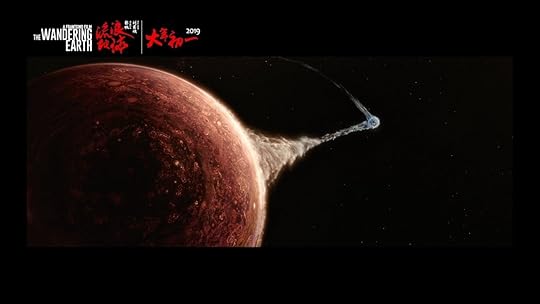
The graphic novel adapts the already condensed novella into a visual medium, and is a triumph for several reasons - the translation, story boarding, character designs, art and illustrations are all extremely high quality, so the graphic novel is in some ways superior to the source novella, especially the gorgeously rendered larger panels with pull outs that need to be seen to be appreciated. I wish I could find an image to link, but you'll just have to read it to see it. I particularly loved the pages where the Earth went past Jupiter's Red Spot, just as beautiful as the shot from the 2019 Movie (on Netflix).
The premise: the Sun is about to unleash a helium flash, threatening to swallow all terrestrial planets in the solar system. On Earth, the Unity Government has erected Earth Engines. With them it plans to propel our planet out of the solar system, setting it on a journey into outer space in search of a new sun. The Earth begins its centuries-long, wandering travels through outer space.
The prose and translation are actually pretty high quality. I didn't notice any idiosyncrasies, or overt / subtle failures in translation which are usually jarring if the translator does a bad job with the interpretation. The plot flows nicely making the audacious premise seem like if it were plausible, humanity REALLY would unite if there were a threat of sufficient size. Even if part of me is really skeptical about this, because I could totally see a scenario where the rich would pay a billion (per person) for spaces on a ship / ark, just like in the movie 2012, which incidentally also had the Earth in a doomsday scenario because something happened with the sun.
This being said, I actually enjoyed the story a lot even if it is totally different from the movie. The story emphasizes the human condition more, and the ending ... well ... mob rule vs. science, it's not like we haven't seen that play out during the COVID-19 era. It's particularly galling that even if science is correct, superstition is very effective at inciting rabid mobs of people to turn against scientific wisdom. That was so depressing, probably because it's true.
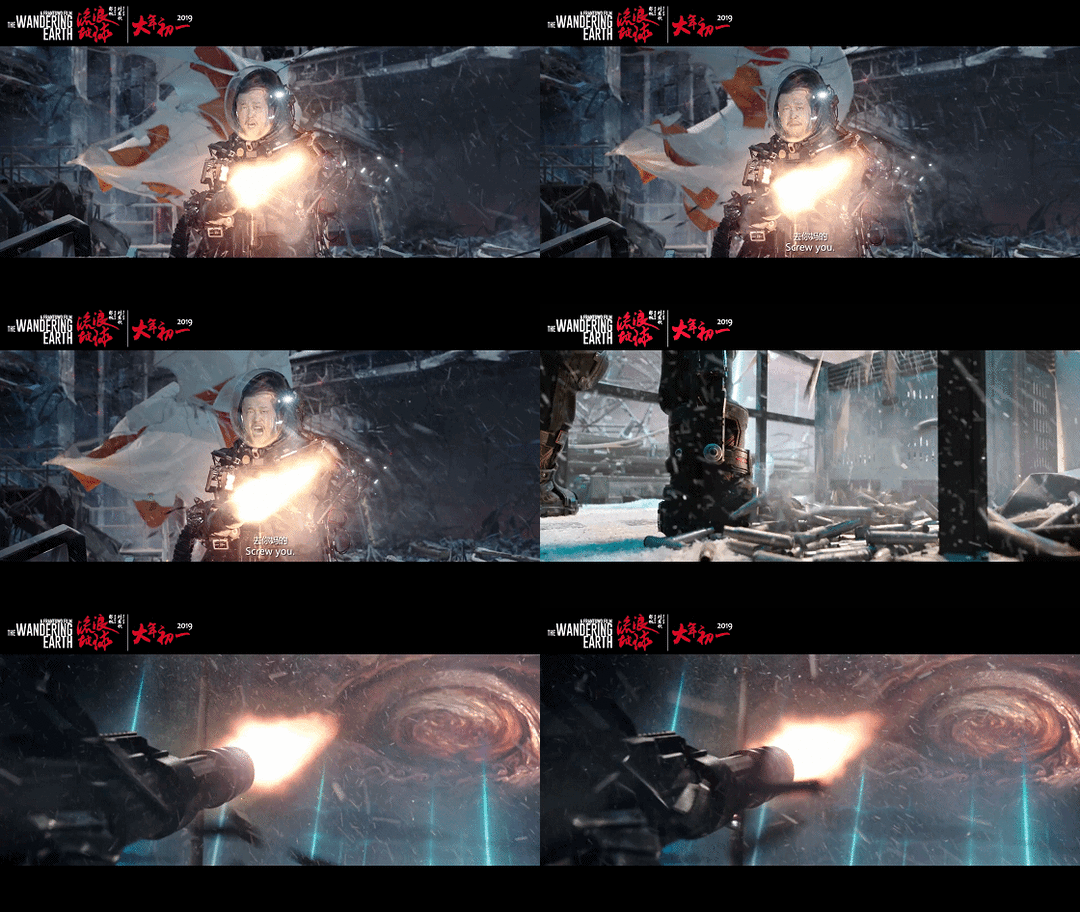
In contrast the movie adaptation is more of an "action movie," but the heart of it is the actor who plays the father. That man was spectacular and the best thing about the movie even if some parts of the movie were ridiculous beyond belief.
It has decent special effects, toned down some of the philosophy, kept the central premise and changed the ending. I enjoyed the book more, but the movie is pretty entertaining and I'd encourage everyone to watch it as it is currently free on Netflix.
Collected in The Wandering Earth: Classic Science Fiction Collection, this Liu Cixin novella won the China Galaxy Science Fiction Award of Year 2000. The novella is short, a lot is condensed and it's not like what I was expecting from the movie but I guess that's the difference between a novella and its adaptation.
The premise: the Sun is about to unleash a helium flash, threatening to swallow all terrestrial planets in the solar system. On Earth, the Unity Government has erected Earth Engines. With them it plans to propel our planet out of the solar system, setting it on a journey into outer space in search of a new sun. The Earth begins its centuries-long, wandering travels through outer space.
The prose and translation are actually pretty high quality. I didn't notice any idiosyncrasies, or overt / subtle failures in translation which are usually jarring if the translator does a bad job with the interpretation. The plot flows nicely making the audacious premise seem like if it were plausible, humanity REALLY would unite if there were a threat of sufficient size. Even if part of me is really skeptical about this, because I could totally see a scenario where the rich would pay a billion (per person) for spaces on a ship / ark, just like in the movie 2012, which incidentally also had the Earth in a doomsday scenario because something happened with the sun.
This being said, I actually enjoyed the story a lot even if it is totally different from the movie. The story emphasizes the human condition more, and the ending ... well ... mob rule vs. science, it's not like we haven't seen that play out during the COVID-19 era. It's particularly galling that even if science is correct, superstition is very effective at inciting rabid mobs of people to turn against scientific wisdom. That was so depressing, probably because it's true.
In contrast the movie adaptation is more of an "action movie," but the heart of it is the actor who plays the father. That man was spectacular and the best thing about the movie even if some parts of the movie were ridiculous beyond belief.
It has decent special effects, toned down some of the philosophy, kept the central premise and changed the ending. I enjoyed the book more, but the movie is pretty entertaining and I'd encourage everyone to watch it as it is currently free on Netflix.
This graphic novel is an excellent way to experience the story of The Wandering Earth. It emphasizes the emotion of the story by using visuals that depict humanity's suffering. Coloring managed to balance a contrast between Earth's icy blues and the warm oranges of fiery death. This adaptation strictly follows Liu Xicin's short story and not the blockbuster movie. The Wandering Earth's movie sequel would be fortunate if it can capture in cinematography the way this graphic novel visualizes the third act climax. Even the brief epilogue added to the story used visual storytelling to beautifully cap off the book.
Read my review of the original Wandering Earth short story by Liu Xicin
There are many aspects of Liu Cixin's narratives that are completely preposterous but are never questioned and apparently just make sense in the world. As a reader you accept it given the nature of the work as parable more than any kind of presumed scientific future, but The Wandering Earth seems to have more than its fair share of these moments yet, remarkably, does not stop the narrative from churning toward its conclusion. Perhaps I'm simply too pessimistic about the nature of humanity to resolve these big, existential problems, and in The Wandering Earth, solving them all at once, all the time, is what we do best!
I haven't read the novel or seen the movie, but I think I enjoyed the graphic novel as much as I'd enjoy the novel because of all the art and way the comic represented a lot of the space stuff and sci-fi elements. It's a very interesting story and there are lots of interesting themes and twists in the story.
That said, I think there were parts of the character/story development that felt rushed (which is the bane of the comics medium for the most part). I'd imagine in the novel, the pacing and the swell of the story would've felt better.
I love sci-fi movies but I haven't read much sci-fi books. This was an unexpected delight. The epic illustrations of a different vantage points of the world were breathtaking. The challenged views of how to save the earth were unique.
I picked up this graphic novel with only having recognised the author's name from a friend's shelf. Didn't realise until halfway through that I'm reading the works of China's most esteemed sci-fi authors. And it felt like it. Brilliant read, now too find more of his works! Would love to read this in Chinese if I can get my hands on a Chinese copy.
This is a graphic novel adaptation of Cixin Liu's science fiction novel, Wandering Earth. It covers a desperate attempt to save life on Earth, by knocking it out of its orbit, after it is discovered that the Sun will soon go supernova. The world-building is very nicely realised, as is the science behind the dying of the surface of the planet, and the method for relocating the Earth to an orbit around a new star. The illustrations are beautifully detailed and do justice to conveying the story. This inspires me to read Liu's novels.
This series just isn’t doing it for me. This was a little better than “Sea of Dreams” but not by much. I feel like the ideas are too big for one-off books, resulting in a unsatisfying read. Stuff just happens and it’s all interesting but at a remove. Nothing is earned. The art is meh, every person has the same dead-eyed expression throughout. As before, 5 star idea, 2 star execution. I’m fairly convinced these are just quickly done cash grabs, piggybacking on the success of “Three Body Problem” in but in comic book form. I’m going to just go to the sources and read those instead.
I saw the film version a few years ago, but it bears little resemblance to the story as told here. For the most part, I found it a really cold tale heavy on the hard sci-fi; honestly, a lot of the text felt like info-dumping. It wasn't until the last 10 or so pages that things started to get good; extremely poignant and moving ending, shame about the rest.
A sweeping saga of human suffering, mixed in with vivid galactic imagery. The art in this is as otherworldly as its premise. It would have been lovely to get more into the characters than the overall background context, but -- again -- foundationally this is a well-told tale of Earth beyond its orbit.
Stunned by this unique and original story. So much thought went into it, the level of detail was astounding. The pacing and the writing of the comic adaptation was spot on. Humane, touching and so real.
Absoulutely incredible. Cixin Liu imagines future scenarios of human survival and then creates the most astounding solutions! His science is flawless. Breathtakingly rendered. I see his skies everywhere.
Лю Цисінь талановитий, хоч мені і важко відділити його творчість від його політичних поглядів. Він думає, що демократії слабкі і не зможуть обʼєднати людство в «life or death situation», а це зможе зробити тільки тоталітарна держава. Але тоталітаризм ≠ ефективність.
This was very disappointing rubbish. Dialogue has never been Liu's strength, but it's so much worse in these short stories. Which are essentially just world building disguised as conversation.