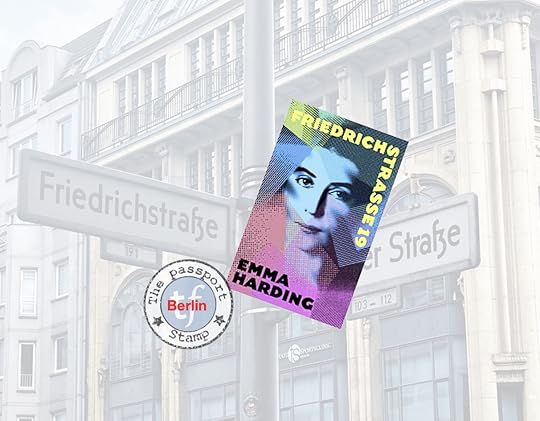
'Sometimes I get fanciful and think the buildings speak. That all their history is locked into the walls and if you listened closely enough, you could hear all the people who'd once been there.'
Sigi lived upstairs from Sara at Friedrichstrasse 19 yet before they met, Sara had no idea that Berlin could be so thrillingly irreverent or that sex could be so intoxicatingly wonderful. But then came the war, and hunger, loneliness and barbed wire. It was just as a young girl, a protegee of The Academy of Magical Arts situated in Friedrichstrasse at the start of the century, had predicted.
Battered and divided, Berlin, like its people, endured. Hans yearns to be part of the boundary-breaking spirit of the age but he's haunted by his mother's part in the war and the absence of a father. Ilse, who escaped from the East, wants nothing more than the freedom she risked her life for.
In 1989 in a wild act of spontaneous joy, Heike leapt from the Wall into the arms of a stranger from the West. Thirty years later, she recognises that what she'd willed to be destiny was nothing more than naivety. Recently divorced, she moves into Friedrichstrasse, to begin a new life. But it's impossible not to hear the echoes of the secrets and lies, visions and misunderstandings, lost loves and fatal mistakes, that have come before her.
Time-travelling between decades, through the interlocking lives of six people, Friedrichstrasse 19 relives the tumultuous experience of a city on the frontline of history.
It’s hard for me to believe that this book was not written by a German since if I did not read the name of the author, I might have assumed that this is a German novel in translation. The theme of time travelling in this story kinda reminded me of Jenny Erpenbeck’s novel Visitation (2008). Erpenbeck through her novel that’s written in 12 snippets chronicles the story of a vacation villa by the lakeside in the southeastern part of Berlin throughout the twentieth century. In Erpenbeck’s story, the characters inhabiting the villa changed throughout the century, from an architect working for Albert Speer during the Nazi era in the 1930s until the end of the Cold War that see the villa abandoned. Similarly, Emma Harding also experiments with time and space in her novel. The timeline is quite ambitious which spans from 1906 to 2019, yet the space remains the same: Friedrichstraße 19.
Friedrichstraße is a unique place in Berlin with its unique history throughout the twentieth century. The street forms the core of the Friedrichstadt district, which was named after Prussian King Friedrich I, and also gives name to the famous Berlin Friedrichstraße Station. Before 1920 when the Greater Berlin Act was introduced by the Weimar government, Berlin was a small city compared to its later areas. The inclusion of the suburbs into Berlin proper made Friedrichstraße the central part of the city, booming in the 1920s with its vibrant queers and underground subcultures, before finding itself in a strange situation during the Cold War. The street was heavily damaged during the Second World War and was divided into two parts as the construction of the Berlin Wall went through it, along with the famous Checkpoint Charlie. Half of Friedrichstraße was located in East Berlin, with its other half in West Berlin becoming a residential neighbourhood, in which the story takes place.
The story begins with Tonja in 1986, in a spur of the moment when the former RAF member escapes in a car driving from West Berlin through the road connecting the political enclave with West Germany bringing a baby in her car’s passenger seat, before quickly turning to Rudi in 1906 who is apprenticing to the Academy’s photographer. The view then changes into Sara in 1929, a Jewish woman unhappily married who finds herself attracted towards Sigi, a female neighbour who just moved in. Two decades later during the Berlin Airlift, as the Soviets blockaded West Berlin for almost one year, Sigi finds herself longing for her former lover even though knowing fully well that there’s little chance for a Jewish woman to survive the war. In 1969, Hans finds himself discovering Ilse, a young girl not yet twenty, who escaped from East Berlin in the fuel tank of an Isetta. In 2019, Heike, a divorced Ossi, finds herself in a strange situation in which she recalls the moment she jumped into her Wessi soon-to-be husband’s hands on the night the Berlin Wall fell.
It’s quite a complex story, so to say, with its ambitious timeline. People who are unfamiliar with twentieth-century German history would probably get lost in the course of the story, as Emma Harding likes to use cultural signifiers rather than merely describing facts. She doesn’t describe openly the confrontation towards the Jews in the 1920s, but put some subtle signs through the actions of cabarets singing anti-Semitic lyrics as Sara watches. In describing the flight of Ilse to pass the Berlin Wall, she hints at subtle references to BMW Isetta, the car model that Klaus-Günter Jacobi used in 1963 to smuggle his best friend from East Berlin. Through the expansive timeline and rich cultural references, Emma Harding manages to document how Berlin as a city and Friedrichstraße in particular which lies at the heart of Berlin had transformed from time to time. In some parts of the story, similar people inhabit different timelines as they grow older or through some mystical connection that allows them to communicate across time in the same space, they inhabit (or had inhabited).
Through her novel, it’s as though Emma Harding invites me (and probably other readers too) to think of time not as something moving in a straight line. But it’s not some story that questions the physics aspects of time. It’s intriguing and the way the story is presented made me all the more interested in the history of Berlin, the people who had been inhabiting the space there, who probably had different fates ascribed to them each in their respective timelines. It could be said, even now, Berlin is still trying to find her own identity. As the saying goes: »In Berlin ist alles möglich« [In Berlin, everything is possible]
Thanks to John Murray Press and NetGalley for providing the electronic advance reading copy.
as someone who is german, who lived in germany almost all her life, i was incredibly sceptical of this book because i usually do not enjoy books written by non-germans set in germany with german characters.
however! emma harding surprised me and actually did a solid job. is some of the german, especially in the second half for some reason, a bit wonky? sure. does a german character use british slang even though they are very much supposed to be german? yeah. but still, i cannot honestly fault the german elements.
i think harding did an impressive job writing a nearly 250-page book that includes SIX different perspectives. it is highly ambitious and she almost pulled it off. i think that, while all perspectives included important topics and discussions, there wasn't enough room to do them justice. sometimes it just seemed like too much in a small book. and still, i don't want to miss any of them!
i also enjoyed harding's writing style. she makes an effort to give everyone a unique voice and transitions between them in an interesting (though to be fair, sometimes clumsy) way. even the ways she connected the plotlines were well done. as a poet, i particularly enjoyed sigi's chapters though sometimes it seemed a bit uncoordinated (which might have been the point, but a few edits and clean-ups might have helped nonetheless, which i think is a good way to describe this whole book (in a nice way!))
The characters all live in Friedrichstrasse 19 spanning a good century and it is the building that acts as the link between all the stories. As one of the characters says: The stage set of our lives remains. It is just us who disappear into the wings. The building is a constant, the people come and go, but delightfully they all leave a story behind.
This novel is constructed like a mutoscope – a flipbook of stories as it were – following the lives of several people in this single, beautiful building on the southern end of Friedrichstrasse in Berlin. The building bears witness to the tumultuous events that have formed and affected the city over the last 120 years or so, as characters grapple with the changing political landscape and deal with the impact of each manifestation on their lives. War, famine, massive inflation, the cabaret scene, terrorism, the city divided, the fall of the Wall – truly a city caught so often at the epicentre of world politics.
This is very much a novel of Berlin, it captures the city’s multiculturalism which has been a feature for decades: “... you realise that hardly anyone in Berlin belongs here, – everyone is a blow-in from the back of beyond, or from other countries altogether – and once you realise that, it is a great equaliser”. This has always been a city of paradoxes, and the stories of the people featured colourfully in the narrative underline the unique nature of the city. If you know Berlin well, then this novel will resonate; if you don’t, it might seem a little off key at times.
Stylistially this is an interesting and unusual construct. One character’s narrative leads to the next character – a sentence is left dangling and the next character picks up the thread, hijacking the story, sometimes intertwining, even though they may well be from different eras. The purpose seems to be to give an ethereal sense of people passing through the four walls, which serves the purpose well. Hopping back and forth through time, with different characters coming in and out of focus (the cinematic sense of the book) can be a little unsatisfying and I did struggle a little at times. And just when one story gets interesting, it peels off to focus afresh on another. It can be frustrating.
For a sense of the city and to really get a feel for it, then this is a great choice for a novel set in Berlin. The style, however, may not be to everyone’s taste.
4.5 stars! really loved seeing Berlin from 6 different perspectives across 6 different pivotal times in German history
it definitely makes you think about what identity means in Berlin - whether the city is still seeking it’s own sense of identity after all it’s been through, what it even means to have a shared identity when experiences in the same place are so different, and how the layers of history continue shape the people there today (shoutout Heike)?!? oooh so many questions
it took me a moment to get into but i really enjoyed this book. on balance, i think there were slightly too many characters - i couldn’t quite track who was who and how they all intersected. but i thought the writing and characterisation was great and an interesting view of berlin history
Excellently written book about the partly overlapping lives of six people who all lived at 39 Friedrichstraße in Berlin over a period of more than 100 years. It also presents an interesting perspective on the history of this beautiful city in a very original way. Highly recommended!
"Berlin had her heart, not just because it was home, but because of the way it had built its own annihilation into its very walls."
Sometimes, you stumble across a book, you didn't know existed untill that very moment but when read, will profoundly impact you. I have come across many such books in my life and coincidentally, found almost all these books in a library. What are the odds that I should pick this book when I am living near the namesake of the book. It was sheer curiosity that made me pick this book.
Set in a Wilhelmine mansion in Friedrichstraße, Berlin, this book traverses through different time periods, capturing the lives of various people, to whom this place was a home.
Tonya from1986, is a young wife and mother who wants to be a rebel and thus gets pulled into political activism and stays with a rag-tag team of revolutionaries.
Heike in 2019, is a middle aged divorcee who is venturing out into the world of dating while being ignored by her friends post divorce.
In 1906, Rudi encounters a young seer who predicts events that will alter both their lives.
In 1948, Sigi and Sara come into each other's lives, only to be separated by forces beyond their control. Their love and life becomes a conflicted memory in the wake of the radical changes in Berlin.
Hans, in 1969 has to confront the bitter truths, hidden in his mother's past. Coming from a generation which is burdened by guilt and the keen awareness of their ancestor's actions, Hans represents both hope for a better future and a need to redeem the past.
The multiple stories seamlessly merge into each other forming a disconnected thread of events that revolve around one place, Friedrichstrasse 19. Nothing remains the same. Both the place and the characters evolve leaving only a slight mark in the past which is written over by the next set of events.
A surreal mix of magical realism and history along with emphemeral moments in the lives of ordinary people affected by extraordinary events, making it a wistfully compelling and intense read.
I find Berlin and it's residents' strength to rebuild their lives while simultaneously undoing the past mistakes and creating a new, vibrant life, astonishing and awe-inspiring.
Half-way through the book, my curiosity got the better of me and I had to go see the place for myself. So with the help of Google maps, I stumbled upon what is Friedrichstraße 19. I was hoping to see either an old building or a sleek apartment, but Google led me to, was the alley adjoining the Judisches Muesum. Nevertheless, both the book and the walk were deeply satisfying.
The book is based on the lives of characters that lived in Berlin over the course of 100 years. I liked the premise but the layout of this book is not for me. I found that just as I was getting intrigued by a story it would suddenly shift to a different character and by the time it got back around to the original I’d forgotten parts of the intrigue. Probably okay if you were planning to read it in one sitting or over a few days.. not over 2 months like me 🙃
for a moment i really thought she wasn’t going to give us a fully formed ending, since telling six stories in only 240 pages seemed to be rushed. although i do think that she could’ve taken her time a bit more, it didn’t feel as if the book ended without the story ending.
obviously i enjoyed some chapters/characters more than others since some of them were just more relatable or written more interestingly, but each of the stories played an important part in the bigger picture and it didn’t feel as if any of them was discardable.
the pacing of the story was (as i said) pretty fast but this made it easy to get into the story and keep reading. the chapters had a perfect length and i really liked how they always ended halfway through a sentence and started as if completing the previous sentence. this felt like a nice detail and cute little metaphor for how the characters’ lives flowed into each other.
i’ve always had a fascination for berlin, which is why i bought the book in the first place, and it was great to see the city evolving and having an impact on the characters’ lives.
i never write long reviews such as this, idk what has gotten over me
A very clever, multi layered book in which Berlin through the last 120 years is almost a character. I loved its description and analysis of the huge turbulence and variety of this wonderful city. I mainly liked the time travel elements... basically, it's about 6 different occupants of the same flat, jumping around from narrator to narrator. It was hard to keep track of who was who. Some of the stories were parallel, with recurring themes, and even some characters seem to be reincarnations of previous ones. The visionary story was a bit lost on me and the whole 1906 flat was less interesting but a carefully plotted, well researched novel.
'...& of course hope is dangerous & of course i am wired with it now...'
Written from the perspectives of 6 Berlin inhabitants of the same house spanning over the last century, this book encompasses the nuances of city life while recovering from the turmoil of the 20th century. Exploring themes of love, betrayal, loss and generational trauma, the author manages to distill the harrowing history of Berlin into 6 complex characters while including profound and lyrical writing that creates depth to the brief chapters. Although, at times confusing in terms of characters and storylines, this book is an tribute to all the victims of the division, poverty and cruelty that had once infiltrated Berlin and the importance of preserving its history.
A novel about the lives of people living in an apartment in Berlin throughout 100 years. It’s told in sections connected by sentences, not chapters, and not in a straight time format, but this works well.
Really sped through this and was surprised to learn the author was not in fact German!! My only criticism is that perhaps there is an attempt to do too much in too little space. Basically I wanted it to be longer 💔
Friedrichstrasse 19 is 6 stories set in the same building over its lifetime. We see Berlin through the eyes of those that lived in the building between 1906 and 2019, and there are some serious historical moments as well as cultural highlights: a woman in the RAF (Rote Armee Fraktion) in 1986; a photographers apprentice in 1906; an unhappily married Jewish woman who meets an actress pre-WW2; the Berlin Airlift post WW2 era, when the actress is trying to find her Jewish lover (she knows there’s little chance); 1969 and a photographer finds a young GDR escapee and decides to help her; 2019, a divorcee originally from the East, who met her ex-husband on the night that the Wall fell.
All intriguing characters and stories that give a glimpse into urban life in Berlin, as well as its history. It probably helped that I was familiar with the history of Germany generally (thanks to a German degree many years ago!), and I make a point of reading fiction set in Germany when/ if I come across it. And this is a pleasure when I come across books like Friedrichstrasse 19!
The premise of this book is certainly interesting. One house, six people, over the span of a century. (This seems to have similarities to Jenny Erpenbeck’s Visitation, but I haven’t read it, so I cannot compare the two.)
And I must admit the execution is not bad either. Every character feels fleshed out and has their own distinct voice, though the division of pages is not always equal. Even the chapter transitions, though they take some getting used to, are fun and interesting.
I admit, I am always rather sceptical when reading books about German characters set in Germany that are written by authors with (seemingly) no connection to either. And having said that it always feels weird reading about Germany in English, my biggest problem with this book is still its language. The book is written in English and that is obviously fine, but some of the German that is (randomly) sprinkled in here and there feels kind of awkward. Especially the mix of English and German slang felt wrong. It would’ve been better to just decisively go with one or the other.
Furthermore, there were some details that just irked me. For example, a German person would never measure their height in feet. (I am very passionate about this!) Or, at some point a character drinks a milkshake, which is not usually on the menu of small cafes. And just one Google search confirmed that the cafe in question does not offer any sort of shakes (nor any cake, it’s more of a bistro).
Despite all of this it’s still an enjoyable read. Most people are probably not as nit-picky as me, but as Berlin is my hometown I do feel entitled to judge.
Lastly, I also caught circa 5 typos. Another round of editing would have been good.
Don't read a review for guidance. Read the book. Truly, it is rare that I'm left overcome by so many emotions that I can't quite articulate/write about it.
Emma Harding has written a novel of great depths and amazing immersion.
A building in Berlin is the perfect setting for a modern gothic. Freidrichstrasse 19 rolls on the wave of an opening quote and a joke: one about life betraying its secrets and the other a Bob Hope and Irving Berlin schtick. Like Berlin, the tale is full of contradiction. It is full of ghosts, but it isn’t a ghost story, steeped in brash politics but subtly preachy, full of relationships that never really bear fruit.
Beginning with a horrific terrorist incident pre- fall of the Berlin Wall, it then spools out through the accounts of its residents. A young apprentice gets caught up in spiritualism and the birth of motion photography. There is a stream of consciousness post-war chronicle, a modern-day tug-of-love-and-angst, and finally an Iron Curtain era photographer’s tale as raunchy as a second-hand PVC SS minidress.
With chapters labelled by character’s names and dates, this is a book of layered consciousness, and true to its Joycean roots, one chapter runs into the other. The stories traverse time, proving to be interlinked with the building and its cast of residents. There’s a mystery, too, weaving its way through the book based on images from the second sight of a young, gifted seer.
If you like Berlin, you will get this book. The East-West divisions that still haunt Berlin, haunt the pages. If you’re into psychological and experimental fiction, the author takes enough chances to make the post-mortem dissection of the unconventional relationships seem fresh. If you like Gothic but want something a little more edgy and demanding, the lack of melodrama in lieu of real life drama will satisfy. Though a few of the mysteries are resolved(ish) in the end, the reader does have work to do à la the ambiguous endings of literary fiction. And, if you struggle with multiple narrators, time shifts and meandering plots, then you will find this book a challenge.
Emma Harding has summoned a creative voice here. Much like Berlin itself Friedrichstrasse 19 leaves a lasting impression, one that is unique and forthright. She has taken chances with the form of the novel, bent time, shown strong women and weak men, and crafted neat memorials to the people (good and bad) who lived within the walls of one building on a street in a capital where disgusting acts were delivered upon humankind.
The writing isn’t punchy or pacy -- I couldn’t finish it in a sitting. I found myself taking breaks and thinking of books that handled the themes better: “The City & the City” as a view of a divided Berlin, “Where’d you go Bernadette?” as a look into a woman’s middle-aged angst. However, Friedrichstrasse 19 offers an a layered amalgamation of those (and other) themes wherein is found the jolie-laide face of Berlin.
Thanks very much to NetGalley UK and John Murray Press for the eARC.
All the characters, at some point in their lives, resided at Friedrichstrasse 19 in Berlin.
The building has been through many events in the German history, including the anti-Semitism, two world wars and their repercussions, and the rise and fall of the Berlin Wall. During those times, Friedrichstrasse 19 housed members of the Academy of Magical Arts, a Kabarett singer, political activists, and pornographic photographer.
I truly enjoyed the concept of the novel.
I found the idea and narrative refreshing and illuminating. As I was reading I kept thinking that this book wasn’t just about the characters, but it was also a story of the building, Friedrichstrasse 19, and the city, Berlin.
I was particularly drawn to Sara’s story, who lived in the swinging 1920’s and tried to be a dutiful wife. I enjoyed reading about her growing friendship with Sigi.
I honestly cannot believe that the book was written by an English author – the knowledge of German history is apparent on each page – I am in total awe of Emma Harding.
3.5? one of the best first chapters I've ever read in terms of everything: character, writing, story, tension, emotionally moving & engaging, pacing etc, and a really brilliantly written last chapter but nothing in between quite matched up to either. too many POVs? not enough differentiation between them? lots of similar threads of wives leaving neglectful husbands or partners but in a way that felt repetitive and blurring of character rather than making a specific point about this type of dynamic being repeated and inescapable? The parts where the stories intersected felt satisfying but not revelatory. I'd give the first chapter a 5*, the last a 4/4.5* and everything in between a 3. It was clearly very well researched but lacked some energy in the writing and I found it hard to care about some of the characters.
A wonderful, brilliant and fascinating story. Filled with characters that just breathe life into an apartment block through centuries of intriguing and tragic events that shook not just Berlin but the world. The main character seems to be the building with all the other characters playing out their lives and adding another layer of a haunting atmosphere which connects each decade to the other. So from mysticism in the early 20th century to the after the First World War and cabarets through the terrifying times of rise of Nazism and through the Second World War all the way through the 60s with the wall to the 80s and knocking down of the wall to present day where someone manages to hear some echos from the past. It’s just mind blowingly brilliant.
A great collection of short stories of a variety of inhabitants of Friedrichstrasse 19, Berlin, throughout the 20th century. I was captured by each of the stories, but the structure of the book made a much harder to read than it needed to be, and didn’t add anything special or valuable to the experience. The structure is complex, with no chapters, short paragraphs separated by line breaks so that there are typically 2 or 3 per page, occasionally interspersed with a name and a date to indicate a switch in character and time. It would have worked much better as a straightforward collection of short stories presented in chronological order.
This is a finely crafted book in which the author takes one address in Berlin, and through the lives of six Berliners occupying the address at different times, tells the stories of their lives and the story of 20th Century Berlin. The author used interconnected sections to tell her story, in which some of the characters appear in the lives of others. The manner in which the account of one person’s life leads directly into the life of another person by means of a linked sentence is both unusual and effective. The book well illustrates much of the trauma suffered by Berliners, including the impact that events have had on later generations. This is a very enjoyable book.
Great concept with interesting characters and ideas. Unfortunately it tried to be way too many things and reading “The Berliners” ended up being a bit of a frustrating experience.
Mixing up the writing styles for each chapter is a great idea. But then you have the constant changing of eras with no real connection between the stories, the paragraph style of writing, and everything gets way too jumbled and atypical to be read smoothly.
Otherwise, as a guy living in Berlin, I think Emma Harding did a fantastic job of showcasing the city through the ages.
I'm not sure if I love or hated this book: it's multilayered and complex as Berlin. A story that talks about the life of different people living in Friederichstrasse 19, in Berlin. Complex, fascinating and well written. I wouldn't define it entertaining but it surely reflect the atmosphere of this fascinating city. Recommended. Many thanks to the publisher and Netgalley for this ARC, all opinions are mine
4,5, splendido racconto e splendidamente costruito. Non senti mai il peso delle narrazioni incrociate e vieni colpito da momenti di letteratura luccicante, come trovare delle pietre preziose in natura. Di colpo, mentre leggi, arrivano quei passaggi e ti folgorano. I temi interessanti: realismo magico, questione dell’umanità del popolo tedesco da ricostruire, la fotografia come tema e come strumento, la casa, la questione ebraica e poi l’amore.
Really well written journey through the past. Normally i find books like this where they switch from character to character really confusing but this one was properly well done and smoothly moved from one to another