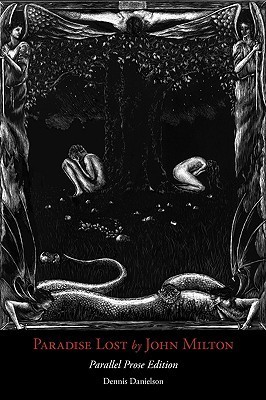
Paradise Lost has long been hailed as one of the most compelling stories of all time. Its cosmic canvas—heaven, hell, chaos, and the Garden of Eden—has enthralled thousands of readers for more than three centuries. For others, however, it has remained an unopened treasure because of the perceived difficulty of its archaic vocabulary and poetic structure. Dennis Danielson's new edition of Milton's great epic offers a vibrant, authoritative rendition in modern prose alongside the original text of Milton's story of heroism, pathos, beauty, and grace, making accessible for the first time a work that continues to be acclaimed as "possibly the most profound meditation on good and evil ever written" (Toronto Globe & Mail, 2000).
See Stanley Fish's review here. Charles Williams, whose academic remarks Paradise Lost C. S. Lewis highly valued, said that "Paradise Lost is much more fun written in blank verse than it would be in prose. . . . Let us have all the delights of which we are capable" (Reason and Beauty in the Poetic Mind 5). But still. This has been a useful reference work for me as I've had to untangle certain passages.
This volume is a must for those who want to experience Milton's Paradise Lost, but may be intimidated by the poetry. The prose was fantastic and engaging, and alongside the poetry enhanced the experience of the poem.
Many thanks to Jeremy Larson for the copy and stoking the interest to read this. It will be a return book for sure.
Not really sure why I put myself through this. Even accompanied by a such great prose rendition, apart from the description of the battle against rebel angels, it's turgid, better to read the King James version of the fall.
honestly, the premise is so nice, and I love that translated verse because the original is so hard to understand 😭. but, and this is a big but, the sexism and hatred of all woman kind is so evident at points. It's really disappointing 😞
6.I read this in winter, near Christmas, at a place elevated a few thousand feet, coming from California to the snow. I think I felt like I wanted to get into something serious. I wanted an epic literary adventure, and got one.
I’ve always loved the idea of the Epic, like Iliad and The Odyssey, and mythologies, up to modern epics like Dune and Lord of the Rings. Only John Milton rivals Tolkien in grandeur and incorporation of the world’s mythology that can only be had by a heavily educated mind in those things.
Whereas Tolkien sought to preserve and promote specifically the English folk stories, Milton was connecting his work to all previous mythologies of the world, tying it together with the Ethos he was trying to build, to justify that concurrent revolution in England, leading to Regicide. Naturally, his protagonist would be Satan. The king would be deposed, so why not tell a tale of the first ultimate rebel, who chose war against the first, and last, ultimate king.
The Puritans were a radical sect of the Protestant revolution who had by this time taken over the parliamentary form of government of this time, where figures like Oliver Cromwell would really clash ideologically (iconoclastic ally) with the Throne of England.
I’m really not a huge fan of Shakespeare, but John Milton is for me on that tier. There’s a reason the English courses of today focus largely on these two titans.